This is just a one stone, three birds.
We want to see how the potential energy can be turned into actual beneficiary for the people of the region.
The hydro power station can help India and Bangladesh regulate the flow.
I feel this can be a great opportunity for China plus South Asia to cooperate in the same way that the Shanghai Five and the initial six members of the SCO had cooperated.
It will reshape a Sino -Indian relation.
Everything will go happening around that.
Lots of opportunities to expect.
The Chat Lounge. Chat Lounge.
Chat Lounge. The Chat Lounge unpacks views and opinions on hot issues in a more casual way.
Welcome to the Chat Lounge.
I'm Tuyin. Joining me to discuss China's new mega -dam on the Yarlong -Zangbo River, Dr. Cui Chang, a fellow of the Belt and Road Research Center at Mingzhu University, Zun Ahmed Khan, a research fellow of the Center for China and Globalization, and Gao Shiwei, a political science Ph .D. candidate in Department of Politics and Public Administration, University of Hong Kong.
Welcome to the chat to you all.
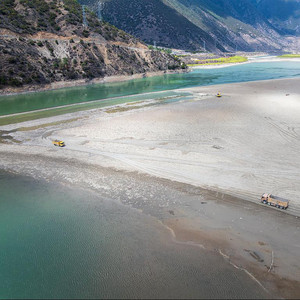
China has broken ground on what's said to be the world's largest hydropower station high on the Qinghai -Sizong or Tibet Plateau, a new engine for green energy.
Let me begin with the lady.
Though it has almost no direct connection with Pakistan.
Zun, may I ask your first response to China's new mega dam and how has Pakistan reacted?
Well, firstly, thank you for having me on this topic.
You know, I think it's a little soon to say if Pakistan will or will not be involved in the future.
We are talking about 10 years and we are talking about Pakistan as a country where we have constantly, you know, dealt with energy shortages.
The China -Pakistan economic corridor has been very helpful.
But let's see, you know, with the largest dam in the world being constructed not too far from Pakistan, if we see geographically, maybe in the future, you know.
know, we never know in a few years down the road, there are potential opportunities for Pakistan to be a beneficiary of this dam.
So that's one thing, you know, I feel that right now when I check the comments coming from Pakistani social media, especially, we really, you know, are cheering on China on this development as a brother country, as a country that's always looking towards China when it comes to advancements.
I think this is really a celebratory moment for Pakistan.
And with the recent issues that we did have with our neighboring country, which is also China's neighboring country, I think there is a sense in Pakistan also that, of course, we want to see more cooperation in the region.
But because of the way India is reacting, I think for Pakistan, that's also a sign of actually India should be looking towards this as an opportunity.
And maybe one of the reasons that India currently has this posture of being very wary of potential consequences that are negative is because India is the only country in the region that has threatened water water shortages and talked about weaponizing water in the recent past. So Pakistan has obviously, you know, an interesting, a very positive reaction.
We want to see how this development works out, how the potential energy can be turned into, you know, actual beneficiary for the people of the region and potential collaborations.
So this is big news.
I think we want to see how, despite the challenges on a technical level as well, how China can further, you know, pursue this in the the coming decade.
Yeah, we'll explore that later on.
And also in old Chinese wisdom that the highest good is water.
It just all depends on how you use water, right?
We'll explore that further later on.
But to Dr. Xu, let's take a look at some basic facts of the project.
The Yarnong Zangbo hydropower project will be the world's largest. And upon completion, reportedly in some 10 years, The 1 .2 trillion yuan, or 167 billion U .S. dollar project, will generate 300 billion kilowatt hours annually.
That's comparable to Italy's annual electricity consumption, or more than half of Germany's total.
So why is China launching this megadam now?
I think there are many reasons for that.
Number one is that everybody knows, actually from very long time ago, China has established the double carbon target, which means we're going to have the carbon reduction and the carbon peaking goes.
So how are Chinese economies still growing very fast?
They're still at 5 % a year comparing to the similar size, you know, large economy.
I don't think there is another economy can do the same thing like in China.
But the problem is if China are growing still at the 5 % a year continuously in the next five years, can we catch up with this carbon target?
So that will be the question.
So at this moment, we really do need a very clean source of the power, source of electricity to help China to finish economic growth, modernization, industrialization.
But on the other hand, to meet the target of this green development because it's already written in the law.
So it's a mandate for us to do so.
A lot of people are saying, OK, is that because China want to downplay the investment to pull up the economy because of a recent slowdown or potential deflation?
might be the case, but still I think the bigger picture and also has already been a long -term target and also I think there are several other conditions have already been established.
For example, ever since 2020, China has established a lot of the electricity transmission infrastructures through Shanghai provinces towards the mid -China Henan provinces and also linking into the main grid towards eastern China, which they consume lots of electricity.
So even if you can build already very long ago, even if it can build this kind of a very large hydropower station in Zhejiang without the power transmission infrastructures, how much ever electricity you can produce on this river basically is going to be a waste unless you can really transmit them to the consumers in the eastern part of China.
And also, I think recently the renewable energy competition or the whole energy sectors competition are also you know in a very brutal competition for example america right now has initiated their energy growth strategy of the whole nation green energy as well as for the traditional energy you know trump is going to drill drill and it drills a whole energy price is going to be very very cheap and competing with china so china needs to have its own source of energy you cannot just yield your energy sovereignty to the other nation and And meanwhile, as we just mentioned, China also needs to down
put more of the infrastructure investment to make sure that the basic size of its national investment will be there to make sure the basic position of the job market, of the national economic growth can also be there.
Because infrastructure investment has always been China's method to pull off the economy, which we've been doing that for more than 40 years.
So that's the reason why China is the megatron of the infrastructure building.
building. That's the reason why we see this mega infrastructure happening here today.
But why didn't we do it earlier?
Because we established the transmission, the ultra high voltage transmission line through Qinghai linking to Shizang and to Henan and to eastern part of China only last year.
So without these high speed electricity transmission route, no matter how much you can produce in Shizang, it can just stay in Shizang.
You cannot send them out for consumption.
So that's the the technological issue that we've been facing before we have this dam.
And also, secondly, is we've been saving this mega project for the slowing down days when China really need a boost up in infrastructure investment.
We need something like this to boost up the major investment position in China.
I think the whole point is that you don't want just a whole lot of money at once in one year.
You just want to go easy on it and one by one.
So the whole economy will have a more smoother curve of the investment leading growth.
And also a lot of investigation, feasibility, research, and all this also needs to be done through many years.
In this area, the slate structure is very complicated.
Earthquakes basically are happening every year because it's the Himalaya earthquake slate co -allied with the ASEAN nation or the South Asian slate.
So basically, it's going to be very dangerous to establish.
such a huge mega project in such a geographically complicated region.
So, before you actually do something for real, you really need to do a lot of scientific research and, you know, have a plan A, plan B, plan C, to make sure the safety can be guaranteed after you down put 1 .2 trillion yuan on this.
A lot of people are saying, are China saving money for this project?
No, actually, even though this project is three times larger than the Three Gorges project, you have to to understand at that time, China only downplayed about 20 billion Chinese yuan for the Strait Gorge Dam.
But even though it's just 20 billion Chinese yuan at that time, it basically equals to one -tenth of the national GDP.
But right now, this down payment, you know, 1 .2 trillion is just like one -hundredth of China's GDP, considering our GDP is much, much larger than 1990.
So the money is not actually a problem.
Right. Thanks for that clarification.
I used to think that Yet we've already conquered the technical capability of tackling high voltage transmission.
So you're saying that's not a problem until now?
No, we have already got the technology, but we need an extra line to transmit out the power we generated in Shenzhen.
We already have this line in Xinjiang from transmitting the power we generated from Xinjiang, from Qinghai to the inner land, to the eastern part of China.
But we still need another line to transmit power from Shizang, which is the southern part of Western China, to the inner land.
And that takes time to construct.
Yeah. All right. Then I'm not sure whom of you is aware of this, why it's built on Yalongzangbo River's lower reaches.
I think they've got one in the middle reaches or upper reaches of the river, right?
Maybe, Sirei, do you have any idea?
Yeah, thank you. I think one reason could be the engineering consideration and another being strategic.
In terms of engineering, I think, most importantly, the Great Bend, where the Yellow Zumba River turns around and drops in altitude, is the optimal.
It means here is the optimal site for the engineering project because what we are building is a hydropower station.
So it used gravitational potential power, and here the river drops in height from almost 3 ,000 meters to several hundred in just 40 kilometers.
It means the gravitational potential energy here is massive, and the amount of hydropower that has been exploited of the river actually falls under 10 % compared to the Yonge River and the Yellow River.
So it means a lot of the hydropower has not been exploited yet.
So it makes sense to build this site just here because of the natural potential here.
And the idea of utilizing the hydropower of Yellow Zamba River is actually not new.
The scientists and engineers are long aware of the great potential of the Great Bend here.
So in terms of project, as far as I'm concerned, the discussion of the feasibility and the scheme has been ongoing for a while.
For instance, choosing the optimal site, considering the strategic importance, etc. And strategically, I think there are maybe three reasons.
First of all, so now we have, just like Dr. Chu has mentioned, we have better infrastructures now, like the capability to send out the electricity.
And we have stronger logistic projection capabilities at Moatuo and Lingzhi now.
There are airport end of construction and secondly, the carbon neutral.
So now, green energy is very crucial for the goal of reaching carbon neutral.
Also, countrywide, our demand for electricity is surging due to global warming, and we need to balance the overall grid stability.
So last but not least, I think building the hydropower station at the lower reaches of the river is closer to the South Asian countries.
And the announcement of the government reads that sending out the electricity, including exporting the electricity, is one of the major goals of this mega project.
So I think building here make it much closer and more convenient to export this electricity to South Asian countries, especially, I think, India and Bangladesh, if it's possible.
Because the manufacturing of Bangladesh and India are on the rise, which means they have huge demands for electricity.
But due to extreme heat, I don't think they can generate enough electricity now.
So there's a huge demand here.
Right. And thanks for elaborating on those basic facts of this mega project.
The Chat Lounge. The Chat Lounge unpacks views and opinions on hot issues in a more casual way.
Now, let's turn to the benefits it might bring to the local communities or neighboring countries.
Sirey, what would you expect this project to bring to local communities?
And what's the most valuable benefit you anticipate it'll generate for the country?
I think there are quite a lot.
So I mentioned, I think there are demands for electricity outside our borders because the manufacturing of Bangladesh and India are rising.
So if we can build this project, we can sell the clean energy to neighboring countries.
So it would, of course, generate the revenue and lowering the cost. That's the very first benefit.
So very direct, it could export electricity and also satisfy our own domestic need.
Secondly, I think since we have many solar and wind, our generation, but this could be seasonal, Meaning that sometimes they have peaks.
They have also time when they don't generate sufficient energy.
So by introducing this hydropower station, we can stabilize the overall grid stability.
Meaning that they can fill in the gaps so that when the demand surge, we have more stabilized the overall grid.
Third, I think the mega project also immediately created more local jobs.
at least maybe 100 ,000, 200 ,000 in Lingzhen, in the Muotou.
And also indirectly creates a lot of the demands for a lot of industries.
For example, explosives, metals, and steel, etc. And even it can develop a Muotou County and probably more people will travel there.
So in the future, more highways, railways, capital flow, population flow, this could also be very beneficial.
for local. Right, that's foreseeable.
And to Zoom, you obviously look forward to this project may benefit especially your home country, Pakistan.
I'm also looking forward to that.
But for now, according to your study or observation, what's the most valuable benefit you anticipate?
I think, I mean, obviously, Cherie also just mentioned the domestic benefits.
And I think the kind of projections that we have right now with the greater economic opportunities, opportunities, industrialization, transportation networks as well can follow.
I think all of that can definitely benefit the immediate neighborhood, which, as you mentioned, I mean, Pakistan is a bit to the west, but India and Bangladesh can be very immediate beneficiaries, even Nepal, for example, right?
This kind of economic activity.
Secondly, I mean, I think, you know, one of the challenges that South Asia as a region really faces is that we are not very well connected and our our cooperation mechanisms on a regional level really need to be energized again.
And that will happen when, you know, we have positive developments happening within the region or just beyond the region, which let's say is this dam is an example.
If, for instance, we can think of, you know, China can potentially propose a cooperation framework where the electricity generated from this dam, just like Kofess also mentioned, China now has this ultra -high voltage transmission line line system domestically this can be extended to regional countries and what that means is that right now the kind of coverage we are seeing where some local you know government officials within India have mentioned that they are worried about this development it should in fact be the opposite maybe this can be a change you know this can be a transformative change
for South Asian countries in the region to think about water as a shared resource and the benefits that can be generated from the construction of this dam to be shared benefits.
I think, just as I mentioned, we have to move beyond the discussion of weaponization of water.
This is not the kind of attitude that is going to help the region develop and move forward. So China, the construction of the dam and initiating potential cooperation can instill a more positive outlook on how we can share resources and benefit each other as a region.
So I think this can really, once this project is underway, We know that Bangladesh, China already have great cooperation under the BRI, Nepal and China have excellent cooperation as well.
So why not? I mean, in a few years down the road, we see India on board as well and how the region can economically benefit from the construction of this dam.
I totally agree with your attitude is to look at things positively, at least at the very beginning.
That's also an attitude shared by a lot of Chinese.
People are talking about incorporating a company in that area and floating on the stock market.
Actually, life is already changing in Medoc County, where the Megadam is located.
And I found a traveler noted one's empty roads now bustling with shops.
Welders earn 800 yuan or some 100 US dollars a day.
That's one -fourth of the local average monthly income.
So, Dr. Xu, is this just the beginning of an industrial transformation like what we've already seen in Xinjiang, another ethnic minority autonomous region?
Oh, yes. I do think this is going to be a really, really great infrastructure project for Xinjiang, very similar to Xinjiang.
Xinjiang used to be basically a full agriculture -oriented province in China, in Western China.
And 80 % of the local residents are basically are doing agriculture.
culture but until that we have and in the 1990s we got the development of the grand west campaign so by that time i think lots of the infrastructures has been built in xinjiang and lots of the mines lots of the factories and a modernized agricultural project that also has been established ever since that i think xinjiang's economic situation has been changed a lot the sheer percentage of the population in xinjiang province actually one more are you know becomes the uh service sector oriented or industry or manufacturer oriented.
And also the GDP per capita in Xinjiang are growing up very, very quickly.
For example, the city of Urumqi and the city of Kora and also the city of Kashgar and all the cities and, you know, are actually growing very, very fast. For example, back in the 1980s, I still remember 80 percent of the people in Kashgar alone are farmers and many of the young people cannot find a decent job.
So there are many problems are popping out back in the 1980s.
But in 2010, I remembered lots of the young people has already find a very decent job and the people's income has been growing up very, very quickly.
And you see the consumption there, infrastructure there.
You see people's house and people's, you know, their cars are actually being upgraded a lot only past, you know, like 30 years.
So it's a phenomenal growth, actually.
Xizhang, what we're talking about, I think is going to be a much, much easier job than Xinjiang.
I think the harder part is that Xizhang actually has a very, very high average plateau and altitude is very high.
So average is going to be 4 ,000 kilometers above the sea level, which makes everything a little bit more difficult, like construction, like people's activities.
So all things are a little bit harder than Xinjiang.
But Xinjiang has dozens of billions of people.
So if you want to get everybody on the same page to get richer, it's quite a lot of work to do.
But Shizheng, they have only 7 million of population.
So it's just like, you know, one fifth or one sixth of Xinjiang's population.
So the project like, you know, the Yajiang hydropower station, 1 .2 billion, if you want.
Basically, just one project can make sure that the whole province in Shizheng and everybody can have a piece of pie, a very decent piece of pie in there.
More than that, I think every year, this hydropower station can bring Shizhong about 20 billion yuan fiscal income.
So it's going to be huge because everybody knows that Shizhong relies on Beijing for the cash transfer to support local development because we have a very important positioning for Shizhong as a natural reserve of China.
You have to protect the wildlife.
You have to make sure that clean water, clean mountain are there because Shenzhen is the mother region for the Yanzhou River.
If Shenzhen gets polluted, Xinhai is going to be polluted.
All of China is going to be polluted.
So we sometimes even are willing to sacrifice or slow down a little bit about economic growth.
We don't want to have any kind of pollutant industry in Shenzhen.
But right now, the hydropower station is a very clean industry, and they will not pollute Shenzhen's natural environment and also drag down a whole investment in there and then bring back a lot of the cash income to the local government.
So I think this is just a one stone, three birds.
That's the reason why I'm seeing that is going to be a very good project for Shenzhen.
And meanwhile, also, it's going to prepare so much of the electricity produced in there to support the whole western region in China to develop its industry, to support Xinjiang, to support Yunnan and Guizhou.
And all those provinces can have very cheap electricity produced by Shizong.
And the transmission cost is also going to be very, very low compared to the use of electricity produced from Xinjiang, which is very far away.
How cheaper is it? I heard it's something like one third or two thirds of the previous cost. Oh, yes, because the vertical drop of the Yalomzang River hydropower station is really, really high.
It's basically the vertical altitude is about two kilometers.
Just imagine that. So just consider how much of the electricity you can produce just by one time.
And also, Shizang is near the, you know, the mountainous area of the whole China, the Tianshan Mountain region and the Himalayan Mountain region.
So most of the water actually coming from the melting snows and ice.
so every year the water will be there in the middle part of china or eastern part of china sometimes you're going to have the rich season and off season and the peak season for the water flows for example in the winter the water flow in the river for the normal hydropower stations is going to be very very small and in the summer sometimes they're going to be flood so the power pressure water pressure is going to be very high so the peak and the bottom will be be very, very different.
But in Xizang, it's a different story.
Because in Yaluzang River, it's in the south slope of the Himalaya Mountain.
So I think the temperature for the whole year is going to be, you know, more average.
It's always cold in the winter.
And also it gets basically a stable temperature range in the summer.
And also every season, there can be a melting snow river.
So I think the whole year, the water flow to support the hydropower's operation is going to be there.
And also, you have to understand this kind of vertical drop is not only good for the power generation, but also it's good for the power storage, because to store the electricity is also very important for the hydropower, for the wind power and solar power.
But right now, the most important technology that everybody is using is called the water storage, which means you are moving up the water back against the slope of the hydropower station so that this kind of power can be stored into the electricity.
So no matter how much of electricity you produce, you can use this way to store, just to think about, to charge them into a power bank.
So we can build a really large power bank alongside this hydropower station.
So the whole year's generation is going to be very stable.
And also we can build a vertical power generation system combining the hydropower with the wind, with the solar, because in Shizong, in the south slope of the Himalaya mountain.
The sunshine every season is also very, very ample and the wind is huge.
So you can build the vertical 360 dimensional ballistic power storage slash generation systems in there.
So regarding the cost you mentioned, yes, right now, so the whole year's average cost comprehensively to generate one kilowatt hour, the power is about 0 .31 per kilowatt hour or 30 cents.
I think in this new hydropower station, it's going to be 0 .2 yuan or even 0 .15 yuan.
So yes, like you mentioned, it's almost like one third of the cost. Even if we counted in the bank loans and interest rate and all the kind of the financial cost, it's still going to be much cheaper than the traditional hydropower station.
This has been the Chat Lounge.
When we return, check out how transformative the Megaderm may be for China and the region.
Stay with us. The best military commander is not he who fights a hundred battles and wins every one of them.
The best military strategy does not lead to the desiccation of the enemy's capital city.
Decoding the Art of War will help you understand why there's no art in war and how Sun Tzu stayed undefeatable using the science of war with fun stories and insightful breakdown of famous battles.
Find Decoding the Art of War wherever you listen Welcome back to the chat lounge We continue our chat So Dr. Xu, one benefit you just mentioned is That this project could bring physical revenue for the local government That's over 20 billion yuan Is that a big number?
Oh yes, it's going to be 1 tenth of the local government's income every year And also the central government, lots and lots of money And this is just the taxation we're talking about I'm not talking about the job creation, so the salaries created for the local people, the tourism interest sites.
I'm pretty sure everybody would like to come here to see this great dam because Three Gorge Dam itself has already become one of the most important resorts for the tourism for Hubei province for already more than 40 years.
and you know power generation is just one money and also uh transportation on the river is another money and then tourism itself is also very important a piece of pie money for the local government if you wanted me to calculate about the general comprehensive benefit it's going to bring to shi zhang province alone i'm going to say it's going to be 50 billion chinese yuan alone and every year and i'm now still not counted in national security benefit ecology benefit and and also how it's going to support all China's industrialization and digitalization and green development.
50 billion yuan, and that's around 7 billion U .S. dollars.
Well, yeah, you've already described a very exciting or promising picture for us.
But then there comes the controversy.
Obviously, Zoom has already mentioned some, especially those concerns from the Indian side.
You know, once the Yarlung Zambu crosses into India, it becomes the Brahmaputra, crucial to millions of lives downstream.
So maybe, Sirai, I understand your study focused on India.
So to your knowledge, could the river that accounts for 12 % of India's water needs become seasonal?
Thank you. So, indeed, both what we call Yalu Dzambu, the upper stream, and Brahmabudra, what India call the song of the Brahm.
So, the river itself is already, I think, seasonal by nature because when the Yalu Dzambu river enters India and becomes Brahmabudra, it already goes to the southern side of the Himalaya ranges, which is humid.
And, you know, the monsoon from the Indian Ocean is really humid.
When it meets the cold air of the Himalayas, it becomes the rainfall.
So in India, we have the monsoon season.
So it is quite seasonal.
When it becomes the peak season, the rainfall will drastically increase the flow of the river.
On the Chinese side, power generation from existing station is more contributed by the glacial melting variability.
But on the Indian and Bangladesh side, I think the monsoon brings more extreme fluctuations, often swelling the river into floods, as you often see in the news.
So concerns over the seasonal variability are valid.
But what I like to point out is actually the hydro power station can help India and Bangladesh to regulate the flow.
So when there's the monsoon season, actually we can regulate the flow to relieve the impact of a flood.
So I think the river itself is seasonal, but building this megaproject actually to help stabilize the river.
All right. But some people also worry that China could use water as leverage in geopolitical disputes.
So, Zune, is that a real risk or overblown?
I think it's important to understand the backdrop of why this may be something that India is mentioning.
So we know that the recent escalations between Pakistan and India as a result, I mean, apart from everything else that happened, India said that we will now renegotiate the Indus water treaty.
Now, the Indus Water Treaty is really, you know, it dates back to late 1950s, when both Pakistan and India decided to share the water, which is in the Indus River basin.
And it's been a successful way to share water.
But then with the escalation recently, and India saying that now we will renegotiate and that matter again, went to the UN because it's not a bilateral treaty, it has some, it had the UN and other bodies involved, they said that it is illegal for India to do that.
Now, the question is really, you know, why should any conversation about weaponization of water become mainstream?
And why should it be a question?
Why should, you know, one country try to threaten another when it comes to something that is so dire?
And the Indus water system, you know, for Pakistan, which flows through India primarily, is much greater than 12 or 20 percent of Pakistan's water resources.
So that said, I mean, I think no country should ever talk about weaponization of water.
This is something that we as regions need to set a positive precedent.
And I remember, you know, at that time, there were Pakistani analysts that were saying that actually India should be careful about what they say, because they are also receiving water, their water resources are also originating beyond India, which also means China, right?
So long story short, and I think the first thing to understand is that a country sometimes can expect another country to behave the way it behaves itself.
And I think just because this was mentioned and it was an active threat to Pakistan, where, you know, even some very extreme nationalists were cheering about cutting off all water supply to the country and more than 70 percent of the Pakistani population not having water, this was celebrated.
And that's not the right posture that we should assume with our neighboring countries, despite hostilities.
And the second factor is that China has always has been a very moral clear in the region and globally.
You know, we were talking about how Professor Zhu was talking about how the Western regions were developed.
And now, you know, this is a new moment for Tibet to develop the way Xinjiang has developed.
Now, we also know that in the 90s, when Xinjiang developed, the region benefited from that.
China had greater cooperation with Central Asian countries, and there was synergy in that entire region because of those developments.
And that synergy only continues.
We also have the SEO.
So I think instead of, of, you know, thinking of such dire scenarios, which do not have a precedent in China's engagement with its neighbors, with the region at large, India should instead focus on what Sri Roy just mentioned, that actually, there can be a lot of positive collaboration.
And if India has the right mindset to engage China on this issue, China has even mentioned that now the resources and the capability that they are developing can, in fact, prevent natural disasters in India, as well as in Bangladesh potentially.
So I think this is definitely blown out of proportion, but it also comes from a very negative trend that they had set.
But, you know, one thing that I also want to mention here is that many people from my country believe that India needs to treat its neighbors as it would like to be treated by its neighbors.
So I think this is also a moment for India to realize that everyone is vulnerable and susceptible if a neighboring country chooses to act against the interests of the region at large.
So not only is Pakistan vulnerable, India could be vulnerable.
Bangladesh could be vulnerable.
Any country can be vulnerable.
So the best way is to look at first the track record of the country that you are supposedly wary of.
And secondly, rather than think of issues to bring up, think of ways to collaborate with China on this.
That's quite sensible.
And again, thank you for your faith or Pakistan's faith in China.
Chinese officials say China will not pursue water hegemony.
But Dr. Chu, is there any possibility that this might change?
Well, it depends on what kind of the admonition or situation you're talking about.
What kind of situation then?
Well, it's going to be very hard. I can tell you, I personally am very attached to this power station because, you know, 10 years ago, I still remember back in 2015 when Jai Shankar, the current foreign minister of India, was the indian ambassador to china and i was on a meeting with him they're talking about on the upstream of the balama water river should we build a power station or not and i personally tell him we should build this power station it's going to be good for everybody it's going to be good for not only in baghistan not only going to be good for the bangladesh and also it's going
to be good for india because you have to understand the whole river i'm just talking about the hydra study the whole river uh you know yellow zumba river or blood mabucho river it's got a progressive water flow system this modeling means if you've got one water in a yellow zumba river and then when it flows down to the blood mabucho river in a midstream and downstream you're going to have the water volume by 10 times or even 100 times that's the reason why shirei has mentioned there are going to be monsoon seasons in india especially in the downstream of the blood mabucho river in india and also this monsoon is going
to be disaster monsoon in bangladesh so every year so many people is going to die a lot of people say okay india is using the water as one tool for the hegemony to control the other nations down the stream well yes they are very correct that's true but also you have to understand india they say i'm going to unleash the power of the the Blama Bhutra River with the power of water.
If you are not in line with my policy, I'm going to flood you.
Well, actually, the real story is that, yes, the first half is correct.
If you're not listening to India, I'm going to flood you.
That part is true. The untrue part is that India actually cannot tame Blama Bhutra River.
The water flow are so large and all the dams and reservoirs and the hydropower station on the river in India are not able to fully contain this river.
So they have to flood the downstreams, let's say Bangladesh, or sometimes when an easy day comes, so they can control the water flow to dry, to get the drought happening in Pakistan.
That's the reason why this year we see Pakistan suffered from the drought, because India are saying hey i'm gonna shut down the tap if you're not listening to us if you're fight us even if you can defeat the whole fleet of our fighter jet on the sky even if you have the j10 from china you can defeat all of our fighter jet we can dry your river but actual story is that because this year on india side the river water flow are also very small so that's the reason why they can control this river.
When they can save enough water, just enough water in India side, they are just able to dry Pakistan side.
So it looks like India got all the power to control the river.
But actually, the say goes with the river itself.
The India can only let it happen and then find a story to say they have a control.
So that's a problem really happening.
So with this great dam happened in China.
And I think for Pakistan, it's going to be really good because for China, like I mentioned, on the Yalu Zambu end, which is upstream, it's easy to control this one water.
Then when it goes to the downstream, you should control the Temb water.
So it's much easier to control the flood from the top, from the source.
So when the tap is in a friendly country's hand, Pakistan actually are having a better view in the water resources and the flood or drought.
And also, I think China China have no direct influences over all the river systems in Pakistan.
So China can control the Blama Bhutan river's water so that India will understand how important to see the whole things in the full picture, to have a holistic view so that Pakistan will be safe.
And also for Bangladesh, it's even more direct impact because talking about the monsoon and flood, Bangladesh is always the worst victim of the water flowing down the India.
Now, since China, as a more responsible nation, has the control of the tap, so Bangladesh can be protected.
And we also will release the pressure on India's hand because India is also a sufferer, is also a victim of the monsoon flood.
So every year, not only Bangladesh people, but also Indian people are dying from this great monsoon when typhoon happens, when flood happens.
So when China can control this one water on upstream, the 10 water flood on India side or 100 water flood in Bangladesh side will be contained.
So great news for everybody, even for the animals, for the ecosystems in those two countries.
And I think the largest benefit we're going to have is that India will become a more peaceful and a reasonable country.
And every neighbor will like India more than currently.
So that's the reason I'm bringing to Mr. Darshankar.
I'm telling him, we need to have the stamp so everybody can benefit from India, including India.
So even though Mr. Jaishankar couldn't fully understand that, right now, look at that.
Right now, on China's side, we are already building the stamp.
And when this stamp has been established, I think my friends from India, they can truly see what's going to happen.
And then they will see how, what kind of advantage it will bring to the whole South Asian part.
Sorry, I have to chime in.
I have to do it. 100%, I could not agree more with these words.
The problem is that India has always viewed the region as its backyard. Whether we talk about Nepal, Bangladesh, Sri Lanka, and Pakistan, even they try.
They try to weaponize.
I don't know if many of the listeners here remember that actually, even when India shut a lot of resources to Nepal, there was a huge blockade on Nepal.
It's when, you know, Nepal pushed even greatly and the people push even more for deeper Belt and Road cooperation with China.
This is back in 2016 and 17.
Similar cases with other countries in the region.
This threat to weaponized water on Pakistan, where, you know, we don't know exactly.
But for example, the current droughts, India may say that it's them, it's nature.
floods have happened the water resources obviously need better regulation but the fact that India can make such threats and can try to coerce its neighbors into following its policies and react very badly to what can only be seen as a relative defeat in whatever small skirmishes that we did have. I think all of this needs to be curbed for everyone's benefit and I think China's general you know involvement in the region whether we talk about greater infrastructure cooperation with other neighboring countries has provided much needed positive leverage and opportunity to other countries in South
Asia and has reduced the impact of India's monopoly or whatever hegemony, regional hegemony that they have wanted to establish.
And completely agree.
I mean, I can't put it into better words than it has already been stated in.
But if China has holds the control to the tap, that means India will at least think a lot before threatening its its neighbouring countries.
This is the minimum of the impact it's going to have. And more likely, China is going to help neighbouring countries, which has been China's consistent policy.
That's all. Thanks.
Yeah, fair enough. I totally agree.
When you want to project or predict what a country might do in the future, you might want to check its track record or what it did in the past. The Chat Lounge.
The Chat Lounge unpacks views and opinions on hot issues in a more casual your way well we've talked a lot about the positive side of this project now that the project is under construction then what do you expect to be the biggest challenge down the road maybe from all of you siri we start with you yeah sure thank you so personally i'm not an engineer but i think there are several factors that could be challenging because first is of course geology stuff it's cold dense rock so the tunneling could be difficult but that's why it makes this project a miracle right so and this region as you have mentioned
is systemically active so there might be a lot of earthquakes and that's why you have Himalaya here because it is active and I think logistics used to be challenging but now we have better projection capabilities and we have now UAVs. So I think all those challenges and bottlenecks in the past could be conquered.
And since we are building a more tall county in the southern side of Shizan, actually the altitude is manageable.
It's not as high as Lhasa, for example.
And it's more humid and not as cold as the northern part, so the oxygen level is less challenging.
So I think there will be some challenges, but that's why it makes this a magnificent project.
And Dr. Chiu, what challenge do you expect to be the most daunting?
Well, I still think the geography problems can still be very challenging.
For example, when you started the whole project, you see if you were going to transport, this is going to be a humongous, very phenomenal, large project we're talking about.
out. But you need all the bulldozers.
You need all this crane.
You need all this kind of the big trucks in the working site.
But right now, you only have just one concrete road to pass all these machines.
It's called the Xiamo Highway.
And sometimes some ultra large machines only need to break down into pieces.
Then you can be shipped into the working site.
For example, this road can It can only take the equipment under 40 tons.
Otherwise, the whole road cannot just take all this heavy burden.
And also talking about the working side, when everybody has already gone to the site to start to work, basically the average altitude is going to be 3 ,000 meters.
The hydrogen, the containment is going to be very, very low.
So everybody needs to bring a hydrogen tank on it, and also the workers are going to take shift. and also letting alone what i'm just talking about earthquake because it's called a lighting site for too slate so uh it's easy to see so basically the four degree of the earthquake and basically are happening every month or every season so eight degree or six degree it's not a you know unusual thing so basically if you're going to build a dam if you're going to build you're going to have a how a lot of the uh you know solidification structures to make sure sure that's anti -earthquake.
If you build those, you're going to need them to last for more than 100 years.
So all this will have huge challenges.
So how are we going to solve that?
I believe Chinese people have all this toughness and wisdom to do so.
And we also have a previous example to follow, like the Dujiangyan, the 2 ,300 -year -old irrigation system still in use in western Sichuan, one, which is also an earthquake area, right?
Yeah, for sure. Then to Zune, do you expect any challenges to come up?
Or do you think it will, there will be no problem at all?
Because it's China that the construction, I don't know, monster or something, I get the?
I agree that China, Chinese people, the government have the experience and the wisdom to be able to face, you know, all of these technical challenges, whether we talk about the geography, the altitude, transportation.
What I also want to mention here is that, you know, I think it would be good because as I'm always looking at, you know, what international media is saying about these developments, right?
And I think some of the concerns that are not really phrased in a very concrete way but are just thrown around here are the potential environmental, ecological, even, So then, you know, when obviously in such a large project, there is a lot of room for opportunity, economic growth and long term benefits for local people.
But we know that people will also be, you know, relocated.
This is how things are.
This is how any region can develop.
So I think what I will say is that in the process, as China is able to, I'm very confident, I think anyone seen China's track record is confident that China will be able to, you know, withstand those technical challenges.
It would be great if consistently, you know, the precautions, the way China is ensuring biodiversity, ecological balance and all of that.
I hope that is also showcased very well for an international audience to not only understand that those talking about negative impacts probably do not know what they are saying, But also, it can be a good precedent for other countries, especially developing countries, to understand how can you develop while respecting the local environment and other factors.
So China is definitely globally spearheading these efforts.
Right. So a bit more about its broader implications that we've already touched upon some of that.
But from a strategic standpoint, how will this mega dam transform China's political landscape or economic trajectory and environmental priorities, Zun?
Well, I'd say that, you know, we've quite in a reasonable way, you know, we've been able to analyze the potential impacts.
I mean, the fact that this dam is going to be large enough to provide electricity, half of what Germany consumes in a year, That is, again, speaking volumes for the fact that China is not only interested in and talking about carbon neutrality by 2060, but acting on it.
And this large project is actually a demonstration also of what Chinese expertise and Chinese technical skills are capable of achieving, not only within China, but in other countries as well.
So I'll also add here that when a lot of countries look towards China for practical cooperation, they are getting a boost of confidence in terms of what is possible to achieve when they cooperate with China when it comes to projects that they want to conceive in their own countries as well.
The regional landscape, I think we already discussed.
I feel this can be a great opportunity for China plus South Asia to cooperate in the same way that the Shanghai Five and the initial six members of the SCO had cooperated, improve connectivity, because in the end, these resources have the capacity to benefit everyone in the region, not just China domestically, but the region at large.
And the economic trajectory, I think Professor Hsu mentioned very rightly so, that this is an opportune time to think about how do we, you know, continue moving towards our goal of peaking in carbon neutrality, while at the same time ensuring economic growth and stability.
So it's showcasing expertise.
It's showcasing commitment to benefiting from a natural resource that, again, as was mentioned, it's a 2 ,000 -meter drop in a region that can immensely use an economic boost. And that's energy that can benefit a lot more people than just that particular region.
Right. Very comprehensive already.
And Dr. Chu, demographically, some analysts suggest this project could reverse a 2600 year trend of population movement toward China's east and south since the Tang Dynasty.
So could it truly have that level of impact?
impact? Well, I'm not sure where the conclusion comes from.
It's going to be a great project, a leading local economic development.
That's for sure. Lots of job will be created.
And the Xizang region, not only Xizang region, but, I mean, the grander southeast China region will be not only a raw material and energy production zone, but also become an industrialization zone itself.
So I think it's spelled over.
In fact, it's going to be making Xizang a not energy producer, user, not just a tourism resort, but also it will have the capability to become an industrialization base of its own and also real non -provinces and also Guizhou provinces.
And also larger than that, I think Pakistan will benefit from it, which means the China -Pakistan economic corridor is absolutely going to benefit from it, considering the current power generation capacity inside of Pakistan is still limited.
So I think the spillover of the energy generation generation we have in Shenzhen can provide ample electricity to support factories and highways and high -speed rail going on on this economic corridor in Pakistan side.
And also Myanmar, as well as for Laos and for Vietnam.
And all those nations are suffering from the shortage of power, especially in the summer.
Just take a look at the news.
Myanmar and Vietnam have several blackouts in this summer alone.
So I mean, this is a very good project for economic growth in a very grand grand region in this whole area.
That comes back to your question.
So are people just going to leave their home, go to Shanghai, go to Beijing to find a new life because they can earn more money in that?
Yes, I do think this trend is going to slow down and some partially get reversed because when people can find a really good life in their own hometown, stay with their family, get a decent living standard, why they just bother to go thousands of miles away to Shanghai and Guangzhou and Beijing, I don't think they need to do that.
And a similar story will happen with It was Vietnam, Myanmar, and also, I think, Pakistan and Bangladesh and, you know, northern part of India and Nepal.
Everybody will enjoy this opportunity generated by this Power Station.
And I have to remind this Power Station, it's not just a power station.
It's a vertical, comprehensive, mega infrastructure project.
They will have, you know, transportation infrastructures, transmission infrastructures, digitalization, factories, industrialization, and everything, including the AI, including the data storage, and everything will go happening around that.
So lots of opportunities to expect.
Indeed, at least the development gap between East and West of the country will be reduced gradually.
Well, last but not least, to Sun Rui, your study area, how will this reshape South Asia that Zun already mentioned?
There might be some cooperation frameworks between the countries along the river.
What would you say?
In terms of South Asia, I think it will reshape the Sino -India relation.
And this side is actually close to the dispute territory, the southern part of Shenzhen, what we call Zangnan.
So when we have this hydropower station done, we have the capability to generate electricity there.
We have all the logistics.
We have the power projection.
So many disputes, I think, become easier to solve.
This project means a lot.
It also means a lot for the integrity of our territory.
So this part of the territory has remained unresolved for more than six decades.
And there are immigrants there.
There are a lot of people living there.
But during decades, there has been a long problem is that we don't have enough energy there.
We don't have railway.
We even don't have a highway until like 10 or 20 years ago.
And when PRC just established, we could not send enough rice supply to that part.
So we have to go to India and then send it in.
So all these lead to the later 1962 problem.
But I think when we have this hydrostation, when we have all the infrastructures, it will change the whole picture.
And it will make both sides be aware that the situations have changed, and the resources that could be devoted, the attention that could be attached to territory is different.
And I think that will greatly reshape territory and also Sino -Indian relations.
On that note, we wrap up our chat for this session.
Many thanks to Gao Shiwei, Political Science PhD candidate, Department of Politics and Public Administration, University of Hong Kong.
Dr. Chu Chan, Fellow of the Belt and Research Center, Minsu University, and the Zong Ahmed Khan, Research Fellow, Center for China and Globalization, for sharing your insights.
The show is available on all major podcast platforms. Please email us your comments at radio at CGTN .com.
I'm Tu Yuen. Thank you for listening.
Join us again next week for more chat at the chat bench. Goodbye.
Goodbye. Sideline story brings you all things.
Sports related the hottest topics, latest events, juiciest stories, all with a very personal take subscribe to sideline story podcast for heated sports discussions, covering events that are happening in China and around the world.