Discussion keeps the world turning.
This is Roundtable.
What if trains could outrun planes?
Well, China just pushed the boundaries with a test vehicle hitting 650 km per hour.
This breakthrough could revolutionize the travel industry and make our trips from A to B a whole lot shorter.
There are challenges, of course.
There are always challenges.
but big changes could be coming to the way we get around.
Coming to you live from Beijing, this is Roundtable.
Thank you so much for being with us today.
I'm Steve, and for today's show, I'm with Yushun and Yushan.
First, on the program.
Chinese researchers have just made history, propelling a test train to an incredible 650 kilometers per hour.
That's over 400 miles per hour.
And they did it in a breathtaking 7 seconds.
It's not just about a new speed record, though.
It's a massive leap in transportation technology.
And in the time it took me to say that to you, a train could have concluded its test run.
That is pretty cool.
Could ultra -fast ground travel soon rival or maybe even surpass short -haul air travel?
Imagine that, crossing vast distances in one country in just a few hours.
With, by the way, a much smaller environmental footprint than flying.
But it's not easy. What does it take to turn this experimental triumph into a real -world transit revolution?
I guess we'll dive into the future of speed on the ground today.
It's commonplace. Good afternoon to you both, Yushan and Yushan.
It's commonplace now, isn't it?
You know, taking the high -speed rail to here and there and everywhere.
It's just become a part of normal kind of everyday life here.
Yeah. And I remember my earliest trip taken on a high -speed train could date back to around 2015, 2014 -ish.
Like when I first attended college and had that freedom of getting on a train with the, you know, the roommates and friends and just travel around China for a bit.
And I remember not feeling like on a train at all back then.
It's so fast, but in the meantime, so steady that you can literally play cards between the seas with my friends.
So, yeah, back then it was quite an experience.
I couldn't even remember the first time that I you know step into a high speed rail.
That's kind of my point is that it's become so commonplace now you can't even remember your first trip.
Yeah exactly and of course like the experience that Yushan had, actually I saw some of the videos that foreigners will put a cup of water on the table of that high -speed rail and to see if the water will....spill out.
Yeah and it didn't.
Yeah almost expecting it to you but it absolutely doesn't.
Let's learn a little bit about the background of it here in China high speed rail because it hasn't been that long has it?
No not really because well when we think about the beginning point it all started back in 2008 isn't it with the Beijing Tianjin line launched and ever since then it's grown at an incredible pace I'll say because we know that China's train network is constantly upgrading, and by the end of 2024, our high -speed rail is set to stretch across 48 ,000 kilometers.
And yep, that's about the distance, a bit more than the length of circling Earth for one full circle.
So get this, by 2030, the plan is to expand it to around 60 ,000 kilometers, and this data comes straight from the Chinese state console.
So in general, it's pretty wild, I'll say.
Yeah. Reports are also saying that in over 10 years' time, China's rail high -speed train service has carried over 7 billion high -speed passengers.
That's second only to the 11 billion carried by the Japanese Shinkansen over the past 50 years.
And this massive scale demonstrates China's commitment to all of the development of the high -speed rail as a core part of its infrastructure.
Yeah. And there's been some pretty significant developments along the way.
Yeah. I mean, technology -wise, I think we just mentioned this earlier in January this year, that we're late December last year.
There's a new high -speed train motor type called the CR450.
Yeah. That was just last December or January, right, of this year?
That's when the the speed raised up from 400 to 450 because we've been living on 400 for i mean by 400 i mean 400 kilometers per hour and we've been on that speed for quite a few years since around a decade ago and starting from earlier this year we've been receiving good feedback on how fast and how spacious the new train high -speed train types are like these days and let's not forget about the the mind -blowing 600 km per hour Megalov train prototype.
Because I remember at the beginning you mentioned there's a new technology for Megalov train, which is something that's totally different, but also it's happening right here in China as well.
So the earliest 600 km per hour Megalov train prototype came out in 2021, and that's when China was really put on the map for ultra high -speed rail.
rail. And that's just a lot of achievements along the line.
In a very, very short period of time.
And the state council said that their next goal is to have 60 ,000 kilometers of high -speed rail by 2030.
I mean, it's just kind of mind -blowing here, right?
I said in the beginning that it's just so commonplace for people to think about it as just part of their daily lives.
But if you compare it to other countries and in terms of high -speed rail, this is from World Population review the next closest country is Spain with 3 ,700 kilometers of high -speed rail compared to the 48 ,000 kilometers of operational high -speed rail here in China it's just a totally different ball game here right it's understandable given the size of Spain and you know and given that China is such a massive country not a fair comparison probably but still for context I I think it just it makes us realize how impressive the expansion has been here.
But in this case, we're not talking high -speed rail, right?
I wanted to talk about that just to give a little bit of a background on how rail has developed, high -speed rail has developed here in the country.
But we're talking about a new maglev test and everybody, this is all over social media.
Everybody's talking about it.
So what was up with this new test?
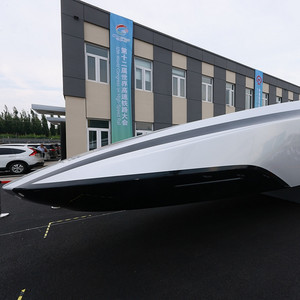
Well, there's the researchers over at Donghu Laboratory in central China's Hubei province that's just setting an incredible new world record for maglev acceleration last month.
And what they did is that they managed to get a 1 .1 ton test vehicle up to 650 kilometers per hour.
That's a little bit over 400 miles per hour in just about seven seconds.
So to put that in perspective, they did this over a 600 -meter stretch of a 1 ,000 -meter track.
And also the director of that project, Li Wei Chao, also confirmed that this is by now the fastest maglev acceleration on record. That's pretty impressive.
And for those who are still quite confusing about what we're talking about, first of all, we talked about a little bit of background of high -speed rail train.
Now we're talking about this maglev, or magnetic levitation support, an electromagnetic propulsion system.
This kind of thing is developed by the lab that Yusheng just mentioned, and this breakthrough relies on these kind of systems. These systems use these electromagnetic forces to levitate the vehicle above the track.
It's not touching the track, right?
You know, eliminating physical contact and also friction, and that's why it can be so, so fast. Yeah.
It's kind of science fiction -y to think about, you know, a train hovering above the track that it's traveling on.
But this isn't – that technology itself isn't brand new, right?
There are other countries, including China, but Japan's using Maglev.
Korea's using Maglev as well.
and there are actually here in china there are different lines in operation across the country right there's one here is it just one here in beijing i think it's called the s1 yeah there's one in beijing and i recently learned about it i always thought it's a subway line right i thought it's a subway line but it turns out to be to be a maglev line and it's only about 25 minutes ride of over 10 kilometers distance so it's not really that big of a project covering giving the say the a massive size of the city of Beijing.
And it's at an average operational speed of 80 to 100 kilometers per hour.
Not really that efficient in my perspective, probably avoiding some traffic lights.
Sure. Yeah. Not the fastest in the world, of course, but still exists here.
Shanghai uses Maglev Tech, too, in at least one of their trains.
I think it connects the airport to the city.
Yes, and it's been there for, I think, more than 30 years now.
And it lasts about 30 kilometers.
And it will make the 30 -kilometer trip into 8 minutes from the city to the airport, which is quite inconvenient.
And also, the price, maybe it's something we're going to talk about later.
But still, that is something people would concern because compared to just subway or just bus, the price of these Maglev trains can be a little bit more expensive than...
Ticket -wise. Yes, ticket -wise.
You got to pay for it if you want to use it, right?
Yeah, still relatively short track distances, right?
And I think in Korea, too, it goes from Incheon Airport into the city.
I think it's only maybe a little over six kilometers, that distance there.
So again, relatively short.
But like we said, the technology has existed for a while.
Then why is this such a huge deal, this new maglev test, this new breakthrough?
I think the significance, it lies in the speed itself, how we are achieving such a fast speed of 650 kilometers per hour.
And it's just done within a relatively shorter track as well, well, because unlike conventional speed tests requiring tracks that's as long as 30 to 40 kilometers, this new method only used a short distance acceleration approach, and this requires a ultra -precise speed and positioning measurement as well, which means that we are achieving multiple, say, technological breakthrough at the same time through one test. I think, yeah, and it's also proved by the speed itself.
that's what matters the most at this point.
Yeah, the speed, the distance.
As you mentioned, these speed tests typically require tracks that are 30 to 40 kilometers.
It's really long. They did this with one kilometer.
So they increased the speed and greatly reduced the distance that they were able to conduct this test on.
But that speed, 650 kilometers, that was the test speed achieved.
But that's not the goal, is it?
I mean, it can get faster.
And it's not just according to me, because right now we're talking about the test that's done back in June this year.
But also the director of this project, Li Weichao, also said that the entire test platform is expected to be completed by the end of this year.
And by then, the operational speed is, well, we hope is expected to be 800 kilometers per hour, which is, well, a new world record. you're getting it you're getting in the range of airplanes there yeah and to put in practice how speed that you know 650 kilometers per hour 800 kilometers per hours can be um now uh when we're uh taking that high speed rail from beijing to shanghai is probably going to take you the fastest one is 4 .5 right hours and um if we're getting into the and now that that high speed rail speed is more of like 320 to 400 around that but then if we're getting to that speed of this new
mag lift system it can be shortening to like three hours or 2 .5 hours if you get on the back of the train and walk to the front by the time you get to the front you'll be in shanghai that's the direction we're heading in but by the way before i mean getting from beijing to shanghai is is quite the distance so to achieve that on high speed rail even at 400 kilometers an hour 450 kilometers an hour whatever that may be to get it to four and a half hours that that is fast was a major breakthrough at the time that revolutionized travel because before that i mean how long would it have taken to get
to to shanghai from beijing or the other way around if you drove it would be over 10 hours i would think and if you take uh the train as i suppose it could be more than 12 hours or even almost to 20 hours if you like if we trace back to like 20 years ago or 10 years ago again they're testing these maglev trains in short bursts here right and i think you can think about that like fine -tuning a race car almost right you test it in really fast bursts over short distances and then you optimize it for long distance performance performance.
One of the other really impressive achievements here with this test was not only the speed, we mentioned that, not only the distance, we talked about that too, but the braking, the amount of time that it took to brake and the distance that it took to brake was also really impressive.
Yeah, I was so astonished by it.
I think it's out of safety concern as well because the tested prototype of maglev train, it allows the vehicle to decelerate to zero in just about 20 sorry 200 meters and this precise control of both acceleration and braking just make the test track a crucial platform for high -speed train research in the future and also just how advanced we we are expecting to see in just a few months or a few years time yeah I mean we'd set 800 kilometers per hour if they achieve that then we're getting into the range of airplanes here And I wonder if this kind of high -speed maglev train, this kind of transportation could actually
challenge short -haul air travel in the future.
My guess would be yes, it could.
In theory, yes, indeed, because typical commercial passenger aircraft, it's cruise around at around 800 to 80 to 925 kilometers per hour.
And that's about 547 to 575 miles per hour.
So if by theory we can accelerate the Megalov train to 800 operational speed, that's 800 kilometers per hour of a speed, then of course it's faster than some commercial planes already.
And it makes the train itself a significant contender for high speed ground travel.
And I would assume that the aero companies, they're going to disagree with this.
to try to, you know, compete.
I mean, but that's the goal, right?
To be in direct competition with short haul flights.
And you could argue, I mean, already you could argue that here in China, many people prefer to use the train if they can.
And I know in Korea, that's an option as well, because they have the high speed rail that connects the northern part of the country to the southern part of the country.
And you can get there in just maybe two and a half hours or a a little less or a little more i forget but my point is is that even at the speeds we've achieved already taking the train is still sometimes a preferred option when you take it when you take into account things like you know checking in at the airport going through security the distance from city center to the airport also has to be taken into account which you may take a train to get there too.
Delays, right? Flight delays either on the ground or in the air.
So when you take all of that into consideration, it's easy to understand why it's already an option.
And it's hard to think if they were traveling at the same speeds, how the air industry is going to keep up with this.
Yeah. I mean, for my family in particular, when we think about traveling, we prioritize looking for train tickets and if the train tickets for example if i'm to go from beijing to say guiyang in southwest china's guizhou province which is like a super long distance and it becomes too hard for the train to travel through mountains and get me there within say eight to ten hours then we will start to consider flights so that's like a thinking pattern for a lot of families when they're planning trips nowadays that i notice yeah Yeah, when the trip can spend longer than like eight hours, then people
will think about another way of taking airplanes.
But now if we have that kind of speed, maybe 12 hour trip can get into five hours, then we have more options to do.
Yeah, because the train seats are so comfortable as well, right?
By the way, of all those advantages that we just said, all these breakthroughs, there's also the advantage of the environmental impact or lack thereof, I guess.
Yeah, I was just about to say that maglev trains, they are also generally considered to be more environmental friendly than, say, traditional transportation methods that has a bigger amount of carbon emission.
Air travel. Yeah, air travel is the same.
We heard on social media all the time of celebrities being criticized for traveling on their private jets and how much emission it produced.
And also Megalov trains, they produce no direct emissions during operation because it basically flows in the air and are significantly quieter and can be more energy efficient in so many ways as well.
And they're powered by electricity, which means, as you said, no direct emission during operation with also high energy efficiency.
Yeah. I was wondering, I was going to say, I wonder if celebrities in the future will have their private maglev trains instead of their private jets.
Who knows? All right.
So, yes, amazing breakthrough.
Amazing what could come, what probably will come in the near future.
But it's not cheap.
that's for sure to make this the current at the current stage let's say the cost of development and also operation for a full maglev project is still very high if let's say that a scenario is applying to real society nowadays celebrities they're building their own private lines that's going to cost like millions i would say this is from the mcgrail business review that one of the most expensive parts of the whole system is the rare earth metal needed to build certain components for the Megaleft project.
So in addition to the cost of building itself, the costs and logistics associated with developing a new, say, infrastructure system within any already existing and extremely densely populated metropolitan area is quite hard because we already have, say, the high -speed train system, the aero line system, and unlike any other railway system, the maglev trains it required just its own guideways so that's its own power stations is unique superconducting magnets that cannot be combined or immersed with existing railroad tracks right and I don't know if we mentioned that already if we haven't I apologize
but in case you don't know right these maglev trains they don't operate on the same tracks yeah that the high speed rail trains do this is completely and totally different right um so that means that you have to build everything from from scratch you can't just use existing infrastructure that was already there and as a result of that that means that you're going to have a limited network yeah because currently the commercial maglev lines they are very limited in china and globally as well meaning that a comprehensive network to rival air travel would still require massive investment in construction and i
from my previous reading i And I also discover that these Maglev infrastructure, they are present.
Well, the issues of how costly it can be and how complicated it can be still present not only in China, but also in Japan as well.
Between Tokyo and Osaka, I'm not sure if there's already such a line running, operating at this point.
But even if it does, it might take a while for it to really start to make benefits.
it like make gainings out of it i think that plan got delayed but i also would need an update on that one another point is public acceptance uh you think so i i think so yeah you know um when something can get that fast and it can be really dangerous for people if there are like um accidents their perception maybe that way and in the you know phase of such kind of um um cool and fast technology it is natural that some people feel worried about you know its safety and other concerns while we understand that you know that kind of exhaustive testing will be carried out before it is ever put into
operation winning genuine public trust will still take time i remember when the high -speed rail really get get that fully operational was that an issue then to also have concerns about that and another thing is I mentioned before the price the ticket price of these maglev trains right the ticket price for the current operational shanghai -line is around it's like remember eight minute trip and it's well cost you around 40 yuan that's about six dollars which means it's not that you you know, daily or common price for a kind of 30 kilometer trip.
You know, you can totally spend less.
Just drive over. Yeah, yeah.
Or take a taxi. I know what you mean.
It's not that expensive, but relatively speaking, it actually is a little bit expensive.
Then, yeah, you've got the technical hurdles too, right?
You've got to scale this technology for commercial passenger use.
You've got to maintain that high speed, right?
And you have to ensure safety across long distances.
And those are real challenges for engineers.
But to put the public's concern at rest or those who might be concerned about it, extensive, extensive, extensive testing is done to make sure that it is safe before they introduce it to the general public.
And then, yeah, a lot of energy, a lot of power is required as well.
So getting back to it then, what's next?
Because as you mentioned before, Yushan, the track at Donghu Laboratory, you said they're going to be finishing that or hope to finish that by the end of 2025?
Yeah, and then it probably is going to take more time to fully put it into commercial use.
But this quick pace of development already shows such a clear drive towards rolling out these next -generation trains for commercial use in the near future as well.
And I would believe that this technology, once it's fully tested to be safe to be applied in daily scenarios, it can also serve as a vital platform for, say, for other future high -speed train or related research and also the development of other transportation technologies as well.
Because nowadays in day -to -day urban transportation system, we've already seen EV design that's so massive, aerospace science that could also use magnetic levitations.
These are all the prospective or say the areas where this technology can be further applied.
Yeah, civilian sector too, where it could be implemented in factories for handling systems, for materials in warehouses.
Imagine that, right?
So if there's an assembly line or storage facilities and the products are able to move through there without any physical contact at all, using maglev technology.
Cargills going through the factories.
Yeah. Because it's going to reduce friction.
It's going to reduce wear and tear on the equipment.
It would increase the efficiency and the precision and the logistics, the speed and the logistics.
The whole manufacturing process could be impacted by this, which is a really, really cool thing.
Anything else? I mean, I think generally speaking, this is very exciting because of what it could do.
Not necessarily so much in manufacturing.
Of course, that's exciting, too.
But just the distance and the time, this could really be a game changer.
And what I was thinking about was for tourism, the benefits for tourism.
Because this long -term goal to build such a system, it eventually benefits the people that's riding these trains, isn't it?
Like for such a quick high -speed connection between major cities from medium distances, I think it's going to help accelerate transportation efficiency in such a massive scope that maybe one day people will prefer going on megalith trains and believing, having faith in the technology that is going to safely deliver them at a much, much faster speed.
And hopefully it's not only working or applying to these short city routes or just city center to airport shuttles.
And I saw some reports of experts in this area saying that actually long distance is the best way to showcase the ability of maglev trains, because when it is long distance, people can actually use and go through that long distance without a frequent stop.
Because when it is like start operation and then pause for it for a middle middle stop station it can create a lot um a bit of um you know energy waste during this but if it is a long distance it is like make it to the most of the efficiency interesting um the reason i mentioned tourism before i think you know to use korea as an example again when they introduced their high speed rail it helped with tourism a lot i don't have statistics or anything like that But if you flew into Incheon Airport and sold the capital as the closest city, right, having that high -speed network available to tourists
made it possible for people to get to other parts of the country and see other parts of the country in a reasonable amount of time.
Because if you're a tourist flying into a capital city and you have to take a bus for 14 hours or whatever, then you're less inclined to visit anywhere else, right?
If you could fly into Beijing or fly into Shanghai and get to Beijing in a couple of hours, that would make things much more accessible from the tourist point of view and more likely to see more areas of China have a greater impact in perhaps smaller communities, smaller cities in China and benefit the whole country.
You know, back then we have that kind of sentence, 这么近那么美 ,周末到河北, saying that it's so close.
so you can so close of Hebei which is a province near next to Beijing which means like at the weekends you can just travel to Hebei because it will probably just take you two hours of car to take driving a car but now if you're like you can like spend two hours on maglev train and you can travel from Beijing to Shanghai that's totally do different weathers yeah yeah it's amazing Amazing, isn't it?
Again, it's such an exciting breakthrough for train technology.