Get the unmissable news stories of the day.
This is the Beijing Hour.
Examining the events that impact and shape China and the rest of the world.
This is the Beijing Hour.
One hour of news and information brought to you every weekday.
Now here's your host. Shane Biggum with you on this Monday, July 14th, 2025.
You're listening to the Beijing Hour, coming to you live from the Chinese capital.
On today's program, Chinese officials say the country's foreign trade showed resilience through the first half of the year.
The EU is pausing its trade retaliation against the U .S. until next month, as the bloc considers its options.
Gaza's health ministry says Palestinian deaths have hit another grim milestone, as Israeli strikes continue in the enclave. In business, China's central bank says financial support for the economy remains stable.
In sports, China's golden results from the table tennis action in Las Vegas.
In culture and entertainment, China's efforts to preserve some of its world -famous grottos.
Now to Checking the Day's Top Stories.
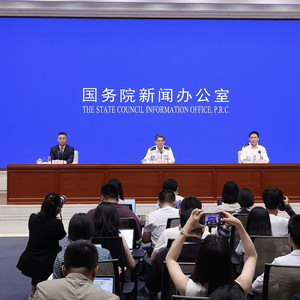
The General Administration of Customs says China's foreign trade showed resilience in the first half of the year.
The country's imports and exports of goods rose by 2 .9 % in the first six months.
Daikai has more. The press briefing officials from the General Administration of Customs said China's foreign trade remained steady growth in the first half of the year.
China's trade volume in the period stayed firmly above 20 trillion yuan, a record high for this period.
On a quarterly basis, trade rose 4 .5 percent year -on -year in the second quarter, marking seven consecutive quarters of growth.
Officials also noted that China's network of trading partners is becoming more diverse.
In the first half of the year, China saw trade growth with over 190 countries and regions.
The number of trading partners with volumes exceeding 50 billion yuan reached 61, 5 more than the same period last year.
While trade with traditional markets such as the EU, Japan and the UK continued to grow, emerging markets contributed even more to overall growth.
At a press briefing officials said export growth was led by mechanical and electrical products which rose 9 .5 % and made up 60 % of total exports.
Products tied to high -end manufacturing and green technologies also stood out, high -tech equipment exports jumped over 20%, while the so -called new three products, namely EVs, lithium -ion batteries and solar products, saw a 12 .7 % increase.
On the import side, demand for industrial machinery in sectors like petrochemicals and textiles posted double -digit growth.
Customs officials say that global trade still faces serious challenges, from rising tariffs to weakening demand, as international organizations revise down on their global growth forecasts.
But officials have also expressed their confidence that with diverse markets, higher -value products and increasingly agile exporters, China's foreign trade is well -positioned to weather external risks in the months ahead.
That was Dai Kai -yi reporting.
And for more on China's foreign trade in the first half of the year, Pan Deng spoke to Professor Qiu Cheng with the Belt and Road Research Center at Minzu University of China.
China. Let's start with this annual increase of China's trading goods, 2 .9 % in the first half of this year.
How much does this number tell about China's resilience in its trade?
This is actually a very, very hard earned result.
I think it's a really good one.
Well, a lot of people say, like five years ago, we're achieving our export growth probably by more than 5%.
But you have to understand the whole economic sentiment right now is It's very different from five years ago, especially when the major trader of the whole world, the United States of America, are waving a baton of the tariff against every other nation in the whole world.
So I think that really has been jeopardizing the whole global trade and economy scenario.
But still, yes, that kind of backdrop, in the first half of the year, we still achieved about 3 % of the growth.
And also, especially, we find out in export, China has been achieving about 18 trillion renminbis worth of the export and growing by 2 .5 percent.
And also, we have to say that China has been achieving, you know, more than 10 trillion yuan worth of the export for several consecutive months.
So I think it's 7 .2 % of the growth against the current very complicated and challenging background, especially compared to other major trading nations like South Korea, like Japan, like Germany.
I think China has really been doing pretty well.
So I think the reason for that, number one, is because China really has a comprehensive manufacturing network and also the supply chain.
It helps China to be very flexible and to accommodate to the change and challenges of the outside world.
For example, if you're blocking the labor intensive industry and products in China are using, you know, green products, the high technology products to supplement that kind of the losses.
and also China's government has also been you know doing a concrete cyclical policies for example when the whole world is shutting down the door and Chinese government are trying to streamline its management and also open it wider to the outside world to improve this competitiveness for the domestic company and also to welcome in the foreign competitors and the companies into China so I think that's a reason why Chinese economy and export is pretty pretty much resilient.
Mr. Chu, looking ahead, are you expecting resilience continue to be the defining feature of China's trading goods in the second half of this year?
What could be the major challenges?
Well, I do think China is going to be resilient still in the second half of the year because China still has 1 .4 billion population.
The huge market is there.
And also China plus ASEAN nations and about plus southern road nations.
This large economy this large market has already been built so no one can deny that I think that is the confidence we have as plus China has been speeding up for upgrading its you know economic structure and also products, technology connotation so I think this is a sure path to you know make sure that economy continue to grow but the problem is still here we have to admit and to see that for example the the gross power for the whole global economy still not there yet.
It's still very, very weak.
And also the high interest rates for the Federal Reserve in America are still lingering around.
And inflation can also be a problem that we're jeopardizing the future trade potential of the whole world.
And also, in order to solve the problem, America is still weaving the baton of a tariff, you know, and also all kinds of the investigation for the trade.
This protectionism has been spilled over not only in America, but also for the rest of the world.
And the geopolitical tension has still been there.
So we're welcoming a more turbulent future in the second half of the year.
And also, from our observation, the recession has already been happening from America.
Just take a look at the real estate market in America.
It's showing a dangerous sign.
So I think probably from the end of this year and also the beginning of the next year, we're going to see more of the problems coming in the international arena.
I was Chu Chung with Minzu University of China, sharing his insights on China's foreign trade in the first half of the year.
China's automobile industry is seeing an increase in global demand as it's shifting into a greener and smarter direction at full speed.
An automaker in central China is seeing such efforts converging with global partnerships to accelerate the creation of a world -class automotive ecosystem.
Hu Chao reports from Wuhan.
An intelligent electric vehicle or EV production line had a state -owned automaker with a legacy of over 50 years.
Based in Wuhan, the capital of central China's Hubei province.
In a spectrum, more than 900 industrial robots operate in a highly coordinated matrix.
One new vehicle rolls out the production line every 118 seconds.
This is Dongfeng, one of China's four major automobile groups, now keeping pace with the country's booming EV sector.
It took just 14 months to convert an old gas -powered vehicle production line into one for high -end EVs. The upgrade took just half the time and only 10 % of the cost of building a new factory.
It's very fast. In the past, it might take three to five years to develop a car.
Now we can launch a new model in just two years.
Behind this speed is Zhejiang's complete auto industry ecosystem.
The rapid rollout of new vehicle models models is made possible by strong support from the surrounding supply chain.
While it previously focused solely on manufacturing, the supply chain in Wuhan has now shifted toward research and development.
This allows us to collaborate across the entire process, from product planning to manufacturing, significantly shortening the development cycle.
Hubei hosts 25 automakers and over 2 ,400 parts suppliers, making it one of provinces with the most complete auto industry chains in china this robust ecosystem is also attracting more and more foreign companies to establish a deeper presence in the region since 2021 we've welcomed 159 foreign firms with an investment of nearly 2 billion us dollars making this one of wuhan's top top foreign business hubs.
Cummings, a renowned US provider of power equipment, has been embedded in the Chinese market for half a century.
Once just an engine maker, the company now provides diversified power solutions across China's auto industry.
Its R &D hub in Wuhan now leads global product development.
Previously, many of our products were first developed in the US or UK and then adapted for china now most of the core rd happens right here and then it is sold globally many chinese automakers are now racing to master core technologies to strengthen their position in the industry earlier this year a test vehicle equipped with china's first high -end automotive grade mcu chip the df30 successfully completed winter testing in northeastern china this high performance chip, essential for power train control and chassis systems, has long been dominated by imports.
Jointly developed by Dongfeng and over 40 partners, the DF -30 marks a major step toward breaking the foreign monopoly.
So far, five auto -grade chips have been successfully they will fill a domestic tech gap and slash costs.
These chips boost supply chain resilience and give other automakers access to homegrown tech. More importantly, we've now built the full chip -to -car ecosystem.
Automakers nationwide are embracing the transition as China's auto industry rapidly shifts from traditional fuel vehicles to new energy and smart technologies.
As you pass by any landmark, a single touch on the screen, an introduction pops up.
This is a model of a smart concept car and this is a glimpse into the future.
China's intelligent vehicle technology is advancing rapidly and owning a car like this would not be far off.
That was Hu Chao reporting.
Coming up, the EU will pause its trade retaliation against the United States until early next month.
Dive into news like never before with Deep Dive, the podcast from CGTN Radio.
Join our global reporters for captivating stories and thought -provoking conversations.
Search Deep Dive on your favorite podcast platforms and get ready to dive in.
At 13 minutes past the hour, European Commission President Ursula von der Leyen says the European Union will pause its trade retaliation against the United States until early next month.
She says the bloc will continue to prepare response options.
The announcement came after U .S. President Donald Trump announced 30 percent tariffs on the EU and Mexico.
Frances Quah has more.
U .S. tariffs dominating headlines across Europe.
The European Union's 27 member states grappling with Donald Trump's announcement of a 30 % levy on European goods into the U .S. European Commission President Ursula von der Leyen saying the EU will hold off on countermeasures for now.
We have developed a second potential list of countermeasures that is by now agreed to.
We are not there yet.
This is very important.
This is now the time for negotiations.
But this also shows we are prepared for all eventual scenarios.
But tougher words from French President Emmanuel Macron, posting on social media.
This announcement comes after weeks of intense engagement by the Commission in negotiations with the United States on the basis of a solid offer made in good faith.
With European unity, it is more than ever up to the Commission to assert the Union's determination to resolutely defend European interests.
In particular, this implies speeding up the preparation of credible countermeasures by mobilizing all the instruments at its disposal, including anti -coercion, if no agreement is reached by August 1st. Trump doubling down during an interview on the U .S. news network Fox News.
And it's basically telling countries that we are going to give you the privilege privilege to shop and work in our country.
And some of the countries are very upset now because they've been taking advantage of us for 30, 40 years and I had it stopped.
But experts warn Trump's tariffs could backfire.
If you look at the trade issue in an isolated way, I would very much recommend to take a hard stance because in my view and and this is also confirmed by economic models the united states might even suffer more than the european union from those tariffs which are implemented by or planned to be implemented by the european union a lot is at stake the eu is a top u .s trading partner and together they account for 30 percent of global trade with the eu exporting more more than $620 billion worth of goods to the U .S., including cars, aircraft, medicinal and agricultural products.
This is a very important market for us.
This market accounts for around 350 million euros yearly for dairy products, cheeses in particular.
We export 25 tons of cheese to the United States yearly, and so this is a shock.
And the shockwaves are bound to hit global markets Monday as this turbulent trade war ratchets up.
That was Francis Kwa reporting.
A European and Mexican leaders have vowed to counter the latest tariff decision from the U .S. president.
Donald Trump has sent letters to 23 trading partners within a week, including Canada, Japan and Brazil.
The letters set blanket tariff rates ranging from 20 to 50 percent.
Kate Fisher reports from Washington, D .C.
The European Union being on the receiving end of a 30 percent tariff, along with Mexico, Those were announced this weekend, and they are two of the U .S.'s biggest trading partners.
So it will make a huge impact on both them as well as the rest of the global economy.
And they join this growing list of countries to which Donald Trump has sent letters outlining their new tariff rates, which will go into effect on August the 1st if a deal isn't negotiated before then.
And they include two of its biggest allies in the Asia -Pacific, Japan and South Korea, as well as several other countries, going up to 40 percent for the likes of Myanmar and Laos.
It's just another section in this barrage of modifications, pauses and changes to Donald Trump's tariff policy that is causing so much uncertainty for consumers and markets and investors alike.
The European Union has said that they want to negotiate, that is still what they're trying to do, but that they do have retaliatory tariffs planned and ready to go, should they need to do so.
Donald Trump has said to that, well, if they do that, he will just add more tariffs.
Donald Trump saying he wasn't happy with how things are going so far.
But so far, there are only two countries who've managed to strike a deal with the United States, at least a framework of one, the UK and Vietnam.
So there is still a lot of talking to do with a lot of countries.
That was Kate Fisher reporting.
German Chancellor Friedrich Merz has warned about the impact of new U .S. tariffs on the EU, saying they would severely damage Germany's export -driven economy.
Speaking in his annual summer interview with ARD television, Merz said President Donald Trump's decision to impose 38 % tariffs on EU and Mexican goods would hit the German export economy to the the core.
He stressed the need for maintaining what he called sensible lines of communication with Washington.
I want to make our voice heard and to ensure that these tariffs of this magnitude do not become real.
That requires two things, unity within the European Union and the sensible lines of communication with the American president.
Remarks come amid rising trade tensions following Trump's announcement of sweeping new tariffs set to take effect on August 1st. Merrits emphasized that only a coordinated approach within the EU would carry the necessary political weight to influence Washington's decisions.
Residents of European Union countries are calling on the bloc to take a tougher stance against tariff threats from the U .S. I think the EU needs to take a tougher stance.
You compromise with them, he says, great, he'll make things better for a little bit and then I'll come right back around later.
As soon as you say the wrong thing, do one thing he doesn't like, he'll do it again.
So I think countries need to learn that compromise with him doesn't work successfully.
You need to be just as tough with him and fight back.
I think U .S.-Europe relations have been tense since the Trump administration came to power.
The U .S. follows an America first approach, putting itself above the rest of the world.
This will only make relations with Europe worse.
Many European leaders have voiced growing frustration over Washington's tariff threats, with many urging immediate retaliatory steps.
French President Emmanuel Macron expressed disapproval of the U .S. move, urging the EU to speed up preparing countermeasures.
Swedish Prime Minister Ulf Christensen condemned the U .S. move as a unilateral escalation.
Czech Prime Minister Peter Fiala criticized Washington's tariffs for negatively impacting transatlantic trade, calling for unity and determination to protect the bloc's interests.
Coming up, Palestinian deaths in Gaza have reached another grim milestone.
Welcome to Climate Watch, the podcast that brings you the latest on climate change, energy, and sustainability, all in under 30 minutes.
Each week, we speak with global experts, from energy policy pioneers to wildfire historians and covering the stories that matter most. Climate Watch is your go -to source for insightful, inspiring conversations.
Tune in to Climate Watch on your podcast platform, and let's navigate the path to a sustainable future together.
21 past the hour. The Israeli military has been continuously striking areas in the Gaza Strip.
The Gaza Health Ministry says the number of Palestinians killed in the enclave has surpassed 58 ,000 since the conflict between Israel and Hamas began in 2023.
Israeli airstrikes on Sunday hit a busy market in Gaza City and a water distribution point in the Nusarat refugee camp, killing and injuring dozens of people.
Rami Amoghari reports from Gaza City.
Two deadliest Israeli airstrikes in different parts of the Gaza Strip in Osiris, Fiji, Cambria earlier in the morning where six children were reportedly killed, three other people also killed, and more than a dozen wounded when an Israeli airstrike hit a location where there was or there is actually a point for distributing water for free for the population, for the locals over there.
AT NINE AM, WE WERE ALARMED BY THE INFLUX OF PATIENTS AFTER A MISSILE HIT A WATER DISTRIBUTION POINT.
MOST OF THE INJURED WERE CHILDREN AND WOMEN.
WE TREATED 17 PATIENTS, INCLUDING SEVEN CHILDREN.
THE PATIENTS SUFFERED FROM VARIOUS INJURIES, INCLUDING SPLINTERS AND FRACTURES.
This was a very deadly Israeli airstrike that claimed the lives of children.
And another airstrike actually hit Gaza City, the heart of Gaza City, in a marketplace where people are gathering for buying and picking up things.
Actually, 17 people were killed during that airstrike on Gaza City, in the east part of the Gaza City.
And also including a senior or a prominent surgeon who's working at the Al -Ma'madani Hospital just nearby.
whereby this situation goes with other desperate situation in the Gaza...
desperate conditions in the Gaza Strip, particularly that 47 % of the medicines in Gaza are hitting zero, some in the territory.
Lack of medicines, lack of fuel is affecting also the hospitals' functioning.
Only the... only few quantities of hospital have been...
of fuel have been pumped into hospitals, particularly the Al -Shifa Hospital, which is having a very big load of capacitors of work for the time being.
That was Rami Amagari reporting.
Hopes for breakthroughs in the latest Gaza ceasefire talks have been high, but progress is stalled after weeks of indirect negotiations in Doha.
Jonathan Regev reports from Tel Aviv.
So the ceasefire negotiations seems to be stalled, and the Prime Minister is meeting with some top security advisors, top security personnel.
Why so? There's one sticking point, which is derailing the whole thing, that is the issue of this humanitarian city in Rafah that was just brought up.
In order for that city to actually take place, Israel needs to maintain control of the Moraga Corridor, which will be the northern edge of that city, separating it from Chaniunas, from the rest of the Gaza Strip.
This is something that Israel wants to create, but Hamas thoroughly objects.
Why so? It would be perhaps the first time that Israel would create some kind of an alternative to Hamas that within Gaza there would be an area, quite small, only the city of Rafah and the surrounding areas, but which would be independent from Hamas control.
This is something that Hamas is clearly concerned from because it would lose not only the security control, but also the civilian control.
This is something that worries Hamas, and this is something that is currently derailing the negotiations.
How much can Israel perhaps concede?
How much can Israel be flexible on this?
This is what will be on the table as the security cabinet or this security meeting convenes if Israel would perhaps be a bit more flexible on this issue, it could maybe help things proceed in the negotiations.
That was Jonathan Regev reporting.
Iranian Foreign Minister Abbas Arachi says Tehran's cooperation with the International Atomic Energy Agency will take on a new form.
He said the IAEA monitoring of its nuclear sites will be reviewed on a case -by -case basis.
The minister also hoped Iran can resolve concerns of its nuclear program through diplomacy.
Our cooperation with the IAEA has not stopped.
Of course, it would take on a new form, which is entirely natural, given the current realistics and developments.
Tehran suspended cooperation with the UN nuclear watchdog earlier this month.
Arachi said Iran will need an assurance of no further attacks on its nuclear facilities.
Israel launched a bombing campaign on Iran last month, just days before Tehran and Washington were set to revive nuclear negotiations.
But the US joined Israel on June 22nd in carrying out strikes of its own.
Iran has blamed the IAEA for providing a pathway for strikes on its nuclear sites.
Tehran's repeatedly denied ambitions to develop nuclear weapons.
Arachi said any new nuclear deal must uphold Iran's right under the Non -Proliferation Treaty to enrich uranium for peaceful purposes.
The internationally recognized Central Bank of Yemen has rejected a Houthi move to issue a new 50 rial coin for use in areas under its control in the north.
The Houthi -controlled branch of the central bank in Sana 'a is backing the circulation of the freshly minted coin.
The official central bank has denounced the branch as illegal.
The issuance of the new coin has deepened the financial divide in Yemen.
Ahab Alfandi reports.
The central bank in Sana 'a announced the release of a new 50 real coin.
The move aims to ease the liquidity crisis and replace damaged banknotes.
The 50 riyal coin will benefit us a lot.
It will replace the damaged banknotes and also make up for the paper money that used to go to waste at the grocery store, where we got no real value.
The change would often come back as lollipops or leftover sweets from the shopkeeper.
Of course, this new 50 riyal coin will help the Yemeni economy.
It also serves as a replacement for the notes of 10 and 20, especially because the paper money is damaged.
this metal coin is a better alternative.
This move shows the deep financial divide in Yemen.
Two separate monetary authorities operate in the country, one in Sana 'a under the Ansarallah group and the other in Aden under the internationally recognized government.
This spell has caused a sharp difference in the dollar exchange rate with about 535 riyals in Sana 'a and over 2 ,800 riyals in Aden.
This has led to a big rise in the prices of basic goods, especially in the south.
The monetary division has affected all aspects and sectors of the economy.
It has harmed Yemeni society across all segments.
Weakened purchasing power led to rising prices and the depreciation of the national currency, the Yemeni rial.
It has also caused the official economy to disappear and given rise to a parallel economy, namely the black market in the country.
Economic analysts say that moving the central bank to Aden in September 2016 made the financial crisis worse.
Salaries stopped being paid to young Poles in the northern areas and internal transfer fees increased.
This doubled the suffering of citizens and deepened one of the worst humanitarian crises in the world.
With a financial divide going up, political solutions absent, living conditions in Yemen are versatility declining further in the Rwandan economic stability and deepening the hardships faced by the people.
That was Ahab Alfandi reporting.
We're at 29 minutes past the hour, checking the forecast ahead of the break.
And Beijing's down to 24 Monday evening, a slight rainfall of 31 degrees for Tuesday.
Nanchang's 28 overnight and then cloudy in 36.
Elsewhere in Asia, Islamabad's down to 25 degrees, that's followed by a slight rain and 29 on Tuesday.
Vientiane's 25 overnight, then moderate rainfall and 31 degrees.
Phnom Penh's at 25 this evening, then rainfall and 33 degrees.
In Africa, Nairobi's getting a slight rain and 23 on Tuesday.
Kampala's at 19 overnight, then a slight rain and 24 degrees.
Juba's down to 20, followed by a slight rain and 29 degrees Celsius.
It's time for a short break.
So far this hour, Chinese officials say the country's foreign trade showed resilience through the first half of the year.
The EU is pausing its trade retaliation against the United States until next month as the bloc considers its options.
Gaza's health ministry says Palestinian deaths have hit another grim milestone as Israeli strikes continue in the enclave. Shane Begum with you.
Stay with us here on The Beijing Hour.
Shh, listen up. Can you hear the heartbeat of our world?
It's vibrant and pulsating with the essence of life itself.
From the stem of trees to the gurgle of rivers.
From the silent strength of mountains to the icy whispers of glaciers.
Even the solid ground beneath our feet.
right there, in the midst of all, beats the heart of humanity.
What if those other heartbeats were to stop?
Would ours keep on ticking?
Ever wondered what's actually going on in Africa through the perspective of an African?
How are things really going between China and Africa?
What's the narrative of this relationship?
Well, get a perspective with China Africa Talk.
Hear from African diplomats, entrepreneurs, academics, Chinese natives, and more.
Get on our wavelength every week to find out what's real with China Africa Talk.
Find us on your favorite podcast. We'll see you there.
Examining the events that impact and shape China and the rest of the world.
This is the Beijing Hour, one hour of news and information brought to you every weekday.
Now, here's your host. Shane Bigham with you on this Monday.
Still to come, in business, China's central bank says financial support for the economy remains stable.
In sports, China's golden result from the table tennis action in Las Vegas.
In culture and entertainment, China's efforts to preserve some of its world -famous grottos.
To contact us, you can email radio at cgtn .com or follow our X account at CGTN Radio.
First, checking the day's headline news, here's Tian Yu.
Thank you, Sheng. Chinese Foreign Minister Wang Yi has urged China and Russia to deepen strategic coordination, promote development and jointly tackle challenges in a turbulent world.
In his meeting with Russian Foreign Minister Sergey Lavrov in Beijing, Wang said China is willing to work with Russia and other members of the Shanghai Cooperation Organization to plan for future development.
China currently holds the SCO Rotating Presidency.
Wang highlighted the organization's role as a platform to support support multilateralism and unity within the Global South.
Lavrov said Russia is willing to work for new achievements in its ties with China.
A customs official had said China and the United States are accelerating efforts to implement outcomes from the framework of the economic and trade talks in London.
Wang Linjing said trade between the two countries recovered covered to over 350 billion yuan last month, or around US $49 billion following recent economic and trade talks in Geneva and London.
The figure was less than 300 billion yuan in May.
The deputy head of the General Administration of Customs described China -US economic and trade cooperation as mutually beneficial, saying it represents the trend of globalization and the need for deeper industrial chain integration.
The official also said the two countries should should jointly steer the global trade system back to a fair and open track and contribute to the recovery and growth of the global economy.
The European Commission president says the EU will temporarily pause its planned retaliatory tariffs against the US until early August. It follows President Donald Trump's decision to impose sweeping new duties on European goods.
Ursula von der Leyen said Brussels remains committed to de -escalating tensions but will continue preparing response options should talks fail.
As you know, we have prepared and agreed on the first list of countermeasures.
We have developed a second potential list of countermeasures that is by now agreed to.
This is now the time for negotiations, but this also shows we are prepared for all eventual scenarios.
On Saturday, Trump announced that the US will impose a 30 % tariff on goods imported from the EU and Mexico starting August 1.
This is in addition to existing tariffs of 50 % on EU steel and aluminum, 25 % on automobiles and a standard 10 % on most other goods.
The decision has provoked strong criticism across Europe.
German Finance Minister Lars Klingbeil warned that the EU must respond firmly if negotiations fail.
Clean Bell also pledged that Germany would intensify efforts to diversify its trade partnerships beyond the U .S. Spanish Prime Minister Pedro Sanchez echoed the concerns and reaffirmed Spain's support for the European Commission's efforts to secure an agreement with Washington.
The EU initially planned to implement its first round of retaliatory tariffs on Monday, but that move is not on hold amid ongoing negotiations.
And finally, U .S. President Donald Trump says the U .S. will send Patriot air defense missiles to Ukraine to help bolster the country's defenses against Russian attacks.
Trump says the European Union will purchase the missiles from the U .S. and then deliver them to Ukraine.
The president also says he plans to meet NATO Chief Mark Rutte in the coming weeks to discuss Ukraine and other urgent matters.
Bank says financial support for the economy remains stable.
the Hang Seng Index increasing nearly 0 .3%.
In Japan, the Nikkei dipped almost 0 .3%.
Data from China's central bank indicates that support from the country's financial sector to the real economy remains stable.
Yuan -denominated loans grew by nearly 13 trillion yuan, or around 1 .8 trillion US dollars, in the first half of the year.
Key sectors such as manufacturing and infrastructure were the primary borrowers.
By the end of June, the country's outstanding social financing increased nearly 9 % from a year ago to $430 trillion.
Meantime, the balance of broad money or M2, which encompasses cash in circulation and all deposits, reached $330 trillion.
That was an increase of 8 .3%.
A central bank deputy governor says China will continue to implement a loose monetary policy.
For more, Michael Wong spoke spoke with Chen Jiahe, chief investment officer at Novam RK Technologies.
China Central Bank was just telling us about how the interest rate on newly issued corporate loans and individual mortgage rates continue to fall in the first half of the year to the tune of 45 and 60 basis points respectively, quite low, I would say, relative to history.
Talk to us about how you see the effectiveness of monetary policy in supporting the real economy.
Yeah. In the past half year, we have seen that the monetary policy has been really working effectively with supporting the real economy.
I mean basically the most important contribution comes from three areas.
The first one I think would be the property market.
I mean if you look at China's property market, it's working out of its trouble in the past six months.
The market started to stabilize.
People started to buy them.
The price is starting to be stabilized.
Behind this is the supporting of China's monetary policy.
And the second is that the monetary policy has been really helping China's consumption.
I mean, a lot of support has been given to the consumption market.
The mortgage that people pay has been significantly reduced so that people are having more money to spend.
So this really supported the consumption economy, which is now probably the most important part of China's economy.
And third is that amid the global trade war started by the Trump administration, the monetary policy has been helping China's caprice.
I mean, China has really a lot of companies exporting things to the world, and they have to transfer their exports from countries like, you know, United States, which keeps on adding tariffs to all the countries around, to the economies who are more stabilized.
So this transfer needs the support of policies.
So China's monetary policy has been really helpful in this area.
yet. Right. Jacqueline, let me ask you about these targeted monetary policy tools that I feel are quite unique to China, because the People's Bank of China also said that as of the end of May, when it comes to green loans, science and technology loans and inclusive finance related loans, these grew by 27 .4, 12, 11 .2 percent, double digit growth, right, overall year on year.
Tell us more about China's targeted monetary policy tools, its uniqueness and how they support growth?
Yeah, this is a very good question.
I mean, it's a very good tool that China has been using to help its economic growth.
I mean, if you look at the traditional monetary policy, it's that you set the interest rate and you leave the rest of the job 100 % to the market.
You trust the market will always make the right decision.
So this is a traditional kind of monetary policy.
But history tells us that this doesn't work from time to time.
I mean, the market is never 100 percent correct.
That's the first thing.
The second thing is that the market doesn't have a long vision.
The market never looks for like 10 years or 20 years.
People invest the money.
They ask, what's the return this year?
What's the return next year?
Probably they give you three years, but that's the maximum.
So if you leave everything to the market's decision, that's the result.
So China has been using these targeted policies to help special industries, for example, the high tech industry, which has been its primary focus in the past few years.
A growing economy, protecting the environment at all costs, all these kind of things has been done.
So it's really good policies.
I mean, it probably never bring the largest amount of return in one to two years, but it's helpful to the country's growth in the long term.
That was Chen Jiahe on China's monetary policy.
Now China's smart consumer device manufacturing sector has seen rapid growth this year, filled by a government -backed trade -in program.
From January to May, the country's electronic information manufacturing industry maintained strong momentum.
The revenue of surveyed enterprises reached nearly 6 .5 trillion yuan, or around US $900 billion, up 9 .4%.
Production of electronic consumer goods recorded steady increases.
Manufacturers produced over 140 million computers, up 8 % from a year earlier.
More than 14 million television units rolled off assembly lines, up 1 .7%.
Zuo Kai -re is with China's Academy of Information and Communications Technology.
Consumption scenarios are becoming more diversified.
On the demand side, new smart products are quickly entering the market, opening up emerging markets in home services, health management and beyond.
On the supply side, the industry is clearly moving toward transformation and upgrading, with new growth drivers accelerating.
China also plans to go on promoting its AI plus consumer goods initiative, encouraging the development and application of new technologies such as smart wearables, ultra -high -definition videos and robotics.
Meanwhile, authorities will continue to foster high -growth consumer sectors and guide the smart device industry towards greener and more service -oriented developments.
China's city of the future, Xiongan, features aerial drone inspections and intelligent monitoring systems that are transforming urban governance.
Ning Hong has details.
Mounted on this smart streetlight pole in Xiongan New Area is a drone bay.
Several times a day, a drone equipped with a high -definition camera will be sent out to patrol the street.
The entire process is automated.
We preset three daily patrol sessions with customizable routes into the system.
The drone's algorithm library identifies urban elements including vehicles, bicycles, pedestrians, rubbish on the road, street lights, and trash bins.
At the same time, an automated underground system continuously monitors the city's gas supply network.
Monitoring devices work under the manhole covers, requiring no pipeline reconstruction.
By detecting methane concentration fluctuations, minor leaks can be swiftly identified.
This technology has been deployed across multiple cities.
In a recent project, the system integrates 280 million urban data points and over 7 ,000 surveillance feeds with AI algorithms' auto -flagging anomalies.
3D visualizations replace traditional computer -generated blueprints.
CAD blueprints previously caused frequent utility ruptures during construction Now, visualized pipeline layouts enable hazard avoidance before groundwork begins From aerial drones to invisible underground sensors technological innovation is reshaping urban governance across China That was Ning Hong reporting While much of China's waters under the summer heat Jilin province in the northeast has emerged as a sought -after destination thanks to its cool and refreshing weather.
Many ski resorts in the province have launched summer operations, energizing the local economy by blending culture, sports and tourism.
At Songhua Lake Resort in Jilin City, tourists have been flocking to a wide range of outdoor activities.
One of the resort's most distinctive new offerings is a mountain trail running event.
With modern facilities and professional support, the event has become a favourite among runners.
Jilin City enjoys an average summer temperature of 22 degrees Celsius.
Its abundant ecological resources make it an ideal location for outdoor sports.
An official from the Chinese Commerce Ministry has hailed national economic development zones as powerful engines for regional growth.
Ji Xiaofeng says the zones extend the economic influence of developed areas and accelerate development in regions that need it.
Ji also says the zones function as platforms for global openness and harps for orderly cross -regional industrial transfers.
The official added that while strengthening clustered development of competitive and leading industries, the ministry fully leverages the zones' radiating effects on their host regions.
For example, the Beijing Economic Technological Development Area has expanded its production and supply chains to neighboring areas, enabling local businesses to benefit from its flagship enterprises and achieve mutual growth.
The ministry also prioritizes deepening ties between regional industry leaders through the integration between eastern and western development zones.
China established its national -level economic development zone in Dalian in 1984.
By 2024, the number of such zones surpassed 230, generating a regional GDP of nearly 17 trillion yuan, or about 2 .4 trillion US dollars.
latest events, juiciest stories, all with a very personal take.
Subscribe to Sideline Story Podcast for heated sports discussions covering events that are happening in China and around the world.
47 past now and turning to sports, here's Yang Guang.
Thank you, Shane. First, in table tennis, world champion Wang Chuqin dominated Japan's Tomokazu Harumoto in just 35 minutes to win the man's singles gold at the WTT US Smash in Las Vegas.
The world number two extended his head -to -head record to 11 -2 against Teramoto with a 4 -0 sweep.
Wang cruised through the first two sets, rallied from a game point down in the third and sealed the title in the fourth.
He talked about his feeling after the victory.
I'm still really happy to win a title at the stop.
I think this tournament has helped me see a lot more clearly.
There are still many issues and areas where I can improve.
I definitely need to take time to reflect on that.
At the beginning, I didn't feel comfortable with the table or the venue but gradually things got better and that's something I can take pride in.
In the women's final, Zhu Yuling from the Macau region etched China's Chen Yi 4 -2 in a tightly contested 56 -minute battle.
Chen started strong with two straight wins but Drew mounted the comeback taking the next four sets to clinch the gold.
Turning to football, Cole Palmer produced a dazzling first -half display as Chelsea stunned Paris Saint -Germain 3 -0 to win the inaugural Expanded Club World Cup at New Jersey's MetLife Stadium.
The 22 -year -old midfielder scored twice and assisted Ruao Pedro, dismantling the Champions League winner in just 45 minutes.
Chelsea, who came in as the underdog after a fourth -place Premier League finish and a Conference League title showed no nerves on the big stage.
Palmer opened the scoring in the 22nd minute after Mauro Augusto pounced down on the PSG error.
He doubled lead with a slick solo effort and then set up Pedro for smooth chip over Gianluca Donnarumma.
PSG's meltdown was capped by Joao Neves' red card in the 83rd minute.
After the final whistle, US President Donald Trump presented trophy to Chelsea captain Rhys James games, and posed for photos with players and officials.
Palma was named the tournament's best player while keeper Robert Sanchez won the Golden Glove.
In tennis, Yannick Sinha has claimed his first Wimbledon crown with a 4 -6, 6 -4, 6 -4, 6 -4 victory over Carlos Alcaraz in the high -energy final, avenging last month's French Open loss and capturing his fourth Grand Slam title.
The winnings ended, Alcaraz beat for a 3rd straight Wimbledon title and made Sinner the first Italian ever to lift the men's singles trophy at All England Club.
In the first Wimbledon men's final contested by two players born in the 2000s, Alcaraz took the opening set with a late break, but Sinner responded with poise.
After a brief disruption in the second set due to a champagne cork flying onto center court, Sinner broke early and levelled the match. He tightened his grip with a brick at 5 -4 in the third, closing the set with ease.
The top seed struck early in the fourth as Alcaraz showed rare signs of frustration.
Senna remained composed and served out the match, completing a memorable win in just under three hours.
The Italian player was emotional after recovering from the epic loss in the French Open final last month.
Yes, I would say mostly emotionally because I had a very tough loss in Paris.
So it's, but at the end of the day, it doesn't really matter how you win or you lose the especially important tournaments.
You just have to understand what you did wrong, trying to work on that.
That's exactly what we did.
We tried to accept the loss and just kept working.
And this is for sure one of the reasons why I hold this trophy here.
And I'm just so grateful that I'm healthy, that I have great people around me, which is the most important part, and having this trophy with me means a lot.
El -Kheraj, meantime, also talked about his rivalry with Sina.
First of all, I'm just really, really happy about having this rivalry with him.
I think it's great for us.
It is great for the tennis.
Every time we play against each other, I think our level is really high.
I think we don't watch a level like this, if I'm honest, with you.
I don't see any players playing against each other, having the level that we playing when we face each other." Sina's triumph also snapped a five -matching losing streak to Alcaraz and narrowed their head -to -head matchup to 8 -5 as their growing rivalry continues to shape the future of men's tennis.
And finally, in cycling, team earlier edged out Jonathan Milan in a thrilling sprint finish to win stage nine of the Tour de France.
Well, defending champion today Pogacar held on to the yellow jersey.
The 199 -kilometer stage from Sinan to Shotoku saw an early solo breakaway by Mathieu van der Poel who built a lead of over five minutes on the flat terrain, but the peloton gradually closed the gap and his valiant effort came to an end just 700 meters from the line.
Milan appear set to claim back -to -back stage wins, but Mourinho surged ahead with 50 meters to goal, securing his second stage win of the race after his triumphant stage three.
Arnold Delea finished third. All right, thank you very much. That was Yang Guang with sports.
Just ahead in culture and entertainment, China's efforts to preserve some of its world -famous grottos.
From north to south, east to west, people in China are chasing their dreams and leaving their mark.
Want to know how they beat their odds and made a difference?
Footprints brings you the true life stories of their journeys.
Turning to culture and entertainment.
Amid the summer holidays, heritage sites across China are bracing for a surge in visitors.
Among the most popular is the Maogao Grottoes, which is also at the forefront of the country's preservation efforts.
Chen Mengfei has more.
In the Gobi Desert of western China, a short stretch of cliffside holds one of the world's most treasured cultural legacies.
Home to nearly 500 caves featuring diverse artistic styles created over a millennium during the Silk Road era, the Mogao caves have long been a preservation priority.
In recent years, however, their digitalization and international collaborations have highlighted China's increasingly ambitious and innovative efforts to safeguard and promote cultural heritage.
Neil Schmidt is the first Western scholar to join the Dunhuang Academy, the institute dedicated to protecting and studying the grottos.
The Academy recently launched an online database that offers unprecedented access to tens of thousands high -resolution images of the Grotto's mural sculptures and scriptures.
And for me as a scholar, it's a game changer, because suddenly I can access all this material online and I can do searches, I can use AI.
And this is really cutting edge.
It's a prime example of how the government supports heritage, conservation, culture and cultural infrastructure.
It's not a small project.
It takes a lot of money, but it also takes a lot of planning.
And this is what the Chinese government really does well.
It's a long term view of history of investment and some ways of returns on those investments.
and investments. Dunhuang's multicultural legacy is especially relevant today as China takes a more active role on the global stage.
The city recently hosted the fourth Dialogue on Exchanges and Mutual Learning Among Civilizations, welcoming hundreds of foreign visitors to the grottos and to performances inspired by their art.
It's a vivid example of how the country is weaving its history into its vision of modernization.
But it's having resources like this, right, the art, you know, for example, the range of art, again, that human creativity that we can draw on, not only to get a glimpse into the past and understand what their lives were like, to challenge our own views of who and what we are, but also as resources for future creativity.
In other words, protecting our heritage is protecting our future.
That was Chen Mengfei, reporting from Gansu province.
Two Chinese documentaries, Generation Z's China -Africa Stories and Along the Silk Road, have premiered at Lu Yanzhi Institute of Technology in Uganda, highlighting cultural exchange and youth cooperation between China and Africa.
Produced by Zhejiang University, the films officially entered Ugandan mainstream media after director Zhang Yong signed a broadcast deal with UBC and Star Times.
The event featured highlight screenings and drew praise from officials.
UBC's Winston Nagaba called the collaboration a step toward mutual growth, while Zhejiang University's Zhu Hui emphasized the documentaries as reflections of youth -driven global connection.
The documentaries underscore growing links between Chinese and African youths through shared stories and aspirations.
Warner Brothers' new Superman films opened with an estimated $122 million in the U .S. and Canada, leading the weekend box office Office and marking a strong start to DC Studios' new era.
Internationally, the film earned $95 million, bringing its global total to $217 million through Sunday.
Directed by James Gunn and starring David Coren Sweat as the Man of Steel, the reboot sets the tone for future DC films, including Supergirl, Batman and Wonder Woman installments.
A Gunn, who is known for Marvel's Guardians of the Galaxy, took over DC Studios in 2022 to steer the franchise forward. Despite a massive $225 million budget, analysts noted the international performance was weaker than expected.
Still, the film is one of only three in 2025 to top $100 million domestically.
We're at 57 past the hour.
Checking the forecast before we go.
Beijing's down to 24 degrees Monday evening, a slight rainfall in 31 for Tuesday.
Nanchang's at 28 overnight, then cloudy in 36.
Elsa in Asia, Islamabad's 25 overnight Followed by a slight rain in 29 on Tuesday The intense down to 25 degrees Followed by moderate rainfall in 31 degrees Celsius And that's it for this edition of the Beijing Hour Making news today, Chinese officials said the country's foreign trade Showed resilience through the first half of the year And the EU is pushing its trade retaliation against the US Until next month as the bloc considers its options On behalf of the staff, this is Shane Bigham In the Chinese capital Hoping you'll join us For the next edition Of The Beijing Hour And open a window To
the world together Find The Beijing Hour At precisely 6pm Beijing time We meet you on podcast And on air Every weekday The Beijing Hour Your window on China And the rest of the world He can't live without the Yellow River in his eyes.
The Yellow River is so noble and elegant.
Both my grandpa and dad made a living from the river.
Would you like to move away from the Yellow River?
I don't think I will.
I love it so much. The Yellow River – the second longest river in China – is regarded as a shaping force in the history, economy and culture of Northern China.
Today, about 100 million people live within its water basin, making up nearly 9 per cent of the country's population.
How is climate change felt at its headwaters?
And what are the locals doing to cope with it?
What are the descendants of the boatmen doing?
What has kept some people from leaving their home village by the river?
And what has drawn others back?
Could the fading fishing community revive in a time of digital transformation?
From 2021 to 2024, our reporters visited the upper, middle and lower reaches of the Yellow River talked to the herders, farmers, boatmen, fishermen and eco -activists who share a close bond with the river and present their stories in pictures, podcasts and videos all in our 12 -part series, The Yellow River Mosaic, available only on CGTN Radio.