China's targets and roadmaps to achieve zero -wave cities, electrify transport, enhance natural areas is what the world is going to need to journey to a pollution -free planet and climate stability.
China has transformed itself enormously in 10 years and it has moved from somebody in the back seat on the environment protection into the absolute front seat.
Working with China is today the most certain way to get to a greener world.
Welcome aboard a journey through time at the chat lounge.
From an underachiever in environmental protection to a global leader in climate action, China's journey towards eco -frontliness over the past 75 years has been winding but steady and adamant.
What triggered the transformation?
What has enabled the country to emerge from smog, polluted water and degraded land in its cities and some rural areas in just a few decades?
And what goals should China prioritize to ensure sustainable development in the future?
Hello and welcome to the chat lounge.
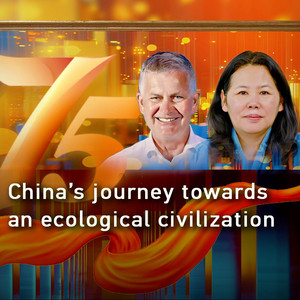
I'm Tuyin. In this episode of our special series commemorating 75 years of the People's Republic of China, we first talked to Dr.
Eric Solheim, former chief of the United Nations Environment Program and now president of the Green Belt and Road Institute, about China's journey towards building an ecological civilization.
Thank you, Eric, for joining the chat.
Let's start with one of your articles I published earlier this year.
You wrote, and I quote, 10 years ago, if people asked me where shall I go to get the best green technology and ideas, I would always answer, please go to Brussels, to Paris and Berlin.
If they ask me the same question today, I would say please go to Beijing.
Or if you cannot go to Beijing, maybe you should go to Shenzhen, Hangzhou or to Lingde, unquote.
So can you first elaborate a little bit about what's behind the change?
There is a big shift because 10 years ago, China was still very productive.
I mean, I would never go running in Beijing in 10 years ago because it was such an enormous pollution.
I didn't want to inhale that smoke.
Now all the big cities in China is cleared up.
I was running a number of times this with Beijing and the sky was bright, the sun was clear, and you can inhale any amount of air.
It was simply a huge, hugely, hugely great.
While 10 years ago it was very bad.
So China has transformed itself enormously in 10 years and it has moved from somewhat in the back seat on the environmental protection into the absolute front seat.
The cities I mentioned are both cities, which are in the forefront of this shift.
I mean, Lingde is a small city in Fujian province, that's the home of Seattle, which is now by far the biggest producer of electric batteries in the world.
About 10 years ago, Seattle was a small outfit of no significant friend of mine.
It's a huge company, one of the most important in the world for the green transformation.
Hong Shou is home to a number of big companies.
And of course, in Shenzhen you have BYT, Huawei, you have DJR, which is in the forefront of the drone revolution and other companies.
So this particular southern Chinese cities are not completely there in the green transformation technology, but also in cleaning up the cities.
There's no city in the entire world, with so many electric buses and electric cars and electric taxis as Shenzhen.
And if you have to choose from those four cities, which one maybe is your favorite?
Maybe. And the Shenzhen from an environment perspective, because it's wonderful to have achieved it's in the forefront of the high tech green revolution.
Also very, very green city.
That is a huge wetland for birds, right in the city center Shenzhen.
There are fantastic green corridors in Shenzhen, which are very green.
Batocos, Hong Shou and Beijing are much more historical cities.
So if you have many interesting history, you will go to places like Hong Shou, Shie and Beijing.
But if the focus is environment, I think Shenzhen is number one.
Right. And zooming out to a longer period of time, the past seven and a half decades since the founding of the People's Republic, China's journey towards eco -friendliness seems very winding, right?
So what has enabled the country to emerge from being haunted by smog or degraded land in its cities and some rural areas over a period of 40 plus years since its opening up?
I think it's all about political leadership.
I mean, when you want to change a nation's political leadership is the core.
That applies to everything.
Even China was still very, very poor back in the 1970s.
I mean, China was as pure as Africa.
Well, then Deng Xiaoping came and constructed with the help of the people of China, a new China, much richer, much more efficient, much more opening up to the world.
And then the last ten years, President Xi has been a firm driver of the green transformation of China.
So leadership is key.
Without that, you come nowhere, whether it's in business or in politics.
But I think it's also the mindset, because China not only saw an ecological opportunity in transformation, but also economic opportunity.
China was not, for instance, very strong in the old car economy.
Japan or the United States or Germany was much, much stronger.
But then China saw an opportunity in being the world leader in electric cars.
And China's now 60 percent of all electric cars in the world.
That's very good for the people of China because it produced jobs and prosperity.
But of course, also gave news for the world because we need much more transportation in all of the cities.
You talked about this mindset change.
Can you tell us what has prompted such a mindset change, then, and your observation?
I think it is to see a business opportunity in going green.
Going green is not just good for the environment, but it's also good for jobs, for prosperity, for bringing all people into that new economy.
And China is now the world leader in every green technology.
60 percent or more of solar in hydropower, electric cars, electric batteries, high speed trade, whatever you mention is happening in China.
And that's good for the ecological civilization, but it's also very, very good for the Chinese economy.
Look, just a few weeks back, I was in Xinjiang and saw the biggest solar plant in the entire world.
It's already 4 gigabathors outside of the machine.
And of course, it produces an enormous amount of energy in an environment friendly way, which can be used for industrial parks, for lighting the homes of the people, and producing electricity for heat, heating in wind.
I mentioned it's a very cool place.
You need a lot of energy to heat the place.
So, see a business opportunity, see an opportunity to create a stronger China by going green.
I think that was the key, the shift of mindset.
And that's exactly what you need to see in Europe, America and everywhere else.
The 75 years of green development.
During this process, what were the major milestones you observed about China's green development?
I think the major milestone was the understanding that China was so polluting and it needed to change.
Back in 2005, then -partner secretary of the short -term province, Xi Jinping, made a very remarkable speech in Hongji, which most Chinese know.
I mean, he said that busy waters and bush mountains are invaluable assets like silver and gold.
It was very polluted and you can see the photos of the walls there today.
There was a enormous pollution to the environment and also the workers in the five days there at the time were inhaling smoke.
Then came President Xi and showcased a new future for China, much much greener and much more prosperous.
So I think the realization that China cannot continue to be so polluted was the most important milestone.
And Zhejiang is now a leader in not cleaning the air, cleaning the water.
When I was in the UN, we gave the champions of the Earth Award to the de -relectification programs in Zhejiang because that cleaned up something like 99 percent of the rivers and waterways in this very, very beautiful province.
It's remarkable. And it's an achievement which most both developed and developing nations in the world can learn a lot from.
Right. But when compare, you know, especially Zhejiang with your home country, maybe you can tell us some a little bit difference between these two when it comes to a natural environment.
I think what we're trying to stands out is basically the speed because cleaning up on rivers has happened also in Europe.
I mean, the CEM is not during the Olympics.
They have some of the some other swimming competitions in the CEM because the CEM has been cleaned up, was very polluted in the past.
But now it's fairly clean.
And the same is the case with the Ryan or Don Yube and all the major rivers in Europe.
However, that is taking very long, like, say, 40 years or hard work to clean them up.
The speed in China was much higher.
China did in 10 years what Europe did in 40 years.
The direction, fortunately, is the same.
Both Europe and China are much cleaner, much less polluted than they were a few decades ago.
You used to be chief of the UN Environment Program.
So during your tenure, that was between 2014 and 2016.
If my memory is correct.
2016 to 2013. I worked very closely with China's Environment Minister Li Gonsheng, who is now on the Politburo of the Party.
He was so determined to make China greener.
And together, he also formed the Green Belt and Road Alliance.
It is about sharing Chinese experiences.
And Chinese green investments with the 150 countries which are part of the Belt and Road.
That's your key observation about China's environmental policies and actions.
Anything else? What stands out to me is to go around China and see the transition on the ground, because it's not theoretical.
It's in people's lives.
I was just in Guangxi Province in South China at the Li River, which is the most beautiful one, the most beautiful places in the world.
But it was quite polluted in the past, and you look at the photos now, it's absolutely clean.
It's an amazing one, most beautiful scenery you can see anywhere in the world.
If you go to Koming, this great lake, the Jiangxi Lake, there's lots of Koming.
Again, it was very polluted in the past.
Now there are bike paths, there are walking paths, you can walk or go biking around the lake.
Wonderful, beautiful.
West Lake in Hongshou, exactly the same.
And I can go on and go on.
Wherever you go in China, you see this green progress.
Nature is coming back, which was destroyed, cities are much cleaner and China is in the lead in the technological revolution of green.
This has been the chat lounge.
Next, check out what goals China should prioritize to ensure sustainable development in the future.
Stay with us. The best military commander is not he who fights 100 battles and wins every one of them.
The best military strategy does not lead to the desiccation of the enemy's capital city.
Decoding the art of war will help you understand why there's no art in war and how citizens stayed undefeatable using the science of war with fun stories and insightful breakdown of famous battles.
Find Decoding the Art of War wherever you listen.
Welcome back to the chat lounge.
We continue our chat with Dr.
Eric Solheim, the former chief of the UN Environment Program on China's journey towards eco -friendliness.
A dilemma for, I would say, most of the countries in the world is choosing between the environment and economic development.
So some people say we can't follow the old path of developed nations and sacrifice the environment for economic benefits.
But others would argue that improving economic conditions should come first.
After all, you know, it's what some developed countries still do today, right?
You know, we've seen the U .S.
withdrawing from the Paris agreement, as then -President Donald Trump believed it undermined the U .S.
economy. And the U .S.
is the only country that has not ratified the 1992 treaty that established the United Nations Convention on Biodiversity, with pushback from the timber industry and property rights groups.
But China seems to have chosen a path toward the environment, emphasizing building and ecological civilization, even when it's still a developing country.
My question is, should China wait until after it realizes its industrialization goals?
The thinking that is a choice to be made between the environment and economy is so old -fashioned.
It was true in the past.
50 years ago, there was no way to prosperity anywhere in the world without using a enormous amount of coal and oil and gas.
So Trump was very right if he was describing the situation in America in 1970, 1980, maybe even 1990.
He was right. People didn't choose coal because they believed it was good for the environment and for people's health.
They did it because it was the one and only way to prosperity.
The 21st century is completely different because the price on solar and business now no one can say if you go into solar and then you don't waste, you save and create more jobs and better jobs and cleaner jobs.
So there is no longer such a choice to be made.
The first nation which discovered this was Singapore and the very wise leadership of them, Singapore as a at the time, small, developing, poor nation understood that they could dramatically become richer and protect the environment at the same time.
We know Singapore is maybe the richest place on the Earth, at least one of them.
A wonderful place with great living, but it's also a very clean and very environment friendly way.
Fantastic mass transit, no garbage in the streets, but they understood it as an early stage.
Most nations are not as wise as Singapore, so it has taken longer.
But China's now doing at the much, much larger scale while Singapore at an early stage was available, was able to do at the smallest scale.
There is no such choice every longer.
So Trump is simply wrong or to build it more kindly to him.
He was right in 1970, but he's absolutely wrong today.
So you're saying China now is on the right track.
Absolutely. China is moving very, very fast in a positive direction on the environment and the rest of the world should simply stop being jealous and start trying to understand what China gets right and learn from it.
You're saying China is acting very fast.
And actually, in January, Chinese authorities issued an opinion on developing a beautiful China.
New targets include electric vehicles making up 45 percent of new car sales by 2027, like you already mentioned, and 60 percent of zero waste cities by 2027.
And by 2035, all cities should be zero waste.
And a beautiful countryside should be basically realized.
I think that's what you mentioned earlier.
And from your perspective, can China reach these goals as planned?
Are we too ambitious?
No, I mean, I think China is already well on the way to achieving these goals.
And the target of electric cars may already have been released this year, and also the target for 2027.
But already China is close to 50 percent of new cars being electric.
As you would recall, President Xi promised that China would peak its carbon emissions by 2030.
Well, it seems that goal is already reached.
So China is ahead of the target, which is very good because there are some nations in the world who make targets and they do nothing to achieve them.
So it's great to have an example of a nation which have ambitious targets and very often reach the targets even before the deadlines.
Right. Actually, there are years to go before we reach these goals.
So what would you say are the biggest challenges facing China?
I think the biggest challenge for China, which is similar to every other nation in the world, is to make sure that the green transformation is people centered.
It's about people. And you need to set out a green transformation that benefits everyone in the context of China.
It must be a benefit to the old farmer in Henam, the cold worker in Shanxi, the workers in the old industry.
So Haichong Jiang, he cannot own the benefit to Yongan Zhengde in Shenzhen or Hongshan or Shanghai.
It must benefit all Chinese because unless you bring everyone on board, make the small changes in their lives, which benefits the big picture, then it's very, very hard.
And that's in some nations, unfortunately, the very struggle because there's so much opposition to the transition, so much fake news being put up.
And China seems to have to be in a more lucky position.
But I think also for China, bringing everyone on board, making it people centered is the number one challenge.
Right. You talked about being more people oriented.
So are you hinting that we are not people centered enough in your observation?
Yes, I think the global green movement has failed spectacularly in some of these issues.
We have set out environment as a target for young people, students in the cities, not for the rural people, not for the industrial workers, not for the big groups of people.
Sometimes environmentalists also speak a very, very difficult language using a lot of acronyms, also technical phrases, using cover points at conferences if no one can understand.
You must speak to the harder people to bring everyone on board and make the environment that people centered issue.
Every Chinese I have met has that love for the beauty of China.
They want to contribute to make China a more beautiful place.
Everyone wants their children and grandchildren to live a better life.
So let's make these people centered movement rather than very technical, sometimes very boring and sometimes kind of very academic movement.
We need to do more in that respect.
Talking about reaching goals in advance, it seems China has already reached some goals ahead of schedule.
Right. We've seen international climate watchdogs issuing reports earlier this year expecting China's greenhouse gas emissions to peak years earlier than anticipated possibly as they said as soon as this year.
So what role do you think China has played in global environmental initiatives?
At the moment, China is in an ideal by itself when it comes to fulfilling international climate targets.
More than 90 percent of all the increased renewable capacity in the world last year came in China alone.
China last year invested as much in renewable energies as the top economy of Turkey.
Turkey is not a small nation.
It's a big nation and China is 60 percent or more of all the green transition.
There is no way the world can go green without China.
The nation tried to go green without Chinese technology.
Well, it may succeed if it's a big nation, like the United States, but it will be much, much more costly.
And if it's more costly, it takes much longer time.
So working with China is today the most certain way to get to a green world.
But of course, China must also accept that, well, if you are the president of the United States, America, you want jobs in America.
If you are the Prime Minister, I mean, they want jobs in India for sure.
So we need to work together and Chinese companies must invest abroad to make sure that jobs are coming in Europe, America, Africa, everywhere else.
That's what we're demanding and expecting China and it's happening now at that very, very high speed.
Right. And in your article published earlier this year, you said your hope for China is that it will help steer the global green transformation and help create a global economy benefiting everyone.
Are you expecting too high for China in this regard?
No, absolutely. We see now a lot of the Chinese companies in the green sectors investing abroad.
Long ago, I saw the companies invested in Vietnam, B &B, investing in Brazil, Seattle and Europe.
I could give many, many more examples.
And that's exactly what you want.
We want more green Chinese investments so that people can benefit from the green technological revolution in China and so that the jobs can come everywhere.
Look, there is one million young Africans joining the labor market every month.
They all want jobs, nearly all, most of them at this point are just getting very, very simple, low paid jobs in the informal sector.
They all want good jobs in the real factories or in the public sector wherever and China can help them in the main drivers who have to be the African nations themselves, but China can help.
Basically, all African nations now have China as the main trading partner.
So the partnership between China and African nations is key for the green development of the world.
And look, also both China and Europe and most other places in the world have a challenge with the H, we are getting older population, but Africa is the place where all different people of the world are now coming and they're still used to population growth.
So China partnership between China and Africa is key for the green transformation and operation in Africa.
And the last question, you know, during the latest plenum of the Central Committee of the Communist Party of China, it prioritizes green and low carbon development.
So what would be your suggestions for China to ensure sustainable development is more sustainable, I would say, development in the future?
China first should continue all the processes which are well established, meaning go much further into electric cars, electric vehicles, solar, and a lot of something that must continue to create this green renewable economy.
And then second, you should continue the great work which is not happening.
You can create a beautiful China and many more national parks coming up in Shanghai, Tibet, and other places all over China.
A lot of good work is done to protect animals like they don't pump and sit on, for example.
This must continue and strengthen.
But then a new kind of frontier or a new horizon is the circular economy.
You mentioned earlier that a number of Chinese cities will not be zero based cities, but to create that complete circular economy, look, 99 percent of all the clothes you produce on this planet are going right into the dustbin.
Why don't we recycle the clothes into new jackets or new shirts?
I think we are doing that right now.
When we have this, it should be recycled.
All the components in the forms can be reused.
There is more gold in one kilo electronic waste than there is in one kilo of a gold ore from, say, South Africa.
So it's such a waste that we just throw them away.
So they start recycling, clothing, electronic waste, food, everything, and create to that new jobs, new prosperity, but much less wasteful society.
China started its process, but there is a lot of work to be done.
And of course, whatever success story China can pull off, we can learn from in Europe and other places and vice versa, we do something new to Europe.
We should invite Chinese to come and learn from our success stories.
Thank you very much, Eric.
And hopefully next time you visit China, you will find it greener and more naturally or environmentally friendly and with lower carbon emissions.
Thank you, Eric. Thank you so much.
I'm very optimistic that we will sector that now.
Thank you. That was Dr.
Eric Solheim, former chief of the UN Environment Program, now president of the Greenbelt and Road Institute.
For a complete version of our chat with Dr.
Solheim, you can visit our YouTube channel, CGTN Podcasts.
When we return, we'll talk to Dr.
Dechen Tsering, regional director of the UN Environment in Neixa and the Pacific.
Don't go away. 75 years ago, a new chapter in history began, a momentous journey of resilience, innovation and unity.
This year, we celebrate the 75th anniversary of the founding of the People's Republic of China.
Join us for a special series as we speak to renowned politicians, economists and senior officials of international organizations about their personal experiences and views on the events that have defined modern China.
From the triumphs of the past to the promises of tomorrow, we'll explore the milestones, challenges and remarkable progress that have made China a global power that continues to shape the international stage.
Subscribe to the chat lounge for the 75 years of China's rise on your favorite podcast platform as we commemorate this unforgettable journey.
20th century, as Edith Eaton's delicate prose weaves together themes of tradition, change, love and identity.
Forget all that belongs to the joy of life.
Follow the journey of Mrs.
Spring fragrance and witness the struggles and fights of those living on a rapidly changing exotic land while holding on to their cultural traditions, or more importantly, to their identities.
We certainly believe that his daughter was seriously opposed to becoming the wife of such a good looking, prosperous young merchant as Wang Li.
Join Books and Beyond for Mrs.
Spring fragrance. Let the stories come to life in your imagination.
Subscribe to Books and Beyond for free on your favorite podcast platforms or log on to radio .cgtn .com for more.
Welcome back to the chat lounge.
We're sitting down with Dr.
Dechang Tsering, regional director of the UN Environment in Asia and the Pacific, for her view on China's environmental journey focusing on the last two decades.
Welcome to the chat lounge, Dr.
Tsering. So let's start with a recent finding by the United Nations World Meteorological Organization and its annual bulletin published ahead of the International Day of Clean Air for Blue Skies, which falls on September 7th every year.
The agency said the level of health damaging nanoparticles known as PM2 .5 in the air declined in China last year and stood actually below global average.
So does the finding come in line with your observation?
Thank you for inviting me.
I've been visiting China since 2006 and I've been impressed with the way that the government of China and the people really have tackled air pollution.
So the findings are very much in line with my observation.
Air pollution is one of the three planetary crises we face and air pollution has become really an issue of global concern because we're finding that at least in our region, 9 out of 10 people breathe unsafe air and we can see the impacts for children under 15.
There is some statistics that say as many as 93 % of children under the age of 15 breathe air that is so polluted it risks not only the health but their development.
When was your last time visiting China then?
In 2023. And what I've seen, I mean, if we can see, I mean, when I first came to China, Beijing had already initiated a really intense air pollution control program.
And over the last two decades, we've been working very closely with the Beijing metropolitan authorities and we've seen how they've reduced their pollution sort of the heavily polluted days of particulate 2 .5.
And then we did a review unit of 20 years air pollution control in Beijing and we looked at many of the lessons that we've learned to serve as examples for best practice.
And a few lessons stand out.
I mean, one of the lessons was just the level of investment that Beijing did in terms of the resources that was needed.
Another aspect was they did source apportionment so they knew exactly where the emissions were coming from.
And then they had these mobile enforcement units so they were in real time monitoring air pollution.
Right. You mentioned a lot of measures the government has taken over the past 20 decades, actually.
What would you say was the key turning points or policies that marked this transformation?
What would you value most?
I mean, it was really clear the energy source and reducing coal.
It was also taking steel mills, you know, and really transforming it into an outdoor Olympic Games.
There was a lot of communication talking about bringing back blue skies and of course the electric mobility looking at the even and uneven number plates that came in.
But the mobile enforcement units and the science and the evidence in terms of where the emission came from.
So it was really science.
It was policy. It was regulation.
And it was working with all actors in Beijing.
And of all those measures taken, what would you say that impressed you most if you have to choose one or two of them?
I think the measure that impressed me the most was taking the science and the mobile enforcement units and just the commitment to look at the numbers and to bring back blue skies.
I mean, it was it was decades in the making.
And it was also the link that being developed meant you had blue skies because it was a very difficult transition with difficulty at the personal level.
How difficult was it?
I understand cities like London have experienced similar pollution before right in the 1960s?
I think with air pollution, when I first went to Beijing, you could actually see days where the air pollution was so strong that you could smell it.
You didn't see blue skies.
You could see days where school children had difficulty going to school.
So it was quite visible and demonstrable.
But the difficulty with air pollution is it's just not one measure.
It's a series of measures.
And this is where many, many other countries they're trying to learn from Beijing to see what are the lessons that they can take from Beijing.
Having regulation, having accountability from mayors, that is also extremely important.
Actually, the core of traditional Chinese culture, both Confucianism and Taoism, is harmony between man and nature.
And in the early days of the People's Republic, the government carried out projects such as the Shelter Belt Forest Project in three North region, also known as the Green Great Wall.
Not sure if you've heard of it, to protect the environment.
But due to the economic difficulties China faced in the early years, the country's environmental policy experienced some evolvement from economy centered in its early industrialization period to its current emphasis on ecological civilization.
And globally, when it comes to reforestation, the country registered the highest increase in forest coverage from 1990 to 2020.
And among the 230 plus countries and territories covered by the FAO, Global Forest Resources Assessment, China stands out in terms of its high end consistent increase in forest coverage during that period.
So wondering what's the significance of this achievement in your eyes?
When you can't overstate the importance of forests, so you look at forests that support livelihoods, food production, critical ecosystems.
And so when forests are degraded, the ability to purify air and water declines, it impacts air and water quality.
And you think about forests, they sequester carbon dioxide emissions, but when they deforested, they release carbon dioxide emissions.
So the 24 % forest coverage, and you can see that the forest cover and the forest stock and volume has been growing in China over the last 30 years.
And China accounts now for more than 25 % of the world's new green areas.
I think China's efforts to expand its forest area and improve forest quality have improved the ecosystem carbon sink.
And this is going to be really important when China looks at achieving its climate goals as well as combating nature and pollution.
At a personal level, I had really the opportunity to travel and I visited, and I don't know if I'd say it well, the Sayan Bao Forest.
And what I found there was just in the really extreme climates, there was an ability to really bring back our forests.
And they had a beautiful museum where you saw people are really, really looking at how they monitored forest fires and the sacrifices that people made at a personal level to protect forests.
And that's why the Sayan Bao, a forestation community, you never awarded a Champions of the Earth in 2017, and it was in the category of inspiration and action.
So you saw a marinari in the 50s due to logging, you saw multiple generation of foresters, and, you know, just the individuals, you saw forests of light, clean water to Beijing and Tianjin and the source of green economic rule.
It's really very, very visible.
This is a journey through time, a special series dedicated to the 75th anniversary of the founding of the People's Republic of China.
Renewable energy and emissions reduction, let's talk a little bit about that.
You've already obviously touched upon that, but China has invested heavily in renewable energy and is now a global leader in solar and wind power.
So how do you assess the impact of these developments on China's carbon emissions?
And what further steps do you think are really needed to meet international climate goals such as the Paris Agreement for China?
In China's rapid growth and investment in renewable energy has been impressive, particularly solar and wind.
And it's really important part in reducing the greenhouse gas emissions for China and meeting its national climate pledge, including carbon neutrality.
But when you think of China, it's really a global leader in the renewable energy capacity, accounting for more than three fourths of global solar panel production.
But fossil fuels are still a significant part of China's energy system.
The expansion of solar and wind energy has helped reduce reliance on coal and China's made a commitment to no longer build overseas coal plants.
But when you think of the climate goals, we're really looking at needing to face down really coal reliance, expanding green technology, stronger policy enforcement.
And again, to do this, when we talk about a just transition, so you're still thinking about jobs, you're thinking about livelihoods and we're thinking about sustaining efforts across all sectors of the economy.
And you're talking about decarbonization investments, which are very heavy.
You're talking about scaling up large scale battery storage systems.
So we get, you know, we tackle the intermittency of solar and wind energy.
We need to improve transmission infrastructure.
We need to promote demand side management to balance renewable energy supply and demand.
Also working very, very much in, you know, different parts of the world.
And you start to think about electric mobility, so many parts of the world.
I mean, you start to look at the investment that China has made in electric mobility.
And so this really is an opportunity not only for China, you know, to sort of lead become a leader sort of in renewable energy, but it's also an opportunity for China to put forward an ambitious new pledge at the global level.
Then do you think China has been too ambitious or have we done enough in that regard?
I think the scale of ambition that China had in solar with meeting three thoughts of the world's, you know, solar production is exactly the kind of ambition that the world was going to need to bring on solar energy costs.
And we look forward to consumer ambition from China.
All right. And another important aspect when it comes to environment protection is conservation of biodiversity.
It's a major goal, obviously, in building an ecological civilization.
So can you tell us any successful project or challenges you've noticed China has faced in protecting endangered species and restoring natural habitats?
So the Shanshui Initiative, it's really sort of a very impressive example of when we call the Decade for Ecosystem Restoration.
And what it does is when, you know, at the UN Decade on Ecosystem, restoration, we named the initiative as one of the global restoration flagship.
And what this project did was it was launched in 2010.
It took really a systematic approach to restoration.
It did national land use plans.
It worked in landscape and watershed scale.
It took agricultural urban areas.
It took natural ecosystems and it boosted multiple local industries.
And so what it did was two million hectares were restored already.
And they plan to restore 10 million hectares by 2030.
So that really is really impressive.
Also, China officially established the first batch of five natural parks in 2021, including the and I will pronounce it badly, Sanjian Yuan National Park, perfectly Sanjian Yuan and the Jai Panda National Park.
You're really to talk about, you know, a megabiodiversity species to strengthen biodiversity protection.
And here again, it's 230 ,000 square kilometers.
So really the sort of the approach to strengthen national parks, number of flagship species, increased diversity.
And here the park system protects over 80 percent of wildlife species and their habitats.
So, again, extremely impressive.
China cannot make those accomplishments only by itself.
Actually, the country made the progress, like you just mentioned, with the help from and collaboration with international organizations like UNEP.
I understand in late 2021, China announced an initiative to establish the Kwimming Biodiversity Fund and taking the lead by investing one and a half billion.
You know, that's around over two hundred million US dollars during a meeting of the Conference of the Practices to the Convention on Biological Diversity, which is also known as COP 15, held in Kwimming.
And it was announced the fund would be used to support biodiversity protection in developing countries.
So what's the implication of such a move?
You know, China served, you know, with the Convention on Biological Diversity.
They have what you call conference of parties.
So China was the president of the 15 conference of parties for the UN Convention on Biological Diversity.
And like you said, the Kwimming Biodiversity Fund was a baton with 33 million.
And what it does is the global biodiversity framework really is a shared blueprint to look at how you halt and reverse loss of biodiversity.
And so what this the Global Biodiversity Framework shows us is really how do we support countries leverage resources to close sort of what you call the gaps for funding nature.
And you're looking at, you know, needing protected areas.
We're needing to redirect our finance for protection.
We're talking about needing.
And we had this a target of 30 by 30 by 30.
And basically we're talking about increasing resources for biodiversity.
And we're also talking about in addition to protected areas, all the measures to address biodiversity through agriculture, through nutrient waste.
And there's a lot of funds in order to help countries prepare the National Biodiversity Strategy and Action Plan.
So when they work with an economic development plan, the National Biodiversity Strategy Action Plan is a part of it.
And you think, I mean, in China you think about the flagship species, you know, the Yangtze, Finilis, Bopoys, which increased 29 .4 percent in 2022.
You talk about the podia, you talk about the wild bander that now stands at around 1900.
So this Goodman Biodiversity Fund also helps the world provide resources for conservation of tiger habitats for the snow leopard.
It also helps country put aside protected areas, both terrestrial and marine protected areas.
So the contribution by China and getting a global framework was significant.
But also the fund to actually help countries are on the ground that allowed the implementation of this framework.
This is a journey through time, a special series dedicated to the 75th anniversary of the founding of the People's Republic of China.
And let's talk a little bit about the challenges ahead.
China obviously aims to reach its carbon emission peak before 2030 and become carbon neutral before 2060.
So your perception of the plan, which is regarded a bit too ambitious by some observers, what do you think?
It's really two levels.
When we think of the commitments from China, they're very much welcomed.
Because if we are going to stay within a 1 .5 degree warming world, we need all countries to increase the ambition to tackle the climate crisis.
So of course, China plays a really critical role in closing the emission gap.
We need China to transition to a green, low carbon economy.
And this is one of the most fundamental elements that was laid out in the climate goals set down in the Paris Agreement.
We're talking about the shift to renewable energy.
And this is really a positive sign for China, because between 2019 to 2024, China will account for 40 percent of global renewable capacity expansion.
The area where we're looking to China's leadership, the UN's Secretary -General Mr.
Ntornogo Terrace, has repeatedly called for no new coal plants.
And we're looking at every country reducing the coal share in the energy mix.
But when we think of the China's income level, the economic structure, the energy mix, economic growth, achieving the goals will require continued, dedicated effort and determination.
And I think what is going to be really important is in the transition that we still think about jobs, we think about employment, we think about livelihoods, we think about poverty reduction, so that, you know, the cost of the change in the energy mix does not fall upon a certain segment of the population.
Right. And actually, last year, China participated in the international initiative, Buildings Breakthrough, which aims to decarbonize the building sector.
So to what extent would such a move helped the country meet its emission targets in time?
So when you think about, you really think about the buildings, Buildings Breakthrough, one of the issues that's really come about with buildings is it's an area where there's really been very, very little recognition of construction in most countries, nationally determined contributions.
But if you start to think about the role buildings and construction play in the economy for prosperity and well -being, we're talking about needing to green and improve resilience of the sector and the buildings and construction sector represent 37 percent of global greenhouse gas emissions.
And also, we start when you think about the sector, it's a major consumer of natural resources.
So we're talking about, you know, and you increase the buildings and construction sector, we will increase the greenhouse gas emissions needed to double.
So we're saying, OK, if you decarbonize buildings, firstly, there's a boost of business in jobs, because this is new skills.
The built environment contributes 11 to 13 percent of global GDP, 7 percent of global employment.
What does efficient buildings mean?
Efficient buildings mean you'll use less heat when it's cold and you use less air conditioners, you know, when it's hot.
And I mean, the whole idea of extreme heat with climate change and the cooling sector really is going to become both a significant challenge or a significant opportunity.
So we're looking at investment opportunities in the building sector in emerging markets.
Some estimates, 24 .7 trillion by 2030.
Again, if you take a dollar and your retrofit efficient measures, you create DC nine to 30 jobs.
So what the buildings breakthrough did was it brought together 29 countries that lead to global partners and really committed to a worldwide worldwide near zero mission for resilient buildings.
So we now have a global alliance for buildings and construction.
So when you start to think about, you know, this transition, it's not only new investments, it's also looking at how we consumption and production, the sustainable consumption and production.
And it's also looking at behavioral like in many countries.
You know, if you have a three bedroom apartment and people look at, you know, the energy use and then they start to do trends and then they start to tell, you know, residents, your neighbor has an energy bill, a third less than yours.
Can you start to review how you utilize energy?
So it's retrofitting.
It's looking at buildings and construction, but it's very much behavioral.
And we're going to need all these changes if we're going to move forward to stay within a one by five degree warming world.
It sounds very promising, but obviously it would come with a lot of challenges.
So do we have any other examples to follow in other parts of the world then?
So if you think of Eastern Europe, I mean, you know, the old boilers used for the buildings were massively converted into district energy systems.
And China is also doing that.
I mean, a lot of this in China is doing, but it's really looking at that, you know, infrastructure and investment is what China did in Shanghai with the rooftop panels.
So a lot of these changes and these charges, there are a lot of really good pilots.
Often they're not at the scale that's needed for the transformation.
Right. And also in January, the Chinese government issued an opinion on developing a beautiful China.
New targets include electric vehicles making up 45 percent of new car sales by 2027.
60 percent is zero waste cities by 2027.
And by 2035, all cities should be zero waste.
And a beautiful countryside should basically be realized.
So what do you think of those targets?
I think, you know, the clean energy transition moving to zero waste, you know, old string nature are really key to achieving shared goals on the environment.
When we look at these targets, I mean, if you talk about, you know, zero waste, you're really talking about sustainably using resources and resource efficiency, putting them back in the cycle.
When China had, you know, started to work on food loss, food waste, you really talked about the efficiency in utilizing scarce resources, because when you do agriculture, you think of the water used, you think of the energy used.
So all these targets can bring benefits to our health, can reduce emissions and can really ensure that cities are livable and sustainable.
You think about waste management really is going to be fundamental to shift the circular economy, where we make the most of precious resources.
The global transition to circularity can save us, you know, and save us resources, can create jobs.
And I think we have to think of, you know, you know, the take, make waste, that model doesn't apply to scarce resources.
So I think this vision that's outlined, I think, is very, very promising.
Yeah, you said it's very promising, but some people would doubt whether we can achieve that, because, you know, back in just a couple of years ago, during the pandemic, there's a lot of restart of coal -fired plants in China.
So there are some doubts over China's ability to achieve goals.
You know, it's all cities should be zero waste by 2035.
Is it too, you know, again, too ambitious?
So we're really starting to think about if you can quantify the environmental aim and you provide a clear timeline.
So what does zero waste mean?
It means that we're able to compost food waste.
It looks like we recycle, we manufacture and we do product design in a way that bottles can be reused.
So you really minimize, you know, what really goes to waste.
This, like you said, is not easy.
It's going to need a whole of government, a whole of economy approach.
But I mean, we don't really have a choice.
We don't have resources.
We have global warming.
So I think China's targets and roadmaps achieve zero waste cities, electrify transport, enhance natural areas is what the world is going to need to journey to a pollution free planet and climate stability.
So we are counting on your success.
Last but not least, as China approaches its centenary in 2049, what are the main environmental challenges and opportunities it faces in achieving its vision of an ecological civilization?
How may you and environment and China cooperate during this process?
Then I think China will be facing the challenge of seeking sustainable growth while reducing pressure on the environment, you know, economic growth and living in harmony with nature.
So really, that's that's the balance.
We talk about the triple planetary crisis, and this is the crises of climate change, loss of nature and pollution.
And China has worked aggressively to address each of them and has been critical to progress on all accounts.
You know, I attend the China Council for International Corporation and Development annually and we see China's engagement on international environmental policy in action.
They work to discuss China's policy, but they work with other countries.
And you start to think of China taking a leadership role, whether it's on the Ramsar Wetland Convention, whether it's on the convention to combat the certification, whether it's a convention on biological diversity.
And so you see, you know, very, very ambitious national targets.
You see working with the global community to set these global frameworks.
And you also see successes, like you've asked me, what has been successful in the recent decade?
If you think of successes at scale, a lot of it comes from China.
And so we, you know, China can share stories and lessons learned together with other countries in Asia Pacific.
And I think when UNEP did a review of China's evolution in Beijing, Tianjin and Herbei, what we did was we really recorded the lessons learned and examples for other countries.
And so the UNEP Executive Director is a vice chairperson of the China Council and Special Corporation, Environmental Development.
And we've worked over the last 30 years together.
And so we very much count on the Ministry of Ecology and Environment as a very strong partner of the UN Environment Programme.
That's Dr. Dechang Seiran, Regional Director of the UN Environment in Asia and the Pacific.
For a complete version of her interview, visit our YouTube channel, CGTN Podcasts.
With that, we wrap up this episode of our special series on 75th anniversary of the founding of the People's Republic of China.
Don't forget to check out the last episode of this series next week on your favorite podcast platform.
If you have any comments or suggestions on the series, let us know via Radio at CGTN .com.
I'm Tien. Bye for now.