Get the unmissable news stories of the day.
This is the Beijing Hour.
Examining the events that impact and shape China and the rest of the world.
This is the Beijing Hour.
One hour of news and information brought to you every weekday.
Now here's your host. Tianlu with you on this Thursday, July the 10th, 2025.
You're listening to the Beijing Hour coming to you live from the Chinese capital.
on today's program chinese premier lee chan voices support for arab nations strategic autonomy during his meeting with the arab league secretary general in cairo u .s president donald trump is to impose tariffs on eight more countries including a 50 percent levy on brazil and former south korean president yong suk -il returns to jail after prosecutors secured a warrant In business, China's e -commerce logistics index reaches new high in June.
In sports, Paris Saint -Germain cruises into the club World Cup final.
In culture and entertainment, the latest on the Nishan Forum on World Civilizations.
Now checking today's top stories.
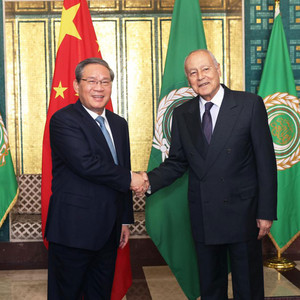
Chinese Premier Li Qian has expressed the country's support for Arab countries in strengthening strategic autonomy, enhancing unity and self -reliance, and pursuing development paths suited to their national conditions, he made remarks during a meeting with Arab League Secretary -General Ahmed Abel Gait in Cairo.
Premier Li is on a two -day official visit to Egypt.
He said China is ready to further align its development strategies with Arab countries and proceed with their high -quality Belt and Road cooperation.
The Premier called on the two sides to expand collaboration in energy, economy and trade and explore cooperation in emerging fields such as artificial intelligence and digital economy.
Ahmed Abolget reiterated support for the One China principle, the Belt and Road Initiative and the three global initiatives proposed by Chinese President Xi Jinping.
He said Arab countries stand ready to work with China to deepen political mutual trust, deepen exchanges and cooperation, implement the outcomes of the first China -Arab states summit and make the second one a success.
Chinese Premier Li Qian has called on China and Egypt to facilitate two -way trade and investment and push for a higher level of win -win cooperation.
He was speaking when meeting with Hanafi Ali Jabali, a speaker of the Egyptian House of Representatives.
Premier Li said the two sides should strengthen market connectivity and expand cooperation in emerging fields such as the digital economy and green development.
Jabali said Egypt adheres to the one -China principle and opposes interference in China's internal affairs.
He said Egypt is ready to expand cooperation with China under the Belt and Road Initiative, uphold a multilateral trading system, and jointly address global challenges.
Hossam Zaki is an assistant secretary -general of the Arab League.
He says Arab League countries and China have the best of relations.
We are not talking here about relations between Arabs and Chinese civilizations only, which have historically enjoyed excellent relations between both sides.
But we are talking about economic relations, about political relations, cultural relations between China and the Arab world.
And the Arab League in the middle of this is the engine on the Arab side in order to make sure that the momentum of the relations is always kept high and is always looking forward to better and bigger achievements.
The discussions with the Chinese officials, and especially someone as high in the hierarchy in China, of course will deal with many issues.
The issues that we would like to discuss with the Chinese side will include political issues of the region and in particular the issue of the question of Palestine.
So we are looking forward to our discussions and we think that the discussions are going to reveal great areas of accord and of agreement between the two sides on the assessment of the world scene and the regional scene, in particular the Middle East. Zaki adds that the two sides have good economic relations, which he says can be qualified as being excellent.
We have Chinese investments in Arab countries.
We have Arab investments also with China and Chinese companies.
We have trade balances.
We have exchanges. We have a variety of economic activities that are of great importance to both sides.
And we are always aiming for a better and bigger number in terms of objective and economic objective.
We have had in the past years some progress, but we always aim for bigger progress in terms of our trade balance.
The Arab League, officially known as the League of Arab States, was formed by seven member states in Cairo in 1945.
Its main goals include drawing closer relations among member states, coordinating collaboration, safeguarding independence and sovereignty, and managing affairs and interests of Arab countries.
The organization has expanded to 22 Arab states.
It keeps its headquarters in the Egyptian capital.
For more on Premier Li Qiang's visit to Egypt and the growing momentum in China -Egypt cooperation, Gao Junya spoke with Hassan Raghab, Professor of Chinese Studies and Director of the Confucius Institute of the Suez Canal University in Egypt.
Professor Hassan, could you please share with us the significance of Premier Li Qiang's visit to Egypt?
I think it is a good visit to Egypt and China, a good relation.
They will encourage cooperation more and more facilitated.
Because Egypt and China now in recent years have many cooperation projects.
So I think Lijiang, now in Egypt, the cooperation in culture and the economy and the education may become a benefit for the two peoples.
Yes, and we understand that Egypt actually was the first Arab and African country to establish diplomatic ties with China, right?
And so, yes, just share with us, you know, what unique factors have distinguished China -Egypt ties as a model for cooperation among developing countries?
Because Egypt is the first country to establish diplomatic ties with China.
So it is a good element for the other African and Arabic people to make like Egypt.
So China now considers this as a historical element and it will be a good relationship in the future for the people.
And you just actually mentioned that in recent years there have been a lot of new projects undertaken by China and Egypt.
Yes, can you share with us more details, like what have been some of the new momentum of China -Egypt collaboration in recent years?
some examples? In recent years, now China helped Egypt to build a new capital near Cairo, about 50 kilometers.
China helps Egypt now to many electric car manufacturers for many factories, it should become in Egypt now.
So, in technical and industrial, many, many projects it has become in Egypt now, like higher production like Huawei, Xiaomi, and all kinds of activities.
Yes, actually you just spoke in Chinese with me.
I know that you're actually here in China, in Shifu, Shandong province, for this Nissan Forum on World Civilization.
We know that China and Egypt, as ancient civilizations with enduring legacy, legacy, amidst the global complexities and shared challenges, how can the two countries strengthen their civilizational trust, deepen mutual understanding and advance common ground?
Do you know about the two countries civilization, it is ancient, it is support all the nation world and i think if we discover the value of our civilization will help now the culture conflict about what's happening in all the world now because the two countries civilization it is aim for the peace peace for all the all the nation now with hassan ragab professor of chinese studies and director of the Confucius Institute of the Suez Canal University in Egypt.
Chinese Foreign Minister Wang Yi and his counterparts from ASEAN countries have held a meeting in Kuala Lumpur.
The meeting coincides with the 58th ASEAN Foreign Minister's meeting this week with economic ties and strategic partnerships dominating the discussions.
From the Malaysian capital, here's Ryan Mauser.
Morning did begin with the ASEAN plus China meeting.
with ASEAN and China being each other's number one trading partners having already concluded the upgrade to their free trade agreement the AFTA 3 .0 as it's called and as well as having comprehensive strategic partnership so the ties are already very strong and of course with all the external strains and stresses of the U .S. policy primarily and the threats to the trading order it's likely to push China and ASEAN to seek even greater areas of cooperation, intra -regional trade, intra -regional investment.
And the ASEAN Plus Three meeting, which is ASEAN plus China, Japan, and South Korea.
And let's face it, the three East Asian countries often don't see eye to eye.
But I think that Trump's trade policies are focusing minds here.
These countries, China, Japan, South Korea, and the ASEAN countries are all part of the giant free trade deal, the Regional Comprehensive Economic Partnership.
And they need to look at how to build upon that even further to boost interregional trade and investment.
And I think that Trump's policies are really adding impetus to already the strong momentum that RCEP had given.
We heard Wang Yi at the opening remarks for the ASEAN plus China meeting saying it's a choice between peace and conflict, cooperation and confrontation.
And when it comes to ASEAN plus China, clearly the hope is for a great deal of cooperation and to look at ways to reduce the tensions that do exist, particularly in the South China Sea.
And as well, I think now that we're going to see that with the ASEAN plus three, too, that the East Asian countries plus ASEAN are going to look to put their differences behind them and focus on how they can collaborate to combat these tariffs.
Because out of these countries, the 10 plus three, only Singapore faces the minimum 10 % tariff as it stands right now.
And the rest face tariffs of between 25 and 40%.
So the potential devastating impact on the economies of this region, on the supply chains and so on is very clear.
So it's time for them to band together even more and build on the already very deep ties and collaboration and cooperation.
And this platform is a good place to make the next step toward doing that.
Now with Ryan Mauser in Kuala Lumpur.
A special program China launched nearly 30 years ago to mobilize nationwide support for the development and poverty elevation in Xinjiang has delivered tangible results across the northwestern region.
Gongming reports from Houtan where the initiative has transformed lives in the city in southern Xinjiang.
Senior Communist Party official Wang Hulin joined the delegates from 19 provinces and municipalities at a 10th annual meeting on China's pairing assistance program in Xinjiang.
The event which wrapped up in Houtan on Wednesday highlighted the progress made to to relieve poverty and improve livelihood in the Uyghur autonomous region.
Attendees visited the local site to see progress on the ground first hand.
In Houten's industrial park, a car manufacturing plant built with support from Anhui province in 2022 has filled a major gap in the region's heavy industry.
Manufacturing up to 20 ,000 vehicles a year, it marks a first for local auto production and is creating job opportunities for young people.
I didn't have a job before and just stayed at home, so I didn't have this kind of opportunity.
I've been working at this company for about a year now, and I make over $3 ,000 a month.
I'm starting to save some money and planning to get married next year.
Financial assistance from Anhui province is also helping develop local agriculture.
In Pisang County, a large -scale plantation of guano, A plant used in traditional Chinese medicine has created jobs for more than 2 ,500 people.
The project also promotes cultivation techniques among local villagers.
Encourage them to grow the crop in their own courtyards to boost household income.
The company gave us the seedlings, fertilizer and taught us how to grow them.
Now they've already started coming up.
and once they're mature we expect to make over 3 ,000 yuan from just a small plot before we only had a few fruit trees in the yard and they didn't bring in much if this one does well I'm thinking about planting even more next time in addition to boosting Xinjiang's economy an assistant's arrangement with Beijing has focused on cultural development supporting the construction of museums and libraries and promoting traditional culture and education By revitalizing old towns and restoring historical districts, cultural tourism is also on the rise.
Houtan prefecture welcomed more than 30 million visitors last year alone, with tourism revenue up about 35 percent year on year.
China's Parent Assistance Program has played a key role in lifting Xinjiang out of poverty.
As the region continues to tap into its unique strength, the programme is set to keep driving economic growth and improving living standards across all ethnic communities, paving the way for a brighter, more prosperous future.
Coming up, US President Donald Trump is to impose tariffs on eight more countries, including a 50 % levy on Brazil.
TikTok is building a new version of its app just for the American market.
Could this mark the end of its long -running standoff with the U .S. government?
Washington says a deal with Beijing is nearly done, but Beijing isn't exactly on the same page.
Is this really just a business move or a high -stakes political gamble?
What's the likely endgame and what could it mean for the future of global tech?
don't miss this week's chat lounge wherever you get your podcasts and on CGTN radio now 16 minutes past the hour US President Donald Trump says his country will impose its highest ever tariff so far of 50 percent on all imports from Brazil this came after he criticized the Brazilian government's legal action against the former President Raul Bolsonaro Bolsonaro Trump has threatened additional 10 % tariffs on emerging economies of the BRICS group, which held its summit in Rio de Janeiro this week.
Brazilian President Luiz Inácio Lula da Silva hit back at Trump, saying the world does not want an emperor.
Vice President Geraldo Ocman described Trump's move as unjust, adding that the U .S. has a trade surplus with Brazil.
Bolsonaro is on trial of an alleged coup attempt.
Trump claimed that it is a witch hunt that could end immediately.
The U .S. president has also notified seven other countries of new tariffs that will apply on their products entering the U .S. from August 1st. The levies range from 20 to 30 percent.
Trump has set a 30 percent tariff on imports from Libya, Iraq, Algeria and Sri Lanka.
Imports from Brunei and Moldova will face a 25 percent tariff, while imports from the Philippines are slapped with a 20 % levy.
The U .S. president sent his first batch of tariff letters on Monday, notifying 14 countries of tariffs ranging from 25 % to 40%.
The country's trade talks with China and the European Union are ongoing.
The European Union remains hopeful of reaching a trade deal with the United States before August 1st and avoiding a sharp rise in tariffs.
William Denslow has more from Brussels.
The European Commission says its teams have been working tirelessly on both a political and technical level to reach an agreement in principle with the US.
President Donald Trump threatened back in April to raise tariffs on European goods to 50 percent, up from a benchmark 10 percent level if no deal was reached in 90 days.
That's on top of a 50 percent duty on steel and aluminium, as well as a 25 percent tariff on car imports.
ports. The deadline has been pushed back to August, but the White House has suggested that the EU could receive a letter informing it of a new tariff rate later this week.
Over a dozen nations have received such letters, but European Commission officials say they expect to avoid this fate and resolve trade disputes through dialogue, potentially in the coming days.
We count on the US continuing to engage in this sense.
Reaching a deal now depends on the willingness to find an outcome that is acceptable to both sides.
President Trump this week said the EU is being very nice, having alleged that it had treated the US badly in the past. The EU has criticised the use of tariffs, describing them as a tool that hurts businesses and consumers on both sides of the Atlantic.
Addressing the European Parliament, the Commissioner for Trade said he wanted trans -Atlantic trade ties to return to a more predictable path.
The agreement in principle we are striving to finalize is not the end, but rather the start of the new beginning.
It would provide a framework upon which we can continue to build, defining the exact parameters of the later agreement.
The European Commission has been tight -lipped on the details of the negotiations and whether certain tariffs will remain in place.
The EU says it seeks a win -win outcome, but has a raft of countermeasures lined up should the two sides fail to come to an agreement.
That was William Densler in Brussels.
Chilean President Gabriel Boric says the country has yet to formally hear from the United States on potential copper tariffs.
Boric made remarks after US President Donald Trump said on his social media platform that he planned to impose a 50 % tariff on copper imports.
Faced with these issues, our government reacts cautiously, as is appropriate in diplomacy.
In diplomacy, politics is conducted through official communications, not social media, and therefore we are waiting for the official communication from the United States government regarding what the policy will be, whether or not it includes copper cathodes, what the limits are, and whether this will actually be implemented or not.
The United States imports about half of its annual needs for copper, which is used in many industries, including construction, transportation and electronics.
Meanwhile, the Chilean foreign ministry says that it's not aware of an effective tariff on copper, the country's largest export.
The South American country is in talks with Washington on the general 10 % tariff announced by President Trump.
Singapore is bracing for the impact of failure to secure a deal with the US on tariffs.
The island nation is turning its focus toward regional alliances and new trading partners for stability and growth.
Marilu reports. These are not actions one does to a friend.
It's going to affect our trade, it's going to affect our economy.
And it's actually the kind of formula a bully would use.
It's designed to actually maximize coercive bargaining power.
In April, the U .S. imposed sweeping tariffs.
Singapore was hit with the baseline rate.
But for an open economy built on trade, even that 10 % was enough to rattle business sentiment.
In May, Singapore's non -oil domestic exports fell 3 .5%.
largely due to a sharp 20 percent decline in shipments to the U .S. Factory output has slowed, and the government downgraded its full -year GDP forecast by one percent.
This leads to a decline in business confidence in terms of doing business and engaging in this global trade.
And the firms will try to postpone their hiring and their huge capital investment and also their shipment.
The uncertainty -driven hesitation is already already impacting key sectors.
Electronics, led by semiconductors, make up close to half of Singapore's manufacturing and nearly 30 per cent of its exports.
Supreme Components, a major distributor of electronic parts, has already reported a clear drop in demand.
ANYBODY I SPEAK TO, ANY OF MY CUSTOMER SUPPLIERS, ANY OF MY COLLEAGUES IN THE INDUSTRY, IT'S ALL WEIGHT AND WATCH. NO INVESTMENTS ARE TAKING PLACE, EVERYTHING IS ON HOLD.
The government is responding on multiple fronts, from forming a task force to rolling out support for businesses and households.
Singapore's government aims for the long term.
One is to continue to build up its capabilities in high tech like AI and biomedical related.
We aim for increasing expenditure in research and development.
Analysts say Singapore and its neighbors must also prepare for a future where the U .S. plays a smaller role in global trade.
The U .S. administration under President Trump is not a reliable trading partner.
The U .S. contributes about 13 % when it comes to global imports.
They're a fraction of global trade.
and the way they are going, it's going to be smaller.
So I think we're already starting to directly or indirectly prepare for a world where the U .S. is a less important partner.
Since taking office last year, Prime Minister Lawrence Wang has made Asia its priority.
He has visited almost all ASEAN nations and recently traveled to China after the tariff shock.
In a recent video, he urged ASEAN to act as a more unified and competitive economic bloc, not only to broaden trade under the current agreement such as RCEP, which has been slow moving, but also continue to engage with other trading partners around the world.
The goal is clear. Singapore must recalibrate its strategy in an increasingly fragmented and uncertain world.
Now with Myra Lue reporting.
reporting. Coming up, former South Korean President Nong Suk -il returns to jail after prosecutors secured a warrant.
Dive into news like never before with Deep Dive, the podcast from CGTN Radio.
Join our global reporters for captivating stories and thought -provoking conversations.
Search Deep Dive on your favorite podcast platforms and get ready to dive in.
Now it's 25 minutes past the hour.
Former South Korean President Yong Suk -yool has returned to jail after a court approved a warrant sought by prosecutors.
According to a special counsel investigation, the former president's attempt to impose martial law in December represented obstruction of justice and abuse of power.
Shin Ham has more from Ui -wan.
Former President Yun Suk -yool has now been formally arrested and is being held here at the Seoul detention centre.
A judge here approving an arrest warrant in the early hours of Thursday, agreeing with the special prosecutor investigating the case that Mr. Yoon could interfere with witnesses or tamper with evidence.
The now former president is under investigation for allegedly plotting to declare martial law last December, a move that led to his impeachment in April.
The special prosecutor in his request accusing Mr. Yoon of abuse of power and obstruction of justice, among other charges.
Here outside the detention center, security remains extremely tight.
There's a large law enforcement presence here and a small contingent of his supporters that continue to stand by the former president.
I came out here today to tell President Yoon Seok -yool to stay strong and have courage, even as he heads to court for questioning.
He should know that behind him are patriotic citizens like us, working hard for our country and supporting him all the way.
Mr. Yoon's legal team, meanwhile, calling the warrant unreasonable reasonable and denying all allegations against him remember the former president is already undergoing a separate criminal trial on charges of insurrection over his failed martial law bid this is the second time he's been detained here earlier this year he spent nearly two months in detention before being released on technical grounds while he was actually still the president now as a former president mr yoon will be held here pending further investigation for up to 20 days as prosecutors prepare a formal indictment, truly unprecedented
as this marks the first time a former South Korean leader has been impeached, removed and then jailed in a special prosecutor -led investigation.
Now with Sheng Han reporting.
The UN special envoy for Yemen has warned against the country being drawn deeper into regional crises involving Israel.
Hans Grudenberg said the stakes for Yemen are simply too high.
Yemen must not be drawn deeper into to regional crises that threaten to unravel the already extremely fragile situation in the country.
There has been a continuation of military activity in governments such as Al -Daleh, Al -Jawf, Marib, Taiz and Sadar.
A military solution, however, remains a dangerous illusion that risks deepening Yemen's suffering.
Grunberg said the Iran -Israel ceasefire is a welcome development for the region.
But against the backdrop of negotiations for a a ceasefire in Gaza, the Houthis in Yemen launched multiple missile attacks against Israel in the past few weeks.
An escalation followed in the Red Sea with attacks on two commercial ships earlier this week that led to civilian casualties.
In response, Israeli airstrikes have hit Sanaa, Hodeidah and other cities.
The UN envoy called for efforts to support de -escalation along the front lines and work with the parties toward a nationwide ceasefire that's 29 minutes past the hour checking the forecast before the break beijing is down to 25 on thursday evening friday will be cloudy with a high of 34 nan cheng's 28 tonight then thunder showers and 34 fujian in fujian province is 24 tonight then heavy rain and 29 degrees celsius guangzhou is 25 tonight then torrential rain and 30 degrees celsius elsewhere in asia islamabad is 23 tonight Friday will see slight rain with a high of 31.
Bientian is 25 at night, then heavy rain and 28 degrees Celsius.
It's time for a short break.
So far this hour, Chinese Premier Li Chen voiced support for Arab nation strategic autonomy during his meeting with the Arab League Secretary General in Cairo.
US President Donald Trump is to impose tariffs on 8 more countries, including a 50 % levy on Brazil.
Tianlu with you, still with us here on the Beijing Hour.
Listen up. Can you hear the heartbeat of our world?
It's vibrant and pulsating with the essence of life itself.
From the stem of trees to the gurgle of rivers.
From the silent strength of mountains To the icy whispers of glaciers Even the solid ground beneath our feet And right there, in the midst of all Beasts the heart of humanity What if those other heartbeats were to stop?
Would ours keep on ticking?
Ever wondered what's actually going on in Africa through the perspective of an African.
How are things really going between China and Africa?
What's the narrative of this relationship?
Well, get a perspective with China Africa Talk.
Hear from African diplomats, entrepreneurs, academics, Chinese natives and more.
Get on our wavelength every week to find out what's real with China Africa Talk.
Find us on your favorite podcast. We'll see you there.
Examining the events that impact and shape China and the rest of the world.
This is the Beijing Hour, one hour of news and information brought to you every weekday.
Now here's your host. Tianlu with you on this Thursday, still to come.
In business, China's e -commerce logistics index reaches new high in June.
In sports, Paris Saint -Germain cruises into the club World Cup final.
In culture and entertainment, the latest on the Nishan Forum on World Civilizations.
To contact us, you can email radio at cgtn .com or follow our ex -account at cgtnradio.
But first, checking today's headline news.
Here's Tianyu. Thank you, Tianlu.
Chinese President Xi Jinping has pledged efforts to work with all countries under the Global Civilization Initiative to establish a global network for dialogue and cooperation among civilizations and inject fresh impetus to the advancement of human civilizations and world peace and development.
In the congratulatory letter to the Global Dialogue on Civilization Ministerial Meeting, President Xi stressed that humanity must prioritize exchanges and mutual learning among civilizations over isolation and confrontation.
He expressed hope that participants at the meeting in Beijing will build consensus and contribute strength and wisdom to the harmonious coexistence of civilizations.
Chinese Premier Li Qian has expressed the country's support for Arab countries in strengthening strategic autonomy, enhancing unity and self -reliance, and pursuing development paths suited to their national conditions.
He made the remarks during a meeting with Arab League Secretary General Ahmed Abogate in Cairo.
Premier Li is on a two -day official visit to Egypt.
He said China is ready to further align its development strategies with Arab countries and proceed with their high -quality Belt and Road cooperation.
The premier called on the two sides to expand collaboration in energy, economy and trade and explore cooperation in emerging fields such as AI and digital economy.
Ahmad Al -Baghdade reiterated support for the Wang China principle, the Belt and Road Initiative, and the three global initiatives proposed by Chinese President Xi Jinping.
He said Arab countries stand ready to work with China to deepen political mutual trust, deepen exchanges, and cooperation, implement the outcomes of the first China -Arab State Summit, and make the second one a success.
Chinese Foreign Minister Wang Yi met his Russian counterpart Sergey Lavrov on the sidelines of the ASEAN meetings.
Wang said as ASEAN's important dialogue partners, China and Russia should strengthen strategic coordination and support an open and inclusive regional cooperation framework with ASEAN at its core.
He also urged the two countries to promote East Asia as an engine and positive force for global development.
Lavrov pledged Russia's commitment to deepening cooperation on the framework such as BRICS.
A spokesperson for the UN Secretary General says the United Nations will allocate $3 million to support thousands of South Sudanese refugees who lack access to basic needs and services in Ethiopia.
Stefan Djarek says the money will come from the Central Emergency Response Fund.
At least 35 ,000 people fleeing escalating violence in South Sudan have crossed the border into Ethiopia's Gambela region.
This influx is stretching already limited resources.
The new funding from the Central Emergency Response Fund will support both refugees and the communities that are generously hosting them.
It will also be prioritizing food, protection, shelter, clean water, sanitation, health and other critical support for vulnerable groups.
According to estimates from UN agencies, Sudan's civil war has left about 40 ,000 people dead and nearly 13 million displaced.
placed. Nearly half of the population remaining in Sudan is facing acute food insecurity, with some areas of the country suffering from malnutrition.
Sudan plunged into war in April 2023 when simmering tensions between the Sudanese army and its paramilitary rival, the Rapid Support Forces, escalated to fighting in Khartoum and spread across the country.
The Los Angeles Fire Department says all 31 workers have been rescued from a tunnel collapse.
The fire agency said they had no visible injuries.
He said the incident occurred in an industrial tunnel under construction for municipal wastewater management.
And finally, several hundred people have gathered for a worship ceremony at a high school stadium in Texas to remember the at least 120 people who died in the catastrophic flash floods over the July 4th holiday.
White went track, his local youth minister.
Our communities were struck with tragedy literally in the darkness.
in the middle of the night.
But as the sun rose, as the light came, we were the light of Christ. Amen.
And so many of us have been called into action to serve in our communities, in our churches.
And I've had to be reminded often that for us as believers, one thing that every single one of us can do is to pray.
Many attendees wore green ribbons for Camp Mystic, the century -old all -girls Christian summer camp in Kerr County, where at least 27 campers and councillors died.
Thank you very much. That was Tianyu with Headline News.
Coming up in business, China's e -commerce logistics index reaches new high in June.
The Beijing Hour, your window on China and the rest of the world.
Now it's 36 minutes past the hour, turning to business.
Chinese stocks closed higher on Thursday, the Shanghai Composite Index grew nearly half a The Shenzhen component index was also up nearly 0 .5%.
The Hong Kong stock market ended higher with the Hang Seng index up nearly 0 .6%.
In Japan, the Nikkei lost over 0 .4%.
China's auto production and sales both posted double -digit growth in the first half of the year, signaling robust domestic demand in the world's second -largest economy.
Data from the China Association of Automobile Manufacturers shows that total vehicle output reached over 15 .6 million units, up nearly 13%, while sales climbed 11 % to 15 .6 million.
The industry's momentum was driven by steady economic growth and expanded consumer goods trading program and the rapid rise of new energy vehicles.
N -EV sales rose 40 % to about 7 million, making up 44 % of total new car sales in China during the first six months.
The 2025 Eco Forum Global has just concluded in southwest China.
Over 800 delegates from around the world gathered in Guiyang, Guizhou province to discuss the progress and challenges for sustainable development.
Xu Yiyi sat down with the former Under -Secretary General of the United Nations, Eric Sohim, for more insights.
So we know that you are a regular guest to China and you've been to a lot of places like Anji in Zhejiang and it's your second time to be here in Guiyang.
So what are the impressions of this city so far?
We made a short round trip in Gushu province the other day and it's such a beautiful, beautiful place.
is very hilly, extremely green.
It has the biggest ethnic diversity of any province in China.
By the way, it's also a data experiment zone or pilot zone for China for big data.
So it's not just the beautiful nature, but also the high -level technology in this province.
So as you mentioned earlier, that China is accelerating its dual carbon goals and green transformation.
So how could Chinese models and achievements achievements contribute to the SDGs.
President Xi Jinping is inspiring people by his speech that lucid waters and lush mountains are invaluable assets, underlining that economy and ecology is one.
And then it's business because all the scale and innovation in the green sector is coming in business.
Last month I visited Yadaya.
This is the largest producer electric scooters in the world.
They make incredibly one electric scooter every two seconds, and then batteries will be cheaper, more secure, and much more environment -friendly.
And that's the contribution of business and the private sector.
China is now by far the most important investor in green development, also outside China, but we should welcome many more investments.
So, Mr. Soham, you're one of the representatives from the BRIJC, and you've suggested that we need to position the BRI as the major platform for green investment at the Green Corridor.
So, how has the greening of the BRI progressed in recent years?
Look, there's enormous progress.
I mean, in the early days, there was a lot of brown projects in Belt and Road.
But after President Xi declared that China will stop all overseas coal investments, there was a sea change.
Now the background color of Belt and Road is green.
We see green corridors, like, for example, the high speed rail from Jakarta to Bandung in Indonesia, or the China Laos railroad, or many railroads in Africa, built and constructed by China, financed, sometimes from China, and part of Belt and Road.
Wonderful green corridors.
Look, China produces the cheapest solar panels in the world, makes the most wonderful electric cars in the world, the most wonderful electric batteries in the world.
we just spoke about CATL so we should encourage Chinese companies to make more investments abroad adjustments in CATL in Indonesia BYD has made a huge number of investments in Brazil in Turkey in Uzbekistan many other places we need to see more Chinese foreign investments because then they help spread the share the technology and they will also help producing jobs.
Now as Eric saw him former Under -Secretary General of the United Nations.
The China Federation of Logistics and Purchasing says China's e -commerce logistics index climbed to its highest level this year.
The index reached over 111 in June.
It has risen for four straight months, driven by rising consumer demand, government subsidy programmes and aggressive e -commerce promotions.
Sub -indices for business volume, rural deliveries and freight low rates all saw gains.
Federation Vice President He Hui says the growth of demand for digital products has played a role in driving the economic growth.
The overall consumer demand has kept rising thanks to the government subsidy policies and sales promotions by e -commerce operators.
The data reflected the existence of consumption potential in the market, including the growing demand for digital products and electric appliances, which has given rise to new production orders.
Looking ahead, demand is expected to rise further in July thanks to the graduation season and the summer shopping rush.
Experts also noted that AI technology is reshaping the logistics landscape.
Smarter delivery systems and better integration of business and data flows make express services faster and more efficient than ever.
The 12th World Congress on high -speed rail has returned to Beijing.
This year's event puts the spotlight on China's high -speed rail technology and its global impact.
Xu Xingchen has more.
It's the first high -speed rail project built entirely with Chinese technology and standards outside of China.
What began with just 14 daily trains has now grown into 62, with seating capacity capacity constantly expanding.
On peak days, up to 25 ,000 Italy -esque travelers hop aboard, with seat occupancy rates close to 100 percent.
It's clear, the railway is a HUGE hit.
Mr. Readi? At the 12th World Congress on High -Speed Rail in Beijing, I caught up with the President Director of KCIC, operator of the Jakarta -Bandung High -Speed Rail.
WUSH and Jakarta Bandung High Speed Road project is more than a business venture.
It's a symbol of friendship and deep commitment between China and Indonesia.
I believe that the cooperation between Indonesia and China goes beyond the WUSH project alone.
However, the presence of WUSH has significantly strengthened the good relationship that has long existed between Indonesia and China.
I was also told that the China -Indonesia team behind the railway runs like a well -oiled machine, seamlessly managing everything from train dispatch to weather -related disruptions.
And local talent is on the rise.
Chinese engineers are sharing their expertise with Indonesian counterparts so that the high -speed trains in Indonesia can be run by locals.
Successes, like the WHO, are drawing more countries to partner with China.
You know the Chinese technology is the best in the world right now.
There's no doubt about that.
So we want the best. Out of the high -speed rail, what I was told today, 70 % is already in China.
So we want to learn from here.
The railway isn't just a transport, it's a game changer.
New homes and businesses are sprouting up along the route.
It's creating jobs, stimulating the local economy and reshaping the region.
That was Xu Xinchen reporting in Beijing.
The Modern Railways 2025 exhibition is underway in Beijing, showcasing cutting -edge railway technologies and equipment from around the world.
One of the highlights is China's next -generation Fuxing model.
The CR450 bullet train has reached testing speeds of 450 km per hour, the fastest in the world.
Despite the speed, the train maintains low noise, reduced energy use and short braking distances.
Another eye -catching exhibit is the world's largest tower crane.
It's capable of lifting 600 tons to a height of over 92 meters.
The crane is currently used in major railway bridge projects across China.
This year's event features over 520 companies from 14 countries, including Germany, France and the United States with global giants like Siemens and Austin showcasing their latest breakthroughs.
Coming up in sports, Paris Saint -Germain cruises into the Club World Cup final.
overheated sports discussions covering events that are happening in china and around the world that's four to six minutes past the hour turning to sports here's yang guang thank you tianlu we begin with football paris saint -germain cruised into the club world cup final with the commanding four new win over real madrid spanish midfielder fabian ruiz scored twice in the dominant first half display leading the charge for the french champions real madrid were without dean hoison who was sent off on Saturday against the Borussia Dortmund.
And Trent Alexander -Arnold, sidelined with a right -leg muscle issue.
PSG head coach Luis Enrique called on his players to make one final push to complete what has been already been a historic season.
We are one game away to not just make history, but to build the history of Paris, of a French club that might get every cup, every tournament.
This is very significant for us, for our fans.
Paris Saint -Germain have already clinched the domestic league and cup double, as well as their first ever UEFA Champions League title.
A win over Chelsea in Sunday's final would seal a truly historic campaign for the club.
In women's football, China opened their East Asian Cup campaign with a dramatic two -all draw against host South Korea.
Yao Wei gave China a dream start in the 15th minute, it, firing a long -range strike to put her side ahead.
South Korea fought back aggressively, creating several chances through relentless pressing before finally equalizing in first half stoppage time.
China regained lead in the 67th minute when Yao nodded a perfect cross to Xiao Zichin who headed home.
But in the dying seconds of stoppage time, South Korea salvaged the dramatic draw with a stunning long -range strike.
In tennis, seven -time champion Novak Djokovic battled past Italy's Flavio Caballi in a hard -fought match, securing his place in the Wimbledon semi -finals.
Chasing a record 25th Grand Slam title, the Serbian veteran rallied from a set -down to win in four sets.
Djokovic converted six of 12 breakpoints, while Caballi committed 44 unforced errors, double Djokovic's total of 22.
Throughout the match, Djokovic was seen doing stretches and breathing exercises during changeovers, signalling the physical toll of the contest. Sometimes I get tired of all the chores that I have to do on a daily basis to get my body ready to be able to perform.
It's a lot of hours, a lot of hours spent off the court, in the gym or on the table, you know, work with what I have. And look, I am very satisfied as a 38 -year -old to be able to move the way I'm doing, that I'm moving right now and playing.
Up next for Djokovic is world number one Yannick Sinan, who dismissed the pre -match injury concerns and swept past Ben Shelton in straight sets.
On Friday, Djokovic will aim to reach his seventh straight final at All England Club, moving one step closer closer to matching Roger Federer's men's record of eight Wimbledon titles.
Djokovic holds a 2 -0 Wimbledon record against Cena, having beaten him in the 2023 semi -finals and 2022 quarter -finals.
On the women's side, Igor Sviantak advanced to her first Wimbledon semi -final with a 6 -2, 7 -5 victory over Lyudmila Samsonova.
Sviantak is already a five -time Grand Slam champion with four titles on the red clay of Roland Garros and one on the hardcourts of the U .S. Open.
She's already reached the semifinals twice at Australian Open.
Elsewhere, Switzerland's Belinda fingerprints defeated Mira Andrieva in street sets, securing her first Grand Slam semifinal berth since the 2019 U .S. Open.
And while table tennis U .S. smash Chinese paddler Lin Xidong powered through a demanding The founding schedule of three matches in one day, advancing in Men's singles, Men's doubles and mixed doubles.
In singles, Lin breezed past Feng Yixuan of Chinese Taipei 11 -8, 11 -4, and 11 -8.
In men's doubles, Lin and Huang Yujun beat American brothers Sid and Nadine Nerish in straight games to reach the quarterfinals.
They were next to face Chinese teammates Wang Chuqin and Liang Jingkun.
Lin also teamed up with Kwai Man in mixed doubles, cruising into the semifinals with with a 3 -0 victory over their Brazilian opponents.
In women's singles, Wang Manyu and Wang Yidi both advanced with strong performances.
Meanwhile, in women's doubles, Sun Yingshao and Wang Manyu, along with Wang Yidi and Kuai Man secured quarterfinal boots.
And finally, in Formula 1, Red Bull has partied with long -time team principal Christian Horner, ending a 20 -year tenure that brought the team eight Drivers' Championships and six Constructors' titles.
The team didn't provide a reason for the decision but thanked For Honor for his contributions, saying he will forever remain an important part of the team's history.
Laurent Mackie is currently with sister team Racing Bulls, will take over as team principal and CEO of Red Bull Racing.
Horner had led the team since its entry into Formula 1 as a full constructor in 2005.
Under his leadership, Red Bull captured four Tri -West titles, with Spartan Vettel and four four with Max Verstappen, firmly establishing itself as a dominant force in the sport.
But this season, McLaren has taken control of the grid while Red Bull's form has dipped.
Defending champion Verstappen is currently third in the standings and the team sits fourth overall.
Thank you very much. That was Yang Guang with sports just ahead in culture and entertainment.
The latest on the Nishan Forum on world civilizations.
civilizations. From north to south, east to west, people in China are chasing their dreams and leaving their mark.
Want to know how they beat the odds and made a difference?
Footprints brings you the true life stories of their journeys.
Now it's 52 minutes past the hour.
The 11th Nishan Forum on World Civilizations is underway in Chufu, Shandong Province.
More than 500 guests are in attendance, including around 300 international participants from over 70 countries and regions.
Scholars are engaging in discussions on a wide range of topics from the origins of civilization and confusion culture to issues like family, social development and the role of AI in shaping the future.
What's particularly important is Confucius' emphasis on pluralistic thinking and harmonious diversity.
Generally speaking, Westerners often interpret him through the lens of modern values, viewing traditional learning as relatively conservative and lacking in inclusivity and pluralism.
However, Confucius actually proposed such ideas long ago, offering valuable reference points and intellectual resources.
The noble seeks harmony but not uniformity so we don't need to be exactly the same.
We can have different civilizations and cultures.
What matters most is that we can cooperate and communicate peacefully.
During a panel discussion on the influence of Confucianism on education and social cohesion, Awinyu Salome Nambura from from Kenyatta University in Kenya, noted that people -to -people exchanges have deepened Kenyan interest in confusion values.
Most Kenyans are fascinated by the Chinese culture, given that we have had a good number of Chinese people coming to Kenya.
Chinese have built our largest railway line from the coast to the centre of the city.
So through that construction of the radio station, there was a lot of interaction with Chinese people.
And also there are many enterprises that have set up shop in Kenya.
And so there is need for people to learn the language because some of the people coming to us don't know English and our people don't know Chinese language.
And that's why there has been need.
Actually, in the last five years, there's been a lot of increase in the number of people who are interested in Chinese language.
So for the jobs, for the culture, for business, we have almost three flights from Nairobi to Guangzhou every week.
So that's a lot of business that is coming in.
So all these business people coming from Nairobi want to come and interact with the Chinese people they're buying goods from.
So there's that. But the experience is that we find our students really enjoying the interactions with Chinese teachers who come over to teach. That was Awinyo Salomi Nambura from Kenyatta University.
Social philosopher Steve Fuller also shared his insights at the ongoing Nishan Forum, noting that China's perspective is playing an increasingly influential role on the global stage.
age. The ascendancy of China, so in a sense the Chinese point of view in a way is more significant than perhaps it was when I was younger.
I think a lot has to do, well first of all the breakdown, the end of the Cold War made a big difference in terms of breaking down the world from being bipolar, right, US, USSR, and so it opened up a kind of space and China's been very rapidly developing economically especially and and so it's become much more visible and and now China is the second economic power in the world the point of view the world view of people who are Chinese becomes more important you might say Confucius in a way is very distinctive figure at least from a westerner standpoint in terms of what the Chinese mind is because some
other figures might be easier to assimilate, but Confucius is different.
And so he's a good person to stand for China, you might say.
That was social philosopher Steve Fuller.
A lighthouse on China's Hainan Island has received the honor as the Heritage Lighthouse of the Year 2025.
The International Organization for Moraine Aids to Navigation awarded the honor to Linggao Lighthouse, which was built in 1894.
It marks the first time a Chinese lighthouse has received the honor since the award's launch in 2019.
Now it's 57 minutes past the hour checking the forecast before we go.
Beijing is down to 25 on Thursday evening.
Friday will be cloudy with a high of 34.
Nanchang is 28 tonight then thundershowers with a high of 34.
Fuzhou in Fujian province is 24 tonight then heavy rain and 29 degrees Celsius.
Guangzhou is 25 tonight then torrential rain and and 30 degrees Celsius.
Elsewhere in Asia, Islamabad is 23 tonight.
Friday, we'll see slight rain with a high of 31.
Vientiane is 25 overnight, then heavy rain and 28.
Phnom Penh is 26 overnight, then moderate rain and 33 degrees Celsius.
That's it for this edition of the Beijing Hour Making News Today.
Chinese Premier Li Chang voices support for Arab nations' strategic autonomy during his meeting with the Arab League Secretary -General in Cairo.
road. On behalf of the staff, this is Tianlu in the Chinese capital, hoping you'll join us for the next edition of the Beijing Hour and open the window to the world together.
Find the Beijing Hour at precisely 6pm Beijing time.
We meet you on podcast and on air every weekday.
The Beijing Hour, your window on China and the rest of the world.
He can't live without the Yellow River in his eyes.
The Yellow River is so noble and elegant.
Both my grandpa and dad made the living from the river.
Would you like to move away from the Yellow River?
I don't think I will.
I love it so much. The Yellow River, the second longest river in China, is regarded as a shaping force in the history, economy and culture of northern China.
Today, about 100 million people live within its water basin, making up nearly 9 % of the country's population.
How is climate change felt at its headwaters and what are the locals doing to cope with it?
What are the descendants of the boatmen doing?
What has kept some people from leaving their home village by the river?
And what has drawn others back?
Could the fading fishing community revive in a time of digital transformation?
From 2021 to 2024, our reporters visited the upper, middle and lower reaches of the Yellow River, talked to the herders, farmers, boatmen, fishermen and eco -activists who share a close bond with the river, and present their stories in pictures, podcasts and videos or in our 12 -part series, The Yellow River Mosaic, available only on CGTN Radio.