Get the unmissable news stories of the day.
This is the Beijing Hour.
Examining the events that impact and shape China and the rest of the world.
This is the Beijing Hour.
One hour of news and information brought to you every weekday.
Now here's your host.
Shane Bigum with you on this Thursday, January 29th, 2026.
You're listening to the Beijing Hour coming to you live from the Chinese capital.
On today's program, the Chinese president met with the UK's visiting prime minister, with both sides agreeing to develop long-term stable relations.
Tehran's told Washington it must drop its military threats if it wants negotiations on Iran's nuclear program or any other issue.
France, Denmark and Greenland have issued a call for European unity amid the current global tensions.
In business, the US Fed has put interest rate cuts on hold.
In sports, Chinese tennis star will play in the women's doubles final in Australia.
In culture and entertainment, relics from an ancient Chinese kingdom are on display in Beijing.
Now check in the day's top stories.
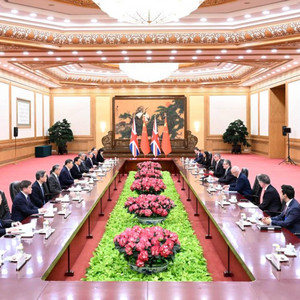
Chinese President, Xi Jinping, has called on China and the United Kingdom to work together to safeguard global stability and promote shared development.
He made the remarks on meeting British Prime Minister Keir Starmer in Beijing, with both sides agreeing to develop a long-term stable relationship.
The current international situation is chaotic.
The international situation today is complex and turbulent.
As permanent members of the UN Security Council and major global economies, China and the UK must strengthen dialogue and cooperation to safeguard global peace and stability and promote the well-being of our peoples.
By adopting a broad historical perspective, respecting one another and rising above our differences, we can achieve outcomes that will stand the test of history.
President Xi called for deeper cooperation in areas including education, finance services, artificial intelligence and green technology, and urged the UK to provide a fair business environment for Chinese companies.
He also voiced support for expanding people-to-people exchanges and said China's considering unilateral visa-free entry for UK citizens.
Starmer conveyed greetings from King Charles III and said he was pleased to be the first British prime minister to visit China in eight years.
This is the first visit by a UK prime minister in eight years.
To my mind, that's been far too long.
China is a vital player on the global stage and it's vital that we build a more sophisticated relation.
We reaffirmed the UK's unchanged policy on the Taiwan question, expressed willingness to deepen cooperation in trade investment, climate action and global governance, and said closer exchanges would benefit both countries and global peace and stability.
China and the UK have said a number of firsts and mosts concerning investment, finance and many other sectors in recent years.
Qi Zhi has more.
The UK became Europe's largest source of foreign direct investment into China in 2024, ranking third globally.
UK investment into China grew 19.3% last year.
The country also sent its largest-ever business delegation to the 2025 China International Fair for Investment and Trade, with over 100 companies attending.
In the finance sector.
London is now the world's largest offshore Chinese currency trading hub outside China.
The volume of Chinese currency trading in London jumped 43 in 2024, with cross-border transactions rising over 20.
This means that London has become one of the main gateways for the Chinese currency to go global.
In April last year, China launched its first-ever grain sovereign bond on the London Stock Exchange, raising more than US820 million.
In people-to-people exchanges.
China became the largest source of international students in the UK in 2025, with over 200000 studying in the country.
About 50,000 UK students studied in China between 2013 and 2024.
For the Beijing Hour, I'm Qi Zhi.
As Europe reassesses strategic autonomy amid global uncertainty, the British Prime Minister's visit to China is seen as an effort to explore further cooperation.
Zhao Yunfei has more on what this visit could mean for the future of China-UK relations.
UK Prime Minister Keir Starmer's visit to China could mark a strategic reset in bilateral relations.
It is the first visit to China by a British prime minister in eight years.
The trip follows a prolonged cooling of ties after the post-2018 golden era shaped by Brexit, global turbulence and intensifying geopolitical pressures.
So how might this trip shape the future direction of China-UK relations?
The China-UK golden era can be traced back to more than a decade ago, when economic cooperation was the main focus.
It is great to be back.
The UK Prime Minister, David Cameron, sought to access to the Chinese market to help recover from the 2008 financial crisis.
The frequent exchange lasted till Theresa May's leadership.
2018 was also the last time a UK Prime Minister visited China, when the two sides vowed to carry on strengthening ties.
The momentum, however, did not last.
Brexit was one factor reshaped the landscape.
The UK's decision to reverse its earlier stance on Huawei's role in its 5G network was also seen by China as a setback to mutual trust.
The Ukrainian crisis, COVID-19 or some other also have a very, very negative influence on this foreign policy of the UK towards China.
Domestic restructuring and trade negotiations took priority, while uncertainty over Britain's post-EU role complicated long-term planning with partners including China.
But the rising trade protectionism and geopolitical tensions are reshaping the global landscape.
Across Europe.
Concerns over US policies and shifting security priorities are prompting countries to seek greater economic resilience and strategic autonomy.
China is increasingly viewed as a constructive partner in that process.
The international landscape is witnessing turbulence and transformation.
It serves the common interest of both peoples and contributes to promoting global peace, stability and development.
For China and the UK, as two permanent members of the United Nations Security Council, to maintain communication and enhance cooperation.
This time, Prime Minister Starmer's visit focuses on pragmatic topics.
He's travelling with senior business leaders, signalling the revival of a high-level bilateral business dialogue.
About 50 major British companies and organisations from sectors including finance, medicine and manufacturing are expected to take part.
Ahead of this visit, China's Commerce Ministry convened a roundtable with British-funded companies operating in China.
Chinese officials highlighted new opportunities linked to China's 15th five-year plan, particularly in services, green transition and innovation.
British representatives noted China's market potential and expressed confidence in long-term cooperation.
The broader data reinforced this picture, with bilateral trade volume reached 103 billion US dollars last year.
The market potential extends beyond the UK.
Following visits by leaders from Ireland and Finland, Starmer is the third European leader to visit China since the start of the year.
More and more European companies and investors they find out there is out of a reason to have this so-called derisive policy towards China.
Because fundamentally, both China and Europe, we are working in the same industry chain and we share more and more common interests.
Despite turbulence, the UK is signaling a recalibrated approach under Prime Minister Starmer's Labour government, reopening channels of communication and identifying areas where cooperation is possible and mutually beneficial.
Though differences persist, China and UK both recognize that the dialogue and exchange serve the long-term interests.
Starmer's visit could open a new pragmatic window for China-UK relations moving forward.
That was Zhao Yunfei on China-UK ties.
And for more about relations between China and the United Kingdom.
Du Hongyu spoke with Zhou Mi, a senior research fellow with the Chinese Academy of International Trade and Economic Cooperation.
Both sides highlighted the potential for China-UK cooperation in areas such as green energy, finance and people-to-people exchanges.
What concrete outcomes can we expect from this visit to turn that potential into tangible results?
Well, we know that this time the Prime Minister of the UK has brought about 50 companies with him.
So it's really likely that both sides have some discussion about properly kind of cooperation areas, including the areas you have mentioned.
But how can we just transfer the potential into the real results?
I think that depends on several factors.
First of all, whether we can see that UK is giving us some kind of promises or kind of framework that we can trying to deliver by both sides, that they are going to protect these benefits of the investors from China in the UK, like what is happening has been doing, you know, for many years.
Well, the second, we have to understand that the supply chain is under potential a lot of threats.
So can we just try to, you know, make it happen for the more uh, strengthened supply chains between our two sides?
I think that there are so many complementary areas for both sides, so we should try to put it uh, you know, in the framework to protect the benefits.
But the third one I would say that is about our attitudes towards the global governance.
Both China and the UK are really our supporters for the global governance and globalization.
We should try to raise out our voice to the world that we want to protect these benefits of the globalization.
You mentioned global governance and, as major economies and permanent members of the UN Security Council, what implications do closer China-UK ties have for global governance?
As you mentioned, both China and the UK are really important.
We have something to say in the global governance.
The UN Security Council is really important for maintaining the peaceful world, the governance, the order after World War II.
So it's really a very important mechanism.
We should not just try to violate this kind of mechanism because of some countries' own attitudes or own demands.
So i think that we are already seeing so many unfairness, so many kind of different treatment to different stakeholders.
So we should try to treat every countries, no matter whether it is strong or weak, the same, the equal in the position, like the attitudes towards the sovereignty problems.
So the uk is also facing many changes we are seeing right now from, you know, greenland issues, from some of the ukraine issues.
We should try to look at what are the differences, what are the same things.
Should we just try to follow our promises to the world as some of the mainly countries who are supporting the global business?
I think that is really important because many countries depend on us.
They still believe that the UN is the only one, only one mechanism that they should believe they should depend on for the peaceful
That was Zhou Mi with the Chinese Academy of International Trade and Economic Cooperation.
As global trade faces rising protectionism, the vast consumer market in China has become a source of opportunities for British companies.
They're focusing on cooperation, consumer services, and business expansion.
They say China offers a platform for long-term growth and innovation.
Biran reports from Shanghai.
It's early morning but this british hotel is already buzzing, not in london but in shanghai.
Steam rises from tracing the food house.
Coffee machines harm families.
Business travelers and local guests move through the space with ease for intercontinental hotels group, or ihg since, like days highlight a deeper shift.
China's hospitality market is evolving.
China, for us, over the last 50 years, has evolved with pace.
But we built a business that's very much related to being in China.
We are an in China for China business, which is also one of the key reasons that has driven our success in this part of the world.
The group's experience mirrors a broader trend.
Global brands are learning to listen, adapt and evolve in China, while British, in arranging The company's operations here, are shaped heavily by local consumer habits.
From hotel design to digital services.
Local Insight executives say it's now central to the brand's performance in China and beyond.
China is one of the world's most demanding hospitality markets.
Guests here expect convenience, speed, and seamless experiences.
So for many hotel groups, they turned China into a big testing ground.
New ideas are made, tried, refined and in some cases scaled to the rest of the world.
If I look where 50 years ago we brought Holiday Inn to China, we actually now take the designs, the feel and how we look at Holiday Inn in China.
We actually take that out now globally.
Because the Chinese consumer has pushed us to evolve very fast.
Now we take what we do for Holiday Inn and other brands in China and we export it back to different parts of the world.
By the third quarter of 2025, IHG's footprint in Greater China had expanded to more than 1400 hotels, including those in operation and under development, making China one of the group's largest global markets.
Beyond hospitality, both China and the United Kingdom see scope for deeper cooperation in areas such as green energy, the digital economy, advanced manufacturing and the creative industries.
Sectors closely aligned with long-term development priorities on both sides.
UK companies like in the pharmaceutical sector with AstraZeneca, for example, or in the energy sector with BP, are very active in China as well, or Jaguar Land Rover in the automotive sector although it's also an Indian company now are very active in China.
Generally, British companies, according to the Chamber survey, are quite positive about China.
At a time of mounting economic pressure in the UK, Dialogue and cooperation are seen as more important than ever.
For British firms, China's market is not just large.
It's increasingly viewed as a source of stability, innovation and long-term opportunity.
That was Bi Ren in Shanghai.
Coming up, Iran rejects military threats from Washington and refuses negotiations.
Find your way to a wealth of Chinese culture and thinking, all on POS+.
It's past 16 past the hour.
Iran's rejected talks with the U.S. as it faces continued military threats from Washington.
Foreign Minister Syed Abbasarachi says the U.S. must abandon threats if it wants negotiations.
He says Iran welcomes a new deal on its nuclear program, but will respond forcefully to any US military operation.
An advisor to Supreme Leader Ayatollah Ali Khamenei, warns that any US military action will open the US, Israel and its supporters to being targeted by Iran.
U.S.
President Donald Trump has urged Iran to return to talks over its nuclear program, even as he deploys significant military forces in the Middle East.
Trump says they're ready to act if necessary.
The Chinese envoy to the UN says China supports maintenance of stability in Iran and opposes military adventurism.
Futsong made the remarks at a Security Council open debate on the Middle East.
Iran is an independent sovereign state.
Iran's affairs should be independently decided by its own people.
China hopes for and supports the maintenance of stability in Iran.
China supports the safeguarding of Iran's sovereignty, security and territorial integrity.
The use of force cannot resolve problems.
Any military adventurism would only plunge the region into the abyss of uncertainty.
Iran's permanent mission to the UN's reiterated Tehran's readiness for dialogue with Washington and its willingness to defend itself if provoked.
Foreign ministers in the Middle East have also expressed concerns over the rising tensions.
Saudi Arabian Foreign Minister, Faisal bin Farhan al-Saud said in a phone call with his Iranian counterpart that maintaining stability and security is the shared responsibility of countries in the region.
Egyptian Foreign Minister Badr Abdel-Adi spoke separately with the Iranian Foreign Minister and U.S.
Special Envoy Steve Witkoff.
He urged both sides to step up efforts to reduce tensions.
The final Israeli hostage recovered from Gaza has been buried.
The return of the last hostages marked the end of phase one of the ceasefire.
Attention now turns to phase two, as disagreements remain over the Israeli military withdrawal and reconstruction of Gaza.
Jonathan Regev has more from Tel Aviv.
843 days, 12 hours and nearly six minutes after this clock began ticking, it finally stopped.
It marked the time that had passed since the October 7th attacks.
That morning, 251 hostages were taken into Gaza.
Four others were already being held there, some since Operation Protective Edge in 2014.
Now, they're all back home.
The return of the last hostage marked the emotional end of Phase 1 of the ceasefire agreement.
Attention now turns to Phase 2. and a new set of challenges for Israel.
Now we focus on our two remaining missions disarming Hamas and demilitarizing Gaza from weapons and tunnels.
Phase two includes proposals that many in Israel view as deeply uncomfortable, including a full withdrawal from Gaza and the reconstruction of the strip, even as Hamas remains in control, at least for now.
The Prime Minister has instead emphasized Israel's core demands, with supporters arguing that no progress can be made before they're met.
Phase two means the defeat of Hamas and demilitarization of Gaza.
This is the deal that President Trump led.
And if you listen to the president, he says Hamas will be demilitarized the easy way or the hard way.
These are the words of the president.
And so I think Israel is leading exactly toe in line with President Trump and his policy.
Aligning with President Trump's approach could also mean reopening the Rafah crossing.
Aid trucks are already waiting on the Egyptian side.
But for Israel, the issue goes beyond monitoring what enters Gaza.
Rafa crossing, I remind you, can also serve as an exit route, not just as an entry route, and I welcome Palestinians who would like to move elsewhere temporarily, while the Gaza Strip is reconstructed.
What lies ahead for Gaza, what lies ahead for Israel are all unclear, but at least this very dark episode of the hostages is now over And the Israeli society can finally find some healing and maybe some reconciliation, mostly with itself.
That was Jonathan Regev reporting.
The Rafah border crossing linking Gaza with Egypt is due to reopen on both sides for the first time in nearly two years.
It'll allow Palestinians to travel in and out of Gaza.
The crossing from the Palestinian side has been closed since 2024, after Israel seized control of it from Hamas.
Yasser Akeem reports from Al-Arish, a city next to the Rafah border crossing.
The Rafah border crossing is along this road till the end, linking from Al-Arish city to the border crossing itself.
And this is the only lifeline that connects Gaza to the outside world.
But this lifeline had been blocked by Israel for the past two years after it waged the war on Gaza in 2023.
That has so far killed over 70000 Palestinian civilians.
Israel's border blockade has also deprived Palestinians from badly needed humanitarian aid and prevented patients to be treated outside Gaza after the health sector has been destroyed by the Israeli onslaught described by the United Nations as a genocide.
After several delays, Israel has finally agreed to reopen the Rafah border crossing.
Remember it was only open from the Egyptian side, but that was useless because Israel has not allowed anything to go through from the Palestinian side.
The Gaza Health Authority says there are 20000 Palestinians on the waiting list to travel for medical treatment.
Israel says the opening is limited to pedestrian movement.
According to the Israeli prime minister's office, those leaving Gaza will be free to travel.
However, every Palestinian entering Gaza will encounter stricter regulations First a security check from a European Union delegation at the border, followed by an Israeli military checkpoint, and then a full screening by Shin Beit, an Israeli intelligence agency.
As for the ones who are leaving Gaza into Egypt, well, the priority is for the injured and the sick.
And many of them will be going to the hospital in Al-Arish here.
That was Yasser Hakim reporting.
UN Deputy Special Coordinator for the Middle East Process says that there might be a turning point for Gaza, with profound opportunity and considerable risk.
Ramiz Alikbarov says the task at hand is monumental.
Across all sectors, humanitarian actors are still unable to operate at scale in Gaza.
Their work is being hindered by insecurity, customs clearance challenges, the limited number of partners authorized by Israeli authorities to bring cargo into Gaza, delays and denials of cargo at crossing and limited routes available for transporting supplies within Gaza.
Alec Barov said, despite the ceasefire, the Israeli military continues to conduct military operations.
He added that hundreds of Palestinians have been killed since the ceasefire began, including women and children.
Coming up, France, Denmark and Greenland call for European unity.
You've been listening to programs from CGTN Radio.
We invite you to visit us online for more audio, pictures and in-depth reports.
At radiocgtncom, you can access a wide range of programs and find your favorite news, talk features, entertainment shows and podcasts.
Hear the difference with CGTN.
Four minutes past the hour.
French President Emmanuel Macron's reaffirmed support for Denmark and Greenland, calling for European unity at a time of rapid change.
Macron's hosted Danish Prime Minister Meta Frederiksen and Greenland Prime Minister Jens Frederik Nielsen at the Elysee Palace.
Ross Cullen reports from Paris.
Just before they went in for the talks, there was a short press statement between the president and the two prime ministers.
Emmanuel Macron now wearing those trademark sunglasses.
Many people around the world know so well because of his benign eye condition.
Started by speaking in French and then moved into Kalachlisut speaking in Greenlandic and then addressing Meta Frederiksen, the Danish prime minister, in Danish as well.
And he was saying that France remains committed to territorial integrity, to respecting sovereignty, was actually opening a consulate in Anouk.
Emmanuel Macron himself referenced his own visit to Greenland in 2025, saying that France was committed to upholding support for Greenland and for Denmark as well.
We are deeply committed to the principles of sovereignty and territorial integrity alongside all our European Union partners, and France will continue to defend these principles in accordance with the United Nations Charter.
We have the Danish Prime Minister, who was saying that the world order is rapidly changing.
Europe needs to stand up for itself, defend its values, defend democracy.
Thank you for standing up for the fundamental values we share and where we cannot compromise democracy serenity, the right of every country to choose its own future.
And the Greenlandic Prime Minister, Jens Fredrik Nielsen, thanked Emmanuel Macron for replying without hesitation, supporting Greenland immediately.
France sent some of its specialised mountain patrol troops to the Danish self-governing territory and saying that unity is what we need, not division.
Our close cooperation in this situation is not only about Greenland.
It goes beyond Greenland.
For us, this is about the values in the world, our democracy, respect for international law and order and integrity.
That was a report on a trilateral meeting among the leaders of France, Denmark and Greenland.
European leaders have been discussing ways to handle the U.S. push to control Greenland.
EU Defense Commissioner Andreas Kubilius says Europe must rapidly build independence in defense.
He urged the development of pan-European capabilities during a defense agency meeting, urging the continent to invest in production potential.
EU Chief of Diplomacy Kayakala said Europe must step up defense as Washington upends ties.
But Europe needs to adapt to new realities.
Europe is no longer Washington's primary center of gravity.
The shift has been ongoing for a while.
It is structural, not temporary.
It means that Europe must step up.
No great power in history has ever outsourced its survival and survived.
The Belgian prime minister also criticized Washington, saying Europe faces mounting geopolitical and economic instability.
That the continent's greatest ally is trying to exploit this vulnerability.
A US judge has temporarily blocked a recent Trump administration policy targeting about 5600 refugees in Minnesota awaiting green cards.
The order blocks federal agents from arresting lawful refugees who've not been charged with immigration violations.
Tensions continue to escalate in Minneapolis after nurse Alex Preddy was shot dead by ICE agents.
Hundreds of people in Paris have gathered to support the American people after U.S.
Immigration and Customs Enforcement agents killed two people in Minneapolis.
Protesters chanted anti-ISIN, anti-Trump slogans and carried banners.
The ICE agents fatally shot and killed U.S. citizen Rene Good in Minneapolis on January 7.
The second shooting occurred last weekend, less than two miles from where Good was shot.
The incidents have touched off widespread protests.
Mississippi says winter storms have left 10 people dead and at least 14 injured in the state.
The governor says over 100000 people are still reeling from sub freezing temperatures and widespread outages.
The growing misery and anxiety comes amid what Mississippi officials say is the state's worst winter storm in more than three decades.
We're at 29 past the hour.
Checking the forecast ahead of the break.
Beijing's cloudy overnight.
It's down to minus 3.
A light snowfall with a high of 0 in the forecast for Friday.
Chuma and Dian will see heavy snowfall and a low of 0 tonight.
Then sleet with a high of plus 2.
Nanchang's getting some rainfall tonight and tomorrow.
A low of 5 and a high of 9.
El Sur and Asia.
Islamabad's overcast and 7 this evening.
A light rainfall Friday.
The high is 16.
Vientiane will be overcast tonight and tomorrow. a low of 16 and a high of 30.
Phnom Penh's overcast in 21, followed by clouds in 33.
It's time for a short break.
So far this hour, the Chinese president's met with the UK's visiting prime minister, with both sides agreeing to develop long-term stable relations.
Tehran's told Washington it must drop its military threats if it wants negotiations on Iran's nuclear program or any other issues.
France, Denmark and Greenland have issued a call for European unity amid the current global tensions.
Shane Bigham with you.
Stay with us here on the Beijing Hour.
Shh, listen up.
Can you hear the heartbeat of our world?
It's vibrant and pulsating with the essence of life itself.
From the stem of trees to the gurgle of rivers.
From the silent strength of mountains to the icy whispers of glaciers.
Even the solid ground beneath our feet, right there in the midst of all, beats the heart of humanity.
What if those other heartbeats were to stop?
Would ours keep on ticking?
Ever wondered what's actually going on in Africa through the perspective of an African?
How are things really going between China and Africa?
What's the narrative of this relationship?
Well, get a perspective with China Africa Talk.
Hear from African diplomats, entrepreneurs, academics, Chinese natives and more.
Get on our wavelength every week to find out what's real with China Africa Talk.
Find us on your favorite podcast.
We'll see you there examining the events that impact and shape china and the rest of the world.
This is the beijing hour one hour of news and information brought to you every weekday.
Now here's your host, shane biggum, with you on this thursday.
Still to come in business.
The us fed has put interest rate cuts on hold In sports.
Chinese tennis star will play in the women's doubles final in Australia.
In culture and entertainment, relics from an ancient Chinese kingdom are on display in Beijing.
To contact us, you can email radio at cgtn.com or follow our ex-account at cgtnradio.
Now to check the day's headlines, here's Do Hongyu.
Thank you, Shane.
Chinese President, Xi Jinping, has called on China and the United Kingdom to work together to safeguard global stability and promote shared development.
He made the remarks while meeting British Prime Minister Keir Starmer in Beijing, with both sides agreeing to develop a long-term stable relationship.
President Xi called for deeper cooperation in areas including education, finance services, artificial intelligence and green technology, and urged the UK to provide a fair business environment for Chinese companies.
He also voiced support for expanding people-to-people exchanges and said China is considering unilateral visa-free entry for UK citizens.
Stormer conveyed greetings from King Charles III and said he was pleased to be the first British prime minister to visit China in eight years.
He reaffirmed the UK's unchanged policy on the Taiwan question, expressed willingness to deepen cooperation in trade investment, climate action and global governance, and said closer exchanges would benefit both countries and global peace and stability.
Chinese Foreign Minister Wang Yi says China and Azerbaijan should strengthen the alignment of development strategies and use high-quality Belt and Road cooperation as a guide to aid modernization efforts.
While meeting with his Azerbaijani counterpart.
Wang said, as global South countries, China and Azerbaijan should practice true multilateralism, uphold the international system with the United Nations at its core, and promote the establishment of a more just and equitable global governance system.
Jehon Bayramov said his country is ready to expand bilateral and multilateral cooperation.
China's permanent representative to the United Nations has called for efforts to promote a lasting ceasefire in Gaza.
Fucong has called on all parties, especially Israel, to comply with the ceasefire agreement.
The humanitarian situation in Gaza remains critical, with access to humanitarian supplies severely restricted.
We urge Israel to fulfill its obligations under the international humanitarian law by opening all crossing points, lifting restrictions on the entry of humanitarian aid and halting suppression of humanitarian organizations.
The situation in the West Bank remains tense as Israel continues to expand settlements and condone settler violence.
Fu said Israel should immediately halt settlement activities and curb settler violence.
Local residents, nurses and federal workers in the U.S.
Capitol have attended a vigil to remember ICU nurse Alex Preti, who was shot and killed by federal immigration agents.
They expressed grievance and anger over Preti's death.
Alex Preti was a wonderful human being with holidays to celebrate and family to still hug.
His life was taken by the same apparatus that took Renee Nicole Goode.
Silverio Villegas Gonzalez and Keith Porter.
All people with loved ones waiting at home with a meal served and warm and ready for them.
I hate to give you the worst news though.
This is not new.
This is a simple new iteration of jump outs that are historically been targeting black folks.
Authoritarians across the world fear one thing.
They don't fear politicians.
They don't fear courts.
They certainly don't fear laws that are written in books.
What they fear are thousands, tens of thousands, hundreds of thousands, millions of people organizing against them.
The Department of Homeland Security said that two federal agents involved in Petty's shooting have been on leave since Saturday.
The announcement came as U.S.
President Donald Trump seemed to signal a willingness to ease tensions in Minneapolis after a second deadly shooting in the city by federal immigration agents.
A plane crash in northeast Colombia has killed all 15 people on board, including a member of Congress.
The airline that operated the flight said the aircraft's final contact with air traffic control came minutes after takeoff.
Officials did not provide a cause for the crash, but said there would be an investigation.
The plane was carrying two crew members and 13 passengers, including a member of the House of Representatives for the Catatumbo region.
Thank you very much.
That's Do Hongyu with Headlines.
Coming up in business, the U.S.
Fed has put interest rate cuts on hold.
Thank you, Shane.
Stock markets on the Chinese mainland closed mixed on Thursday.
The Shanghai Composite saw a small gain, rising by nearly 02, while the Shenzhen Component dropped by 03.
Stocks related to liquor oil and media and entertainment led the gainers, while shares in the power generation equipment and electronic device sectors suffered major losses.
Hong Kong's Hang Seng Index climbed by more than half a percentage point, while Tokyo stocks ended slightly higher, with the Nikkei increasing by less than 01.
The US Federal Reserve has paused its rate-cutting cycle, keeping its benchmark interest rate unchanged.
The Fed announced it will maintain the key lending rate between 35 and 375, noting that US economic activity has been expanding at a solid pace.
This marks the first pause since July following three rate cuts last year.
U.S.
President Donald Trump has often criticized Fed Chairman Jerome Powell for not cutting rates more aggressively.
Powell cited persistent inflation as the primary reason for the decision, while reaffirming the Fed's commitment to political independence.
Kate Fisher has more.
Well, the Federal Reserve had cut interest rates in three straight meetings, but on Wednesday it hit pause.
Several policymakers have said recently that they want to see how those previous rate cuts play out before considering lowering borrowing costs further.
Fed Chair, Jerome Powell, said on Wednesday that more positive job numbers and cooler inflation readings have also released the pressure on the Fed for more cuts.
The U.S. economy expanded at a solid pace last year and is coming into 2026 on a firm footing.
While job gains have remained low, the unemployment rate has shown some signs of stabilization and inflation remains somewhat elevated.
In support of our goals, the Federal Open Market Committee decided to leave our policy rate unchanged.
Now there was a significant change in the language used by the Fed chair from his last press conference.
He said economic activity has been expanding at a solid pace and that's an upgrade from from the moderate pace in December.
That's the word he used then.
And then that note that the unemployment rate has shown some signs of stabilisation, after previously saying it had been just edging up.
But inflation remains somewhat elevated.
So, even while the economy and job market show signs of improvement, the Fed has decided to wait to see how their previous three cuts continue to play out.
But the president's made no secret of the fact that he wants the Fed to lower rates to help make things more affordable to voters.
We are, of course, in a midterm election year.
But Jerome Powell reiterated in the press conference the importance of the Fed staying out of elected politics.
That said, he sounded slightly more confident on inflation.
Noting the fact that inflation has been mostly due to tariffs is good news, because it would be harder to manage it if it was demand-driven inflation.
He said the Fed's preferred inflation gauge, the PCE index, is still well above the Fed's 2 if you take out the impact of tariffs, an impact he expects to work its way through the economy completely this year if nothing changes.
Now, Jerome Powell will leave his post in May as the Federal Reserve faces mounting challenges from President Trump to its longstanding ability to act independently as well as facing a criminal inquiry.
Jerome Powell said that he and his colleagues are strongly committed to maintaining the central bank's independence and that his advice to his successor would be to stay out of elected politics.
That was Kate Fisher reporting from Washington.
International gold prices have surged to new records, with spot and futures gold breaking above US5500 per ounce.
Spot gold rose more than 1 intraday, reaching the milestone.
For the first time In the past 72 hours, gold prices jumped over 500 per ounce, boosting the market value by more than 35 trillion.
The overall gold prices increase in early 2026 stands at about 20%.
Silver futures also hit a new high on Thursday, breaking $120 per ounce.
Growing concerns over U.S.
Federal Reserve policies, geopolitical risks and inflation have led investors to accelerate their gold purchases.
China's Commerce Ministry has highlighted efforts to promote the high-quality development of the home service industry.
The ministry emphasized that home services, including elderly and childcare care, are closely linked to people's livelihoods.
In 2019, the government introduced a range of tax and fee exemptions to support home service providers, involving value-added tax, property tax and other local taxes.
These measures have reduced the financial burden on providers, helping to lower operating costs and encourage industry growth.
The government has extended these policies until 2027 to further stimulate consumption, stabilize employment and improve living standards.
The ministry will continue to promote these policies to support home service businesses.
Chinese authorities expect a record 95 billion inter-regional passenger trips over the 40-day Spring Festival travel rush beginning February 2.
Car journeys will remain the most popular mode of transport, accounting for around 80 of total trips.
Railways will handle 540 million passenger trips, while civil aviation is preparing for 95 million.
Deputy Head Li Chunling of China's National Development and Reform Commission elaborated on the travel rush.
To increase transport capacity, the railway has implemented a new train schedule, with over 14000 passenger trains expected to operate on peak travel days, representing a 53 year-on-year increase in seating capacity.
While fully leveraging the high-speed rail network, services such as green trains and slow trains will continue to operate, ensuring that residents in rural areas can also travel by train to visit relatives and celebrate the spring festival.
Civil aviation will focus on increasing flights to airport hubs and popular tourist destinations, with an estimated daily average of 19400 flights, up 5 year on year.
We will enhance highway services around popular tourist destinations and rural areas, while waterways will enhance support for key routes such as the Qianzhou Strait between Hainan and Guangdong provinces.
The country has pledged to enhance capacity across all transport modes to ensure a smooth travel season.
Data shows that outbound investment by Chinese companies grew steadily in 2025, with nearly 80 of surveyed firms maintaining or expanding their investment abroad.
According to the China Council for the Promotion of International Trade, nearly 90 of the surveyed companies are optimistic about the future of overseas investments.
60% of companies reported stable or increased profitability from their foreign investments.
Nearly half of the respondents expressed interest in forming industry alliances for collective overseas expansion, with a particular focus on the manufacturing sector.
Qingdao Port serves as a crucial gateway for China's foreign trade, highlighting the country's economic resilience and efficiency through advanced innovations.
The port in Shandong Province is powered by automation, digital customs clearance, a dense global shipping network and AI-driven services.
It handled over 700 million tons of cargo last year.
It now operates more than 230 shipping routes connecting over 700 ports in more than 180 countries.
Chen Jiayin has more.
This is Qingdao Port's automated container terminal.
Everything is running at full speed.
Containers are moving, driverless vehicles are navigating the docks.
But you can barely spot any people working on the ground.
Behind it all is a powerful, smart system, one that has helped Qingdao Port break the world record for automated container handling efficiency 13 times.
In 2025, Qingdao Port handled over 700 million tons of cargo, a scale made possible not by more manpower but by deeper automation, digital coordination and a tightly connected global shipping network.
From a central control room, operators can oversee the entire terminal, from vessel schedules to container movements.
Tasks that once required multiple handovers are now connected in real time through integrated systems.
The systems act as the port's digital brain and nervous system, directing everything from key cranes to driverless vehicles, all through system-issued instructions without manual intervention.
Efficiency at Qingdao Port also depends on what happens beyond the terminal itself.
Customs procedures, once a major time bottleneck, are now embedded into port operations.
As a major foreign trade gateway in China, Qingdao Port connects to markets all around the world, with ships sailing out to almost every corner of the world.
Every box here carries trade, jobs and global opportunities.
In the first month of 2026.
New shipping routes are coming online, making that global network even stronger.
A strong industrial internet with stable cargo flow of crude oil, machinery and chemical products creates a positive circle between cargo volume and network expansion.
Beyond infrastructure and logistics, efficiency at the port now extends to services powered by artificial intelligence.
The ARC task model supports shipping companies agents, cargo owners, freight forwarders and drivers, allowing port services to move ahead of demand.
From automated terminals and streamlined custom clearance to global shipping networks and AI-powered services.
Qingdao Port offers a real-time snapshot of China's economy at the start of 2026 not just growing, but operating smarter and more efficiently within a global system.
That was Chen Jiayin reporting.
Thank you very much.
That's Tianyu with Business.
You're listening to the Beijing Hour.
Coming up in sports, a Chinese tennis star will play in the women's doubles final in Australia.
Sideline Story brings you all things sports related.
The hottest topics, latest events, juiciest stories, all with a very personal take.
Subscribe to Sideline Story Podcast for heated sports discussions covering events that are happening in China and around the world.
At 48 past the hour, turning to sports now, here's Yang Guang.
Thank you, Shane.
We begin with tennis.
China's Zhang Shuai is charging towards a historic second Australian Open women's doubles crown.
In former duel of John and Belgium's Alice Merton stormed into the final, overwhelming Anna Shibahara and Vera Zvonovera in a commanding 6-3 6-2 victory.
John is now just one match away from recreating her 2019 Melbourne Park triumph, which she clinched alongside Samantha Stoser.
In women's singles, Jessica Pegula finally broke through in Melbourne by beating fellow American Amanda Anisimova to reach the semifinals for the first time after three previous quarterfinal losses.
On the men's side, Novak Djokovic advanced to the semifinals after Lorenzo Mussetti was forced to retire in the third set of their quarterfinal.
Serbia's 24-time Grand Slam winner dropped the first two sets, but jumped ahead in the third, before a leg injury forced his Italian opponent to pull out.
Djokovic wished Mussetti well and admitted he was the better player in this match.
I don't know what to say except that I feel really sorry for him.
He was a far better player.
I was on my way home tonight.
I don't know what to say.
These kind of things happen in.
Djokovic will face two-time defending champion, Yannick Sinner in the semifinals.
The Italian player defeated American eighth seed Eben Shelton in straight sets to record his 19th straight victory at Melbourne Park.
The president of the Italian National Olympic Committee has spoken positively for the 2022 Beijing Winter Olympics.
Luciano Bonfiglio also reflected on his memories from the Games four years ago.
In my view, sustainability means impact.
What impact can the Olympic Games bring at the sports level?
Countless young people are inspired to take up sports after witnessing the champions' excellence.
This is the primary impact and the most fundamental sustainability of the Olympics.
That is promoting sports culture and encouraging universal participation.
I still vividly remember the Beijing Olympics with great passion, not only because I was younger then, but also because of your exceptional organization capabilities.
I believe no country could have hosted the Olympics better than you did.
Meanwhile, the torch rally for Milan Cortina successfully negotiated the ski jump venue in Pridazzo, as the flame made its way from Canassi to Cavalessi.
One of the key morning stops is Moina, nicknamed the Ferry of Dolomites, which is one of the most picturesque resorts in the Valle di Farsa.
The region is known for its enchanting landscape and strong ties to the Latin tradition.
The torch rally will continue its journey to Milan ahead of next Friday's opening ceremony.
In football from the UEFA Champions League, Jose Mourinho's Benfica upset his former club, Real Madrid, in stunning fashion.
The 4-2 win dropped the record 15-time champion out of the top eight.
A stoppage time header from Benfica goalkeeper Anatoly Trubin kept the team alive in the competition.
Mourinho praised Trubin's historic last-minute goal.
I've won and lost matches and have won and lost knockout ties in the last minute, but never with a goalkeeper scoring a fantastic goal that even the best strikers of the world would love to score, so the emotion really is huge, even for someone like me who's already been through everything.
The big guy scores fantastic goal and i think that for benfica, is fantastic night.
Regardless of what happens in the future i know we had incredible luck in the jewel we could either enter Real Madrid.
Regardless of that is a fantastic night and a night to remember.
Meanwhile, Real Madrid coach Alvaro Avila acknowledged his role in his team's poor performance against Benfica.
As I always say, when things don't go right, when the team is far from the level we were at, for example, in Villarreal, the responsibility is always mine, because I didn't manage to get the players to approach the match in the way I wanted.
The result seeded Benfica finished 24th on goal difference to claim the last playoff spot.
A third defeat of the campaign for Real dropped them to ninth, meaning they also must contest the two-legged knockout playoff.
Friday's draw will decide whether Benfica get rematch with Real or face 10th place Inter Milan, another former Mourinho club, with whom he won the competition in 2010.
I would swear Arsenal became the first club to win all eight matches in the league face of the Champions League, after edging Kasich 10th.
Carrot Almaty 2-1, 2-3-2.
With the plays in the last 16 already assured, Mikel Arteta made 11 changes from the side that suffered their first home defeat of the season against Manchester United on the weekend.
Thank you very much.
That's Yong Guang with sports.
You're listening to the Beijing Hour.
Coming up in culture and entertainment.
Relics from an ancient Chinese kingdom are on display in Beijing.
To west, people in China are chasing their dreams and leaving their mark.
Want to know how they beat the odds and made a difference?
Footprints brings you the true life stories of their journeys.
53 past the hour.
In culture and entertainment.
The National Museum of China is hosting an exhibition featuring treasures of an ancient kingdom from over 3000 years ago.
More than 200 of these artifacts reveal a glimpsing of the Shu civilization that once flourished in southwestern China.
Li Chong reports.
The exhibition marks a significant gathering, including dozens of treasures that have never before left their home museums in Sichuan Province.
37 artifacts in this exhibition are leaving the Jingsha Museum for the first time, including this bronze standing figure.
He stands with hollowed hands held before his chest, once holding an object whose identity remains unknown.
His status was likely high, presiding over rituals.
He wears a sun-shaped crown with 13 rotating spikes reflecting sun worship.
A scepter hangs from his belt, a jade bracelet encircles his wrist and a three-strand braid falls down his back.
Hairstyles were important icons to signify different tribes.
The exhibition reveals how the Shu people absorbed bronze casting techniques from central China, then innovated with distinct local styles, a testament to early forms of cultural exchange.
Gold was a signature material in Shu culture.
Check out this gold mask.
Can you believe people crafted this masterpiece some 3,000 years ago?
This mask on display is remarkably thin yet delicately three-dimensional in form.
Among the gold work is a ceremonial crown band.
This gold crown band displays a distinct pattern, a human face. a fish, a bird, and an arrow.
It reflects ancestral worship of the fish totem and once served as the royal emblem for a Shu king.
These objects offer a glimpse into a kingdom that combines sophisticated artistry with a unique spiritual world.
The exhibition runs at the National Museum of China until August 18.
That was Li Chong reporting.
Senior members from leading British cultural institutions are visiting China.
They include those representing the Birmingham Museums Trust, the Edinburgh International Book Festival, the National Galleries of Scotland, the National Theatre and the Royal Shakespeare Company.
They're part of the high-level delegation during British Prime Minister Keir Starmer's ongoing trip to China.
The iconic Uyghur Lantern Festival is opened in Shanghai.
It ushers in celebrations for the upcoming Year of the Horse, with a striking blend of centuries-old heritage and cutting-edge digital technology.
Now in its 31st edition, the 36-day festival showcases lantern displays inspired by the Chinese zodiac.
Recognized on China's National Intangible Cultural Heritage List.
Since 2011, The events expand beyond Yuyuan Garden for the first time, spanning six interconnected areas, including the Bund and Gucheng Park.
This year's highlights include a three-story revolving lantern built with traditional mortise and tenon techniques and enhanced by digital projections, bringing classic Spring Festival customs to life through light and shadow.
Digital light shows, performances, markets, and interactive games run throughout the festival.
Visitors can also use AI-powered guides, AR storytelling, and VR experiences via smartphones.
Experts say the fusion of heritage and technology is boosting Shanghai's global cultural appeal and offering international visitors an immersive gateway into traditional Chinese culture.
We're at 57 past the hour.
Check in the forecast before we go.
Beijing will be cloudy and it's down to minus three on Thursday evening.
A light snowfall, but the high of zero on Friday.
Chu Madian will see heavy snow and down to zero overnight, then sleet and plus two on Friday.
Nancheng's getting a light rainfall tonight and tomorrow, a low of five and a high of nine.
Elsa and Asia, Islamabad's overcast and seven this evening, a light rainfall and a high of 16 on Friday.
Vientiane will be overcast overnight and tomorrow. a low of 16, a high of 30.
Phnom Penh is overcast and 21 this evening, followed by cloudy skies and 33 degrees Celsius.
And that's it for this edition of the Beijing Hour.
Making news.
Today, the Chinese president has met with the UK's visiting prime minister, with both sides agreeing to develop long-term and stable relations.
And Tehran's told Washington it must drop its military threats if it wants negotiations.
On behalf of the staff.
This is Shane Biggum in the Chinese capital, hoping you'll join us for the next edition of The Beijing Hour and open a window to the world together.
Find The Beijing Hour at precisely 6 p.m.
Beijing time.
We meet you on podcast and on air every weekday.
The Beijing Hour, your window on China and the rest of the world.
He can't live without the Yellow River in his eyes.
The Yellow River is so noble and elegant.
Both my grandpa and dad made a living from the river.
Would you like to move away from the Yellow River?
I don't think I will.
I love it so much.
The Yellow River, the second longest river in China, is regarded as a shaping force in the history, economy and culture of northern China.
Today, about 100 million people live within its water basin, making up nearly 9 of the country's population.
How is climate change felt at its headwaters? what are the locals doing to cope with it?
What are the descendants of the boatmen doing?
What has kept some people from leaving their home village by the river?
And what has drawn others back?
Could the fading fishing community revive in a time of digital transformation?
From 2021 to 2024.
Our reporters visited the upper, middle and lower reaches of the Yellow River, Talk to the herders farmers boatmen, fishermen and eco-activists who share a close bond with the river, and present their stories in pictures, podcasts and videos.
All in our 12-part series, The Yellow River Mosaic, available only on CGTN Radio.