The unmissable news stories of the day.
This is the Beijing Hour.
Examining the events that impact and shape China and the rest of the world.
This is the Beijing Hour.
One hour of news and information brought to you every weekday.
Now, here's your host.
Shane Begum with you on this Wednesday, November 12th, 2025.
You're listening to the Beijing Hour coming to you live from the Chinese capital.
On today's program, the Chinese and Spanish heads of state have met in Beijing to ensure the right path for bilateral ties.
The U.S.
House of Representatives is expected to approve the bill that would end the government shutdown.
And Typhoon Fenghuang is weakened to a tropical storm, but the Taiwan region is maintaining warnings for strong winds and heavy rains.
In business, China's Double Eleven shopping festivals ignited a surge in consumer spending.
And today we continue our special series on China's path toward its dual carbon and sustainable development goals with carbon trading, empowering action among people and industry.
Now the day's top stories.
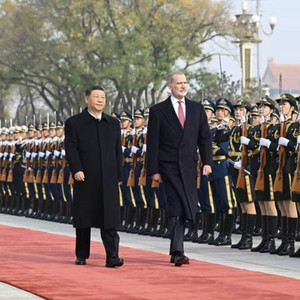
Chinese President, Xi Jinping, is calling on China and Spain to ensure bilateral relations remain on the right course.
In his meeting with Spanish King Felipe VI, President Xi said China cherishes the friendship and values Spain's role in international and regional affairs.
The Spanish royal family has made outstanding contributions to the development of China-Spain relations.
In a couple of days, the two countries will mark 20 years since the establishment of the comprehensive strategic partnership.
Your first state visit to China at this juncture is important for advancing bilateral ties and our traditional friendship.
China is ready to work with Spain to build a comprehensive strategic partnership with greater strategic resilience, stronger development vitality and broader international influence.
President said China is willing to import more high-quality products from Spain and tap cooperation potential in emerging sectors such as new energy, the digital economy and artificial intelligence.
He also said the two countries can complement each other and jointly explore other markets, such as Latin America.
He said China will extend the visa exemption for Spain to facilitate people-to-people exchanges.
King Felipe reaffirmed Spain's commitment to the one China principle and support for actions defending territorial integrity.
This state visit has very special meaning for me, because it's my first state visit to China since I ascended to the throne.
But the friendship between our countries has run long and deep.
I first came to China in 2000.
Throughout the years, China has completed remarkable development achievements and won international acclaim.
We believe that friendly Spain-China ties will benefit the people of both countries.
McKin said Spain will seize the opportunities from China's 15th five-year plan and enhance ties.
The two leaders attended the signing ceremony of 10 cooperation documents covering trade science, technology and education.
As delegates at COP30 in Belem, work out a plan for the planet's future toward climate resilience.
The China Pavilion on the sidelines of the UN conferences hosted a session focusing on the country's high quality development in carbon market.
Vice Environment Minister Li Gao said China remains committed to action in addressing climate change.
China's national carbon emissions trading market has also emerged as a strong measure to advance carbon peaking and neutrality.
Jackson Ewing is a director of climate policy at the Nicholas Institute for Energy, Environment and Sustainability.
And he says China's transformation to low carbon developments provided the world with many alternatives.
Since China has stopped investing in coal-fired power generation abroad, it's actually scaled up its investment in other types of energy.
And China's economies of scale at home allow it to export things like solar technologies and increasingly EVs, electric vehicles, batteries and storage, even wind energy production, abroad at levels that really go beyond many of the other investors in the international community.
China deserves credit for that.
And Chief Economist Andrea Mjuma at Malawi's Ministry of Finance and Economic Affairs says China's actions have made the country successful.
It just shows me that China is not just leading in words, it's leading in actions.
We've seen the philosophy of ecological civilization, which has driven all its successes in trying to green its economy as well as transit from high carbon consumption into renewable low-cost, affordable technologies.
Other experts and insiders also noted China's support for the Global South to address climate issues.
Apart from switching to renewable energy and committing to the country's dual carbon goals, China's also been making efforts in biodiversity conservation.
While reviewing China's role in global cooperation, Environment Minister Huang Runqiu listed outcomes such as hosting the UN Biodiversity Conference COP15 in 2021 and promoting a green Belt and Road.
For more on China's role in aligning nature with climate action.
Zhao Chenchen spoke with Worldwide Fund for Nature Director General, Kirsten Schuett.
How do you think China's two mountain theories could perhaps offer the world a replicable path for biodiversity?
So what's interesting about this work is, of course, it goes to the core of the problem that the world faces not just China, but the world faces which is how do you ensure economic development and progress while not harming the environment?
And I think this is where there is a lot that the world can be inspired by what China is doing on the, For example.
The green is gold vision right.
Which goes to the heart of that.
I think there's a lot of work that is taking place in China on protected areas on land or in marine.
We were speaking about the progress, of course, in species.
We know the success story of the giant pandas.
We know that the number of tigers in China has doubled over the past years.
And of course, the work on climate mitigation.
So there's so much work that's happening in China, where I think it's an inspiration, not just for what's happening in China, but also what can happen in other countries, especially countries that are developing and that are grappling with this topic.
Okay, how can we grow but not harm people and basically deplete biodiversity in the process?
I think the statements during the UN General Assembly were very, very much welcomed.
The consumption of renewable energy has bypassed the consumption of coal.
So now we have renewable energy I think it's 34% and coal globally at 33%.
And so it shows that the green revolution is taking place globally, and China has a key role to play within that.
And I think setting those ambitious targets are really important to show not only that China is serious about its own role within that in the world, but also showing other countries that this is a process that's taking place and there's no way back.
How do you think China can build upon its COP 15 legacy, sharing its NDC, to drive more nations to reach for more concrete agreements at the COP 30?
The Global Biodiversity Agreement focuses on 30 by 30, right?
So the protection of 30 of land and sea by 2030, and the Chinese government is on a path towards reaching that 30 goal, which I think is great, and it also sets an important inspiration to the rest of the world that these steps take place.
And secondly, I think it's the role that China plays internationally.
China was a key player, of course, as we know, in getting the Kunming-Montreal Protocol ratified.
And in place, it was a key player in setting up the biodiversity fund.
And in fact, I think it's the first investor in that fund.
And so it will continue to play that important role in rallying other countries in support of not just signing the JPF but showing that those signatures actually mean real action on the ground.
That was Kirsten Schuett at the Worldwide Fund for Nature.
African countries at COP30 are calling for more funding to boost their renewable energy transition.
In Kenya, several small-scale clean energy projects are already underway.
Well, Kister Nyabwa has more from Nairobi.
One little spark turns into a flame that quickly heats up a midday snack.
Treehill School in the Kibra informal settlement in Kenya's capital Nairobi, is one of a growing number of urban institutions turning to alternative sources to meet their energy needs.
We had an issue of usage of firewood and the air around the way it was affecting the students.
With the help of Omanda Trust, a Kenyan civil society organization, the school built a special ablution block.
The local community pays to use the washrooms and the human waste is directed to a biodigester.
The biogas generated is used to cook school meals and power the local community.
There are people who are still holding on to the fact that it's not clean energy.
And so talking to a few traders here and there, asking them to go and try it out to see that it can also reduce their overall operating cost.
But this is only one small piece in a bigger puzzle.
As the world becomes more aware of the need to shift to renewable energy sources.
In Kenya, where many such small-scale projects exist, stakeholders are exploring ways to scale them up in order to make more of an impact.
Kenya is a leader in the production and use of renewable energy in sub-Saharan Africa.
It generates over 90 of its electricity from renewable sources, such as solar panels, which soak up the sun's rays, as well as wind turbines and hydroelectric plants.
Yet for millions of households and businesses, power remains expensive.
Many Kenyan households prefer cooking using gas, charcoal or firewood, which leads to the cutting down of trees and depletion of forests.
Making the shift, especially on a small scale, also comes with cost implications.
There are some challenges that we may talk about when it comes to energy harvesting in Kenya.
One of them being the cost of renewable energy is a bit high.
Despite its significant need for improved energy access, Africa receives just 2 of the global investment in renewable energy production.
The Nairobi Declaration on Climate Change set a target to increase Africa's renewable energy generation capacity to 300 gigawatts by 2030, from 56 gigawatts in 2022.
At the UN Climate Conference in Brazil, one of Africa's goals will be to campaign for increased financing for energy transitions.
Already in Kenya, stakeholders are pushing for increased government support.
If the government can come with a public-private partnership, that we also try and bring on board major companies, the manufacturers of these modules, storages.
They work together.
That's why I say it's a concerted effort for everyone that needs to be taken seriously.
The impact of this effort, stakeholders say, would ripple across the continent, lighting a spark that could power up the continent sustainably.
That was Will Kister, Niagua on Africa's appeal for support in achieving sustainability.
As the world moves towards more sustainable practices, the maritime industry is also getting a green makeover.
Electric cruise ships are emerging as a cleaner, quieter alternative for sightseeing along the Yangtze River.
Reporter Ma Jing had the chance to board the Yangtze River Three Gorges One.
With an impressive battery capacity of 7500 kilowatts and a length of 100 meters, it stands as the world's largest electric cruise ship.
What's it like riding an electric boat and how is it different from traditional fuel-powered vessels?
An important thing is that the ride is much smoother and quieter.
In fact, if you didn't look outside, you might not realize the ship is moving.
Unlike conventional vehicles, there's almost no vibration, and the electric engines are way less noisy compared to fuel-powered engines.
This makes for a much more peaceful and immersive sightseeing experience.
We heard you also went to an orange grove.
What can you share with us about efforts to modernize farming and agritourism?
Yes, I had a chance to visit an orange grove along the Yangtze River in Yichang, nestled on the slopes of the mountains beside the river.
The owner told me that In the past, transporting the oranges down the steep hills was a major challenge.
His father used to carry baskets of oranges on his back.
It's a very labor-intensive process that limited their efficiency.
But to improve the situation, the owner installed a one-kilometer monorail system that could transport the oranges down the hill using a motorized vehicle.
So this innovation kind of boosted their efficiency by at least five times, he said.
And several years ago, he also discovered the benefits of using drones for transportation.
These drones can carry between 50 to 65 kilograms of oranges and complete the journey in just a few minutes.
So, according to the owner, the use of drones has doubled the efficiency compared to the monorail system.
So I think this is a perfect example of how modern technology is transforming farming practices, making them more sustainable and efficient.
That was Ma Jing in Yicheng, Hubei province.
Venezuela's historic coffee sector, once a major Latin American producer, is recovering from decades of neglect during the oil boom.
Yet this revival is now confronting dual challenges, climate change and U.S. sanctions.
Lei Shengping has more.
Renato Muxica owns a 14-hectare coffee plantation in the Miranda Mountains south of the capital Caracas.
More than a decade ago, he left his hardware business in the city to return home and take over his family's farm.
He says he expanded the plantation from three or four hectares to 14 in the last five years, helped by strong coffee prices.
But last year, extreme weather hit his production hard.
Output fell sharply from 8,000 kilograms to 5,000.
Climate change affected us a lot last year.
We saw very cold mornings, which is normal in the highlands, but strangely, by 8 o'clock the sun was already scorching.
It burned the fruit before it ripened, reducing the quality.
For those of us growing specialty high-altitude coffee, those bins can't be used.
Mojica's experience reflects the broad impact of abnormal weather across Venezuela's coffee-growing regions.
Irregular rainfall and rising temperatures have disrupted flowering and harvest cycles, leading to reduced yields nationwide.
At the same time, the industry is also feeling the effects of U.S. sanctions.
Mushika says foreign currency shortages and rising costs for fertilizer and other imports have placed financial pressure on small and medium-sized growers.
Vincente Perez, executive director of Venezuela's National Federation of Agricultural Producers and head of its coffee division, says that, although food products are not directly sanctioned, the industry still struggles.
Even if food trade is exempt, the banking system remains a problem.
While funds move across several banks, any one of them may block the transaction just because it says Venezuela.
Payments become complicated and slow.
To address this, the government created a state-owned coffee company, but its capacity is limited.
With sanctions and declining oil revenues, the government can no longer fund agricultural training and promotion as it used to.
Despite the combined strain of climate change and US sanctions, coffee has shown strong recovery as Venezuela seeks to reduce its dependence on oil.
According to the National Federation of Agriculture, production is climbing back toward its historical peak of 18 million bags.
Exports are also defying the headwinds, rising to 150000 bags last year and expected to exceed 200000 this year.
Gabriel Gonzalez, president of the Venezuela International Specialty Coffee Exchange, says planting areas have expanded and quality has improved thanks to targeted support.
Nine years ago, Venezuela had only 112 registered coffee brands.
Today there are more than 476.
Nine years ago, there were just eight producer associations.
Now there are over 130.
Climate change is one of our greatest challenges.
Its variability is extremely complex.
Another is pricing.
As a commodity, coffee is heavily influenced by international market fluctuations.
We also need to push for regenerative and smart farming practices, encouraging growers to build systems that are more resilient and environmentally sustainable.
From weather disruptions to financial constraints.
Venezuela's coffee sector continues to navigate significant obstacles.
Yet it remains a key pillar of efforts to diversify the national economy and the symbol of cautious optimism as the country seeks a future less reliant on oil.
For the Beijing Award, this is Li Xiangping in Caracas, Venezuela.
Coming up, the bill to end the U.S. government shutdown awaits approval in the House.
Berlin is setting up a committee to re-examine its security-related trade policies toward Beijing.
This comes as China just overtook the United States to become Germany's number one trading partner.
What's driving this sudden rethink?
Is it politics, pressure, or protectionism?
How will Germany's biggest companies, from autos to chemicals, react as the rules of engagement shift?
And where will a possible new phase of Sino-German relations lead, and what might it mean for Europe and the world?
Join us on this week's chat lounge, wherever you get your podcasts, and on CGTN Radio.
19 minutes past the hour.
The longest government shutdown in US history is nearing an end, after the Senate passed a bill to reopen the government.
The measure now heads to the House of Representatives, where lawmakers are expected to endorse it.
Jim Spellman reports from Washington, D.C.
The deal to end the shutdown has made it through the Senate and will now move to the House of Representatives.
It's expected to pass there in the House and it will then go to the White House for President Trump's signature, paving the way for the US federal government to reopen.
Based on everything I'm hearing.
They haven't changed anything and we have support from enough Democrats and we're gonna be opening up our country.
It's too bad it was closed, but we'll be opening up our country very quickly.
The deal would fund the entire federal government through the end of January and fund some agencies for a full year.
The SNAP food assistance program will be funded through September of next year.
The measure also reverses layoffs of more than 4000 federal workers initiated by the Trump administration during the shutdown.
The deal came together when seven Senate Democrats and one Independent broke with their leadership to join Republicans in moving to end the shutdown.
So far, there's widespread opposition to the deal by many Democrats.
The measure doesn't guarantee an extension to those healthcare subsidies that will expire at the end of the year.
Instead, the Republican Senate leadership merely committed to a vote on the issue, and the House has made no commitments on healthcare.
The majority of Democrats in the House and Senate will vote no on the deal.
Democrats who, for a variety of reasons, decided not to continue the fight.
And needless to say, I think that was a terrible, terrible mistake.
We had the American people on our side.
We should have continued that fight.
I think the Republicans would have yielded.
Those health care subsidies were the primary reasons for the Democrats to push to shut down the government.
And now many Democrats are asking themselves, what was the point of the shutdown?
That was Jim Spellman reporting.
U.S.
House Minority Leader Hakeem Jeffries says Democrats will introduce an amendment to extend Affordable Care Act tax credits for three years.
The move aims to make health care more affordable for millions of Americans.
Representative Jeffries addressed the Rules Committee ahead of a House vote on Wednesday, stressing the urgency to extend the credits to protect families from rising premiums.
While Democrats push for the extension, Republicans are expected to oppose it.
Representative Jeffries criticized GOP actions that have led to a healthcare crisis across the nation.
Republicans have created a healthcare crisis all across America.
Largest cut to Medicaid in American history.
Hospitals, nursing homes and community-based health centers closing all throughout the country because of what Republicans did in their one big ugly bill.
Healthcare for people all across this country is on the brink of becoming unaffordable.
Democrats argue that failing to extend the tax credits will disproportionately affect working families, and especially in rural areas.
Despite media reports to the contrary, the Pakistani Taliban's denied responsibility for a suicide attack in Islamabad that's killed at least 12 people.
Authorities say the attack targeted a judicial complex.
Victims and eyewitnesses include lawyers at district courts.
I had just stepped out of my chamber and was waiting for a client.
I stood there for about 10 minutes and then there was a huge explosion.
I don't remember anything after that.
We were inside the chambers when we heard the explosion.
Everyone ran outside and we saw many bodies and injured people.
There was smoke everywhere and a lot of chaos.
Authorities have tightened security as the defense minister says the country is in a state of war.
Indian Prime Minister, Narendra Modi, has vowed to bring all those responsible to justice following a bombing in Delhi.
At least eight people died in the explosion on Monday and several suspects are in custody as police investigate the attack under India's anti-terrorism laws.
Ravinder Bawa reports.
India's capital Delhi is in a shock.
The news of Monday night's car explosion has sent the city into high alert.
The injured are being treated while their loved ones wait for them to recover soon.
This is a militant attack.
It's not just one person who has died.
The government should punish the militants.
The victims' children must also get support.
My nephew died in the Red Fort incident.
He used to drive an e-rickshaw.
He was passing that area when the blast happened.
Security has been beefed up in the city and in many parts of the country, including the neighboring state of Uttar Pradesh and the financial capital Mumbai.
Officials say investigations are ongoing and forensic teams are examining evidence.
I wish to assure my citizens that the country's leading investigative agencies are conducting a swift and thorough inquiry into the incident.
The findings of the investigation will soon be made public.
So far, three people have been detained, including the driver of the vehicle which triggered the fire and damaged several vehicles nearby.
The Prime Minister of India has said those responsible for the Delhi blast will be brought to justice.
That was Ravinder Bawa in India.
Coming up.
Typhoon Fenghuang is weakened but remains a threat in the Taiwan region.
Or visit radiocgtncom for more in this program.
We're at 25 minutes past the hour.
Meteorologists in Taiwan have downgraded Typhoon Fenghuang to a tropical storm, but warned that it will still bring strong winds and heavy rains.
The island has issued a warning ahead of its projected landfall on Wednesday.
In Taipei, Andy Lee tells us about the damage and responses.
This Typhoon Fenghuang is right now bearing down on Taiwan.
It's torrential rain.
Its cloud system is already covering Taiwan and has brought wreaked havoc to Taiwan, especially in the eastern parts.
Torrential rain has caused flash floods all over Hualien and Yilan.
So we see streets being flooded and the authorities are trying to evacuate.
People and cars are being swept away and people's basement parking lots are flooded as well as the streets.
We see very muddy water streaming down the streets and people running back into their homes.
The local authorities here in Taiwan are already warning people to stay away from the mountainous areas, the low-lying areas and the seaside.
More than 6,000 people already have been evacuated and placed into temporary shelters.
Now, even though the authorities are trying to prepare people, we are already seeing reports of 33 incidents of people being injured and over 50 areas 59 areas of the island have already been flooded and are still under the threat of flood.
And the flood has yet to recede.
That was Andy Lee reporting.
That same storm hit the Philippines as a super typhoon, killing at least 27 people.
Fenghuang reached the Philippines after Typhoon Kalamagi hit the country earlier in the month, triggering massive flooding and mudslides that left more than 230 people dead.
The two storms displaced millions of residents and damaged homes, farms, and key infrastructure.
Fenghuang was the 21st tropical cyclone to hit the Philippines this year, surpassing the country's annual average of 20 storms.
Gretchen Melalad has more on recovery efforts.
We went to Ilagan City earlier where more than 30 villages remain flooded.
Well, some areas Gus are still cut off because roads are blocked by debris and thick mud.
In Barangay, Bagong Bayan.
Only rooftops are visible.
So the rest of the homes are underwater and some residents who have second floors are staying put.
They are using small boats to get around.
Others have evacuated and are now sheltering in temporary shelters or evacuation areas.
So local officials, Gus, tells us it could take about a week before the water goes down.
So the main dam here has been releasing water.
And these are what they call the catch basins, which is the last places for floodwaters to drain.
And beyond the homes and roads, Gus, the farmlands have also taken a hit.
Thousands of hectares of rice and cornfield are still underwater.
Local and national governments are sending in food packs, drinking water and other essentials, trying to reach families.
Relief convoys are also moving slowly and in several cases, boats and helicopters are being used to reach remote communities.
So the palace says, President Marcos Jr has ordered full government response, directing key agencies like the Social Welfare Department, public courts and even the armed forces to fast-track rescue, relief and clearing operations in harder-hit provinces.
That was Gretchen Malalad in the Philippines.
A rare nationwide blackout has hit the Dominican Republic, leaving nearly 11 million people without power.
The outage on Tuesday shut down businesses and halted public transport in the capital.
Officials say the problem began with a failure in the national transmission system, though the exact cause remains unknown.
By Tuesday night, Energy Minister Joel Santos said about 15 of power had been restored and that electricity would gradually return.
29 past the hour.
Beijing will be cloudy overnight.
It's down to plus 2 Wednesday evening.
Sunny and 14 for Thursday.
Taijo will see heavy rainfall in 17 tonight, then cloudy in 22.
Nanchang's cloudy tonight and through tomorrow, with a low of 15 and a high of 20 elsewhere in Asia.
Islamabad's down to 10 this evening, then it's sunny and 21 for Thursday.
Vientiane will see moderate rainfall and a low of 21 overnight, then overcast and 26 degrees.
Phnom Penh will see moderate rainfall and 24 this evening, then some rain and 30.
Africa, Nairobi's getting a light rainfall and 25 on Thursday.
Kampala's getting a light rain Wednesday night and through the day tomorrow, with a low of 19 and a high of 27.
Juba will be getting cloudy conditions and 23 tonight, then overcast and 36.
It's time for a short break.
So far this hour, the Chinese and Spanish heads of state have met in Beijing to ensure the right path for bilateral ties.
The U.S.
House of Representatives is expected to approve the bill that would end the government shutdown.
Typhoon Fenghuang is weakened to a tropical storm, but the Taiwan region is maintaining warnings for strong winds and heavy rains.
Shane Begum with you.
Stay with us here on the Beijing Hour.
Shh, listen up.
Can you hear the heartbeat of our world?
It's vibrant and pulsating with the essence of life itself.
From the stem of trees to the gurgle of rivers.
From the silent strength of mountains to the icy whispers of glaciers.
Even the solid ground beneath our feet.
And right there, in the midst of all, beats the heart of humanity.
What if those other heartbeats were to stop?
Would ours keep on ticking?
Ever wondered what's actually going on in Africa through the perspective of an African?
How are things really going between China and Africa?
What's the narrative of this relationship?
Well, get a perspective with China Africa Talk.
Hear from African diplomats, entrepreneurs, academics, Chinese natives, and more.
Get on our wavelength every week to find out what's real with China Africa Talk.
Find us on your favorite podcast.
We'll see you there.
Examining the events that impact and shape China and the rest of the world.
This is the Beijing Hour, one hour of news and information brought to you every weekday.
Now, here's your host, Shane Bingham, with you on this Wednesday.
Still to come in business.
China's double 11 shopping festivals ignited a surge in consumer spending.
And today we continue our special series on China's path toward its dual carbon and sustainable development goals with carbon trading, empowering action among people and industry.
To contact us, you can email radio at cgtn.com or follow our X account at CGTN Radio.
Now checking the day's headlines, here's Wang Ziheng.
Thank you, Shane.
President Xi Jinping says China is willing to work with Spain to build a more stable and dynamic comprehensive strategic partnership.
He made the remarks when meeting with King Felipe VI, who is on a state visit to China.
President Xi said China is willing to import more high-quality Spanish products and explore cooperation potential in emerging fields such as new energy, the digital economy and artificial intelligence.
King Felipe hailed China's successful experiences in poverty alleviation and green low-carbon development.
He said Chinese companies' investments have aided Spain's economic development and green transition.
He also said the Spanish government is firmly committed to the One China policy.
The visit coincides with the 20th anniversary of the China-Spain Comprehensive Strategic Partnership.
After the meeting, the two heads of state jointly witnessed the signing of 10 cooperation documents in areas such as trade, technology and education.
The U.S.
Federal Aviation Administration still hasn't said when it will lift nationwide flight limits, although the government appears to be moving to reopen in the coming days.
Transportation Secretary Sean Duffy says the cards will stay in place until safety improves and air traffic control staffing stabilizes.
The reduction will increase to 10% starting Friday.
We used to have four air traffic controllers retire every day.
We now have 15 to 20 air traffic controllers retiring a day.
So that's a problem.
Long after you all finish covering the shutdown, we are going to be stuck dealing with this problem where we're about 2000 controllers short, trying to make up that difference.
Since the cars were ordered last week, airlines have cancelled more than 9000 flights nationwide, with major hubs like Atlanta Chicago Dallas, Denver and New York hit hardest.
Union leaders say the US government shutdown has pushed many controllers to miss work or even retire early, revealing just how fragile the system has become.
UN humanitarians say sporadic fighting and drone activity in Sudan's North Darfur state have left civilians vulnerable, although major clashes have subsided.
Nearly 89000 people have fled al-Fasher since the rapid support forces captured the strategic city late last month.
Officials say the United Nations and partners are providing food water sanitation, healthcare and psychosocial support, but needs continue to outpace resources.
UN Under-Secretary-General for Humanitarian Affairs, Tom Fletcher, visited Port Sudan to press for an end to the atrocities in Kordofan and Darfur.
Now turning to sports.
The Hubei delegation has announced tennis ace Jiang Qinwen's withdrawal from the national games.
The medical team decided that the Olympic champion's condition does not meet demands for competition after she received elbow surgery back in July.
Jiang was scheduled to compete in women's singles and doubles events.
She was the flag bearer for the Hubei delegation at the opening ceremony.
Macau's regional government and local groups have rolled out activities to spread the fitness spirit and energize its city of sports vision during the national games.
Nearly 2,000 of the region's 12,000 associations are sports-related.
Many have received government funding this year to boost public participation.
Sports officials and members of the Legislative Assembly in the Special Administrative Region have welcomed the initiative.
Macau is one of the three co-hosts of the national games in the Greater Bay Area, along with Hong Kong and neighbouring Guangdong Province on the mainland.
And finally, Cristiano Ronaldo says next year's World Cup will likely be his last at age 41.
In a recent live interview, Ronaldo told CNN he plans to retire soon, likely within one or two years.
When I mean soon, it's really soon because I give everything for football.
I've been in the game for the last 25 years.
I did everything.
I have many records in the different scenarios in the clubs and also in the national teams.
I'm really proud.
So let's enjoy the moment.
Live the moment.
The Portuguese star has scored five goals in qualifying.
His national team needs just two points to secure a spot in next year's tournament.
Ronaldo will make history with Lionel Messi both heading to their sixth World Cup, breaking the record set by Lothar Matthäus.
The US, Canada and Mexico will co-host the tournament next year.
Your window on China and the rest of the world.
37 past the hour now.
Turning to business and starting with the markets.
Stocks on the Chinese mainland closed lower on Wednesday.
The Shanghai composite remained almost flat.
The Shenzhen component lost nearly four-tenths of a percent.
Commercial vehicle and home appliance shares were among the top gainers.
The Hong Kong stock market ended higher, with the Hang Seng index increasing over eight-tenths of a percent.
In Japan, the Nikkei rose over four-tenths.
Chinese e-commerce platforms have taken advantage of the country's trade and programs to boost sales during this year's Double Eleven Shopping Festival.
On Alibaba's Tmall sales of consumer electronic products, including AI, glasses and robots, have surged, fueled by new product launches, AI features and sales promotions.
Tmall has reported that sales of smart glasses jumped 25-fold on a yearly basis by October 30th.
Robotics brands such as Deep Robotics and Ubitech Robotics have recorded double-digit growth.
On JD.com, sales of consumer electronic products with AI features more than doubled as of Tuesday.
Smart glasses have seen the fastest growth, at 346, followed by 238 for digital cameras and 220 for action cameras.
Zhu Ke Li with the China Institute for New Economy, says tech products such as smart home systems and health monitoring devices are becoming mainstream choices.
AI is also transforming the e-commerce sales process itself.
Tmall has leveraged AI to help hundreds of thousands of merchants boost marketing efficiency, including a system that matches discount coupons with potential buyers more precisely.
The system covers a wide range of sectors, including fashion, electronics and home appliances, improving consumer conversion rates.
Small commodities equipped with smart technologies are becoming increasingly popular among international buyers at the Yiwu International Trade Market in Zhejiang Province.
The world's largest wholesale market for small goods, has enjoyed strong foreign trade growth in the first three quarters of the year, despite a challenging global trade environment.
A range of smart wearable devices is attracting attention.
One of the best sellers is a multifunctional ring that performs similar to a smart wristwatch, while also collecting and monitoring health data in real time.
Business owners say these innovative offerings are helping drive considerable growth this year.
Many of these products have become big hits overseas, and more and more foreign buyers are flocking to the Chinese market to check out the latest items for themselves.
Total imports and exports at the small commodities hub rose more than 26 during the first three quarters and hit a record high of 630 billion yuan roughly 89 billion US dollars.
You're listening to the Beijing Hour.
Coming up with our special report on China's drive to net zero emissions.
We look at how carbon trading is empowering action among people and industry.
Devastating hurricanes.
Unprecedented heat waves.
Catastrophic flooding.
An upward trend of extreme weather and climate events is leading to significant losses across the globe.
In the fight against climate change, no one is a bystander.
China has pledged to peak the nation's CO2 emissions before 2030 and achieve carbon neutrality by 2060, to shed light on the country's journey towards sustainable development.
Our reporters travelled across China to capture the stories of individuals, enterprises and public institutions who are striving to make a difference.
CGTN Radio brings you a special series, Greener China.
A Journey to 2060.
Join us on your favorite podcast platforms and search Climate Watch to witness Chinese people's awareness actions and the challenges we face as the country journeys into a greener future.
41 past the hour.
We continue our special report on China's dual carbon ambitions in the pursuit of sustainability.
Today's episode is about how carbon trading helps with climate goals.
From national policies to corporate innovation and even our daily habits.
Carbon trading is changing the way that China tackles climate change.
Feng Yu Xun explores how industries are cutting emissions while boosting profits, how universities are preparing the next generation of green talents and how individuals are rewarded for their eco-friendly choices.
Do you hear that?
These are the everyday sounds in our lives.
And surprisingly, they're also the sounds of carbon trading in action.
What do I mean by that?
Welcome to the second episode of our carbon trading series, The Power of Action.
I'm Yishun.
Today, we take you right into the heart of China's carbon trading market and explore how the country's policymakers businesses, universities and even ordinary citizens turn ideas into impactful actions.
The journey of China's carbon trading market began back in 2011 with experimental pilot projects in seven regions.
They were Beijing and Tianjin in northern China, Shanghai in eastern China, Chongqing in southwestern China, Hubei Province in central China, Guangdong Province and the city of Shenzhen in southern China.
Fast forward to 2021.
China Carbon Emissions Trading Exchange, or the carbon trading market, went live officially, a milestone that marked a new era.
Just as a dedicated gardener transforms barren land into a flourishing forest.
China has since built a complex system that includes carbon emission accounting, quota allocation and a dynamic trading mechanism.
According to the Ministry of Ecology and Environment, as of the end of 2024, the completion status of quota settlements has improved significantly.
The total quota required for settlement in 2023 was over 5 billion tons, with a completion rate of approximately 9998.
In March 2025, China's Minister of Ecology and Environment provided an update on the status of the carbon trading market during the annual meeting of the country's top legislature.
The trading scale of the national carbon emissions trading market has continued to expand and transaction prices have remained stable, with an upward trend.
Through this market, China's electricity carbon emission intensity has decreased by 878 cumulatively.
We have also expanded the coverage of the national carbon emission trading market and launched the national voluntary greenhouse gas emission reduction trading market.
This has been a powerful driver in achieving synergy between pollution control and carbon reduction.
As the market continues to be refined, more industries are being incorporated into this mechanism.
Ministry of Ecology and Environment released a work plan in early 2025 to expand the carbon trading market to include steel, cement and aluminum smelting industries, marking the first industrial expansion since the market's launch in 2021.
The three sectors are responsible for over 20% of the country's total carbon dioxide emissions.
The expansion is expected to add 1,500 enterprises to the carbon trading market.
In practice, however, a question arises.
What if a company driven by maximizing its profit disregards carbon quotas altogether?
What if it simply keeps buying more quotas, perpetuating a cycle where it continues emitting at a high level?
Head of carbon trading department of Hubei Carbon Emission Exchange explained to me that the carbon trading market mechanism is not merely to impose restrictions.
This is the very essence of the market.
If a company, after calculating its costs, finds that it can afford to emit more and is willing to pay for it, then it will do so.
But at the same time, there must be sellers, right?
The sellers are those who have achieved surplus emission reductions through energy-saving modifications.
So while one company may increase its emissions because its business is thriving, another company reduces its emissions.
In the end, the total emissions are still under control.
The market exists based on scientific reasoning.
Regardless of which company is emitting a ton of CO2, the impact on global warming is the same.
The key is to regulate total emissions instead of focusing on individual enterprises.
The creation of the mechanism is not simply about restricting enterprises, nor does it aim to impose one-size-fits-all regulations.
Our carbon market follows a basic principle, rewarding efficiency and penalizing inefficiency.
Companies that perform well generate surplus allowances to sell, while those that underperform have to bear additional costs.
However, carbon reduction must be promoted actively yet cautiously.
On the one hand, we must push forward.
On the other hand, we need to regulate the intensity appropriately.
If the restrictions are too severe, business may struggle to survive.
That's why we consider the unique circumstances of different industries and apply tailored approaches accordingly.
No great movement can thrive without fresh talent.
Universities across China have stepped up by creating specialized programs and even entire colleges focused on low-carbon and green economy education.
According to the official website of China's Ministry of Education, over 10 new undergraduate programs have been approved in recent years, including energy storage science and engineering, new energy vehicles and engineering and smart energy engineering.
As of 2022, there are 21 undergraduate programs nationwide directly related to the fields of carbon peak and carbon neutrality.
The programs are offered by more than 2,000 educational institutions.
At Hubei University of Economics, the School of Low Carbon Economics serves as a prime example of the educational push, standing as a beacon for students eager to delve into areas like energy efficiency, environmental policy and low-carbon technology.
Professor Yan Fei, dean of the school, shared with me his insights on their students' career paths.
Our graduates have relatively broad career prospects.
Many of them join enterprises and public institutions working in industries such as energy, environmental protection and manufacturing, where they engage in the research, application and promotion of low-carbon technologies.
Additionally, some graduates enter government departments, taking on roles in environmental and energy-related agencies, where they contribute to policy-making, regulation and enforcement.
Others pursue further studies and join research institutions or universities focusing on low-carbon economics, climate change and related fields.
A smaller number of students find opportunities in international organizations and NGOs engaging in international cooperation and exchanges related to low-carbon development.
Since the introduction of the National Due Carbon Strategy, the demand for talent in this field has surged.
But learning about sustainability is just the beginning.
The real test comes when these ideas are put into action.
Now let's move from academia to the business world, where companies are shifting from passive compliance to active profit-making through carbon trading.
For a long time, many companies saw carbon trading as just another compliance hassle.
Today, however, big players are changing their perspective.
Take Huaxing Cement, a domestic cement manufacturing company for example.
Production manager Xu Gang explained how his company has embraced innovation by using municipal waste as alternative fuel.
We have adopted a second-generation intelligent production line, extensively using municipal waste and alternative fuels.
Every year, we process up to 900000 tons of household waste, helping to address urban waste management issues while significantly reducing our reliance on fossil fuels.
Additionally, we handle 150000 tons of industrial waste annually and comprehensively utilize residual materials from other industrial processes, such as tailings from copper and iron production, incorporating over 100000 tons per year into our operations.
How much is 900,000 tons of waste?
To put it in perspective, the daily household waste generation in Beijing in 2023, as reported by the city, was around 20000 tons.
So 900,000 tons is roughly the amount of waste produced in the megacity in one and a half months.
This approach is not unique to this facility.
Many companies are leveraging similar methods to reduce carbon emissions.
Yang Tao, deputy director of biomass operation department at Hubei Huadian Xiangyang Power Generation Corporation, explained how they use biomass materials such as straws, tree bark and peanut shells to generate electricity.
The biomass fuel is fed into the gasification furnace via a belt conveyor, where it produces combustible gases such as carbon monoxide, hydrogen and methane.
These gases are then transported through pipelines to the coal-fired boiler, where they mix with coal for coal firing, enabling integrated biomass and coal power generation.
On one hand, coal-firing biomass helps reduce coal consumption.
On the other hand, we can obtain carbon credits, further supporting our emission reduction efforts.
Yes, you heard that right.
Everyday household waste, discarded materials, and crop stocks can all be turned into wealth.
What was once seen as a burdensome cost is now an opportunity for technological upgrade and financial gain, proving that sustainability and profitability can indeed go hand in hand.
But what about you and me?
While corporations trading tons of emissions, individual actions might seem like just a drop in the bucket.
Yet, collective small steps can spark a major change.
In this regard, low carbon behavior points may be the most accessible method.
Through initiatives like the carbon inclusion mechanism we, as citizens can accumulate carbon points, or carbon coins, through low-carbon actions such as riding a bike or turning off unused lights.
These points can be used to redeem goods, services, or participate in carbon offset projects.
For example, tech giant Alibaba's Ant Forest records its users' low-carbon behaviors and converts them into green energy, which is used for public welfare projects such as tree planting.
In addition, if you have sufficient professional financial knowledge, you can participate directly in the carbon trading market by opening an account for trading, investing in carbon funds or participating in carbon sink projects.
But, of course, compared to the emissions of large enterprises measured in tons, emissions from small and medium-sized enterprises and individuals are still minimal.
I can't help but ask, why spend so much effort trying to change the behavior of each individual?
Liu Shu, founder of Wuhan Low Carbon Universe, a carbon inclusion mini-program, explained.
A survey conducted by the Chinese Academy of Sciences reveals that 53 of emissions in China are caused by people's consumption habits.
What we'd like to do is to gradually change the general public's mindset on consumption behaviors, forcing the production side to adopt energy-saving reforms and upgrades.
By connecting people and industry, we can achieve the ultimate goal.
Imagine earning points for simple actions, Points that might someday help offset your carbon footprint or even be exchanged for rewards.
It's like turning your daily commute into a fun, habit-forming game that helps save the planet.
Do you still remember the sounds from the start of the show?
They remind us that carbon trading is quietly at work all around us, driving China closer to its ambitious dual carbon goals.
From national policies and corporate innovations to university initiatives and personal eco-friendly choices, our carbon trading market is steadily gaining momentum.
Every individual, every enterprise and every institution plays a role in achieving carbon peak and carbon neutrality.
Our journey is far from over.
Challenges remain, so does hope and determination.
Stay tuned for our next episode to explore the hurdles that lie ahead on this transformative path.
Thank you for being with me.
Until next time, keep listening, keep acting, and let's build a greener future together.
That was Feng Yishun uncovering how carbon trading is creating new incentives across society, turning climate responsibility into opportunity and helping China move closer to its carbon neutrality goals.
57 past the hour.
Beijing, cloudy overnight.
It's down to plus 2.
Thursday, sunny and 14 degrees.
Taijiu, we'll see heavy rainfall with a low of 17, then cloudy in 22.
Nanchang's cloudy tonight and tomorrow, with a low of 15, a high of 20 elsewhere in Asia.
Islamabad's down to 10 this evening, then sunny in 21 for Thursday.
Vientiane, we'll see moderate rainfall with a low of 21 overnight.
Tomorrow's overcast and 26 degrees Celsius.
That's it for this edition of the Beijing Hour.
Making news today, the Chinese and Spanish heads of state have met in Beijing to ensure the right path for bilateral ties.
The U.S.
House of Representatives is expected to approve the bill that would end the government shutdown.
On behalf of the staff.
This is Shane Biggum in the Chinese capital, hoping you'll join us for the next edition of the Beijing Hour and open a window to the world together.
Beijing Hour at precisely 6 p.m.
Beijing time.
We meet you on podcast and on air every weekday.
The Beijing Hour, your window on China and the rest of the world.
He can't live without the Yellow River in his eyes.
The Yellow River is so noble and elegant.
Both my grandpa and dad made the living from the river.
Would you like to move away from the Yellow River?
I don't think I will.
I love it so much.
The Yellow River, the second longest river in China, is regarded as a shaping force in the history, economy and culture of northern China.
Today, about 100 million people live within its water basins, making up nearly 9 of the country's population.
How is climate change felt at its headwaters?
And what are the locals doing to cope with it?
What are the descendants of the boatmen doing?
What has kept some people from leaving their home village by the river?
And what has drawn others back?
Could the fading fishing community revive in a time of digital transformation?
From 2021 to 2024.
Our reporters visited the upper, middle and lower reaches of the Yellow River, talked to the herders farmers boatmen, fishermen and eco-activists who share a close bond with the river, and present their stories in pictures, podcasts and videos, all in our 12-part series, The Yellow River Mosaic, available only on CGTN Radio.