Get the unmissable news stories of the day.
This is the Beijing Hour.
Examining the events that impact and shape China and the rest of the world.
This is the Beijing Hour.
One hour of news and information brought to you every weekday.
Now here's your host.
Shane Begum with you on this Friday, February 27th, 2026.
You're listening to the Beijing Hour, coming to you live from the Chinese capital.
On today's program.
A top meeting in China says the next five years will be critical for the development of socialist modernization across the country.
Pakistan says there is open war with Afghanistan now, as the two countries continue to launch attacks against each other.
China is preparing for its annual two sessions meetings in Beijing, with the opening sessions beginning next week.
In business.
China's central bank is making moves as the country's currency approaches a three-year high.
In sports, China takes a win at the qualifiers for the FIBA World Cup.
In culture and entertainment.
An art exhibition in the US with themes related to the Year of the Horse.
Now checking the day's top stories.
Top meeting in China is described the next five years as a critical period for laying a solid foundation to realize socialist modernization.
General Secretary Xi Jinping chaired the meeting of the Political Bureau of the Communist Party of China Central Committee.
It reviewed a draft outline of the country's 15th five-year plan for economic and social development.
The meeting called for steady progress, high-quality development and innovation.
Officials also discussed a draft government work report the State Council will submit to the annual session of the National Legislature for review.
It noted the building of a strong domestic market, fostering new growth drivers and developing high-level technological self-reliance.
China's space program is set for a dynamic 2026, with plans to send two crewed missions and one cargo resupply flight to Tiangong Space Station.
The China Manned Space Agency says missions aim to expand the development of the space station and advance the lunar exploration program.
Astronauts from Hong Kong and Macau could take part in space station flights as early as this year.
A member of the upcoming Shenzhou 23 crew will begin a year-long stay in orbit as part of an extended mission trial.
A Pakistani astronaut will take part in a short-term flight to the Chinese space station as a payload specialist, conducting scientific experiments on behalf of Pakistan.
China aims to land astronauts on the moon before 2030.
With more.
Tian Liu spoke to Zhang Fan, an associate professor of astronomy at Beijing Normal University.
This will be the first time that a Chinese astronaut will work and live in orbit for a year, because previous missions lasted six months at most.
So what do you think are the reasons why such a target is set?
The main reason would be to prepare for a longer duration deep space mission, for example going to Mars.
The round trip would take something like over two years, and you'll be staying on your trip there, sort of in your travel modes, for way longer than six months or so.
That China's astronauts has already had experience with when they're in the space station.
So that kind of information on how the body behaves you can't sort of extrapolate from shorter duration stay either.
It's not a linear process.
You just have to go there and collect data firsthand.
So internationally, the Russians and Americans, they have the kind of data.
The Russian record is over 400 days uh, the american record is just over a year.
So china is catching up, uh with this mission.
So collect data for the for the year-long duration, and once that data is there, you could then plan your your, uh your trip to mars accordingly, and also not just mars, even going to the moon, The moon.
It didn't take that long to go to the moon, but because it's a very expensive and very dangerous journey, you want to have as few trips as possible while still maintaining an overall mission duration for your international lunar research station.
Which means you want to push the envelope to make sure you can stay there healthily for as long as possible with each tour of duty.
So which is why this kind of a first-hand data collection will be necessary.
And what do you think are the challenges that need to be overcome for achieving the goal?
And how can they be coped with?
The most obvious problem would be physiological effects from prolonged sort of exposure to a microgravity condition.
So the human body is actually a very efficient machine, meaning that if you don't make use of some sort of organs or muscles, it tries to do away with it it doesn't it stops sending resource to it which means in the microgravity you don't need to fight as hard just to stay upright you don't need to your heart muscle doesn't need to pump as hard to pump so the blood upwards against gravity to your brain then you experience muscle atrophy and bone density loss and also your heart becomes weaker and your vision actually changes because of gravity effect so all of that causes major problems once you come back to Earth, when you need those muscles again.
So to fight this, the countermeasures you could adopt is exercise regimes, resistance training.
You need nutritional support obviously, medical monitoring and everything else.
And secondly, there's the psychological effect as well.
You're staying in a fairly isolated, confined environment where it's complete darkness or too bright all the time.
And then you're so far away from help from anybody else.
That puts a tremendous psychological strain on people.
And the most important measure to alleviate that problem would be to be able to communicate efficiently with your family, with people on the ground, with colleagues.
And certainly, radiation is a big problem.
When you're in space.
Although in the space station you're still in Earth's magnetic field, that protects you from some of the radiation from the sun.
When you're going on further out, the radiation will be more more sort of problematic.
So for that, the measures you can take would be, for example, to surround your crew cabin with water, which actually stops a lot of radiation.
That was Assistant Professor Zheng Fan from Beijing Normal University.
China's Commerce Ministry says the German Chancellor's recent visit included in-depth exchanges in economy and trade.
A ministry spokesperson said enterprises from both countries inked over 10 business arrangements spanning industries such as automobiles machinery energy, logistics and finance.
The spokesperson said that China's efforts to pursue high-quality development and expand opening up will bring broad opportunities for cooperation between China and Germany.
Chancellor Friedrich Merz has concluded his visit to China.
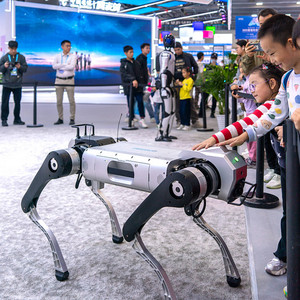
While in Hangzhou on Thursday, he met with business leaders and toured local tech companies, including Chinese robotics firm Unitree Technology.
Earlier, Aaron Leo spoke with the company's CEO and founder, Wang Xingxing.
Wang said that only through collaboration can humanity fully harness the benefits that robots have to offer.
We're honored to host German Chancellor Merz and his team.
During this process, we've noticed the global attention on China's robotics industry.
I believe with the world's joint efforts, we can push humanoid robots and AI to the next level and truly make robots benefit the globe.
I mainly introduced our company's progress, showcased our small and large-scale robots and highlighted our Wukong robots' performance in the Spring Festival Gala.
Robot, Combat and Industrial Applications.
I'm looking forward to more business and cooperation with German and global companies.
We believe robotics is for the future and the whole world.
Only through joint efforts can we succeed.
What insights can we gain about the path of Chinese tech companies from labs to the global stage?
How does this reshape global views on quality productivity and Chinese innovation?
I feel that in emerging tech fields, whether it's AI or robotics, they're really crowded with young people.
In a vibrant country like ours, young folks can really show their worth and chase their dreams.
I reckon this age we're in is just great.
There are loads of chances out there waiting for folks like me, for everyone to team up and make our dreams come true.
Given Germany's strengths in high-end manufacturing and China's leading artificial intelligence algorithms, Where do cooperation opportunities between China and Germany or the EU in humanoid robots and embodied intelligence lie?
I think both the robotics and AI fields are super new globally.
Actually, there's huge room for cooperation.
China has its strengths, and so do other countries.
If we work together and push for common goals, we can make a big cake and everyone can get their share.
Also in the AI field, it's not just one or two companies doing the work.
Many companies contribute.
It's the same in the robotics field.
Our company makes some contributions and so do other companies worldwide.
Only by working together can we break through the industry's critical point and truly make robots benefit all of humanity.
That was Wang Xingxing, the CEO and founder of China's Unitary Technology.
Michael Schuman is the chair of the board of directors at the German Federal Association for Economic Development and Foreign Trade.
During an interview with Zheng Tao, he described Chancellor Merz's visit to China as constructive and classic German diplomacy.
Schuman also said Chinese President Xi Jinping's vision for bilateral ties matches the priorities of German business.
How do you assess the overall significance of Chancellor Friedrich Merz's visit to China at this particular juncture in global affairs?
And in your view, what concrete outcomes stand out the most?
First, I guess one can say that it was a remarkable, constructive visit.
I would even go as far as saying, you know, Germany is back.
The classical school of German diplomacy is there.
And I think this visit marked, in my view, a return to this classic German diplomacy.
Obviously, the Chancellor sought a reset in German-Chinese relations, combining openness for cooperation also with a willingness to address sensitive issues, but in a discreet and in a respectful manner, behind closed doors.
And the fact that he was accompanied by the larger business delegation since the time of Angela Merkel, and it also underlines that Germany is ready to re-engage pragmatically.
And there were many concrete announcements, not only about the Airbus purchase but, I think, the announcement that the government consultations, The regular government consultations between Germany and China, will be resumed and they will be held in China this year.
It's also highly significant because it will bring many members of the German cabinet to China to see with their own eyes.
And hopefully this will deepen the mutual understanding at the working level.
You mentioned the progress made in bilateral relationship, and earlier President Xi Jinping outlined three propositions for advancing China-Germany relations, namely being reliable partners, innovative partners and partners with strong people-to-people ties.
How do you interpret these proposals?
Well, I think these three dimensions, they correspond very closely together to what our bilateral relations need, and certainly to the German economy.
Reliability.
Stability and reliability creates a framework for engagement and for business cooperation, economic cooperation and for long-term investment.
And the second dimension he mentioned innovation, reflects the what I would say, the reality that our relationship is increasingly shaped by joint innovation.
And then, of course, people-to-people exchange builds the trust, the trust that allows cooperation to continue.
This is what we've always stressed at BWA.
You connect projects, you connect companies, but ultimately you connect people with each other.
And I think this trust is what saves the basis for our economic engagements.
That was Michael Schuman, the chair of the board of directors at the German Federal Association for Economic Development and Foreign Trade.
Coming up, Pakistan and Afghanistan appear to be at war as China urges restraint.
You've been listening to programs from CGTN Radio.
14 past the hour.
Pakistan says it's carried out airstrikes on Kabul and Kandahar Afghanistan, in a dramatic escalation of tensions between the two countries.
Afghanistan says it has responded, attacking Pakistani troops.
The Pakistani defense minister wrote in a social media post that it's now open war between Pakistan and Afghanistan's Taliban government.
Simari Lai Abassin has more from Kabul.
Afghan forces launched what they called a large scale of military offensive against Pakistani military posts along the Durian Line, a 2600-kilometer border that separates Afghanistan from Pakistan.
In response to Pakistani airstrikes from the previous week, fierce ground clashes were reported in multiple sectors and several provinces worldwide.
Paktika, Khos, Kandahar, Helmand and Kunar.
And also that continues for more than four hours.
Soon after that, when the Afghan defense ministry announced the conclusion of their so-called retaliatory strikes against Pakistani forces along the border, the Pakistani jet were heard in Kabul and there were heavy sounds of explosions.
A government spokesperson said that fortunately, these strikes from the Pakistani air and defense forces had no casualties along the country.
And he said there were several provinces, including Kabul.
So for the people, it's a moment of panic and still it's not ended.
And I hear.
Well, rows of the jets in Kabul sky and the defense system here is also active every minute.
And for for the people, it's a very hard time.
On the other side, the mediators haven't issued any formal statement about these recent clashes.
And that's what must be awaited from the people of both countries, because war is always ugly and it brings destruction.
And hopefully there could be find any kind of solution between the two neighboring countries.
That was Zemari Lai Abassin reporting.
A Pakistani security source says the Afghan Taliban launched what it called a retaliatory attacks on Pakistani border posts on Thursday evening.
Islamabad and the Taliban administration claim to have destroyed or seized opposing border posts.
Daniel Khan reports from Islamabad.
Pakistan has launched a major cross-border military operation, named Operation Ghazal-ul-Haqq, against the Afghan Taliban, following unprovoked firing from across the border.
According to Pakistan's Information Ministry, Taliban fighters opened fire on multiple locations along the border in the northwestern province of Khyber Pakhtunkhwa.
Islamabad says two Pakistani security personnel have been killed in the clashes.
In response to this attack, 133 Afghan Taliban operatives have been killed.
According to the state Pakistani state media, the Pakistan Air Force has carried out what officials are calling precise and targeted airstrikes, not only along the border but deep inside Afghanistan.
Afghanistan, including Kabul, Kandahar and Paktika provinces, destroying multiple brigade and corps headquarters as well as ammunition depots and logistics bases.
Now, according to security sources, Pakistani forces have destroyed Taliban posts at the Keith Orkham crossing as well.
Meanwhile, the escalation is also affecting civilians.
Reportedly, Afghan families who were due to be repatriated through the Torkham border have been sent back to holding centres.
Now, senior Pakistani ministers, as well as the spokesperson for the Prime Minister, have accused the Afghan Taliban of targeting civilians and vowed what they describe as a befitting response, warning that Islamabad will not allow its security to be compromised.
That was Daniel Khan reporting.
China's called on the two countries to exercise restraint and resolve disputes through dialogue.
The countries expressed concern about the conflict, saying it's closely watching the development of the situation.
The foreign ministry says it's working with the Chinese embassies in Pakistan and Afghanistan to de-escalate tension and improve relations.
Iran and the US have wrapped up their third round of indirect nuclear talks in Geneva, mediated by Oman.
Iranian Foreign Minister, Syed Abbas Arachi, spoke positively of the discussions with both sides to meet a game in the coming days.
I can say that we made good progress after several hours of intensive negotiations.
We have started serious discussions about elements of a deal, both in the fields of nuclear issues and the removal of sanctions.
We agreed that technical teams should start technical work in the IAEA in Vienna on Monday.
It was decided that the next round of talks will be held soon, maybe in less than a week.
Omani foreign minister said the two sides plan to resume negotiations after consultations in their country's capitals.
A senior US official has been quoted as saying the negotiations were positive.
The talks come amid heightened tensions between the two.
Washington demands a deal to prevent Iran from developing nuclear weapons, while Tehran insists it's not seeking such arms and calls for sanctions to be lifted.
The US is sending more military assets to the Middle East as nuclear talks between Washington and Tehran continue.
The aircraft carrier, the USS Gerald Ford, has left Greece and arrived in Israel.
The stop in Greece was required due to a prolonged deployment as well as persistent plumbing problems.
Officials say clogged sanitation systems have led to severe delays, with sailors reportedly facing wait times of up to 45 minutes to use the restrooms on board.
Meantime, a U.S. official says that around a dozen F-22 fighter jets have also landed in Israel.
This marks the first time these specific combat aircraft have been deployed to the country for potential wartime operations.
Washington's been pressuring Tehran to agree to a nuclear deal or face military action.
Last week, President Donald Trump warned Iran to make a deal within 10 to 15 days or face the consequences.
Ukrainian and US officials met in Geneva on Thursday for talks on post-war reconstruction, even as broader negotiations with Russia remain deadlocked.
Officials in Kiev are hoping to finalize key details of the settlement at a trilateral meeting in early March.
Ukraine's chief negotiator confirmed that preparations are underway for the next round of talks.
After speaking with Rustam Umarov and envoys from U.S.
President Donald Trump, Ukrainian President Volodymyr Zelensky said the next round of negotiations with Russia will most likely be in Abu Dhabi in early March.
He added that the aim of these talks would be to pave the way for a meeting between the leaders of Ukraine and Russia.
Russian state media reported that President Vladimir Putin's special envoy also held talks with US officials in Geneva on the same day.
Kirill Dmitriev has declined to comment on the outcomes of that meeting.
Tensions between Hungary and Ukraine are rising.
Hungarian Foreign Minister, Peter Siartos, accused Ukraine of blackmailing his country by blocking supplies of Russian crude oil.
He demanded Kiev resume operations of the Druzeba pipeline immediately.
Oil shipments to Hungary and Slovakia via that facility have been interrupted since January 27th.
Ukrainian officials say the pause is due to damage by Russian drone attacks, but Hungary and Slovakia believe the pipeline is fully capable of resuming deliveries.
Earlier this week, Hungary threatened to block a major EU loan for Kiev and vetoed a new round of EU sanctions against Russia.
Cuba says it's foiled an armed infiltration attempt involving a U.S.-registered speedboat.
In a social media post, President Miguel Diaz-Canel said Cuba neither attacks nor threatens any nation, but will defend its sovereignty against what he called terrorists and mercenary aggression.
Cuba's Interior Ministry says border guards intercepted a Florida-registered speedboat that illegally entered Cuban waters, sparking a gun battle.
Four people on the boat were killed, six others wounded.
Authorities say the vessel carried 10 armed Cuban nationals living in the United States, several of them reportedly on Cuba's wanted list.
Weapons and military-style equipment were seized.
A separate suspect accused of coordinating the operation was detained in land.
U.S.
Secretary of State Marco Rubio says no US government personnel were involved, adding that Washington is now verifying the details.
Coming up, preparations underway for the annual two sessions meetings in the Chinese capital.
A selection of the best podcasts in China, covering history customs music, literature and in-depth dialogues.
Find your way to a wealth of Chinese culture and thinking all on POS Plus.
At 23 past the hour.
China's annual two sessions meetings begin next week, among the most important annual political events in the country.
The fourth session of the 14th National People's Congress will open on Thursday.
The annual session of the top political advisory body, the Chinese People's Political Consultative Conference, begins a day earlier.
More than 3000 journalists have registered to cover this year's meetings, including over 1000 reporters from Hong Kong Macau, Taiwan and overseas.
The media center for these events has already opened.
The National People's Congress includes 13 deputies from the Taiwan region.
They listen to the voices of Taiwan residents on the mainland and work to bring people on both sides of the Taiwan Strait closer together.
Chen Tong met with a third-generation Taiwan compatriot to find out more.
Tao Jun is one of the 13 deputies from Taiwan and the National People's Congress now dedicated to serving and connecting Taiwan residents in Zhejiang province.
One of his key tasks ahead of two sessions is to listen to their concerns and suggestions.
These are young Taiwan residents who work and live in Hangzhou.
As Tao Si said, their biggest challenge is the lack of effective communication channels for Taiwan residents to better understand the mainland.
Many of our favorable policies, including employment business startups, cannot be well known by Taiwan residents, so they couldn't know the information.
The current cross-strait situation is complicated and severe, and the Democratic Progressive Party authorities in Taiwan have set a lot of communication barriers for people to know about the mainland.
Breaking through these barriers is the key focus of Tao's proposals this year.
We can encourage young people work at Taiwan, companies and associations to use their strategies to publish information on social media, such as the Line mobile application.
Our contents cannot be all texts, but should be easily accepted by people like animations and videos.
Tao himself is a third generation Taiwan compatriot, born and raised on the mainland.
There are more than 50,000 people like him across China.
Though he does not speak with the Taiwan accent, his family roots give him a strong sense of belonging within the Taiwan community.
Although I am a third-generation compatriot born on the mainland, our family ties remain unchanged.
I have always cared about our compatriots in Taiwan and the development of cross-strait relations.
The Zhejiang Federation of Taiwan compatriots was the first such organization established on the mainland, founded in 1980.
While Zhejiang does not have the largest number of Taiwan investors and prices, more than 1 million people from Zhejiang live in Taiwan.
Deputies like Tao serve as the important bridge of communication.
In the National People's Congress, there are 13 deputies from Taiwan.
They are from industries including technology, healthcare, culture and education.
Nearly all of them have working experiences at local Taiwan business associations.
They use their voices to bond Taiwan more closely with the mainland.
That was Chen Tong reporting.
China's pushing humanoid robots out of the lab and into the real world.
Huang Fei reports.
Humanoid robots have been flexing their skills for years, running marathons, fighting close-range battles, even performing coordinated stunts on live television.
In China, they're moving beyond spectacle.
Humanoids are clocking in for real jobs stocking shelves, moving supplies and learning to operate like human employees.
So how do you train a robot to think, move and behave like one?
Welcome to the AGI bot data factory here in Shanghai.
It looks almost like a miniature human world, with every task you want your humanoid friend to master making juice folding, laundry and it's open source.
The data generated here can be used by many other companies to train their own robots.
Nearly a thousand humanoids are learning their trade here every day.
Human trainers quite literally hold their hands guiding each motion until the robots can solve the task on their own.
This is demonstration data created by humans.
We call it expert data.
We also get data from the algorithm's own reasoning.
Data, hardware and algorithms improve together in a positive spiral.
More data leads to better models, which can be deployed in real-world scenarios.
By open sourcing our datasets.
We invite the global developer community to contribute and speed up progress together.
That open approach is paying off.
Global shipments of humanoid robots surged to around 18000 units in 2025, more than five times higher than the year before.
Chinese firms dominate the market.
AGI bought a loan shipped over 5,100 units last year, which is nearly 40% of the global total.
China now has an engineer dividend.
Our teams bring strong innovation experience from smart vehicles, drones, LiDAR, and more.
We also benefit from a complete industrial supply chain.
The sensor ecosystems from EV and drones can be recalibrated for robotics, enabling fast iteration and scale-up.
Report from Huangfei in Shanghai.
Around 29 and past now.
Beijing cloudy overnight.
It's down to zero.
Saturday's overcast and four degrees.
Shanghai is cloudy and seven this evening, then overcast and 15.
Chongqing will be getting clouds and 14 tonight, then a light rainfall developing 18 degrees for the weekend.
Nanchang's a light rain and 10 overnight, then moderate rainfall and 15.
Last is down to minus two, then sunny and 16.
It's time for a short break.
So far this hour.
A top meeting in China says the next five years will be critical for the development of socialist modernization across the country.
Pakistan says there's open war with Afghanistan now, as the two countries continue to launch attacks against each other.
And China is preparing for its annual two sessions meetings in Beijing, with the opening beginning next week.
Shane Bigham with you.
Stay with us here on the Beijing Hour.
Listen up.
Can you hear the heartbeat of our world?
It's vibrant and pulsating with the essence of life itself.
From the stem of trees to the gurgle of rivers.
From the silent strength of mountains to the icy whispers of glaciers.
Even the solid ground beneath our feet.
Right there, in the midst of all, beats the heart of humanity.
What if those other heartbeats were to stop?
Would ours keep on ticking?
Ever wondered what's actually going on in Africa through the perspective of an African?
How are things really going between China and Africa?
What's the narrative of this relationship?
Well, get a perspective with China Africa Talk.
Hear from African diplomats, entrepreneurs, academics, Chinese natives and more.
Get on our wavelength every week to find out what's real with China Africa Talk.
Find us on your favorite podcast.
We'll see you there.
Examining the events that impact and shape China and the rest of the world.
This is the Beijing Hour, one hour of news and information brought to you every weekday.
Now, here's your host.
Shane Bigum with you on this Friday.
Still to come in business.
China's central bank is making moves as the country's currency approaches a three-year high.
In sports, China takes a win at the qualifiers for the FIBA World Cup.
In culture and entertainment.
An art exhibition in the US with themes related to the Year of the Horse.
To contact us, you can email radio at cgtn.com or follow our ex-account at CGTN Radio.
Now checking the day's headlines, here's Tianlu.
Thank you, Shane.
A top meeting in China has described the next five years as a critical period for laying a solid foundation to realize socialist modernization.
General Secretary Xi Jinping chaired a meeting of the Political Bureau of the Communist Party of China Central Committee.
It revealed a draft outline of the country's 15th five-year plan for economic and social development.
The meeting called for steady progress high-quality development and innovation.
Officials also discussed the draft government work report the State Council will submit to the annual session of the National Legislature for review.
It noted the building of a strong domestic market, fostering new growth drivers and developing high-level technological self-reliance.
The Environment Ministry says China's air quality reached its best level on record in 2025.
The average PM25 concentration dropped to 28 micrograms per cubic meter, with 893 of days experiencing good air quality.
Northern regions showed the most significant improvement, with Linfen in Shanxi province recording the sharpest decline in PM25 levels nationwide.
Key industrial upgrades included ultra-low emissions retrofits for steel, coking and cement production during the country's 14th five-year plan period.
China has criticized the Philippines for disrupting peace and stability in the South China Sea using countries from outside the region for so-called joint patrols.
A spokesperson for the People's Liberation Army Southern Theater Command said the Navy completed a routine patrol in the South China Sea this week.
The spokesperson said, theater command forces will safeguard China's territorial sovereignty and maritime rights and interests and firmly uphold regional peace and stability.
Pakistan's defense minister says the country has started an open war against Afghanistan.
Pakistan has launched airstrikes on Afghan defense facilities in major cities.
It said the strikes were a response to the attacks on Pakistani posts on the border on Thursday.
Afghanistan said it conducted retaliatory operations on Pakistani military targets.
China has expressed concern about the conflict.
Foreign ministry spokesperson Mao Ning warned against prolonged hostilities.
She said the ministry, along with the Chinese embassies in Pakistan and Afghanistan, are making efforts to de-escalate tension and improve relations.
A UN spokesperson says more than 7600 people died or went missing on migration routes worldwide last year.
Stefan Durerik cited a report by the International Organization for Migration saying sea crossings remain among the deadliest routes.
In 2025, at least 2185 people died or went missing in the Mediterranean, while 1214 were recorded in the Western Africa Atlantic routes towards the Canary Islands.
Despite year-on declines, IOM says the real toll is likely much higher, as at least 1500 additional people were reported missing at sea but could not be verified due to limited access to search and rescue information.
The IOM also said the number of deaths last year was lower than the nearly 9,200 recorded in 2024.
It said, the decline means fewer people attempt dangerous irregular migration routes, but it's also due to restricted access to information and funding constraints for humanitarian actors documenting migrant deaths.
Lawmakers from Uruguay and Argentina have approved the trade agreement between Mercosur and the European Union that created the world's largest free trade zone.
They become the first among the founding members of the South American bloc to ratify the pact.
The trade pact covers a market representing nearly 20% of global GDP.
Brazil and Paraguay are also preparing to take the same measure in the coming weeks.
Thank you very much.
That's Tian Liu with Headlines.
Coming up in business.
China's central bank is making moves as the country's currency approaches a three-year high.
The Beijing Hour, your window on China and the rest of the world.
36 past the hour.
And with business now, here's Wang Zihang.
Thank you, Shane.
First of all, let's take a quick look at the Chinese mainland markets.
The Shanghai composite edged up 0.4% and the Shenzhen component was down slightly.
Timothy Pope has more.
The markets here on the Chinese mainland locked in again for the week, since trade resumed on Tuesday.
But today, only the Shanghai Composite Index was making any really decent headway.
It added 0.4%.
Down in Shenzhen, the Component Index was flat and the Chinex board sank.
But we have seen interest resume in equities really again after the holiday.
And a lot of the heavy selling that we saw before the Spring Festival, including from the big funds, that seems to have really slowed significantly, or stopped, at least for now.
For the next little while, everyone's attention will be on policy signals and interpreting every announcement from the government before the two sessions begins later next week, and also during it.
Today, of course, the big announcement was the PBOC has basically axed the forward Forex risk reserve requirement.
So financial institutions wanting to hedge using the US dollar or other currencies don't need to give 20 of the value of the investment to the PBOC to hang on to for a while.
The markets like this kind of signal ahead of the two sessions, because the UN has been going pretty strongly and this will help to curb excessive currency value rises.
Exporters are going to feel the benefit of this move, and we saw consumer stocks gain some ground today as a result of that.
Otherwise, the big winners today were material stocks.
We saw steel, rare earth and critical minerals producers contributing a lot to the gains, as did energy and telecoms companies.
That was Timothy Pope reporting.
Elsewhere in China, the Hong Kong stock market ended higher, with the Hang Seng up by 0.9%.
Meantime, stocks in Japan closed higher as well.
The Nikkei rose 0.1%.
China's central bank will cut a key ratio as part of a move to maintain stability in the Chinese currency and curb potential capital outflows.
The foreign exchange risk reserve ratio for forward forex sales will come down to 0 from 20, effective on Monday.
The move comes as the yuan reached its highest level in nearly three years on Thursday.
For more.
Lincoln Humphreys spoke with Xu Qiang, a fellow of the Belgian Road Research Centre at Minzhou University of China.
So how do you interpret the broader strategy behind the People's Bank of China's move to lower the foreign exchange risk reserves?
And what signals does this send to the market?
Well Lincoln, you have to understand.
Actually, ever since 2022, Renminbi has actually been seeing a great plunge against the US dollar.
So actually I think, in order to stabilize the health market, Central Bank of China actually upgraded this, rising up the whole risk reserve from 0 to 20, which means if you want to buy more of the US dollar in any case in the future, you basically will have to pay more of the cost on that.
So through this kind of operation, they lowered the pressure on the renminbi's dropping.
But now I think the whole situation has been reversed.
Well, I think, in a very short term, renminbi has been rising up against US dollar for a very, very quick pace.
So I think the central bank has been removing this 20% of extra cost on the risk reserve.
It's basically telling the whole market.
Number one do not bet on the single-handed appreciation of the renminbi in a short term.
So by doing so they can cool off the whole market and warming everybody, that the reserve, the foreign exchange reserve, actually are fluctuating in both ways.
Number two they're telling the whole market that within the pocket of the central bank they still have lots of the tools.
If renminbi keep on rising too quickly and too sharply, the central bank of China actually can use some other tools to balance the whole trade.
For example, we still have the counter cyclical adjustment to factors and all the other kind of measures to do so.
And also, I think, Central Bank made it very clear.
They also try to do this in order to lower the cost for the traders, especially those ones who imported the rail things, rail services, so that we can serve the rail economy by doing more on this financial market.
So how will foreign trade enterprises most likely respond to this move and how does it affect their options in the Chinese market?
Well, absolutely, I think they welcome it.
I think number one is they will have more options.
Like we just reminded everyone that we have to do this before is because we want to add into some 20 of the extra cost.
To slow everybody down, do not rush into the US dollar market.
But right now, I think when the whole market has been reversed, would try to lower this cost.
So I think eventually it's going to be the great news for all the traders, because when they try to buy or sell, they will have less of a cost anyway.
So I think it's going to be cheaper and also that will be translated on the cost of all the imports.
For example, if you buy something in China right now, imported from outside world, outside market, it's going to be cheaper.
So I think that this is good news.
And also, I think, for all the traders.
I think the least thing they want to see right now is, you know, when the international geopolitical conflicts are happening, when the inflation are happening, they don't want to see renminbi to rise up to appreciate that much, because that means the export from China will get more and more expensive.
So they don't want to see renminbi to rise up so quickly and so sharp.
So I think there's cooling off by the central bank of China.
Actually help us to you know mild people's expectation for the rising renminbi and also cooling off the rising expectation for export from China.
That was Qu Jiang at Minzu University of China.
Now the Chinese yuan became one of the world's first interest-bearing central bank digital currencies at the start of the year.
Yu Li spoke with chief researcher Dongxi Miao at Merchants Union Consumer Finance to find out what the shift could mean.
Starting January 1, funds in digital yuan wallets will earn interest at demand deposit rates, making the RMB one of the world's first interest-bearing central bank digital currencies.
Before, the digital yuan was positioned as M0 digital cash equivalent to banknotes.
It is now classified primarily as M1 or deposit money, meaning banks will treat it as deposits that can be used for lending and accrue interest.
Dong noted that this move will broaden the digital yuan's use cases and strengthen its role in cross-border settlements, advancing the currency's internationalization.
The PBOC first began testing a digital fiat currency in 2014.
And in 2020 it launched pilot digital currency electronic payment projects in the Guangdong, Hong Kong, Macau Great Bay area, the Beijing Tianjin Hebei region and the Yangtze River Delta.
Since then, the digital yuan has seen significant growth both in its range of applications and in overall usage.
The digital yuan supports both online payments through mobile apps and offline transactions.
It comes with hard wallets like mobile, NFC or physical cards, so payments can be made even without a network connection.
In the next phase, smart contracts could be added enabling conditional payments such as installment plans.
Currently, there are 10 designated institutions authorized to operate the digital yuan.
These include six state-owned commercial banks, two joint stock banks and two internet banks, with more banks actively applying to join.
That was Yu Li reporting.
Trade in the mainland cities of the Guangdong, Hong Kong Macau, Greater Bay Area has surged to record levels during China's 14th Five-Year Plan period, highlighting the region's growing weight in global commerce.
Officials say total imports and exports reached over 98 trillion yuan in 2025, up more than a third from 2020 and accounting for about 20 of the country's overall trade.
Private companies led the expansion, while higher-value general trade took a larger share.
Exports of high-tech products and green industries, such as electric vehicles, lithium batteries and solar panels, surged.
Trade with emerging markets such as ASEAN and Latin America grew quickly, pointing to stronger resilience and diversification.
China's electric vehicle charging network continued to rapid expansion at the start of this year.
The National Energy Administration says the total number of charging points nationwide had reached nearly 207 million by the end of January, up almost 50 yearly.
Of these earth, public charges totaled about 48 million, rising 31, while private installations climbed 56 to nearly 159 million.
The figures highlight accelerating infrastructure growth as China scales up support for electric vehicle adoption and cleaner transport.
China's second domestically built large cruise ship is on track for delivery by the end of the year.
China's state shipbuilding corporation says the Odora Flora city is set to undock in mid-March for initial testing, with sea trials planned for late May.
At nearly 142000 metric tons, it marks another step forward in China's ability to build large cruise liners.
The new ship is longer than the country's first domestically built model and features expanded public spaces, improved comfort and upgraded environmental systems designed to reduce emissions during operations.
And finally, Paramount Skydance has emerged as the leading bidder to acquire Warner Bros.
Discovery after Netflix declined to raise its offer, ending months of takeover competition.
Netflix said matching the latest bid would no longer be financially attractive.
Warner's board must still vote to terminate the Netflix agreement and approve Paramount's proposal, reportedly valued at 31 a share higher than Netflix's bid of 2775.
CEO David Zaslav said the merger could create significant shareholder value and strengthen global storytelling capacity.
As consolidation pressures reshape the entertainment industry,
Thank you very much.
That's Wang Zaheng with Business.
You're listening to The Beijing Hour.
Coming up in sports, China takes a win at the qualifiers for the FIBA World Cup.
Sideline Story brings you all things sports-related the hottest topics, latest events, juiciest stories, all with a very personal take.
Subscribe to Sideline Story Podcast for heated sports discussions covering events that are happening in China and around the world.
We begin with basketball from the Asian qualifiers for next year's FIBA World Cup.
China beat Japan 87-80 in Okinawa on Thursday.
It's their first win in the Asian qualifiers for the 2027 Basketball World Cup.
Five Chinese players scored in double figures.
The win improves China's record to 1-2 in Group B.
Coach Guo Shicheng says the team's comeback was fueled by belief, trust and defense.
Look in the whole game.
We did not play well, either offense or defense, in the first half, but at half time i told the players we had to keep our belief, trust our teammates and trust this china man's basketball team.
We had to start from defense, take it step by step and gradually turn around, and in the end we did gather win, especially in the second half.
Every player on the floor did a great job and they really show our focus.
They now have a chance to advance.
They'll play Chinese Taipei on Sunday.
In table tennis, China's Chen Yuanyu has pulled off a major upset in the round of 16 at the Singapore Smash.
He defeated second seed Hugo Calderano 3-1.
World number one Wang Chuqin also booked a place in the quarterfinals.
Wang beat Anders Lind 3-1 after a closely contested battle.
This match was truly an awkward win.
Playing against Lin again was still very tough, as his style feels awkward for me and I struggled to find scoring opportunities.
Early on I was probing but could not figure it out.
After falling behind though, I gradually calmed down and became more confident and resolute, and that's how I ended up winning.
On the women's side, Chen Yi made it to the quarterfinals after defeating Hanoka Hashimoto in straight games.
In the next match, she'll face third-seeded compatriot Chen Xingtong.
Wang Manyu and Wang Yidi have also progressed.
Quan Mai is out, losing to Hina Hayata in five sets.
In the NBA, the Phoenix Suns beat the Los Angeles Lakers 113-110.
Royce O'Neal hit a winning three-pointer with less than a second left.
Grayson Allen scored 28 points for Phoenix.
Luka Doncic led the Lakers with 41.
Austin Reeves missed a three-pointer at the buzzer for L.A.
The Suns won despite missing their two top scorers.
Devin Booker and Dylan Brooks both have injuries.
Los Angeles Lakers head coach J.J.
Redick expressed disappointment.
We talk about this as a staff.
Our losses are louder than other teams because we're the Lakers and because of the way we lose.
You get this deep in the season and again tonight was a A one-possession clutch game which now we've lost a few of those, but we've been great for the most part in the clutch all year.
Our losses are louder, I would say, so we had some adversity tonight.
Did we not respond?
Phoenix has won two of five games since the All-Star break.
The San Antonio Spurs have taken their 11th straight victory, beating the Brooklyn Nets 126-110.
In tennis from the ATP Mexican opener in Acapulco, Wu Yibing lost to Flavio Caballi in the quarterfinals, failing to build on previous wins over Kasparud and Sho Shimabukuro.
This was Wu's first appearance in the last eight of an ATP 500 event.
A solid performance could have propelled Wu into the top 100.
Fifth seed Caballi will meet Serbian Miramir Kecmanovic for a place in the final.
Francis Tiafoe has also reached the last four after knocking out Matteo Bellucci in straight sets.
Over in the UAE, Felix Auger-Aliassimi has booked a place in the semis of the Dubai Championships after a straight sets victory against Yuri Leheka.
The top seed is yet to drop a set through his three matches this week in Dubai.
The Canadian will meet third seed Daniil Medvedev in the last four.
Medvedev came into the semifinals in Dubai for a third time in his career, after beating Jensen Brooksby in under an hour.
Talon Greek Spore reached the last four of the Dubai Tennis Championships for a second year in a row after picking up a three-sets win over the sixth seed, Jacob Mensik.
He'll next take on Andrei Rublev for a place in the final.
It's 52 minutes past the hour.
Coming up in culture and entertainment.
An art exhibition in the US with themes related to the Year of the Horse.
From north to south, east to west, people in China are chasing their dreams and leaving their mark.
Want to know how they beat the odds and made a difference?
Footprints brings you the true life stories of their journeys.
52 past the hour.
A turn into culture and entertainment.
An exhibition in the United States has been displaying more than 100 artworks to explore horse-related symbolism, as 2026 marks the Year of the Horse on the Chinese lunar calendar.
And Francesco reports here at this spot in Alexandria Virginia, outside Washington DC, culture and community intersect.
This brings a lot of different people into one space and it opens up conversation.
Morgan Parr is curator of this exhibit featuring more than 100 pieces of art coming together to usher in the year of the horse.
The stability and the the strength of the horse, i think, was what spoke to me, each of these works telling its own story of the symbolism behind the animal.
But a lot of people really kind of dug deep through a variety of media.
We have folks who do oil paintings, we have folks who do photography, print making, paper folding, acrylics.
Nearly 70 artists are channeling the spirit of the horse, Symbolizing vitality, unbridled spirit and transformation.
An animal that spoke to artist Kelly Snyder when she was a kid.
A love she manifested in a piece featuring a black horse.
They're just so beautiful.
They're so beautiful. colors and they're majestic and they're just, I just have always loved horses.
In this show it's all about positivity, and peace and the just in general like horses bring that kind of like awe.
Nancy Patrick's lifelong love for the animal expressed through these paintings.
And one of the first books I ever read was Black Beauty.
And I was struck by how sensitive the horse was, but how strong and adaptable.
For Tao Gao.
Originally from China's Shangxi province, his three golden pictographs feature the Chinese character for horse Ma.
A single character can be rendered in countless forms and methods, each revealing its essence.
This is both a character and a horse.
Calligraphic artistry, there's so much depth.
Writing with a brush is rare now.
Mastering brush tips, upper, lower and center is profoundly intricate.
The beauty of this exhibit was born out of a dark time, says curator Morgan Parr.
A friend of mine was walking home one day and she was accosted by a bunch of guys who were just walking around and kept yelling at her to go back to China.
I was really upset.
The hope here that these art creations will encourage what Parr says is a lost art, dialogue.
What a great way to kind of bring different Asian cultures in to the forefront and uplift them.
We learn about everyone's differences, how we're alike, how we're similar, and that's how we overcome any kind of obstacles that we have in our society.
That was Frances Coat reporting.
Chinese racing film Pegasus 3 has held its London premiere.
It was the highest-grossing film in China for the 2026 Chinese New Year holiday.
The comedy's earned over 3.4 billion yuan, that's roughly half a billion U.S. dollars.
Directed by Han Han, it stars comedian Shen Tung.
The previous two films in the franchise earned 5 billion yuan together, and Pegasus 3 is now among China's top 20 films of all time.
The release of the martial arts film Blades of the Guardians during the 2026 Spring Festival holiday has brought significant attention to Karamei Xinjiang, one of the movie's key filming locations.
Revered as a natural film studio.
The area's yardunk landforms and Gobi Desert provided an authentic visual foundation for the film's portrayal of a rugged, heroic frontier.
Local authorities have launched curated cultural tours and travel packages.
Visitors can now step into the region's stunning desert scenery and experience the film's cinematic atmosphere firsthand.
Li Jingchao is head of Self Drive Tours and he says the number of visitors has been increasing.
To turn screen buzz into on-site visits.
We introduced policies like free entry with a movie ticket stub and half-price accommodation vouchers during the Spring Festival.
The strategy has paid off.
Visitor numbers surged over 20% year-on-year.
This film has raked in roughly $1 billion at the box office so far.
We're at 57 past the hour, checking the forecast before we go for the weekend.
Beijing cloudy overnight.
It's down to zero.
Overcast conditions and four degrees on Saturday.
Shanghai will be cloudy in seven, then overcast in 15.
Chongqing's cloudy in 14, then a light rainfall in 18.
Nancheng will see a light rainfall this evening in 10 degrees, followed by moderate rain in 15.
Last is down to minus two, then sunny in 16.
Elsewhere in Asia, Islamabad will be cloudy and 12 degrees.
This evening Saturday, sunny and 25 degrees Celsius.
That's it for this edition of the Beijing Hour.
Making news today.
A top meeting in China says the next five years will be critical for the development of socialist modernization across the country.
And Pakistan says there's open war with Afghanistan now, as the two countries continue to launch attacks against each other.
On behalf of the staff.
This is Shane Bigum in the Chinese capital, hoping you'll join us for the next edition of The Beijing Hour and open a window to the world together.
Find The Beijing Hour at precisely 6 p.m.
Beijing time.
We meet you on podcast and on air every weekday.
The Beijing Hour, your window on China and the rest of the world.
He can't live without the Yellow River in his eyes.
The Yellow River is so noble and elegant.
Both my grandpa and dad made a living from the river.
Would you like to move away from the Yellow River?
I don't think I will.
I love it so much.
The Yellow River, the second longest river in China, is regarded as a shaping force in the history, economy and culture of northern China.
Today, about 100 million people live within its water basin, making up nearly 9 of the country's population.
How is climate change felt at its headwaters?
What are the locals doing to cope with it?
What are the descendants of the boatmen doing?
What has kept some people from leaving their home village by the river?
And what has drawn others back?
Could the fading fishing community revive in a time of digital transformation?
From 2021 to 2024.
Our reporters visited the upper, middle and lower reaches of the Yellow River, Talk to the herders farmers boatmen, fishermen and eco-activists who share a close bond with the river, and present their stories in pictures, podcasts and videos.
All in our 12-part series, The Yellow River Mosaic, available only on CGTN Radio.