Get the unmissable news stories of the day.
This is the Beijing Hour, Examining the events that impact and shape China and the rest of the world.
This is the Beijing Hour, one hour of news and information brought to you every weekday.
Now here's your host.
Shane Bigham with you on this Tuesday, September 30th, 2025.
You're listening to the Beijing Hour, coming to you live from the Chinese capital.
On today's program, China's marked Martyr's Day, honouring revolutionary heroes and others who've made the ultimate sacrifice for the country.
Israel has agreed to Washington's 20-point plan for ending the conflict in Gaza.
And Denmark will be the guest of honor at the China Nordic Economic and Trade Forum in the city of Wuhan.
In business, surging travel and nighttime spending as China prepares for the Golden Week holiday.
In sports, a Chinese tennis star bows out at the China Open.
In culture and entertainment, the Greater Bay Area film concert is now underway.
Now checking the day's top stories.
China's honored revolutionary heroes and others who sacrificed their lives for national causes.
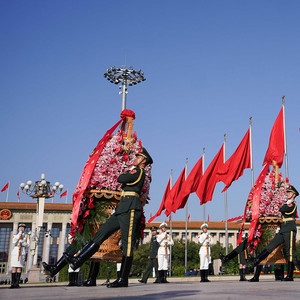
President Xi Jinping has held tributes at Tiananmen Square on Martyr's Day.
Chinese leaders, along with representatives from all sectors, attended a ceremony on Tuesday morning.
Commemorative events also took place across the country.
Hundreds of students gathered in Hezhe in eastern China and listened to stories of fallen heroes.
Students at Sichuan University learned about female revolutionary hero Cheng Zhiyun and her courage.
More young people in Sichuan province paid respects and laid flowers at a site dedicated to the Red Army's Long March.
China will celebrate National Day on Wednesday.
China has been honoring fallen heroes in various ways.
The September 3rd military parade marking 80 years of victory in the war of resistance against Japanese aggression and World War II featured a battle flag formation bearing the names of heroic units from the blood-soaked front lines.
China has regulations for commending martyrs and protecting the rights and interests of their families.
A DNA laboratory has helped locate burial sites or identify relatives of thousands of national heroes.
China's manufacturing activity picked up in September.
The purchasing manager's index rose to 49.8, up 0.4 points from last month.
The sub-index for production jumped to 51.9, the highest level in six months.
Demand also showed signs of recovery as new orders edged up to 49.7, up two-tenths.
Meanwhile, the non-manufacturing PMI stood at 50 even this month.
And for more on the performance of China's manufacturing sector.
We are joined by Liu Zhuqin, a senior fellow at the Chongyang Institute for Financial Studies at Remen University of China.
Thanks for joining us this evening.
And first up, what messages does the rebound of the headline PMI signal?
I think this figure shows the very positive and the incorrigible message to the market, as we know that in September is very special for China's economy.
Normally the September and October are the best season for the manufacturing and the production line.
So this figure shows three things.
One thing is that China's economy is still on the territory of expansion for further development.
And secondly, it's on the way to recovery, because I think the number is 498 is quite better than expected expectation.
And the third, that shows the stabilizing of the market expectation.
This is a very important signal to the world market also for the domestic market.
At least it shows that from the manufacturing side and also the non-manufacturing industry, from both sides that we can see the supply chain and the demand chain are in good balance.
That is a very important precondition for further recovery and development for the next three months.
And what policy measures and market trends could help sustain this momentum in the coming months?
As we know that our major task for the next three months, the last quarter, is to make our economic development more stable, more sustainable, especially to make our expectation certain.
Because now we are facing uncertainty all over the world from the external market.
So the certain expectation is very important for domestic market.
So I suggest that we should have very strong expectations and active policy measures to support our market development.
For instance, how to make the financial sections more active and more budget-oriented.
This is a very important thing to further support real economy and also to support the innovation industries.
Secondly, also this policy to support AI and high technology development, especially for the innovation sections that we should have more power to promote.
So I think China in the next three months will have more room for further development, not only for the basic infrastructure but also for high technologies, because this is still very important and a lifeline for China's economy in the world.
Thanks for joining us this evening.
That's Liu Zhijun from Renmin University of China.
Small and medium-sized enterprises on the Chinese mainland have achieved remarkable results in digital transformation and intelligent production by teaming up with the Hong Kong Productivity Council.
The partnership has enhanced their business competitiveness and boosted high-quality manufacturing.
Chen Yilin reports.
For the latest industrial trends in China, Shanghai is the place to be.
One standout example is this lights-out factory developed by Home Radar Group.
It's a powerful tale of transformation from a traditional mold-making company to a smart manufacturing leader.
Our transformation began in 2016.
Our group has four bases in Malaysia Hong Kong, Zhongshan and Shenzhen.
Before it was very difficult to manage.
We have benefited greatly from digital transformation, developing a digital management system that allows for real-time data connectivity, which has significantly maximized our efficiency.
A key contributor to the company's digital transformation is the Hong Kong Productivity Council.
As one of Hong Kong's largest RD institutions, Tecumseh is making its first appearance at the industrial fair.
Beyond bringing advanced technologies, it aims to meet vast demand, helping China's manufacturers go global.
So we are very honored to be able to participate this time for our first time, because we want to showcase our capability and experience in helping enterprises to go through the technology transformation.
Again, we have been helping Hong Kong companies to go global for the last 58 years.
So that's why when we heard that, oh, you know, we did it and finally there's such a big need here.
That's why we changed our focus.
We set up Cradle specifically to support mainland enterprises to go through Hong Kong, make use of Hong Kong Productivity Council services to go global together.
A prime example is a collaboration with Beijing's Yunji Technology, a company that has deployed AI robotic solutions to over 30000 scenarios, not just in China, but in the Middle East, North America and beyond.
Yunji's partnership with the Hong Kong Productivity Council is crucial to our global expansion.
It has helped us quickly adapt to international technical standards and provided valuable advice on localized operations and intellectual property protection across over 40 countries and regions.
Through these partnerships, we hope to bring China's innovative smart service robots to a wider international market.
It's this blend of learning from the best at home while collaborating for new opportunities on the world stage that truly transform China's manufacturing sector.
That was Chen Yilin reporting from Shanghai.
China is expecting a peak in passenger flow on Wednesday at the start of the eight-day holiday.
Big cities such as Shanghai, Guangzhou and Beijing remain popular destinations.
Cultural tourism is an alternative at lesser-known sites.
In the resort city of Haikou on Hainan Island, authorities are rolling out a series of entertainment activities for the National Day and Mid-Autumn Festival break.
Ding Siyue takes a look.
Haikou City in southern China's Hainan Province has prepared over 100 events, including art shows, concerts and sports competitions.
More than 10 sporting events will also take place, including canoeing, basketball leagues and sailing competitions.
A variety of cultural activities will also be held in High Coast Holiday Resort, ranging from intangible heritage fashion show and romantic wedding tourism events to celebratory National Day concerts.
Heiko is also treating visitors to a culinary feast with special dining offers.
We are launching substantial dining vouchers to invite everyone to experience authentic Hainan cuisine.
Over 20 business districts will host nearly 160 promotional events.
Heiko's beautiful scenery, vibrant culture and authentic cuisine warmly welcomes global visitors to come and experience them firsthand during this holiday.
That was a report on ways to spend a holiday in Hainan province.
Mooncakes are the traditional snack for the mid-autumn festival.
Yunnan-style mooncakes have become popular in overseas markets for their rich flavors and variety.
Recent markets for the pastries from the southwestern province include countries and regions like Singapore, Malaysia and Hong Kong.
Yunnan's been exporting ham mooncakes for 34 years.
Flowers and black truffles are also distinctive fillings.
Customs data shows that the province exported more than 7500 tons of mooncake products in the first eight months of the year, with a value of 130 million yuan or 18 million US dollars.
Coming up, Washington's 20-point plan for ending the conflict in Gaza.
To buy or not to buy?
That's the question.
China is easing property restrictions and loosening cross-border financing rules to draw more foreign buyers.
Is this a last resort to boost its housing market?
How much appetite does foreign capital have for Chinese real estate?
Which cities are likely to stand out for overseas investors?
And what further reforms are needed to bring in capital without tipping the balance?
Tune in to The Chat Lounge this week, wherever you get your podcasts, and on CGTN Radio as we break down the changes that might reshape China's property market.
We're at 11 minutes past the hour.
U.S.
President Donald Trump and Israeli Prime Minister Benjamin Netanyahu have agreed on a 20-point plan aimed at ending the conflict in Gaza following talks at the White House.
Trump said it includes a deal to release all hostages.
Hamas source said the group has received the U.S. proposal through Qatari and Egyptian mediators.
Tony Waterman has details.
This is an agreement between the US and Israel and it comes with a warning to Hamas, which was not part of these negotiations.
And that warning is agree to this deal or Israel has the full backing of the US to finish the job in Gaza, to get rid of Hamas once and for all.
Under this plan, all of the hostages dead and alive will need to be released within 72 hours.
Hamas has also refused to disarm, and that is a central tenant of this deal.
So the ball is very much being left in Hamas's court, which may be intentional.
If Hamas rejects your plan, Mr President, or if they supposedly accept it and then basically do everything to counter it, then Israel will finish the job by itself.
This can be done the easy way, Or it can be done the hard way.
They're the only one left.
Everyone else has accepted it.
But I have a feeling that we're going to have a positive answer.
But if not, as you know, baby, you'd have more full backing. to do what you would have to do.
When it comes to governance, which has really been the big question mark over a post-war Gaza.
We now have more detail on that.
There will be a technocratic, apolitical Palestinian committee that is going to be created and they're going to be responsible for the day-to-day operations.
But that committee is going to be supervised by a new Board of Peace, as it is being called.
The chairman of that board is going to be US President Donald Trump.
Other members will include former UK Prime Minister Tony Blair.
Now it's this body that is going to set the framework and handle the funding for the redevelopment of Gaza.
Ultimately, under this plan, it will be the Palestinian Authority that will have control once certain milestones at reform are met.
And the plan makes it very clear that Hamas is going to have no role in this new government.
Prime Minister Benjamin Netanyahu and Israel have really been coming under a lot of international pressure for this war to come to an end.
So was pressure from US President Donald Trump.
Trump and Netanyahu have been close friends.
They are close allies, but their priorities are really starting to go off in different directions.
And Trump wants to bring this war to an end.
And this is why this pressure and why this meeting at the White House is taking place.
Again, it's going to rely on Hamas agreeing to these conditions, conditions that it has said in the past it would not agree to.
That was Tony Waterman in Washington.
Palestinians in Gaza say they doubt U.S.
President, Donald Trump's meeting with Israeli Prime Minister Benjamin Netanyahu will bring a breakthrough in ending the war.
For two years we've been hearing that tomorrow or the day after there will be good news or something.
We no longer believe anyone, not the president of a superpower, nor the president of a small or big country.
We want this war to end.
We are drowning and clutching at straws, clutching to a dream that there will be a permanent ceasefire or a ceasefire and choose of 60 days.
We are exhausted.
I swear, we are exhausted.
Enough.
Entire generations have been lost.
In Israel, the families of the hostages are hopeful after the two leaders said they'd agreed to a plan to end the war in Gaza.
Guy Gorin's the son of hostages whose bodies are still held in Gaza.
He's eager to bring them home.
We are trying to be optimistic today.
We were very happy to hear what Trump said.
We were happy to hear that Trump saw us.
Many hostage families say they want to believe progress is being made, but fear being disappointed once again.
Former U.S.
National Security Advisor, John Bolton, says that he doesn't think Hamas or Iran will sign on to Trump's proposal to end the war in Gaza.
Well, I don't think there is a Palestinian state and I don't think there ever will be a Palestinian state.
I don't think what was announced is going to happen.
I'm not sure Hamas is willing to sign up, and I don't think Iran is.
Trump's proposal to stop the war in Gaza calls for an immediate ceasefire, the release of all hostages and a gradual withdrawal of Israeli forces from the Palestinian enclave.
China's ambassador to the United Nations has urged an immediate halt to the Gaza conflict during a Security Council session on Palestine.
Permanent Representative Futsong called on Israel and countries with influence to take action.
China urges Israel to immediately halt all military operations in Gaza.
Fully assume its responsibilities as the occupying power.
Guarantee that humanitarian supplies can enter substantially, swiftly and safely.
Israel must support the UN and other humanitarian agencies in carrying out aid operations.
Countries with special influence on Israel should also assume responsibility.
The Chinese envoy also pressed Israel to end its settlement expansion in the West Bank and stop undermining the Palestinian Authority.
He welcomed recent recognition of the State of Palestine and called for joint efforts to safeguard the two-state framework and support Palestine's bid for full UN membership.
U.S.
President, Donald Trump has met with the top four congressional leaders for the first time since his second term began.
But the White House talks did little to ease the threat of a looming government shutdown.
Senate Democratic Leader, Chuck Schumer, said they pushed to protect health care funding in any agreement.
We have very large differences on health care and on their ability to undo whatever budget we agree to through rescissions and through impoundment, as well as pocket recisions.
And I think for the first time, the president heard our objections and heard why we needed a bipartisan bill.
Their bill has not one iota of democratic input.
That is never how we've done this before.
House Minority Leader Hakeem Jeffrey says they are not going to support a partisan Republican spending bill that continues to gut the health care of everyday Americans.
Republican leaders Mike Johnson and John Thune signaled that they're open to discussing the issue, but not as part of the current negotiations.
The Republicans are united.
House Republicans, Senate Republicans, President Trump.
The House has passed a clean funding resolution to fund the government until November the 21st.
It's clean.
It is bipartisan and it is short-term, but it gives us enough time to finish the appropriations process, which is the way we should be funding the government.
Government funding will expire on Tuesday unless Republicans and Democrats agree to a last-minute temporary spending deal.
A prolonged shutdown could impact the Bureau of Economic Analysis' initial estimate of third-quarter gross domestic product that's due on October 30th.
Coming up, previewing the China-Nordic Economic and Trade Forum in Wuhan next month.
He can't live without the Yellow River in his eyes.
Both my grandpa and dad made the living from the river.
The Yellow River Mosaic is a 12-part series of multimedia stories featuring the people who live by the river and share a close bond with it.
Subscribe to Yellow River Mosaic on your favorite podcast platform or visit radiocgtncom for more in this program.
20 minutes past the hour.
China's invited Denmark to be the guest of honor in the China Nordic Economic and Trade Forum in Wuhan.
The Commerce Ministry said the event in central China will focus on international participation, technological innovation, connectivity and interactive experiences.
More than 30 countries and regions and over 200 Fortune Global 500 companies will take part in the forum next month.
Li Shuang has more.
From 18th century maritime trade to today's push for green technology.
China and the Nordic countries share a long history of exchange.
That partnership is now entering a new phase with the 7th China-Nordic Forum, co-hosted by the Ministry of Commerce and Hubei Province.
Since its debut in 2018, the forum has become an essential bridge for trade, innovation and investment.
From January to August this year, trade between China and the five Nordic countries reached nearly 38 billion, growing 7 year-on-year more than twice the pace of overall China-U trade.
Pharmaceuticals and precision machinery remain the main drivers of Nordic exports to China.
Investment is also on the rise.
Nordic giants like Novo Nordisk and Yara are deepening their footprint in China, while Chinese EV and battery makers are setting up factories and research hubs across Sweden, Finland and Norway.
The ministry says the forum is about linking China's vast market with Nordic innovation and sustainability goals, creating new growth points in digital economy, green energy and advanced manufacturing.
This year's forum will also see the launch of a new Nordic route for the China-Europe railway express, further cementing Hubei's role as a gateway between China and Europe.
That was Li Shuang reporting.
A Norwegian official says the Nordic country looks forward to strengthening cooperation with China in the maritime industry and other fields.
Trade Minister Evan Trondstedt-Sagabacken said China is the leading shipbuilding nation for Norwegian ship owners.
Sagabacken, who is also serving as the fisheries minister, pointed out growing seafood ties and welcomed China's approval of imports of live snow crab.
He said Norway aims to expand seafood exports to China while ensuring sustainability.
Norway will be the guest of honor at Marine Tech China in December and will set up a pavilion for maritime exports at the exhibition in Shanghai.
Peru has become a major supplier of frozen avocados in China, marks a milestone for the Andean country's agricultural sector, which is already enjoying win-win results thanks to the Chinese-built Changke Port.
Dan Collins reports from Lima.
For the first time, Peru has sent frozen avocados to China.
Earlier this month, the first batch of frozen Peruvian avocado chunks arrived in the Chinese market.
The delivery by company Sunshine Export represents a milestone for Peruvian agricultural exports.
China represents a great opportunity, as it is one of the most important and demanding markets in terms of quality and consumer preferences.
Furthermore, we are very pleased to be the first Peruvian export company to bring frozen avocados to this market.
Fresh avocados, along with other fruits like blueberries and grapes, were already one of the main drivers of Peru's food shipments.
But now opening up the frozen product market means higher growth potential.
First Peru had to comply with Chinese food safety laws and pass a series of protocols.
Then the deals were signed at the Asia-Pacific Economic Cooperation Leaders Meeting hosted in Peru at the end of last year.
More than 12 years ago, we added avocados to our frozen fruits portfolio, and today they have become one of our most important products.
This year we achieved a historic record of more than 8000 tons of frozen avocados, with the opening of the Chinese market to frozen products from Peru.
With this new step in the trade relationship between the two countries, the door will open for more processed products to reach the Chinese market.
For Peru, shipping frozen avocados to China means leaping into another sector the export of value-added products.
That means, on the one hand, bigger profits and, on the other, greater consumer confidence in a gigantic marketplace that keeps growing.
Overall, China is Peru's most important trading partner, and agricultural exports are growing to 420 million annually.
Now, with the chinese-built mega port in chiang kai, just north of peru's coastal capital lima, peruvian exporters have direct access to asia.
What the sport will do is give us a tremendous competitive advantage, because it will reduce travel time to asia by at least 30 percent and cost roughly 30 percent less, so that will allow us to have higher margins on this side of the world.
Peru remains a major exporter of minerals, particularly copper, to China.
But making inroads into the value-added superfood market is a welcome boost for up and coming agribusinesses.
That was Dan Collins on agricultural ties between Peru and China.
China's been working to promote a harmonious coexistence between humans and nature.
Reporter Yu Li visited migratory bird sanctuaries and the host city of the World Coastal Forum in eastern China.
She spoke with conservationist Zhao Yongcheng, along with researchers and officials, about China's efforts to protect biodiversity and safeguard the environment.
I'm in Yancheng on the eastern coast of Jiangsu province.
This region is truly special.
It's home to the largest and most pristine wetlands on the western Pacific.
Every year, more than 3 million migratory birds traveling along the East Asian-Australasian Flyway stop here to rest moult, spend the winter or breed.
The spoon-billed sandpiper is among them.
We detect about 200 spoon-billed sandpipers passing through the coastal areas of Yancheng each year.
Zhao's team has successfully bred 300 red-crowned cranes, one of China's top-class protected species, and is carrying out wilderness adaptation training to boost their numbers in the wild.
The team now hopes to apply similar conservation methods to the spoon-billed sandpiper.
We are conducting rescue, captive breeding and rewilding release efforts for the spoon-billed sandpiper's similar species in the hope of better understanding its habits and laying the groundwork for future population recovery through studying ecologically similar species.
As these long-distance migrant shorebirds traverse between the Southern Hemisphere and Arctic regions of Alaska and Russia, their protection demands a coordinated global effort.
At the 2025 World Coastal Forum scientists, financial institutions and governments are collaborating to protect critical migratory stopover habitats for these species.
One of the key challenges lies in resolving the spatial and ecological conflicts between human activities and preservation of critical birds' flyways and habitats.
Procuratorial authorities across China have launched a special operation targeting casualties of migratory birds caused by the use of mist nets in agricultural production and aquaculture.
This issue reflects the inherent tensions between socio-economic development, the legitimate rights and interests of the people, and the protection of wildlife and the natural environment.
It represents not only a governance challenge, but also a complex global problem.
Procuratorial authorities are pursuing preventive public interest litigation in key flyways and habitats, aiming to tackle risks before they cause real damage.
This approach has won strong recognition from BirdLife International.
So the issue of misnets is such a big problem across Asia and across the world, but nobody really has been taking action to address it.
But here in China, the government has started to look at it and look at it in a way which I think is really creative.
From initiatives that boost rare species populations to government-led operations safeguarding migratory bird flyways, China is actively protecting ecological environments and biodiversity.
This commitment ensures that future generations will inherit lush mountains, clear waters and thriving ecological spaces.
That was Yu Li on nature conservation in China.
Typhoon Bualoi and subsequent floods have killed at least 19 people in Vietnam and injured 88 others.
The disaster also unroofed or damaged over 100,000 houses.
The Prime Minister has called for urgent measures to support affected residents and mitigate the aftermath.
He's also ordered the repair of damaged education and medical facilities before Sunday.
At 29 past the hour, Beijing is down to 16 on Tuesday evening.
Sunny conditions in 29 for Wednesday.
Shenzhen is down to 16 overnight, then heavy rainfall in 20.
Bajong will see heavy rains in 18 overnight.
Downpours continue tomorrow with a high of 25.
Nanchang is cloudy this evening, 25 degrees, then cloudy and 33 Celsius.
Elsewhere in Asia, Islamabad is 21 overnight, then moderate rainfall in 35 on Wednesday.
It's time for a short break.
So far.
This hour, China's marked Martyrs' Day, honoring revolutionary heroes and others who've made the ultimate sacrifice for the country.
Israel's agreed to Washington's 20-point plan for ending the conflict in Gaza.
And Denmark will be the guest of honor at the China-Nordic Economic and Trade Forum in the city of Wuhan.
Shane Begum with you.
Stay with us here on The Beijing Hour.
The Beijing Hour.
On the 25th anniversary of FOCAC, the Forum on China-Africa Cooperation, CGTN Radio presents a special feature series Together Forward, showcasing the breadth and depth of the China-Africa partnership.
Clean water projects in Zimbabwe.
New classrooms in Botswana.
Grand innovation in Kenya.
Agricultural training in Handan, a vibrant trade in Yiwu and a documentary producer's journey in Hangzhou.
These are the stories that bring this partnership to life.
Join us in celebrating 25 years of FOCAC.
Stay tuned with China-Africa Talk and discover the real impact of China-Africa cooperation and how we're moving forward together.
Examining the events that impact and shape China and the rest of the world.
This is the Beijing Hour, one hour of news and information brought to you every weekday.
Now here's your host.
Shane Bigham with you on this Tuesday.
Still to come in business.
Surging travel and nighttime spending as China prepares for the Golden Week holiday.
In sports, a Chinese tennis star bows out at the China Open.
In culture and entertainment, the Greater Bay Area Film Concert's now underway.
To contact us, you can email radio at cgtn.com or follow our ex-account at CGTN Radio.
First of all, check in the day's headlines.
China's marked Martyrs' Day, honoring revolutionary martyrs and those who've sacrificed their lives for national causes.
Chinese President Xi Jinping and other leaders of the Communist Party of China and the state laid flowers and paid tribute at the Monument to the People's Heroes in Tiananmen Square in Beijing on Tuesday morning.
They were joined by representatives from all walks of life.
In 2014, China's top legislature designated September 30th as National Martyrs' Day.
Commemorative activities have been held annually since then.
This year also marks the 80th anniversary of victory in the Chinese People's War of Resistance against Japanese aggression and the World Anti-Fascist War.
The Chinese ambassador to the United States has called on the two countries to properly handle differences and be champions of peace and stability.
Speaking at a reception marking China's national day, Xiaofeng said the key is to respect each other's core interests and major concerns.
He urged both sides to keep to the bottom line of non-conflict and non-confrontation and add more stability in a turbulent world.
Xi also called for the US to exercise prudence on the Taiwan question and abide by the one China principle and the three Sino-US joint communiques.
U.N.
General Assembly President Annalena Baerbock has emphasized the United Nations' relevance as the annual gathering concludes in New York.
Across the week, certain themes resonated above all others.
Chief among them, peace and security.
Gaza, Ukraine, Sudan, and the many forgotten ones.
The clear message was member states must do more to stem the tide of war and violence, to protect and feed starving civilians in Gaza, to return to peace, to Ukraine, to protect women and girls in Sudan.
The UN General Assembly has brought together leaders from nearly 190 member states.
In her closing remarks, Baerbock said the real test now is whether the momentum gathered at the meeting can be translated into tangible short-term measures in and for Gaza.
U.S.
Vice President J.D.
Vann says the government is headed to a shutdown after the two parties concluded a meeting with little progress.
Democrats say, any agreement to extend the Tuesday deadline must also preserve expiring health benefits.
Republicans insist health and government spending must be dealt with as separate issues.
Senate Minority Leader Chuck Schumer said the two sides have very large differences.
Majority Leader John Thune said Republicans are willing to discuss the issue later.
U.S.
President Donald Trump's administration is stepping up its campaign against Harvard University.
The Department of Health and Human Services said it's begun a process that could make the Ivy League school ineligible for federal funding.
The department's Office for Civil Rights referred Harvard to a unit that handles suspension and debarment cases.
The move could block the university from receiving government contracts or research grants.
The action follows allegations that Harvard failed to address discrimination and harassment targeting Jewish and Israeli students.
Harvard offered no immediate comments.
The Council of the European Union says it's reinstating a broad range of sanctions on Iran.
The sanctions cover travel bans, asset freezes, and restrictions on trade, finance, and transport.
They also include bans on Iranian oil, gas, and petrochemical imports.
The EU move follows the return of UN sanctions after Britain, France and Germany triggered the snapback scheme of the Iran nuclear deal.
The European Union's maritime mission says the crew from a Dutch-flagged cargo ship has safely arrived in Djibouti after an attack with an explosive device.
The vessel's operator said the ship remained adrift in the Red Sea following the attack that set it on fire.
There were 19 crew members on board.
The French and British militaries say Yemen's Houthi rebels attacked the ship in the Gulf of Aden with a missile, but the Houthis did not immediately claim responsibility.
Coming up in business, surging travel and nighttime spending as China prepares for the Golden Week holiday.
You're listening to the Beijing Hour 60 minutes of comprehensive news, your window on China and the world.
36 past the hour and turning to business.
Here's Do Hongyu.
Thank you, Shane.
And let's first take a look at the equity markets in Asia.
Chinese mainland stocks closed higher on Tuesday, supported by growing confidence in the country's AI sector.
The Shanghai Composite Index was up by half a percent, while the Shenzhen component rose nearly 04.
The Hang Seng Index in Hong Kong gained 0.9%.
Tokyo stocks ended lower.
The Nikkei was down nearly a quarter of a percent.
Chinese authorities say waterway passenger traffic is expected to reach 125 million trips during the National Day holiday and Mid-Autumn Festival, up about 12 percent from last year.
More travelers are choosing city sightseeing and cruise tours.
In Shanghai, one port is set to handle over 43,000 passengers.
Ports across the country are ending electronic patrols, monitoring and weather tracking to ensure safe travel.
Meanwhile, the city of Guangzhou along the Pearl River is seeing a surge in nighttime spending.
Analysts say the trend is boosting the night economy and helping drive the growth of new industries.
Tao Chufeng has more.
For a taste of traditional Chinese nightlife, look no further than this restaurant.
It's part of a century-old family-run brand that has grown from a single shop to a modern chain.
We mainly attract nighttime customers through immersive performances.
In the evenings, we stage traditional-style shows.
Guests can enjoy delicious food while watching the show, which instantly takes them back to the Qing dynasty.
In Guangzhou, nightlife is second nature.
Known for their love of food, Locals treat dinner as the most important meal and late-night snacks as a daily ritual.
Today, there are even more reasons to stay out after dark.
We usually come in the evening because there are performances at night.
Also, everyone gets off work, so in the evening it's more relaxed.
These youngsters are lining up to enter a themed lifestyle and entertainment store filled with toys, snacks and daily essentials inspired by popular cartoon characters giving a more modern twist to after dark entertainment.
During the day, people usually wait about three minutes in line.
But once the evening rush comes, it can be five to eight minutes.
You'll see six or seven rows of customers right at the entrance.
The whole front area is packed.
The restaurant and the store sit along Beijing Road, one of Guangzhou's 15 metropolitan-level night market pilot zones, launched last year.
Together, the zones draw 367 billion visits between the second half of 2024 and the first half of 2025.
The night economy, seen as a way to extend spending hours, has become a national strategy to boost consumption.
Experts say it still has further potential.
The nighttime economy is something many cities are exploring.
What really matters is striking the right balance between an active government and an efficient market.
We need to fully unlock the creativity of entrepreneurs.
They know what truly appeals to young people.
But simply copying one another, say everyone's setting up barbecue streets, is not the right path.
It's neither sustainable nor lasting.
While the term night economy may sound as just about business and gross, its meaning goes beyond just numbers.
It's about creating a more vibrant and richer offline life for people, offering spaces and events to connect, enjoy and gather.
That was Cao Chufeng reporting.
Shanxi Province has launched its first railroad freight train on the China-Kyrgyzstan-Uzbekistan corridor, opening a new route to Central Asia.
The survey shows the northern provinces shift from coal to advanced industries like solar panel manufacturing.
The journey will take about nine days, six days faster than the previous route.
Malaysian carmaker Proton, owned by China's Geely Group, has begun producing its first electric vehicle locally.
The move supports the country's plan to develop a high-tech automotive hub around Pearl Town's main plant.
Malaysia is now Southeast Asia's second-largest car market, and other Chinese automakers are expected to follow, further boosting the nation's grain and automotive ambitions.
Rae Meltzer reports from Kuala Lumpur.
China's BYD leads in electric vehicle sales in Malaysia, while national carmaker Proton's EMAS is the country's best-selling EV model.
Previously, these vehicles were assembled in China by Proton's parent company, Geely.
Proton has now opened a local plant to assemble the EVs domestically.
While setting a minimum ceiling price of around US25000 to protect companies making internal combustion engine cars locally.
Malaysia's government has effectively waived taxes on imported EVs since the start of 2022.
But that tax exemption for imports is set to expire at the end of this year.
The prices are just going to... hit straight up.
In some cases, it could be up by 50% to 100%, perhaps.
So there's a scramble amongst the serious players, the big players, to start setting up a local production facility.
So, they also get to enjoy the tax-free incentive post-2025.
In addition to Proton, the second national carmaker Perodua, owned by Japan's Daihatsu, is slated to begin local EV production this year.
China's Leap Motor, in partnership with Europe's Stellantis, as well as BYD, have also announced plans to follow suit.
I think it's a good practice in terms of international trade principles to actually be open to whoever that wants to come into the market.
They are taking the risk.
So I think that should be welcomed, because the competition will drive higher efficiency, as well as lower the cost for consumers and giving consumers a wider choice.
Malaysia's well-established network of parts makers for the auto industry will have new opportunities, but will also need to up their game to cater to these new EV assembly operations.
And analysts say Malaysia's government must provide more rules and incentives to expand charging facilities if it wants to drive adoption of EVs and the sales of locally assembled cars in the process.
That was Rai Meltzer reporting from Kuala Lumpur.
The US tariff war is taking a toll on American farmers from planting to harvest.
Despite a strong soybean crop this year, Overseas sales have plummeted, causing farmer sentiment to decline in July and August.
China has not bought any U.S. soybeans since May, down from $14 billion in 2016.
Meanwhile, ample growers in Washington state face a labor shortage, with record harvests but too few workers to pick them.
Rosa Hassan has the story.
Yakima Valley, the heart of Washington State's apple industry, which produces nearly 70 of America's apples.
But growers here say rising labor costs and a shrinking workforce are threatening the state's most valuable crop.
Right here, this is organic clay.
It wipes right off.
Rob Balakoff, a third-generation farmer, says the only way to make sure his fruit gets picked is by hiring foreign labor through the H-2A temporary guest worker program.
Well, it started back in 2006 because you could see, the workforce was getting older and there's no young ones going to do the agriculture work.
What began with 20 workers has grown to more than 200 and, at peak harvest, almost all of his employees come from Mexico.
Like Angel Gustavo Valencia Soto, who's been returning for nine months each year for nearly a decade.
Where we live, there are no job opportunities.
The money we earn here helps us buy a piece of land, build a home, a house, and we can live better.
And leaving family to come here for nine months is worth the sacrifice.
Leaving their loved ones for the grueling work growers say few Americans are willing to do.
As fewer locals want to work this orchard every year, US farmers have had to rely more on the guest worker program.
Its usage in Washington state, for example, has soared to more than 36000 workers last year, up from just over 10000 in 2013.
Nationwide, guest workers now make up 15% of the total crop farm workforce.
But the program comes with a hefty price tag.
In Washington, farmers must pay guest workers nearly $20 an hour, 60% more than 10 years ago.
They must also cover transportation, utilities, visa costs, and provide housing.
What private sector houses their employees for free?
Give me one.
You can't agriculture, why'd they pick on agriculture?
We can't sustain what we're doing there because it's too costly.
Some in the us congress have proposed freezing h2a wages, but farm worker unions warned that would undercut domestic workers and hurt rural communities in the long run.
Worker advocates say us farmers must offer better incentives to attract local farm workers.
But small family growers like Fuller say they're just trying to survive.
As farmers and labor advocates class over solutions.
The future of America's harvest hangs in the balance.
That was Rosa Hassan reporting.
Thank you very much.
That was Do Hongyu with Business.
Coming up in sports, a Chinese tennis star bows out at the China Open.
Sideline Story brings you all things sports related.
The hottest topics, latest events, juiciest stories, all with a very personal take.
Subscribe to Sideline Story podcast for heated sports discussions covering events that are happening in China and around the world.
47 pass now and turning to sports.
Here's Yang Guang.
Thank you, Shane.
We begin with tennis at the WTA China Open in Beijing.
Chinese Olympic champion Chen Qingwen retired in the deciding set of her third round match against the Czech player, Linda Noskova, due to persistent elbow pain.
I didn't finish the match tonight.
I'm really sorry because I always say I want to stand till the end.
I just had the first surgery in my career.
That's why I was opting for a more conservative approach.
Next step, I'm not sure yet.
We need to do more checking and then discuss with my team to see whether a three-step match can have a bigger impact on my body.
This is something I need to discuss with my team members.
Jen underwent surgery in July and missed more than two months on tour.
The 22-year-old only returned this week, admitting she was not fully fit but wanted to compete in front of home fans, despite her team's advice.
Last year, Jane made her first WTA 1000 semi-final in Beijing, before going better in Wuhan, where she reached the final.
Noskova now advances to face Anastasia Potapova for a place in the quarter-finals.
On the men's side, World No.
2.
Yannick Sinner powered past Fabien Morozan in street sets to reach his third consecutive semi-final.
The Italian has now won 61 street matches on hard courts against opponents ranked outside the top 10.
Now into the semi-finals.
In Beijing for the third time, the six-time major champion faced Alex de Minou of Australia and beat him in three sets.
We continue in Beijing with table tennis at the WTT China Smash.
In women's singles, top seed Sun Yingsha defeated compatriot Zhu Sijin in straight sets to advance to the round of 16.
The two players, both born in 2000, faced off for the first time in an international competition.
After a brief adjustment period, Sun took control, winning the first set 11-4.
In the second set, she continued her dominant performance, conceding just 3 points to take a 2-0 lead.
In the third set, Zhu couldn't find a way through and Sun sealed the match with an 11-3 win, conceding only 10 points in total for commanding victory.
Elsewhere, World No.
2, Wang Manyu defeated compatriot He Zhujia in straight sets.
Wang took the opener 11-8, then rallied from 7-8 down in the second set to win 4 straight points and close it out 11-8.
She dominated the third ceiling victory with a powerful forehand.
In men's singles, Lin Gaoyuan cruised past Chu Tin of Hong Kong in straight sets.
We are quite familiar with each other and I prepared a lot before the competition.
I didn't win for a long time and I needed to find the feeling of a victory.
I did a good job on my preparations and played well when the match began.
I played resolutely and made adjustments effectively when meeting difficulties.
Ling now sets up an all-Chinese clash against Liang Jingkun in the round of 32.
In the UEFA Champions League.
Chelsea is welcoming back former boss Jose Mourinho as the Blues prepare to take on Benfica.
Mourinho spoke about his affection for Stamford Bridge and the new job.
I will always be a Blue.
I'm part of their history and they are part of my history.
I helped them to become a bigger Chelsea and they helped me to become a bigger Jose.
When I say I'm not a Blue, I hope Everybody understands that I'm speaking about the job that I have to do.
Chelsea's quest for a third continental crown began on a disappointing note with a 3-1 loss at Bayern Munich.
The Premier League giants find themselves struggling, having lost three of their last four matches across competitions and winning just one of their last five.
Parts of Chelsea's difficulties stem from an injury crisis, with key players like Cole Palmer, Levy Colville, Liam Dillard and Wesley Fofana all sidelined as the FIFA Club World Cup champions cope with the aftermath of their busy summer in the US.
And finally, still in football, Brian Romero scored twice in the first half to lead Valet Sarsfield to 3-1 home win over Atletico Tucuman in Argentina's Primera division.
Atletico Tucumán took the lead through Mathieu Bahamic's 14th-minute strike, but Romero equalized with a chipped shot over goalkeeper Mathieu's Mancilla.
Romero then gave Vélez the lead finishing from close range after a slick 1-2 with Thomas Galvin.
In stoppage time, Diego Valdez sealed win, converting Claudio Baez's pass with a low strike into the bottom corner.
The victory moved Valdez into second place in Group B, with 21 points just behind leaders Divotivo and Riastre.
Athletical Tucumán remain in seventh, nine points adrift.
Elsewhere, Belgrado drew 1-0 at Baraka Central and Instituto Cordoba was held to a 0-0 home draw by Lanus.
Thank you very much.
That's Yang Guang with sports.
Just ahead, in culture and entertainment, the Greater Bay Area Film Concert is now underway.
From east to west, people in China are chasing their dreams and leaving their mark.
Want to know how they beat the odds and made a difference?
Footprints brings you the true life stories of their journeys.
At 53 past the hour.
In culture and entertainment, the Greater Bay Area Film Concert is kicked off with a symphonic tribute to the moon's beauty, a celebrating cinematic heritage and cultural exchange.
Held in Macau.
The event also coincides with the Mid-Autumn Festival, a special time for family reunions under the full moon.
Artists from Hong Kong Macau, Taiwan and the Chinese mainland performed iconic songs from beloved films like Thinking of You 365 Days and Dear Little Child.
Now in its fourth year.
The concert showcased the region's artistic diversity and Macau's growing role as a cultural hub.
Buried for more than 3000 years, Sanxingdui in southwest China has amazed the world with its mysterious bronze mass and groundbreaking archaeological finds.
At the Sanxingdui Forum, leading experts and Gen Z creators came together to explore why this ancient civilization represents the shared heritage of humanity.
Wu Yunlio has more.
Sanxingdui belongs to China and to the world.
But what's the secret behind its global appeal?
Let's find out at the Global Dialogue Parallel Session at the Sanxingdui Forum.
Sanxingdui and Qingsha civilization is so unique that I can stand shoulder to shoulder with all the world's civilizations.
Yet at the same time, it has so many things in common, the level of accomplishment.
So I can relate with all the cultures in the world.
How to put Sanxingdui's study in the context regional and the global context.
Involve as many scholars as possible from different disciplines to bear on the scientific study with their own achievements, their own insights and their own perspective would be very important.
Imagination under a tree.
At the Youth Innovation Parallel Session, participants explored a key question.
How can they use the language of young people to share the 4500-year-old civilization with the world?
We reimagined the wide-eyed bronze mask, known for its mythical powers of all seeing and all hearing, into trendy collectible toys.
It keeps the cultural identity while speaking to Gen Z aesthetics.
Young people today are passionate and curious about cultural roots.
I truly believe the next generation will be able to tell our stories well and pass on the essence of Chinese civilization to the world.
One word kept coming up again and again, connection.
Academic, civilizational, and generational.
Sanxingdui connects the ancient with the modern, China with the world.
It's not just a regional heritage, it's a global one.
And the ongoing study and protection of Sanxingdui will continue to shape how we understand human history and our shared future.
That was Yunliu reporting.
The Xinjiang Intangible Cultural Heritage Museum in Urumqi has officially opened, quickly becoming a must-visit destination.
The museum offers a rich blend of exhibitions, live performances, hands-on craftsmanship demonstrations, interactive experiences and academic exchanges.
Visitors can explore nearly 3000 carefully curated pieces ranging from traditional music, dance and theater to folk art, textiles and ceremonial objects.
The collection spans China's diverse regions and also includes contributions from countries along the Belt and Road.
The museum is designed for a two- or three-hour visit, guiding audiences through the story's skills and creativity of generations past and present.
From watching master artisans at work to participating in interactive exhibits, guests are offered a vivid and engaging glimpse into the living traditions that continue to shape Xinjiang and the wider region.
57 past the hour, checking the forecast before we go.
And Beijing's down to 16 on Tuesday evening.
Wednesday, we'll see sunny skies in 29.
Sanmenxia is down to 16 overnight, then heavy rainfall in 20.
Baozhong will see heavy rains overnight, then 18, with downpours continuing tomorrow in 25 degrees.
Nanchang will be cloudy overnight, 25 degrees, then more clouds in 33.
Elsewhere in Asia, Islamabad's 21 overnight, then moderate rainfall and 35 for Wednesday.
And Vientiane's getting downpours this evening, 23 for a low, a light rainfall and 33 tomorrow.
Phnom Penh's getting downpours and 24 overnight, then moderate rain and 31.
In Africa, Nairobi's going to be overcast and 30 on Wednesday.
And that's it for this edition of the Beijing Hour.
Making news today China's marked martyr state honoring revolutionary heroes and others who've made the ultimate sacrifice for the country.
And Israel's agreed to Washington's 20-point plan for ending the conflict in Gaza.
On behalf of the staff.
This is Shane Biggum in the Chinese capital, hoping you'll join us for the next edition of the Beijing Hour and open a window to the world together.
Find The Beijing Hour at precisely 6 p.m.
Beijing time.
We meet you on podcast and on air every weekday.
The Beijing Hour, your window on China and the rest of the world.
He can't live without the Yellow River in his eyes.
The Yellow River is so noble and elegant.
Both my grandpa and dad made the living from the river.
Would you like to move away from the Yellow River?
I don't think I will.
I love it so much.
The Yellow River, the second longest river in China, is regarded as a shaping force in the history, economy and culture of northern China.
Today, about 100 million people live within its water basin, making up nearly 9 of the country's population.
How is climate change felt at its headwaters?
And what are the locals doing to cope with it?
What are the descendants of the boatmen doing?
What has kept some people from leaving their home village by the river?
And what has drawn others back?
Could the fading fishing community revive in a time of digital transformation?
From 2021 to 2024.
Our reporters visited the upper, middle and lower reaches of the Yellow River, talked to the herders farmers boatmen, fishermen and eco-activists who share a close bond with the river, and present their stories in pictures, podcasts and videos.
All in our 12-part series, The Yellow River Mosaic, available only on CGTN Radio.