Not a last resort, but a new lever with mixed objectives.
This really eases the procedures for buying the property here.
Probably the institutional investors will be first.
Singapore's GIC has already been doing its due diligence.
At this very moment, it's not because they're trying to invest in China's property market.
In a Q4 of this year and next year's Q1 and Q2, I think they will have some temptations.
Monitoring how the speculation happens, how the market moves after this policy is going to be very, very important.
The Chat Lounge unpacks views and opinions on hot issues in a more casual way.
To buy or not to buy?
That's the question.
China is easing property restrictions and loosening cross-border financing rules to draw more foreign buyers.
Joining me to discuss this topic Professor Qu Qian, a fellow of the Belt and Road Research Center, Minsu University of China, Professor Kwan Ok Lee, the deputy head of the Department of Real Estate National University of Singapore, and Chen Jiahe, the chief investment officer of the Beijing-based Nova Market Technologies.
Great to have you all back on the show.
So let me start with the lady here.
Professor Lee, from your perspective, is this Beijing's last resort to revive the country's falling housing market?
Not a last resort, but a new lever with mixed objectives, I think.
So China market, housing market has been softer for the last two years and then it has not been getting better.
So the government is trying to use whatever the tools that they can use.
Right.
So I think that this kind of easing the foreign capital gap coming into the market and then making this cross-border investment easier, I think is one tool to attract more investment.
And at the same time also to contribute to more like the housing development, especially the affordable housing sector.
So I think this is a right move at this point of time.
Let me turn to Professor Chu.
According to your observation or study, what's the current status of foreign investment in real estate in China then?
Well, you're asking the right person, because my doctoral degrees is actually on the foreign capitals in Chinese asset market.
I'm telling you that the area I've been affecting the most in Chinese asset market is bond market, which has been opening up the earliest to the outside world, not only in a very small amount.
And secondly, and also the most popular one is basically the stock market.
Everybody knows that.
So Hong Kong, Hong Kong Express, Shanghai Express.
And we see very vibrant foreign capitals, you know, jumping into Chinese stock market.
And talking about housing market, actually housing market is probably the least open and, you know, probably the toughest regulated area towards the foreign capital, because everybody understands if you open up the gate.
The flood of foreign capital as well just made the assets market, housing market, really bad towards the emerging market.
Thailand used to be there.
Malaysia used to be there.
Even Japan and South Korea used to be there.
Foreign capital as well just ferociously boosted up the housing market.
And then when the house prices tried to go down and then foreign capital would just fly out of the country immediately with a blink of an eye, just within a snap, they're just going out.
And then the house prices started to plunge.
So the Chinese government really understand how is it gonna go if that gate has been opening.
So ever since the designing of the housing market, we actually locked down the quota for the foreign funds investing Chinese market.
Well, if you are a foreign citizen working in China, a foreign expert, if you wanna buy a house for your own to live in fine, you can do that.
But if you are like the capital fund hedge fund you want to do, to buy just uh, lots and lots and lots of chinese houses and just for investment purposes, i don't think that's going to work for you.
The regulations can forbid that.
But there are some exceptions.
Number one is for the rights the r-e-i-t-s.
The rice found is actually some of the channel that foreign companies can get involved with chinese housing market, that's for sure.
And also for some, a very special quote-unquote foreign fund.
Actually it's from hong kong, macao and taiwan And they're part of China, but they are outside the border according to the Chinese financial regulation.
So it's financially not inside of China, even though they are China.
So they are merchants like Hutchinson, like you know, many other Hong Kong companies like Xin Hongji.
They used to invest in the mainland housing market through their local operations that they established. housing companies and realistic companies in mainland and then they will use some other channels invest in their homeland companies inside of the border and then use this the domestic companies and invest it in the domestic housing market further and that have some really heydays back in the 2000 and 2010s But I think this climax has been quitting out on, I think, ever since 2015, ever since Li Ka-shing and his Pachisen Fund has been, you know, try to slowly quitting the mainland market.
So I think, ever since that domestic fund has become the major player to uphold the housing market within the mainland.
Right now I still don't think foreign player is a major part in Chinese housing market, even though, for you know, I mean all the channels that we just mentioned think the foreign direct investment in chinese market is less than 05 percent.
It's far far, far lower than other important economy like in singapore.
Even singapore have the government housing project like this is the rule for biden houses.
Singapore still have more than 20 percent of the house welcoming the four capitals and their limits is about uh 99 years or 999 years, and also in dubai is more than 30 percent.
So i think they are more like international housing market, but not china.
I think currently Chinese regulators are considering about because Chinese renminbi exchange rate are very strong, even in the current stage are still very strong appreciated a lot against the US dollar.
And I think this trend is going to continue in the next three years.
So I think the central bank is probably going to allow that we have some pilot program on the capital account allowing foreign capitals to get involved in Chinese housing market in a more direct way with a larger size.
So I think that's going to be the future.
But only in the pilot program, only first, not like an all-around way.
Thanks a lot for that detailed clarification, especially the timeline of what's happening on the property market on the mainland.
But, like Professor Li just mentioned, the country's property market has been sluggish over the past couple of years.
But Professor Chi, why do you think...
The government didn't make this move earlier.
And is it more about stabilizing housing, drawing in foreign capital, like you just mentioned, or further opening the capital account?
That's a great question.
Now I'm thinking I'm defending my doctoral degree.
Good question.
Why now?
China used to be a small country in a capital market.
You have to understand that.
Even though China right now is the second largest stock market, China probably one of the largest housing market in the whole world.
I think only next to America, but not like this today.
Even China right now has the largest foreign reserve, but not like today.
China used to be weak in the capital market.
We're a smaller country, small player.
So if we just remove the ban, remove all this limits on the capital account when foreign capital is flooded in and then take a flight out, those kind of the turbulence on assets market will crush the young economy like China, because Chinese market building is still very immature.
Chinese capital market has not such a large size.
Even it's very shallow in capacities and also the legal framework are not very mature.
So we dare not just open up that wide towards the foreign market.
And plus, China is in an upward cycle in the housing market.
Everybody knows, if you want to regulate the finance, you will do some counter-cyclical regulation, which means when the market is going up, you will put on more of the limits to slow down the market, to cool it off.
But when the market is falling or slowing down, you will need to, you know, release more of the easing policies, try to uphold the whole market and bring in more of the liquidities.
So that is the basic rule for the regulators.
And currently, I think the Chinese housing market is slowing down for sure.
And for several consecutive months.
I think we're looking at about 10 of the slowing down, or even 9 of the slowing down of the whole market.
I think this is a time to bring in more of the confidence and the expectations and to bring in foreign capitals to join in the Chinese development.
But we have to understand, even though a lot of people are saying okay, the housing market is down, we have no future, but no, actually this is wrong.
All economies have a cycle.
Even for Japan.
Japan is a small economy and they used to open up too wide for foreign capitals and their financial regulations does not have so many experiences back in the late of the 1990s.
So they have experienced probably the largest turbulence in human history in financial regulations.
So the worst case scenario happened in Japan and housing market and even as bad as Japan used to be.
But still, I think Japan's housing market right now are welcoming a very good situation.
Right.
Everybody are investing back in Japan.
So I don't think China would be that back.
We have 14 billion population and our financial regulation framework is much, much more mature than at that time because we have, you know, stand on the shoulder and experience of America back in 2008 and also back in the 1990s of Japan.
So we understand what's going on and we have learned a lot.
So I don't think China will take that long time, 20 years like Japan to recover.
So I think right now we have already seen about five years and six years past.
So I think another two or three years, probably the whole market will get reversed.
That's the reason why I think right now it's every condition has been there for us to open up further to the housing market for capitals.
But I say, as we say, cap a pilot program first.
Actually, can I add one thing?
So I think this policy really has the mixed objectives.
I think I mentioned this before.
First, to steady a soft market.
You know, as the other panelists mentioned, by widening the, widening the buyer base right.
But I think the other kind of important objective is to signal that the foreign capital is welcome.
I think the reason why the foreign investment has not been very strong in Chinese market is because people were not really feeling their investment is welcomed, and especially the institutional money right.
And then the other one is to improve the plumbing of cross-border payments.
We'll probably talk about this in more detail in the later question, but the foreign investment in china market has been uh quite small.
I think the other panelists mentioned it's only five percent or less.
Mostly uh this uh has been through listed shares or private funds or joint ventures rather than into individual buy to let.
So i think uh the authorities try the domestic easing first, like a mortgage down payment cuts and local deregulation, state purchase of the inventory of the unsold housing units.
And then now it's the time that they are fixing the further kind of way to boost the housing market, which is a transaction of frictions to help those close right.
Internationally, Singapore show how targeted levers can stabilize housing market without a big capital account opening.
Japan.
I think that the other panelist mentioned has shown how the professional rental platforms like Real Estate Investment Trust can draw the long-term foreign funds.
So I think the Chinese government is blending these two ideas.
Then you do expect some changes or some improvement that can be made on this market, especially when it comes to foreign investors.
Well, yes, because now it makes easier for the foreigners to invest, right?
Because basically two practical changes, if I understand correctly.
One is now the use of the foreign currency, right?
I think before the foreign currency when they want to convert to Chinese renminbi was very challenging.
Because you need the actual registration of the housing units.
But to get the registration, you need the money.
So I think that was a catch-two-two kind of situation.
Banks can now convert and settle the payment once there is a signed sale contract, even if the property registration isn't finished yet.
Before, like I mentioned, the buyers can be stuck.
No payment without registration, no registration without payment, right?
And then I think the shorter can't do least.
So foreign capital can be used for housing-related transactions that were previously blocked, and especially for non-self-use through corporate structures, because corporate investment has been the main fraction for housing investment in China.
So I think this move is very important to attract foreign investment.
The Chat Lounge The Chat Lounge unpacks views and opinions on hot issues in a more casual way.
Then to our investment expert here, Jia He.
Have you seen any of your foreign investor friends or individuals upbeat about the new policies then?
Or they're eager to make any move here.
Well, basically speaking, the reason that foreigners are coming to buy the properties in China at this very moment is not because they're trying to invest in China's property market, but basically because they want to live here and they want to have property that you know owned by themselves.
And you can see this kind of purchasing has been happening more in cities, especially the Guangdong province, because many people are moving between the cities of Hong Kong and Shenzhen, Hong Kong of Guangzhou and they prefer to buy some properties there.
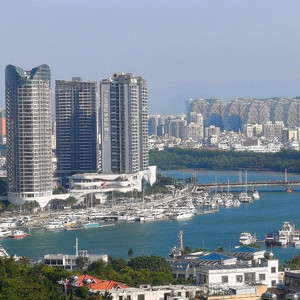
Another purchasing is in Hainan Island.
Currently, I'm living in Hainan right now.
And because Hainan is open to the global market as this duty-free island which China is currently setting.
You can see more and more foreigners are currently living in Hainan province.
You really see a lot of them moving around.
So quite many foreigners would like to buy their own properties when they are settling here.
I mean the American lady who is opening a bakery at the ground floor of my building.
She has been in Hainan for over 10 years.
And her bakery is really famous in the local markets.
For people like her, she would definitely need to buy her own property.
So this is the reason why a lot of foreigners are coming to buy the properties here right at this moment.
Because if you talk about investment, then actually the property market is not that attractive when compared with the equity market.
I mean, if you look at the equity market, currently we've got this Shanghai and Shenzhen to Hong Kong connection program.
And that means you can move a billion or 10 billion yuan in and out within a day without a problem at all.
But if you talk about property, then you still have many detailed jobs to do if you want to invest in China's properties.
For example, many cities, especially the first tier cities like Beijing, Shanghai.
They are still restricting that one person can only buy one property.
And that means only a few million yuan or maximum probably 10 million yuan.
That's about it.
So you can't move in a large amount of money in and out.
And especially when you consider the property, is that you don't have a national trading market like the equity market.
So if you want to buy some properties, you have to do this from house to house.
You have to talk to every client for every deal.
That probably just cost you a few million yuan.
That takes a month to complete the deal.
But if you look at equities is that you can do 10 billion yuan within just a few minutes.
So I would say, for investment in China right now, The equity market is definitely more convenient when compared with the property market.
The bakery lady, can I ask which country is she from?
She's from America.
She has been living in Hainan for about over 10 years.
And her husband is working at the international part of a very large local hospital as a doctor.
So both of them are working in China right now.
I think she's got like three kids.
I don't know where her kids are working.
So she's actually opening a very good bakery here.
This bakery has been here for about three years and really making a profit.
She employed some, I think it's three or four local ladies helping her bake everything.
So it's pretty good.
And she also did some English education over the weekends.
You know, she holds some little classes that support the local kids to study English.
So she really did a pretty good business here, I would say.
That's quite a detailed profile of that family.
But to my understanding a lot of foreigners in Hainan.
They're from Russia or other, like in Poland or those countries right.
So you do see a great potential.
You actually see people from everywhere.
I actually met some foreigners kids studying at a private high school who came from England and Scotland.
And there are quite some people from Russia, especially if you go to Sanya city, because Sanya is really a tropical city which is favored by Russian people.
You know, Russian people living in really cold weather for most part of their years.
So they prefer tropical weather, which Sanya actually offers.
So if you go to Sanya, there are quite many Russians there.
I even saw an advertisement in the drop market days ago that they are requiring the bartenders to be able to speak Russian not English, but Russian.
So yeah, you do see a lot of Russian in Sanya, but in Haiku you actually see people from all over the places.
Of those foreign visitors, be it long stay or short stay, do you see a big potential?
Or who would you say can afford the houses in Hainan?
Is it a big proportion of them?
Well, I would say, you know, as Hainan is opening to the world and you've got all these visa-free policies, there are people coming in to go.
You know, coming in for different purposes.
I mean, tourism is definitely one of them most important purposes, but many people still choose to stay here because they love the environment.
They love the, you know, they're pretty friendly and easing people.
I mean, Hainan province is really famous for its local culture of easing.
You don't get many stress.
You don't work really too hard and not at all.
So Hainan people are really, you know, easing their lives.
So people enjoy that.
And some of them choose to stay for really long time, years.
I mean, I saw a lady, I don't know where she's from.
I didn't talk to her, but she's definitely not Chinese.
She has always been working with two dogs.
So I believe she didn't take these dogs from her own country.
So it's like she's been living here for quite a long time.
And these people do need to buy their own properties, especially when you consider the housing price in Hainan province is not very high compared with Beijing or Shanghai.
So it's really cost you about a million yuan, which means about 150000 thousand USD, to buy your own flat.
So in a pretty large flat, I would say about 100 square meters, something like that.
So it's not too costly, especially if you can apply for the loans.
Currently, the down payment is about 15 to 20%.
So it's like costing not too much money to own your own flat in Hainan province.
Okay, you did a very good job advertising for the Hawaii of China.
Yeah, definitely.
Professor Chi, your take here.
Who do you expect to be the first or to move first, like corporate investors or individuals?
And which cities or areas do you think would be most heated for foreign investors?
Kosovo hubs? or the first-tier cities like Beijing, Shanghai, or Shenzhen?
Well, I think probably the institutional investors will be first.
Right now, according to my knowledge, Singapore's GIC has already been doing its due diligence.
In Canada, the Brookfield, which is also an investor, also are doing the same thing.
And they've been targeting at the Guangmao, the CBD area in Beijing and the Lujiazui core area and a bond in Shanghai.
And they probably are looking at those 3A business buildings.
And I think their capitalization rate for that kind of the business building is probably around 5%.
I think it's higher than I think of right now.
Some points like 3.2%.
So I think, for the investment purpose, I think this is actually a good business, considering the Chinese renminbi is appreciating against US dollar, Canadian dollar.
So I think it's still worth a shot.
And plus in more of the increasing tension of the geopolitical conflicts.
I think the far eastern area, like Beijing Shanghai, like Singapore, those areas are still very safe to invest in.
Probably they're going to have another buff that is – it's very safe.
It's very, very peaceful.
That's the reason why you've been seeing the Ukrainians are flying to China and Russians are flying to China.
They find their second home in China, in Sanya, like Jia He has just mentioned.
They used to love Turkey.
Just go to Turkey.
Basically, you can speak Russian everywhere.
But right now, because of the geopolitical situation, many of them choose to go further, to China, to Japan, to the warmer places and safer places.
So institutional investors are absolutely going to be the first batch.
And also for the individual investors.
There is a very special group, which is a high net worth ASEAN nations, Chinese, overseas Chinese.
Those people are probably – they were going to invest in China for themselves as well, from Malaysia, from Indonesia.
Those people are very high net worths in position of themselves.
And also –
I think they behind themselves, they have companies.
So that's very special.
So they are their company.
It's a very unique situation.
They are their own company.
So basically, their company is tied to them.
So when one really wealthy Indonesian Chinese investors want to invest in China, basically means his own company and also his overall extended family probably can follow him to invest in China as well.
Right now we've been probably setting up some channels for them to move their money into Chinese market for house buying.
Even though right now a lot of people say, okay, in China, the housing markets are slowing down.
Basically, the capital return ratio right now is still around 2%.
It's also trying to have no inflation.
So the real interest rate is even higher than America right now.
In America.
The real interest rate right now you're looking at even less than 1, especially when the Federal Reserve is dropping its interest rate.
So the real interest rate in America is going to be lower than 1%.
But right now, China, the real interest rate is basically about 2%.
So I think this is also the easy calculation, considering Chinese yuan are also very strong.
So I think this is basically scenario.
Beijing, Shanghai is definitely is going to be the international city and the welcoming more of the investors.
Shanghai and Shenzhen and Guangzhou and Sanya, which is the southern China pearls are also going to welcome them.
And also in eastern part.
I'm going to mention that eastern part of China used to be a blind spot for the international investors.
But now, I think there's going to be very, very popular investment destination like Chengdu.
Chengdu is a fantastic place.
You mean western part?
Yeah, the western part of China.
Chengdu is fantastic.
Xinjiang has had phenomenal growth ever since this year.
We have $4 trillion investment over Xinjiang just this year alone.
And I think the growth is going to be really fast or picking up the pace.
Ever since, you know, the China Kyrgyzstan, Uzbekistan railways have been opening up and it's the second line of the China Afghanistan railways have been opening up.
I think this is going to be a very golden place, you know, for the house price to go up, up and up.
Then, for those who see this as an opportunity, what kind of properties do you think will stand to gain the most, like luxury housing, or affordable housing, or office space or other types?
Oh, yes.
I think the equation is very easy.
Location, location, and location, plus the quality.
I think everywhere.
If you're looking at the low turbulence, high growth of the target, basically the core area of luxury houses, the condos, will be absolutely the best investment destination, like the Changcheng Jiping in Shanghai and the Wanliu Shuyuan in Beijing.
It's still going to be very, very expensive right now.
And I think even in the worst case of the scenario, I think in ASEAN nation back in the 1990s and even in the 2008s In ASEAN nations, those core area and their luxury condos still have a very high premium against some other average, low quality or remote areas housing.
And also for the top class of the business building.
I mean, besides those condos, I think top class of the business buildings, like in Beijing CBD, in Shanghai Bonn, they are also going to be very, very uh, you know good bargain right now.
I think they have really good discount price and if you buy in, i think if you're looking at the five to ten years investment, it's going to be a good return, because do not take housing market as a short-term hatch or speculation.
It's a long-term investment.
It absolutely can help them more than five years to 10 years.
And also, i think rights in a longer term, rights is also a very important uh tool for the foreign fund to come in.
And, for example, the QFLD for the qualified foreign investors.
They can come in and to jump into the rights and the user rights for the buying and quitting mode.
So in the past cycle from 2008 to 2015 or 2019, I think, in the past 10 years, last cycle, I think their return is basically averagely about 10 a year is a really good return.
So You need to really have the confidence.
When everybody's saying avoid some places, some market, just jump in.
But when everybody's saying some market is really good and everybody's trying to get a piece of cake, just try to avoid that place.
This has been the Chat Lounge.
Then what further reforms are needed to bring in capital without tipping the balance?
That's coming up next.
Don't go away.
He can't live without the Yellow River in his eyes.
Both my grandpa and dad made the living from the river.
The Yellow River Mosaic is a 12-part series of multimedia stories featuring the people who live by the river and share a close bond with it.
Subscribe the Yellow River Mosaic on your favorite podcast platform or visit radiocgtncom for more in this program.
Welcome back.
We continue our chat on China easing the access for foreign capital into its housing market.
Professor Li, are you as optimistic as Professor Chi?
You got a different interpretation.
I think there's an article published weeks ago on investasiancom saying that buying property in China is bad for foreigners.
Obviously, that's before these new rules came out.
But yeah, it quoted some...
Issues like a trade war and China's housing oversupply issue there, unstable market.
Your interpretation then?
Yeah, so I think that there are four big uncertainties that if I can categorize into four.
So the first one is a price floor.
Do we believe the price is really bottomed?
If not, the buyers will wait, right?
The second one is the rules and execution issues. are quite uncertain.
City by city differences in terms of eligibility, taxes and registration is a big hurdle for the foreign buyers to enter Chinese market.
And then number three is money in, money out.
This is something that I mentioned earlier.
It's a practical issue around how we actually uh inject the money into china and then how we get the money out of china.
If we have a dividends or the sales proceeds right, and then the last one everybody knows is a geopolitics, and then the policy reversals right.
Investors want a consistency when they look into a huge chunk of investment and i think the bad for foreigners argument that you mentioned captured many of these afflictions right, especially uh the uh old payment loop uh that i mentioned, And then the exit concerns.
This is very important for institutional investors because of course you know they will hold the asset for a long time.
But anyways, they have to exit at some point.
So this kind of friction is quite an important hurdle for the investors.
And I think some frictions have now eased, as we discussed.
But the quotient remains reasonable still.
For example, like Vancouver and London show that capital surge can raise affordability concerns.
And then Berlin shows that scaling institutional rental without safeguards can push up the rents for domestic renters.
Singapore shows the opposite.
We have had very tight controls, including the high extra stamp duty for foreign buyers can keep the speculation in check while still allowing institutional money through listed vehicles.
So I think China still holds similar breaks eligibility, down payment flows, holding periods and could add targeted surcharges like STEM duties if we really concerned about domestic housing affordability.
And then you know one thing that I want to add about the segment of the market.
I think the previous panelists mentioned location is very important and that the luxury market is strong.
I agree.
And you know definitely the geographically capital will concentrate in top tier and policy predictable cities.
Again, because investors do not like uncertainties that will concentrate their investment in Shanghai, Beijing and Shenzhen, because this is less uncertain and more predictable.
And then maybe a few strong second tier cities like Hangzhou or Suzhou.
And you know, since Hainan came up, I think that was kind of interesting, incredible owner occupied story there.
But I think that that will be more genuine demand buyers with a small fraction not, like you know, huge investment demand like institutional investors.
And for the segment of the market, I kind of disagree that luxury will be the main platform for the foreign ambassadors to come in.
I think a more kind of feasible kind of platform for the foreign ambassadors will be the affordable housing, especially the rental housing, because this lines up with the policy priorities in China.
And then now it tends to run a very high occupancy rate in big cities.
I think it can be bundled into public real estate funds later, like a real estate investment trust which gives investors a clear exit.
Again, the exit strategy is very important for investors.
So this is the kind of same logic that has put foreign money into Japan's multifamily blocks for years.
And steady, bond-like income rather than big capital gains, right.
So I think this is actually healthier investment, rather than investment that looks into the big capital gains.
Singapore shows a similar institutional tilt toward the living assets, such as student housing and worker accommodation, segments where the cash flows are predictable and vacancy risks are rather lower.
Right.
Then Jia He.
From an investor's point of view, what kind of risks mentioned by Professor Li just now would be most concerning to an investor on China's property market?
And if you're an advisor for the authorities, what further reforms do you think are needed to fully unlock foreign capital without creating new risks?
Uh well, while we talk about investing in china's property market right now, the risk is actually much smaller at this year i mean 2025 compared with five years ago, because if you look at the property price, it has been basically dropping by about 20 to 30 percent in most of the cities around china, and i think about the china's income and GDP actually increasing by about 30 to 40 during these five years.
So that means you have the income and purchasing power increasing by about 40 on one hand and you go to the property price dropping by about 20 to 30 on the other hand.
So that means you are basically facing less risk compared with five years ago.
But also there are still risks remaining because the rental yield in some cities are not that high at this moment.
Because if you want to buy the property market without too much risk to worry about, then we would suggest that you look at maybe 4 rental yield, which is what this property can provide by renting it out.
I mean, you get 4% return per year, then you're probably safe enough.
But currently, most of China's properties are still trading at 2% to 3% rental yield.
So that's much better than five years ago, but it's still containing some risky point if you want to invest in.
And if you talk about the reform of China's property market in the future, I'd say there are actually many detailed works to do.
But they have actually been doing this in the past few years.
Also there is one thing is that I think we should keep on opening to foreigners, because currently the foreigners who are buying the properties in China are still a very small amount at this moment.
And you also have to remember that most cities still restrict foreigners to buy only one property in one city, which is enough for their own living, because you probably only need one property to live in.
But when we talk about investment, then that's still a very small amount.
And I consider that China currently still needs the development of a good property market.
Then opening more restrictions to foreigners, I would say, is still a good idea, especially considering the fact that in Most of the cities where foreigners would buy their properties, such as Shanghai Beijing Shenzhen, the property price is actually pretty high.
So you're not worrying that foreign capital might come in and cause the market to go somewhere you don't want to, because the price is already pretty high.
So that means when they are deciding to buy a property here, they have considered all the risks.
They are paying a pretty high price.
Then the risk of market disturbance would be diminished because of this high price that foreign capital would pay.
Then, of those three or two types like the Bangkok and Vancouver style and the Singapore style, which one do you think China should follow then?
Well, I think China is definitely following the path of Singapore, which has been proved as a very successful example of global property market.
I mean, if you look at Singapore's property market, it's much better than most other property markets in the world.
It doesn't have too much property bubble and people are living in pretty large flats and the cost of mortgage is not really high for the citizens.
So it's a pretty good pattern, because if you look at the property market, what is going on is that if you leave the property market to what we call market oriented economy completely, then in most cases you're having problems.
I mean, look at the United States.
I mean back in the year of 2008, they got a huge property market meltdown and this was caused by a very large bull market of the US property market before the year of 2007.
So the market kept on rising and rising and people you know added more and more mortgages onto the property market.
The government did not intervene until the last minute which the meltdown almost crashed the global financial market.
So, that is to say, I think the pattern of Singapore, which means the government has much more intervention into the property market, is a much better idea than leaving it completely to the force of the market.
Especially if you look at China, I mean, China is a very large economy.
I mean, this economy is way too large.
I mean, if the government doesn't do anything and allow the market to do whatever it wants, it causes problems from time to time, especially when we look at property market, because property market has so much participants who are just individuals, who lack the financial skills to value properties, who lack this kind of professionalism that you can really see, for example, in the bond market.
I mean, if you come to China's bond market you can see 90 I think it's about 98 of the trading value are contacted by institutional investors, which means they are much more matured.
But if you look at the probing market, it's not the case.
Can I add something here?
Yeah.
So think about this way.
You know, focusing on the foreign investment segment, Singapore keeps the money pipes wide open.
So you can wire funds in and settle a purchase with very little friction.
Anybody can buy any property in Singapore.
Very easy.
But it uses price-based brackets to cool demand, right?
The clearest example is the very high additional buyer stamp duty that I mentioned on foreigners.
So currently it's a 60% ABSD additional buyer stamp duty if you are the foreigners.
And this is the same for foreign corporations, not only the individual investors.
And this is why I've been in Singapore for 14 years but I still have no home because I am not a Singapore citizen.
It's very difficult to purchase a house in Singapore as a foreigner. because of this stamp duty.
But of course, if you do not mind paying, it is obviously very simple.
You just pay and then you can buy.
And this makes speculative buying expensive without blocking it outright.
So speculators are welcome as far as they pay additional money, right?
China has been taking the opposite route.
It's making the mechanics of paying for a home easier and, for example, the letting banks convert foreign currency and settle once a contract is signed.
Yet it is still relying on quantity type controls to manage demand.
Those include who is allowed to buy in each city, how many homes a household can own as the other panelists mentioned, maybe only one house.
Usually minimum down payment ratio that can be tightened and holding period rules that discourage quick flips.
So Singapore's philosophy is free flow money, but tax the surge.
China is smooth the payment process but keeps strong purchase and mortgage levers to decide who can buy and on what terms.
So the upside is that China can attract patient institutional capital without throwing the doors open to speculation.
The risk, as always, is execution, I think.
How consistently execution those are city level rules applied and how quickly they tighten if we observe any speculative activities to try to part in.
And i think that is one of the kind of you know concerns that we really have to think about, because attracting foreign money is always good but if that hurts the domestic affordability, that is the definitely unexpected policy outcome that we want to observe.
So we Monitoring how the speculation happens.
You know how the market moves after this policy is going to be very, very important in my opinion.
The last thing that I also want to add is I think the further reforms that we can consider to unlock more foreign capital without new risk will be the Real Estate Investment Trust.
I think we can actually really deepen the onshore wheat pathway for rental assets that you know.
That mentioned the affordable rental asset.
Can we make a rules and tax and you know other things are clear, so that the investment can come in in the long term, long horizon?
And then they can let the small investors also participate indirectly through the weed platform.
The Chat Lounge.
The Chat Lounge unpacks views and opinions on hot issues in a more casual way.
Professor Zhu, you agree?
Oh, yeah, I agree.
I think every country have their own situation.
I think for every country.
Well, it's very complicated for the smaller economy like singapore.
They are monetary authority can basically anchor the whole currency not everything but uh, very important part of the currency towards us dollars.
So they will flow up and down together with the international assets markets easier to make sure that their financial system has to be safe, stable.
But the same logic does not apply to china.
China is a very, very large country and with a huge population.
That's the reason why We're having this kind of control on the capital account and further on housing market.
Well, some anecdotes.
I think our currency towards foreign investment in the housing market are always the same.
I think in the 2010s, when people are hearing that Some foreign experts or foreign workers in Beijing and Shanghai they can buy one house for themselves to live in.
A lot of people are boycotting.
They say, OK, we will have the limits to buy the house in Beijing and Shanghai.
So why the foreigners are able to buy them?
And they are the culprit. who pushed up the housing prices in Beijing and Shanghai.
So we should bang the foreigners to buy any kind of houses in Beijing and Shanghai.
It's not just a fair.
You see, this is just 10 years ago.
Now, if you ask anyone, everybody are saying okay, we should welcome more of the foreign capitals to come into Beijing and Shanghai or Shenzhen to buy houses.
They should come.
Yeah.
So you see, people are very, very sensitive towards kind of issues.
So for the government, How can be a safe player, stable player is very, very important.
That's the reason why Chinese government are taking this issue very, very seriously.
We have lots and lots of pilot program.
Try it to see if it works or not and then amplify it to see what kind of the turbulence or systematic problems it's going to generate or it can be really working.
So until that, we will have a nationwide policy.
Otherwise, we're going to shut down the pilot program for the safety purpose.
So I think to be safe, to be stable is always a top priority for the Chinese policies.
And I think that's the reason why we're kind of a bit of the different in here.
But I think currently out of the same logic, because we're in the slowing down cycle for the housing market.
So I think the easing policies and the deregulation is probably going to come out more and more.
That's the reason why we'll be seeing all those policies come out.
And as I mentioned, China is a large country, very, very large, second largest economy.
If Japan can come up.
If Singapore can come up from the low point of the housing market, I think China will definitely come up from the lower point.
Even go to some other, even more extreme examples.
Go to Turkey.
Go to Russia.
You'll find out their housing market is even higher than 10 years ago.
And you will have understanding why is that.
Right.
Then what kind of specific reforms or measures do you think should be taken to fully unleash the potential?
Well, I think still we need to have more of the rule of law.
I think rule of law is very important.
It's not like that's criminal laws, but like financial laws and regulation framework.
That is very important.
And secondly is institutional arrangements, for example, like the foreign fund-oriented rights.
We should allow foreign funds to hold part of the housings for the living purposes, that kind of housing, in the form of the share of the funds, so that they do not need to actually to hold a house, they do not need to register as a homeowner, but still they can own the house.
This is very important and also we need to build a cross-border regulation system.
For example, in dubai they have the difc court, which means in dubai foreign homeowners or home investors can use this court to deal with all kinds of the you know troubles and problems and the arbitrary and ruling are, you know, are all you know applying to the foreign, you know home buyers.
If you encounter any kind of problems, it's easy just to go to the court.
Everything can be solved with the same standard so you wouldn't face any discriminations, you wouldn't face any kind of the other troubles i think america are doing very well, in japan not so well.
If you go to japan you have to speak japanese and the homeowners And everything is going to take you a huge huge huge, lots of the troubles for you to get through all kinds of troubles.
If the home you're going to buy can get involved in certain kinds of debt or bank mortgages still left there unresolved, and then you will face more troubles.
So buying housing in Japan can be some potential risks.
In Dubai, but in America, they're doing pretty well.
In Singapore, I think they're doing very well as well.
Shanghai, I think, has tried their own pilot program already.
In Pudong, new area, I think this kind of the practice will be further pushed to all over China.
And also, I think, for foreigners they also adopted.
Another thing is about 70 years of the ownership.
Because when we have the market-based housing arrangement, It has already been passed more than 30 years, so lots of the houses only have another 40 years to go if you're buying an old house.
And also for the commercial buildings.
Some commercial buildings only have ownership about 40 years to 50 years, so basically you only have 10 to 20 years to go.
What's going to happen after the expiration happening?
So foreign investors will feel very uncertain because there is no example or no law to tell you what's going to happen after the expiration.
So Shenzhen, right now have a pilot program to say OK, if you hit the expiration term, let's say hit the 40 years for the commercial building, you probably will.
Just to down put another 1% of the housing prices as a tax for the government.
So you can use it for another turn, like another 40 years or 50 years.
So I think this is a good arrangement because for investors they do not quite care about how much this kind of the compensation fee or the releasing fee for the government would be.
But you have to tell them what's a real number and put it down on law so everybody will be confident to buy it.
You know the houses to use it for long-term.
Singapore doing very well.
And America basically are doing in another form, because America they're basically average of charging 15 of the housing tax every year.
So basically when you buy a house in America, so every 30, 60 years or 70 years, basically you're like buying a house again because your tax you paid to the government is basically equating to the home price you paid to the market.
So every 70 years, you buy a house again to the government.
So I think buying a home in China is much, much cheaper than in America, because after 70 years we only charge you another 1.
But in America, after 70 years, we're going to charge you 100%.
So this is the deal.
Yeah.
So I think if we can make all this institutional arrangement or legal framework more clear and mature, I think foreigners investors, they probably will see the benefit in here in the come.
Right.
Thanks for those detailed examples and tips.
And last question to you all.
How quickly do you expect foreign capital to warm up to China's property market?
Will it be a slow climb or a sudden surge or no real interest at all or wait and see attitude?
Shall we begin with Jia He?
Well, I would say, when China lowers the restriction for foreigners to buy into the properties in China, for some foreigners who has really got a demand to buy their own properties in China, this really eased their procedures for buying the property here, because it's just an easier job now to transfer money into China to buy their own properties.
So, for example, if you're living in China or doing your job or planning to stay in China for 10 years, then it's much easier thing for them to buy the properties.
But if you talk about how much this will do to China's property market, then I would say it's a relatively small amount of money because currently the intention for foreigners to buy properties in China compared with this large scale of China's property market that has a market of over 10 billion people 14 billion people actually.
It's actually pretty small.
It's not that many foreigners are intending to buy the properties here.
So I would say this increment of capital would not be a very big issue for the local property market.
But it will mean a much more convenient thing for the foreigners who are living and working here.
It's really making the job much easier.
So you would see like a very quick surge?
You will see people coming in to buy the properties.
I mean if they have been planning this for a long period of time and now, But they have been stopped because they can't move the money into China so easily before you will see them coming in right away.
Because you know, for example, I have been looking for some equities in Hong Kong market which is not in the Shanghai and Hong Kong connection program.
But if this equity is included into the program, for example the JDcom, which I have been studying for quite a long period of time.
But it's not in the program, so I can't buy it.
But if it is included, I buy it the next day.
So for this group of people, you definitely see a surging of purchasing.
The only question is that how much they would do to China's property market, because this is a relatively small amount of people compared with these huge markets, that you have so many cities over the population of 10 million.
So it's not that much purchasing.
For these large markets, it's not a very large impulse.
Okay, got your point.
And Professor Chu?
Well, I think the foreign investors are going to come in for sure, but not at a very fast speed.
I think in a Q4 of this year and next year's Q1 and Q2, I think they will have some temptations in this buying.
For example, many of the Shanghai is old houses, the kind of old villa from the 1900s.
But I think the size is small.
Only, I think it's just a half a billion US dollar kind of size.
And I think next year, probably after Q3 and Q4, if renminbi's exchange rate can be stabilized at 7 to 1 against US dollar, I think lots of the American US dollar fund probably will use SPVs for Singapore coming in.
And that will buy a certain part of the Chinese luxury houses and condos.
I'm thinking 5 billion probably will be the size according to the gross rate.
And also, I think, after 2026 and 2027.
I think we need to look at the Federal Reserve's interest rate pathway and also the Chinese potential GDP growth.
If 10-year American T-bond yielding rate has been dropping below 3, probably the foreign capitals will duplicate.
What happened was Japanese yen in the cavalry trade about from the 2010 to 2014.
And lots of the capital is going to flow into Chinese yuan, like they used to flow in the Japanese yen back in that year.
And a size probably is going to be 20 billion US dollar.
So what we can see is that lots of foreigners they come to China to buy the houses.
Basically is to just to buy in the great discount, especially the core assets, the core houses.
They see this discount are really great.
It's already been falling beyond the reasonable price.
So they come here to put a bet on the reverse of the market.
And also they come here try to use the housing market as one of the way to speculate on the institutional opportunity.
For example, the exchange rate of the renminbi and interest rate.
So I think these will slowly, even though they're not going to save the Chinese housing market.
It's never their intention.
And also they're not going to create another bull market in Chinese housing market.
Objectively they're going to stabilize the market and bring in some confidence for the other investors from international society.
So I think eventually it's going to be a good thing.
All right.
The momentum will slowly build up then.
So last but not least, Professor Li, your expectation, please.
So I agree with the panelists that some individual buyers who've been waiting on the sidelines will move first, maybe almost immediately, because they've been living in China and then they wanted to buy.
But I think that it will be a very small fraction.
Most of the big cities have purchase eligibility checks, higher down payments and especially for investment and title mortgage for non-locals.
So I think our sentiment is cautious and registration tax steps are not trivial.
So it will take some time to really for us to see this in the market.
So the near term upticks is likely to be owner occupiers in some specific pockets big cities like Beijing and Shanghai, or those small cities that have really a genuine demand, like Hainan that we talked about.
Then I think for the institutional investors, the gradual is the key word.
I think we need to give at least six to 12 months to watch and verify kind of time.
What will these investors want to see?
They want to see a couple of landmark joint ventures or block deals that actually close under the new payment rules that we talked about today.
Then they want to prove uh, you know that the process works, because this is a huge chunk of money from the investors like gic.
They will not go immediately to the market right after these new payment rules.
The second is the signs that prices are stabilizing in the core cities, especially shanghai, beijing and shenzhen.
Again, as i mentioned, the uncertainties are the push factors that have been seen in Chinese markets.
So if the prices are stabilizing, that is going to be a very strong pull factor to the foreign ambassadors.
And then the last one is a visible path from the projects into the public real estate funds.
I think this real estate investment trust and then the funds are the key kind of lever for China's attraction of the foreign capital again to establish the strong and clean exit strategies for the foreign investors.
So I think with all these kind of policy tools and mechanisms, we'll see something on the ground, but it's going to take a time, I think at least six to 12 months.
All right.
On that note, we wrap up our chat.
Many thanks to Professor Kuan-Wu Lee, Deputy Head Department of Real Estate, National University of Singapore, Professor Ji Jian, Fellow of the Belt and Road Research Center, Minsu University of China.
And Chen Jiahe, Chief Investment Officer Novem RK Technologies, for your time and insights.
You can find us on all major podcast platforms.
Please email us your comments at radio at cgtn.com.
Until then, join us for more insights at the chat lounge next week.
The strong wind was howling and whistling.
He was the first Chinese citizen to graduate from Yale University in the mid-19th century.
I was born on the 17th of November.
She had prominent features.
Three of us were old enough to lend a helping hand.
He navigated between two vastly different cultures and moved further to realize his dream and promote understanding between the people of China and the United States.
Xie Minxin was a native of Hanyang.
I realized no danger.
China is really awakening.
Come and join us in discovering the incredible journey of Yong Wang in his autobiography My Life in China and America.
Check out the audible stories on radio.cgtn.com and all major podcast platforms.
Just search for the podcast Books and Beyond and find My Life in China and America.