Discussion keeps the world turning.
This is Roundtable.
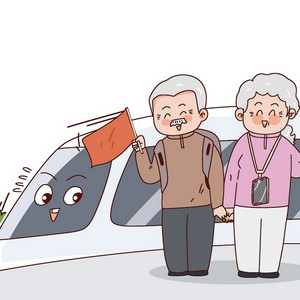
China has introduced specialized tourist train services tailored for the elderly, offering comfortable and accessible travel options to popular destinations.
These trains feature amenities that cater to the needs and preferences of older travellers.
The initiative aims to promote senior tourism, allowing elderly citizens to explore the country's cultural and natural wonders in a safe and relaxing environment.
But why now? And how will these trains differ from regular trains?
After that, Autonomous, the new AI -driven hotel in Las Vegas, promises a futuristic experience with personalized services powered by advanced technology.
But will customers be comfortable sharing extensive personal data from preferences to biometrics to an AI system?
While the convenience is enticing, concerns over privacy and data security may make some travelers hesitant to fully embrace this high -tech hospitality revolution.
We are live from Beijing, this is Roundtable, welcome, I'm Steve, and for today's show, I'm joined by Niu Honglin and Lai Ming.
First on the program.
China has introduced specialized tourist train services aimed at elderly travelers, creating opportunities for older adults to explore the country's diverse cultural and natural attractions.
This initiative reflects a broader effort to cater to the growing senior demographic, encouraging them to travel comfortably and confidently.
By designing these services, China is tapping into the potential of senior tourism, a market often underserved in the travel industry.
As the population ages, such initiatives could set a precedent for other nations to follow, ensuring that tourism remains accessible and enjoyable for all age groups.
Nyo Honglin and Lyming, good afternoon to you both.
Choo -choo, all aboard.
Hello, great to be here.
As we talk train tourism for the elderly.
You Hong Lim, what's going on here?
Well, apparently we are looking at something that can make our lives, especially after retirement, much more interesting.
Because when it comes to elder generation, we think about those above the age of 60, because that is generally or for most people, in average, that's when you retire and start being able to enjoy your life.
In that situation, you're not exactly that old per se, because you can still definitely take care of yourself.
And also you have your life savings, you have your pension, and you have a lot, a lot, a lot of time to travel to different places.
Sometimes the grandparents' responsibilities haven't kicked in.
Exactly. Take advantage of that time before the grandchildren show up is your point, I guess.
Exactly. And now we see that actually at the end of 2024, China's aging population, those aged 60 and above, exceeded 300 million, which accounts for around 22 percent of the national population.
So like Steve has just said, it's a huge population, it is a huge market that we need to do something about.
Because currently, definitely when they travel around, they can have or the options are there for any kind of transportation.
But we do not really have a specific kind of transportation designed for the elder generation.
And that is why earlier this month, the country unveiled an action plan to expand and improve senior -friendly tourism train services.
The idea is to complete the design of more than 100 high -quality railway routes for elderly tourism, with the operational scale of such trains exceeded to surpass 2 ,500 trains annually.
That's a significant number, 2 ,500 trains and 100 high -quality routes, so that's going to be covering various parts of the country.
Plenty of opportunities for people in that age group to get to places perhaps that they've never been before or maybe their favorite places that they'd like to give another visit to.
Lai Ming, this isn't a sudden move, correct?
No, this is somewhat in line with a state council office guideline that was published in early 2025, in fact, in January.
And it was a guideline on developing the silver hair economy to improve the well -being of the elderly.
And this guideline includes description or stipulation on the senior tourism sector and is hoping to effectively stimulate the vitality of the elderly population in the field of cultural and tourism consumption protect their legitimate rights and interests and enable them to promote the high quality
development of the silver economic culture and tourism.
I think the need obviously is there, especially right after the COVID -19 pandemic.
The government and various regional governments have done a lot to promote and in fact to prop up the tourism industry.
I remember back then my parents, they were very often on the move because every so often they got an offer to travel to a nearby village or nearby township, oftentimes for free or for a minimum payment of, you wouldn't believe it, 50 yuan or 15 yuan.
That's like 15 yuan is kind of like $2.
Yeah. So it's basically a free travel package.
You sign up, they take you there, you enjoy the stay, and you come back.
So that means then that...
So the need is there.
The need is there and the demand is there as well.
Yes, and actually, according to data, the number of silver -haired tourists has accounted for more than 20 % of the total number of tourists in the country.
And senior tourism is transforming from definitely a niche market to a mainstream market.
And also we have data showing that in 2024, 17 % of the middle -aged and elderly groups travel three times or more per year.
And more than 40 % of the middle -aged and elderly travel once or twice a year.
People want to travel, but for the aging population, if you really think about it, they're not that different from any other kind of population.
They wanted to go to different places, sightseeing, visit museums, and they want to go to far away places.
And the only thing that might be stopping them would be, you know, it's too tiring, it's too exhausted.
And maybe when they get onto the train, the seat is not comfortable enough.
And they might be worrying about, oh, I have a heart condition.
What if I do not have access to a doctor on a really long trip on a train?
And these problems might just be solved by the specialized train.
So it's not that there's a lack of demand or a lack of desire for people in that age group to travel.
The want is there. The concern may have been about their comfort level in getting to those, into those destinations.
There are statistics that back this up as well.
There's a travel site, A -O -Y -O -U, Aou .com.
And they talk about the fact that elderly tourists, they account for nearly 40 % of their overall travel tourists and the proportion is constantly increasing.
And in Canada, we see something similar as well.
I love it when I can find cultural similarities and it's usually not that hard to find.
Have you heard of snowbirds before?
are there a special kind of migratory bird it's older people they're called Canadian snowbirds and they're tourists it's a group of tourists there's an association actually it's called the Canadian snowbird association and they are a 115 thousand member group and they represent Canadian travelers from across
the country snowbirds are older Canadians it could be from other countries too who travel from colder climates to warmer climates.
That's why they're called snowbirds.
So my parents are snowbirds, as a matter of fact.
So when the Canadian winter comes, they will travel to Florida to stay there for a few months of the year, and then when the weather is warmer in Canada, then they'll go back.
That's one similarity.
And also the statistics are similar, too.
In Canada, 7 million people age 65 and older in 2021, That represents about 1 in 5 Canadians or almost 20%, about 19 point something percent.
So the statistics are similar between Canada and China too.
So then if we know that the desire is there, then how can we make these trains more comfortable for people, for that age group, so that they don't need to be worried if they're considering traveling?
Number one, to better manage the schedule of the trains to begin with, because we have made a lot of progress in infrastructure building and in planning the routes and then expanding the number of trains running on the routes.
I remember the first time I traveled on the train, that was to leave my hometown to the big city of Shanghai.
I think more frequent listeners and older listeners of the show might remember, I lost my slipper.
in the struggle to get on board.
This is not the first time.
Really, really loyal listeners would know this.
We've heard this story before.
I'm hearing it for the first time.
It was a scramble. I know it was a scramble.
It was difficult to get a ticket.
It was difficult to get on board.
It was difficult to get to your seat before a missed a crowd.
So I imagine that would, if things do improve, don't change.
Not a lot of elderly folks might want to risk being squeezed on the train.
But luckily and unfortunately, things have changed over time.
Still, there is the issue of whether the elderly folks would enjoy getting into the same crowd as, you know, office workers and students who may have gone off on festivals or holidays.
Now these days, precisely this time of the year, we are talking about college students leaving their hometown and traveling back to the school because the schools are in session again this week.
So I imagine as the way it is, of course the resources are scarce, the Railway Authority should be able to coordinate the trains and the schedule to allow for a large influx of passengers during this time of the year.
But I'm not sure they will consistently keep the number of trains running on the tracks when that rush hour has passed.
Well, the action plan does advocate for improved coordination between tourism trains and scenic spots, too.
So not just the coordination of getting them to the train station or getting them on the train in a comfortable and safe way, but also the locations that they're going to.
What they're hoping is that they can encourage local tourist destinations to offer different types of tailored services, reservations, green channels, transportation connections, and dedicated reception services for senior travelers.
I really like that one, dedicated reception services, so that when they arrive, you know, maybe sometimes they'll be traveling with their children or someone who can help them on the other end.
But if not, then if they have these kind of reception services, I think this is a really, really good idea as well.
Yes, I totally agree.
And I think the first step is to make the trains more comfortable.
And they're doing actually more than that on top of enlarge the seats, making sure the restrooms of passenger trains are senior friendly.
They are also inviting more personnel onto the train.
For example, I've already seen a train with a traditional Chinese medicine specialist on it.
And they're not only providing services in need, they're also booking sessions on a certain carriage.
You can, while you're on the train, you can get a lecture of how to better maintain your well -being in your daily life.
You can talk to the specialist already.
So that's one thing.
And another is, like Steve has just said, is to pair up with the scenic spots to design special routes and to design a whole package.
So instead of traveling on, for example, long -distance bus so that you can have a three -day or five -day kind of trip to different places, Now you can do that on a train.
And the train, you do not have to worry about booking the train ticket and finding a hotel and buying the ticket into the Cynic Spot.
Actually, all the things are together in a package.
And the package is designed especially for relatively elder generations.
So while you're on the train, the train moves really, really fast.
Yet you have a bed, a bunk bed that you can sleep, you can rest very well.
And when you land into the scenic spot, you just go right in with some guide that knows you cannot walk as fast as a 20 -year -old.
So it's a whole package.
And it's important to differentiate the demand of relatively younger passengers from those elder generation passengers.
passengers. A very specific detail is that perhaps as compared to high -speed railway trains that travel really fast and takes you from Shanghai to Beijing in a matter of four hours during daytime, oftentimes the elderly folks might enjoy a relatively slower sleeper train where they can sleep, and so they're
not in a hurry. They don't need to get to meet a business partner in a matter six hours.
They're not in a rush.
They value comfort over efficiency and speed.
I definitely have a lot of generalized, correct, or maybe biased impression about the elder generation because I have elder generation, elder people in my family, and they're quite different.
I thought in your retirement year, you would want to relax and maybe lying on a beach with a little bit of sun and then go back.
No, no, no, no, no.
That's not what my mom is doing.
My mom is over the age of 60.
She is currently on online courses from I think these are open courses from universities about history.
She's learning history and she's reciting Chinese poems and I saw this trip.
I really want to book this trip for her.
It's a trip in Zhejiang province with famous Tang Poitry Road in Zhedong.
It's the east part of Zhejiang province in the history of Chinese literature.
It links up a large number of scenic spots, such as Hedong River, Tianmu Mountain, and Tiantai Mountain, etc.
It is a kind of root with rich historical heritage and geographic characteristics.
And I've heard my mom reciting those poems.
It would be nice for her to actually see the places.
She must have been seeing them when she was young already, but now it's a different kind of feeling.
And this is actually just a three -day, two -night entire package.
So when we try to imagine what do the elder generation want, actually, they want a lot of things.
I've even seen people over the age of 16, 70 climbing mountains like snow -peaked mountains in high -altitude areas.
They are quite energetic, and we need to cater to their needs, actually according to their needs.
Well, that's why I wondered, and I just had a thought.
Let me first list some other facilities or some other amenities that will be on these trains.
Handrails will be there.
Oxygen cylinders, first aid equipment, emergency call buttons.
You could argue those are also on other trains as well.
But here's my question.
Is this condescending at all to, because we're talking about 60 and older, right?
If you suggested to your mom, oh, I'm going to put you on this train that has oxygen cylinders and emergency medical assistance on hand, and also there are handrails to assist you.
And might your mom feel a little offended by that?
I think China is too big to have only one kind of elder people.
So if we are saying we're designing a train specializing, specialized on catering to the needs of elder generation, then you're thinking about all the elder generation.
You're thinking about those who might need a little bit of help walking around.
You're thinking about those who enjoy mahjong so much that you would design a certain carriage full of people playing mahjong.
There actually is that kind of train there.
Yeah, it's in Shanji province.
They play mahjong and enjoy the local food on the train.
Exactly. And you're also thinking about...
I want to take the elderly train.
So that's the idea.
There are so many different types of need.
We are trying to make sure we are covering the basics.
So if one out of 10 ,000 passengers, there is one having a heart attack on a train, then the first aid tools would be necessary.
So that is the first thing.
And the second one is, I think one thing we can think about that's definitely common among the elder generation who are actually taking a train outside and travel is that they have time.
And they're relatively, some of them might be price sensitive.
Who would say no to a cheaper yet with the same quality kind of trip?
So that is why Lai Ming mentioned that these trips are arranged around the not traditionally peak season.
So I don't think it's condescending.
I think it's trying to cover all the ground.
Yeah, I made that point and I was even disagreeing with myself as I was making the point.
I was just wondering.
But you're right, making these services available for those who need them and for those who would feel more comfortable taking advantage of a travel opportunity, The fact that this exists is just a wonderful thing.
So, I mean, what more can be done to promote elderly travel then?
Well, number one is to make sure that elderly folks know the services exist.
And number two is to make them affordable.
I know our economic situations are improving from generation to generation.
in my grandparents generation when they travel they bring their own steamed buns they would consider it a shame to spend money on on a on a meal pack on a train because they are traditionally considered to be expensive and then in my parents generation they were bringing some additional snacks like
uh wings and and and chicken claws that kind of thing so besides staple food to bring, snacks.
And in my generation, I think New Holy and I, we are quite used to ordering food before we even get on board the train.
It's one of our trees in fact to look into the menu before, as we order the train tickets, to look at the menu that we can go through when we travel and we know that which station provides the best takeout food.
So we are pretty much aware and we know how to navigate the system the train system and the and the online app application that is actually a really good point because i think with that point we can say one of the things to do with the elder generation is to solve the digital gap making sure that they
can enjoy the apps and the system as well yeah so or we could have somebody on board to teach them what to do with the app yes and besides that we see that uh travel agencies can offer middle and lower bunk on the train, and hot water supply during an overseas trip.
For sure, I love hot water when I'm overseas.
I don't know why. And free Wi -Fi device, low sugar diet for consumers with diabetes, special diets.
And special diets are actually already offered in many of the trains.
If you tell an elder people or person or in general that you have to pay for your food on the train, they might hesitate a little bit.
But if you say we have specially designed some diet for you, and also there are local specialties offered on the train, that is a different story.
That is a different additional experience.
Yeah, I agree with that.
I agree with Professor Wu Li Yun from the Institute of Chinese Culture and Tourism Industry at Beijing International Studies as well, saying that there was a lack of high -quality products for silver -haired tourism and that there are still many low -priced tour groups.
Some tour groups will promote high -priced products and force customers to go shopping and this could affect the travel experience of the elderly.
And what we're talking about here is making sure that people can feel confident when they book a package that they're getting what they pay for and there won't be any extra added costs.
There won't be more transparency in what's being sold.
I think that suggestion is a good one too.
I also like the idea of having facilities in place, infrastructure in place that could help out as well.
This is from Sonia Hong, who is the vice dean of the School of Tourism at Beijing Union University.
The suggestion here is to set up more infrastructure to help the elderly climb up and down mountains or provide more resting seats in scenic areas.
I love this idea because so far we've talked about, okay, getting on the train with comfort, being on the train with comfort, arriving at your destination with comfort.
But what about when you're actually at the tourist destination itself, providing more services, more infrastructure at those spots?
That's a really great idea too.
Yes. Over the years, I've seen more cable cars being built at scenic spots featuring great mountains.
And my parents and also even my wife and I at our age, we have been enjoying that service.
And so I can see how we need more all over society coordination, not just the efforts of the railway authorities to try and make traveling experience better for the senior citizens of our country.
Because currently, they make up 20 % of the population.
And at the rate in which our population is aging, it's only going to be a bigger proportion.
And they're going to be better off given the level of insurance and pension coverage in this country.
So the demand and their consumption power is only going to improve.
So it's important that the whole society take something to accommodate this change.
Exactly. That is why I'm shouting out to fellow travelers out there, the younger ones.
You can learn a thing or two from the elder generation as well.
And if they are walking a bit slower and, you know, be polite and be nice and talk to them.
Most of the strangers I met when I'm traveling, when I'm saying strangers, I mean the elder generation, they talk to me very friendly and we exchange phone conversations.
And they can sometimes take really, really good pictures too.
You know, sometimes I feel like it's the babies and the elderly who have it the best.
The babies get all the best toys.
The elderly get these wonderful tourist travel trains that they can travel around the country on.
Maybe we need stuff like that as well.
I think it's a great idea.
Limey, you make some great points, is that the sector is growing.
And when the sector is growing, that means that demand is growing as well and the necessary steps are being taken.