The key principle here, mechanical redundancy beats elegant dependency.
They're trying to eliminate a very basic risk, which is being trapped in the car.
It makes it all the more urgent for the Chinese regulators to step in to sort of redress the problem.
Let the best standard win.
Regulation is not really what constrains innovations.
So the standards that have been achieved or are being implemented in China will ultimately set new global standards around some of these design questions.
The chat lounge.
Chat lounge.
Chat lounge.
The chat lounge unpacks views and opinions on hot issues in a more casual way.
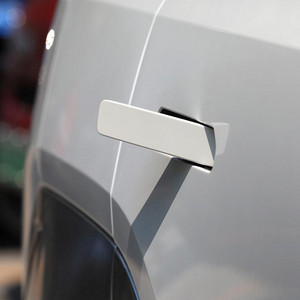
Sleek, flush, futuristic.
Hidden door handles once symbolized the EV era.
Now they are being flagged as a safety risk.
Welcome to the chat lounge.
China is set to ban so-called Tesla style hidden door handles, becoming the first country in the world to do so.
Join me on this topic.
Professor Yan Liang, professor of economics, Willamette University, the United States.
Professor Andy Mock of Beijing Foreign Studies University, who's also a senior research fellow at the Center for China and Globalization.
And Professor Warwick Powell, adjunct professor, Queensland University of Technology, Australia.
It's a great pleasure to have you all back on the show.
So the core demand of the new rules is for reliable, immediately operable mechanical releases, specifically banning hidden or flush-mounted electric handles.
Let me begin with the lady.
Yan, I remember you got a Tesla, but I can't recall which model.
So why do you think Chinese regulators feel the need to step in now?
And from a consumer's perspective, do you see it imperative?
I do think so.
You're right.
I do have a Tesla, and it does have the hidden door handles.
And I think this has actually been a ongoing issue.
There has been safety hazard.
There have been problem with even just operational issues.
So we know that in China, for example, there has been a spate of accidents that unfortunately became sort of fatal right.
When these kinds of hidden door handles becomes a barrier for drivers to get out of the car or for emergency responses to be able to get in the car.
And so that created some really life-threatening situations and even fatal cases.
And so I think that's why it makes it all the more urgent for the Chinese government and regulators to step in to sort of redress the problem.
So we know that again, that the safety hazard is really when there's a power failure.
Then you can't open the door right.
Because all these doors require electricity to be able to open.
And so it could trap the passengers, the drivers inside the car.
And when you have rescuers that are not able to open a car after a crash or power failure, you know then again you will not be able to get that emergency accessibility.
And in terms of operational issues, I think you know when you have freezing weather the door would be pretty much the handle right would be frozen.
And so you can't actually push and open.
And I also have friends who complain about, usually take them two hands.
So one hand to push the handle, the other hand to open.
It actually took me a while to get used to open the car door with only one hand.
So again, I think you know weighing the pros and cons, weighing the benefits of having you know so, of this good looking sleek, futuristic look, but apparently also with a little bit sort of energy saving right.
There's some kind of aerodynamics.
When you have this kind of hidden door handle, it reduces energy consumption, but really not a lot.
The engineer report that I saw is it could save you about five to 10 kilometers per charge.
So it's really not a lot of energy saving but again, I think, quite a large in terms of risks, and you know danger right, this hazard.
So I think it really makes sense to take measures to ban it or to at least, you know, substantially improve it.
Indeed, safety comes first.
Why did automakers adopt this design in the first place?
Andy, I know you're a tech guy.
Can you take us through this?
Probably a little bit of history of such kind of a course.
Sure, absolutely.
So, you know, I think to really understand this we have to really go back to automobiles, internal combustion engine automobiles, because you know, obviously many people think of it as a utility kind of thing.
It's a tool that lets us move efficiently from point A to point B, But over time it has evolved to not only become a status symbol but actually a part of a consumer's identity, especially in the United States that people really do tend to identify with their cars.
And what this means then, is that design becomes very, very important, because it lets you express who you are, perhaps from a design aesthetic to express your taste, or perhaps lack of taste in some instances with certain cars.
And you know and again we see that Tesla is the pioneer here that they not only wanted to make a technological breakthrough, but also to have a product that would be really lauded as beautiful.
And you know we think about, like the iPhone, similarly right that Apple with its design aesthetic, that this is really what's going on here.
But, you know, at least the glaring blind spot is what we're talking about today.
And I would just add a little bit to what Yan Liang was saying is that this really has been the perfect storm of bad things that can happen.
Because, first of all, when you have accidents, with people getting trapped in vehicles and the vehicles on fire, it's an awful, awful way to die.
And it really is very frightening for people.
So this triggers a very, very powerful emotional response.
Most people are afraid of being trapped, afraid of being burned to death.
So this is a very, very powerful emotional issue.
And then, as Yanlang was saying, from a practical perspective, if you're a first responder and you can't get into the vehicle, or if you're inside and you can't get out, and even if the system works, it hasn't failed because of an accident.
In this situation, you know, people are really, really stressed, right?
And it's really hard to think clearly and remember, oh, this is where the handle is.
This is what I have to do to open it.
So, you know, in a way, it's like an enormous blind spot that people didn't realize this.
And I think the real question is you know, why haven't other governments around the world moved more quickly to address this issue?
And I think the short answer which I'm sure we'll get into more is there are different values.
I think that motivate the government in China.
And the governance structure is the kind that allows very rapid response rapid and coordinated response once an issue is identified.
Right.
Not sure if you've gone through the specifics of the new rules.
There are a lot of emphasis on clear operation in this new rule.
Do you think such emphasis could introduce any new ambiguity or force new design trade-offs for automakers?
Well, it certainly could to you.
And here, you know, again, you know, maybe we see two principles in conflict.
Right.
So humans love beautiful things.
So from the aesthetic perspective, you know, this is great.
But of course, another important truth is people don't want to die.
So, you know, then and how do you reconcile this?
And of course, there are tradeoffs.
But I think the key principle here is that mechanical redundancy beats elegant dependency, right?
Especially when failure is catastrophic.
So you know again.
I think the Chinese message really is you can be sleek, you can be beautiful, but you can't be sleek and beautiful at the cost of escape or of saving human lives.
So I think it will impose trade-offs.
But the other way to think about it, to put a little more positive spin on it, is the most brilliant design often comes from the most severe constraints, right.
So Yanling mentioned that this is not only aesthetically appealing, but it also does add to aerodynamic efficiency, meaning that a car with these kinds of door handles can drive further.
You know, maybe a little bit further, maybe a lot further, whatever you know with it.
And that's obviously a benefit as well.
So I think again we're looking at a trade-off that has the potential at least to result in maybe even better design.
Of course, we'll have to see.
Right.
Well said.
To Warwick, actually, Yen and Andy have already said mentioned some of that.
But from your perspective, also a driver's perspective.
What specific risks do you think the Chinese regulators are trying to eliminate?
Do you see it necessary?
Well, they're trying to eliminate a very basic risk, which is being trapped in the car.
So it seems to be a very reasonable response in the end to to a problem that was not anticipated when the original designs were done.
Clearly, when the original design work was undertaken, the priority was around both aesthetics and arguably, on the issue of aerodynamics.
But the developments in battery technologies, I think, have superseded the aerodynamic gains of these handles.
In any case,
Let's not forget that when Tesla first came out with this particular handle, the battery technologies at the time were probably half as good as they are today.
So not being trapped in a car when you've had an accident is probably not a bad idea.
Right.
I'm not sure what car you're driving right now, but there's a view, since you all mentioned Tesla, there is a view that this role is aimed squarely at Tesla, the biggest rival of Chinese automakers in the EV space.
So from your perspective, how credible is that interpretation?
No, look, I mean, just about every contemporary EV has emulated Tesla's design on this front.
So no, I don't think it's targeted at Tesla at all.
And, in any case and it's probably something we'll touch on again shortly the design engineers will necessarily respond to the regulatory requirements and um, you know, in 12 months time, you know, the world will move on with car door handles that meet the safety requirements and, by the way, no doubt with an aesthetic sensibility that will evolve with the times.
So um, you know what?
What we think is beautiful today will, in five years time, be considered to be a little bit old hat, and it will take another 30 to 40 years before it's considered to be beautiful again.
The chat lounge.
The chat lounge unpacks views and opinions on hot issues in a more casual way.
Yan, do you think or do you expect Tesla to be?
I'm not sure if it's appropriate to call it a victim of the new rules.
What's your take on this?
No, I don't think this is deliberate sort of action against Tesla per se.
You know, this hidden door handle was sort of invented by Tesla back in 2012 with a Model S to start actually,
So, as you see, there is a past dependency and Tesla's definitely would have to spend a lot more money to redo their models if they have to, if they're mandated to make the changes.
And I think, going back to Andy talked about earlier right, there is simply, I think there's not enough incentives for American government, for example, to push for the changes right.
Because, of course, Elon Musk is very well connected.
And again, this past dependency would take a lot of money and design capacity to rewind.
So I think that's why the US, even though the government has been investigating on this issue, nothing definitive or nothing substantive has been done.
But I think, you know, in Chinese government's case, I think I agree with what has been said.
I think regulation is not really what constrains innovations.
I think regulation I would say regulatory uncertainty or regulatory rigidity is what really constrains the innovations.
So in this case, yes, it will take quite a bit of costs.
And also, by the way, this is not just Tesla.
I think the report shows that About 60 of the new EVs in China, or the available EV in China, all have this kind of design.
All have this, you know, hidden door handle kind of design.
So it's definitely not a Tesla only problem, right?
And talking about cost, right?
And so I think the estimate is that it would take about 100 million yuan per model to innovate or to remodel the door handle.
And, as you point out, the rule here is it's not only that you need to have interior and exterior mechanical door handle, but also these door handles need to be made a lot more intuitive and visible, with clear marking.
So it will take you know money and you know sort of innovative, sort of capacity right to do this.
But again, I think overall it's worthwhile because, again, safety, right, it's most important.
And even if the government does not mandate this, I think sooner or later right with all these incidents happening.
I think car companies themselves have incentives, right.
They do not want to ruin the reputation of their cars.
They would not want to, you know, get themselves into a lot of legal disputes because of these incidences.
So in that sense, I think it's definitely not a Tesla only problem.
And I also think that in the long term, this is actually more helpful than harmful for auto companies to make their cars safer.
And I also agree, you know, aesthetic is sort of It changes over time.
And I think it takes a lot more, you know, might be marketing or advertisements, right?
To sort of make people develop this sort of the taste and preferences for certain designs.
So I don't think this is something undoable or unreasonable or ultra costly, but we could talk about you know, I think it does come at a time where I think the EV industry is facing some headwinds, not only in China's market but globally.
So yeah. there is silver lining about this, right?
Because the more innovation you need, the more investments you need.
That means the more you're likely see kind of the investment demand right.
That would, that would rise.
But at the same time, I do think that this will, at least in the short term, create some headwinds um for for these EV makers.
Right.
We'll explore the cost of, uh, of the new designs or new models later on.
But um.
The Ministry of Industry and Information Technology actually first opened a public consultation on this standard in May last year.
And from consultation to final release, it took less than 10 months.
And manufacturers have less than a year before enforcement.
So, Andy, does this timeline feel a little bit rushed?
You know, in this instance to you, I'm not sure that it does.
Right.
And again I go back to this idea that you know this is kind of a perfect storm, where you know this is an emotionally very powerful uh issue, you know, for consumers being trapped in a car and burned to death.
Right.
So, um, the optics are terrible.
Right.
Um, And so I think it's not, but I think what's important to point out here is really the profound differences in how these systems are motivated.
You know, China and maybe I can use the US as an example here is that I would disagree with what Yanlin was saying was that, you know, I don't think automakers or any companies on their own would necessarily say you know, we need to stop this because people are dying.
Because, you know, for better or worse, they're driven by equity markets and maximizing revenues and profits.
Right, and we've seen so many instances of this, you know, in the united states, where how you have to fix this problem is a consumer has to be the champion, rise up, create enough blowback that companies are forced to change.
And this is, you know, how the the us system maybe not intentionally designed, but you know, i think, is in fact how it works.
Now we contrast that with china again.
You know, the government of course recognizes the importance of private enterprise, markets etc.
But says look, whatever we do, the well-being of the people come first.
Right.
So this is, you know, a different explicit principle than I would say the implicit principle of how the US system works of you know you have to, someone has to go fix this problem when it you know, when enough, people are killed or injured.
Right.
So so I would say one the Chinese system is one more proactive and structurally is able to move very, very quickly when something is prioritized.
So you know again, I would say that you know this in a way, you know to use a very American expression is a no brainer.
You know that I think everyone would say something needs to be done.
And the question is why haven't other leading markets or economies done something about this right?
So that to me, that's, perhaps the better question.
But I think no, I don't find it unusual at all that China moved so quickly in this particular instance.
Yan, your response to Andy?
I'm quite confused about what Andy said.
He disagrees with me, because I think that's exactly what I meant.
In China.
Even if the government doesn't mandate a change, I think companies themselves will make a change right.
Because we do know, for example, Xiaomi saw its share price, I think, fell about 7% or 10%.
I remember it was kind of in that ballpark when they had the April accident after this fatal EV crash and then this awful, awful incident that happened.
So my point is that, even if the government doesn't mandate it, I think companies would have to think about ways to right to innovate and to make the products better.
And I also mentioned in the United States, I think you know again, there is a past dependency because you know this kind of EV design has been really now more than a decade.
And also there's less sort of political pressure right from the government's regulatory sort of from the regulatory pressure right to force Elon Musk to make changes.
And I also think that you know we don't have to go into that, but in the United States, of course, the whole medium environment is different, right?
In China, when you have this awful incident, social media and major news outlets would broadcast it.
People would know it.
But in the United States, I mean, you don't likely to see a lot more on these kinds of reports, right?
Like awful incidents by Tesla or others.
And so I think in a way sort of consumers are definitely better informed, right?
And they also would have a lot more, I would say, you know, voting by foot than in the United States, because Tesla is the almost the only game in town, right?
I mean, even if people are not happy with Tesla's design.
But if you wanted to drive an EV, there are not a lot of choices?
So again, I think, because of the political connection, because the longer past dependency, because of the media environment And also because of lack of choices, I think in the US it would take a lot longer for Tesla to redesign anything or for the government to even regulate anything right, especially in this idea that you know Donald Trump's decision is all about deregulation.
So that's why I said I see the difference.
And I see in China, even without a government regulation right, I think businesses will sooner or later, you know, make changes and again innovative products better.
Yeah.
So if I could clarify, where I was disagreeing with you was that companies would act on their own.
In the US or in China?
So I would say, you know, as a general statement okay, which does not mean anywhere.
But publicly listed companies, I think in particular, are powerfully incentivized to not do things that will cost them money or create operational problems.
And, you know, I think and I believe that is universally true.
Now that doesn't mean that certain companies like Xiaomi and not to get into the weeds on this, you know but if we say they risk losing a lot of revenue.
That certainly is motivating.
Right.
But independently.
If just people were dying and not to say anything about Xiaomi.
But companies in general would prefer to not have to act if it will hurt their profitability or their share price.
And it's only when government steps in or there's enough of a public blowback that makes it unavoidable that companies have to act.
So that was my only point.
Right.
No, I see what you're saying.
But again, there's no such, you know, that was part of us.
Right.
Because if accidents happens, companies, stocks, you know, will will be affected negatively.
Right.
The sales will go down.
So one way or the other, they have to act not because they love the customers.
Right.
Not because they want to save lives.
Again, we don't necessarily mean this is Xiaomi or others, but.
The point is there will be consequences.
The consumers will act in a way that would hurt the bottom line, and therefore they have to make changes.
I think that is what I'm trying to say.
Right.
Actually, I'm sorry.
Sorry, guys.
This is opening a whole can of worms.
But let me just make one statement and then I will not say anything more about this.
Well, that may be true.
There are so many instances of where companies, at least in the United States, have engaged in cover ups, taken all sorts of actions to avoid having to solve precisely these kinds of problems, and they only did it when you know there was a big enough class action lawsuit or there is some very severe governmental change.
Right, actually it's.
I think the company isn't, whether be it in the states or in china.
They've got the similar uh inclination, but it's just in china.
Probably the authorities or the government acts more swiftly than those, let's say, the states.
They want to reduce the negative impact to minimum, right?
I'm not sure if that's the essential point that you're trying to make, but that's what I get from what you just mentioned.
Yes.
That's exactly my point to you, in that I think companies left to their own devices would prefer, to different degrees, to not do anything, even if people were being killed.
But when the government steps in and forces them to do something you know that generally works out better for society in these instances,
This has been The Chat Lounge.
Check out how the new rules may ripple into global standards when we come back. stay with us.
Tales of Chinese Children is a collection of fairy tales and fables written by Edith Eaton, one of the first Asian American women writers from the turn of the 20th century.
Edith focused on children who were treasured.
They are the sweet lost.
Get away from me.
Get away from me or misunderstood my son.
The evil spirit in your sister had almost lost you to me in the complicated adult world and much more.
Search for books and beyond, on radiocgtncom and all major podcast platforms to delve into an audio journey which allows the sound to linger around and above you for stunning realism.
Welcome back to the chat lounge.
We continue our chat on China becoming the world's first country to ban hidden car door handles.
Let's move on to the impact of this.
I think Yan already mentioned there is some estimation that the cost of modifying a single vehicle model could exceed 100 million yuan, or that's around 14 million US dollars.
And Not quite sure how big a burden it is for those car makers.
Like economically, what does the rule mean for, you know, Chinese automakers first in particular?
Because basically it's for those cars sold inside China, right?
So Huawei, do you have any study here?
Look, $14 million in the cars business is not a lot of money.
All right.
But it's just for one model.
Well, you've got to understand that the design engineering will be done to be portable across multiple models, because we're dealing with internals.
We're dealing with door mechanics.
And good designers are not going to undertake design that will only be useful in the context of one particular model.
Yes, there is going to be changes in terms of some of the machining, the dies, et cetera, et cetera.
But these things happen.
And this isn't the first time.
We've had a century or thereabouts of of mass manufactured automobiles.
We've had a good 50 or 60 years of genuine mass manufacturing, where automobile manufacturers have had to recall vehicles for various reasons, including design faults, repair those problems and ultimately, the world moves on.
If they don't do it at some point in time, they'll stop selling cars.
The word will get around that they are a health hazard and people will progressively I suspect You know stop buying them, notwithstanding the efforts of automakers to cover it up, blame others, obfuscate responsibility, etc etc.
So look, I'm not particularly sympathetic to automakers if they have to spend money staying in business by creating safe products.
They're either going to or they're not.
But if they're not willing and incapable of investing in enhanced safety for their products, in line with social expectations reflected through regulatory requirements, then I wonder whether or not they should stay in business that much longer.
All right.
Yeah, we don't have to be sympathetic to automakers, but objectively speaking Jan, You mentioned that like 60 of the EVs sold in China are equipped with hidden door handles.
So generally, all in all for Chinese automakers, would that be a big issue or is it a big burden?
Right.
I think, according to the auto industry analysts, I think this particular regulations will affect mostly the luxurious or the high-end EVs.
But for BYD, for example, they already indicate that this kind of cost is manageable and they're also prepared to adapt.
So I agree with Warwick.
I think in terms of you know, the EV makers, 100 million per model is really not that much as a matter of fact,
And so, you know, I agree that, you know, the bottom line is to maximize the profits.
So if you're thinking about again in Xiaomi's case right, even if they have to redesign the model and spend 100 million per model, but just think about that their market capitalization was about 100 billion Hong Kong dollars, right.
And so when we talk about 7 drop because of the accident, because of the concern about safety, that means a 7 billion loss in their stock capitalization.
So it makes a lot more sense for them to redesign the corridor to reduce or mitigate the kinds of safety concerns.
That would make their consumers happy.
That would allow them to compete better in the marketplace.
And I agree.
I think in the United States, especially there is a really, really good book.
It's called the car guys and being Congress.
It's about how the U S automobiles industry has been declining and why the industry becomes so financialized and disregard safety.
They actually purposefully try to use some of the defective mechanical design because it saved the money.
Right.
I understand all that.
But at the same time again, when you just think about making a small tweak in your innovation, spend a small buck for big bang, for really winning your customers' loyalty, or remove the safety concerns and compete better with your other competitors, especially in China's ultra-competitive environment.
I actually think it makes a lot of sense.
And again, you know, I think BYD is really the industry leader right now.
It's the global top seller and, you know, giving their bigger sort of investment budget, given their innovative drive, I think actually not going to be a really sort of burdensome innovation or redesign for them.
Okay then can i just add something into you all right um, just to keep things in context right, 14 million dollars us um, byd's um annual revenue exceeds 100 billion us dollars.
Right, so we're talking about less than 002 percent, less than 0015 percent of um of annual revenue.
Um to make design modifications to ensure that they comply with with safety standards.
As i said, this is a drop in the ocean and um and when you're doing new model iterations as fast as chinese automakers are doing, there is r?
D being spent anyway.
Right, so it's not like you're suddenly going to need to incur a substantial additional marginal cost above and beyond the kind of RD activity that you're already undertaking.
Sure, I get the fact that you've spent money designing a particular car handle mechanism that you hope will be usable for a lot more models going forward, so that you can amortise those costs over more models.
Well, the truth is, is that you're not going to be able to.
And the world will, as I said, move on.
Automakers whose financials are in a situation where they can't cope with this will simply vacate the market.
Both Warwick and Yan said that this wouldn't be a big issue for Chinese auto EV makers.
But what about those...
Foreign brands like Mercedes-Benz and BMW, they are actually sort of a latecomer in this market.
They were about to introduce their EV models to this market, but suddenly there is a new role coming in right.
So, Andy, do you see this new role?
How would it affect those foreign brands or companies?
Do you see it more like a chance or titan curse?
Well, you know, I would agree both with Yen and Warwick on this, in that you know the cost that is involved in complying with these new you can call them regulations or industry standards.
Really isn't very much.
And the other thing I think to point out here is that it would be a one off cost as well, meaning that once you've solved this design problem, you're done.
It's not like you have to spend this money every year.
So from a cost perspective, I don't see it as a problem.
I would say if some companies, maybe like Mercedes, would look at this as a second mover advantage benefit right.
So Tesla was first and Xiaomi, we could say here.
They were first to the market with a sleek aesthetic design, and then they were the target of this.
You know, public relations disaster, you know, and then, of course, the government response.
So in a way I think later entrance to the market might look at it and say you know, thank God, this wasn't us right.
And we just need to fix this thing and then, you know, we don't have to worry about it.
But I think there's a more subtle effect here.
And that is that In the US, once upon a time when the US auto industry was the most dominant globally, California really drove standards improvements because it was such a big market.
And because this is such a scale business, you don't want to have multiple versions.
You don't want a California version and a non-California version that what automakers ultimately decided was that it's better to you know I don't know if I have the details right.
I'm sure Yan Liang knows this much better than I do.
But you know, just for the sake of discussion, California mandates, you know, certain kinds of seatbelts or certain kinds of bumpers to make cars safer.
And what the automakers ultimately decided was that it was actually cheaper in the long run to make all the cars with these new safety features that California acquired and thereby California kind of moving, raising the standards in this way.
And I think China is playing the exact same role, not only for China, but for the entire world here with this.
And So I think this is an important kind of second order effect.
And what this means for companies non-Chinese automakers is they're going to, I think, even more pay attention to what Chinese regulators are thinking or planning, because they know that if it's implemented in China, sooner or later, or probably sooner they will have to implement it globally as well.
Right.
I think Yen earlier mentioned that regulations are not there to kill innovation, right?
But some people still worry that once safety rules become this granular, other features like oversized touchscreens or fully digital controls could be next.
Andy, do you have any similar concern or is that a like slippery slope concern?
Could it end up stifling innovation?
You know I don't because you know again, the profit incentive is very, very powerful, especially when there's a lot of money involved, meaning you know these are very expensive units to buy.
Right.
And It's an enormous market globally that I think any kind of regulatory change again, as long as it's clear and predictable really drives quote unquote innovation, meaning that companies will adapt, they'll find new ways of complying while being profitable and hopefully making even more money as a result of new, new regulations.
The chat lounge.
The chat lounge unpacks views and opinions on hot issues in a more casual way.
Although this rule only applies to cars sold in china, there's also some suggestion that this could spill over into the global market, given China now is, I think, world number one EV maker.
So Warwick, do you think automakers may build different versions for different markets, or could China, as a standard, influence designs elsewhere?
No, I think that Andy's right.
Where possible, design solutions for one market, particularly the largest market in the world, is going to enable manufacturers to save costs as they upscale production.
And so the standards that have been achieved or are being implemented in China will ultimately set new global standards around some of these design questions.
That's going to be great for places that come second.
And they'll end up with a fleet of EVs that will not have this safety risk.
And again, as I've said all along, I think this is a classic case of sensible response to obvious problems, and the world by and large will be better off for it.
And I don't think we'll see a proliferation of models with door designs that are less safe than the safest ones possible once the design work's been done.
But do you expect regulators and other parts of the world say, like in Australia, your country to follow suit?
Well, Australia is particularly conservative on road safety.
And, in fact, when it comes to questions of self-driving cars, it's very conservative in terms of approving that to take place.
But you know, provided that whether or not the regulators adopt immediately a specific standard on this question, I think, will largely be moot.
Australia doesn't manufacture any vehicles anyway.
So whatever vehicles it will have will be imported.
The vast majority of EVs that are imported in Australia will be manufactured by Chinese firms.
Chinese firms, I can't see any reason why they would not simply adopt a new standard for all of their manufacturing lines and be done with it.
Nowadays, a lot of issues have been politicized.
This is China that introduced this first.
Do we have to follow that?
Maybe the question asked by a lot of insiders or business people.
Well, let's say that they don't.
Let's say that they don't mandate it.
The cars will come in anyway with the new handles and they'll become part and parcel of the fleet across the country.
For those cars that have the old handles.
The outcry will come when the first person and the first baby dies because of a car crash and there's a fire and they can't get people out.
And if that's what it will take to ultimately push these issues along, then sadly that's what it will take.
Right.
And then Yan, do you expect it to be picked up in other parts of the world, like the EU or the States?
Well, I would agree with Warwick.
I think, you know, safety issue is really the priority when it comes to cars.
And so I think unfortunately, if these incidents happen, I think eventually that would push some sort of registration change.
But even without that, what I believe is that when, As we know again, China is accounting for about 70 of the EV production in the world and 68 of global sales,
And so as long as the country or market allows the Chinese cars to come in with better safety net features.
And we're not just talking about these hidden door handles, but we're talking about also China's much stricter battery safety standards.
When you have safer cars at the competitive price, I mean, consumers will make their choice right.
And so to be able to compete with the Chinese cars, then I think some of the local car makers would have to also make the same move.
And once you get enough I would say critical mass right, when you have certain market movers that are able to adopt innovation and corner the markets and take up the shares, then again I think you know there will be a lot less when it comes to regulatory barrier right.
These companies, they adopted innovation because they wanted to compete.
They wanted to get the better car out there, get more market share.
Then they would not oppose the governments to regulate if they're already meeting the regulations right.
And, as a matter of fact, I think you know, once you adopt the technology uh, the good innovation, the good, the good, the good safety features of your car, you actually want the government to regulate.
So then you're able to uh, you know, reserve the market for yourself, because if other car companies cannot meet the regulations, then you know the market is offering to grab.
So I think in many ways I do see um.
You know, having the stricter regulations and having the better standards will become the market leader.
And I think that's also Andy's example, where California, you know, has better or stricter emission standards and they also have better safety standards right.
They require the rear-facing car seats for, you know, young children and infants.
And so those standards then become popularized in the country and other states imitate that.
And so I think that's just the example that usually if you're able to promote a higher standard, then sooner or later I think the standards will become sort of the industry's benchmark.
And that's, I think, how industry innovations are, you know, moving forward.
That makes every sense.
But the reason why I brought up this issue is that whenever China introduces rules or standards that could have international reach, critics in the West are quite vigilant.
They're quick to say Beijing is trying to rewrite or dominate global standards, especially in tech.
So do you see it a fair charge or an like an overreaction, Yan?
Well, I think that's possible, because we all know how, especially in the Western world, they're super paranoid about China's technological rise and they will do whatever they can to smear China's efforts to make better cars, make better innovations, make better green technologies.
You see all these accusations of overcapacity, dumping, and so on and so forth.
But I think again, be that as it may, as long as you can protect your own market against any sort of Chinese products, then you probably can dodge the changes for as long as you can.
But if the market is open, consumers will vote with their foot.
And I think that regulations and businesses will have to catch up with the kinds of competition right.
So I think you can really sort of, how would I put it?
You can prevent, right this Western accusation about China setting standards.
But if China is leading in its innovations, it is, you know, providing the best options out there in the market.
Then I think that will become sort of the emulation right.
That will create a kind of emulations. be it in regulation changes or, you know, industry standards.
Right.
And then Huawei, what's your take here?
Is China's growing role in standard setting, better understood as a you know a natural outcome of a scale and market gravity, or is something more strategic at play?
Well, let's not forget that China represents about 19 of humanity and that its economy, these days, on power purchasing parity terms, is close to a quarter of the global GDP.
So China has heft.
It has heft largely because it has become a very productive place.
Historically, countries and regions that have represented much smaller proportions of humanity have written all the rules, and we've seen that across every technology and non-technology arena over the last 10 years.
We have, of course, seen a whole bunch of western complaint that china has increased its activism in areas of standard setting, whether it's in telecommunications standard, information technology standards, et cetera, et cetera.
And doubtless there will be those in the West who will see China's expansion in the area of safety standards as something problematic.
No doubt there'll be folk on the relevant committees of the Congress who will see this as further encroachment of some nefarious Chinese activity.
But let's not worry too much about it, Tu Yun, because Chinese-made cars basically aren't available in the United States anyway.
So the United States can create its own walled garden and the rest of the world will get on with having safer cars.
I just don't think this is overly complicated anymore.
If the West does not want to participate in genuine goodwill standard setting around issues that really shouldn't be controversial, such as safety in motor vehicles, then the country that has one of the largest markets and with the largest production capability will get on with designing things that it believes actually deliver the best outcomes all around.
And the countries around the world who aren't trapped by the regulatory impositions of the United States, such as those countries in the global south, will benefit from having better, safer automobiles because of China and its regulatory response to these issues.
Right.
Fair enough.
And last question to Andy.
Looking ahead, how should we understand the idea of competition and global standards setting if such competition does intensify in the future?
Well, I think, you know, of course, the ideal is let the best standard win.
Right.
And I think Orwick makes a great point that, you know, size matters.
So if you're a big market, you will have more influence on that.
But I want to go back to this point about.
You know, will these you know anti-China people you know, use this as another attempt to smear China?
I want to say first of all, I think we are witnessing a clear trend where these people are increasingly marginalized, in that, you know, as we see, you know the last if you've been following this, like i have, for like almost more than 20 years.
Um, you know the shift in that it was kind of conventional wisdom 20 years ago.
China is bad right, everything about it is bad.
It's going to collapse soon.
Um, now to i think you know what these critics would describe as a more nuanced view.
So I think, if we look at that as the background, if now they choose to attack common sense standards like this, I think it would only further marginalize them.
And we look at what's happening today, even the economist says China is cool.
And you have millions, hundreds of millions of consumers all around the world saying hey China, that's TikTok.
I love TikTok, right?
Or China is this.
That's really cool.
So these people are becoming increasingly marginalized.
And I think they're really getting to the point of when they criticize China.
Who are you going to believe?
Me or your own eyes, right?
So I think this is becoming less of an issue.
And then when it comes to global standards more generally, I think that again, market size matters a lot.
But I think also thought leadership matters as well.
And here I think China is somewhat unique, certainly unique from a large country perspective, in that the, I would say, the political energy that goes into developing standards that are not narrowly, you know, parochial in terms of, you know only solving China problems right,
But really thinking from a global perspective developed countries, the global south, et cetera what kind of standards really are global standards?
And I think this is a unique combination, right?
Again, the ability to set standards and the kind of standards or the principles that motivate these standards I think is very important to be aware of.
Right, and on that note, we conclude this session.
Many thanks to Professor Andy Mock of Beijing Foreign Studies University, Professor Warwick Powell, Adjunct Professor Queensland University of Technology, and Professor Yan Liang, Professor of Economics, Flemish University, for your time and wonderful insights.
Drop us a line anytime at radio at cgtn.com and tell us what you think.
Until you join us for more at the chat lounge next week.
Until then, take care.
As you sip your morning coffee, we transport you from the sea of tulips in the countryside to the exciting moments of table tennis worlds.
As you commute in the hustle and bustle of rush hour traffic, we guide you to navigate from intricacies of global markets, tech revolutions to the El Nino-triggered fires.
As you gather around a community event, we provide you the vibrant sounds on different topics, such as how AI empowers education.
What does Lung, or the Chinese dragon, mean to the Chinese people?
Why live stream shopping is gaining popularity in Brazil?
Entrepreneurs are seeking to establish a strong presence in the Brazilian markets.
You can download the CGTN app to get more valued information.