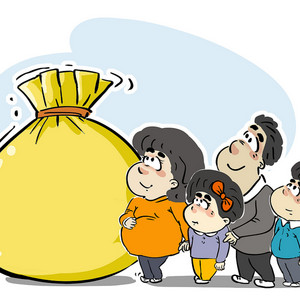
Raising a child is no small feat, and for many young families in China, cost can be a deal breaker.
Now, for the very first time, China is putting real money on the table. to support families with newborns.
It's a big step in the push for a more birth-friendly society.
But can cash really inspire confidence in child rearing or even move the needle on birth rates?
Coming to you live from Beijing, this is Roundtable.
I'm He Yang. For today's program, I'm joined by Steve Hatherly and Yushan in the studio.
First on today's show. All of China has just launched its first nationwide child care subsidy for families with children under the age of three.
Starting late August, parents around the country can apply for the program. which offers 3,600 yuan, or about 500 US dollars per child each year.
The cash handout is expected to benefit tens of millions of households. and marks an important step toward making child rearing a bit more affordable.
Let's start with the basics. What is this subsidy, who gets it, how much, and how does it work?
Yeah, we didn't ever hear about it previously on the Nationalscope, and this is something that China is now introducing starting from this year that this nationwide child care subsidy program, and it is a part of a broader effort to support families and encourage childbirth so this applies to families with kids born before January 1, 2025, who are still under the age of three.
So if your child qualifies, then the subsidy is calculated by month.
So 3600, that's 3600 yuan a year. which works out to 300 yuan a month so for example if a child is born in December 2023, then he or she would get fully two years' worth of subsidies, and that's $7,200. yuan worth of subsidy in total.
But if let say if the kid was born in november 2023 that's a month earlier that marks a 25 months of subsidy then that accounts for 7,500 in total.
So we know that there are existing policies in various parts of China previously, and this current new policy it doesn't really go against the previous existing ones so In a press conference held recently, the deputy head of the National Health Commission, Guo Yanhong, she clarifies that regions that already have local programs that exceed national standards may still continue after evaluation and record filing. and regions that previously didn't have one are now required to adopt the national policy to ensure an equal access.
That's pretty good news for families who had a kid born in December of 2023.
It's like a little bonus on top, right?
Yeah, there's a lot of money, this is a big program And there's a lot of money being allocated for this.
They'll put about 90 billion yuan. That's about 12 and a half billion dollars. that will go towards the program this year.
The director of the Department of Social Security at the Ministry of Finance said that the central government's going to cover 90% of the subsidy costs.
So you're wondering, okay, where does the other 10% come from?
That is going to be paid by local governments.
So that's how it's going to be paid for.
And as you said, Hyoung, at the top of our chat here, people can now... or will be able to apply for it online through a unified national system.
Everyone can submit applications without leaving the comfort of their living room, if you will.
But there's going to be offline channels as well.
There will be in-person services. They'll be put in place. if you don't have access to that internet or if it's more convenient to go there.
Before we started this discussion, I kind of was curious about what about kids that's born after January the 1st this year? so how do they get the calculation done?
Apparently it's like we still have that amount of monthly calculated subsidy for them, but it only goes on kind of like an announcement process right now.
And it's also confirmed by Wang Haidong, the director of the Commission's Department of Population Surveillance and Family Development as well. that all provincial-level regions are expected to implement the subsidies by the end of August.
Let's see after August on how this subsidy is delivered, whether it's given by month.
300 yuan per month or just once and for all 3600 in one go per year.
So that's still kind of to be decided, let's say, but it's still nice to hear about the news.
Oh, of course. And also, I think the key note here is basically 300 yuan per month.
And we're seeing that Once these subsidies are collected by individuals, these households that qualify, it will be exempted from individual income tax.
And that's really you know, so tax discounts and that's always good to know.
And apparently this policy is expected to benefit more than and 20 million families each year in... this country that's pretty big logistical undertaking and also a symbolic one.
It tells families, particularly parents, that the state is willing to put real money on the table to acknowledge the cost of early child rearing.
Whether it's enough is another question and we can get into it. but it's a starting point that creates a baseline of support where none existed nationally before.
What do you think is driving China to introduce this subsidy at this moment?
There's a lot of people in China. We know that, right?
The National Bureau of Statistics said that The Chinese population was a billion and 408 million at the end of 2024.
Yes, that is a lot of people. Also, 1.39 million fewer than that at the end of the previous year.
Not only that, but the country recorded a population decline for the third consecutive year in 2024.
Not only that, when we look at the birth rate, China's birth rate and the number of newborns, had been falling for seven straight years before seeing a slight rebound in 2024.
And this is according to a China Daily report from August. that year meaning last year that the birth rate dropped to six around six per 1000 people in 2023. which is a down from 11 per 1,000 people just two years earlier and also If we look at the fertility rate, that also plunged to 1.15 in 2021 from the 2.01 in 1991. some estimations of the fertility rate in the past few years also indicates that it still hovers around one.
So that's kind of below the state council's 2016 projection of 1.8 for both 2020 and 2030 so the forecast that kind of assumed that the population would keep growing.
But now that we're seeing this lower birth rate that's indicating the other way around.
Yeah, and also none of these parameters should be looked at. without the context, and that is with other figures as well.
And this is all happening in the backdrop of an aging society.
So you guys could maybe go a bit further into the aging. society reality that we've been living in and also, you know, come combine that with lower birth rates, then it's kind of a gray picture.
Speaking of which, I very recently saw a video online about how the Japanese society are having more and more old people beyond 60 and 70 coming out to work and the ratio is reaching above 10% of their population or something,
Please don't refer to me as official data, it's just me drawing from memory. as one of the world's most populous countries China here, we also face, say, the mounting challenge of ageing. at a rapid rate as well.
So China now has become a moderate aging society. meaning that those over 60 take up over 20% of population.
And also the number of over 60s in China right now reached 21.1% and that's back in 2023. roughly 297 million people are counted inside and that's an up from 14.9% a decade earlier.
So this number of those who aged 65 and over surpassed 217 million, accounting for more than 15 percent of the total Chinese population Also, following this growth rate, there are estimations saying that by 2050, seniors are expected to account for nearly 35% of the nation's population.
So that's how how big of an aging population we're facing in China right now. and that puts that puts pressure on on all of society not that anyone is to blame per se and But there was another article from a media group talking about the dependency ratio of of the elderly population aged 65 and over. reached 22.5 percent.
That was at the end of 2023. And what that means is that 4.4 people at the working age or in their working age need to support an elderly person on average.
Um, so again, it's, it's kind of a spider web, isn't it?
Where you have. one issue that is very closely connected to another issue.
And they both put pressure on each other.
Absolutely. And that dependency ratio, you mentioned, Steve, was cited by Caixin.
And Caixin has done plenty of studies on this, actually.
And then one can only assume, and this is a very logical induction that as time moves on, as we're seeing these lower birth rates and also very high and increasingly high aging society rates, that means this dependency ratio is only going to grow and actually, it's the opposite way. it's only going to this dependency rate ratio is going to be smaller and smaller when you have less number of working people who can support these elderly folks who need to collect pension.
Sure, because the population size of that age group 65 and older is going to continue to grow and the population size will, of those in their working ages will continue to shrink.
That is exactly the problem here and like you said nobody's to be blamed here but this is the social structure and we see this in other developed developed countries as well.
And these are some numbers that really should draw more attention for people.
I saw this in Newsweek. In June, the UN Population Fund, they found that 39% of the 14,000 people watching surveyed in 14 countries, said that there were limitations that would prevent them from having their desired family size.
And then there was a report from The Lancet from 2021 that talked about fertility rates in more than half of the countries and territories on the planet... um had below replacement levels that 2.1 that we talked about before.
That's the kind of global average. It varies from country to country or region to region. but fertility rates in more than half the countries and territories below that level.
You take that stat from the Lancet from 2021 combined with the UN Population Fund survey result.
And this is not a good recipe for population success.
Yeah, it is really interesting to compare across the board in different countries and see how countries are dealing with this.
And in China, we've seen Yes, the country has tried dealing with the situation and One very notable, if not a milestone moment, was in 2009. when the country announced the first time in many years the loosening of the decades-long family planning process. policy and allowed Chinese families to have two kids if they wanted to.
And then that led to sort of an immediate, uptick of people having more kids.
Those who wanted to have a second one and could do so, they really went for it. but now we're 10 years later and we're seeing that relaxation of policy waning in its impact and Cash subsidies could do the work, maybe.
What do you think? I mean, sometimes we see that the amount and just judge merely on the number of financial subsidy that's assigned, but Still, personally speaking, I think it can make a meaningful difference for lower income households.
And some examples do show that that's actually happening.
The cash subsidies, they do work. And also experts are saying that international experience shows that cash subsidies, they are a key part of pro-birth policies.
And that's quoting from John Benbow, which is a researcher at a think tank under the National Development and Reform Commission.
Also, Song Jian, a professor at Renmin University of China, noted that most developed countries that faced low fertility earlier have adopted similar child care subsidy programs.
Here in China, we know that from various data, especially the one from National Health Commission, showing that by the end of last year, There are already 23 provinces that have explored fertility subsidy policies at various levels. that covers all different kinds of, we say subsidy, but it can be financial support, but also extended to maternity leave as well.
One example is in Pan Zhihua, the city of pen jihua in southwest china sichuan province that the first city they are the first city in china to offer such subsidies and it has already seen its permanent residents population growing. for four consecutive years.
Another really interesting The example here is a county-level city in central China's Hubei Province named Tianmen.
So they recorded a 17% year-on-year jump in newborns in 2024. and that's well above the national average of 5.8%. it also ends an eight year decline for them.
And of the 7,217 newborns that year, more than half or a second were third children of that family.
And I looked just a little bit deeper into what Tianmen did to have such a kind of like a record-breaking outcome.
What the city offers is that they can give one-time birth reward of 2,300 yuan for a second child, and 3,300 yuan for a third child plus monthly child care allowances of 800 and 1,000, yeah, 800 to 1000 yuan until the child turns three.
There's also maternal leave. and that's set at six seven and eight months for the first second and third childbirth for the moms.
So there are all kinds of policies that's trying to make sure that there's a stable support during the maternal leave for the whole family it's kind of It's kind of like trying to figure out a puzzle, isn't it?
Right? And countries around the world are... are trying to kind of get that last piece of the puzzle to unlock what could change this. this trend and sometimes we'll have positive stories of things working in Hungary. is a good example of that this is what they did and this is getting a lot of international attention by the way They in 2019, as part of their family protection action plan, they offered a state-subsidized discretionary loan of up to approximately 30,000 US dollars.
Sorry, I'm not familiar with the Hungarian currency.
But that was available exclusively to married couples.
It's a loan. So you're thinking, wait a minute, that's a loan.
That's not a grant or anything like that.
But here's how it worked. upon the birth of the first child the lone would become a interest-free for the full term if you had a second child 30% of the remaining debt would be forgiven by the state.
If you had a third child, the entire remaining balance would be cancelled.
You wouldn't have to pay back anything at all.
And on top of that, repayments could be suspended for three years with each birth.
But if no child was born within five years, repayments must be made retroactively. at market interest rates.
Now you're thinking, oh, that's quite, the interesting scheme, isn't it?
Well, by the end of 2024 around 230,000 couples had taken advantage of that scheme.
And that model was credited with some success in reversing that country's decreasing birth rate.
Its total fertility rate, the average number of children born per woman. increased from 1.21 in 2010 to 1.56 in 2022.
Some evidence that it worked. Yeah, and through a loan, that is very interesting.
It's actually... Some people would argue an even stronger financial incentive because you kind of really want the loan to be resolved.
Right. Yeah. Very interesting. And, uh, If you look at the Chinese examples, the examples that are deemed successful as Yushan has cited for us, they have one commonality, that is, these are tiny.
These are very small cities if you consider the grand scheme of Chinese cities. and therefore it makes a lot of sense.
Like even with the national standard of the 3,000
Sorry, 300 yuan per month. Subsidy that's going to be handed out since later this month.
That's going to act as a pretty compelling, financial incentive if you live in one of these smaller cities or the rural areas but Possibly this is also one of the reasons why it's not been rolled out in some of the bigger cities until now. is that the child-rearing cost is actually very high.
Let's give people a reality check when it comes to this part.
It's not cheap, and I think even people without children know. that raising a child is not cheap.
In 2024, there was a report specifically about that as a matter of fact.
It was called the China Child Rearing Cost Report.
And it showed that since 2022, the overall cost of raising a child on the mainland has increased by 10.9%, so almost a full 11%. and it ranks as one of the highest levels globally per GDP.
Shanghai families face the highest child rearing costs It averages out to about 1 million yuan or about $140,000 per child. from birth to the age of 17.
I think raising children is one of those elusive missions in life if you choose to do it.
There's no sky's the limit if it comes to spending.
But you can also try to spend little be more thrifty about raising kids.
But of course, you know, there's still quite a lot of money and time to devote to it, but it kind of really varies for people.
It really does. And Shanghai is going to be on the more expensive side of things, right?
Yeah. because Shanghai is a pretty pricey place to be.
Nationwide, lower middle income families, they spend on average That's about $39,000. and then low-income families, they'll spend about 126,000 yuan or seventeen and a half thousand dollars But childcare costs for children aged zero to three, they make up 20% or almost 21% of total child-rearing expenses across all income levels regardless. of where you live or how much you make?
I guess this is when young people start to ask questions like, Why do I still want to build a family and have kids?
Hey, I was just talking about this with my friends earlier this week.
Having kid may want you to think that, what am I going to be rewarded afterwards?
Right now we have financial subsidies, But hey, if you look at the fact, the value of what it means to build a family, then To be honest, what we concluded after that chat was having kid, the fact that we're having children, as a family is the biggest reward.
And also, While the total three-year subsidy of 10,800 yuan may not feel that big of an amount to urban middle-class families or just to the families in bigger cities in general, it still helps.
And as some feedback are saying that, you know, some parents are already saying that while subsidies, they don't cover all, of course they can't. but they still help with essentials like formula and buying diapers. which is one way of easing the financial strain for the families.
So it's still working. 100%. And that report that I talked about before, the UN Population Fund report.
And again, that statistic, 39% of the 14,000 people surveyed in 14 countries said, I mentioned limitations before.
I think I forgot to mention financial limitations was the reason people said that would prevent them from having.
And I think this is an important point. their desired family size.
I'll reiterate that. So that speaks to me.
It says... It's not that people don't necessarily want to have children.
It's that they feel they can't be financially responsible for the family that they want to have.
I saw this kind of criticism before when I lived in Korea.
They offered financial incentives and The internet said, well, it's not enough.
It's not enough to change people's minds.
And okay, fair enough. But at the same time, you know, if you're hungry, what's the solution?
Food. If money's the problem, what's the solution?
Money. That's what I mean. It's very difficult to come up with the final piece of the puzzle to solve this problem. financial worry that people all around the world seem to have about raising kids. two immediate reactions to what you just said steve first of all south korea is well known for females often saying that they find it difficult to come back to the workforce after having children and more equal the two sexes in contributing to child rearing and family responsibilities, would really help women to want to have kids in the first place.
Second of all, you mentioned that sort of like being very rational in deciding your family size and how many kids you want to have.
And I think that is maybe more of a modern and contemporary human mindset because let's say in the beginning stage of the founding of People's Republic of China. people weren't necessarily thinking, oh, I just want two or I just want three.
Maybe some people did, but a lot of families were like, we'll just have as many or. see how things goes, that kind of thing.
But today's young people, especially those who live in big cities, They're pretty rational about this because they want good education, a good future for their kids.
And you can argue not solely confined or directed to educational levels but a lot very educated or those who've received higher education, they want better for their kids in the sense that they want to plan the resources and be ready for each stage.
And if they're not ready, if they don't feel like I can um earn enough money to send my kids to all these extracurricular classes up to like 18 and pay for college tuition, et cetera, they won't have the kid.
So therefore, a whole basket of policies are needed.
It's not just zero to three. for these three years, give me some extra cash.
It's about also what about the rest of it?
And it's society changing at the same time too, right?
I'll look at Finland for this example to make Child or parenthood more appealing there.
They extended their parental leave this happened in 2022.
They extended their parental leave, which is now a total of 13 months.
So that's six and a half months for each parent.
Didn't really work out. the declining number of births, it threatens the financial health of their very well-developed social welfare system.
Here's my point about society changing. The rising age of first-time mothers in Finland is a big challenge for the government.
In 2018, 24% almost 24% of mothers giving birth for the first time were 35 or older.
And again that's a challenge for the government.
Now what are the reasons for that? Well there's probably a basket of reasons for that.
Getting married later in life or just different wants and desires for your own personal life.
I think we came to a good conclusion here today in the sense that there is no magic perhaps won Size fits all.
So that's why it's such a challenge. Right.
Well, certainly cash handouts are hardly enough on its own.
Raising children isn't just about money, even if money helps a great deal.
So what does a truly birth friendly society look like?
And how close is China in creating one? some Chinese experts are already voicing for it like you mentioned earlier like how such a holistic childcare friendly society can be built.
And that involves more than just simply say financial child care subsidies.
Indeed, it is a key step towards easing the burdens of families, but it is not a cure-all solution and that the importance of integrating it with other measures such as parental leave, childcare services, education, and just housing in general to avoid limited impact from isolated efforts. is crucial for our society nowadays.
So here's what China is doing right now.
That's according to the National Health Commission Vice Minister Guo Yanhong that all provincial level regions have extended maternity leave to at least 158 days.
And that's established about 15 days of parent PaternityLIV and also implemented ParentalLIV ranging from five to 20 days.
So that's already going on right now. I personally, of course, I haven't had the experience of giving birth to i i don't really have an idea of how long it takes for a female to recover from the maternity leave but As per previous experience, I think 158 days It's a good start, at least.
The more the better. Yeah, the more the better.
Yes indeed. At the end of the day, the decision to have a child or not is deeply personal.
But policy plays a role in shaping that decision.
When people feel supported, When the load feels shared, it can boost inclination.
Still, financial aid alone isn't enough.
Like you guys said, affordable housing, flexible work arrangements and accessible childcare services all need to be strengthened if we want more people to feel secure and inspired. to get married and start a family.