This is Planet Money from NPR.
In the wake of news that the United States had captured and arrested the leader of Venezuela and would run the country for some amount of time, one specific American company found itself suddenly in a very strange spotlight.
A case in point, a huge meeting last week at the White House.
But today I'm delighted to welcome almost two dozen of the biggest and most respected oil and gas executives in the world to the White House.
President Trump assembled basically the entire American oil industry to discuss his goal of turning Venezuela back into a booming petroleum exporter.
But Trump appeared to be looking out into the crowd for one company in particular.
Where's Chevron?
Where's Chevron, he asks.
No, I thought you'd have a better location.
You were the only one that was there for all that.
Yes, Chevron was there in Venezuela from the time that oil literally rained down on the country, caused a boom and turned Venezuela into the biggest oil exporter in the world.
Chevron was there when that oil money transformed Venezuela into the first petrostate and transformed Caracas into a gilded global capital.
But most notably Chevron, kept being there when things went bad and when Venezuela took more and more of the oil industry away from foreign companies.
And so, in that White House room full of the most powerful oil executives on the planet, Trump singled out Chevron's executives.
I used to call you and say, what the hell is going on with Venezuela?
He stuck it out.
I don't know if you made money or not, but you stuck it out.
They got to give you a lot of credit for that.
Pretty sure Chevron did make money and are pretty well positioned to keep making it.
Hello and welcome to Planet Money.
I'm Kenny Malone.
And I'm Erika Barris.
Venezuela and Chevron are perhaps one of the strangest public-private partnerships ever.
One of the world's most famous and profitable corporations has for decades been plugging away in one of the world's most famous and infamous socialist countries.
Today on the show.
Before Saudi Arabia, before Iran, there was Venezuela, the first petrostate, the first country whose entire economy became dependent on oil.
And with that blessing, an entire economic textbook of complications opened up, from the Dutch disease to the resource curse, to mono-economic vulnerability.
And oddly, along for that ride, a little old Chevron.
Or at least it was little at first because, thanks in part to Venezuela, Chevron is now the second largest oil company in the US.
Yeah, even if they got seated pretty far from the president at the White House.
Marco just gave me a note.
Go back to Chevron.
They want to discuss something.
Go ahead.
I'm going back to Chevron.
Thank you, Marco.
The economic history of Chevron in Venezuela.
The OG Petro State after the break.
This message comes from Dell Technologies.
In economics, trade-offs are expected, sacrificing one thing to gain another.
But what if there was no need to choose?
What if you could have it all?
The all-new Dell XPS redefines what's possible.
It's a masterpiece of design.
Inside the Series 3 Intel Core Ultra processors deliver uncompromising performance, while the Infinity Edge display immerses you in every detail.
It's everything you imagined, crafted for you.
Check out the all-new XPS at dell.com slash XPS.
So you had all those oil executives at the White House talking about Venezuelan oil and not all that excited, except for Chevron.
We very much look forward as a proud American company to help it build a better future.
And so, Mr. President, thank you for your leadership.
You really suffered there.
You stuck it out.
To understand what happened to make all those companies leave while Chevron stayed.
We called up Stanford political economist Terry Carl, who told us she's interviewed every Venezuelan president except Nicolas Maduro since she started following the story of oil in Venezuela back in the 1970s.
Venezuelan oil was discovered more than 100 years ago at Lake Maracaibo, which actually happens to be the same lake that inspired Italian explorer Americo Vespucci to give Venezuela its name.
He sees these indigenous people living in houses on stilts and he says, my goodness, it looks like Venice.
And he calls it Little Venice, which is what Venezuela means.
Over the next couple centuries, Venezuela became a Spanish colony.
Then it was part of Colombia.
And by the early 20th century it had gained independence, was run by a series of dictators and had its own export economy.
Venezuela is an agrarian country.
It exports one thing.
I was going to ask, should we guess?
Erica, you want to guess?
I think I'm going to guess coffee.
It has to be coffee.
Atta girl.
The country's number one export was my favorite bean.
But not for long.
This is a time in the world where there are European and American explorers and botanists and geologists all over the Americas looking for something on land or in the ground that might make them rich.
And in Venezuela, some of them were digging up oil in that same place that gave Venezuela its name.
Yeah.
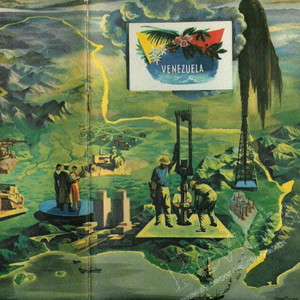
In 1922, they made a huge oil discovery at Lake Maracaibo, the Lake Maracaibo Gusher.
Some surveyors had been digging for oil for years around that lake.
And then one morning, the earth started to rumble and there was a loud roar.
And this small well came alive in a way that no one had ever seen before.
It started spouting up oil.
You want sound effects?
Yeah, please do.
200 feet above the derrick.
That's what we call the oil well tower thing.
It spewed oil.
This black, tarry oil that sprayed everyone and everything in the town.
And that oil, it blew for nine straight days.
Raining oil on people and trees and houses.
It made headlines.
It made lines of oil on people's heads.
Also, kind of freaked out the townspeople reasonably.
It made a huge mess, and then it caused a proper oil rush to Venezuela.
The news that Maracaibo has oil trickles out and there's a huge rush of primarily U.S. companies.
Because, of course, oil in the ground is not an oil industry.
Turning that into something requires machinery and geologists and refineries and companies.
And so Venezuela's strongman dictator allowed more than 100 foreign companies to just set up shop and drill away in search of more gushers.
Venezuela makes some money from this, but those companies make so much more.
It was a boom, a boondoggle.
Through the 1920s, Venezuela very quickly became the biggest oil exporter in the world.
And a small group of oil companies emerged as the most aggressive, the most prominent and the most productive.
Companies, you know, like BP and Shell.
Eventually, they'd be called the Seven Sisters.
And among them was a small oil company from California.
The company we now know as Chevron.
And so this was the very messy, gold-rushy way that the world's first oil-based economy sort of snapped into existence overnight.
There is a word for a country like that.
A word that Terry Carl is semi-certain she coined in her writing about Venezuela.
Petrostate.
No one said petrostate before you?
No one said petrostate before me.
Are you sure?
I'm pretty sure.
How do you know that?
That's what they tell me anyway.
That's what they tell me.
And the argument I made is that oil states are different from all other states.
Period.
Petrostates are, simply, countries with an economy built around having oil.
And overnight, Venezuela had become the first discovering massive amounts of oil.
Is a treasure chest holding a Pandora's box, holding an economics textbook.
Because along with the possibility of global riches comes a host of potential issues.
Venezuela would not have known about these issues in the 1920s, but today these things have memorable names, like the Dutch disease, the resource curse, mono-economic exposure to exogenous shock which okay, fair enough, that doesn't have a memorable name, but all of these things would debatably shape Venezuela over the next century.
The first and most immediate effect of all this oil was the Dutch disease.
When something obscenely valuable is discovered in a country, it tends to upend the rest of the economy.
Like in the Netherlands when natural gas was discovered, international money poured into this new sector.
And that raised the value of Dutch currency in the global market, which is great, I guess.
Except no, because that means buying things from the Netherlands becomes more expensive.
And so suddenly the existing industries, often agriculture and manufacturing.
They have a hard time competing with other countries.
Now, in Venezuela in the 1920s, it was like Dutch disease on steroids.
Remember, they had a coffee industry.
Terry Carl explained to us that the oil boom caused the bolivar, the Venezuelan currency, to skyrocket, which meant Venezuelan coffee was like, suddenly way too expensive compared to coffee sold by other countries.
So Venezuela loses its entire coffee market.
So which is to say they lose their entire economy up to that point.
They lose it entirely.
Gone.
Gone.
And what replaces it?
The export of oil.
1928.
So, in case you just heard a loud thump, that was Terry doing the motion of a switcheroo of commodities.
Yes.
Coffee to oil and whack on the old mic.
And it's astonishing.
The Dutch disease is a less debated prong of a very debated idea called the resource curse.
The idea that maybe discovering something like oil is a curse in the long run.
Because when one resource becomes a country's solo source of riches, it tends towards things like economic instability authoritarianism, corruption.
You'll also hear this called the paradox of plenty.
And the evidence for this is spotty as a general rule.
But Venezuela has become one of the cases that people point to.
Yeah.
Once oil took over the Venezuelan economy, there was all this wealth.
And one of the big challenges that arises with a petro state like this one is you end up with all the power and wealth concentrated in one set of hands or, in this case, seven sets of hands the seven sisters.
And concentrated power tends to lead to big power grabs.
And that happened during World War II, when the US needed massive amounts of oil from Venezuela and Venezuela's government realized how much money was leaving its country in barrels.
Venezuela rulers now are much more savvy about what petrodollars do.
And they go, you know, the United States is entering the war and they really need our oil.
At the time, Venezuela's minister of development was like why are these seven sisters making so much money off of our oil?
They need us just as much as we need them.
This minister his name was Juan Pablo Perez Alfonso would eventually change the way the whole world thinks and talks about oil.
He was the one who took the first step in Venezuela's long march towards taking control over the country's oil.
This is the beginning of really strong oil nationalism in Venezuela.
This is our oil.
Okay.
They're taking it out and using it for war, for the developing United States, et cetera.
But this is our oil.
So they negotiate what is called the 50-50 agreement.
The 50-50 agreement means we're no longer going to do these little contracts with you and give you some rights and have you take it all.
We want 50% of everything you take.
50% of everything you take.
That's a lot.
That's a lot.
Chevron and the other seven sisters did not like it, but they didn't really have a choice.
Venezuela had the biggest and closest foreign source of oil for the U.S.
They had the upper hand, so the sisters agreed.
And in the not-so-small print of that agreement was a longer-term plan that Venezuela would in fact take over the country's oil completely.
It would own everything in 40 years.
At that time, if they wanted, the Seven Sisters would have to negotiate new contracts.
So in the years after the war, oil continued to flow generously and so did money.
A lot into foreign hands, but more than ever into the hands of the Venezuelan government.
And all that money started streaming into the country.
There was new infrastructure, new jobs, a growing middle class.
All thanks to oil.
And these would be the moments in a petro-state that seem wonderful, that make people gloss over what could be the downside.
Because that single resource just feels like abundance.
I mean, it is abundance.
Oil was everywhere.
You could not escape it.
That is the world Miguel Tinker Salas entered into in the 1950s.
I was born in eastern Venezuela in an oil camp named Caripito.
You were born in an oil camp?
Yes, an oil camp, a company town built by the American company, one of the seven sisters, Creole Petroleum.
In fact, we found a little promotional video about their Venezuelan oil operation.
The oil beneath these waters belongs to those people.
But the stupendous task of bringing it to the surface, refining and marketing has been the work of private foreign capital and engineering genius, much of it North American.
Miguel's mother worked at the Creole Petroleum Hospital.
His father worked at the ports on the docks in the refinery.
My father was not... in the upper echelons of the oil industry.
He worked in the docks with his hands.
He would leave in the morning early and come back sometimes by 4 o'clock covered in oil.
My mother would have to wash him down with kerosene to get the oil stains off.
I recall that very vividly as a child, seeing him having to clean all the oil off of his body and off of his clothes.
And even at that age, Miguel says he could see the profits from the oil were not necessarily being distributed equally across the country.
In the camp, Creole Petroleum defined everything about the lives of the people who lived there.
It was this city within a city, a state within a state, that operated independently of the larger society in Venezuela.
It was this American-US enclave.
You had the professional senior staff camp.
You had the junior staff camp, which probably meant mostly Venezuelan professionals.
Each one had their own social club.
Each one had their own residential area.
This single resource fueling the entire country's economy meant that Venezuelans were completely at the mercy of these oil companies, though.
By the 1960s, Juan Pablo Perez Alfonso had become the oil minister of Venezuela.
He was working on a way to expand Venezuela's power even further by banding together with other petro-states like Iran Iraq, Saudi Arabia, Kuwait.
He didn't want them to compete with each other and he said that they should standardize how oil is bought and sold.
They became an oil cartel.
That was the beginning of OPEC, the Organization of the Petroleum Exporting Countries.
They said, we're going to agree on how much oil to produce.
And by doing that, they set a price.
At the opening speech of an early OPEC conference in Caracas, Juan Pablo spoke to his fellow founding members.
It is not possible to ignore the relatively low price at which He tells them.
We can't ignore the low price we're charging to rich countries for our finite resources.
He says we can't let our chance to rise out of poverty just slip away from us.
Now the OPEC countries were setting the rules, not the multinational oil companies like Chevron.
But Venezuela and all the petro-states were still at the mercy of big swings in demand for oil, whether driven by supply or by politics.
So Venezuela constantly went through a period of boom and bust cycles.
Boom and bust.
Monoeconomic vulnerability.
A classic feature of a country with a resource curse, many would argue.
Yep.
Miguel would grow up to be a Venezuelan historian.
Mostly here in the US, but in the 70s he was still in Caracas for one of the biggest booms Venezuela experienced.
At the time, because of politics, the US was not getting oil from Arab countries, which meant it was paying oodles of money to Venezuela for oil.
And with that agreement to share at least half their profits with Venezuela's government, it was boom boom, boom time baby.
Caracas, the swinging city of Venezuela.
Good climate, fine buildings, wide highways with plenty on them.
All in all, a pretty nice place to be for many reasons.
You had freeways, high-rise structures.
You had American-style department stores.
We had the Concorde landing in Venezuela with direct flights to Paris.
The Concorde?
Wait, what was the Concorde doing there?
It was flying from Caracas to Paris.
Some people could take flights on Friday and be in Miami in a couple hours.
Spend the weekend shopping.
Return to Caracas on Sunday.
Now, while this was all happening, Venezuela was taking the next step on its march towards nationalization.
In 1976, Venezuela made good on its promise to fully take over the ownership of its oil from the multinational corporations.
No more 50-50 agreement.
A new company, Petróleos de Venezuela, known as PDVSA, would be in charge of all the oil.
Venezuela said, we're the boss now.
The foreign companies could stay, but under strict rules.
They would essentially be contractors of the state-run oil company.
So under this new arrangement, Chevron and Exxon and all these big oil companies remained.
But they were more than ever beholden to Venezuela and sharing more profits than ever.
During the period known as La Venezuela Saudita or Saudi Venezuela.
Saudi Venezuela.
Like Saudi Arabia?
Saudi Venezuela?
Saudi Arabia, yes.
Saudi Venezuela, where the slogan was, It's cheap, give me two, because I can afford it.
It was actually around this time that Stanford political economist, Terry Carl first went to Venezuela as a graduate student.
Oil funds are just pouring into the country.
There's so much money around that you can't even believe it.
Everybody's wearing gold.
Everybody has three cars.
You know, I went to the inauguration of a book by one of the famous economists of Venezuela.
And to baptize the book, they poured an entire bottle of scotch over it.
What?
And scotch was like, back then, this was a lot of money.
This is wild.
So this is wild.
It's a wild time, right?
Terry told us that a close personal friend of the then president was flaunting the tools of oil extraction.
He said lover.
She said it was the lover.
His lover used to wear a gold chain around her neck with a huge gold derrick, you know, in her cleavage.
So, Venezuela was richer than ever, but there was one problem.
Those riches were being mismanaged, many would argue.
Terry told us this story of a visit with Juan Pablo Perez Alfonso, that key oil minister who had driven so much of Venezuela's oil policy in the past.
Juan Pablo was out of office at this point, and when Terry told him that she was planning to do some research on OPEC, Juan Pablo told her no no, look elsewhere.
I said, okay, so what would you have me study?
And he said, study what oil is doing to us in Venezuela.
Es el excremento del diablo, which means it's the devil's excrement.
Oh, yeah.
Yes, yes, yes.
Yes.
That one translates pretty clearly.
And I just went, what are you talking about?
And I couldn't get his phrase out of my mind.
So I kept going back and I started to see Venezuela as he saw it.
Over the next couple of decades, what she saw?
A near-nationalized oil industry that was rife with corruption, waste, inefficiency.
They were using it as sort of the goose that laid the golden eggs, but they were slowly killing the goose.
Corruption is another classic feature of the resource curse.
And Terry was seeing some of this up close.
The money is flowing, but not necessarily where they say it is.
For example, there's an area of Venezuela that floods six months out of the year and that Then all the waters recede and it's desert.
It's not habitable.
It was full of crocodiles.
And the president at the time told her they had this major infrastructure project there to make it habitable and fertile and all kinds of exciting stuff.
So Terry wanted to go check it out.
I actually went by horseback to that area and I got out there and there was absolutely nothing there.
Huh.
Nothing.
Not the beginning of infrastructure, not anybody measuring anything, nothing.
Just nothing.
So I don't know where that contract money went, but I know it didn't go to where it was supposed to.
The most striking thing she saw out there was what looked like a big old tire on the ground.
And my horse was rearing and screaming and somebody was screaming at me, Anaconda, Anaconda.
And I thought Anaconda was the name of a copper company.
So I missed exactly what was going on.
And this big inner tube was, in fact, the biggest snake I've ever seen and most dangerous snake I've ever seen in my entire life.
I'm glad you're still with us, Terry.
I'm glad you're still with us.
In Terry's defense.
It is the name of a copper company and the groundbreaking Ice Cube movie Anaconda had not come out yet.
So how was she to know?
She couldn't have known.
One way to understand the impact of Venezuela's resource curse is that it wasn't only the government that became corrupt.
Everyone knew the oil money was plentiful, so they didn't bother to develop other sources of income.
Oil created complacency across the country.
Everybody was just tapping the oil well.
If you were going to be a construction company, the cost of building a house, you would probably ask for three times from the government the cost of what it really costs.
It's a system of distribution.
So everyone was kind of playing this game, like the schools, the companies.
That's why I knew it was going to come apart, because this game doesn't last.
After the break, how Venezuela went from a swinging, money-flinging economy to what it is now.
By the 1970s, oil had turned Caracas into a booming metropolis where the scotch flowed and the rich rocked their oil derrick necklaces.
But Venezuelan historian Miguel Tinker Sala says there was another side to it.
Poverty was everywhere.
Caracas was ringed by what was euphemistically called ranchos or ranches, which were in fact cardboard neighborhoods.
A song by Ali Primera called Casas de Cartón, Houses of Cardboard, was playing at this time.
En las casas de cartón In the 80s, oil prices dropped.
Venezuela's boom turned again to bust.
Some Venezuelans continued to expect oil-fueled handouts from its oil-rich government.
But the well was simply dry, or maybe not dry, but worth a lot less.
There were massive cuts to services and subsidies.
And when that happened in 1989, there was a massive protest known locally as El Caracazo.
Protesters and looters are out on the streets of the Venezuelan capital, Caracas.
Ordinary Venezuelans, many of them residents of the poorest neighborhoods that surround the capital, are venting their anger.
Miguel says the Caracazo was a turning point.
You had the rise of new political forces, new political arrangements that claimed that they would solve Venezuela's long-term problems.
In the 1990s, Venezuelan leaders moved to save its oil economy by encouraging the foreign oil companies to come back and giving them better contracts.
It was called Apertura, the opening.
And that did keep oil money flowing.
But the Venezuelan masses were still not getting what they wanted.
Their discontent continued to grow, and that ushered in a new political force, Hugo Chavez.
May God accompany all the people of Venezuela in this stellar moment that we are living in, this moment of resurrection.
Lord.
In 1999, Hugo Chavez was inaugurated as president.
He says, God bless the people of Venezuela living a resurrection of the country.
And he told Venezuelans, we, Venezuela, we were rich.
Now we aren't.
Where has all that money gone?
He starts redistributing oil profits to poor people.
And over the years, he takes tighter control of the oil industry.
And ultimately...
He just takes it over completely.
He says, you oil companies, you don't sell oil to us.
It is just ours now.
Your employees, ours.
Your equipment, ours.
By that time, there were just three American companies left.
And two of them, Exxon and Conoco, they were like, deuces, adios, no mas.
Leaving just one American oil company, which worked out a deal with Chavez and stuck it out.
Chevron stayed.
Chevron agreed.
Why did they make that choice?
I believe it's because they saw Venezuela as a long-term investment, not a short-term investment.
It didn't make any sense.
It didn't make any sense.
But with the exit of the other company, Chevron then shines.
Yeah, when Venezuela's economy started flagging, Chavez realized he needed foreign help with oil production.
He looked around and there's Chevron.
Chevron got a contract to keep drilling, keep exporting.
Chevron has somehow managed to walk the line between the Venezuelan government, its oil fields and the US government.
As Chavez's power grew and then Nicolás Maduro took over in 2013, the U.S.'
's relationship with Venezuela soured.
The U.S. sanctioned Venezuelan oil.
The Venezuelan economy tanked.
It was plagued by hyperinflation.
And still Chevron has managed to negotiate these delicate deals with both Venezuela and the US government to stay in Venezuela and keep exporting its oil.
And the other argument that they kept making to the US when they wanted to have their license renewed is, if we leave the Chinese step in,
So that there was an argument being made that Chevron's presence had both a geopolitical interest as well as an economic interest.
And to the extent that you had Chevron, an American company, in Venezuela, you had an American footprint.
The idea is like, well, if we leave, we're clearing the way.
So you may as well allow us to keep operating.
That was their argument, that they made to the United States government, to the Treasury Department and to the Trump administration and to other administrations, to ensure that their license would be renewed.
Chevron has continued its work in Venezuela.
It employs around 3000 Venezuelans and produces about a quarter of all of Venezuela's oil, around several hundred thousand barrels of oil a day, all of which comes to the United States.
So you can see why Chevron was the only American company that was well-placed when Trump announced that the US is now running Venezuela and taking over its oil.
And you can see why.
When President Trump excitedly suggested to all the other major American oil CEOs that they invest billions back into Venezuela, the excitement was not exactly mirrored back.
This is how the CEO of Exxon responded.
If we look at the legal and commercial constructs and frameworks in place today in Venezuela today, it's uninvestable.
Yeah, perhaps not the celebratory reaction Trump was looking for.
And you know from Exxon and Conoco's perspective.
They say they are still owed billions of dollars that Venezuela took from them two decades ago.
Also, Venezuela's oil fields have gotten less productive.
It is harder to get oil out of them.
And it would take more than $100 billion to get the oil industry in Venezuela back to where it was.
Is the equipment up to date?
No, it's not.
The equipment is in deplorable conditions.
In my hometown of Caripito, it's incredible.
What was left of the industry has been stripped down.
The metal has been sold in some areas for recycling.
The wires have been taken out of the building.
The windows have been taken out of the buildings.
They have stripped it because when you have difficult conditions, people will do whatever it takes to survive.
Also worth mentioning, about 8 million Venezuelans have left the country since 2014.
Some of those were people that had knowledge of the oil industry.
You might miss them if you're trying to get that industry up and running again.
Right.
So almost no one is set to win right now, except Chevron.
And Chevron stands to benefit today from the so-called negotiations that Trump has been having with the oil companies, because it's on the ground and it can expand the quickest.
It knows the fields.
It knows where the production sites are.
It knows where it can tap into the petroleum, whereas the other companies would have to start, in many ways, fresh oil.
But even if Chevron or any of the oil companies step up and make the oil flow again, we don't know what that will actually mean for Venezuela.
It's a petrostate.
And our political economist, Terry Carl says, in a petrostate, it really all comes down to how the people in power decide to handle the riches from their resource.
In fact, this is why Terry told us she does not like the term resource curse with regards to oil.
I call it the political resource curse because a resource doesn't have a curse.
It's just black, viscous stuff.
You know, it's just a liquid.
It doesn't have a curse or a blessing.
It's how you use it.
And that is about human beings.
Human beings in political offices, in C-suites.
The blessing or the curse is in their hands.
This episode was produced by Luis Gallo with help from Sam Yellowhorse-Kessler.
It was edited by Marianne McCune, fact-checked by Ciara Juarez, and engineered by Sina Lofredo.
Alex Goldmark is our executive producer.
Also, Scotch rules.
Well, you want to get into that?
We can get into that.
What was the deal with Scotch?
It's a status symbol.
Scotch did not sponsor this episode.
I'm Erica Barris.
I'm Kenny Malone.
This is NPR.
Thanks for listening.