Hi, Rebecca Shear here. Before we get to our story, exciting news.
Circle Round is going back on tour. with live recordings across the united states our first stop Sunday, October 5th in Parker, Colorado at the Pace Center.
And Circle Round Club members are invited to a special post-show meet and greet with me and composer Eric Shimalonis.
Get your tickets at wbur.org slash circle around and click on events.
We're announcing more tour stops soon, so stay tuned.
We look forward to circling around with you live.
Produced by the iLab at WBUR Boston. Have you ever heard a rumor?
A rumor basically is gossip. A story about someone or something that gets passed from one person to another.
And that story, by the way, isn't necessarily true.
We're about to meet some characters who love spreading rumors until their tales come back. to bite them.
I'm Rebecca Sheer, and welcome to Circle Round, where storytime happens all the time.
Today our story is called The Chattering Clams.
It's based on a Native American legend from the area we now know as Washington State in the northwestern United States.
Some really great people came together to bring you our version of this tale, including Mindy Thomas and Guy Raz.
Mindy and Guy are the hosts of Wow in the World. the NPR podcast that encourages families to say wow. about the amazing things happening in the world of science, technology, and innovation.
So circle around, everyone, for the chattering clams.
Thank you. Long ago, before people roamed the Earth, animals ruled the planet.
Back then, all the animals talked. And the most talkative, chattery, and chit-chatty of all of them were... Wait!
It's us, right? It's totally us. As I was saying.
The most talkative, chattery, and chit-chatty of all of them were...
The Clams. I knew it was us. We're total chatterboxes.
Or would it be... Chatter shells. Get it?
Like clamshells but chattershells? Ha ha ha!
But back then, you wouldn't find clams buried beneath the sandy beach or under the muddy bottom of the sea like you would today.
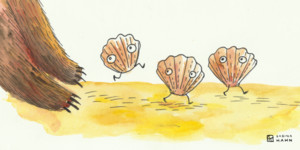
Instead, the clams walked around on two little feet sticking out of their shells.
And all day long, those shells clicked and clacked like crazy.
Crazy as the clams engaged in their favorite activity. spreading rumors.
Or starting them, really. The clams went around making up stories that simply were not true just to cause trouble.
For instance, one day Bear was heading to the river to catch fish when the clams scuttled his way.
Hey, Bear, you'll never guess what Elk said about you.
Oh, what did she say? Well, we really shouldn't tell, but, uh...
Since you asked, we heard her say that she could run way faster than you.
She did? Yeah, she said... that if you too ran a race, you could barely keep up with her. laughter laughter Then there was the time Frog was settling down on her lily pad. gearing up for a long night of croaking.
Rub it. Good evening, Frog. Nice croaking.
Why, thank you. Yeah, really nice croaking.
You know, we have no idea why anyone would say it's annoying.
Wait, somebody called my croaking? Annoying?
Well, owl stays up all night, you know. And even if she did call you annoying, why should you give a hoot?
What she thinks. Bear, elk, frog, and owl had been friends.
But thanks to the clams, They stopped speaking.
They stopped hanging out. In fact, they started avoiding one another altogether, all because of the clams' vicious rumors.
Now, there was one animal who kept his head down and stayed out of the fray.
And once he learned what was going on, boy, those clams were in for a big surprise.
Which animal do you think we're talking about?
We'll find out who he is after a quick break.
Support for Circle Round comes from Indeed.
You just realized that your business needed to hire someone yesterday.
How can you find amazing candidates fast, easy, Just use Indeed there's no need to wait.
You can speed up your hiring with Indeed. and Circle Round listeners will get a $75 sponsored job credit to get your jobs more visibility. at indeed.com slash circle round.
Just go to indeed.com slash circle round right now.
Support the show by saying you heard about Indeed on this podcast.
Indeed.com slash circle round. Terms and conditions apply.
Hiring? Indeed is all you need. need. Welcome back to Circle Round.
I'm Rebecca Shear. Today our story is called The Chattering Clams.
Amen. When we left off, the chattery, rumor-spreading clams had turned all the animals against each other.
Well, all of them but one. Beaver. That's me.
Now, if you'll excuse me, I gotta get back to work.
We've all heard the expression, busy as a beaver, right?
Well, it's no joke. Beaver slept all day, but come night, he got to work.
He started by chopping down a tree. He stood upright, Gnawing the trunk with his teeth and using his long flat tail as a kind of kickstand to hold him up Then he dragged the tree to the river to build...
Sorry, what's it called again, Beaver? A dam!
Now, like I said, I really need to get back to work Of course you do, get to it A beaver dam is basically a plug that slows down the flow of a river.
As a result, a new pond forms within that river.
And in the middle of that new pond, Beaver used mud and stones and wood to construct his home. which is also known as... Remind us what it is, Beaver?
A lodge. Now, seriously, I really... really need to get back to work.
I know, I know. Thank you for your time.
Now, here's a really cool thing about beavers' dams and lodges. when Beaver did his work.
Elk got to nibble all the bark and branches on the fallen trees.
Owl used those same trees as a safe place to nest.
Frog laid her eggs in the nice, shallow pond the dam created, and Bear used the pond to catch fish who had paused in the still water to rest.
But at some point, Beaver noticed he hadn't seen any of his friends in quite a while.
This is weird. I've got all these nice fallen trees for elk and owl.
I've got this lovely shallow pond for frog and bear, but nobody's come around to the river lately.
What's going on? Well, we know what was going on, right?
Clams' vicious rumors had torn apart their friendships And now elk, owl, frog, and bear were steering clear of one another. the one place they knew they'd run into each other was near Beavers Dam.
So they began avoiding the river. But Beaver had been so busy working, He didn't know that.
Boy, I sure do miss everybody. I wish I knew why they were staying away.
Maybe they don't like you anymore. Beaver spun around.
Guess who was skittering toward him? That's right, the clams.
Wait, what are you talking about? We're just saying that...
Maybe the other animals are done with you.
Why? Well, you are pretty antisocial, Beaver.
Sleeping on it. day, working all night.
But That's how I operate. You know the expression, busy as a beaver?
Well, we also know the expression busy as a bee.
And it looks like you're friends have made like a bee.
Oh. Oh. As the clams scurried away, Beaver was more confused than ever.
The other animals know I'm too busy to chit-chat, right?
Are they really angry with me? Now, in addition to busy as a beaver, there's another expression we use when talking about beavers.
Has anyone ever called you an eager beaver?
Well, Beaver was eager to learn if what the clams said was true.
Instead of getting angry at his fellow animals or avoiding them...
He sent each one of them a message and asked them to meet him by the river at sunset.
When Bear, Elk, Frog, and Owl arrived, Beaver noticed they seemed uncomfortable.
The usually friendly creatures weren't talking or even making eye contact.
Hey, everyone. Thanks for meeting me here, but based on your behavior, I...
I'm going to assume that the clams were right and you're all mad at me.
Bear, elk, frog, and owl were confused. Mad?
At you? The clams told you that? Why would we be mad?
We don't know what we'd do without you. Now Beaver was confused.
But why have you all been staying away from the river then?
The clam said it's because you don't like me anymore.
Well... I've been staying away because Elk doesn't like me.
And I've been staying away because Owl doesn't like me.
Wait. What? Who said that? I thought you didn't like me.
And I thought you... Didn't like me. What?
Well, you said the same thing. The animals began squabbling over who said what and what said who.
Meanwhile... The beaver stood off to the side, his flat tail softly thumping as his eager mind engineered Finally... Enough!
He spoke up. Listen, everybody! I think it's clear what all these arguments have in common.
The clams! The clams are making up stories about us.
And they're tearing our friendships apart.
We have to stop them. And I believe we can if we work together.
Are you with me? At first. The other animals eyed each other suspiciously, then sheepishly.
But then... Count me in. Roger that. I'll help, Beaver.
Me too. Alrighty then. Listen up. Here's the plan.
The animals went into a huddle. When they came out of it, they were grinning from ear to ear.
Okay, everybody. You know what to do. See you tomorrow.
The next day, as the sun was setting, bear and elk met at the river.
Just as they'd hoped, the clams immediately scampered over, their shells clicking and clacking away.
Wait, so you two have made up? Your friend.
Friends again? Even after all the awful things And the horrible way Bear handled it?
Bear and Elk exchanged a look. Actually, yes.
We're friends again. But you know who we're not.
Friends with? Little creatures who are much smaller than us.
Who we could easily eat for dinner. The clams let out a collective squeal.
Eww! as Bear and Elk took off after them.
The clams ran and ran on their tiny legs as Bear and Elk chased them away from the river and through the forest.
And who should be waiting for them at the forest's edge but Owl?
She flashed Bear and Elk a smile. I'll take it from here, friends.
Then she gathered the clams up in her talons And sword up.
And up. And up. And all the way to the ocean.
When she reached the seaside, she dropped the clams onto the beach one by one.
The clams were scattered all over the shore.
And before they could move a muscle, who should come hopping along?
But Frog, thanks for the delivery, Owl. I've got this.
Frog began leaping around the shore. Every time she reached a clam, she would jump on top of it. and use her weight to smush it down in the sand.
Finally. You rocked that one, Frog. It was Beaver's turn.
Now I'll finish this job. Beaver raced from clam to clam.
He used his long, flat tail to smack each clam even further beneath the shore.
Soon, all the clams were buried deep in the sea. beneath the sand.
Aha! That's the last we'll hear of your mean spirited stories, clams.
And it was... That's why today, if you walk along the beach, you might see little spurts of water squirting up around your feet.
Those are the clams spitting out. the sand and seawater they have swallowed while trying to spread their spiteful tails.
. . . Now it's your turn. The clams went around saying mean things about others. behind their backs.
So what if you do the opposite? Think of something nice you can say about someone.
Then find that person and tell them to their face.
Chances are that face will light up with a smile.
Woo-hoo! This week's story, The Chattering Clams, was adapted by me, Rebecca Shear.
It was edited by Katherine Brewer. Circle Round's original music and sound design is by Eric Shimalonis.
Eric has released the very first Circle Round soundtrack, and you can own it.
The music of Circle Round Volume 1 features music from our first season and is available on iTunes, Spotify, and Google Play.
Amazon and the CD baby store For more information, visit our website, wbur.org slash circleround. and click on Soundtrack and Coloring Pages.
While you're there, you can also find, yes, our coloring pages.
Our artist, Sabina Hahn, has made a black and white picture for every Circle Round story, and you can color them in.
Special thanks to this week's actors. Elle Borders, Gamalia Farms, Maisie Scarpa.
Chris Tucci, Guy Raz and Mindy Thomas. Mindy and Guy are the hosts of Wow in the World, the NPR podcast that encourages families to keep their eyes up Their screens down and their jaws dropped with the latest stories in science, technology, and innovation.
Learn more about this super fun show by visiting our website again, That's wbur.org slash circleround.
This week's featured instrument was the ballaphone. learn more about this member of the percussion family and see a picture on our website.
Once more, that's wbur.org slash circleround.
Circle Round is a production of WBUR, Boston's NPR news station.
I'm Rebecca Shear. Thanks for circling around with us.
As you're listening to Circle Around right now, did you know that you're not alone?
That's right, hundreds of thousands of other kids are listening too, all over the world.
And many of them have sent us recordings where they talk about their favorite Circle Round stories.
Have a listen. Maybe one of their stories is one of yours, too.
I am Rosalind. I am four and a half years old.
And I, my favorite surf around story is...
Lion's Whisker. And um... My favorite part is when they ask for the whisker and he gives them the whisker.
My name is Charles. I live in... Sammamish Washington and I like 100 rooms.
Hi, my name is Vivian and I live in California and I'm five years old.
My favorite Circle Round story was The Shepherd's Disguise.
I like it when the queen faints. I'm Wilson.
In my favorite circle, round story. It's the Lion's Whisper.
Because the brother and sister stopped fighting.
I am Ruby. I live in Colorado. I am six years old.
My favorite story is the woman who lived in the vinegar bottle.
We'll see you next time. That's WBUR.org slash CircleRound or wherever you and your grown-ups get your podcasts.