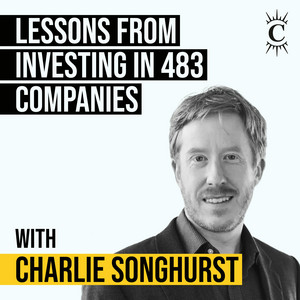
Welcome to this Classic episode.
Classics are my favorite episodes from the past 10 years, published once a month.
These are end -of -one conversations with end -of -one people.
Charlie Songhurst is a brilliant strategist, an accomplished executive, and a prolific angel investor.
It's one of my all -time favorite conversations, not just on the podcast, but period.
I hope you enjoy it.
Here's a puzzle. What do OpenAI, Cursor, Perplexity, Vercel, Plaid, and hundreds of other winning companies all have in common?
The answer is that they're powered by today's sponsor, WorkOS.
If you're building software for enterprises, you've probably felt the pain of integrating SSO, SCIM, RBAC, audit logs, and other features required by big customers.
WorkOS turns those deal blockers into drop -in APIs with a modern developer platform built specifically for B2B SaaS.
Whether you're a seed stage startup trying to land your first enterprise customer or a unicorn expanding globally, WorkOS is the fastest path to becoming enterprise -ready and unlock growth.
growth. It's essentially Stripe for enterprise features.
Visit WorkOS .com to get started or just hit up their Slack support.
Yes, they have real engineers in there who will answer your questions fast. WorkOS allows you to build like the best with delightful APIs, comprehensive docs, and smooth developer experience.
Go to WorkOS .com to make your app enterprise ready today.
Hello and welcome, everyone.
I'm Patrick O'Shaughnessy, and this is Invest Like the Best. This show is an open -ended exploration of markets, ideas, stories, and strategies that that will help you better invest both your time and your money.
If you enjoy these conversations and want to go deeper, check out Colossus Review, our quarterly publication with in -depth profiles of the people shaping business and investing.
You can find Colossus Review along with all of our podcasts at joincolossus .com.
Patrick O'Shaughnessy is the CEO of Positive Sum.
All opinions expressed by Patrick and podcast guests are solely their own opinions and do not reflect the opinion of Positive Sum.
This podcast is for informational purposes only and should not be relied upon as a basis for investment decisions.
Clients of Positive Sum may maintain positions in the securities discussed in this podcast. To learn more, visit p -s -u -m dot v -c.
My guest this week is Charlie Songhurst, the former head of strategy at Microsoft and a prolific investor having personally invested in nearly 500 companies through his career.
I met Charlie at an event hosted in New York, and you can tell within one minute of meeting him that his mind is sparkling with ideas and curiosity.
It's no wonder he's been among the most commonly requested guests when I asked several top investors and CEOs who I should have on the show.
We discussed the lessons he's learned about business, investing, and people from such a large sample size of companies.
I won't reveal any more here.
I highly recommend you just listen to Charlie and learn.
Let's dive in. Charlie, I like starting these things in a a unique way.
And one idea that you've had is to have people stack rank their vices of power, money and fame.
I'd love you to begin by explaining why you're interested in this idea and what you've learned from the answers over the years.
So it's a two -part question.
One is the virtues, which is working with people you like, working on amazing problems and having impact.
And then the three vices, power, money and fame.
And you can't avoid them.
They have to be stacked separately.
And it's really trying trying to get at the differences between...
There's no good answer, but there are definite good fit answers.
So someone who's interested in power tends to be better at execution.
Someone who's more interested in money tends to think more about some capital efficiency.
I tend to avoid people interested in fame.
But if you were doing something in showbiz, it would presumably be the number one criteria.
If you think about the difference between impact, intellectual interest, working with people, you really get impression of where people are going to be happy and where they're not going to be happy.
You also start to understand why certain organizations do so well.
So SpaceX, if you think about it, stacks high on all three.
It's intellectually interesting.
You're working with amazing people.
You have huge utilitarian impact in the world.
Whereas if you're working in fintech, you're less likely to have that utilitarian positive impact.
Any especially memorable or interesting series of answers that you've gotten on the two stack back ranks that come to mind?
A lot of people have negative utility from fame.
A lot of people start with power.
And then when you push them, it's actually money, but they don't want to say it.
And that's more true outside of the U .S. culture than it is in the U .S. It's particularly true with Europeans.
And so a lot of it is trying to get people to actually say what they truly believe, as opposed to say what they think they should say.
I'm curious in what context, whether whether it be interviewing prospective founders, interviewing potential hires or others, you find it most interesting and useful?
All of the above. The founder one is fascinating because you actually end up going down different lines and helping them depending on whether they answer the power and the money.
Founders that answer with power tend to need help more on managing their startup capital efficiently.
They tend to be the ones that spend more.
They tend to be the ones that overexpand.
They're often too aggressive.
Conversely, So the ones that answer money tend to be very capital efficient, but often slightly too cautious, slightly underaggressive, sometimes not willing enough to stamp their authority on the company and make it the culture that it needs to be to be successful.
When it comes to hiring or evaluating founders, apart from this two -part stack ranking, are there other favorite questions or devices that you return to again and again?
I think what you're really looking for is founder market fit.
it. I think there's a sort of mistaken concept that there's this platonic ideal of an entrepreneur.
And I think maybe there's two very basic things.
There's energy and there's sort of cognitive ability.
But after that, you're really looking for fit.
So if you take the sort of prototypical consumer founder, they tend to have more empathy for how people behave. Whereas if you take the classic enterprise founder, they tend to be more rational because in some ways you can just go and ask your customers what features do you want and go build them.
And so you go down those different lines.
And I think there's a lot of phallus in that sort of platonic ideal.
What you're actually looking for is someone who's a good fit for a business.
I'd love to take a step back now and introduce you to the audience a little bit.
One device that I've been using with people on the podcast is to ask you to give the thumbnail two -minute sketch of your life and career up until this point.
Studied politics, philosophy, economics at Oxford, ended up very briefly at at McKinsey, then at Microsoft, and then sort of bumbled my way into becoming an investor and do a lot of angel investing.
So I think I've done about 500 angel investments.
I think the actual number is 483 and about 300 in the portfolio at the moment.
I believe you ran strategy at Microsoft. What exactly did that entail?
And what is most memorable about that time?
There's so many memories working with amazing people.
The hostile acquisition of Yahoo as an attempt was just unbelievably intellectually fascinating.
Trying to buy a company in a hostile acquisition for, I think it's $47 billion, and just the drama and the soap opera, and realizing how much path dependency matters on big deals, how much a casual comment misinterpreted by one side or the other actually changes the outcome.
It's remarkable how little system theory there is in the sense of if you ran experiments again and again, I think you would get a lot of of different results in M &A activity.
Whereas in things like product usage, good products and bad products would probably be the same in each experiment.
483 investments is a crazy amount.
I want to come back to your time at Microsoft probably later on and talk in more depth about strategy.
But given the sheer volume of investments that you've made, I think a great place to begin our conversation is your idea or your thinking around why startups succeed and fail.
I'd love to begin by you outlining sort of what, if anything, is shared in common across those 483.
So are there certain features that you're always looking for and sort of how your process works?
And then we'll get into the success and failure of startups.
In some ways, it's too tied together.
So I think the dominant sort of failure mode for startups is the same at each different stage.
So sort of pre -seed to seed, you basically have a failure to achieve labor productivity, which is really just a polite way of saying the team doesn't come together doesn't gel and produce good output.
Usually a team that just produces good work will generate enough sort of kinetic energy to get continuing funding.
Once you're sort of going from seed to series A, it's another single cause, which is failure to get product market fit.
You're basically on the search for demand curve, and you either find one or you don't find one.
And this is where you've got the highest element of pure chance in a startup.
It sort of always feels akin to sort of gold prospecting in the california gold rush which is you can be good or you can be bad you can do the right thing you can do the wrong thing but there's some irreducible man to chance the wisest prospector with the best maps and the most intelligent strategy sometimes just won't find it and someone will just fall asleep put the pan in a stream and gold will come out and there really is a real nexus of serendipity at this stage Then when you move to Series A, it's really all about labor productivity, but in a different form, it's can the manager scale?
And one of the fallacies is most early stage startup founders think they're managers and they're actually not.
What they have is a team that's actually managing them.
Because when you're managing, say, 10 or less people and you're spending time with them every day, what's actually happening is they're managing you by influence because they know know you well enough, and they talk to you enough to work out what your desires are.
So as long as you're articulate and energetic and sort of engaged, you actually don't have to manage.
The team manages you upwards.
But when you scale to 30 people to 90 people or above, you no longer have those personal connections.
You have to move to formal management techniques.
And that's like a sort of Fermi paradox great filter.
It wipes out up an amazing amount of startups.
And the way that's devinced is a collapse in the labor productivity per person.
There's a term in microeconomics called managerial diseconomies of scale.
And I think in some ways, the angle of the decline of productivity per person is the difference between the stripes, the great startups, and the failures.
And maybe if you're a great startup, as you go from 10 people to 100 people, output per person drops 15%.
And if you're a bad startup, it actually drops over 90%, with the result that often 100 people startups produce less than they did when they had 10 people, because the managerial collapse has been so extreme.
And one interesting thing is if you look at the companies that get very big, maybe there's a sort of interesting explanation where one of the shared attributes was an instinct for the sort of structures and processes of management that were shared between Gates, Zuckerberg, Bezos, the Carletons, all these sort of super talented people, because my guess is they didn't receive formal instruction on it.
Their VCs and advisors weren't that helpful on it.
It may be either by chance or by skill, they just intuited their way through it.
Then when you get beyond that sort of series B and beyond, I think it's institution building.
And one of the interesting problems is the sort of people that become entrepreneurs are often full of energy and sort of flexibility, almost a sort of combination of street smart and book smart.
But there's a point where they've hit product market fit, where actually what they're doing is repeating a process at scale.
And to repeat a process at scale, you need to build an institution.
And often that sort of is almost arithmetic to their personality.
If you're going to take in revenue from 42 countries, you really need a well -developed finance department.
Once you get to a certain size, you will always be in court cases because of being sued by ex -employees, you'll have patent infringement suits, you'll be debt collecting customers that didn't pay, like the shift to sort of building an institution with institutional norms and of institutional values, of institutional culture, and all the boring stuff of building strong finance departments, strong legal departments, strong HR departments, that again is a big filter.
And so those are sort of filters by stages.
What's interesting is some of those you can do when you meet someone in pre -seed.
One interesting thing is I sort of close my eyes and think, can I imagine this person in a public company conference school, remembering they sit in the Microsoft, some of the Microsoft earning schools.
And I'm thinking, can I imagine them sitting as a sort of CEO next to their CFO, talking talking with all the sort of Wall Street equity analysts on the buy side on the phone, and just be incredible enough and deep enough and mature enough to pull that off.
It's a fascinating set of framing.
The one that jumps out is maybe most interesting to me is this idea of the declining curve of people's productivity.
And in your experience, whether or not that is something that is typically innate to the founder, meaning they just handle that naturally and with aplomb, or if instead it's something perhaps that could be coached.
And if it's really just a set of best practices that are fairly universal that the founders just don't get?
I think the irony is it is absolutely something that can and should be coached, but often isn't.
So often the people that get it intuitively are the people that survive, but there's no need for that.
It can just be coached in.
And I think a lot of it is you get this very strong transition.
When you're a very small startup, most of the people you're employing just come in and do their job and go home.
And the drawback of that is you tend to end up having having to do type management, a lot of micromanagement.
And the beauty of it is you tend to get a very low level of politics within the organization.
Then you get this transition to where you're hiring people that are sort of execs, would be the sort of headhunter's description, VPs, senior people.
And the beauty of these more senior people is you can give them much more complex tasks.
Build me a product division doing this.
Go open European markets for me.
And the drawback is it, anyone capable of those complex conceptual abstractions necessary to do that, tends also to be capable of politics.
And because the world is not composed of saints, as an organization scales, the level of internecine politics increases exponentially.
Someone once said to me, the difference between a great company is one where the execs spend only 25 % of their time playing politics, and a bad one is where they spend 50 % of their time playing politics.
And that delta is the entire Gaussian bell curve from the best Fortune 500 company to the worst. And I think one of the things that really matters as a founder is acting as a dampener on politics.
So reducing internecine warfare, reducing the tendency for marketing to try and take control of the sales funnel, reducing tendency for the head of sales to want to take over sort of inbound marketing, trying to stop the CFO controlling spending so tightly that you don't get positive return on capital investments by sales, trying to stop sales getting so much control over spending that your margins go out of control.
All those boundary conditions between sort of VP leaders and functional heads, defining those well and managing through that transition is just so important.
And there's nowhere where someone learns that through the process of entrepreneurship.
One of the things that's, I think, very interesting about people's careers in general is the early stages and the personalities that go into them often have negative correlation with the later stages.
So if you look at a sort of McKinsey or Goldman Sachs analyst. Often what they need is attention to detail, strong work ethic, high diligence, high conscientiousness, and sort of five factors, all those sort of things.
If you look at middle management at those companies, they need good project management, good ability to abstract and structure problems, good ability to pull a team together and create team morale, and the sort of being across the detail and the technical knowledge matters less.
And then if you look at the sort of partner level in those firms, often all that matters is relationship building and sales and charm and the ability to empathize with the client and connect with them and so it's very hard to find people that are stars in all three parts of those careers and i think it's the same with entrepreneurship the street smart entrepreneur at sort of precede who can raise money with a good narrative and get energy and recruit people and sort of create a sort of sense of momentum and esprit de corps is often very negatively colorated with the sort of personality that wants
to put in quarterly HR reviews and QBR reporting and really make sure that the finance team is taking at a later stage.
And then conversely, often the entrepreneurs that do very well later find the early stage capital raising hell on earth because in some ways they're so tightly gripped to reality and they're slightly pessimistic, which makes them very good at sort of avoiding chaos, often makes them very bad at pitching.
I'd love to hear your thought on this This interesting concept that actually our mutual friend Graham and I have batted around quite a lot, which is this notion, the term we use based on a blog post by a guy named Rick Burton is the idea of an alien founder.
An alien here is used as the best possible compliment to a founder, where it's somebody that just has sort of what seems to be in like an unfair and privileged access to some sort of underlying substrate, the thing that is going to build the business.
And they just kind of know what to do.
They have an incredible first principles mindset typically.
And say Bill Gates would be a great example of this.
I think Bezos would be a great example of this to use obvious ones.
What do you think of that idea that in some ways the absolute best founders are in some sense alien and distinctly unique people?
I will maybe for the Socratic sake of it sort of take the opposite argument and say, I think one of the mistakes that we're into is just sort of seeing sort of effervescent genius.
Because you're seeing people at the height of their powers, you're not seeing them on the way up.
There's that famous clip of Bezos, I think in 99, with Amazon sprayed and spray paint in the back of the office.
It would be really interesting if you talk to him, whether he is similar to the Bezos of today, because in the intervening 20 years, remember, you've got this incredible training program for the mind.
They're working every hour in the startup.
They're talking with the smartest people.
They're constantly getting new information.
education they're hiring they're firing so their pattern recognition of executives gets so much better they've got a million failed initiatives so they have all these learnings of what not to do they've got all the things that have worked and they've seen what scale they've seen the commonality and so how much of that is sort of looking at an athlete at the peak of their performance and not seeing the 10 000 hours of practice that got them there and i could almost argue you could invert it and say, what are actually the causes of mortality?
And how do we just avoid suffering that mortality this year?
And if you survive long enough, maybe greatness eventually becomes you.
So one of the things I think that sort of is perhaps underestimated is if you want to live forever, maybe don't start thinking about study centenarians.
Instead, work out how to not die of a DUI or drink driving or smoking 20 cigarettes a day.
And to some extent, the same in entrepreneurship is, it would be amazing.
And of course, the problem with the observation of the world is people spend a lot of time studying greatness.
They don't study failure.
They study Muhammad Ali.
They don't study all the heavyweight boxers that flaked out after losing their first match. But maybe if you study all of those, you can find a commonality in their mistake.
Maybe they all, I don't know, offered their chin to the opponent or something.
And in startups, I think there are common mistakes.
There's an original sin about capital raising.
I see so many startups ups three to five years in, still haunted by bad capital raise at the beginning, some investor they don't want, some valuation that was hopelessly dilutive and puts VCs off now.
Often, one of the things that I see correlate very well with success is how quickly they exit their first employee that doesn't fit.
I think what that's actually showing is, are they willing enough to be disagreeable to make the company what they want?
The willingness to cross that chasm, and often you're dealing with young founders, that's some major infraction point.
And if you don't do it, that often leads to a toxic culture and bad results.
Then there's sort of more subtle melodies like sort of turning things into an academic project, particularly with founders with very strong academic backgrounds, often in deep tech and PhDs.
They're sort of like generals fighting the last, where they think of prestige as a currency because it is an academia.
And so they just think if we do amazing work and we tell the world about that amazing work, good things will happen.
Because as a heuristic, that did work, but it means they don't engage with revenue, they don't get quite product market fit, it's too much of a sort of ivory tower intellectual exercise?
Or conversely, do they just sort of think, we get momentum, we get revenue, we get traction, it'll work, and they haven't really thought about the deep microeconomics and unit economics of a scaling company?
And so I almost invert it and say, don't study greatness, study failure, and work out how had not to be that.
If you're sort of thinking of history, trying to be as good a remnant as Augustus would be really, really difficult.
Not being as incompetent as Caligula seems really easy.
And so as a practical advice, not making the catastrophic mistakes and just surviving long enough feels like a good strategy.
There was some general somewhere that said, it's not that good soldiers become veterans.
It's that lucky soldiers become veterans, but veterans are good soldiers.
was meaning just the luck of surviving the first few hours put you up an experience curve.
And I see entrepreneurs transform in those first 36 months of leadership and management.
And half of it is just stay alive till you get good.
We've talked a little bit about recruiting as someone that all of a sudden seems like half my time is spent just recruiting people in all different directions.
Curious how early you encourage entrepreneurs to make that a major part of of what they do, and whether or not that effectively lasts the rest of their career if they're successful.
So I think recruiting is way underestimated, precisely because in an early company, people replicate themselves.
So because people tend to hire not so much in their own image, but with their own set of biases, all the initial people you hire will influence all the other hires.
And so you can either get this sort of upwards -iterating culture of excellence, or you can get this downwards iterating culture of excellence.
So those first few hires are utterly critical.
And I think people way underestimate just the sort of the maths of the return, which is it seems excessive to say spend 100 hours hiring a person.
But if you're only hiring 10 people, that person is 10 % of the output of your company for the next seven years if they stay.
But then if they hire as well, they may actually contribute to 10 % of the productivity of the company for the first decade, aid, both by their own labors in the early years, but also in terms of the way they themselves recruit.
So I think people just sort of underestimate the power of the math here and don't focus on bias that entrepreneurs often have of going for speed and the desire to move fast. And partly this has sort of come out of startup culture because of the synergies of network effect businesses, where speed often really does matter.
But 99 % of startups don't have strong network effects.
80 % don't have them at all, maybe 19 % only have weak network effects.
And in those, quality matters far more.
And so going slower, spending an inordinate amount of time picking exceptional people that are deeply synergetic, exceptional in and of themselves, and then have deep and meaningful synergies with the other team members creates this thing, which is a sort of algebraic functional labor output.
And I almost think that's how you have to think in the first year.
year, how do I find amazing stand -alone people that are also synergetic?
And so my net labor output of the firm is super high.
And the biggest mistake I see is when they're panicked to hire someone because they need sort of a job done.
And so they just go for the earliest person.
And then, sorry to monologue here, the pernicious mistake is the change in hiring rate based on the amount of capital available to the startup.
So what you notice if you grafted is hiring is not consistent on a quarter -by -quarter basis.
It bulges after each capital raise, pre -seed, seed, A, B, and then it's attenuated almost to nothing in the six months before the next capital raise.
So the sort of entrepreneur is like the proverbial sailor coming into port who spends all their money and then doesn't have any months afterwards, but it's in hiring.
And if you think about that, that's absolutely insane because what's the chance that you can find, say you're hiring 10 people, what's the chance you can find eight in the first 90 days that it's right to find eight in the first 90 days and then only right to find two in the next 540 days your chance of coming across the exceptional people is so much lower than if you space that out evenly and because you'll know the existing people and see them working together if you hire two in that first quarter each next one you hire you will understand their synergies with the existing team so much more
what have you seen successful founders do to make sure that when recruiting, they're able to win the best candidates out there.
So it's one thing to be patient and spend the time to identify them.
You also have to hold out an attractive proposition to those very talented people who presumably have other opportunities as well.
So what have you learned about the best recruiters in terms of how they market the opportunity and market the firm?
I'll give a sort of very cynical answer and then a more aspiration answer.
The cynical one is just just be in labor markets at a low competition.
You really don't want to be sitting there in San Francisco trying to close your candidate when John Cullison's trying to close the candidate as the alternative, because John's going to win.
Knowing John, I agree.
He's one of the greatest experts of his age.
But you see this actually happen.
Whereas if you're hiring that person in Kiev and their other option is working in outsourced IT for Deutsche Bank, it's a much, much easier win.
So in some ways, what you want to find is where are the incredibly incredibly qualified people in weakly competitive labor markets.
And that is a much easier filter than actually being good at recruiting and a much more powerful one.
You're much better being a heavyweight boxer who's not very good fighting lightweight boxers than you are getting good as a heavyweight boxer.
And it's the same. You're better going and competing in a market where the other recruiters are lightweight, because they're boring industrial firms with tenure -based commotions.
So that's one. And then two, it's some combination of painting a vision that people want want to be part of, understanding what they themselves are motivated.
So it goes back to those sort of early questions.
Are they motivated by working with great people?
Are they motivated by utilitarian impact?
Are they more motivated by things like money and power?
It goes back to just getting the impression that they want to spend time with you.
Do they actually want to spend every day with you as a founder?
Because these companies are small.
It's not like you're recruited by a big company and the hiring VP you may be going to spend an hour a month with, you're going to spend a lot of time with this founder so there has to be a natural desire to do this and then third i think there's just a sort of sense of being in a sort of gang that's going to succeed a sense of we happy few to quote some shakespeare of just i want to be with this because this is going to be something that changes the world and it's going to be an adventure and and that cliche the journey will be the reward will be true and the economic outcome will be a reward
and when i look back the impact will have a reward and if you get that trip tech Beck, you'll close them.
I would love your take on the sort of interesting tension between what I'll call in the U .S. sort of East Coast versus West Coast investing, where I would say East Coast investing is very traditional Wall Street, more quantitative, West Coast, more startup -y in technology and more qualitative and almost cavalier about in some cases about the quantitative aspect of things.
I'd love you to riff on the pros and cons of these two styles and where you see the appropriate mix of them.
I think there's a sort of multi -part explanation for that.
One part I think is the absence of existing status hierarchies on the West Coast meant there was less of an opportunity cost in sort of not joining Goldman.
And you can almost do a counter history and say, maybe all this story about DARPA and the Valley and all of that is much less important than people think.
Maybe you just have a new country formed of 70 to 100 million million people without an existing status hierarchy, it would obviously glom onto the new tech, to the new industry.
The industry was obviously going to be tech. And so it was obvious that a new country, which is really what the West Coast has been since World War II, when you look at just the population numbers, the West Coast would obviously win.
That's one part of it.
I think the second part is differences in the nature of trust and zero -sumness, partly because financial markets are, in the traditional sense, zero -sum.
One person's stock alpha is another person's negative alpha.
East Coast investing has had this sort of sense of, I need to beat the other person, I need to get a deal.
And that has led to sort of lower trust between participants.
And the West Coast, maybe it's sort of part of California hippie culture tradition coming in, has this very high sense of trust. And if you look at sort of the convertible note, if you look at sort of letting the founder make decisions below supervision, these things things only emerge in a very high trust culture.
And I'm not sure you can build trillion dollar market cap companies without that high trust culture.
I think if you don't have it, you end up building something worth a billion dollars and then arguing over how to sell it or how to optimize it.
And you don't get that sort of aspiration that you see in all the trillion market cap companies, all of which are on the West Coast. And then I think there's some interesting little sort of cultural foibles, possibly with an actual dress by the East and West Coast, but more by the nature of investing, maybe what people do as analysts between the age of 21 and 23.
So if you spend your time between 21 and 23 building Excel models, you tend to think more about numbers.
And so you tend to have a much better intuition for margin economics.
And so where is the East Coast off tonight over the West in the way they look at businesses?
It's They correct to identify businesses with shaky unit economics, but fast revenue growth and good product market fit.
And they're like, look, you have product market fit, but only because you're giving away $100 for 90.
So of course you've got good product market fit.
I'll give you some counterpoint where West Coast investors do very well is where you have a product leap that doesn't get evinced in the numbers immediately, but is such a sort of tactile and visceral experience when you use it.
You have to make an imaginative leap to turn that into numbers.
And there are two examples.
One is the early iPhone, and I was doing some investigations for Microsoft at the time.
And it was always easier to talk about competitors than to talk about yourself because you're less likely to say something you shouldn't.
So you're always trying to steer the conversation on to talking about Apple or Google or something.
And one of the things you realised is there was a bunch of investors that sort of thought Apple was overvalued when it was sort of 100, 200 billion market cap because they took the tam of Nokia and said, even if they take all Nokia's market share, this business can't be big because phones only sell whatever it was back then.
And they couldn't intuit the increase in pricing power that you were going to get from turning the phone into a computer.
And the West Coast VC community immediately intuited that.
And then you see the same in this sort of almost comic battle over Tesla as a stock.
The Apple one we can say is a win on the West Coast. The Tesla story isn't fully written yet.
But again, it's this difference between a culture that's, look, this product is so amazing, it will redefine economics for category, and investors saying, well, when you look at this in a spreadsheet, it just doesn't work.
And I think one interesting thing in general in the search for alpha is, where do you get intuitions that are hard to make?
Because there's no natural person to think of it.
There's a public company called Xero, X -E -R -O, which is a small business accounting company.
And it's headquartered in New Zealand, listed on the ASX.
Its biggest market is accounting software in the UK.
But the people that fundamentally understand accounting software would be people that have followed Intuit, which is a West Coast stock, NASDAQ listed, would be more the people that maybe look at Intuit, that look at H &R, that maybe even go into Tableau and business analytics.
And so there you had a company that quietly went from $50 million market cap to $10 billion market cap.
And I'm not sure anyone intuited it because New Zealand investors weren't used to tech. The Australian investors came out of a sort of mining culture, and the US investors tended tended not to look at ASX listed companies.
And so one thing that's taught me is trying to be smarter than other people is very hard and doesn't work very often.
Trying to have an insight that you get because you sit in a different information flow just seems exponentially easier.
Everything you highlight suggests exactly what's happened in the last 10 years, which is that the primary sin for public market investors is being overly quantitative, that basically anything quantitative, whether pure quantitative strategies or people that rely rely heavily on spreadsheets, as you say, have tended to get trounced by people that have the more qualitative fundamental insight about what will become a very big market.
I'm curious how you apply those concepts in your own style of investing at an earlier stage.
So where does, obviously, there's a lot of qualitative, but where does the quantitative come to play?
We'll just go a little bit further on the thoughts around that, which is, I think one of the things that's very interesting is the way you model companies in Excel with the DCF. There's a sort of set of cultural norms, like trending down the growth rate to a terminal value over time, that obviously would correct industrial era companies, the sort of companies that a KKR would buy.
If you were sort of modeling Nabisco and Barbarians at the Gate, it's obviously the right conceptual approach. Maybe that's just not right for network effect businesses, because instead, literally, how do you model and excel the concept of in year six, something becomes a standard and therefore gets sustained or accelerating growth?
There was a sort of joke in the 80s of, you'd never get fired for buying IBM.
Well, maybe in 2006, it suddenly became, you never got fired for buying salesforce .com.
How do you model in that as a concept, suddenly kicking into revenue growth?
Maybe what you should actually be doing is writing a sort of 3 ,000 -word essay on revenue growth drivers, as opposed to sort of trending it down over time as an automatic default.
fault. So there's sort of certain things where I think the industrial era protocols actually just mislead you.
Conversely, I think the counterpoint to that, which is the sort of two product -driven mistake, is when you look for network effects everywhere and you sort of assume they exist, and actually you're just getting into a standard competitive market.
Trying to turn that to startup investing, I think a very good rule of thumb is to think it's very hard to extract extract economic rents to get revenue without solving someone's problem.
So go right back to a sort of Jeremy Bentham utilitarianism.
Why are you making people happier?
How much happier are you making them?
And what percent of that can you extract as economic surplus, and what percent goes to them?
So an interesting one is if you pick up Google, there's lots of charts saying people would pay thousands and thousands of dollars for search, yet Google's ad revenue per person is much lower.
So potentially, the utilitarian output of Google is 10x, maybe even 20x, the economic value derived from that.
Whereas, I imagine if you looked at something like Oracle, you would actually find the utilitarian benefits, the economic length, so a much higher percentage of the utilitarian benefits.
There's more value capture as a percentage of the total common wheel created, the total common utility.
But I think even when you're talking to a company at seed, you can start to have that conversation over how big a problem are you solving?
How many people are you solving that for?
Or how much money have those institutions got to spend on your product if it's in the enterprise.
And then if that's utility created, that's part one.
How big is that? And then two is, what are the competitive dynamics in this marketplace?
So how much of that utility will you capture?
And how much will just be given to your customers as consumer surplus?
And one of the sort of interesting, wonderful tragedies of the economy over the last four years is there are so many companies where 110 % of the economic energy passed over to consumer surplus.
So you just had massive increases in living standards, sort of accidental wikipedias so there's very strange examples like lcd televisions everyone switched from cathode tube to lcd in the early 2000s that's an increase in human utility but no tv companies made money because the market was too competitive same with things like improvements in consumer modems routers switches you don't see 200 billion market capital out of companies like intel but we all benefit from far faster speeds than we did 20 years ago and so what you're looking Looking for, as an investor, is high utilitarian outcome and the ability
to capture it. Are there markers of that latter piece, the ability to catch it, that you see again and again that interest you?
Most extreme is obviously network effects.
Obviously, you get these in marketplaces.
You get them in the classics, Metcalfe law.
You get some examples where you combine data from other companies to generate insight.
So each time you get a new customer, you improve the product for all the existing customers because you get a bigger data set to work on.
Strangely, I think spotting them has less use than spotting the fallacies.
If we go to data, there's an amazing sort of the last gasp of a company whose unit in economics don't work is the values in the data.
And 99 % of the times that isn't true.
And the idea is you've got unique data set that's going to be incredibly valuable, maybe for advertisers, maybe for other customers, maybe for enterprises because of the insights to be generated.
But it actually turns out most datasets will get you the same insight and people.
There was once a company, I don't know if it's true from those principles, but they said if you gave the last five browsing sites that someone had been to, or their last five latitude, longitude locations in real space, or their last five Google search terms, or their last five credit card purchases, you could basically get the same level of accuracy on that person's predicted behavior.
behavior, which means there's a sort of false millage of an oasis, which is there's going to be value in the data.
And it turns out to be a millage because there's so many other ways to get to that answer.
And so half the time, what you're looking for is sort of the exact opposite.
It's where it appears there should be value capture, but there won't be.
I asked once a group of people what, if any specific sector or category of companies they would invest in, if they could only choose one for the rest of their career.
And one person said communications, because you'll always have some monopoly to pick from, which is sort of a classic expression of the network effect idea?
I'll go for, if you pick two axes, one called axis is boredom and the other is complexity.
You want highly boring and highly complex because everything in the universe is a supply and demand curve, and you just get insufficient supply of entrepreneurs in the highly boring but highly complex space, and therefore you get elevated returns.
So if you go through the quadrants, you've sort of got the whole simple side, boring and simple and complex and simple.
It's just too hard to get differentiation without without enough complexity.
That's when you get commoditization.
If you go for interesting and complex, you get brilliant entrepreneurs.
This is a problem, say, with space tech as an area of innovation.
Every single person involved with space is basically a brilliant genius who's passionate about their work and loves it, and so very, very strong competitive dynamic.
On the other hand, if you hang out in audit software, accounting software, you're sitting in an area that's complex, but no one wants to boast they do it at a dinner party.
What you you might call the sort of spiritual rewards of the industry are lower.
And therefore, you just get less by entrepreneurs.
Therefore, the chance of every entrepreneur succeeding is significantly higher.
Do you think that two by two matrix squares with, say, the trillion dollar club today of Amazon and Apple and some of the FAANG stocks?
Do you think that they generally were at their start board?
No, I think it would more work in the sort of case of Salesforce, Workday, Tableau, Datadog, all those classic enterprise SaaS names.
I think the truly really exceptional ones, are so idiosyncratic, there's no way to find them.
Because if they were predictable, you would get so much competition, they wouldn't exist. Interesting when you look, say, at Google, how many failed search companies preceded them.
AltaVista, Excite, Lycos, Infoseek, AskJeeps.
Imagine someone sent you something about Google when it was a small company.
You'd say, oh, it's just another search engine.
In some ways, you almost need the the opposite.
You need a case for why it was so unobvious.
If you look at early Facebook, there's all these comments on, but surely MySpace has only won this market.
I think the exceptions are just so exceptional, you can't formulate rules for them.
I think it's the next tier down where there's probably more repeatable behavior.
Of the 483 angel investments that you've made, what percent would you say are clearly boring?
To whom would be the sort of counter question?
I think to sort of the average person, probably 350 of them, obviously, they're not bullying to the founder.
And they're never bullying to me.
I find things like accounting software deeply interesting because it's an intellectual puzzle, you're solving someone's problem.
And I also think the utilitarian output to the world is way underestimated of these things.
If you were to think, what was the precursor technology to Manhattan?
Sewers. Very hard to have Manhattan without sewers.
But they don't sound exciting, right?
If you were to suddenly remove them, human living standards would drop exponentially.
And so those base technologies that sort of double entry accounting in the sort of 14th century under the Medicis or whoever, those things really matter as sort of system -wide improvements to the thing.
And sometimes the joy of those can be missed.
Before we started recording, you mentioned this interesting word, which you don't often hear in investing, which is aesthetics.
I'd love you to talk a bit about investor aesthetics, why they matter and why they may create bias.
I think there's this thing where if you think about the investment career, most people join a place where they fit.
And so they join an organization that gets them.
So you do have this sort of birds of a feather flock together.
So you tend to find that you get a set of people that either like the gritty and the real and the physical and the tangible.
Look at, say, the overlap between stock investors looking at things like mining companies and shipping companies.
And then you get people that like the abstract and the ethereal and the sort of conceptual.
Think of Atlassian, Stripe, companies of that ill.
Then I once saw this tweet, some joke about rad investors, that they love owning things with names like American asbestos.
And it made me chuckle because it seemed that there was some sort of truth to that.
that it felt grittier and truer and more real and more like just better to own something that's a steel mill plant in Pittsburgh than it is to own a Tableau or some company doing this sort of weird software stuff.
And so the interesting trend about that is does that create biases and oversights?
So maybe because VC sort of in the 2010 to 2013, 2014 network effect consumer businesses were so so good, maybe too much capital went into those in the subsequent years.
I think of Li Chen and scooters and things like that, because there wasn't enough Darwinian survival of people that focused on unit economics.
Those partners had diminished in their political power within the VC organization versus the partners that bet more on a network effect on the product.
Then there's actually a chapter in Dawkins' selfish gene on hawks and doves and evolutionally stable populations of different behavioral strategies.
Maybe that also replicates in investors.
And of course, as an investing type succeeds, so it attracts more capital and more disciples, and therefore there's more people looking for it, and therefore the alpha is more diminished.
We've talked a lot about the founders and characters of entrepreneurs, less so about characteristics of investors that you've worked with or seen operate.
What are your observations there?
Probably haven't processed 483 of them in the same way, but I'm sure you've been around them.
what do you think makes for the right mix?
Success is very idiosyncratic.
While they're like entrepreneurs, it's sort of finding a fit for their style.
So I know one investor at Siege is a fantastic investor and just has an absolute essence of getting to the nub of the character of an entrepreneur.
Just the descriptions, the articulation, the strengths, the weaknesses.
You would have thought you should spend 300 hours doing a psychological profile.
It's sort of like those TV shows when you have someone profile the serial killer in like 30 seconds, it's almost sort of a gif like that.
Then there's another investor at the same stage who almost ignores the personality of the founder and is all about the structural economics of the business, the market power, that ability to capture value.
And both those styles work beautifully.
And then I've seen a third type almost doesn't think about the underlying company.
What they actually watch is other investors and sort of like a pack of lions.
They don't try and kill the antelope.
They just steal the antelope once it's down and they just swoop in and win deals that they saw other good investors go for.
So three wildly different strategies, all three I've seen work superbly.
And so no cookie cutter solution.
I'd love to hear your take on the effects that COVID now, three, four months into it are having on the world at large, both from a company standpoint, for societal standpoint.
And at what point sort of the behaviors that have changed become very set?
and in some way permanently change how we live.
I see two main effects.
One is this sort of tech acceleration.
You've got this shift in behaviors that would have happened only over the long term from demographics.
I was a sociologist at Microsoft who once said, look, there's a thing called the rule of 1975, which is people born before that just never had computers at school.
And so they'll never have the same intuitive behaviors as people born after that.
And it sort of reminded me of the Einstein Stein or maybe it's Einstein comment of science advances one funeral at a time.
And so in some ways, the natural movement of progress is as generations of people get older.
Video gaming is a classic example of this.
It was seen as something only for kids until those kids grew older and kept on doing it.
I think COVID has changed that because what you've had is 70 and 80 year olds get on and use Zoom and use digital apps in a way that was much more akin to 25 year else.
That's a permanent one -off shift. And you really see it in the numbers for all e -commerce startups.
Every e -commerce startup, the numbers have gone insane to the point where you almost start wondering whether they've made a mistake because it can't be that good.
You can't get that fast an acceleration, but no, it really is that fast an acceleration.
And my guess is the emotional experience of retail will just be less appealing than it was.
And so even in a world of reopening, opening, my guess is you get this continued elevation of e -commerce.
And then once people have shifted from doing some activity like going to a bar to playing some video game competitively, probably a bigger percentage of that will stick and seems obvious because this is lasted long enough that you get habit formation.
It's certainly longer than 30 days that that's probably meant to take.
Then there's a much more subtle impact, which is you've definitely had a globalization of investing.
One of the things that never made any sense to me was investors that define themselves by geography.
They were in Berlin and they invested in companies in Berlin because the commonality in running a startup by geography seems almost de minimis, whereas the commonality of, say, fintech globally seems much more similar to each other, or quantum computing startups globally seems much more similar than a quantum computing company and a credit card company, both within a few streets of each other.
It always seemed more logical to me for startups to be defined by functional area than by geography.
That's starting to happen because if you're doing Zoom calls with someone, there's no difference whether they're a mile away from you or a thousand miles away.
And then the same with the labor force.
Startups are starting to do remote in a way that was inconceivable before.
And what it's starting to do is make them think very deeply about where they can find talented people.
Maybe I'm too optimistic, but I think that may just lead to a permanent shift in overall productivity upwards because you're putting together a team not defined by the accidents of geography, but defined by finding the best people you can anywhere in the world.
And if everyone does that, you just have a bigger sort of liquidity in every type of output.
And that leads to just a massively higher output function.
What are these changes in sort of demographics and the way we live now?
It does seem that there's likely to be some sort of city to suburban transition.
And one of the things that I like to do is sort of, I think history is really useful for investing.
Because I think one of the mistakes you can make as a sort of temporal arrogance of thinking the time one lives through is sort of overly unique.
There's a book by Will Delonte called Caesar and Christ, and it's a sort of whole history of Rome from the founding to 500 AD and sort of the fourth Roman Christianity afterwards.
It's always interesting to think, how would you invest through that?
Do you buy or sell Roman real estate when Caesar's murdered?
Because you get a civil war, you get chaos, but then you get Augustus and peace afterwards.
Then Then when you get this whole spate of bad emperors, and it looks like everything's going to fall apart, maybe you would sell.
And then you get the Spasian, Trajan, Hadrian, good emperors, and you get a great hundred years.
It makes you think about sort of volatility and about having to make information so they don't need information available at that time.
And what's so interesting is you do get this sort of pattern of going from power and sort of fashion being to have your base in the city of Rome to being out in Capola or out in the smaller provinces or out on rural estates.
And that cycle seems to go exist for like the 500 years of history.
And if you look at London, I think the peak population was in the 1930s.
I think it's still higher than the present population, or it may just have peaked.
So maybe there's the beginning of one of these great 40 -year demographic changes where people move back to the suburbs or not.
This is speculation.
I certainly don't have as much conviction on it as I do on startup stuff.
What do you make on the other end of that barbell?
So certainly agree that the far off collaboration is probably going to permanently change.
I've seen it happen just personally in many examples where now you don't care where the person is zooming in from.
It opens up an enormous pool of talent and you seem ridiculous for not having tried to tap that earlier.
The other extreme would be like hyper local.
What I've also noticed is the middle is gone.
New York City for me, which is 50 minutes away, is way less relevant, but my town is now way more more relevant and the people in it.
Do you think there's investing opportunity there?
Or I would just be curious for any thoughts you have on kind of the local community versus the distance Zoom?
I'm sadly out of insight on it, but I think you're intuitively right in predicting the outcome.
I think one of the things that's going to be very interesting is I do think there's a sort of U -shaped curve where for companies, you either have to be remote or you have to be centralized.
The bit that's going to be absolutely nightmarish is if you have a hybrid mix, because what that'll lead to is everyone at headquarters will have a political advantage over everyone that works remotely.
And so you'll end up promoting people who chose to move to headquarters rather than work remotely.
So you'll end up promoting them more politically aware, which is probably the most toxic criteria you could have for long -term productivity of the firm.
As a quick aside, Sarah told me to ask you about crypto and farmland.
And I'm curious if those were meant to be topics that are grouped together in your mind or separate.
And of course, I'm interested in your thoughts on both.
Crypto is super interesting because it's so unanalogous to anything that's come before it.
So one of the interesting things with investing is people get a dopamine effect from things they've made money on before.
And so they like to invest in similar things or at least things that their friends have made money in before.
So they think there would be a dopamine hit for it.
So if you look at decks in startups from 2016, you would be amazed how often the Uber of, or Airbnb of, appear as sort of marketing poise to sort of almost say you're going to get the dopamine effect investing in a business that is similar to these existing successes.
Once every so often you get something that just sort of has no epistemological priors.
There's just nothing like it before.
And I think crypto has that.
And then what's so interesting about crypto is it has such strong psychological law tests.
So the biggest variable I've seen amongst people I know of whether they believe something like a Bitcoin is viable is age in a way that I don't see for any other element of tech. Younger people find digital money more intuitive.
Older people find it less so.
There may also be something subtle there about the strength of the nation state.
bait. Then US investors find it less intuitive than non -US investors because they think of the US government, say, banning crypto like FDR confiscated gold.
And so they think of it as unlikely.
Whereas if they're from a country like Belgium, it's less obvious that your government really has the capability to do something like ban crypto.
So all these strange variables like the size of the country you're in and the government capability affect your conception of its viability.
And then it's also interesting within crypto itself that you have these two major platforms, Bitcoin and Ethereum, and they sort of attract different investor types.
So Bitcoin's got the sort of association almost with Austrian monetary policy, with sort of gold, with preservation of value, with this sort of very trust minimized, sort of slightly dark, slightly almost gothic view of humanity and sort of Bitcoin as a sort of place of greater safety.
Whereas Ethereum is much more want sort of visionary about defi changing stuff much more software much more network effects much less consciousness of trust and store value and you start to see the sort of bickering between those two cultures and it's fascinating how you've got two sort of shilling points of shilling points not only are there shilling points at the economic level but also shilling points for investor personality types that go into them what's interesting is if they continue to do that they probably diverge far enough that there's no longer in fact any competition between them
because they've diverged so much culture in their aspirations, they're no longer direct competitors.
One of the things that's sort of interesting is how is wealth preserved over time?
And if you look at one of the best stores of value, it was forestry.
And there's two very interesting attributes to forestry.
One is it's so balling no one ever bothers to seize it.
So if you look at people that were in a country on the wrong side of a war and occupied by an an invading power over the last 2000 years.
Things like houses and artworks were confiscated, things like businesses were nationalized.
No one ever thought about forestry.
It just sort of slid under the radar.
And then the second interesting attribute of it was that the cash flow characteristics are so terrible, you have to wait 50 years for trees to grow.
You got very few investors and very few corporations doing it, because imagine Imagine building an Excel model showing a payback in 51 years that's really sort of only two to three percent of your principal.
It's so appalling. You never go into it.
And therefore, it had these characteristics that really did work superbly well.
It's sort of interesting to think, what are the digital equivalents of things that have some psychological repellence to them, and therefore actually will have great economic capture because there's something unappealing about them?
What do you think some of the best examples of that last concept are?
Digital equivalents of a repellent asset.
I think certainly up until 2017, crypto had that.
It was such a strange topic.
The association with things like Mt. Gox and Ford and things just made it slightly sketchy.
And then the abstraction, the lack of physical reality of it, I think makes it unintuitive to people.
You can't touch it, you can't feel it.
It's sort of numbers in the sky.
Things like that just don't have psychological appeal.
And that absence of psychological appeal is the source of alpha.
What do you think the most misvalued asset in the world is today?
I would say it's probably entrepreneurs in markets that are non -obvious.
And I don't mean because their end market is non -obvious.
It's people addressing global problems, but in some secondary city in Romania.
mania because capital markets at that stage was not efficient enough to find them there's a famous company ui path i think now worth about 10 billion that came out of romania and sort of is a paradigmatic example of that i think if you were to say where is there a call option it's probably something in crypto it may exist or it may not exist i think one of the great questions is is everything in that space now out of this exciting like or space or is it at the google and amazon and stage?
That's a very, very hard question to answer in foresight, irritatingly obvious in hindsight.
But it does seem there's a probability mass of something being very big there, because there's something about finance where it's demarcated by nation state, even though it's a pure electron good.
And so anything that's just pure numbers in the sky should actually be globally scalable, but it isn't because of the existing finance regulatory environment and the existing historical paths of banks when they were physical institutions.
That makes me think this globalization of finance has the potential for multiple trillion dollar market cap companies over the next decades.
You mentioned Romania, which just makes me think of Europe, more broadly speaking.
I'd be curious your relative take on opportunity in Europe for business and investing when the last decade has been relatively underwhelming, certainly relative to the performance of US companies.
It is amazing that if you look at the top 10, maybe even the top 20 by now, companies in the world by market cap, they're exclusively US and China.
That's an absolutely fascinating stat and says so much about the last 10 years.
There's a very dark line of thought which says one of the best things about Europe is that you probably have a less geopolitical risk than any other place.
There's something about the horrors of Salman, Ferdinand, and Stalingrad, that makes it sort of unimaginable for Germany and France to have a conflict.
Whereas I think it is much more imaginable to have China, India, US, those countries have conflict.
So in some ways, one of the things you have in Europe is a sort of absence of systemic risk of wipeout.
Because if you look at what really destroys investment returns, it's geopolitical conflict.
If you look at the collapse of European wealth in World War I, in World War II.
It's just absolutely epic.
And I think that may be an underpriced benefit of Europe.
I think the other much more cheerful and practical one is there are countries whose institutions weren't developed enough to build a Google.
Arguably, that's every other country apart from the US.
But I think it is certainly true of very small European countries, because they just don't have the complexity of legal system.
They don't obviously have a means of company going public.
They don't have the institutional norms or the depth of financing thing or anything like that.
But now I see so many companies come out of Europe that are Delaware corporations, LLCs that have, say, West Coast investors, their legal documents by Wilson Sonsini or some other US firm.
And you have this amazing mix of sort of Soviet quality education, which is very high in math and logic, post -Soviet GDP per head, which basically means your capital Capital goes very far when hiring a labor force, but with U .S. high -trust institutions acting to sort of scale it as a corporation.
And that unique coming together feels special.
It's a fascinating take on everything.
I mean, I had never considered really any of those angles.
Again, appealing to the 483 companies that you've invested in, I'd love to know the geographic dispersion of those things, generally speaking.
thinking? Almost an even mix between US, UK, continental Europe would account for 90 % with the remaining 10 scattered to Asia, Africa, Latin America with a particular hub in Singapore because we incubated called entrepreneurs first that I invest with a great deal.
Yeah. I've had Matt on the show, which was a fantastic episode.
I love his idea of the history of the technology of ambition.
It's completely Matt's IP, which was, it's very interesting to think where talented talented people go as a framework.
And so if you go back and go the other way and say, what can you learn from investing when you look at history?
It's interesting to think is an underestimated cause of the decline of some institution, not all the stuff people think about when they wrote about it, but just that very talented people who were young chose to go a different direction.
So there was a time when you're a young man and you could choose, do I go and do an administration of a Roman province or do I join the early Christian church. Possibly the talent started to flow towards the church and away from institutions, and that actually caused a weakening.
That is a generalized framework of where exceptional talent chooses to go.
It's super interesting.
So one thought that occurs in our world is perhaps the sort of investment banks and consulting firms and law firms of tomorrow will be much less good than their precursors 20, 30 years ago, because so many talented people are going into entrepreneurship, and that talent has to pull out of somewhere.
Now, I think, again, Again, from a sort of societal viewpoint, I think putting very talented people in things that can scale their products to millions of people is higher utility than putting them in effect by a high -end artisan profession like consulting the law where the output doesn't scale.
It seems to me that a lot of what you're doing with your life and career is curation of people, ideas, companies, history.
for he I mean, so many different examples in our conversation today.
I'd love you to riff on that idea of curation and whether or not it's going to become an increasingly important skill in a world that is exploding with information and content and data.
Very simply is if you think back to sort of 30 years ago, your basic problem is lack of information.
So you sort of read about capital markets investors in the 90s, and they're reading SEC firings, reading sell side reports, courts.
They're trying to get time with management, but it's a fundamental lack of information problem.
Now you look at the massive growth of available information, and I think it becomes much more of a filtering problem.
And in some ways, the best way to filter is to have second stage filters before your filter, which is just to find amazing people and use them as filter points.
So there's a sort of phrase which is, if you hang out with people smarter, harder working, and morally better than oneself, you always live in a funnel of positive serendipity because effectively you're dragged upwards to the mean benchmark, which is higher than oneself.
So that's what I try to do.
You just described my whole life.
I'm playing with this idea now of it's better to be interested than interesting.
And as someone that's never been particularly interesting, a great way to eventually become interesting is to be purely interested all the time.
Yes, 100%. And I think actually if you could overlay amazing people in a unique configuration, you get an information flow that is both accretive to you, it pulls you up, but is also a unique lens in the world.
And from unique lenses, you get unique opportunities.
By that, do you just mean non -overlapping kind of backgrounds and areas of interest in the people in your network?
Yeah, and one of the ones that I think is always fascinating to me is just how geographically disparate networks.
Often you get these very sort of tight communities, in some the valley, in some ways, sort of New York, say the hedge fund community.
And sometimes the most obvious insights are just from going between one to the other, and just seeing the difference in worldviews in stark relief from each other.
And so I sort of think about that constantly.
And one of the ones that's most powerful is just thinking from a, say, imagine thinking about the same problem, not from a US perspective, but from, say, a Finnish perspective or an Albanian perspective.
And suddenly topics look very, very different.
And there's a danger of defaulting to this because the US is sort of the world hegemon to defaulting to that mindset.
And that's not always the best, most predictive view.
We've talked about a lot.
And as we wind down, I'm curious what topic that we haven't talked about at all you are most interested in.
Of course, after we finish this, I'll think of tons, but I'm sort of failing to think of anything thing in the moment i think there's one i would pick it would be i think one of the things that's sort of fascinating in sort of the history of tech is how much startups are temporal inevitabilities so there's a phrase someone said to me what's the difference between a heretic and a profit in tech the heretic gets burnt at the stake you know the profit becomes becomes famous, about two years.
And you sometimes wonder how much timing matters.
Was a site like Pinterest always going to exist within a year that you could download a page of images on the internet in under 100 milliseconds?
Was that the sort of temporal inevitability of a product like that?
And is it the same for most products?
Was GPS and mobile phone, did that make an Uber -like thing inevitable in around 2009, 2010.
One of the great unknowns is the temporal one.
And then I think the other sort of great unknown is how much of value is actually created for the top layers of the stack by the bottom layers that don't capture it.
So are we all just the beneficiaries?
Is angel investing purely the beneficiary of the emergence of AWS and Azure?
Because I can tell a story whereby angel investing just didn't exist because it was negative ROIC because you had spent so much on some micro system servers and sort of physical equipment that you just had poor IRR across the whole industry.
Then AWS and Azure come along.
And critically, as a startup, you don't know your own future demand curve because you don't know whether you can get product market fit.
So you either had to buy too many servers, in which case you waste capital, or too few, in which case you couldn't beat demand.
Whereas with AWS and Azure, they've effectively taken that risk out of the equation.
And you can almost know that your cost base only scales with your success.
Is the entire industry just sitting on that?
I kind of an intuitive feel it probably is.
Better luck than good.
Maybe we get an AI boom in the next couple of years.
Maybe that will be written about as that breakthroughs in ML.
Maybe it's actually NVIDIA's Ampere chips and the emergence of sort of five and seven nanometer nodes just drive improvements in throughput that drives ml up so it's nothing to do with the companies that are actually working on it it's to do with sort of the pickaxes being turned from wood to iron making their work far more efficient and but nvidia will probably capture some value of that but probably won't capture the greatest of value same if you were to write a sort of history of early computing the 90s and 2000s be interesting to write it from the importance of the evolution of Intel chips
and modem speeds as the primary drivers, as opposed to the narrative history of the growth of these great companies.
Well, Charlie, I feel like I could do this with you almost weekly basis and be sort of endlessly entertained by your prolific interest in so many different things.
I'll certainly remember this conversation as one that's a reminder that investing in business are complicated.
And if you want to spend your career in those spaces, you better love it because there are so many variables and so many things happening.
And you have to develop your own niche and your own strategy.
My closing question for everybody in each of these conversations is to ask for the kindest thing that anyone's ever done for you.
Oh my God, there are so many.
There are so, so many examples.
I think it's probably a recurrent one of often my enthusiasm has been greater than my competence.
And it's the people that bet on the enthusiasm more than the competence.
I'm internally grateful to them.
I love that. Again, you're sometimes describing my life, so I know exactly what you mean.
And it is a wonderful thing.
And a major category of these answers is betting on somebody early, seeing something in them and taking that risk is always a great kindness.
Well, Charlie, this has been a highlight of my early week, even though it's just Monday.
I really appreciate your time and I've loved all your insight.
Thank you. Thank you.
If you enjoyed this episode, visit joincolossus .com where you'll find every episode of this podcast with hand -edited transcripts.
You can also subscribe to Colossus Review, our quarterly print, digital, and private audio publication featuring in -depth profiles of the founders, investors, and companies that we admire most. Learn more at joincolossus .com slash subscribe.
Thank you.