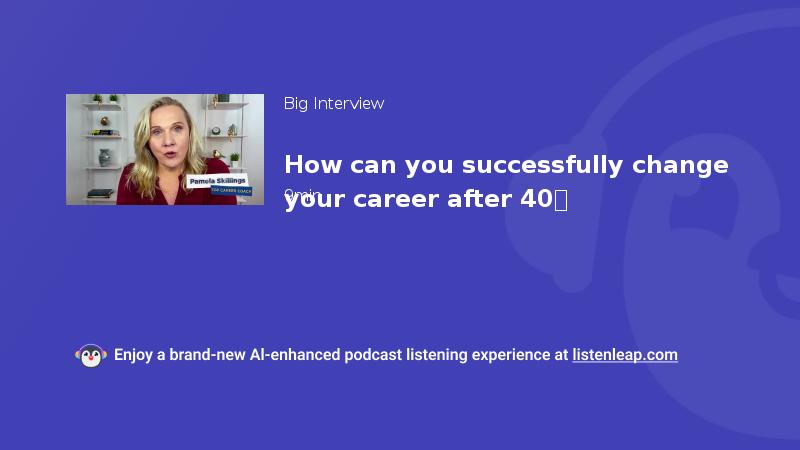
Today i want to talk to you about changing careers at 40 and beyond.
It's easier to make a career change when you're just starting out.
When you're more established, it's harder to break out and do something new and you have more to lose if it doesn't work out.
In this video, i'll go over five common scenarios i see in 40 year old career changers, six steps you should take when changing careers later in life, And then I'll finish with some tips for resume writing and interview preparation that are specific to career changers.
My name is Pamela Skillings and I'm a career coach with more than 15 years of experience as a hiring manager, an HR executive and a professional coach.
As a career coach, I often get to meet people around 40 who are looking for a change.
And they typically fall into these five categories.
The first category is people who are having a career crisis after spending 15 or 20 years in careers that are no longer fulfilling.
The second category is people who want to slow down a bit.
This is where I typically meet people who are feeling burned out or just feel they've done the big career and they want to make more time for other interests.
Then there's the third group, people who are tired of in-person office jobs.
Especially this year, when so many employers are forcing their remote and hybrid employees back to the office.
Next, we have those who are simply in transition mode and whose values have changed.
Around 40, it's natural to go into a period of reflection and assessment of your life.
Choices include in your career.
And finally, we have the people who want to enter a more lucrative industry.
Of course, money is another valid and motivating factor for changing careers.
When you're 40, you have financial responsibilities like mortgages, kids' education and retirement planning.
There's a lot of pressure to meet these obligations.
And it's normal to look for a change if your current job doesn't provide financial security or growth potential.
What all of these people have in common is that they feel stuck, burned out, and uninspired.
They need a new sense of purpose.
Now you're probably excited about changing careers, but also a bit freaked out.
That's perfectly normal.
I have yet to meet a person who says they're 100% confident and optimistic about it.
You probably have a lot of mixed feelings, just like most of my clients.
There'll be days when you'll feel extremely hyped up to learn and look for new jobs.
There will also be days when you'll feel discouraged.
Before you even begin the transition, I want you to remember these things.
First, it's normal to be scared.
The world today and the world when you were first entering the job market in your early twenties are two entirely different things.
There are new emerging professions that didn't even exist when you were graduating.
Remote and online jobs too.
You'll be surprised to know that most people actually get a clear idea of what they want to do with their life after 40.
You're not crazy or alone.
As a matter of fact, millions of Americans change careers every single year.
At 40, you still have another 20 plus years to spend working, which makes the change totally worth it.
But no matter how many inspiring stories you hear, you'll still have some inner fear holding you back.
To overcome it, you'll need guts, but also planning.
To successfully change your career at 40, you need a smart and strategic approach.
I happen to have a proven six-step process that's based on the successful career changes I've seen with my clients.
You can replicate it for your own career change.
Step one, do a self-assessment to determine the direction that you wanna take.
This is especially important if you're feeling a little lost and don't really know what you wanna do next.
Ask yourself, what do I enjoy learning about?
Which of my skills do I enjoy putting to work most?
What do my friends and family come to me for help with?
What are my top three values in life and in career?
And what do I want more of in the future?
It may sound obvious, but many people will ignore this advice and try to skip ahead.
Do some self analysis of who you are and what you want at this stage in your career.
Brainstorm a list of careers that have potential.
Include some wild fantasies and some more practical options too.
Step two is to research potential new careers.
If you really don't know what field you want to go into, a good place to start is by looking up the most in-demand careers for the next five to 10 years and then narrow it down to one that matches with your goals, your needs, your lifestyle and your self-assessment that you conducted earlier.
Of course you shouldn't just pick any career because it pays well or happens to be popular at this moment.
Remember why you wanted to change careers in the first place.
Think about one, how this new field aligns with your current needs and values.
Two, if there are transferable skills you can use to level up fast.
And three, if you think you could be happy on that career path for the next 20 years or so.
Step three is to upskill.
Your biggest obstacle by far will be lack of skills and experience in this new career.
This is the part that will take some true effort.
Figure out what technical skills a job requires that you don't already have, and find out how you can get them.
There are many courses, workshops and certifications that you can take without having to go back to school.
Any certifications that you obtain will be a big plus when you start applying for jobs.
For jobs in IT sales, marketing or design.
You can get excellent and affordable certifications through online learning platforms.
This step is where you're most likely to get stuck, especially if you have a full-time job and a family.
I understand it's difficult and that you have very little free time.
That's why it's so important to know what you want, so you can be sure the time sacrifice will be worth it.
Another thing, don't give up if the technology learning curve scares you a little.
If you're not in the digital native generation, you may feel less confident about mastering new tools and technologies.
But you're smart, and you can do it.
Be patient and stay the course.
Step four is to network.
Yes, everyone says it, and hardly anyone does it the right way.
Use industry events, conferences, and social media to talk to people in your desired industry.
Don't dive right into asking for a favor.
Simply show curiosity about what they do and their expertise.
Say that you're really excited to join the industry and ask for advice.
This will get you started without too much effort.
And don't forget to keep up with the top voices and household names in the industry.
Subscribe to newsletters, follow them on LinkedIn, attend webinars, and remember to keep notes.
Step five is to optimize your resume, cover letter, and LinkedIn profile.
This is the part where most career changes hit obstacles.
Your experience, no matter how impressive, won't get you this new job if you submit a resume that's completely focused on your old career path.
What would be impressive is for you to show how your previous accomplishments fit the requirements of the new role, especially if you've added a few relevant certifications you obtained in the meantime.
Here you want to advocate for your experience and position your transferable skills as company benefits.
Make a list of all the hard and soft skills you obtained throughout the years and see how you can frame them for this new role.
Also, your resume may first be reviewed by bots before it gets to human evaluation.
That's why you need to mirror the terms used in the job description.
Also, if you haven't applied for a job in a while, take the time to explore the resume trends.
For example, it's no longer common to include an objective statement or references in your resume.
You should also make sure your resume is clearly formatted, well designed and submitted in the right format.
I recommend that you use a hybrid resume format.
You start with a resume summary where you highlight that you're transitioning to a new career path.
Add your main transferable skills.
Then add your related skills, accomplishments, or projects.
List all the certifications and coursework you've done.
Then, after you've made the case for your career change and everything that's relevant, present your work experience in the more traditional reverse chronological format.
This will help them see the most relevant qualifications first, but still provide enough of your career history to head off any questions about what you did and when.
In your cover letter, you can also position yourself as a perfect fit, even if you don't have all the experience.
The cover letter is an opportunity to share more about your passion for the new career and show that you're serious about it.
And finally, step six is to prepare for your interview.
Without this, all the work and the other steps won't mean much.
You need to be able to one tell a compelling story to explain the motivation behind the career change.
Two, sell all of those strengths you acquired in your old career that others can't offer.
And three, practice your answers to all the questions you'll be asked.
Interviews are stressful, especially if you haven't had one in a while.
So take the practice part seriously.
Go over the most common interview question and practice your answers out loud.
If you're a Bing Interview user, there's a special curriculum for career changers that you can try out.
It's in the curriculum under Playbooks.
Look for the Career Change Playbook.
Then, when it's time to practice, from your dashboard, go to Interviews, then Practice Sets, then General and pick Career Change.
If you're practicing on your own, you can set up your phone or laptop and record yourself answering.
Before I leave you, I have a few last tips to make this journey a little bit easier.
Be prepared for rejection.
It happens to everyone and it's not a reflection of your worth.
Be patient and persistent.
If you start applying and don't get invited to interviews, don't lose hope.
Keep learning and adjusting your strategy, and you'll find a way to get your foot in the door.
Don't be afraid of competing against younger applicants.
You have hands-on experience and maturity, and the best employers value both of these.
Ask for help when you need it.
Join online communities of career changers or find a mentor.
You might have to start with a more junior role and lower salary, but don't get discouraged.
Remember why you wanted to make the change in the first place.
Once you start your new career, keep pushing.
Get new certifications, take relevant courses, or enroll in training programs.
Never stop learning, because the world and your new industry are going to continue to evolve.
So that's it for me today, and thank you so much for watching.
If you haven't subscribed to my YouTube channel, hit subscribe if you want more interviewing and career tips.
You can also follow me on LinkedIn.
I left a link in the video description together with links to more resources you could find useful.
Good luck.