Here at NPR, we've been following the news unfolding of the Minneapolis protests, including the recent shooting and killing of a 37-year-old man Saturday morning by federal agents.
That's the third shooting and second death in Minneapolis involving federal immigration officials in January.
We'll bring you more details on that developing story when Up First returns tomorrow.
I'm Aisha Roscoe and this is a Sunday story where we go beyond the news of the day to bring you one big story.
On the morning of January 28th 1986, Bob Ebeling was anxious and angry as he drove to work to the Morton Thiokol booster rocket complex outside Brigham City, Utah.
He knew that 2000 miles away at the Kennedy Space Center in Florida, ice had formed on the launch pad that cradled the space shuttle Challenger.
Seven astronauts, including a civilian, a high school teacher, were set for liftoff that morning.
Ebling believed their lives were at stake.
His daughter Leslie was in the car with him.
And he said, we are going to have a catastrophic event today.
The night before Ebling and his Thiokol colleagues all booster rocket engineers argued for a launch delay.
They said the freezing weather overnight could cause a catastrophic failure in the booster rockets that would lift Challenger towards space.
And he said, the Challenger's going to blow up.
Everyone's going to die.
And he was beating his hands on the dashboard.
He was frantic.
But in Florida, all systems were go.
The NASA launch control team declared Challenger ready to fly.
I uphold the technical community and you will have our confession to proceed with this launch.
Good luck and Godspeed.
Except that wasn't true.
There wasn't consensus among the technical community to proceed.
But the launch director and other top NASA officials didn't know this.
They didn't know that Ebling and other engineers at Morton Thiokol had told other NASA officials it was too risky to launch.
Today, on the Sunday Story, we look back 40 years ago this week at that desperate 11th hour effort to keep the space shuttle Challenger grounded, at the resistance to heeding those warnings, at a persistent and crushing burden of guilt for some of those involved, and at lessons learned from the Challenger disaster which continue to resonate today.
If they would have waited one day discussion here would be completely different.
We'll be right back.
This message comes from Middie Health, a virtual care platform for women in perimenopause and menopause.
CEO Joanna Strober shares the mission behind working with women in midlife. not just about hormones.
It's not just about weight loss medications.
We are very much a holistic care platform and our job is to figure out whatever medications are appropriate for you and offer you those medications.
Midi Health committed to helping women in midlife with perimenopause and menopause care accessible via telehealth visits at joinmidicom.
This message comes from BetterHelp.
President Fernando Madeira shares BetterHelp's commitment to expanding access to therapy.
Our State of Stigma report helped us understand that believing in mental health is easy, but asking for help is not.
Now, with the report on our hands, we can work to make mental health care more accessible to.
To get matched with a therapist, visit BetterHelpcom.
Slash NPR for 10 off your first month.
I'm Aisha Roscoe, and this is a Sunday story.
And today we're looking back at the Challenger disaster of 40 years ago.
With us is retired NPR correspondent Howard Berkus, who investigated the decision to launch that day back in 1986.
He and another NPR journalist were the first to report in detail on the desperate last-minute efforts to delay Challenger's liftoff.
Howard, welcome back to The Sunday Story.
It's always good to be with you, Ayesha.
Thank you so much.
So I mean Howard, I have to say we're looking at the anniversary.
That is 40 years old, but I'm also 40 years old.
So I don't have any personal memory of when the Space Shuttle Challenger exploded.
And there are a lot of people in my generation and younger.
It's like it's history, right, to us.
Right.
But you were a part of that history.
And I can say I didn't know that till today.
But I'm learning something.
You were living it in real time.
So take us back to 1986.
Like, what was at stake for the space program with that Challenger launch?
You know, there was so much at stake, Aisha.
NASA, the National Aeronautics and Space Administration, was desperate to prove that space shuttles could literally be like shuttle buses, you know, rocketing skyward and returning to Earth on a regular and reliable schedule.
And to do that, to carry into space these commercial, scientific and even secret military payloads, They had to prove they could launch in every month of the year, on both warm days and cold days.
So how common had space shuttle flights become by January 1986?
That was when the Challenger was scheduled to launch.
You know, by then shuttles had been flying for five years and there had been more than two dozen missions, but delays plagued the program a lot.
This was a highly technical spacecraft, after all, with thousands of complex components, so a lot could go wrong.
Plus, there were other uncontrollable variables, like the weather.
In fact, this Challenger launch had already been delayed five times.
So it sounds like NASA was really struggling with reliability in the shuttle program, especially when dealing with elements out of their control like weather and all this stuff.
No, that's right.
But still, you know, shuttle flights had become routine enough by 1986 that public interest had waned.
In fact, the three major television broadcast networks at the time had stopped covering shuttle launches live.
Only cable news network CNN, and NASA's satellite feed were set to go live for this Challenger launch.
And Ayesha.
The lack of major network coverage was likely concerning to NASA, because public attention and enthusiasm were important to assure continued funding of the space program.
And Challenger was set to have a teacher on board, Krista McAuliffe, who taught high school in New Hampshire.
Was her participation part of NASA's effort to attract more attention to shuttle flights?
Absolutely, and it worked.
There was enormous attention to the process of picking a teacher in space.
There were 11,000 applicants after all.
And when Krista McAuliffe came out on top, her astronaut training attracted even more attention.
Several days before the Challenger launch, McAuliffe stood before a gaggle of microphones and a royal blue astronaut jumpsuit at the Kennedy Space Center.
She talked about her plans to teach the loftiest lessons ever.
Well, I am so excited to be here.
I don't think any teacher has ever been more ready to have two lessons in my life.
I've been preparing these since September and I just hope everybody tunes in on day four now to watch the teacher teaching from space.
Oh, my goodness.
I mean, it does sound so exciting.
And because I am a kid of the 80s, I remember a Punky Brewster episode where they showed that kids around the country were watching the launch on TV.
Because like this is like educational.
So now all the kids in the you know, in school rooms they could be watching like a teacher teaching from space.
Yeah, the teachers had rolled out TV sets in classrooms all across the country so that the kids one could watch the launch live and then later watch these first ever lessons from space with a real teacher.
And there were also busloads of schoolchildren in the crowd watching the launch at the Kennedy Space Center.
OK, so at this point, the Challenger launch had already been delayed five times.
And so you got this teacher on board.
People are excited.
That is going to not look so great to have all those delays.
It seems like there would be a lot of pressure on NASA to get the Challenger off the ground this time.
There absolutely was a lot riding on getting Challenger launched.
So let's get back to the morning of the launch, Howard.
Remind us what happened.
And I have to say, I'm dreading it because I heard the teacher, and she sounds so happy.
But I know this is not a happy story.
It's not.
And it's so, so sad to hear her voice in this context.
So let's go back to January 28th, 1986.
School children and space enthusiasts around the nation have their TV sets tuned in.
And at the Morton Thiokol Complex in Utah, company executives and the booster rocket engineers crowded into a conference room to watch the launch on a large projection TV screen.
Bob Ebling was there along with his daughter Leslie, and just the night before Ebling and a few other Thiokol engineers had been in the same conference room on a conference call with officials from NASA's Marshall Space Flight Center.
The Thiokol engineers tried to convince those NASA officials from the Marshall Space Flight Center that the unusually cold weather in Florida could cause a booster rocket joint to fail.
They thought Challenger would explode right at ignition.
So you can imagine the tension and fear as they watch the launch countdown.
And again, here's Bob Ebling's daughter, Leslie.
They had the countdown.
T-minus 10, 9, 8, 7, 6.
We have main engine start, 4, 3, 2, 1, and liftoff.
Liftoff of the 25th Space Shuttle mission, and it has cleared the tower.
And my dad bent down to tell me that it wasn't over yet, that things weren't clear.
Engines beginning throttling down now at 94%.
And I could feel him trembling.
Challenger, go at throttle up.
Challenger, go at throttle up.
And then he wept loudly.
And the silence in that room was deafening.
There was no one talking.
It was just dead silence.
At the Kennedy Space Center in Florida.
A TV news camera and microphone focused on the crowd, including the faces of Kristen McAuliffe's parents as they looked in anguish skyward.
We have a report relayed through the flight dynamics office that the vehicle has exploded.
The shock and the grief, it's so visceral and so overwhelming.
Even now, 40 years later, and there were so many people who witnessed this trauma tragedy like live, like people in the crowd school children watching in classrooms, the families of the astronauts aboard Challenger.
It is impossible for us to imagine the depths of grief for the families of Commander Dick Scobie, Pilot Michael Smith, Mission Specialists Ellison Onizuka, Judith Resnick and Ronald McNair, Payload Specialist Gregory Jarvis and Teacher in Space Krista McAuliffe.
And as you know, Daisha, this was also a collective national catastrophe.
Generations were scarred that day.
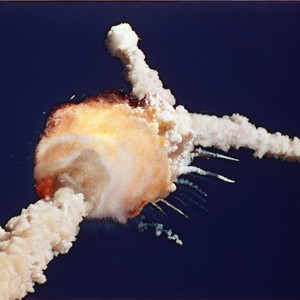
And those not watching live, as it happened, were subjected to a tsunami of TV news reports with horrific images of billowing smoke and flames and pieces of the spacecraft shooting across the sky.
NBC Nightly News with Tom Brokaw.
Good evening.
Tonight from Washington, D.C., it was a nightmare.
The worst disaster in the U.S. space program ever.
The shuttle Challenger is destroyed just a little more than one minute.
Tonight, the search for survivors turned up none.
The search for answers is just starting.
So, Howard, it sounds like the engineers, at least, already knew what happened.
They were sure they knew what happened.
They knew that those frigid overnight temperatures could cause synthetic rubber O-rings in Challenger's booster rockets to stiffen and not fully seal the rocket's joints.
So what are these O-rings and the joints?
How do they work?
The shuttle booster rockets were stacked in segments.
Think of them like tin cans stacked on top of each other.
They were filled with highly volatile solid rocket fuel.
Now where those segments met, there were two rows of synthetic rubber O-rings and they were designed to keep that fiery rocket fuel from shooting out sideways at the joints.
Liftoff and early flight produced enormous pressures on those booster rockets, and those forces tended to pull the joints apart slightly.
The O-rings kept the joints sealed, so the burning fuel went down out of the bottom of the rocket, lifting the spacecraft skyward.
But I thought you had said that the shuttle program was trying to prove that shuttles could launch in both warm and cold places.
So had there been previous cold weather launches?
There had been launches that were relatively cold, cold enough to stiffen those rubber O-rings.
Remember, rubber will stiffen when it gets cold.
And before Challenger, the coldest launch had happened a year earlier, when chilly temperatures had cooled the rocket joints to 53 degrees.
And during that launch the O-rings on two joints had failed to fully seal, searing rocket fuel and gases burned past the first row of O-rings and scorched the second.
Why weren't those leaks catastrophic?
That's because two sets of O-rings provided redundancy.
The second set was there in case the first set burned through.
And in this case, the second set held.
But remember, on this morning in Florida in 1986 it was well below freezing much, much colder than any flight before.
And that had the Thiokol engineers worried that both rows of O-rings could fail.
That's why they formally recommended a launch delay.
NASA's booster rocket.
Project managers at the Marshall Space Flight Center pushed back hard for hours until Thiokol executives overruled their engineers and told NASA it was okay to launch after all.
Okay, so the executives buckled under the pressure.
That's certainly what it looked like to their engineers.
The tragedy of this is that the Thiokol engineers were right.
Did the rest of the world learn?
You know quickly about these O-rings and the cold temperatures and that there was this effort to stop the launch.
Small bits of the story leaked out, but it would be about three weeks before the complete story came out.
That's because nobody at NASA and Thiokol talked about it.
At least they didn't talk about it publicly.
Thiokol had ordered their engineers to keep quiet.
NASA seemed to downplay some would say cover up the fact that the Thiokol engineers had warned it was too dangerous to launch.
So what happened in those days after the explosion?
Well, just six days after the explosion, President Ronald Reagan established a special challenger commission to investigate the accident.
And three days after that, we're at February 6th now, the commission held its very first hearing.
That day, only NASA officials testified.
And one of them was Judson Lovingood of NASA's Marshall Space Flight Center.
He was on that 11th hour conference call with Thiokol.
We had the project managers from both Marshall and Thiokol in the discussion.
We had the chief engineers from both places in the discussion.
And Thiokol recommended to proceed and launch.
So that that was a half truth.
Right.
And where I come from, you know, they say a half truth is really a whole lie.
But I don't want to put that on.
I don't want to put that on.
But like the fire call executives had said they were ready, but the engineers had said they weren't.
That's right.
And Lovingood did add that there was some concern about the cold temperatures, but that's all he said.
And the commission moved on from there.
No, that wasn't really what you would call full disclosure.
Now, four days later, there was another closed door hearing at the old executive office building next to the White House.
And at that point another NASA official from the Marshall Space Flight Center simply said this quote.
We all concluded there was no problem with the temperatures.
But this time, one of the Thiokol engineers was in the room.
Alan McDonald was sitting way in the back in what he called the cheap seats.
He told me in an interview in 2016.
I was sitting there thinking well, I guess that's true, but that's about as deceiving as anything I ever heard.
And after two or three minutes, I couldn't restrain myself anymore.
So I raised my hand.
I said, I think this presidential commission should know that Martin Flacco was so concerned.
We recommended not launching below 53 degrees Fahrenheit.
And we put that in writing and sent that to NASA.
I'll never forget Chairman William Rogers and his vice chairman Neil Armstrong, standing up kind of squinting and looking at me.
And Chairman Rogers said would you please come down here on the floor and repeat what I think I heard?
So this was a hearing without reporters present, right?
So that was a revelation that was not publicly revealed.
That's right.
And four days later, there was another hearing.
Again, this one was also behind closed doors.
This time, the commission finally heard formal testimony from two of the Thiokol engineers Alan McDonald, who we just heard from, and Roger Beaujolais.
Now, Beaujolais led that 11th hour effort to wait for warmer temperatures.
McDonald testified that Thiokol was pressured by NASA to approve the launch.
Beaujolais told the commission he'd been part of a special task force at Thiokol that was focused on the O-ring problem for a long time, in advance of Challenger.
In fact, he wrote a memo six months before the Challenger launch that warned of a catastrophe of the highest order loss of human life if the O-ring issue wasn't fixed.
It's hard to imagine a more powerful warning.
People are going to die if you don't fix this.
So why, with disaster like that predicted, did shuttle flights continue, especially in freezing weather?
Some people say this was due to something called the normalization of deviance.
That's a phrase coined by sociologist Diane Vaughn in 1996 after she studied the Challenger disaster.
And simply put, this is what it means.
When a threat is recognized and defined, and even when it begins to be addressed, as long as nothing disastrous results in the meantime, decision makers tend to continue to operate despite that ongoing threat.
So Howard, when did you and your NPR colleague, Daniel Zwerdling, begin to investigate this?
About three weeks after the disaster.
You know, I was based in Utah in 1986 and I had heard a brief local news story which said that Thiokol was coerced into approving the launch.
So I made a few phone calls.
That resulted in a tip and a name, Bob Ebling.
I called Ebling at home and he answered.
But he said don't quote me, don't name me.
No, I don't want to do an interview, they'll fire me.
But Ebling was clearly upset as he confirmed that Thiokol was coerced that was his word into approving the launch.
Then two other Thiokol engineers were named in news stories, Alan McDonald and Roger Beaujolais.
Bits of their closed-door Challenger Commission testimony leaked.
It was February 19th then, 22 days after the tragic launch, and that's the day I teamed up with my NPR colleague, Daniels Werdling.
So what did you and Zwerdling do exactly to find out those things that weren't public yet?
Like those unreported details of the failed effort to stop the launch?
Zwerdling had learned that Thiokol engineer Roger Beaujolais was in a hotel room near the Marshall Space Flight Center in Alabama.
So he hopped on a plane.
At the same time, I drove to Brigham City, where most of the Thiokol workers lived, and I went right to the public library.
So now, I mean, why did you go to the public library?
Like, what was up with that?
Remember, this was 1986.
We didn't have laptops or the internet or Google to search for home addresses and phone numbers.
We had names of Thiokol engineers and executives so I poured through telephone books stacked in the public library to get their home addresses and phone numbers.
I then drove around Brigham City knocking on doors.
One door opened at Bob Ebeling's house.
But Evelyn wouldn't talk to you like on the phone when you had called earlier.
So why did you think he would talk to you that day?
Is it different when you're in person?
Like, you know, as a reporter reporter, it's different when you show up at the house?
Well, you know, we reporters like to say that 90 of journalism is showing up because, like you say, when you show up face to face, often that has more impact than phoning somebody, when it's much easier to just simply say no and hang up.
So I showed up.
I did ask Ebling 30 years later why he decided to talk to me that day in 1986.
That's my engineering background coming out.
Somebody should tell it the truth.
I think the truth has to come out.
But getting to that truth in 1986 wasn't easy.
First I got into the house because Ebling wasn't home from work yet and his wife Darlene let me in.
You know, in 1986 we didn't have cell phones and I hadn't talked to my NPR editor in Washington for hours.
So I asked Darlene Ebling if I could use their phone, and she said yes.
After checking in with my editor, Darlene offered me some water.
She was friendly and hospitable, and we sat at the kitchen table and chatted.
And so you stayed in Bob Ebling's kitchen until he got home?
I did.
I wasn't asked to leave, and if I had been asked to leave, I would have left.
But we sat there and talked until Bob Ebling got home.
And he was not happy to see a reporter sitting at his kitchen table.
But he was also still frantic.
He paced back and forth between the kitchen and the living room, wringing his hands, shaking his head and complaining that Thiokol was unfairly blamed for the Challenger explosion.
And then he unloaded.
He started to give me a detailed account of what happened the night before the launch.
He had direct quotes with names.
And again, don't record me, he insisted.
Don't name me.
But he agreed to let me report what he was saying anonymously.
And here's an excerpt from my story the next morning.
So this is February 20th, 1986 on NPR's Morning Edition.
Last night he read in a local newspaper that Vandal scrawled a phrase three feet high across a railroad overpass.
Morton Thiokol murderers, it said.
The engineer shakes his head, rises and walks into another room to watch a television report, but turns away when that haunting image is shown again.
I should have done more, he says.
I could have done more.
I'm Howard Berkus in Brigham City, Utah.
I mean.
So that's Bob Ebling blaming himself for the disaster, for the deaths of these seven astronauts, including the teacher Krista McAuliffe.
That has to be such a burden to carry.
So what about his colleague, Roger Beaujolais in Alabama?
What was he saying?
Beaujolais wouldn't open his hotel room door, at least at first.
But he and Daniel Zwerdling talked through the door and Zwerdling could hear Beaujolais sobbing.
And Zwerdling told him the world wouldn't learn the truth unless he opened up.
And he finally did.
Now, neither of us knew it at the time, but Zwerdling was getting.
The same story I was hearing at Bob Ebling's kitchen table.
The same details, the same names, some of the same direct quotes.
And when we finally checked in with each other later in a conference call that we had with our editor, we discovered how identical these accounts were.
We knew we had a powerful untold story.
When we come back, how that story revealed what really happened behind the scenes as the launch neared.
FIAC Hall Executive Bob Lund wraps up the presentation to NASA with the company's official recommendation.
Do not launch the shuttle tomorrow.
Stay with us.
Support for NPR and the following message come from Warby Parker, the one-stop shop for all your vision needs.
They offer expertly crafted prescription eyewear plus contacts, eye exams and more, for everything you need to see.
Visit your nearest Warby Parker store or head to warbyparker.com.
This message comes from Carvana, who makes car selling easy.
Enter your license plate or VIN, get a real offer in minutes and have your car picked up from your door.
Sell your car the easy way with Carvana.
Pickup fee may apply.
We're back with a Sunday story, and I'm speaking with retired NPR reporter Howard Berkus.
Howard, you had two unnamed sources back in 1986.
They weren't on tape.
Was there any hesitation at NPR about going with the story with those sources not named?
There was.
You know, the general ethical policy at NPR back then was pretty simple.
Don't quote unnamed sources unless you have three of them confirming the same story.
And we only had two.
So I was sent back out to knock on more doors in Brigham City while Zwerdling wrote what was essentially a play-by-play, a story with a minute-by-minute account of what we both had learned from Beaujolais and Ebling.
And I had no luck getting a third source.
So our editor made the decision to go with what we had.
You know, their accounts were identical.
And what they told us, it was too important.
We had to report it.
So the next day's wordling story aired with mine on Morning Edition.
A Morton Thiokol engineer sits before me, his eyes getting red with tears.
I fought like hell to stop that launch, he says.
I'm so torn up inside I can hardly talk about it, even now.
And at this point Ayesha, I want to walk you through in more detail some of what we learned from Ebling and Beaujolais.
Beaujolais said that the day before the launch, the forecast for freezing temperatures in Florida prompted Thiokol engineers and managers to pull together data charts and photographs showing what happened to booster rocket O-rings in cold temperatures.
That then led to the 11th hour teleconference, the concerted effort to stop the launch the next morning.
Here's Werdling again reporting what happened next.
They all agree that it's too risky for the shuttle to take off.
8 p.m.
They call NASA officials over a special telephone conference network and, one by one, four key Siacol engineers lay out the troubling evidence.
Point number one both NASA and company engineers have known for several years that when the shuttle starts to take off, tremendous forces warp the joints where sections of the solid rockets fit together and some of those crucial seals don't work right.
Point number two, the colder the weather, the worse it gets.
IACOL executive Bob Lund wraps up the presentation to NASA with the company's official recommendation do not launch the shuttle tomorrow.
The NASA officials listening on the telephone lines are shocked.
I am appalled, says George Hardy of NASA's Marshall Space Flight Center in Huntsville, Alabama.
I am appalled by your recommendation.
Another top Marshall official, Larry Malloy, argues with the Siacol engineers.
He challenges their figures.
He says the company doesn't have firm enough proof that the seals will fail in cold weather.
But Siacol engineers vehemently disagree, at some points almost shouting with anger.
They insist that NASA should postpone the launch until the weather climbs into the 50s.
And at that point, according to one engineer, NASA's Malloy exclaims My God Thiokol, when do you want me to launch?
Next April?
I mean that sounds like a pivotal moment, because here you have this NASA official, Lawrence Malloy, and he seems mainly focused on the impact of the delay than on the ability to fly in cold weather.
That's right.
You know, that statement certainly set the tone for what came next.
The Thiokol executives then decided to put the NASA officials on hold so they could talk to their company engineers privately.
And the engineers were still insistent.
But the Thiokol executives, after hours of challenges and resistance, decided to reverse the earlier recommendation of a delay.
They overruled their own engineers and said the booster rockets were ready to go.
And in his anonymous interview with Zwirdling FIACOL engineer, Roger Beaujolais recalled his experience the morning of the flight.
When the shuttle lifted off the pad, he says, I thought, gee, it's going all right.
It's a piece of cake.
And when we were one minute into the launch, a friend turned to me and he said, oh, God, we made it.
We made it.
Then, a few seconds later, the engineer says the shuttle blew up and we all knew exactly what happened.
I'm Daniels Werdling in Huntsville, Alabama.
So how did NASA and Thiokol respond to your reporting at that point?
I assume that you reached out to them for comment.
We did, and they did not respond back then.
But six days after our stories aired, the Challenger Commission heard about something from our reporting, from something Bob Ebling told me.
There was that dramatic quote from NASA booster rocket program manager, Lawrence Malloy, when he said you know, my God Thiokol, when do you want me to launch?
Next April.
Malloy defended himself during commission questionings.
Now, that has been interpreted by some people as applying pressure.
I certainly don't consider it to be applying pressure.
Anytime that one of my contractors who come to me with a recommendation and a conclusion that is based on engineering data, I probe the basis for their conclusion to assure that it is sound and that it is logical.
OK, so so that's Malloy, you know, kind of downplaying the impact of the statement or trying to explain it from his position.
But I'm wondering, like, why did the Thaya Call executives give in on this?
Was there a lot at stake for them and their company with this launch?
Oh boy, was there, Ayesha.
Under Thiokol's contract with NASA, a launch delay due to the booster rockets triggered a 10 million penalty.
And that booster rocket contract was valued at $800 million.
And that contract was up for renewal in 1986.
So yeah, these Thiokol executives had a lot at stake.
And their decision to back off a delay produced another dramatic moment that night down at the Kennedy Space Center, involving Alan McDonald.
He was the immediate supervisor of the Thiokol engineers.
And he told me in an interview in 2016 that he was expected to sign in person the company's official launch approval document.
That was the reason I was at the Cape, because it required that a senior official be at the Cape to approve or disapprove a launch if something came up.
And I made the smartest decision I ever made in my lifetime.
I refused to sign it.
I just thought we were taking risks we shouldn't be taking.
So back in Utah a fire call executive signed the launch approval document and it was faxed to NASA.
And so Howard, since your reporting with Daniels Werdling in 1986, you've learned more about the dynamics of that teleconference.
And you've stayed in touch with four of the key Thiokol engineers in the decades since the disaster.
That's right.
And you know, with each conversation over the years, there was something surprising.
We reported 40 years ago that the NASA program managers were not convinced it was too dangerous to launch.
And I've since learned more about one piece of data presented in the 1986 conference call that fed their resistance.
There was one shuttle launch before Challenger with what was called blow-by, which is burning rocket fuel and searing gases getting past an O-ring.
But that launch it was really warm that day.
The temperature was like 75 degrees.
That was not a cold weather launch.
And that then was a conflicting piece of data that said, hey, temperature doesn't make a difference.
This is Brian Russell.
He was one of the Thiokol engineers on that 11th hour teleconference call.
We talked about this recently.
And so it wasn't just as easy as saying that hey, we were on a solid, a rock solid foundation with no opposing data.
We weren't.
But there were lives at stake in the arguments you were making.
Yes.
And we knew it.
Here, Russell's eyes welled with tears as he recalled what happened next, the night before the launch.
The NASA officials were still on hold waiting.
Thiokol Senior Vice President Jerry Mason pushed his executive team in Utah for a final decision.
And finally, Jerry Mason said, we've plowed this ground before.
Mason asked three top executives, should we launch or not?
The first two said yes.
Then he turned to Bob Lund, the Thiokol vice president in charge of engineering.
And Bob hesitated and hummed and hawed and I could tell it was just such a difficult decision for him.
And it was all hinging on him.
He was the final vice president in the room and he was representing both management and as well as engineering engineering.
Saying we should delay management now.
Saying that we should launch.
And in his hesitation Jerry Mason said Bob, it's time to take off your engineering hat and put on your management hat.
And that's precisely what engineering executive Bob Lund did.
He put on his management hat and voted to overrule his engineers.
Thiokol was go for launch.
Challenger's fate was set.
When we come back, NASA leadership faces tough questions.
Did any of you gentlemen prior to launch know about the objections of Thiokol to the launch?
I did not.
No, sir.
I did not.
I did not.
Stay with us.
This message comes from NetSuite.
Every business is asking, how can they make AI work for them?
No more waiting.
With NetSuite by Oracle, you can put AI to work today.
Trusted by over 43000 businesses.
It's the unified suite that brings your financials inventory commerce, HR and CRM into a single source of truth.
That connected data is what makes your AI smarter, helping you make fast decisions.
Right now, get the Business Guide, Demystifying AI, free at netsuite.com slash story.
We're back with the Sunday story and I'm speaking with NPR well, with retired NPR correspondent Howard Berkus.
Howard...
There's also something else that was hinted at in your reporting in 1986, but it wasn't fully explained then.
Thiokol engineer Bob Ebling told you that NASA lost its code of conduct that night before the launch.
Have you learned more about what that meant?
I have.
You know that was a reference to a launch decision standard that NASA routinely applied when it surveyed its contractors before a launch.
That standard was different that night.
This is how Thiokol engineer Roger Beaujolais described it to me a year later, in 1987, in an interview that was on tape and on the record.
I mean, we were put in a position of proving that it was not safe to launch.
That was totally unheard of before this flight.
We were always being put in a position as a contractor of proving that it was safe to launch.
So that is a change in the burden of proof that contractors like Thiokol have to meet.
What difference does that make in assessing like, the readiness of booster rockets for launch?
Why does it make a difference if you're proving whether it's safe to launch or whether you're proving it's not safe to launch?
You know, that's what I asked former Thiokol engineer Brian Russell when I interviewed him recently.
It's impossible to prove that it's unsafe.
Essentially, you have to show that it's going to fail.
What we were saying was we're increasing the risk significantly.
We shouldn't be doing that.
And so that's what we're really arguing for when we're saying prove it's safe.
You don't fully prove it.
But to go the other way, you just can't do it.
And so we were in an absolute lose situation.
And there was another shocking revelation in a commission hearing a week after our story aired.
This was in testimony from four of the most senior NASA officials responsible for launch decisions.
Here's Commission Chairman William Rogers questioning Kennedy Space Center Director Dick Smith, Launch Director Gene Thomas and top NASA executives Arne Aldrich and Jesse Moore.
Did any of you gentlemen know prior to launch know about the objections of Thiokol to the launch?
I did not.
No, sir.
I did not.
I did not.
Certainly four of the key people who made the decision about the launch were not aware of the history that we've been unfolding here before the commission.
How can that be?
Like, how does that happen?
These top NASA officials, the people with the final word on launching Challenger, and they didn't know that the Thiokol engineers said it was too dangerous to launch.
Why didn't that critical information get to them?
Back in 1986, the launch director and other top NASA officials were actually isolated from the final reviews for major components of space shuttles.
Those reviews were conducted at lower levels by each NASA center responsible for each component.
And so any issue with Thiokol's booster rockets was handled by NASA's Marshall Space Flight Center.
And the Marshall officials told the launch decision makers that the boosters were ready to go, and that was all they said.
This failure to communicate significant problems to the highest levels was supposed to change after Challenger.
I'm wondering about the four Morton Thiokol engineers we've heard from today.
I know that you've kept in touch with some of them for decades.
What happened to them after this monumental moment in their lives?
They had dramatically different reactions to their places in history.
Alan McDonald was sidelined and essentially demoted by Thiokol.
That angered some members of Congress and they threatened Thiokol.
Punish McDonald and the other engineers.
They warned, and Thiokol will never receive another NASA contract.
So Thiokol relented and McDonald was then put in charge of what became a successful redesign of those booster rocket joints.
That included an additional O-ring and a heating element to keep the joints warm.
He spent most of the rest of his career at Thiokol.
If I'd have been lamenting, like the rest of them were, about what else I could have done, I probably would have ended up in the same place.
But I focused my energy to make sure that it never could happen again.
And that turned out to be the best therapy in the world.
So what did Alan McDonald mean when he said, you know, lamenting like the rest of them?
He was talking about engineers who were more deeply affected, like Roger Beaujolais, for example, who suffered physically and emotionally.
He had disabling depression, double vision, sleeplessness, severe headaches.
Beaujolais never went back to work at Thiokol, and in fact, he sued the company.
He didn't feel that he failed.
He blamed Thiokol and NASA.
This is how he explained that to me in 1987.
I have flashes still.
I wondered if I could have done anything different, but the comfort that I have as a result of asking myself that question is that no, there's nothing I could have done further.
Because you have to realize that we were talking to the right people.
We were talking to people that had the authority.
We were talking to people that had the power to stop the launch.
And Beaujolais went on to become a writer and lecturer on ethical decision-making and engineering.
He was honored for that by one of the world's biggest scientific organizations.
He's featured to this day in leadership and engineering school curricula.
Beaujolais died in 2012, and his wife Roberta then agreed to allow us to name him as one of our anonymous sources in our 1986 reporting.
And I know from your reporting since then that Bob Ebeling had a very different long-term response to Challenger.
He couldn't let go.
And he said to you in 1986, I could have done more.
I should have done more.
That seemed to define the rest of his life.
Bob Ebling also suffered physically and emotionally for decades.
He retired after Challenger and he did spend a lot of time volunteering at a wildlife refuge near his home.
In fact, he helped restore the refuge after flooding from the Great Salt Lake nearly destroyed it.
He was actually honored for that work by the president at the White House.
And I thought that would help him get past his lingering sense of guilt about Challenger.
And I was wrong.
Ten years ago, on the 30th anniversary of the Challenger launch, I drove an hour from Salt Lake City to his house in Brigham City.
And, you know, the same house, the same kitchen, the same living room, the same kitchen table.
Little had changed, including Bob Ebling.
Had they listened to me and wait for the weather to change, it might have been a completely different outcome.
If they would avoid it one day, discussion here would be completely different.
Ebling sounds really frail there.
But he still sounds so focused and affected by what happened that night in 1986.
He was still deeply affected, and he was very frail.
He was then 89 years old.
He had hospice care and he used a set of parallel bars to get from the kitchen table to his favorite easy chair in the living room.
He still bore that weight of guilt, which is something he prayed about.
And I think that was one of the mistakes that God made.
He shouldn't have picked me for that job.
I don't know.
But next time I talk to him, I'm going to ask him, why me?
You picked a loser.
Oh, my goodness.
After all of those years, he's blaming himself and so deeply and painfully just taking on the responsibility of this tragedy.
It's just beyond sad.
You know, I did another story which included that comment and when it aired, hundreds of NPR listeners responded the same way.
We were inundated with emails and letters, most with messages of comfort for Ebling.
We heard from all kinds of engineers.
They told him he did what engineers are supposed to do, provide the facts and data.
The final decisions belong to the decision makers.
But Ebling was stuck on who he hadn't heard from.
This is what he and another daughter, Kathy, told me on a return visit.
You aren't NASA.
You aren't THICOL.
I haven't heard any of those people speak.
He had gotten confirmation that he did do his job and he was a good worker and he told the truth.
So I reached out to a few of the Thiokol and NASA people who rejected the engineers' arguments in that 11th hour teleconference in 1986.
This is 30 years later now.
And George Hardy responded.
Remember he was the Marshall Space Flight Center deputy director who famously said he was appalled at the push for a launch delay.
But he wrote this to Ebling.
You and your colleagues did everything that was expected of you.
You should not torture yourself with any assumed blame.
I also reached out to former Thiokol executive Bob Lund, and he called Ebling.
Now remember, Lund put on his management hat before overruling the engineers and he told Ebling, you did all that you could do.
I contacted NASA, and a spokeswoman there sent me a statement.
So I drove back to Brigham City to read that NASA statement to Ebling.
It first referred to the Challenger astronauts.
We honor them not through bearing the burden of their loss, but by constantly reminding each other to remain vigilant and to listen to those, like Mr Ebling, who have the courage to speak up so that our astronauts can safely carry out their missions.
Bravo!
I've had that same thought many, many times.
And finally, after 30 years, Ebling seemed to let go.
He smiled.
He put his hands over his head and clapped some more.
And I asked him if he had something to say to the people who wrote to him.
Thank you.
You helped bring my worries of mine to ease.
You have to have an end to everything.
And he was still clapping when I left that day.
A few weeks later, Bob Ebeling died at peace, his family said.
Hmm.
I mean, that is just a remarkable change and a blessing for Ebeling and his family from you and your work.
What about the other Thiokol engineer that we've been hearing from, Brian Russell?
He's the last of those four engineers still alive?
That's right.
Alan McDonald died in 2021.
And like McDonald, Russell was involved in that successful redesign of the booster rocket joint.
And he stayed at Thiokol and the aerospace company that later absorbed it until 2015.
But he still harbors some doubts about his role that night 40 years ago, especially after the Thiokol executives voted to overrule Russell and the other engineers and approve the launch.
Now remember when the Thiokol executives got the NASA officials back on the line.
They simply declared Thiokol's booster rockets ready to fly.
The thing that I feel the most guilt over And the thing I wish so badly I had said.
I wish I had said there's a dissenting view here.
I wish the people on the phone call would have heard that.
But I still didn't speak up.
So I regret that.
To this day. this day.
Now Russell is addressing his own lingering sense of guilt by directly connecting a critical lesson from Challenger to the space program today.
The importance of listening to dissent, of listening to the people who are telling you what you don't want to hear.
In the past year, Russell has been a featured speaker at NASA headquarters, at the Kennedy Space Center, at the Johnson Space Center and at the Marshall Space Flight Center.
There twice.
He's told the story of the Challenger launch decision to mission management teams and other agency leaders.
The people that are involved in the programs today face the same issues.
They face the same pressures.
When it comes to wanting to launch, they're going to be under the pressure to perform.
And no one wants to be the one to stand up and say, I'm not ready.
But the listening under high-stress environments like that is really crucial, and that's the crux of our message.
I think these things need to be repeated.
I think human nature is that we tend to forget about things in the past.
NASA has also had an internal series of presentations for thousands of engineers and mission management teams, as well as contractors.
And that includes Boeing, SpaceX, and Blue Origin.
You have to be vigilant.
Every day you've got to make sure that the message is being sent to the workforce.
This is Michael Ciannilli, who developed and ran the NASA Lessons Learned program that focused on the Challenger, Columbia, and Apollo disasters.
The folks in the organizations have to feel it's not just platitudes or a nice slogan, but that's really how it is.
You know, we honor dissenting opinion.
We welcome dissenting opinion.
There's no ramifications.
Maybe lose a little time, maybe cost a little extra, but it's far short of having another accident.
Howard, I know that NASA, like many other government agencies, had massive budget and staff cuts last year.
Close to 4,000 people left the agency, according to some reports.
Will this focus on lessons learned from Challenger and other disasters continue when you have budget cuts and staff cuts like this?
Well, Michael Ciannilli, who ran that lessons learned program, is among those who left.
He took early retirement in September.
But he'll continue as a contractor, he tells me.
And he says his lessons learned talks will continue.
I should add though, that NASA did not respond to our multiple interview requests or to direct questions about the space agency's plans for this lessons learned program.
So 40 years after Challenger, The lessons of that fateful launch decision are clear.
Less clear is how NASA itself will keep them alive.
Well Howard, thank you so much for bringing us the history of this Challenger disaster and really, the unspoken heroes who did try to make a difference.
And thank you for your important work.
Thank you, Ayesha, for giving me the opportunity to talk about it all again now.
Howard Berkus is a former correspondent with the NPR investigations team, but he can't seem to stay retired.
And we're so happy about that because he is truly a reporter's reporter.
This episode of The Sunday Story was produced by Andrew Mambo and edited by Jenny Schmidt.
It was fact-checked by Jane Gilvin.
Our engineer is Robert Rodriguez.
The Sunday Story team also includes Justine Yan and Liana Simstrom.
Our executive producer is Irene Noguchi.
The 1986 NPR reporting on the Challenger launch decision was edited by Ann Gudenkoff.
Howard's 2016 reporting about fire call engineer Bob Ebling was edited by Robert Little and produced by Nicole Beamster-Boer.
I'm Ayesha Roscoe, and Up First is back tomorrow with all the news you need to start your week.
Until then, have a great rest of your weekend.
This message comes from Lisa.
Lisa has a lineup of beautifully crafted mattresses tailored to how you sleep.
Each mattress is designed with specific sleep positions and feel preferences in mind.
Lisa mattresses are meticulously designed and assembled in the USA for exceptional quality.
Plus, they back it all up with free shipping, easy returns and a 120-night sleep try.
Go to Lisa.com for 25% off mattresses, plus get an extra $50 off with promo code NPR.
Support for this podcast and the following message come from the NPR Wine Club, which has generated over 175 million to support NPR programming.
Whether buying a few bottles or joining the club.
You can learn more at nprwinecluborg slash podcast.
Must be 21 or older to purchase.
This message comes from Sony Pictures Classics with A Private Life.
Academy Award winner Jodie Foster stars as Lillian Steiner, a psychiatrist tortured by the death of a patient, taking the case into her own hands.
Now playing select cities, coming soon to a theater near you.