Rome is the birthplace of Baroque, the highly ornate and elaborate style of architecture, art and design that flourished in Europe in the 17th and first half of the 18th century.
Unlike the Renaissance, which was all about control and perfect balance, the era was famous for its dramatic flair and sense of movement.
The Baroque style was also the first global art form.
It spread from Rome throughout Europe and to Asia.
The upside of the Roman Catholic Church's immense wealth has been its support of hundreds of artists, including the three we are looking at in this video.
Michelangelo Merisi da Caravaggio, Andrea Pozzo, and Gian Lorenzo Bernini.
In this episode, Great Cities Explained goes outside the galleries and museums and inside three Baroque churches that still house their work today and cost nothing to visit.
Caravaggio, Bernini and Pozzo were born into a world that had been shaken by the Protestant Reformation, which had significantly weakened the Catholic Church's influence across Europe.
The Protestant Reformation began in 1517 when Martin Luther challenged the Catholic Church with his 95 Theses criticizing indulgences and clerical corruption.
Rooted in disputes over salvation and scripture, it spread across Europe via the printing press and through other reformers.
The movement fractured Christianity, eventually sparking religious wars and reshaping Europe's religious and political landscape.
One of the weapons the Catholic Church used in the fight against Protestantism was art.
It's one thing for the church to tell priests what to teach and to write new laws and new decrees, but they also had to transmit this information to the everyday person on the street.
And to do that, they put these ideas in the place that people know best where they go to celebrate their faith on the walls of the churches.
The church's counter-Reformation movement demanded that art be used as a tool to inspire faith, devotion and, more importantly, to emotionally engage.
The church would use powerful imagery to reinforce Catholic doctrine, inspire faith and counteract the spread of Protestantism.
It decreed that art should be clear direct, emotional and didactic, conveying religious messages in a way that was accessible to all, including the illiterate.
Baroque art was a direct result of this need for works that were characterized by emotional intensity, religious ecstasy, suffering and triumph.
And Rome, the spiritual and cultural capital of the Christian world, became the epicenter of Baroque art, architecture and culture during the 17th century.
Many artists, as you know, are troubled, difficult and sometimes problematic.
Caravaggio was someone who certainly liked the seedy underbelly of life and is sometimes referred to as Baroque's bad boy in itself a problematic term.
He had over 40 police records, mostly for violent activities, and he was eventually condemned to death after killing a man, necessitating spending most of his life as a fugitive.
This might make him a terrible human being, but in a period of complete uncertainty about the sacraments, about what part saints played, about what we believe and why, it also made him the perfect artist to express the incredible tension that was so prevalent in this period of the post-reformation.
He was also the best qualified artist to portray the calling of a sinner.
By the late 1590s, Caravaggio was working in Rome, trying to make a name for himself in the competitive art scene.
Already known for his rebellious nature and rough temperament, which often clashed with his professional ambitions, Caravaggio was struggling to get commissions.
Then, in 1599, after another artist dropped out, he was asked to create two scenes from the life of Saint Matthew for the Contarelli Chapel in the Baroque church of San Luigi di Francesi, the national church of France in Rome.
It is these paintings, more than any others, that establish Caravaggio.
They marked the moment when the mannerist conventions of the late 16th century rational intellectual, perhaps a little artificial give way to the Baroque.
The two huge paintings were to stand either side of a statue of Saint Matthew by Flemish artist Jacob Colbert.
But the clients rejected the finished statue and Caravaggio was asked to create a third painting as a centerpiece above the altar, showing Saint Matthew writing the Gospel under the guidance of an angel.
The first painting in the trio is the Calling of Saint Matthew, which depicts the moment in the Bible when Christ calls Matthew, a tax collector, to follow him.
The scene is set in a dimly lit Roman tavern, the sort of dingy place Caravaggio and his friends hung out in, with figures dressed in the same type of 17th century contemporary clothing that the artist and his friends wore.
In fact, Caravaggio often included his friends in his paintings.
Here is the artist, Mario Minniti, who appears in several of his works and, like Caravaggio, was part of the seedy underbelly of Roman life.
But why does Caravaggio show them in modern clothing?
It would be like walking into a church today and seeing a painting with Christ.
Contemporaries in t-shirts, jeans and sneakers.
Later on, Caravaggio will include 17th century armour in another illustration of the gospel story.
It is a deliberate choice to bridge the gap between the biblical story and the viewer's reality.
This anachronism to our eyes was totally understandable to a 17th century audience and in line with counter-Reformation thinking.
It told the viewer that the possibility of redemption was as relevant in their present as it was in biblical times.
Christ and Peter in the painting however, are both barefoot and dressed in the more familiar robes we know from biblical paintings to help distinguish between the divine and the secular.
Christ gestures towards Matthew, who sits at a table counting coins with other tax collectors.
The moment captures Matthew's surprise and his inner conflict as he realizes he is being chosen.
Structural composition serves as the backbone of a painting and plays a crucial role in guiding the viewer's experience, conveying meaning and creating aesthetic harmony.
With so much going on in all three paintings, the structure and the symmetry is important.
This one is almost square, and then within it there are a series of squares and rectangles, giving it coherence.
It also has a series of diagonals, starting from the light behind Christ.
Another diagonal follows the young boy's sword, another St.
Matthew's leg, and yet another the leg angle of the boy on the left.
Matthew's call is shown through the extreme sense of light and shadow we know from Caravaggio's signature use of chiaroscuro, something I have discussed in my other video on Caravaggio.
A beam of light comes from behind the head of Christ, who stands to the right, partially obscured behind Saint Peter, and the light illuminates the group, but not through the window that is visible, but from an unseen supernatural source, underscoring the idea of redemption, that even a sinner like a tax collector in a den of sin can be transformed into something extraordinary.
A large part of the painting is blank space, or rather light And, as I've discussed before, light is used in religious art as a metaphor for the presence of God, divine intervention or, in this case, spiritual awakening.
The light hits all of the men around the table, but a choice is being made by each individual whether or not to look into the light.
These two men are more engrossed in material concerns, counting coins, and their indifference to Christ or their spiritual blindness is there as a contrast to Matthew's moment of recognition.
There is a lot less certainty than we see in many other treatments of the theme.
Matthew himself is not sure who is being called, as indicated by both his quizzical expression and the way he points to himself as if to ask is it me?
The rather undecided way Christ points towards Matthew adds to this ambiguity.
And as we see from this x-ray, it was something Caravaggio experimented with.
The hands of Christ, Peter, and Matthew are strikingly similar.
Christ's hand pointing towards Matthew is the highest, followed by Peter's, which emphasizes Christ's selection, and finally Matthew's.
All three share the same gesture with subtle variations, adding to the symmetry of the composition.
It is no coincidence that Christ's gesture echoes the hand of Adam in Michelangelo's creation of Adam in the Sistine Chapel, perhaps emphasizing Christ's divine mission, while subtly connecting the act of calling Matthew to the act of creation itself, suggesting that Christ is giving Matthew a new life, a spiritual one,
Matthew and his friends' clothing is made from rich fabrics, silks, velvets and brocades, the most beautiful clothes of the 17th century.
And along with the coins.
These luxuries all indicate that, should Matthew accept Christ's calling, there is a lot to be given up.
The martyrdom on the facing wall of the chapel tells us that it cost him everything.
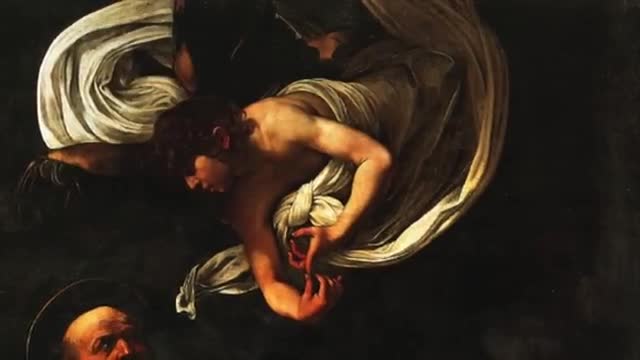
The inspiration of Saint Matthew is the centerpiece and represents the moment of Matthew's inspiration to write the Gospel.
The first thing to notice is the contrast between the two figures.
The angel comes down in a spiral and looks like a beam of light, while Matthew is projecting heat and warmth as if he is on fire, with inspiration delivered from heaven.
This was not the first version.
Caravaggio originally created this image for the chapel, which was rejected by the church because it showed Saint Matthew as an uneducated, unkempt peasant with dirty feet.
The painting was destroyed in the Second World War, but this is an original photo, which is sometimes colorized.
Caravaggio's inclusion of dirty feet into a sacred context was radical, raw and authentic, a move away from the idealized religious imagery and a message that holiness and divinity could be found in the lowliest and most unexpected places.
He always used life models and often used poor or working-class people beggars streetwalkers, criminals and manual laborers.
Again, emphasizing realism and the divine within the ordinary.
The use of lower-class, less-than-perfect models to portray holy figures is sometimes interpreted as blasphemous by modern writers, but this is not true.
While there were critics of Caravaggio at the time, he was simply following counter-reformation ideas.
By showing the physical, earthly realities of life, the dirt and the clutter, he emphasized the human, humble nature of his subjects, tapping into the church's aims of appealing directly to the masses.
In this second version, Caravaggio painted.
Instead of being fully controlled by the angel as he appears in the first version, it shows Matthew kneeling with a strong weathered appearance, leaning forward as if deeply immersed in the act of writing.
The angel above him delicately encourages or inspires and counts on his hands how many verses Matthew has completed, rather than dictates.
The interaction between the angel and Matthew, deliberately fluid, emphasizes that this is a collaborative process of divine inspiration rather than one of full control of an illiterate peasant.
Caravaggio connects the two figures visually.
Matthew's bent right arm matches the angel's left and the curve of his left arm matches the angel's right.
Their hands are close together.
Their shoulders are parallel, both lean forward onto the right hand, both raise their left leg and both stretch out their right leg.
Unlike in the previous version of this episode, the angel's wings are dark, hard to make out against the background, which gives the work a sense of drama, tension or foreboding of what is to come.
The angel feels strangely grounded and tangible, consistent with Caravaggio's naturalistic style.
While not identical, there is a visual echo between the positioning of Michelangelo's god and Caravaggio's angel.
Both figures lean towards the human counterpart in a gesture of divine communication or intervention.
Additionally, the drapery in both works flows dynamically, adding to the sense of motion and divine energy.
The martyrdom is the last of the three and according to tradition, the saint was killed on the orders of the king of Ethiopia.
While celebrating mass at the altar, Caravaggio chooses the moment when the murderer has already stabbed Matthew once and is about to administer the fatal blow.
We can see splattered blood from that first wound.
It is the sort of violence Caravaggio himself was all too familiar with.
The artist is never really interested in the physical environment in his paintings, and the altar, so important in other versions, is almost entirely obscured by the angel's cloud.
The angel with a head of thick brown curls and a muscular adolescent body is similar to that in the inspiration and almost certainly was the same model.
He seems to have been inspired by this painting by Titian.
The martyrs are in identical but reverse positions.
The assassin looms over the saint with one hand gripping his arm and the other raised with a weapon.
The nearby companion recoils in panic and flees, almost a mirror image, and the angels reach out to the saint with a palm leaf, the symbol of martyrdom.
Caravaggio had never painted such a large canvas, nor one with so many figures, and it seemed to have caused him considerable difficulty.
X-rays reveal two separate attempts at the composition.
Originally it was a much more crowded painting with some architectural features and many more characters.
By taking away these elements and removing the architecture, Caravaggio removes any distractions from the main story Matthew's martyrdom.
Each figure in the painting, many in contemporary clothing, is an individual the artist would have cast from the streets of Rome, each with a unique expression, ranging from indifference to curiosity, to fear.
The three men here are in loincloths, so were waiting to be baptized by Matthew.
The assassin himself is in a loincloth, suggesting he was pretending to be one of those waiting to be baptized.
If we look at this figure here, we see a self-portrait of Caravaggio, a likeness we know from his other paintings.
And if you look carefully, Caravaggio's bare buttocks tell us he is wearing a loincloth, suggesting he too was about to be baptised but is now running away.
A comment perhaps, that he, like the other people fleeing the scene, would have lacked the courage to help Saint Matthew.
In the case of the martyrdom, The light source is coming from the left.
For the calling, it comes from the right.
And for the inspiration, from above.
In other words, as if the light from the chapel's real window extends into the three paintings.
He uses light to guide us around the painting and to pick out the most important elements of the subject.
In much the same way, a spotlight picks out the action on a stage.
Our eyes are of course drawn to the central figure, the assassin, who is also the most brightly lit.
We follow his arm down to Saint Matthew, who appears to be holding his hand up for protection, but is in fact reaching for the angel, who only he can see, who is in turn reaching down to him with the palm.
This is not a painting about fear, but rather a moment of joy or ecstasy.
A common way, martyrdom was portrayed by Baroque artists, as we shall see with Bernini.
Once again, Caravaggio uses mirror images and balance to create symmetry and help guide the viewer's eyes towards the key figures.
The assassin and Saint Matthew are positioned symmetrically and if we flip Saint Matthew up we can see it is a mirror image.
St.
Matthew reaches out to the angel passing him the palm of martyrdom with both their arms, at a 90 degree angle to their bodies, creating a vertical line straight through the painting.
As with the inspiration of St.
Matthew, their body positions are almost identical.
Right arm reaching, left arm bent.
Left leg outstretched, right leg bent backwards out of view.
The movement and energy in all three paintings is intense.
There is a real sense of dialogue and motion.
Figures are in mid-action, capturing a specific moment and emphasising the drama that seems to be taking place right here, right now.
His characters lean twist, grimace and gesture, bringing biblical narratives to life with unprecedented immediacy.
It is anachronistic, of course, but there is a good reason to call Caravaggio's art cinematic three centuries before cinema was invented.
His work had an immediate influence on artists like Peter Paul Rubens, Artemisia Gentileschi and Bernini.
But in the 20th century his influence extended to the art of cinema and cinematography, in the many films which were influenced by the painter's visual style and themes.
His paintings of Saint Matthew marked a turning point in his career and he became the most celebrated painter in Rome.
But his success in that city was short-lived.
On May 28, 1606 Caravaggio became involved in a deadly duel with a man named Ranuccio Tomassoni, likely over a dispute related to gambling.
A lover or personal honour?
The fight took place in the Campo Marzio district of Rome, and Caravaggio fatally wounded Tomassoni.
In Rome at the time, murder was a capital offense, punishable by death.
A bando capitale or a death warrant was issued, meaning anyone could legally kill Caravaggio and claim a reward.
By 1610, the artist had been living in exile for four years, moving between Naples, Malta and Sicily, seeking protection from powerful patrons who would overlook his criminal convictions as long as he continued to paint masterpieces for them.
His work from this period often reflected themes of guilt, mortality and redemption.
This image features him as the defeated Goliath and his former assistant as David.
Caravaggio died in Porto Ercole on July 18th or 19th, 1610, at the age of 38.
The exact cause of death remains uncertain.
His untimely but some might say unsurprising death brought a tragic end to his story but left behind a legacy of revolutionary art that changed the course of Western painting.
In part two of Great Art Cities Rome, I look at two more Baroque churches containing great masterpieces.
One is an immense optical illusion painted onto a flat ceiling by a Jesuit brother, Andrea Pozzo, and the other shows the murder of a Spanish Carmelite nun, created by another troubled and violent artist, Gianlorenzo Bernini.
Thank you.