N -P -R. We are just at the start of hurricane season, and already we're seeing the danger and tragedy storms can cause.
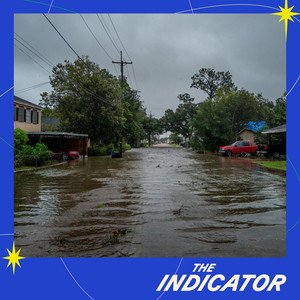
Flash floods in Texas have killed at least 107 people, with many more still missing.
Storms can also destroy people's homes and livelihoods.
Take Hurricane Helene.
That's It's a storm that slammed the southeast, especially North Carolina last year.
That storm alone caused nearly $80 billion in damages.
There's also another cost that comes that gets a lot less attention.
A gamble that anyone in the path of a storm has to make.
And that's whether or not to evacuate.
Evacuating can cost someone hundreds and in many cases thousands of dollars.
And the bad news? That cost is only getting more expensive.
This is The Indicator from Planet Money.
I'm Waylon Wong, and I'm here with friend of the show, Stephen Bassaha from the Gulf States newsroom.
Welcome back, Stephen.
Always good to be with you, Waylon.
And you know, we are actually just at the start of hurricane season.
So on today's show, I'll bring you my conversation with an accountant who had to evacuate last fall to avoid Hurricane Francine, plus why evacuation costs in general are going up.
This message comes from NPR sponsor Holiday Inn by IHG.
It's a new day for a new stay at Holiday Inn for business travelers.
With modern spaces for meeting and working, plus delicious dining from breakfast to happy hour and dinner, you have everything you need to get work done.
Give your everyday business travel an upgrade.
Book your next business trip at Holiday Inn by IHG.
Visit HolidayInn .com to book your stay.
This message comes from Ritual.
What makes Ritual vitamins different?
Ritual vitamins are made with bioavailable, clinically studied key ingredients, as well as the essence of mint.
Get 25 % off your first purchase when you visit ritual .com slash NPR.
Last September, Hurricane Francine made landfall in Louisiana as a Category 2 hurricane.
Sustained winds were estimated at 100 miles per hour, and the hurricane was heading straight for New Orleans.
The city did not have an evacuation order, so people in New Orleans had to ask themselves a way too familiar question.
Stay or go? Nick Okwin decided to go.
It is raining and it's been raining since I left my house.
Nick lives in New Orleans with his wife and two kids.
One of them was just a month old at the time of the storm.
And Nick was worried about them all being stuck in the city for days without power.
So Nick and his family loaded up the car to drive from New Orleans to Alabama.
He agreed to give us real -time updates.
And we got our first video call from Nick about an hour or so into the drive.
I see a lot of smiles right now.
Yeah, well, that's why I waited to call you.
They weren't smiles about 30 minutes ago.
Nick said the kids were not fans of evacuation traffic.
Ugh, as someone who would just get car sick after one minute in the car, I can't imagine.
So to calm down those backseat drivers, Nick paid for his first evacuation expense.
So far, the grapes at $3 .99 a pound are pretty much a budget killer so far.
OK, so first thing on the spreadsheet, grapes.
Grapes. Now, Nick is also an accountant, and he agreed to use his Number Crunch powers to help us track his evacuation expenses.
And grapes, really food in general, was the first expense to consider.
We didn't really bring anything with us besides the car snacks, so we'll be eating out the entire time.
Yeah, and eating out these days can get pretty expensive.
Yeah, certainly, certainly.
At minimum, 50 bucks a meal.
Wait, I gotta say, for a family of four, 50 bucks a meal is pretty impressive.
Not so bad, right? I mean, I guess the baby probably isn't eating a lot of solid food at this point.
Yeah, not really ordering a lot off the fast food menu.
Well, you know, the other expenses to consider are gas and a place to stay.
Lost wages because of missed work time is also a big worry.
And the big multiplier on top of everything is how long an evacuation lasts.
That's the major factor to this entire, you know, the cost of this entire trip will be how long before the power is restored at my house.
Given all of that, Nick hoped the final cost would come in under $1 ,000.
Yeah, not a small amount of money.
And the thing to know about evacuations is that you might need to do it more than once a year.
Right, because hurricane season is long.
Like, consider possibly the most infamous hurricane, Hurricane Katrina.
Katrina made landfall in Louisiana 20 years ago as a Category 3 hurricane, and it was one of five major hurricanes that hit the Gulf Coast that season.
Evacuating for every storm coming your way can be exhausting.
That's what Paul Mzumder says.
He's an economist at Florida International University.
Hurricane fatigue is a real thing.
If you have two, three major hurricanes in the season, people really get tired.
Paul studies hurricanes, including how much evacuations cost. He surveyed about 450 evacuees to get those costs for both Hurricanes Irma and Harvey in 2017.
That's $1 ,500 to $3 ,000 per household.
That did not include lost wages, and on average, the evacuations lasted more than a week.
Those evacuations were also way more expensive compared to ones about a decade earlier, even after adjusting for inflation.
like roughly four or five times higher, according to Palub.
Palub says one of the reasons evacuations are more expensive today is that it's gotten harder to predict what kind of storm you're going to get.
Lately, hurricane is getting more complex. You know, it's telling you for a while that it's not coming on your way.
And all of a sudden, it probably changed direction.
Or the storm quickly intensifies, like Hurricane Milton last year.
In less than 24 hours, it jumped from category one to five.
These fast -growing storms can catch people off guard. And that leads to late evacuations, jammed -up roads, and packed hotels.
And then there's the increased demand for lodging and gas.
And of course, there's price gouging.
Now, there are supposed to be price gouging laws in states like Florida to protect against this.
For example, in Texas, two gas stations were forced to refund customers for charging nearly $10 a gallon for gas during Hurricane Harvey.
But Pollop says those laws aren't hard to enforce, especially during an evacuation.
It took two years for Texas to hold those gas stations accountable.
Depending on the storm, FEMA can help cover some evacuation costs.
FEMA is the federal government's disaster relief agency.
And back during Katrina, FEMA gave $2 ,000 checks to evacuees.
But audits of FEMA's Katrina response did find millions of dollars were wasted due to things like fraud and overpaid hotel rooms. rooms. President Trump has appointed people critical of FEMA to run the agency, and they say it's become inefficient and wasteful.
Trump says he plans to phase out FEMA after this current hurricane season ends.
He wants states to be the ones covering more of the costs.
But an analysis from the Urban Institute found that would leave states with several financial challenges in the years after a disaster.
We asked FEMA for comment on what happens if states can't afford to cover disaster We got an emailed statement from spokesperson Jeff Harbaugh saying FEMA has failed Americans for decades and the federal government will shift to supporting state disaster response and preparations.
Polop says he's not aware of any state programs that reimburse evacuation expenses.
And he says whether it's the states or the feds, someone has to pick up the tab.
You can deny it for a while, but it's basically a real tax on people.
Even when it comes to getting assistance from FEMA, the agency typically only helps with expenses directly caused by a declared disaster.
The White House declared last September's Hurricane Francine a disaster, but not in New Orleans.
The worst of the damage was in the Louisiana Bayou, not where Nick Okwin lives.
Hurricane Francine caused tens of thousands of people to lose power.
But it ended up not being as bad a storm as some of the others from that year.
And lots of people like Nick got power restored to their homes in just a few days.
So he decided to drive back.
Hey, Steve. We're back home on the couch. The final total for his two -day evacuation, $505.
Now, Nick was also lucky because he was on paternity leave, so he didn't have to miss time from work.
And he acknowledged he was in a place where 500 bucks wasn't much of a dent in his overall budget.
Not counting the school supplies that we bought while we were there.
Yeah, we can leave those out.
You probably need to get those anyway.
Yes, yes. You know, evacuating is sort of a luxury.
But with hurricane season continuing to intensify, that luxury may become more often a necessity, whether or not people can afford it.
This episode was produced by Corey Bridges with engineering by Robert Rodriguez.
It was fact -checked by Sarah Juarez and edited by Julia Ritchie.
Our editor is Kate Kincannon, and The Indicator is a production of NPR.