From The New York Times, I'm Michael Barbaro.
This is The Daily.
Good morning.
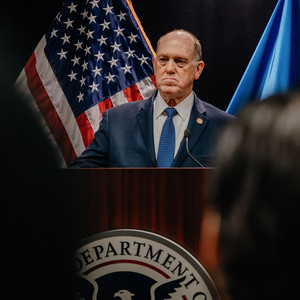
I'm Tom Holman, the border czar for President Trump.
I'm here on behalf of the president, along with U.S. commissioners.
A few days ago, the president's border czar traveled to Minneapolis with a simple message.
I didn't ask him to be an immigration officer, sir.
I'm asking them to be cops, working with cops, and help us take criminal aliens off the street.
The faster local officials there cooperate with federal immigration agents, the faster those agents will leave.
This is common-sense cooperation that allows us to draw down on the number of people we have here.
Yes, I said it.
Draw down the number of people here.
Today the history of why that kind of cooperation is so difficult to pull off and potentially even illegal.
I turned to two of my colleagues, Hamid Aliaziz and Ernesto Londano, to explain.
It's Monday, February 2nd.
Hamed, I wonder what you were thinking, as a longtime immigration reporter, when you heard Tom Homan deliver the message that he did to officials in Minneapolis, essentially offering that drawdown of federal agents if local officials cooperated and gave access.
I was thinking Tom Homan was uniquely fit to carry this message for the Trump administration.
He is somebody who has seen the entire evolution of cooperation between local law enforcement in liberal cities, with ICE, with the federal government.
He's really someone who was there at a time when this was just normal practice at ICE 15 years ago to work closely with local law enforcement.
And he's been there as it's faded away, as it's become a political issue and more and more local governments find it unacceptable to work alongside ICE.
And so this is really a that Tom Homan has waged for a decade now, not only from his position as leading ICE during that first Trump administration, but continuously as well on Fox News and testimony to Congress.
This is really a core issue for Tom Homan.
Well, what is that history that Homan seems to embody today, of this evolution from cooperation to official non-cooperation, and where does it start?
So 15 years ago, during the Obama administration, Tom Homan was leading deportation efforts.
He was the person overseeing all deportation officers.
And I think it's important just to know that when someone gets arrested in a local jail, your fingerprints ping to a federal database and that federal database goes to ICE.
So ICE is always aware when someone is arrested.
They have records on individuals and they find out if someone that they're looking for is in a county jail.
And it doesn't matter if it's in San Francisco or in Alabama.
And so one of the key strategies for the Obama administration was to utilize jails and prisons to pick up people.
And at that time, when it was a less political issue, ICE had the ability to request local jails to hold on to people 48 hours after they're supposed to be released.
This made things really easy for ICE, because they could show up to a jail and they could take multiple people at once and they could arrest them, take them to ICE detention and deport them.
So this made the entire process very efficient and they really tapped into local jails and prisons across the United States.
So it created a very seamless pipeline from local law enforcement to federal immigration efforts and seemed to be working for more or less both sides.
Exactly, and they were getting big numbers.
Mr. Holman?
Unlike you, sir, I've carried a badge and gun for 29 years.
I think I care about the security of this country and I think it's my job to protect the security of this country and the security of our communities.
So I think the biggest threat is those that want to come to this country and do harm.
And this is something that Homan at the time was testifying to in Congress, you know, really speaking to the idea that the Obama administration, their approach, it makes sense.
I've been doing this for a long time.
There was a time when I was a street agent.
We'd just go out and arrest aliens because you're here in a violation of law.
And I'm enforcing immigration law.
But at the end of the day, what impact did I make?
At the same time I'm arresting this person that's here illegally but maybe hasn't committed another crime.
There's a child predator walking out of state prison because we didn't have presence in all the jails across the country.
We're prioritizing the types of people we're arresting.
We're going after the worst of the worst and we're not just going out there willy-nilly picking up people.
We have a virtual presence in every jail.
When an alien gets arrested and fingerprinted, we're going to find out about that alien and we can take action on him and remove him from the country.
This jail model really made sense to him.
The strategy ICE has built on prioritizing what we do on national security threat aliens, aliens that are a threat to public safety.
It makes sense to me.
It's the right thing to do.
We're built to remove 400,000 people.
Let's make that 400,000 count.
And so when does this start to change?
Well, you know, the Obama administration became so effective at deportations that President Obama started to be labeled the deporter-in-chief again.
Right, deporter-in-chief, not in a good way.
Exactly, exactly.
He was facing intense criticism from immigrant advocates and certain congressional officials who were quite critical of this approach, where they were deporting hundreds of thousands of people a year.
And during this time there starts to become a growing idea, a growing movement toward the fact that cities should be a sanctuary for immigrants, that they should be protected from immigration enforcement.
Right.
And just to jump in, because one of the very first episodes of The Daily we ever did was about this idea of a sanctuary city.
This idea literally emerges from churches' decisions to turn their sanctuaries into a place that protects undocumented immigrants spread around the country.
And eventually, it becomes an urban legal movement in places all over the country.
Yeah, that's right.
And it becomes a focus for the sanctuary movement to ensure that local law enforcement is not working with ICE and is not allowing ICE to have that efficient funnel of people from local lockups to detention centers for ICE and ultimately deportations.
And just remind us why the sanctuary movement ends up focusing on local law enforcement.
What the argument they're making is.
Yeah, there are several arguments.
One is the idea that immigrants in a community will feel more willing to come forward to local law enforcement with tips, with reports of crime, more willing to interact with local law enforcement because they know that local law enforcement is not working with ICE.
So that base level, there is a belief that it makes communities safer.
And then local jails are typically not given money, extra money for interacting with ICE, for holding people for ICE.
So there is a real cost to local jurisdictions.
And you know, around that time when ICE is getting these jails to hold people for a longer period of time so that they could come and pick them up, there were several lawsuits in which individuals who should not have been held longer for ICE were locked up.
And I think that gave pause to some of these communities as well.
And just to explain, they're facing lawsuits because those immigrants who are being held for extra days in order for ICE to be able to come and get them are essentially facing an illegal extra punishment on behalf of whatever jurisdiction we're talking about, just so that ICE has a chance to deport them.
They're suing and sounds like in some cases they're winning.
Yeah.
And I think what these lawsuits showed local jails and local politicians was that when there's a mistake made by ICE, you're going to be on the hook.
You're the one who's going to be sued.
You're the one who's going to face this extra scrutiny.
And I think it lent more ammo to organizations like the ACLU to point this out, to say you don't want to get involved with this.
You should try to rid yourself of this potential liability.
Right.
Leave it to ICE.
Let them do what they need to do, but don't help them.
Exactly.
You know, the immigration system and the criminal justice system should remain separate.
And there's an argument from activists and immigrant advocates that Some of these individuals that ICE has picked up have been maybe not even charged after they've been arrested, or the charges ultimately don't lead to the conviction.
And so these are individuals who don't necessarily meet the definition of a criminal, but they've been arrested and thrown into the criminal justice system.
And as a result, they are being transferred to ICE in a way that they should not be.
Hmm.
So Hamid, once this idea of non-cooperation settles in, what does that look like, and how broad does it become?
You know, it's during this time, toward the end of the Obama administration, where places like California buck back at the idea of holding people longer so that ICE can come pick them up.
So you see, the Obama administration really try to figure out a way, and this is during a time when Tom Homan's there to work with these liberal jurisdictions.
So they come up with this idea that okay, you don't have to hold onto somebody longer for us, but how about you notify us 48 hours before somebody's released from custody, so that we could be there at the jail and pick them up?
All that liability, all those potential lawsuits, hey, you don't have to worry about that.
Just give us a heads up before someone's released and you don't need to hold on to them longer.
So some low level of cooperation is still happening.
Yeah, the federal government offers it as an option.
But then Donald Trump wins the presidency on the basis of cracking down on immigration and deporting many immigrants.
And so it becomes a cause for many of these progressive cities to limit even that level of collaboration.
During this time, California puts in place an expansive sanctuary state policy, really limiting, severely limiting immigration. the cooperation and interaction between local law enforcement and ICE.
And soon you start seeing cities and jurisdictions across the country taking up this idea of limiting any type of cooperation with the federal government and with ICE, because it was seen as a way of helping President Trump.
So basically, at this point, the door comes down on any form of any cooperation.
Yeah, it becomes really limited.
I mean the ability for a jail to provide the release date information for an immigrant that ICE wants became limited for a very specific type of violent criminal, a very serious criminal.
And that made life much more difficult for people like Tom Homan who, by the time Trump comes into office, he's put in place to run ICE.
And he really makes California and this whole idea of a sanctuary jurisdiction, a sanctuary state, a cause for him.
He focuses on it relentlessly.
Sanctuary cities, I think, in my opinion, raise a serious officer safety and community safety issue.
And much of the message during this time is very similar to the message that we're hearing now.
For every person that I can arrest in a county jail in a sanctuary city means that a law enforcement officer has to knock on the door of a home to arrest somebody that has a criminal history, when they could have arrested them in the safety and security and privacy of a county jail.
In June of 2017, he goes in front of Congress and he tells them that...
The idea of sanctuary cities makes it less safe for communities, not only by releasing alleged criminals into the communities, but making it harder for ICE to find these people.
It's only a matter of time before when the men and women of ICE don't go home at night because they had to go arrest a criminal alien in a home rather than get them in a county jail in a sanctuary city.
The sanctuary cities are a danger to the men and women of ICE.
And when they go into these communities and they go to homes and they try to make these arrests, there's a greater possibility of a violent confrontation of people being in danger.
And on top of that, more people being arrested just for being around some of the targets.
He's basically saying ICE and immigration enforcement in general is at its worst and its most confrontational when we don't get the access that we believe we need to your jails in particular.
Yeah, exactly.
But ultimately, Trump became harsher.
His language became more aggressive.
And these cities and these jurisdictions.
Really there was no pathway for them to come back online and work with ICE.
It was seen as the only way, or one of the main ways, for these communities to protect their immigrants online from the onslaught that Trump was bringing to them during that first Trump administration.
And ultimately Homan and the administration's efforts to sue California over this really expansive, unprecedented statewide sanctuary policy that failed.
And Homan and ICE, they weren't able to get more access to jails.
They got less.
So by the time Tom Homan ends up in Minneapolis last week and is telling local officials, just give us access to your jails and everything will be copacetic.
He knows full well, because he's lived through the whole history of this, that that's not a simple thing.
It's been legally codified as unacceptable in many, many places around the country.
Yeah, exactly.
Exactly.
You know, Homan is well aware.
He knows that this idea of working closely with ICE, allowing ICE into local jails in Minneapolis, is a political non-starter.
But he also recognizes that The idea of allowing some cooperation, some effort to work with ICE could really be a way, an off-ramp for both sides to say that they won something in this battle and now they can move on from this crisis.
Well, Hamed, thank you very much.
Thank you for having me.
After the break Ernesto Landano on how Minneapolis is navigating the Trump administration's latest demands for cooperation.
We'll be right back.
Ernesto, you're in Minneapolis.
It's where you live.
Talk to us about how these demands for cooperation from Tom Homan and the administration to leaders in Minneapolis are playing out there on the ground.
Well, Tom Homan has been here for a couple of days.
He's met with the governor, with the mayor of Minneapolis, with the mayor of St.
Paul.
But arguably I think the most consequential meeting he's had is one of the ones that has drawn the least amount of attention.
He met with Hennepin County Sheriff Dawana Witt.
The reason this matters is that Sheriff Witt oversees the largest jail in the state and the only one that has a clear-cut record policy saying that they will not cooperate with ICE.
So if there's one person in the state currently who could, as a matter of policy, under her authority, you know, kind of give the administration a big win, a trophy, so to speak, to you know, walk away from this immigration crackdown, it's Sheriff Witt.
And what's the story of this jail this jail that it sounds like Tom Homan is very focused on, and its non-relationship to immigration enforcement?
Yeah, this jail has a really interesting story that really dovetails the broader journey of the sanctuary movement in the United States.
So, you know, if you rewind the tape a little bit and go back to the Obama years...
The Hennepin County Jail had a policy where they actually allowed ICE agents to keep a tiny little office in the facility.
It was like the equivalent of a broom closet.
And what the sheriff here at the time did, was he allowed agents to interview immigrants who were booked into the jail.
To assess whether or not they were deportable and to figure out whether or not ICE wanted to grab them the moment that they were no longer going to be in state custody.
That's really fascinating that that's so hand in glove.
That's a deep level of coordination.
That's right.
And sheriffs in Minnesota are elected officials, so they have to run for office and be responsive to what the electorate is feeling and thinking about these issues.
And in the 2018 election, the sheriff, who had been in office for over a decade, lost his race by a tiny margin.
And one of the issues that the guy who beat him campaigned on was rescinding cooperation with ICE.
So we were in a moment where people were outraged by the family separation policy that the Trump administration had been pursuing.
And immigration had become both a very divisive and a very partisan issue.
So you have a new sheriff who comes into office at this fraught political time over immigration and, over a period of months, wound down cooperation with ICE, initially by kicking them out of the jail and eventually by not notifying them when immigrants who were subject to deportation were booked or informing ICE when individuals were going to be due for release.
So no more broom closet for ICE, basically.
Exactly.
They were out.
However, I think it's important to remember that there was still a significant amount of cooperation with ICE.
When you looked at the state prison system which, as a matter of both statute and policy, they always notify ICE when an individual who is serving time on a serious charge is going to be released.
And those individuals are handed over to ICE immediately in a very kind of pragmatic and cooperative style.
You just call up the ICE agent, let them know, be here at such and such prison at nine in the morning.
And here's your guy from our custody to yours.
When it comes to other jails in the state, It's been a little trickier.
I think it varies share to share of just how much effort and time they want to put into cooperating with ICE.
And in the past, this issue has been legally challenging for counties in the state.
There's been lawsuits in at least a couple of jurisdictions that resulted in payouts to immigrants after the courts found that local jails had exceeded their authority in detaining people at ISIS request longer than they legally had permission to do so.
Right.
Haman had talked about this phenomenon.
It ends up being the case that the jails and the communities where these jails are located are on the hook financially for those legal challenges, which becomes a real disincentive to play ball.
That's right.
But I think what you have is a mix of sheriffs here, you know, in suburban counties and rural counties.
I would say, you know, most sheriffs cooperate with ICE to some degree.
The one exception continues to be Hennepin County which, up to this point, maintains that they do not intend to work with ICE in any way, shape or form.
Well, talk about the position that this Hennepin County sheriff is now in.
She's got the federal government in the form of Tom Homan bearing down on her.
And saying, we're asking this one thing.
And I have to imagine in a sense they're making her feel like she stands in the way of ICE and Border Patrol drawing down their numbers in Minneapolis, because she's standing there and saying I won't give you this thing you want.
Yeah, it's really interesting because in the messaging from the Trump administration you know they've gone really hard after Governor Tim Walz, after Minneapolis, Mayor Jacob Fry.
But both of them have essentially said we either already cooperate with ICE or, as it pertains to the governor and the prison system,
And the mayor has no oversight over jails.
So I think everybody's starting to look at Dawana Witt, the sheriff, and say, if there's one person who could, you know, make a real substantive move that might appease the Trump administration, it's Dawana.
Right.
The problem though is, you know, here is somebody who needs to be elected and be responsive to her constituents.
Dewana Witt got elected in the aftermath of the George Floyd era.
You know where the politics in Minneapolis and the county you know really veered to the left.
And she's somebody who I think is at heart a centrist in her political philosophy.
She's somebody who I think is a pragmatist, but she sort of rode the wave of anger that followed the killing of George Floyd during a time when people were really upset at the Trump administration, where immigrant right groups had a lot of political power.
So if she were to make a move that her constituents would see as her having capitulated to the Trump administration and essentially flinging the doors to the jail open to ICE, you would assume that would be politically damaging for her in this moment.
So what has she said about what she plans to do?
She has said very little publicly.
She's been very critical of the way immigration agents have conducted business over the past few weeks.
You know, they've killed two American citizens here.
These immigration rates have been very chaotic and disruptive.
But DeWanowitz so far has not really inserted herself, publicly at least, into this conversation about jails and prisons.
I've been trying to interview her, but she hasn't really been ready to come out and engage and say whether or not she's willing to be the one who makes a bold move as part of the standoff.
The readout she put out about her meeting with Tom Homan was very short and, you know, somewhat vague.
She called their conversation candid and constructive, but she did not indicate in any way, shape or form that she's starting to revisit her policy at the jail or that there could be a deal on the table that she's exploring.
Just to understand, because you're mostly talking about the political predicament that this sheriff is in.
Legally, even if she wanted to, could Sheriff Witt cooperate with the federal government and open up the jail?
So it's my understanding that there's kind of two overlapping things happening here.
One is at the county level, policy is set by county commissioners who are also elected officials.
And they have a separation ordinance as it pertains to ICE cooperation.
But it, you know, addresses kind of simple issues such as the fact that county property and parking lots can't be used by ICE agents to stage their operations.
Mm-hmm.
When it comes to the jail, my understanding is that Sheriff Witt could unilaterally decide to change the policy.
For instance, to start providing information to ICE or to open up a line of communication between her office and the local ICE agents.
And to start heeding their requests for information about when somebody's going to be released.
You know, she could theoretically also decide to once again open the jail to ICE agents and to allow them kind of easy access.
It is, as I understand it, within her purview.
But politically I think it'd be a really difficult and conceivably damaging move for a sheriff who, I think, intends to run for re-election.
Right, and the question would be if she were to let ICE Border Patrol start coordinating with the jail.
To what end exactly?
Because, at the end of the day, what kind of assurances do any of these local officials have in Minneapolis or really anywhere in the country, that if they meet Tom Homan's demands and the administration's demands, if they fling open the doors to?
If they let ICE back into a broom closet in the corner and coordinate release and then arrest and deportation, that then ICE and Border Patrol agents would start to leave the city or that their operations would go back to being less confrontational.
I mean, there's absolutely no guarantee that if you make this gesture, if you were to open Hennepin County Jail to them, that this would all go away.
You know, it's hard to overstate how little trust exists currently between elected officials in the state and the Trump administration on these issues.
This is a state where people feel besieged by the federal government.
They feel that this operation is really, really doing serious damage to people's livelihoods.
It's resulted in two deaths already.
And it's really strained people.
Longstanding relationships between local and federal law enforcement agencies.
But it also, you know, boils down to the principle about these policies.
The reason some police departments and the Hennepin County Sheriff's Office have decided they don't want to be involved in immigration stuff is because they feel it erodes trust with the community they serve.
So...
If they were to make a big concession on this, they would be essentially capitulating on a matter of principle.
And they would be doing so with no guarantee that this would subject them to less pressure from the Trump administration or even less immigration enforcement out in the streets.
Well, Ernesto, thank you very much.
We appreciate it.
Thank you, Michael.
Over the weekend, a federal judge ordered the Trump administration to release a five-year-old boy and his father, whose detention in suburban Minneapolis a few weeks ago had spurred nationwide outrage.
The judge in the case called the detention of the boy, who was wearing a Spider-Man backpack and an oversized fluffy blue winter hat when he was captured unconstitutional, and quote the imposition of cruelty.
We'll be right back.
Here's what else you need to know today.
In an ominous sign for national Republicans, a Democrat decisively won a major special election in Texas over the weekend, carrying a district that President Trump won by more than 17 points a little over a year ago.
The Democrat Taylor Romet, a local union leader and first-time candidate, trounced the Republican in the race, conservative activist Lee Wamgans, in an election for a major state Senate seat around the city of Fort Worth.
Ramet's victory came even after President Trump endorsed his rival, and it reinforced Democrats' growing confidence that their chances of winning back control of the House this fall remain high.
And the latest government release of documents related to Jeffrey Epstein, the single largest release to date, sheds new light on his relationship with several of the country's richest and most powerful men.
The emails show that Epstein exchanged multiple messages with Elon Musk and had invited Musk to his compound in the Virgin Islands.
Another email written by Epstein to himself claimed that Epstein had helped Bill Gates have extramarital sex, a claim Gates denies.
Several emails show that Epstein connected the owner of the New York Giants, Steve Tisch, with several women whom Epstein described in vulgar terms.
Finally, emails showed that Howard Lutnick, now Commerce Secretary, planned a visit to Epstein's island in 2012, despite Lutnick previously claiming that he had severed all ties with Epstein seven years earlier.
Today's episode was produced by Anna Foley, Alex Stern, Ricky Nowetzki, and Muj Zaydi.
It was edited by Michael Benoit and Liz O'Balin.
Contains music by Rowan Emisto, Alicia Baetube, and Dan Powell.
And was engineered by Chris Wood.
That's it for The Daily.
I'm Michael Barbaro.
See you tomorrow.