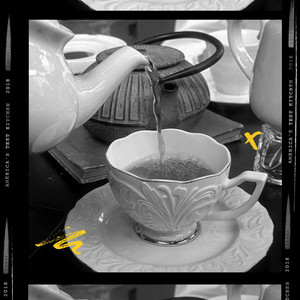
There's something special about a cup of black tea.
Listen and learn, son.
Tea is a herb. It's a simple drink.
Leaves, hot water, occasionally milk and sugar.
It takes almost no time to prepare.
It's relatively cheap and easily offered.
But tea is also so much more than the contents in the cup.
The making of tea has created its own culture, which is oh, so fancy.
Tea here, as usual, miss?
Yes, as usual. It's always been a drink of distinction, from the earliest tea ceremonies in ancient societies to the futuristic imagination of Star Trek, with Captain Jean -Luc Picard aboard the USS Enterprise.
Tea? Belgray, hot. But if you mess it up, it just won't do.
And your guests will be sure to let you know in the politest way, of course.
I'll make tea. No. Today on Proof from America's Test Kitchen, we honor National Afternoon Tea Month month by gazing into the tea leaves, so to speak, all in hopes of figuring out how to make the perfect cup of tea.
And after all this time, can a cup of tea be improved?
And why does this simple drink mean so much?
I'm Jack Bishop. Sit back, stir, sip, and enjoy.
in case you haven't heard it's officially in abercrombie summer the anf vacation shop has everything on your packing mood board i desperately need their new one piece the anf marina it's strapless so flattering and paired with denim shorts will be my go -to beach outfit this summer finally your suitcase isn't complete without finding that dress you know the one for the photo shoot abercrombie's boho dresses have that perfect beachy romantic look make it an and Abercrombie Summer shot their newest arrivals in -store, online, and in the app.
Hey, it's Ryan Reynolds here from Mint Mobile.
Now, I was looking for fun ways to tell you that Mint's offer of unlimited premium wireless for $15 a month is back.
So I thought it would be fun if we made $15 bills.
But it turns out that's very illegal.
So there goes my big idea for the commercial.
Give it a try at mintmobile .com slash switch. A prompt payment of $45 for a three -month plan equivalent to $15 per month required.
New customer offer for first three months only.
Speed slow after 35 gigabytes if network's busy.
Taxes and fees extra.
See mintmobile .com.
Hey, business owners.
We know you know the importance of maximizing every dollar.
With the Delta SkyMiles Reserve Business American Express Card, you can make your expenses work just as hard as you.
From afternoon coffee runs to stocking office supplies and even team dinners, you can earn miles on all your business expenses.
Plus, you can earn 110 ,000 bonus miles for a limited time through July 16th.
The Delta SkyMiles Reserve Business Card. If you travel, you know.
Minimum spending requirements and terms apply.
Offer in 71625. Reporter Jerome Campbell has the story.
There is no sound more comforting in my household than the kettle reaching its boil.
It means some good news is about to come.
I always get a bit excited when I know tea is coming.
I sit up a little, wiggle a bit to get comfortable.
it's like a little gift when it comes and when you take that first sip it's everything in my family a teacup is a big part of life my parents drank it all their lives ever since they grew up in england and when they moved to america and had kids that tradition was instilled in me and my siblings we drink tea on every occasion first thing in the morning after school or work after meals, or for no other reason except we simply fancied a cup.
It was a special time, and also one that had its own challenges.
There was a right way and many wrong ways to make tea for my family, which may sound impossible to the uninitiated tea drinker.
But think about it the same way some families uphold mac and cheese on holidays.
It's got to be made just the right way.
Except for tea, that standard must be reached every day.
There were things to worry about like making sure to add enough water to serve everyone at once.
Brewing the tea bags long enough to be strong.
Adding enough milk to make the liquid turn the right shade of almond.
And it was always two scoops of sugar.
Leveled, not heaped.
On top of all of these steps, you had everyone's particular tastes.
tastes so i like sweet tea not too milky right simple but brood i don't like wheat tea either sweet i like my tea sweet but if it's if it's too sweet it's not good i do enjoy half and half in my tea there's nothing worse than having milky tea or having weak tea what's too milky for one person is just right for another, or too sweet, or not strong enough.
And if they didn't like it, they would let you know.
Sometimes they would get up to adjust the flavor for themselves.
Or even worse, they would offer a meager smile and say something polite, like, It's fine.
That's my grandma Esther.
She's been drinking tea since she was a child in Jamaica.
A British commonwealth.
Grandma is probably the person with the most particular taste in our family.
And I have a personal challenge to make tea the way that she approves of.
Usually, she won't let anyone prepare her own cup.
And when you do, it's generally just passable.
What's your verdict?
It's okay, the color.
Just okay? Except for my dad.
He gets a seal of approval from grandma and everyone else agrees he's the best at taking on this task.
I say dad because when I drink it, it just feels like my childhood.
Yeah, I feel like I have to say dad.
Leroy, definitely. Yeah.
I'll make a cup of tea.
I try, but your tea is usually better than mine.
I think you all have made good tea and you've all made bad tea.
Right? My dad's tea is really good.
It's sweet, but not saccharine, bold, but balanced.
Everything you want in a cup.
Dad even has his own methods of preparation.
You know, after making the tea and, you know, you add your milk and your sugar and all that stuff, sometimes I couldn't come together.
I don't know if it's true or not.
it almost opens up the flavor and the molecules of the tea and stuff there and it's just i don't know if it's a it's a ritual that i've done and sometimes i don't even realize that i'm doing it stirring the cup like 50 times you know or clinking the cups together or tapping the spoon boom together part of that routine, hoping that I can get that perfect cup.
My tea isn't bad. It's quite good if I do say so myself, but it's not grandma approved.
And when I've tried to replicate my dad's methods, clinking the teacups and everything, it's never quite the same.
So I wondered, what made it so good?
And how could I make mine better?
better. So I started by asking an expert.
I always use loose -leaf tea because it gives me a really wide range of different options on flavor profile.
That's Jane Pettigrew.
She is a true tea multi -hyphenate.
She's been in the business of tea for over 40 years.
I use filtered water.
I measure the tea carefully on digital scales.
You can tell Pettigrew's tea preparation method is refined from just listening to it.
She's perfected the practice after years of running tea rooms and studying tea.
I pour the water onto the tea from a little bit of a height so I get lots of oxygen.
The World Tea Expo named Pettigrew one of the best tea educators.
And the British government bestowed her with a medal for, quote, services in tea and tea history.
The idea is to get the leaves moving inside the teapot so that they begin to take on water and then they start to release their flavor and they just gradually unfurl.
Now, Pettigrew runs the UK Tea Academy, where she teaches all things tea, even tea sommelier classes.
For me, the joy is actually doing the routine of brewing the tea.
If there was anyone who could show me a thing or two about tea, pedigree was definitely the one to do it.
And it turns out that there was a lot to learn about how the ritual of tea preparation changed throughout history.
For starters, tea did not start out as a drink.
Many millennia ago in China, people chewed the tea leaves.
It wasn't until about the 700s, when records say a Chinese writer named Lu Yu encouraged people to try the leaves in a drink.
He He wrote a treatise called Tea Classic about enjoying the liquid of powdered tea leaves.
He said that if prepared correctly, with the finest ingredients, tea could rival the finest culinary experience.
And people listened.
These new tea drinkers started to get into the art of perfecting a cup, considering each step in the process from the moment the leaves were picked.
According to Liu Yu, the best tea came from leaves exposed to the most sunlight, and picked at the beginning of the plant's harvesting season.
This method of tea selection is still used by the British brand PG Tips, which is also my grandma's preferred brand of tea, a credit to her discerning taste.
Pettigrew said the Western world wouldn't catch on to the evolution of tea until the 1700s.
And even then, the British were late to it.
The first to bring tea back to Europe were the Dutch. The Dutch were very instrumental in dominating the sea routes and bringing tea and porcelain, etc., back into Holland, the Netherlands.
And from there, it went everywhere.
People migrated from the Netherlands, from Holland, to America.
They took with them household goods, which, of course, by then included their tea wares.
They settled in New Amsterdam, which, of course, we then pinched from them and renamed New York.
So they found that tea was being drunk by pretty much everybody there.
It wasn't until 1657, as far as we have recorded events, was when the first tea was brought into London on a Dutch ship.
It was not the British East India Company which brought tea in.
It was the Dutch. However, the preparation methods in England were not as thoughtful as the Chinese writer Lu Yu first laid out.
British tea drinkers were first introduced to the beverage alongside coffee to accompany business conversations.
The thing about China tea, you can actually brew the tea more than once with quite a lot of them.
So, you know, you use more tea and less water and then you can go on adding water three or four times.
But the standard in those early days was that the coffeehouse owner had to brew the amount of tea that he thought he would serve throughout the whole day in the coffeehouse.
So you can imagine how strong the tea was after it had been brewing all day.
Once tea drinking took a foothold in Great Britain, the nation developed their own ritual ceremonies, including high tea.
You've seen it in your favorite cinematic period pieces.
Hai Ti was the height of society with the whole setup.
You had the crumpets and the manors and the beautiful gowns.
You would have your little bowls, little saucers, little plates for sugar to be put on, a teapot.
And you would have a beautiful silver kettle, which stood on its own little cradle with its own little burner.
And of course, there was black tea leaves from China.
China. About a hundred years later, though, the type of tea leaves changed, too.
In the 1800s, merchants started to obtain black tea leaves from other places.
There was Ceylon from Sri Lanka and Assam from India.
Sometimes the newly introduced tea varieties were sold as is.
But many vendors also started making blends.
The British tea blend that most people know comes from a mix of Ceylon, Assam, and Kenyan leaves.
And for those of you wondering about the origins of the Earl Grey blend?
It consists of black tea leaves and citrusy bergamot, but most companies find a way to put their own spin on it.
Pettigrew says different brands create their Earl Greys with different types of black tea, or they vary the amounts of bergamot.
Most important thing is that the tea and the flavouring, which is added, work together and make a third entity, not that the flavoring overwhelms the tea.
Blending teas is a very careful skill and you really need to understand how you're going to get the best out of the tea and the flavoring.
Pettigrew says the next big shake up in tea came about 150 years later in the mid -1900s.
Up until around that point, most of the Western tea drinking world enjoyed their tea loose leaf style.
But then two inventions changed the way tea leaves were processed to create a cup of tea.
First, a machine called the CTC, or cut, tear, curl.
It macerates the tea down into what looks like lawn cuttings when it comes out of the machine.
And the second, the tea bag.
Pettigrew says the origins of these silken sachets were likely an act of serendipity.
There are stories about merchants who sent tea samples to customers wrapped in little bags of fabric.
And people just stuck them in their teapots.
A little sack of tea meant that everything was so much easier.
It meant you didn't have to measure the tea, you just popped it in your teapot.
It meant that when you came to throw the tea away, it didn't block your sink up because you could throw that bag away in the waste.
The introduction of the teabag and the CTC machine streamlined tea preparation, but also changed its flavor.
The tiny cuttings inside a tea bag were much smaller compared to loose leaf.
Which then brewed much more quickly because you had more surface area in contact with the hot water and gave a lot of strength and a lot of color.
But what you lose when you do that is you lose all the finer, subtle flavors.
As soon as the tea bag became commonly used, tea bags just took over.
The revolution of the tea bag made a cup of tea accessible to the masses, at home and at work.
Pettigrew recalls a moment in British history during World War II, when the government enacted tea breaks to rehydrate factory workers.
The Ministry of Defence decided to introduce tea into the factory to be consumed at a particular point in the morning and in the afternoon.
And that eventually led to the tea lady, and the tea ladies would brew the tea in a great big urn and would push the urn around on a trolley, there would be biscuits etc and people used to go up to the lady with her trolley and get the cup of tea and people would chat and gossip around the trolley because it was a meeting point and with it came an even bolder taste strong tea from a teabag because it's easy to use and very often quite a lot of milk and quite a lot of sugar and they have to have biscuits as well my dad fondly remembered these times when he used to work in england too we would take
it in turns to make tea bring out biscuits along with that and then we would just take 10 minutes just sit in a room kind of like what we did like growing up just sat in a room just talked about anything you know and just relaxed and it was just a way of like unwinding for a little bit nowadays much of the pageantry around tea has gone away but the preparation of tea still boiled down to the the same ingredients, with some new techniques added.
Pettigrew gave me some things to think about, some of which I was willing to try.
Different tea blends were a possibility, but then again, my family were staunch Tetley tea bag drinkers, not likely to change.
I also tried drinking tea out of a small Japanese tea bowl to sample the experience, and it was tedious.
Hideous you can blame my western manners but sometimes I need the caffeine to hit my veins immediately and the little bowl couldn't keep up with my appetite.
My dad had already unlocked the golden ratio of milk and sugar to black tea so there wasn't much to try there but the loose leaf brewing method that was interesting a chance for a more flavorful cup maybe there was something unlocked there so I decided to try this loose leaf tea business I have two cups of tea one the Tetley tea bag tried and true and the other a British blend loose leaf tea that I got from a tea store okay here's Tetley so no surprise that is good and here's the loose leaf hmm let me get another sip okay that's a bit of a cheat i got two extra sips um the loose leaf is really
good it's really smooth you can taste i think more more flavor, like the robustness of the tea leaf and like, like a little bit of sweetness and it just is just mellower and smoother compared to the Tetley.
I sometimes I feel like Tetley is like almost like a cup of coffee, like the way it punches you on first taste, but this loose leaf, it was doing something.
I could see my family liking the taste of loose leaf tea, even my grandma, but I could could also see them being a little bit fussy with the prep.
You have to measure out the amount you need.
Not a big inconvenience, but maybe just enough to not have it every day.
So I considered a different approach. After the break, Jerome gets some advice from an American chemist on how to perfect a cup of tea and learns what she did to turn the British Tea Drinking Society on its head.
And now, back to our story.
Is it fair to call you a tea scientist?
Most of my published research is in theoretical and computational chemistry, so probably not quite fair to call me a tea scientist. On the other hand, I spent three years immersed in the chemical literature on tea, so I know a lot about tea science.
Dr. Michelle Francil is a chemist who teaches at Bryn Mawr College in Pennsylvania.
She focuses on the structure of molecules and what their forms tell us about their function.
Or in her words, I'm pretty interested in what makes a molecule tick, so what makes a molecule do what it does.
Francil says looking at things at the molecular level not only gives us an understanding of how different compounds come together, but also why.
She says, looking at tea as a chain of chemical changes allows you to get really specific about the subtle shifts in a cup of brewed tea.
And in turn, this gives people more control over their end result.
That's the type of attention to detail I was looking for.
Francil's scientific approach might get me closer to a perfect cup of tea.
Francil laid out her tea base investigation in a book called Steeped, The Chemistry of Tea.
It was inspired by a pre -pandemic Twitter question that caught her eye.
And so someone asked on what was then Twitter, does the shape of the teabag matter?
Are those tetrahedral teabags like PG Tips in England, are those better than just your regular kind of, you know, run -of -the -mill teabag?
Or did they just look cooler?
I did a little research and then thought, oh, I could write a whole essay about this.
It turned out that the shape of a teabag didn't matter But size did Francil wrote that when tea brews in water The leaves expand in size By as much as five times Roomier teabags help more of the leaves' surface area Get exposed to hot water Which means a more robust tea brew and flavor An editor at the Royal Society of Chemistry Saw Francil's essay and asked if she could do a bit more.
So when the summer came, I had time to, you know, see if I could write a book proposal about it.
And that's really when I began to think what might be next.
Franzl's book reads as a field guide to tea, as well as a practical introduction to chemistry.
Some of the lessons seemed second nature to me, like the importance of brewing the leaves in boiling water.
212 degrees Fahrenheit for black tea, to be exact.
Studies show that the temperature of your mug or teapot can siphon some of the heat too, causing the brew to not be as robust. But you can help avoid that heat loss by preheating the container for your tea.
My family sometimes uses a tea cozy, sort of like a mitten for your teapot, to keep it warm.
Also, do not do your tea in the microwave. The water comes to a boil too quickly.
You're left with too much oxygen in it.
You lose your flavor.
So don't do that. There were several findings that surprised me, like the value of of agitating your tea leaves.
I'm sure my dad would be glad to hear that his special tea clinking ritual was backed by science.
Agitation is good because you expose more leaves to the water, and so you'll get more of the compounds out that you want, but squeezing out extra, you'll squeeze out more antioxidants, but it'll also be more astringent.
So the taste might not be as good.
On the matter of milk and sugar, it's truly a matter of preference.
Both ingredients can offset set the tea's bitterness with a bit of a trade -off.
The addition of milk can reduce the amount of antioxidants your body absorbs from the tea leaves.
And sugar? It can give you a bit more energy, along with some extra calories.
Francil's book also unpacked some discoveries I wish I didn't know.
Like the origin of that white froth that sits on top of an old cup of tea.
I enjoyed finding out about this gum on tea.
For the uninitiated, tea scum is the white film that forms on the top layer when you heat up a cup in the microwave or it sits on the counter too long.
I'd wondered for years what that was.
Chemically, it's similar to the scum in your bathtub.
And chemically, you deal with it the same way.
You add a little acid stuff to it and it will go away.
A little lemon in your tea will make it disappear.
But there was none as outlandish as this one section tucked away near the end of the book.
It was less than a page, a few paragraphs, really.
It's definitely a rescue technique.
But if you read some of the 8th century manuscripts from China, they talk about putting salt in tea as a matter of routine.
Yes, you heard that right.
Francil said you can put salt in your tea.
The manuscript says do it, but doesn't say why.
And I was kind of pleased that I could track down the chemistry behind that, which is that the sodium in the salt blocks your perception of bitterness.
Okay. The science behind it is kind of cool.
The addition of salt isn't some sort of distraction of saltiness to avoid a bitter taste.
It actually tricks your brain into ignoring the perception of bitterness altogether.
You remember Lu Yu, the ancient Chinese tea influencer?
influencer it turns out that he also said that salt was a welcome addition to a cup of tea so i gave it a try okay you can probably hear the microwave in the background i've had like an old cup of tea um like brewed for like four hours that i put in there to re -warm up to try this like salt addition so let's see if it saves it okay taking it out and let me grab some salt that's weird it kind of doesn't taste like tea anymore it's just like i don't know like the flavor's gone it didn't really land for me it made the tea too weak i could barely taste the flavor and i don't think i could get my family to
willingly try it either they'd find it too crazy as did many people who came across fancil's book within hours of the manuscript's release the british press found it and had a field day.
Jane Pettigrew, the British tea expert, remembers.
We just had a few days of everybody ringing us up saying, what's all this?
This is nonsense. Nobody here thought it was a good idea.
So it kind of died a death quite quickly.
Then the U .S. Embassy in London weighed in on it.
They issued a statement about the salt rescue technique, saying the the unthinkable notion of adding salt to Britain's national drink is not official United States policy and never will be, which then became the topic of a State Department briefing.
What is it that prompted the U .S. Embassy in London to put out a statement about this tea?
Is this the Boston Tea Party joke?
So I think it was a moment when there was a lot going on in the world But I think people kind of found a little bit of amusement and joy in kind of poking fun and salt in your tea.
So I took it all with a grain of salt, let's say.
Francil says everyone was missing the point.
She never set out to write the magnum opus on tea.
Her book was intended to help tea drinkers make better choices for their palates.
I think that you should be willing to experiment with your tea a little bit.
it and find out what you like.
Tea drinking has this incredibly long history.
And so you're kind of plugged into that history.
People have been drinking tea since prehistoric times, they think.
So enjoy the fact that this is a long tradition.
And I find that that's something about our common humanity seems to me to be captured in that cup of tea.
It's not like you're just pouring a glass of water.
There's a little bit of work that has to go into preparing a cup of tea.
And to me, it sort of feels like a way of offering each other care.
That's the thing that gets me about a cup of tea.
No matter when you get it, it always just feels right.
Like the right gesture, a small one.
And it comes that way because someone cared enough to make a cuppa with you in mind.
When I think back on the cups of tea shared with my family, although I felt pressure of getting it right at times, it was one of the simplest ways to show my family that I cared, even when I was a kid with no tea -making skills.
My parents felt the same way.
Here's my dad, talking about when my stepmom, Beverly, makes tea for him.
It's not just the tea itself, it's the act of preparing the tea, because she knows exactly how I want it, right?
she may be a little bit off with the sugar just saying but but she will make the tea and it's almost like the ritual behind it and it's you know and i when i guess for me subconsciously when i think about it it's a means of caring right you know it's it's it's a testament to our relationship i think i like it because it makes him so happy so i do it because of him Yeah.
Like he feels so happy when he comes home and he knows the cup of tea's on and I've made it for him.
It's like being home.
I think that's what it is.
It's we're home. So maybe the perfect cup was not something I could execute, but something I had to listen for and adjust. A work of love perfected in a cup.
I just hope that my grandma will suffer through the journey to let me get there.
Hi, Grandma. How you doing?
Okay. Good, good. Is Dad there?
Yes, I am. Hi, Dad.
Hello, Jerome. How you doing?
Doing good. And you?
I'm good, I'm good, I'm good.
You know I couldn't end the episode without getting my Grandma to try the salt recipe, right?
So, Grandma, has Dad made you the cup of tea?
Yes. Okay, has he told you what's in it?
No. Okay, so I want you to just taste it and tell me what you think.
That had no taste. No taste?
What kind of tea do you like?
I don't know what kind of tea you like.
No. Because you're always into this.
Really? No. It doesn't taste like tea, really.
Okay. Okay, what does it taste like?
What does it taste like?
No taste. Water. Okay, okay.
Just water. Maybe a little less salt next time.
Thanks to Jerome Campbell for bringing us today's story.
story. Next time on Proof, the ice queen cometh.
I never looked at ice like we had those cubes.
They weren't anything, but people will always be like, oh, wow.
And I was like, Americans.
Yeah, I was like, why are they getting mind blown by ice?
Also, make sure to tune in on Tuesday to get a preview of the first episode of another podcast from America's Test Kitchen.
It's called In the Test Kitchen.
If you like Proof, be sure to subscribe wherever you listen so you can get new episodes as soon as they drop.
And while you're there, why not leave us a rating or write us a review?
It really helps other people find the show.
This episode was hosted by me, Jack Bishop, and the podcast is made by the following cast of characters.
I'm Aimee Araki, a Managing Producer.
I'm Executive Producer Caitlin Kelleher.
I'm Senior Producer Alex Curran -Cartarelli.
I'm Associate Producer Angelica Quintanilla.
And I'm Associate Producer Louise Curran -Kensler.
Audio services are provided by Ultraviolet Audio, with scoring, mixing, and sound design by Matt Boynton, Brian Campbell of Signal Sounds composed our theme music, additional music by Kyle Forrester, and Jordan Pearson.
Ann Margolis is our Director of Post -Production and our Director of Production is Diane Knox.
Fact -checking and additional research by Sarah D.
Collins. Special thanks to Jane Pettigrew, Michelle Fransel, and the Campbell family for letting us in on their tea time.
Nina Giannelli is the Senior Vice President of Television, Video, and Podcasts.
Dan Souza is the Chief Content Officer And Dan Surratt is America's Test Kitchen's CEO. Proof is a production of America's Test Kitchen.
This podcast is part of the Airwave Media Podcast Network.
Visit airwavemedia .com to listen and subscribe to their other fine shows.
An Airwave Media Podcast.