Ted Audio Collective
You're listening to Ted Talks Daily, where we bring you new ideas to spark your curiosity every day.
I'm your host, Delise Hu.
Today, a different way to think about politics and challenges of democracy.
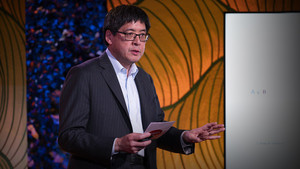
Neuroscientist Sam Wang specializes in simulations, computer models.
He gets into the math to help us understand why political polarization is growing,
how it leads to the elections of more extreme leaders and the repairs required to stabilize democracy.
Coming up after a quick break.
Like Ted Talks? You should check out the Ted Radio Hour with NPR.
Stay tuned after this talk to hear a sneak peek of this week's episode.
And now, our Ted Talk of the Day.
Computer simulations are everywhere.
If you navigated here today or you looked at a weather report, then you use simulations.
A simulation can game through thousands or even millions of possibilities.
What if computer simulations could help us out of one of the most pressing problems of our time?
A rickety democracy here in the United States or around the world?
I'm here to argue today that simulations can help us preserve democracy in a time of crisis,
in a time of rapid change, both technological and demographic, and indeed, climate change,
and tension, again, in the US and around the world.
I'm a computational neuroscientist, and I'm used to handling complex data.
My students and I study the brain, a highly complex object.
We take data and we make it simpler in order to understand it.
We also build models to help understand how a brain might react.
And this kind of understanding, I argue, is useful in understanding democracy itself.
Imagine neurons, which I do a fair bit.
When neurons fire together in synchrony and they fire impulses together, that can lead to a seizure.
Now imagine people doing something together.
When people start believing something in unison or acting in unison, that can lead to political collapse
and it can lead to unrest, and it can even lead to insurrection.
Computation and mathematical analysis can not only help explain,
but they can also help prevent such events from happening
and maybe even help make repairs to democracy.
And finally, and this is important, avoid accidentally causing a problem or making things worse.
I would argue, too, that democracy ought to have several fundamental functions.
It should be representative of all of us.
It should be responsive to us.
If we change our minds, we should be able to get rid of the people who we think have not been doing a good job.
And finally, democracy should be deliberative.
We should elect people who represent us who deliberate with one another and help solve our problems.
But there's a paradox in our democracy as it stands today.
And let me explain to you exactly how that paradox might cause a problem.
If you look at recent surveys, many of us are dissatisfied with politics.
There are more independents than either Democrats or Republicans.
That started two decades ago.
Over the last few years, there are now nearly half of voters in the United States who call themselves independents.
That's more than Democrats and Republicans combined.
But yet, we're also polarized.
Those independents also have highly reliable voting habits,
voting with either major political party most of the time.
Mathematical analysis has shown that one-dimensional dynamics, as you go along a single dimension,
can lead to instability.
And that's important.
To get into math a little bit, imagine animals.
If animals all start moving in one direction, then that puts them at risk of getting into a stampede.
Now imagine people.
If we all start doing the same thing, if we all start behaving in unison,
if enough of us do that, that can cause a political stampede.
And a political stampede can lead to the election of extreme leaders
and it can lead to a collapse of democracy and maybe the loss of democracy in future elections.
Can we prevent this?
Well, I should say that reformers have come up with lots of ideas,
and if you've been paying attention to this space, you've heard about some of these ideas.
But the problem is that we do not have the luxury of time.
It's an unstable time, and I would say that it would be a good idea
for us to make some of these repairs in the next few years,
and we have to get it right maybe the first time.
Simulation can help.
Like navigation on a smartphone,
computation can help us identify paths that can move us forward reliably
and without making too many missteps.
Now, I've told you about independence.
Now I want to tell you about some of the solutions.
Now, you might imagine that a good idea in such polarized circumstances
is to form a third party. Sounds good, right?
But in fact, if we do that before attempting other reforms, that can backfire.
This is now based on results from analyzing hundreds of elections,
and we found that voters indeed do act as if they're piled up into two great mountains.
And in this simulation, they vote under the normal rule that we've come used to,
which is called first pass the post.
And in this simulation, I've set up conditions so that out of 10,000 simulations,
the blues win half the time, 5,000 times, and the reds win half the time, 5,000 times.
And in the simulation, the fraction of the vote that they need in order to win is about 50%.
These are the conditions that we're used to in a two-party system.
Imagine if we suddenly run a third party candidate,
and we put that third party candidate in the middle.
And I've set up the simulation to be a little bit closer to one of those peaks than the other,
because that third party is more sympathetic to those views.
However, there's something a little bit funny here,
which is that now that blue party still needs 50% of the vote to win.
But now, because the third party has divided the vote,
now the reds only need 46% of the vote to win.
And now we have a situation in which out of 10,000 simulations,
the blues win now only 2,000 times, the reds win 8,000 times,
and this third party doesn't win at all.
And so this is counterproductive, right?
This is what we call a spoiler effect,
where paradoxically, the third party has spoiled the chances of the party that is closer to them,
which is presumably the opposite of what they were trying to accomplish.
Now, there are other solutions that it turns out are more likely to work,
and one of them is redistricting.
In the United States, we're mostly represented in single-member districts,
and so we have a particular legislator who represents us.
In recent years, there's been a move to stem this.
You may have heard the word gerrymandering.
Gerrymandering is the artful drawing of lines to disadvantage one candidate or a group,
could be a racial group or a whole political party, and to eliminate competition.
Computation can help identify such a plan.
By doing statistical analysis of the universe of possible plans,
it's possible to show that a particular plan is an outlier.
And when there's an outlier, then a court can intervene.
When the court intervenes, it can dictate the drawing of a new plan.
Computation can also help voters.
Voters who vote to change the system, to change the rules,
to establish an independent commission,
can also take the power away from legislators,
and they again will need computation.
However, this solution, as attractive as it is, is not enough,
and no matter how much we redraw the lines, there's polarization across the nation.
And so the question is, okay, what else do we need to do?
There's something else that's necessary.
The next step is to change the rules of the game itself.
Alaska voters in the last few years have done exactly that.
They voted to do away with partisan primaries.
What they've done is remove the primaries,
replace them with an all-party primary.
Everybody runs in one single primary.
The top four advance to the general election.
Because there are four candidates,
they then have to be elected under a ranked choice rule.
Ranked choice is one where you list your first choice, second choice,
third choice, fourth choice.
If your first choice doesn't cut the mustard,
then they drop out and your vote is reassigned.
The consequence of this is that Democrats and Republicans
still have a chance to advance, and they do, to the general election,
but it changes the incentives.
They have to play not to their party faithful,
but instead, they play to all voters.
It changes tactics.
They try to win over each other's supporters,
and it changes attitudes.
So this is one way that, in fact, a new change of rules can help.
And now, back to the episode.
Now, I've given you a few ideas,
but there are actually many ideas for reform,
and you may know them, eliminating the electoral college,
approval voting, campaign finance reform.
The question is how to choose and how to figure out
which ones to do first and with the most urgency.
And simulations can again help.
Simulations can game out outcomes.
Representation, responsiveness, deliberation.
And simulations can do something that exercising
or that enacting a reform cannot do easily,
which is game out long-term outcomes.
What's going to happen 10 years from now?
And that's important.
Furthermore, every state is different, cities are different.
The same solution is not going to work in every place.
And so it's important to be flexible
and to look for the solution that works best.
Somewhat shockingly, some states have even outlawed ranked choice voting,
and so one would have to come up with another solution for those places.
Now, let me be realistic.
Math is not enough.
But math can be assistive, and it can help speed the process
for people who want to change the system.
In other words, math and computation can act as a GPS
to rescue our lost democracy.
Now, the way you can help is by advocating for reforms
through voter initiatives in states that have that.
You can advocate for local reform in your city or town.
And if you're a scientist, I really want your help.
If you're a scientist, I want you to come and get to work
understanding these things in your city, in your town, in your state,
and in your nation.
As it turns out, some of these reforms, such as ranked choice voting,
have been run in hundreds of elections across America.
And that means that there are experiments being done right now in real time.
I want to end with a quote from a former president, Theodore Roosevelt,
who is not a scientist, but in fact was very interested in this.
And he called democracy an experiment.
He said, democracy is this national experiment
in which it's essential for the rules to end up representing all of us.
It's my hope that math can help get us there
and build a better future for all of us.
Thank you.
APPLAUSE
I'm Elise Hugh.
I'll be back tomorrow with a fresh idea for your feed.
Thanks for listening.
You would definitely know the hidden role of friction in our lives.
That's next time on the TED Radio Hour from NPR.
Subscribe or listen to the TED Radio Hour wherever you get your podcasts.