
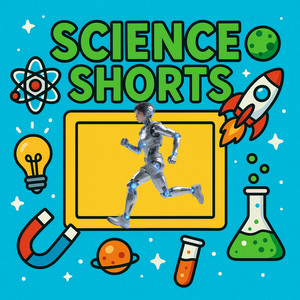
[Can Humans Become Part Robot? The Science of Modern Prosthetics]-[Can humans be part robot? Science Short]
📋 Summary
The Intersection of Biology and Robotics: Understanding Modern Prosthetics
In a recent episode of Squiz Kids Science Shorts, the show addressed a fascinating inquiry from a young listener named Amelia: "Can humans be part robot?" While this concept often evokes images from science fiction, the reality is rooted in sophisticated medical engineering that bridges the gap between human anatomy and technology.
The Purpose of Prosthetics
It is essential to clarify that prosthetic limbs are not "upgrades" intended to turn humans into sci-fi characters. Instead, they are vital "tools designed to restore movement, independence and confidence" for individuals who have experienced limb loss due to injury, cancer, or infection, or for those born with limb differences. The goal is to restore functionality that allows users to navigate the world with greater ease.
Translating Thought into Movement
To understand how a human can control a robotic limb, one must recognize that the human body "already runs on electricity." Every physical movement begins with the brain sending a "tiny electrical signal" down the nerves to the muscles. Modern robotic prosthetics are designed to detect this muscle activity. By placing sensors on the skin, the prosthetic can interpret these signals; when a user thinks about moving, the muscles activate, and the robotic limb responds accordingly.
However, there is a technical hurdle: traditional amputations often disrupt the natural "agonist and antagonist partners" of the muscular system—the "push-pull pair" like the biceps and triceps. When this partnership is severed, neural signals drop to roughly "3% of their original strength," making control difficult. To combat this, researchers have pioneered a surgical technique that "reconnects those muscle pairs," allowing them to pull against each other once more. This restoration ensures a "stronger, clearer signal" for the brain to process.
The Importance of Sensory Feedback
Movement is only one half of the challenge. Humans rely heavily on "touch" and "proprioception"—the internal sense of where one’s body is in space—to perform daily tasks without constant visual monitoring. Without sensory feedback, simple actions like picking up a cup become difficult, and users risk "crushing or dropping objects."
To bridge this gap, scientists are now "building arms that feel." By integrating "pressure sensors in the fingertips" of prosthetics, the device can stimulate nerves in the remaining limb, sending information back to the brain. This creates a biological feedback loop: "Brain sends command, muscle activates, prosthetic limb moves. Senses send feedback, brain adjusts." This makes the interaction between the user and the device feel more like a "conversation" than a mechanical command.
Humans as Biological Machines
Ultimately, the concept of being "part robot" is already a reality in modern medicine. Technologies such as "pacemakers to regulate heartbeat," "cochlear implants to restore hearing," and "insulin pumps to monitor blood sugar" are already integrated into human life. These tools do not replace humanity; they work "alongside it."
As the podcast concludes, the most mind-bending realization is that the human nervous system already functions as a "biological machine." It processes electrical signals, manages feedback, and adjusts outputs constantly. Therefore, robotic limbs do not transform humans into machines; rather, they effectively "tap into the biological machines that we already are."
Deep Learning with ListenLeap


