Ted Audio Collective You're listening to Ted Talks Daily where we bring you new ideas to spark your curiosity every day.
I'm your host, Elise Hugh.
Thomas Domke started from severely information restricted beginnings in East Berlin to become the CEO of GitHub, one of the most influential tech companies today.
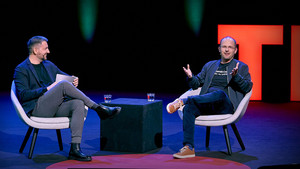
In his 2024 conversation with the co -curator of TED AI Vienna, Vlad Gosman, Domke reflects on the startup ecosystem, smart regulation for the future, and how to best prepare for the next generation of innovation.
It's coming up after the break.
How will humans and machines work together in the future?
We spent so much time discussing how the world's changing.
It would be absolutely absurd to believe the role of the CEO is not.
This is Imagine This, a podcast from BCG that helps CEOs consider possible futures for our world and their businesses.
Listen wherever you get your podcasts.
And now our TED Talk of the Day.
Obviously, people know you as the CEO of GitHub.
You're at the helm of what I would say is the most pivotal tool for developers worldwide and also a player early on in an AI game with co -pilot.
But before we go into all that, I want to go back a bit.
I'm curious. Something what people might not know is how did you get here?
I took a plane from Südger to find here.
But I think you're asking about my life's journey.
I was born in East Berlin in 1978.
And so for the first 12 years of my life, I didn't really have access to computers.
There was a robotron in East German Cologne of Z80, I think, in the geography lab that we were allowed to hack a little bit on.
And then I bought a Commodore 64 in the early 90s.
And it's been forgotten what that was like.
I had to buy a yellow book.
It was called the Big Commodore 64 book.
And then you taught yourself coding.
And there was no internet to go.
There was no forum, no Reddit, no GitHub.
You had to either figure it out yourself or you had to go to Computer Club on Wednesday and hope there's another nerd there that knows the answer to the question.
In 1998, I started a technical university in Berlin.
And one of the big benefits was that you had a landline internet connection from there that didn't cost any money compared to AOL and CompuServe.
And I bought Süzer Linux in the bookstore to get into the world of open source.
And obviously I found lots of other nerds on the internet to ask all the questions in the news groups, the Usenet.
And went through my career journey.
And when the iPhone SDK came out in 2008, I thought it's time to do something new.
I quit my job at Bosch at the height of the financial crisis in late 2008 to become an independent software developer that builds iPhone and Android apps.
And of course, through the cloud, I was able to also distribute all my apps and then later build a platform called Hockey App that was acquired by Microsoft in 2014.
And that then moved me from Stuttgart all the way to Seattle, where I got lucky in 2018 to be in the right time, right place, be part of the GitHub acquisition, and ultimately be here on stage as the GitHub CEO.
What a journey. It all has led to this moment.
But, you know, it raises an interesting point, right?
You've been successful here in Europe up to a point, and then you left.
I mean, your further steps were even more successful, I would argue.
But you left. So my next question is, you know, how do we keep the next Thomas Domke in Europe?
What does Europe need to do?
Microsoft made me leave.
You have to say it like that.
Although, being honest, it also was always a dream of me to live on the west coast.
In the 90s when I was a kid, I felt I was born too late to be part of the home computer revolution.
But then obviously now where we are today, it's clear that there was another one with mobile, another one with cloud, and now we are in one with AI.
And so I think, you know, maybe if Microsoft buys a German company today, they would just say you can work from home as hybrid work or remote only work is much more prevalent than it was ten years ago in 2014.
That said, so if I look at my hometown in Germany, I can come up with three things that are definitely lacking.
And the first one is school and schooling, which is ridiculous to me that we don't teach kids in first grade how to code.
Like, we teach kids physics, biology and chemistry that you almost never use in life anymore, but we don't teach them how to build software for their smartphones and for the computers that we all use day in, day out.
Think about that for a second.
These are the most important devices in our lives, you know, for anyone that doesn't have their phone in their hands anymore, whether it's in the subway, whether it's on a plane, whether it's at work.
So I'd say schooling needs to dramatically change.
And, you know, it's easy to blame the system and think about, ah, the politics have to change something.
I think it starts with us as parents to really encourage the schools to think ahead and think outside the box of what, you know, frontal lessons are and used to be when we went to school.
The second one is startup and the startup ecosystem.
It's so hard to found a company in Germany, in Austria, in many European countries.
The GMBH has to go away.
That's just the fact that you see a lot of German startups that the first thing they do is they go on Stripe Atlas and click on the Delaware LLC because that's much easier to collect angel investments, right?
We have so much like relations in Europe, GDPR, you know, DSA, GMA, you name it, that startups need to follow instead of building cool shit, right?
Like that's, I think, the biggest issue we have where we need to build a new ecosystem that startups, because we know from the innovator's dilemma that disruption is coming from startups.
The big incumbents cannot create disruption.
There's exceptions, of course.
And, you know, hopefully, GitHub and Microsoft are seen as one, but the regular mode is that startups are the companies, the founders are the ones that are pushing society forward.
And then lastly, you know, infrastructure, you know, my hometown on their webpage is saying 95 % of all households have broadband Internet.
But what they mean is 50 mbit.
That's not broadband.
When my kids stream Netflix or YouTube and play Minecraft with their friends and have a WhatsApp chat open, all at the same time, I can no longer join the Zoom call with you to prepare the session.
And I think this is where the European Union ultimately needs to go in and have an infrastructure package and not bridges and streets and all that.
That's good too, but broadband Internet, fiber everywhere.
Well, some might argue that regulation is good.
How do you stand on that?
Regulation is good if you're a big company with a big law department and big enterprise customers, because then you can go into a sales process and say, here, I check all the boxes so you don't have to argue with the legal team and the DPA and whatnot.
Instead, you can just, you know, go through the sales process much quicker, but it's not good for open source innovation.
It's not good for small startups that do not want to spend all their money on billable hours for a consulting company or for a law firm.
And so there needs to be exceptions in those regulations.
Innovation needs to be focused on enabling researchers, open source developers and startup founders to move really quickly.
And then if they reach a certain size when they actually become relevant to the system, same with banking, right?
When they become relevant to the system, that's when the regulation, the strongest regulation needs to apply.
And do you see, so, you know, like we live through this really fast pace, really, really fast -paced environment with AI.
Do you see it now leveling the playing field internationally?
And again, with a bit of a perspective on Europe, how does that change, you know, the game for a small company, a startup from Germany, for instance?
I think it changes the game from two sides.
And one is actually on my shirt.
It says, you know, Copilot speaks my language because you can use Copilot, chat GPT, almost all these AI chat bots in the language you grew up with.
Here in Austria and Germany, it's German, right?
Most six -year -olds, seven -year -olds, first, second graders, they speak mostly German or Croatian or Italian -Spanish while the open source and the software industry are mostly English -speaking.
And so if you want to learn coding because you have already played Super Mario or Minecraft, you don't want to learn English first.
What you want to do is build a little game because that's what humans want to do.
They want to create something.
And so they can now approach this by just asking, you know, in German, how do I create, you know, a snake game or a pong game or how do I build a Minecraft extension?
And they don't need parents at home that have a technical background, right?
Like, if you don't have anyone at home without AI that can help you when you're stuck, and that's the most important moment when you learn something, is when you're stuck, how do you unstuck yourself so you're not frustrated and just throw it away and go back scrolling through TikToks.
That's the moment where AI is really helpful, and that's where I believe there's a huge democratization going to happen.
It's already happening in countries like India or Brazil.
The second piece is, you know, that Europe has slept through the cloud transformation.
Like, most European countries are way behind on the cloud transformation.
If you look in the Draghi report that came out a couple of weeks ago, of the top 50 tech companies, only four are European.
And I'm sure most of you cannot actually name those four.
I can only name one SAP.
And in the last 50 years, there has been not a single European company that has been founded that has reached more than 100 billion in market capitalization while the six trillion dollar companies in the U .S.
all have been founded in the last 50 years, right?
That's where the opportunity with AI is we get a fresh start.
We don't need to catch up on the cloud as much as we need to be all in on AI, and it starts all with you, right?
Like, we can always blame it on the politics and on the system and on our bosses.
It starts with all of us embracing this new technology.
I'm assuming that's why you're here today, you know?
And hopefully tomorrow you're using some AI in your life or figuring out how AI works and how you can leverage AI in your career, your startup or your team.
And now back to the episode.
Yeah, thank you for that.
I want to push back though a bit because it sounds, and probably this is a criticism that Silicon Valley usually gets, right?
It sounds techno -optimistic, right?
What about a comparison that I've always heard is, you know, we're living through perhaps a new type of industrial revolution, right?
When I think back on the industrial revolution, the actual one, it had really heavy short -term consequences.
So what would you say to somebody who would call you a technologist?
What's wrong with being an optimist would be my first response, especially as a German.
I think, you know, being optimistic is separating me from the masses.
I think we, as humans, have the challenge that, you know, we love to focus on the day -by -day, and the day -by -day, whether that's in our lives or whether it's in the stock market, it often has lots of ups and downs, and we focus heavily on the downs because those are impacting us emotionally much more
than the ups. But if we actually zoom out 10 years, 20 years, 30 years, or if I go back to my grandfather's generation, you know, my father was born in 1939, what life was back then, there's no question that life has gotten massively better, like massively.
Like life in Europe, in Germany, in Austria, everywhere here and everywhere around the world has been, has been gotten so much better, our lives are so much more comfortable, our houses are so much warmer, we have food available, and obviously with technology like smartphones, the internet and FaceTime,
it's also much easier to travel all around the world to live on the other side of the planet.
You know, I moved my family almost 10 years ago to Seattle, and we call our parents every weekend on FaceTime.
That wasn't possible, you know, when people immigrated to the United States 100 years ago, right?
So it's undisputable that the world has gotten better, and I think we should have optimism that we can make it better ourselves.
But of course it starts with us, that's what I said earlier.
You know, we need to all have the mindset of I can change the world, I can make the world a better place.
My first job after university was with Mercedes -Benz, or back then Daimler Chrysler, and their slogan is the best or nothing.
I feel like Europe needs to go back to this.
Like we want to be the best in everything.
We want to be the best in soccer, right?
And we are kind of like the best in Formula One, because almost all the Formula One teams are from Europe, but like let's apply that motto to all the things that we're doing, and all the ideas that we're pursuing, all the companies that we are building, and I think we're going to create naturally a better
world in the long run.
Well, I sure hope so.
And I want to pick up on something you said earlier about us teaching our kids to code very early on.
Now, AI is changing the game there as well, right?
It influences the way we code, perhaps though making coders obsolete.
So what would you say if, like, I would argue, okay, you develop technology that makes coders obsolete.
Why should we teach our children to code?
If you look back at the journey, at my journey that I described earlier, you could have asked that question at every point of the way, every year.
You know, you could have asked me the question when we went from cassette tapes to floppy disks to hard drives, when we went from punch cards that I first saw in my mom's office in the 80s to assembly language basic, and all of a sudden higher program languages when we went from no open source at all,
and we built it all from scratch, or we typed listings from computer magazines, and most of the listings weren't actually code, they were checksums, because you could put more checksums into the box on the page to the Internet and open source components.
Today, no startup anywhere around the world, and no big company anywhere around the world, is starting a new project without leveraging open source components, right?
Open source operating systems like Linux, open source editors like VSCode, open source container technology like Docker and Kubernetes, thousands of open source libraries.
When you start a new React project, you immediately have hundreds if not thousands of libraries in your dependency graph, and that means millions of developers have contributed to your project because they built all these open source libraries, they made your life easier, but they haven't replaced the demand for software developers.
In fact, if you are in software development, or if you're in a company that has software developers, I bet you anything, all your feature requests take way too long for your personal perception, because the developers have effectively two backlogs, they have their innovation backlog, their own ideas,
their product manager's ideas, their customer feedback, all these kind of things, the innovation that drives the company forward, and that's an endless backlog.
I will never be done with a GitHub backlog, I will just retire and give up, and somebody else comes in and takes over with my team.
And then on the other side, we have the tech debt, the compliance requirements, all the European regulations and the California regulations, security, privacy, accessibility, all these other things that you also have to do, because if you don't do them, your customers don't trust you anymore, you have a security
issue and you have to go to the press and tell them that you lost all the customer data, which is often driving a company close to bankruptcy.
And so you have to balance those two backlogs, and they're both endless, and you can only do this one, and you can only do that one, so you need to use AI to bring it a little bit further down so developers can actually innovate more, and now with AI, they no longer have to only do backend and frontend,
they have to do backend and frontend AI and offline evals and online evals and prompt engineering and new models left and right, right?
So I'm sure, you know, there's a bunch of sessions for that as well.
And so I don't think they're running out of work, I think they're drowning in software, right?
Mark Andresen said software is eating the world over 10 years ago, software has eaten the world, and we as software developers are drowning in code, and we're still managing COBOL from the 50s and 60s at the same time.
So what you're saying is, with AI, even more work for developers.
And I know GitHub is sort of aiming for a world where even more developers are enabled to work and cooperate, maybe share a bit of that vision.
How would we get to a world where we have not a few hundreds of millions of developers, but over a billion developers, for instance?
And GitHub, one of our most important values, if not the most important value, is that we have the saying is we always put the developer first in every decision we make, every product design, every process.
My HR team is using GitHub, my legal team is using GitHub, which also means that lines are much easier because it's just a diff in a pull request, and that comes with the conviction that if you want to put developers first, that means you want to make developers happier.
Because happy developers are productive developers, productive developers are innovating and building great software.
And so Copilot is following that vision, because we really built Copilot back in 2020 because we wanted to make our developers a little bit more productive, a little bit more happy, and we believe that journey will continue throughout the next years.
If you think about the original Copilot, it was just predicting the next line of code, multiple line of codes, complex algorithms.
Often just boilerplate, you could explain code, you can now document that method, you can write test cases, and you can all do that in natural language, and that building block of a line of code or multiple lines of code is going to grow as the AI becomes more powerful.
We will have smaller agents that write a whole module or a class, something that tests all our software, so we don't have to write test cases.
I don't know many developers that love writing test cases.
It's more like how little test cases can I get away with?
And so I pass code review and can move on to the next cool thing.
So we really are on the journey of sparking new ideas, of enabling people to write a short prompt and getting a little mini -game, a little webpage, a little module, a piece of code that pushes them forward, that lets them stay in their creative flow.
I know many people that use Copilot both in their work life, from Monday through Friday, but also are telling me this is so great for my hobby projects that I work on on a Sunday afternoon because I only have limited amount of time and getting back on my hobby is hard.
If I constantly have to go to my browser and look things up, how things are done instead of just staying in that flow.
So we want to spark ideas.
We want to keep developers in the flow and we want to enable a billion people on this planet, 60 -year -olds, 20 -year -olds, 50 -year -olds, anyone who wants to learn coding, to learn coding.
That's kind of a great future if you ask me.
Now before we go, I know we're running out of time, but I'm curious.
I mean, a lot of people know GitHub here.
A lot of people know Copilot.
I'm curious if you can share.
What comes next? What is GitHub working on?
So we have our conference coming up and we have a lot of exciting announcements that I cannot share with you today.
But I think it goes along that journey that I mentioned that we will introduce a new product that let you spark new ideas and where you can explore those ideas and build little cool apps.
Great. So nice teaser.
Looking forward to finding out more.
Thomas, thank you a lot.
Thank you so much. Thank you.
That was Thomas Domke in conversation with Vlad Gosman at TED AI Vienna in 2024.
If you're curious about TED's curation, find out more at ted .com slash curation guidelines.
And that's it for today.
TED Talks Daily is part of the TED Audio Collective.
This episode was produced and edited by our team, Martha Estefanos, Oliver Friedman, Brian Green, Autumn Thompson and Alejandra Salazar.
It was mixed by Christopher Fasey Bogan.
Additional support from Emma Tobner and Daniela Vallerezo.
I'm Elise Hugh. I'll be back tomorrow with a fresh idea for your feed.
Thanks for listening.