Squeeze Kids acknowledges the traditional owners of the lands on which we podcast the Turrbal and Combermeri people.
Squeeze Kids!
It's your daily news fix.
Fun, free, fresh.
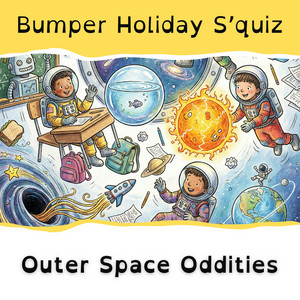
Hello, fabulous Squeeze Kids listeners and welcome to the Kids vs Adults Buffer Holidays Quiz on Outer Space Oddities.
I'm Christy Kidgerina.
Now all through the year, in the Squiz Kids daily news podcast, we've been bringing you the big news stories of the day, run through our kid-friendly filter to make sure that you know all you need to know about the world around you.
And at the end of every week we've tested how much you've retained in the Kids vs Adults weekly news quiz.
And now, because it's the holidays, We're presenting some bumper kids versus adult quizzes on some fun topics, to see who's smarter kids or adults.
Here's how this quiz works.
Ten questions for kids about outer space oddities.
Then ten questions for adults.
And whoever answers the most correct questions wins.
Easy peasy.
Are you ready?
Let's do this.
Music All right, kids, we'll start with you.
Here are your 10 questions.
Question number one.
Which planet is actually the hottest?
And I'll give you a hint.
It's named after the Roman goddess of love and is often the brightest object in the morning and the evening sky.
Did you say Venus?
You would be correct.
Question number two.
On Earth, water falls down, but in space, without gravity pulling it, water floats around.
What shape does water usually form in space?
Is it A.
That's right, the answer is C, floating balls or blobs.
Question number three.
One planet in our solar system is called the red planet because its surface is covered in rusty, iron-rich dust, similar to what happens when metal rusts on Earth.
Which planet am I talking about?
That planet is in fact Mars.
Well done if you got that one.
Question number four.
Out in space.
When you get close to a black hole, gravity is so strong that it can stretch objects out to super long and super thin shapes.
This process is named after a long and skinny food item.
What is this strange stretching effect called?
It sounds hilarious, but I wouldn't want it to happen to me.
It is called spaghettification.
Question number five.
The event that scientists think marked the beginning of our universe starts with the letters BB.
It shares its name with a famous TV show and is something that young Sheldon would go on to think a lot about.
What is this event called?
I think lots of you got this one.
It is in fact called the Big Bang.
Question number six.
If you jumped on the moon, you'd leap much higher than you would on Earth.
Why is the moon's gravity weaker than Earth's is?
Is it A, because the moon spins faster?
B, because the moon is smaller and less massive?
Or C, because the moon is further from the sun?
And the answer is B, because the moon is smaller and less massive.
It has less gravity.
Question number seven.
Here's a true or false question.
Astronauts float on the International Space Station, the ISS, because Earth's gravity doesn't reach space.
Is this true or is it false?
Great work if you knew that it is false.
Earth's gravity does in fact reach into space and to the ISS.
Astronauts float because the ISS and everything inside it are constantly falling around the Earth, not because gravity has disappeared.
Question number eight.
You guys are doing so well today.
When astronauts go on spacewalks, They can see each other, but they can't hear a thing, unless they use radios.
Why can't sound travel in space?
Is it A, because sound is too slow and astronauts are moving too fast?
Is it B, because there are no air molecules in space to carry the sound?
Or is it C, because space is too cold?
Music, You clever cookies.
If you answered B, it is in fact because there's no air molecules in space to carry those sound waves.
Question number nine.
Scientists believe that most of the matter in the universe is invisible.
It doesn't glow or reflect light, but they know it's there because of how it affects stars and galaxies.
What is this mysterious stuff called?
Is it A, black holes?
Is it B, dark energy?
Or is it C, dark matter?
That stuff that we can't see is called C, dark matter.
I wonder if you might discover what it is one day.
Question number 10.
Last one for you kids.
Another true or false one astronauts can be a little taller when they return from space than when they went up there.
Is this true or is it false?
Great work if you knew that it is in fact true.
In space, gravity isn't pushing down on astronauts' bodies the way that it does on Earth.
So without that constant downward force, their spines stretch out, creating a little extra space between the bones in their back.
Unfortunately, it doesn't last and they go back to their original height pretty quickly.
How did you go, kids?
How many did you get right out of 10?
Reckon you're going to beat the adults?
Yeah, I reckon so too.
Alrighty, adults, now it's your turn.
Fire up that old grey matter.
Here we go.
Question number one.
Most planets spin the same way as they orbit the sun, but one planet spins in the opposite direction.
Which planet spins backwards compared to most others?
Is it A, Earth?
Is it B, Jupiter?
Or is it C, Venus?
The answer is, once again, Venus.
While most planets spin anticlockwise, including Earth, Venus rotates clockwise so that the sun would rise in the west and set in the east on Venus.
Question number two.
You have a true or false one for this question.
Time passes at exactly the same speed on the International Space Station as it does on Earth.
Is this statement true or is it false?
Amazingly, it is false.
Time passes very slightly differently on the International Space Station because it's moving extremely fast around Earth and is further away from Earth's gravity.
According to Einstein's theories, speed and gravity both affect time.
The difference is really tiny, but it's real and has to be accounted for in satellite systems like GPS.
Question number three how long did it take astronauts to travel from Earth to the moon during the Apollo missions back in the 1960s and 70s?
And how does that compare to the modern Artemis missions now?
Is it A, it took a few weeks to get to the moon back then and about a day now?
Is it B, it took about three days then and will take about three days now?
Or is it C. It took several weeks back then and it'll take several weeks now.
Great work, adults.
If you said B, It took about three days back then and it takes about three days now.
Technology has advanced but the distance and physics are the same.
Question number four.
Which element dominates stars and galaxies?
It sits at the atomic number one on the periodic table, yet it rarely appears on Earth in its pure form.
Which element am I talking about?
Great work, adults, if you knew that it is hydrogen.
Question number five, another true or false one.
Okay, rockets usually carry huge amounts of fresh drinking water, because astronauts can't make water in space.
And water is one of the heaviest parts of any space launch.
Is this true or is it false?
It is in fact false.
Water is really heavy, but astronauts recycle almost all of it in space, including water from their breath, their sweat and even their pee, so that they don't need to launch massive amounts of fresh water from Earth.
Question number six.
In the 1960s, scientists detected strange background static in radio and TV signals that just wouldn't go away, no matter where they pointed their antenna.
What did scientists later realise that this noise was?
Was it A interference from nearby radio towers, B cosmic dust rubbing together in space or C leftover cosmic radiation from the Big Bang?
Incredibly, the answer is C. It's leftover radiation from the Big Bang.
So that static that you get on the radio or your untuned TV is cosmic microwave background radiation, a faint glow leftover from the early universe.
Amazing.
Question number seven.
On Earth, matter usually appears as a solid, a liquid or a gas.
But the extreme heat of the sun strips electrons from atoms, creating a different state of matter altogether.
What is this fourth state of matter called?
Nice work, adults, if you knew that it is called plasma.
Question number eight.
Several planets have moons, but one planet is the clear champion when it comes to moons.
Which planet currently has the most known moons and roughly how many does it have?
Is it A, Jupiter with more than 200, B, Saturn with more than 140 or C, Uranus with about 30?
The answer is B, Saturn that has more than 140 moons.
Question number nine.
For decades, rumours about aliens and secret spacecraft swirled around a highly restricted US military site.
The government officially denied its existence until 2013, when it was finally acknowledged in declassified documents.
What is this secret place called?
Music That top secret military testing site in Nevada in the United States is called Area 51.
Question number 10.
Final one for you today, adults.
Light travels at around 300,000 kilometres per second.
Given that the sun is roughly 150 million kilometres from Earth, about how long does it take sunlight to reach us?
Is it a. About 8 seconds b.
B, about eight minutes, or C, about 80 minutes?
The answer is B. It takes about eight minutes.
So if the sun suddenly disappeared, we wouldn't know about it on Earth for about eight minutes.
Amazing.
How did you go, adults?
How many did you get right?
Did you beat the kids today?
Who took out the crown this week?
Alrighty, we've given your brain cells a workout, so now it's time for... Shout out.
And it's a very happy birthday to these squiz kids celebrating a birthday today and over the past week.
And because it's a Friday, let's crack out that old birthday reggae tune.
Hit it.
And it's a very happy birthday to Xavier from Glebe, Abby from Maitland, Jackson from Kensington, Meryl from Canberra, Chloe and Frankie from Forest Lake, Tommy from Sydney and a huge happy eighth birthday to Harper from Adelaide.
And thank you and your brother so much for your awesome suggestions for Squiz Kids science shorts.
Well, that's all we have time for.
I hope you've been enjoying these quizzes.
If you're hanging out for something to do over the holidays, we have a whole back catalogue of them for you to listen to and the best bit, they are all free.
Check it all out at squizkidscomau or find it in the Squiz Kids feed of your favourite podcasting app.
And remember, if you subscribe, all this excellent audio content will magically appear.
And if you haven't done it yet, make sure you pop on over to the Squiz Kids website.
We'd love to know what your hopes and dreams are for yourself, your family and for the planet for 2026.
But make sure you get permission from a parent or a carer before leaving us a voice message, because we might just use your voice memo in a podcast when we return this year.
For now though, this is Christy Kidgerina signing off and reminding you all...
Get out there and have a most excellent day.
Over and out.