Well, that one is really cool.
Hi, my name is Savannah.
I'm a friend of Jesse's from work.
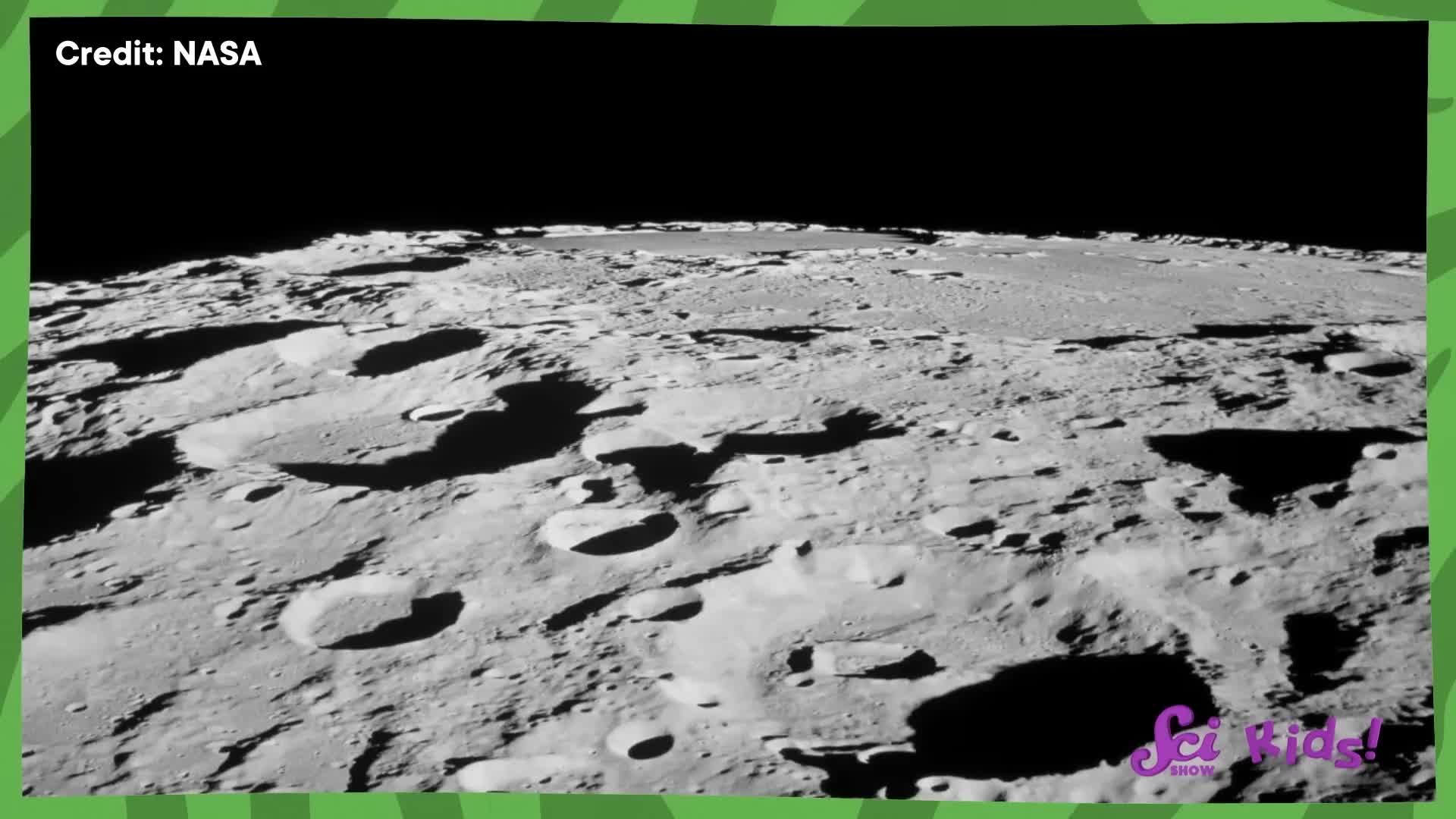
I'm visiting the fort, and Sam has been showing me some great photos of the moon.
Yeah, I wanted to get a better look at all those dark spots covering the surface.
I was doing some reading about them and it turns out those spots are actually special rocks called basalt.
A long time ago, lots of places on the moon got flooded with lava from volcanoes, and the lava somehow turned into rocks.
That is so cool.
I didn't know that spots on the moon were made from igneous rocks.
Igna what now, rocks? igneous rocks are a special type of stone.
They form when a bunch of super hot liquid rocks cool down and harden into brand new solid chunks of rock.
You said that parts of the moon's surface got flooded by lava, right?
Well, volcano lava, which is called magma when it's still underground, is really just a bunch of rocks that got so hot.
They melted into a liquid.
Like when an ice cube gets warm enough to to melt into water.
Exactly.
And when the fiery hot lava or magma cools back down, they go from being liquid rock to solid, igneous rocks.
The word igneous even comes from the Latin word ignis, which means fire.
That's how I remember that igneous rocks are made from fiery heat, then cooling back down.
So igneous rocks are just rocks that have changed from being liquid to solid?
Yep.
But if those igneous rocks melt again, they won't go back to being the same exact rock they were before they melted the first time.
Because the ingredients in the lava might be slightly off or the amount of heat or pressure in the environment around the liquid might be a little different.
You might even wind up creating another type of igneous rock completely.
I'd say that's cool, but I wouldn't want you to groan.
I kind of want to groan anyway.
You can find basalt on both the moon and the earth, and in both places it's made from lava that cools after it erupts from a volcano.
But there are lots of other igneous rocks that do that too.
Together, they're called extrusive or volcanic igneous rocks.
And there are also igneous rocks that form without getting shot out of a volcano.
Instead, they're made when magma cools and hardens underground.
Those are called intrusive or plutonic igneous rocks.
So basalt is an extrusive igneous rock because it cooled and hardened above the ground.
This is a really interesting way to sort rocks, but what if I don't know where a rock came from or how it was formed?
How can I tell if it was an igneous rock or if it's extrusive or intrusive?
That is a really good question.
We usually aren't able to watch rocks form, so we have to look at what we can see and observe certain properties about the rock to make our guess.
The properties of an object can include how it looks, feels, or even tastes.
But when we're dealing with rocks, we don't really need to think about taste.
Yeah, I don't really think I want to lick a rock.
Extrusive igneous rocks tend to form a lot more quickly than intrusive igneous rocks.
And that means the two often look very different.
Because they cooled and solidified super fast.
Extrusive igneous rocks might look grainy or glassy because the crystals are too small to see with your eyes.
Or they might have bubbles of air that got trapped inside them.
Check out this pumice stone.
Whoa.
I can see the air bubbles.
And it's really light for a rock.
That must be because of all the air caught inside those bubbles.
So pumice must be an extrusive igneous rock.
You got it.
Now let's compare that pumice to this piece of granite.
Oh, wow.
The bits and pieces in this rock are much bigger.
I can see all the little crystals that make up the rock.
Yeah.
Can you think of why they might be so big?
Hmm.
Is it because they had more time to grow?
The liquid rock took a lot of time to cool down and harden?
I think you're on the right track.
Keep going, Sam.
What else do you observe?
I don't see any air bubbles, so this rock must have been formed underground where the air couldn't get caught inside.
So granite is an intrusive igneous rock?
Yes!
Granite is super useful too.
What other properties can you notice about granite when you hold it?
Well, it's not a very big piece, but it's pretty heavy, and it feels pretty hard.
Exactly.
And because of all of that, some humans use granite to make really strong surfaces that get used a bunch like countertops.
Plus, because of the way it formed, granite doesn't react that much to heat.
So it's especially good for kitchen countertops, where you'll find people using a lot of hot pots and pans over the years.
I don't think an extrusive igneous rock like pumice would be very good for that.
It doesn't seem as strong.
True, but all of the air bubbles in pumice give it a very interesting texture.
Yeah, it's super rough.
Is texture another type of property?
It is.
Pumice might not be as strong as an extrusive, igneous rock like granite, but its rough texture makes it great to put in scrubbers that clean or polish things.
Some people even use pumice to scrub old skin cells off their body.
And because pumice is so light, it can be added to things like concrete to make it strong, but not as heavy.
Wow, it sounds like igneous rocks have lots of cool uses.
It's amazing that liquid magma and lava can become rocks that we use every day.
And the more we learn about rocks, the more interesting ways we find to sort them and use them.
Say, we might not be able to visit the igneous rocks on the moon, but there are amazing places all over the world where we can see different kinds of igneous rocks.
We could visit the Giant's Causeway in Northern Ireland which, just like those dark spots on the moon, is made up of basalt rocks.
Or we could go to Bear Lodge, also known as Devil's Tower National Monument in Wyoming.
There's a huge natural landmark over there made of a rare igneous rock called phonolite porphyry.
Sounds like we have some traveling to plan.
I'll get my notebook, and we can start writing out details for some trips we'd like to go on.
Wow, check this one out, Savannah.
Hmm, sometimes it's hard to pick my favorite.
Oh, hi everyone.
Sam and I are sorting his rock collection.
Savannah is Jesse's friend who knows a ton about rocks.
Last time they were telling me all about igneous rocks, and now I want to know how many of them I have.
Hmm, what do you think about this one?
I got it from my parents' cave.
I think that is a piece of limestone.
Wait, limestone?
If I lick it, will it taste sour?
Well, you probably don't want to lick anything that's been on the ground, Sam.
But even if it were clean, no, it wouldn't taste like lime.
It's not named after the fruit.
It just happens to have a name that sounds the same.
Well, that's confusing.
Is limestone an igneous rock?
No, limestone belongs to another large group of rocks called sedimentary rocks.
And just like the name igneous helped us understand how igneous rocks form, the name sedimentary tells us how sedimentary rocks are made.
Sediments are little pieces of material that have settled onto the bottom of a liquid, but it doesn't matter how big that liquid is.
It could be as big as an ocean or as small as this glass.
So like when I finish my drink of hot cocoa and I find a bunch of brown clumps have built up in a ring around the bottom of the cup.
Yeah, those clumps are sediment.
But when we're talking about rocks, the sediment tends to be small pieces of dirt or pebbles, or even bits of broken seashells.
I wouldn't want to drink those.
But how do they get into the water in the first place?
Well, it can happen a bunch of ways, but one of the most common is called erosion, which is also sometimes called weathering, because it can be done by wind and running water.
Basically, over really long periods of time, wind and water will flow over the surfaces of rocks and slowly break off tiny pieces and carry them away.
The original rocks.
Maybe one of those igneous rocks we learned about last time will get smaller and its surface will get smoother over time.
But all the pieces that are carried away have to go somewhere.
They might wind up at the end of a river, spilling into a calmer body of water like a lake.
So over time, you can get a bunch of different sediment layers that grow on top of one another.
And after an even longer time, these layers get pressed together into a sedimentary rock.
But remember, sediment isn't just tiny bits of rock.
So sometimes the layers inside a sedimentary rock can be made from things that were once alive, like plants or shells.
So what you're saying is that sedimentary rocks are kind of like rock recycling?
Kind of, yeah.
And depending on what materials make up the sediment and how all the pieces stick together, scientists have come up with ways to sort sedimentary rocks.
Oh, I love sorting rocks.
For example, some sedimentary rocks are made by taking smaller rocks that were created by erosion and squeezing them together really tight until they fuse together.
The individual pieces are called clasts, so the resulting rocks are called clastic sediment.
Sandstone is one of the most common versions of that, and it's exactly what it sounds like a rock made from sand.
Can you see all the layers of sand that were built up on top of one another?
Whoa, what about my piece of limestone?
Some kinds of limestone can be called chemical sedimentary rocks.
They form when water does more than just break a rock into tiny pieces.
It actually dissolves the rock into particles that are too small to see.
If water ever evaporates like a big lake that slowly dries up and completely disappears, it will leave sediment behind that can turn into sedimentary rock.
You can test this out yourself by dissolving some table salt into a glass of water, setting the glass on the table and waiting for the water to evaporate.
The salt will be left behind at the bottom.
In fact, halite is basically table salt, but in sedimentary rock form.
Whoa, that's so cool.
But some limestone can also be sorted into a different group of sedimentary rocks called biological sedimentary rocks.
Can you guess what that group is for?
Well, biology means the study of living things, so biological sedimentary rocks are rocks made of living things.
Yes, well, they're made of pieces of living things, at least.
They form when living things die, get piled up, and squeeze together.
In some limestone you can see the actual chunks of seashells that were left behind by the animals that grew them.
But there are other examples of biological sedimentary rocks, like coal, because coal forms when swamp plants turn into rock after tens of millions of years.
That's a long time.
Yeah, some changes in nature happen very quickly, while others can take a long time.
Like that pumice we looked at last time.
That was created super fast after it got shot out of a volcano up into the air.
But it takes a lot longer for individual pieces of sediment to come together and get compressed into a new rock.
Look at this coal, Sam.
Can you see the layering?
It's a little hard because the rock is so black, but...
Yeah, coal sure looks like, well, coal, but how do you know that my limestone is really limestone?
Well, I don't know for sure, but lucky for us, there's an experiment we can do to find out.
Wanna try it?
Yeah, absolutely.
Okay, if you wanna do this at home as well, get a grownup to help you out.
First, gather your materials before starting.
You'll need a clear glass cup, some vinegar, and any rocks you think might be limestone.
They should all be small enough to put inside of the cup.
First, place your rock in the bottom of the cup and then gently pour some vinegar in.
What do you see?
Whoa, it's bubbling.
That's because all types of limestone are mostly made of a material called calcium carbonate.
And when calcium carbonate interacts with the acid inside vinegar, a chemical reaction happens that breaks down a little bit of the rock and creates carbon dioxide gas.
That's the gas that's inside all those tiny bubbles.
And acid reacts with rock to make gas?
That's awesome.
Does this happen with all sedimentary rocks?
No, it only works with rocks made from the same material as limestone, calcium carbonate.
So this can be a fun way to narrow down what rock you have.
So I got this limestone from a cave.
Are there other places where we can find limestone and other sedimentary rocks?
Great question.
Sedimentary rocks exist all over the world.
For example, the pyramids of Egypt were partially constructed out of huge limestone blocks.
And Uluru in Australia is a giant piece of sandstone.
But one of my favorite examples of sedimentary rocks can be found near the town of Punakaiki on the southwestern coast of New Zealand the Pancake Rocks.
These rocks are made from alternating layers of limestone and siltstone, which is another kind of sedimentary rock that's made from clay and mud.
They formed about 30 million years ago and were slowly pushed above the water's surface by a series of earthquakes.
Then, over thousands of years, a combination of blowing wind, crashing waves and sprinkling rain eroded parts of each layer.
The siltstone was eroded more easily than the limestone, so now the towers of rock look like stacks of limestone pancakes.
Man, looking at those rocks makes me hungry.
Me too.
I think it's time for a snack.
Oh, hey, Sam.
Have you finished sorting your rock collection yet?
Eh, I'm taking a break from sorting.
But I don't want to put my rocks away yet.
They're just so pretty.
They sure are.
Hi, everyone.
I'm Jesse's friend, Savannah, and I've been working with Sam on his rock collection.
And it's so much work.
Well, if you're feeling tired, Sam, maybe we can let some of these rocks tell us a story.
A story?
Yeah, because if you know how to listen, a rock can tell you all about where it came from.
But how can a rock tell a story?
Well, take this rock, for example.
It's called nice.
Yeah, it is pretty nice.
Yeah, that too.
But the name nice is actually spelled differently from nice, the word you might use to describe someone kind.
Can you describe this bit of nice for me?
Well, it's got a bunch of wavy stripes in it.
That kind of reminds me of sedimentary rocks, which can have different colored layers.
But I haven't seen any sedimentary rocks in my collection that have wavy layers.
That's a great observation, Sam.
And these wavy lines might be telling us the story that this gneiss used to be a sedimentary rock, but over time it changed into a completely different kind of rock.
Rocks can change from one kind to another?
Yes, they can.
We've already covered this a little bit when we talked about sedimentary and igneous rocks.
What do you remember about sedimentary rocks?
Hmm.
They're made of sediment, which can be tiny pieces of rock that are broken down from bigger rocks.
They get compressed into a new rock.
Exactly.
And what about igneous rocks?
Igneous means fire.
So those rocks form when liquid rock cools down into a solid rock.
But where did that liquid rock come from?
Hmm, well, I guess it could have been hiding underground the whole time.
But if an old rock gets super duper hot, maybe it would get so hot that it would melt into liquid.
You got it.
But we haven't learned about the third main kind of rock out there.
Rocks like this piece of gneiss.
We've got igneous rocks, which can be made by melting old rocks, sedimentary rocks, which can be made by breaking down old rocks into teeny, tiny pieces, and finally metamorphic rocks.
And how do metamorphic rocks form?
Well, just like the names igneous and sedimentary, the name metamorphic gives us a bit of a hint.
It sounds like metamorphosis, which I know is what happens when caterpillars turn into butterflies or moths.
So is a metamorphic rock just a rock that used to be another rock?
Exactly, it doesn't need to be melted or broken down.
It just goes from being one type of rock to another.
And it turns out the same type of metamorphic rock might have different stories to tell.
For example, some nice rocks start off as sedimentary rocks, like shale, but others start off as an igneous rock like granite.
And then what happened?
What makes them change?
Well, the rock would have been underground.
And for some reason the ground around it either got really hot, but not hot enough to melt the rock, or there was a bunch of extra pressure.
Something started pushing on the rock really, really hard.
Or maybe it was a combination of both extra heat and extra pressure.
That sounds intense. is intense.
Some metamorphic rocks are made.
When an old rock touches hot magma that's coming up through the Earth.
You know how heat can cook your food, changing how it looks or feels?
Well, the magma's heat basically cooks a rock into looking different, too.
But that's not all.
Some metamorphic rocks are made from the movement of the Earth's tectonic plates.
Plates?
Like we have in the kitchen?
No, not quite.
Tectonic plates are kind of like giant puzzle pieces that make up the Earth's crust.
But unlike a puzzle you can put together on a table, tectonic plates are floating on layers of magma and water.
So they're constantly moving around and pushing up against one another.
Wait, I remember now.
When tectonic plates try to move past each other, they can make earthquakes.
Right.
But all that pushing also means a lot of pressure.
So if you're looking for metamorphic rocks, you might want to start with a map of the Earth's tectonic plates and then go to places where two plates are touching.
So what exactly is changing inside a rock with all that heat and pressure?
Like, how did this piece of ice get those funky stripes?
Well, rocks are generally made up of smaller building blocks called minerals.
And if you apply enough heat and pressure, you can rearrange those building blocks or even create different minerals altogether.
In either case, enough has changed that you've got yourself a completely different rock.
You're rocking my world, Savannah.
Sometimes a metamorphic rock can even show us how the heat and pressure twisted and folded those minerals.
Because nice isn't the only metamorphic rock with foliation, which is the word that geologists use instead of stripes.
And foliation happens when pressure squeezes a rock's minerals so much they flatten out into layers, whether the original rock had layers or not.
Check out this granite. which is an igneous rock.
The minerals have grown into fairly large crystals, but they aren't lined up very neatly.
But when granite undergoes a lot of heat and pressure, like where two tectonic plates touch, it turns into nice with a bunch of visible foliation.
That's neat.
But not all metamorphic rocks look like this.
For example, the sedimentary rock limestone can turn into the metamorphic rock marble.
The heat and pressure is high enough to rearrange the limestone's minerals, growing brand new crystals out of the same ingredients.
But it isn't high enough to squeeze the crystals into a bunch of different layers when the marble is done forming.
I've heard of marble.
People use it to make statues.
Yes, they do.
I wonder if anyone has ever combined limestone and marble to make a statue of a caterpillar turning into a butterfly.
That would be an extra great example of metamorphosis.
So both igneous and sedimentary rocks can turn into metamorphic rocks.
Can metamorphic rocks turn into other metamorphic rocks?
They can.
For example, with the right amount of heat and pressure, the sedimentary rock shale can become the metamorphic rock slate.
But if you take a piece of slate and expose it to even more heat and pressure, you can turn it into a piece of schist.
And then that piece of schist can be melted down to make an igneous rock or get broken down to make a sedimentary rock.
Yep.
Basically, every kind of rock can turn into any other kind of rock.
Geologists call it the rock cycle.
And they show how it works using pictures like this.
Let's see.
An igneous rock gets worn down and carried away as sediment that becomes sedimentary rock.
That sedimentary rock can go through metamorphosis to become metamorphic rock.
And when a metamorphic rock becomes so hot it melts into magma.
It'll eventually become an igneous rock all over again.
Or maybe that metamorphic rock gets worn down to make a sedimentary rock which melts to form an igneous rock.
That sounds exhausting.
It kinda does.
It's a good thing rocks can't get tired like we can.
Tell that to my pet rock, Gloria.
Dr. Turtleman gave her to me.
She's my favorite.
Wow, Gloria looks amazing.
But is she nice?
Wait, which nice are you talking about?
The rock nice or the kind nice?
How about both?
Thanks for learning about rocks with Sam and me and Gloria.
It's been so fun visiting the fort.
Do you have a favorite kind of rock?
Does anyone in your family or do any of your friends like rocks as much as Sam and I do?
Why don't you ask them?
And we'll see you next time here at the fort.
Bye.