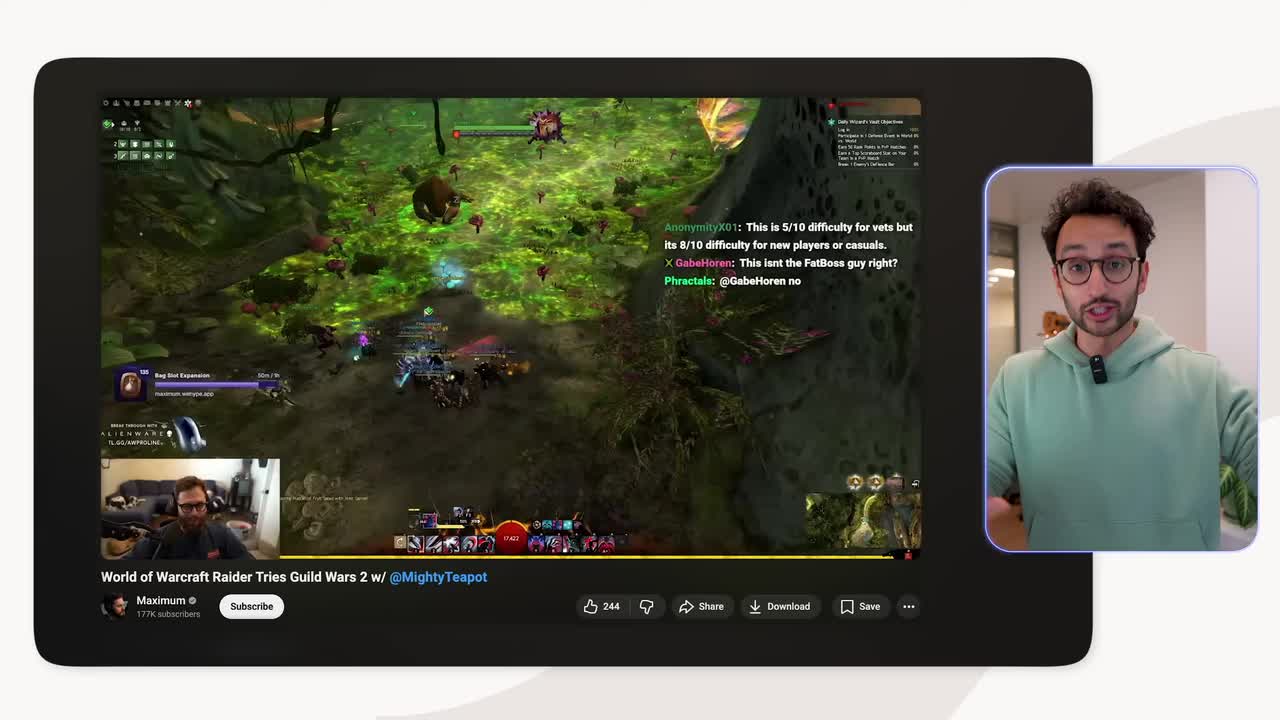
Okay, I would like to start off this video with a little story related to a video game.
Bear with me for a second for the story because I promise it relates to making money.
Now, as you may or may not know, I used to be addicted to a video game called World of Warcraft, which I've been playing on and off for the last like 15 years.
And there is a guild in World of Warcraft called Team Liquid, which is like the best World of Warcraft team in the world.
And they compete in like the competitive esports and all of those arenas.
And the guy that leads this guild, his name is Maximum.
I don't know what his real name is, but that's his like video game name.
And he also happens to make YouTube videos.
Now I watch a lot of Liquid Maximum's YouTube videos because, as someone who's interested in this video game and there's always been a part of me that's been like huh I wonder what it would be like to be a professional video game player.
And so I was watching a video from Liquid Maximum where he was talking about what the difference is between like top 0001 professional level players in this video game compared to even people who are in the top 1 or people in the top 10.
And one thing he was saying is that it is very hard for normal people, like the average video gamer, to even fathom just how much better someone who's playing in the top guild in the world, just how much better that person is like, compared to their own skill level.
And then there was one thing he said in this video that made so many things click into place for me.
And this is where it relates to the art of making money.
He said that if you think about what it takes to get into this guild, Team Liquid like the top guild in the world for this video game.
He was like basically every single person who is in the guild has spent the last 15 to 20 years of their life spending eight to 12 hours a day, every single day, purely devoted to the task of trying to get good at this one specific video game.
You know he's not saying that that's a good thing or a bad thing, or like they're morally better than you or morally worse than you, because they've just spent loads of time devoted to this one thing.
But the way he put it was like hey, these guys have spent all this time just doing this one specific thing and you have spent the last 10 years of your life just doing something else.
Instead of you spending the last 10 years of your life grinding away on World of Warcraft, you might instead have had a real job.
You might have been playing sports, you might have been watching a bunch of TV, but you were doing something other than just single-minded devotion to this one specific video game.
So what he's basically saying is that if you look at the people who are in this top guild in the world, in World of Warcraft, they have just sunk way more hours than you can even fathom into this video game.
Specifically,
Of course there are other factors, like I'm sure there's like skill and talent and all that kind of stuff.
But, like if you wanted to be one of the world's best players at this very specific video game, you would have to sink loads and loads and loads and loads and loads of time into it.
And then, with the time that you're sinking into it, you would have to then actively try and actually improve the game, rather than just playing the game for playing the game's sake.
Now, what does any of that have to do with making money?
Well, there is a pattern that I've seen amongst people that I know who make a lot of money, and people in my audience and people who come up to me and ask questions and workshops and stuff, and friends of mine even, who want to make money but are not really making as much money as they would like.
The pattern is this in general, all else being equal, the people who make more money are spending way more of their time actively trying to make money.
The people who make less money are probably spending less of their discretionary time actively trying to make money.
Now in this video I'm not gonna get into the conversation about privilege and about like unfair advantages and about like all of that kind of stuff.
All of that stuff is definitely important in terms of how rich you can get and also how easy it is for you to get rich.
But the key point I wanna make in this video is if you are trying to make more money, then you probably need to spend more time actually doing that.
So if you're still with me at this point in the video and you haven't switched off yet, then I'm assuming you have the goal of making more money and I'm assuming you're not quite making as much money as you would like.
So I would like to pose a question to you.
If you imagine how you've spent your time over the last 10 years, how much time would you say you have devoted on average every week to something related to trying to make more money?
I'm not talking about your day job.
Unless your vehicle for making money is specifically in your day job like, let's say, you happen to be a super highly paid algorithmic day trader working at jane street or something like that, and that's your vehicle for getting super rich then sure okay, that counts.
But if you're that, you're probably not watching this video but, like in general, of the 168 hours that you've had every week for the last 10 years, let's say you spent 56 of them sleeping.
Let's say you spent 12 of them like eating and going to the toilet and stuff.
You've got 100 hours left.
You've had 100 hours of time that you could play with every single week over the last 10 years.
Now, whether you've had to go to school, whether you've had a job, maybe 40 to 60 to 80 of those hours disappear.
Of course, if you've got responsibilities like kids and families and you're caring for people or any of that kind of stuff again, some of those hours disappear as well.
I'm just curious of those 100 hours in the week, how many have you actively devoted to attempting to make more money?
Whether that's improving in your job, whether that's learning new skills that lead to more income, whether that's starting or growing your own business.
How many hours have you spent doing it?
Now, as I mentioned, the main pattern that I've seen amongst the people I know, including myself, who are sort of wealthy or financially free, or whatever you want to call it, is that they've just spent more of their time actively working on the thing.
Another few examples to drive this home.
I go to the gym a few times a week and I see people who are way more jacked than I am.
In general, all that's being equal, assuming they haven't taken steroids or whatever.
It's a pretty reasonable guess that if someone is more jacked than I am, it's because they've spent more time going to the gym and probably more time caring about their nutrition than I have.
Right, that would be a pretty uncontroversial take.
I have friends who are way better at cooking than I am.
Probably fair to say that they have spent more time actively learning how to cook and improving their skills at cooking recipes and stuff.
They just probably spend way more time cooking than I do.
I'm a pretty basic amateur guitarist.
I have a bunch of friends who are amazing at the guitar or amazing at the piano.
Sure, there might be some level of like innate talent involved but, like for the most part, if someone is way better than me at the guitar or the piano, they've just spent way more time than I have working on the guitar and the piano.
And the reason I'm making this video is because it sounds obvious but I don't think it really is that obvious that if you wanna make more money you gotta spend more of your hours every week actively trying to make more money.
It just doesn't happen on its own.
It doesn't happen by default.
In a video I made about how to get rich last year, I told the story of my friend Jane, who has been wanting to become a millionaire for the last 10 years.
And her key goal in life is to become a millionaire so that she can be financially free and so that she can retire her parents and like pay off the parents mortgage and all that kind of stuff.
And outside of her day job.
When I ask her how many hours a week do you actually spend actively trying to make money?
The answer is basically zero.
She had never even thought about the question.
She just had this goal of becoming financially free and becoming a millionaire.
But for some reason for a lot of people like the goal of making money doesn't feel like a goal like, I don't know, trying to get better at running or trying to get jacked or trying to become a professional video game player where obviously you have to put a lot of time into it.
Because money is sort of like, sort of I don't know woven into the fabric of society in some weird way.
We treat monetary goals often not as in the same way that we treat other kinds of goals, which means for a lot of people it's not actually obvious that if you want to make more money you actually need to spend a bunch more time than you probably are currently actively trying to make more money.
By the way, if you are enjoying this video so far and you're interested in making more money on the internet, which we all are these days, one service that I find super helpful that I've been recommending to everyone for ages now is called Stan, who are very kindly sponsoring this video.
Now Stan is basically the dream toolkit for creators and solopreneurs.
It lets you set up a beautiful storefront where you can sell courses and digital products and coaching calls, build an email list and pretty much anything you like.
And it's all in one place for just $29 a month.
Now what Stan does is that it replaces a bunch of other different tools that you would otherwise have to string together to get something like this.
And it does it all for one super cheap subscription.
Me and my team are huge fans of Stan and we actually recommend Stan to all of our students who are taking our Lifestyle Business Academy, which is our online business school.
And what I love most about Stan is how easy it is to get started.
You don't need to know how to code.
You can be a total noob to business.
And even then, you can still launch your online store in under five minutes.
And they also don't take a cut of your sales either, which feels pretty rare these days.
So if you are thinking of turning your skills or your passions into a business and you would like to get started in the simplest way possible and Stan are offering a free 14-day trial So if you go to joinstanstorecom you can redeem that to get the trial, or you can click the link in the video description and that will get you the trial.
So thank you so much Stan, for sponsoring this video.
And let's get back to it now.
What counts as actively trying to make more money?
If you're just starting out honestly, anything can even like reading books, even watching youtube videos, even listening to podcasts, all that kind of stuff about money, about entrepreneurship but the rule i would suggest is that that only counts for the first, let's say, three to six months.
If you've been spending longer than about three to six months where the only work you are doing on trying to make more money is reading books about it or watching youtube videos about it, including this one, then i would say that those hours stop counting after around about month six, beyond the six month point where Content consumption perhaps counts.
I would say what counts beyond that point is how many hours per week are you actively building either the skills or a product or a service that helps solve problems for other people who are willing to pay to have those problems solved?
So either that's improving your own skills at your own job and trying to get better at solving problems within the context of your job so that you can negotiate for a raise Or, more likely, if you're trying to get rich quicker rather than slower, it's about building some kind of product or service in the context of your own business.
That product or service solves some kind of problem for people who are willing to pay to have the problem solved.
And so you make money as a result of that trade.
How many hours are you spending per week actively working on that?
Now I would like to show you some data here, because for the last few months, I have been running an online business school called the Lifestyle Business Academy.
And we've got a bunch of students that are currently in the program.
Everyone who's in the program is basically a beginner entrepreneur who is like a working professional.
They've got a job and everything, but they want to start their own business.
And so this like online business school, it's sort of like me and my team and our team of coaches and mentors.
We're like mentoring people on their journey to starting their first business.
If you're interested in learning more, there'll be a link down below.
But the reason I mention it is not to do that plug.
The reason I mention it is because every single week, we ask every single one of our students to fill out a spreadsheet.
This spreadsheet is their weekly scorecard.
And actually most of the students have been actually filling it in most of the weeks for the last like many months.
Now, this is one of the scorecards.
I've anonymized the data for one of our students.
Let's call her Hermione, but the numbers in here are actually real numbers.
Now there are various different metrics that we ask our students to put in their scorecards every single week, and you can feel free to copy this if you would like.
We ask them hours intended to work.
How many hours are you intending to work in your lifestyle business this week?
We ask them hours actually worked.
How many hours did you actually spend working on your lifestyle business this week?
Content posted, how many pieces of content have you posted?
How many followers have you gotten as a result of the content you've posted?
How many DMs have you started like direct messages that you've been initiated with people that you know or people commented on your stuff?
How many calls, discovery calls or sales calls have you booked?
How many calls have you actually taken?
And then how much money have you made amongst other things?
But this is sort of like a simplified version.
So, in this context, on Hermione's scorecard, I would like to draw your attention to the hours worked column.
So in week one, she works zero hours because I think she was on holiday and started a bit late.
But in week two, nine hours spent working on her business, trying to actively make money.
Now, Hermione actually has a full time job.
It is a fairly demanding full time job.
And Hermione also has two kids.
But on top of that, Hermione is actively finding the time to work on her business every single week.
So we can see nine hours this week, 11 hours, 10 hours, nine hours, 11 hours, six hours.
Then it was the Christmas holidays or something, or when she went on holiday or whatever.
Then 13 hours, 15 hours, 15 hours.
And you can see how that time spent.
You know she's posting five to seven pieces of content pretty much every week.
She's getting a few dozen followers pretty much every week.
Took her a while to start DMs, but now she started doing DMs.
And now in particular for the last three or four weeks, she's done quite a lot of DMs.
She's been booking in quite a lot of calls, increasingly more the more DMs she was sending.
And we can see she's actually closing quite a lot of revenue for her lifestyle business.
Now in Hermione's case, she has a great offer.
She has good experience.
She knows what she's doing.
She's like a very impressive student all around.
But crucially, none of this would be happening if she wasn't investing somewhere between 10 and 15 hours per week on average into actively working on the business.
Next up, I would like to show you the example of another student.
Let's call him Harry.
Harry has been in the program for the last 12 weeks.
Now, Harry hasn't actually made any sales yet.
He's not actually made any money, but I think it's only a matter of time.
Why do I think it's a matter of time?
Because Harry is very good at actually doing the work.
Look at how many hours he is investing into his business every single week.
Harry also has a full 20 hours, 18 hours 20 20 21 20, 15 hours, 10 hours, 17 hours, 12 hours, 12 hours, 1625 hours.
Harry's going with the strategy of like cold outreach for the most part a combination of cold outreach and content.
So he's sending lots and lots of DMs, 70 DMs, 50, 69, born one, 77, seven, 23, 23.
Harry's posting a bunch of content to try and get leads towards his business.
He's getting small numbers of followers, but he's very, very new to the whole thing.
This stuff takes time and gets better with time.
He's slowly booking in some calls to sort of pitch his offer to people and try and refine his offer.
Harry is entering a market where he doesn't have much experience and so it's unlike hermione where hermione was sort of making money from day one.
It's going to take harry a bit longer to make money because he has to develop the experience first and the credibility and all that kind of stuff, which is totally fine.
But the key column that i look at when i see like who's actually going to make it in terms of their lifestyle business, is kind of this one like how many hours are they actually putting in every single week?
Yes, of course it's not just about the hours, it's also about what you do with that time, so you know how good your content is, how good your offer is, how good your strategy is, all that kind of stuff.
But like the prerequisite is putting in the hours in the first place.
And so i think harry is, in a few years, going to become a very successful business person and it's going to have his six-figure lifestyle business, because i've seen the amount of dedication that harry puts in in terms of just the sheer number of hours that he's willing to work each week.
Now if you are at this point in the video and you're interested in making more money, maybe even through starting a business or maybe in just like leveling up in your existing job, have a look at some of these numbers.
Like these are people who are taking the art of making money seriously.
They are beginners, probably just like you.
They're not like established entrepreneurs.
And you can see how much time every single week is being dedicated to this specific goal of trying to make more money.
Now, again, I just want to say it is obviously not just about the number of hours we do.
Full disclosure, we do have some students, thankfully they're in the minority.
We have some students who are putting in a lot of hours but those hours are not actually translating to meaningful actions, often because they're sort of stuck in their head and they're overthinking their stuff and they're spending like eight hours on a LinkedIn post rather than 20 minutes on a LinkedIn post.
And so, like if they do 16 hours of work, it results in two pieces of content rather than like way more stuff than that.
But you know, as coaches and mentors, we are working with those students to help guide them through, so that they can use their time more efficiently to translate into actions and outputs and outcomes.
But the key thing is they're still putting in the time, right?
Like that's the primary domino.
If you're not putting in the time, then all of the other dominoes like.
It's a lot harder for them to fall over as well, especially when you're a beginner.
When you become more experienced, when you're a pro entrepreneur, you actually don't need as many hours.
If you are, for example, Jeff Bezos or Bill Gates, you can make a ton of money without putting in a lot of hours, because you've already built up so much leverage and so many skills and so much of a network and connections and pre-existing wealth over the decades.
So then your requirement to put in loads and loads and loads of time kind of goes down.
But especially when you're a beginner and you haven't yet built up the skills, the credibility, the experience, the leverage, the team, the money, the network, all of the things, especially in that case, you kind of just have to put in a lot of time and there aren't really any shortcuts other than putting in quite a lot of time and then getting better at the thing over time.
Now, the way i think about this and the way we've designed it, it's sort of like a funnel in our scorecards.
So ultimately, the thing that we want is money.
That is like the end result of this equation.
In order to make that money, we need certain outcomes, for example, a sale being closed or a proposal being accepted, or followers increasing or like email subscribers, or all of these are outcomes like results that we are trying to affect in the world, that are upstream of the money arriving in our bank account.
So then how do we get to the outcomes?
Well, to go one step upstream of that, we have outputs.
So for example, in the scorecard, we ask how many pieces of content did you publish?
That is an output.
How many followers did you gain as a result of the content you published is an output. outcome.
The output is broadly under your control, because you can control how much stuff you're making, but the outcome is a little bit less under your control.
It's still partially under your control, but it's not fully under your control.
It's an outcome that's out there in the real world.
So you've got money.
Money comes from outcomes.
Outcomes tend to come from outputs.
Now outputs tend to come from actions.
You have to take the action of creating the content in order to get the output of the content having been created and having been published.
And then the thing that is upstream from actions is the primary point of this video, which is Time the time that you are putting in every single week, the discretionary time outside of all of the things you have to do, outside of your job, outside of the fact that you're sleeping, outside of all your responsibilities.
For the most part, the more time you are able to devote to this equation, this goal of making money whether it's through your own career, whether it's through your own business or through some other shady mechanism that doesn't fit into those two categories the more time you are putting in generally, the more actions hopefully hopefully, the more actions you're able to take.
Those actions lead to outputs.
As you get better at strategizing and improving your skills at those outputs, they result in more outcomes and those outcomes, if your business model and your business strategy makes sense, leads to money.
We're going to be doing more videos on the channel in the future in the sort of freedom friday series, and we've got a bunch on the channel already about more aspects of this equation.
But the primary thing I would like to leave you with is this question
How many discretionary hours are you spending every week devoted to the goal of making more money?
Now, if you're at this point in the video and you actually don't have the goal of making money and you're just like hate watching an Alibdar video because I don't like, I don't know why, that would be weird.
You don't have to do any of this.
All of this is just if you want the goal of making more money.
If I wanted the goal of becoming a professional World of Warcraft video game player, I would have to devote a lot of time to getting better at the craft of playing World of Warcraft.
Currently in my life, I do not want that goal.
So I'm not fussed about it.
But when I was in my 20s, I had the goal of becoming financially free.
I had the goal of making more money.
And so, to that end, I was putting in somewhere between 10 and 15 hours, in addition to like my full-time day job as a medical student and a doctor from like 2013 onwards, where I was like actively trying to build a business alongside my medical school career.
And this requires sacrifices.
It does require trade-offs.
Like, you know, there are only 168 hours in the week.
As we talked about, you sleep for 56 of them.
You're eating and toileting for 12 of them.
You have 100 hours-ish.
In that time, you've got to do all the things you have to do.
So your day job, your school, whatever the thing is, and all of your other responsibilities.
And so for a lot of people, they simply don't have the extra 10 to 15 hours to actually invest into the goal of making money.
If that's you, then one question might be, where can you find the time?
Is there anything you can cut out from your life if you have the goal of making money?
Have a look at your screen time.
Is your screen time more than about 10 to 15 hours a week?
If so, maybe that's some time that's just materialized out of nowhere that you could use, if you wanted to, to the goal of making money.
I'm not saying it's morally good or morally bad to make money.
Money is a morally neutral thing, but I know a lot of people who follow my stuff, who watch the videos on this channel, do actually care about making money.
So, if that is you and there is one thing that you take away from this video I would love for you to consider tracking how many hours you are spending every single week actively trying to make money.
And that will be a very, very good starting point.
And then, once you're putting in 10 to 15 hours a week of that, Then we can talk about the other things, like what specifically you're doing, what your business strategy is, what skills you're learning, what content you're doing, what your offer is, what your packaging is all of the stuff.
But it all comes downstream of putting in more time.
Now, if you're interested in figuring out ways to actually find more of that time to devote potentially to the goal of making more money, there is a video right over here which includes my 168 hours spreadsheet, And this is a spreadsheet that's completely free.
I explain it in the video.
You can download and you can see where your time is going and you can figure out where you want to be able to carve out additional time to work on your business or to work on your money-making schemes.
So I hope you enjoyed this video.
Thank you very much for watching and I will see you hopefully in the next one.
Bye-bye.