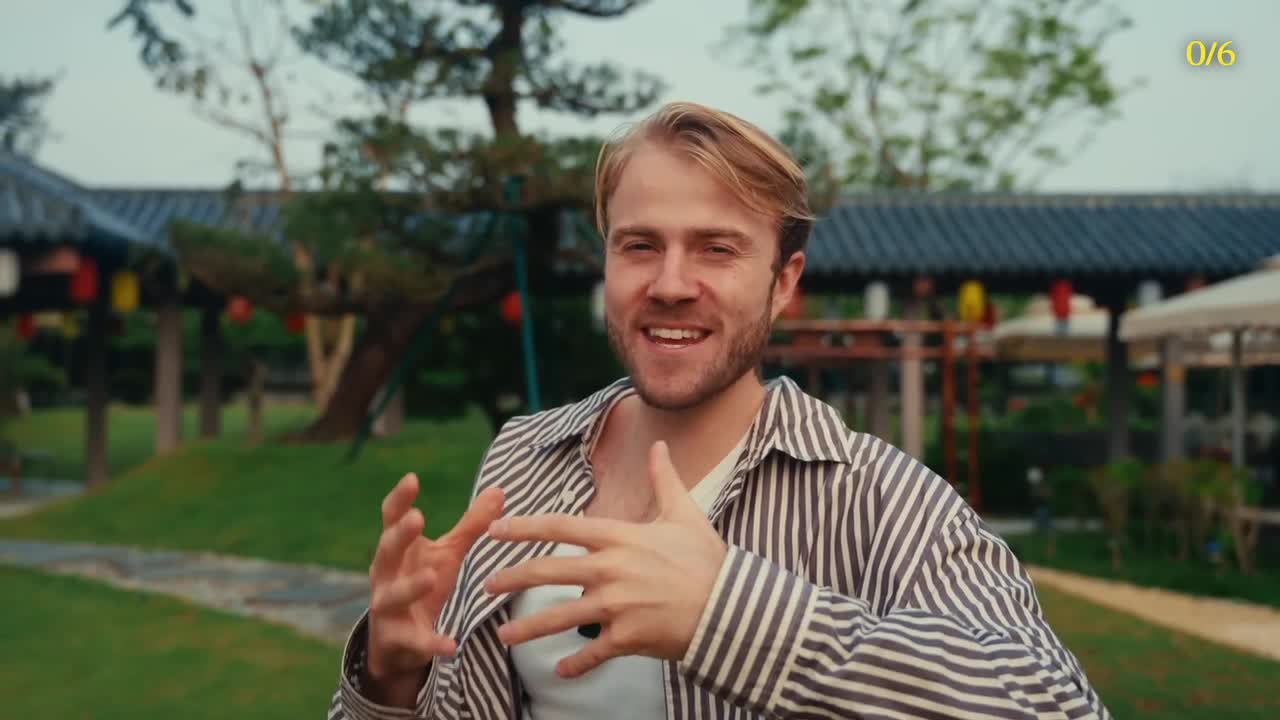
In England, we don't say hello.
We might ask if you're alright.
You alright?
We might say I'm good when life is actually bad.
Welcome to British Small Talk.
Three years ago, I was terrible at small talk.
Why is that?
Nobody teaches you this stuff.
So in this video I will teach you the secrets of British small talk so you can walk into any conversation and feel confident.
And at the end of the video I'm gonna share a special memory trick so you can remember everything you learn.
Small talk is like glue, social glue.
It's about making the other person feel comfortable, showing them that you care.
In the beginning, the goal isn't to talk too deeply.
It's about keeping it light, keeping it fun.
You could talk about the weather, the food, the coffee.
Keep it lighthearted.
In British English, when someone asks, how are you?
They probably don't want to hear about your problems.
So you can respond, I'm good.
How are you?
Another note is that I hear a lot of people say I'm fine.
But I'm fine can be perceived as a little bit negative.
So it's better to just say, I'm good.
That always works.
How are you?
I'm good.
The biggest problem with small talk is that we focus too much on ourselves.
Instead, focus on the other person, ask questions, be curious.
The person who asks the best questions is always the most interesting person in the room.
If you want to be interesting, be interested.
Act like Sherlock Holmes.
Sherlock wouldn't walk into a room and talk about himself.
He's curious.
He observes.
He looks for clues.
In small talk, you have to look for clues and ask questions.
For example, if somebody talks about their love for dancing and you love dancing too don't just say oh, me too.
Dig in.
How long have you been dancing?
What style of dance do you like?
Where do you dance?
Classes or just going out?
How often do you practice?
But what if you don't know the topic they are talking about?
Well, be Sherlock.
Ask questions, be curious.
So you can say something like, ah, interesting.
Can you tell me a little bit more about that?
Or you could say, I'm curious.
I don't know much about that, but can you tell me?
This just gets the other person talking and keeps the conversation flowing.
Recently, actually, I had a student in my group classes who was talking about Ramadan.
I didn't know much about Ramadan, so I asked him.
I said, I don't know much about it, but I am curious.
Can you tell me more about Ramadan?
And he obliged.
He was very happy to talk about Ramadan with me, and I was happy to listen.
And by the way, if you want to join the weekly group classes with me, then you can.
I have a weekly group class on sproutlanguage.com.
You can check the link in the description.
It's super fun and I would love to see you there.
Speaking of curiosity, I'm curious about what's around me right now.
This is a plant pot.
These beautiful pink flowers are called bougainvillea.
Let's keep looking.
Ooh, a petal.
This petal fell from that tree.
And behind me, there is a large pond with koi fish inside.
Small talk is like a game of ping pong.
You answer, and then you return.
Don't hold the paddle for five minutes and talk.
For example, if someone asks... How was your trip?
It was good, thank you.
I went to Hue, I fed the koi fish, and I took lots of nice photos.
How about you?
Meh, I'm just stuck in the ground.
Or... Are you enjoying your holiday so far?
Yeah, I'm having a lovely time.
Thank you very much.
It's been a blast.
How about you?
Are you going anywhere nice this year?
Actually, yes.
I want to go to the UK, but I'm still waiting on my visa.
Anyway, I need to shoot off, so I'll see you later.
Bye-bye.
While the other person is still talking, these small words will help you to let them keep talking.
I'm a tree.
Yep, I'm a tree.
Interesting.
Yep, I've got roots.
Cool.
I've also got branches and leaves.
Nice.
I can dance.
All right.
I can dance.
Did you not hear me?
Wow.
Seriously?
Nah, just kidding.
I wish someone taught me these small little words when I was living in France, because I would just look at people like this.
I wanted to give them expression.
I wanted to show them that I was listening and that I care.
So you can use these small little words to really help you have a better conversation and be a better listener.
Imagine yourself as a time traveler.
We all have a past, a present, and a future.
If you use these in your conversation, then it will always continue flowing.
What did you get up to last weekend?
Have you ever tried?
What's something you've learned recently?
Now for you behind the camera.
What's something that you have learned in this video?
Let me know in the comments.
A great tip to spark small talk is to use your environment to spark up a conversation.
For example, we're on holiday.
I might say, do you come here often?
I have literally never left.
Would you recommend anything nice to do around this area?
Sorry, I just stand here.
You can use this in any location.
If you're in a coffee shop and someone is standing in the queue behind you, You can smile, say hi and ask them do you come here often?
I'm new here.
Can you recommend anything on the menu?
What's your favorite food?
Using your environment is a fantastic way to spark small talk.
Using the future tense in small talk is an excellent way to connect with people by discussing plans, hopes or events.
For example, have you got any holidays lined up this year?
I'm thinking of going to the North Pole.
What are you doing this weekend?
I'm seeing my friends.
By the way, I just said, what are you doing this weekend?
I'm using the present continuous for a future event.
This is way more natural to use than will or are going to.
An even more natural way to say that in British English is what are you up to?
What are you up to this weekend?
Just chilling.
Nice.
See ya.
Bye, Jay.
Now.
I want to share a secret with you, something that goes way beyond English, and it's useful for communication in all aspects of life.
But before that, let's go for a walk and get the body moving.
So now I'm walking by the river and looking out at the boat.
Oh, a man just cycled past.
Now I'm walking through a pine forest.
Forests are my favorite place on earth.
Ooh, a rabbit.
A toad.
Rabbit.
I'm back at the river and now it's time for the most important part of communication.
The most important form of nonverbal communication, which affects how people see you, how confident you seem, is your body language.
Remember, open.
Open shoulders, open chest.
Imagine a string is pulling your head up to the sky so you have a nice upright posture.
You're relaxed, but you're standing tall, standing straight.
Compare that to closed shoulders, crossed arms and now, all of a sudden, I seem less approachable, I seem less confident in myself.
If I remember to take a deep breath, stand up straight and smile, then I appear way more confident and it's going to help you in every social situation.
The next non-verbal communication tip is all about eye contact.
In British culture, it's very polite to give eye contact.
A wonderful tip that somebody shared with me many years ago is to focus on the left eye.
Now you have a focal point and it helps you to maintain better eye contact.
It helps me to maintain better eye contact.
Beyond that, you've got smiling, nodding and showing the other person that you're listening when they are talking.
Matching their energy, matching their facial expression makes you a better listener and it makes you seem more polite.
The final tip of the day is to practice everything that you've learned in this video.
And you can do that with Jai, which is an AI version of me.
You can practice for five minutes per day with him in a stress-free environment.
You can relax.
There's no anxiety about talking with a real native speaker and it will prepare you for real-world conversations.
Try it now for seven days free.
Click the link in the description.
I hope you like it.
And now, to summarize, be sherlock holmes.
Be curious and ask questions.
Play verbal ping pong, answer their question and then return with your question.
Ask questions about the past, the present and the future.
Moving your body, practice good body language and finally, practice speaking with ji on sprout.
And now, as promised, here's the weird memory trick which will help you remember everything from this video.
Imagine Sherlock Holmes playing ping pong, flying through a wormhole, traveling through time.
And look at that body language.
He's dancing.
And on the other side of the net, J.I., helping him improve his English.
And that is how you small talk, my friend.