Hello, welcome to Roundtable, where we serve up piping hot debates on the issues that sizzle in China and beyond.
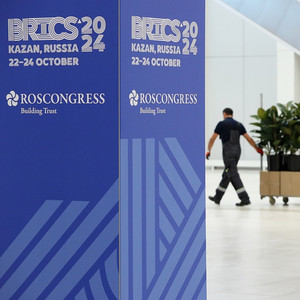
I'm Yeo Hong -lin. With the 16th BRICS summit going on in Kazan, today's episode brings the discussion close to home.
We are joined by three young talents from BRICS countries, Russia, South Africa and Brazil, who have all spent time living in China.
Together, we explore what BRICS cooperation really means for young people, how it helps foster cultural exchange, and what lessons they've learned along the way.
If you've ever wondered how collaboration between countries shapes personal growth and mutual understanding, you won't want to miss this conversation.
To get things started, allow me to introduce our three guests.
We have Alexandra Klimenova, a Russian educator, a BRICS Young Leaders Forum speaker, Viter Mora, market director at Branchham, and an international relations master candidate at Tsinghua University, Sarah Rosier -Rosman, a South African master's student in Chinese medicine and acupuncture at Zhejiang
Chinese Medical University.
Welcome! Hi, hello.
So, yes, my name is Alexandra Klimenova, and I live in St.
Petersburg, in Russia, and I'm a young university teacher and lecturer.
So I have already been in the business for three years, and I'm still trying to cope with all the burdens and the challenges that it involves.
My China story, I guess, is the poorest one in this pool, unfortunately.
So I got a first prize at the Fifth Belt and Road English -speaking competition last year in 2023, and that was my first time going to China.
This day didn't last long, but fortunately, I had enough time to explore China, Shanghai, and the city of Taisang that's very close to Shanghai.
So I did enjoy my time in China immensely.
And now, here in Russia, I'm trying to expand the agenda and involve more new students into the participation.
And that's all thanks to BRICS mechanisms that encourage young people to take a step up.
Thank you. Great to know you.
Alexandra, working in the area of education, I do have some questions about the cooperation in the area of education, and also as a young teacher, your perspective on the differences among different countries when it comes to the development of education.
But we can do that a little bit later, because now I want to give the spotlight to Vitor Mora.
Am I pronouncing your name right?
That's all right. That's all right.
So tell us a little bit more about yourself.
All right. My name is Vitor Mora from Brazil.
I have been in China almost for a decade now, and it feels really old when I say that.
But yes, it's been almost 10 years.
I came to China basically because I found a job.
I used to work in a big IT company back in Brazil.
My clients was a Chinese company, brought me here.
I didn't like the job very much, but I love Shanghai.
Later I learned how to love China as well, and I decided to stay.
And nowadays, I am one of the cofounders of Lantau Business Answers, which is a trading company based in Brazil and in China.
And later on, Lantau joins Bracian, which is the business association of Brazilian entrepreneurs in China, works as a chamber of commerce.
It's not a chamber of commerce per se, but I like so people understand it better.
And I'm on the board of directors now.
And then since last year, I have been doing my master's in international relations here at Xinhua University, where I am right now.
So I moved to Beijing.
I was in Shanghai before.
And after coming to Xinhua, basically and into the field of IR, after many years of work experience, I actually fell completely in love with the BRICS mechanism and the BRICS idea, because it's not only the mechanism, right?
It's about what it represents and where's the trends that are unfolding in this world right now.
And because of that, I thank for to Xinhua.
A lot of my professors open me a lot of opportunities.
I managed to go to the World Youth Festival in Sochi, Russia.
I attended another BRICS summit in Xiamen, in China.
And as my fellow participants here, we all went to Kazan just recently.
And after that, I did join I did try to make my own mission to do further research on BRICS and talk about it as much as I could.
So I joined Think Tanks in Brazil, Russia and China now.
So we have observation in Brazil.
I was accepted to the Valdai Club in the new generation program.
And then nowadays, I'm also the director of the sub BRICS, which is the student Association for BRICS, inside the Student Association for Belt and Road Initiative.
So trying to get the BRICS story out there.
And basically, that is what's going on right now.
And that is why we invite you to our show, because you are really the right person to talk about this content.
Thank you so much for joining us.
At the same time, we also got another very great guest for this show that is Shauna Rose Erasmus.
Am I pronouncing your name right?
Yeah, Shauna Rose Erasmus.
Yes. Thank you for having me on the show to introduce myself.
I am a South African Chinese medicine student, traditional Chinese medicine.
I completed my bachelor degree in Chinese medicine and acupuncture in South Africa at the only university that studied Chinese medicine.
And my first experience with China, the country apart from its medicine, I went on a summer camp in 2018 with my university in South Africa.
And we went to Jinhua and we visited a lot of the hospitals there just to expose the African medical students to how China conducts his medical practice.
And that inspired me to want to return to China after I graduated, which I then did in 2021.
I came to China. I started my master's degree at Zhejiang Chinese Medical University.
And in 2022, I actually made the move to China to complete my studies.
So currently, I'm completing my master's degree in acupuncture.
With BRICS, I think there's a lot of opportunities, especially for students to expand their cooperation because my university had the Confucius Institute of Chinese Medicine join in 2020.
And through them, I participated in the China Bridge language competition for tertiary education.
And I came first, which was very exciting since even though it was my first exposure to the Chinese language.
And that further increased my aspiration to come to China.
So that's what I'm doing now.
I'm currently studying and participating in talk shows and events to further improve the relationship between China and South Africa.
And I'm hoping to really bring forth Chinese medicine in South Africa, increased education and the medical practice.
That is actually something very interesting.
And I'm pretty sure you know about traditional Chinese medicine way more than I do, which is a fun thing that we can discuss a bit more because I know that in South Africa, actually traditional medicine or at least traditional Chinese medicine is very well received in your country.
And we have seen there are many different kinds of events promoting acupuncture, promoting, you know, it's not massage, massage, but it's kind of like Chinese massage in a health care or as a way to cure certain disease or at least to release certain symptoms.
But before jumping into that, just yet, I noticed that all of you have attended the 2024 Bricks Young Leaders Forum.
So how would you describe that experience?
What did you learn from the cultural exchange and all of the different types of discussions and do you think these kinds of activities can benefit young people to better pursue their career goals and to better realize their dream?
Alexandra? So I guess for me, it's more about being a host, because the meeting the Young Leaders Forum took place in Kazan, that's in Russia.
So more or less local, it only took me two hours of flight to get to the destination.
But from my educational perspective, Bricks is all about networking.
And this opportunity to be a speaker and a roundtable host there was a great opportunity again to expand my social connections to network a little bit.
And thanks to Kazan event, I'm here, present recording my experience for you to share and broadcast later.
So and I also managed to meet new people from Kazan University here in Russia.
I'm later on to participate in a forum on linguistic problems of today.
So it worked not only internationally, but also within Russia.
But yeah, I enjoy greatly meeting people all around the world, from Brazil, from South Africa.
And here I see all the faces that I have grown used to in Kazan once again.
And it's a really pleasant surprise to be around you once again.
And also being in Kazan and participating in event hosted by China was also amazing thing, because I'm in charge of teaching students who are about to become teachers of Chinese.
And now I'm more into the wavelength, because we can share the same experience.
And I feel I can be the conductor for them in the for the professional and career growth.
And again, that's all thanks to Bricks that encouraged me to share my experience, my perspective, not be shy enough to show away from challenges.
And because of all the support that again, from government in both Russia and China, I was able to actually meet my own personal goals and to meet my dream of becoming a high flyer.
Wow. So as an educator, you must have attended a lot of different types of forums, of summit of, you know, these kind of exchange programs for this specific one, the one that all of you have actually attended.
Is there any story or opinion that left you a very strong impression?
Or did you learn something specific?
You didn't anticipate learning, or you find very valuable after attending this forum?
Yeah, first thought that I got, you know, after finishing my participation there.
And this thought stays with me for all the time that have come, that have gone after that, is that we need to raise awareness about all the events that take place in different parts of the world.
Sometimes there are outstanding people who can share, who can contribute.
But because of lack of awareness, lack of social media acquisition, sort of, they are left behind.
And for me, as an educator, you know, the first person who young people see when they eventually decide on their career, it's very important to be the transition point from message, give it to the message recipient.
So yeah, and because of networking, making new ties, making new connections, I felt the great importance of it, and, you know, of making other people aware of existing opportunities for entrepreneurship for cooperation.
Thank you. I think that is a very important point.
The reason we're having all of these different mechanisms, we're having BRICS, Belt and Road Initiative, and APEC, G20, all of these mechanisms out there, and a lot of different cooperation, a lot of collaboration, a lot of events and forum.
It's not because human enjoys meeting, it's more like during these kind of occasions we get to talk to each other, we get to listen to each other's brilliant ideas, and have those ideas collide so that new ideas can emerge.
So thank you, I do agree with you, awareness is quite important.
And we see all of our countries, China, Russia, Brazil, South Africa, participating in all these different activities and different events.
So since we're talking about what we have got from the forum, I was wondering what was your favorite topic or theme when you attending the forum.
I think first I would like to reinforce what Alexander said about awareness.
I think there's a new trend in the world with these new multilateral mechanisms that are going on right now.
And just there are a lot of them, most of them are regional or at least attached to a specific region of the world.
And BRICS is showing to be the only one that is global in scope.
Right. And it's important that awareness gets out there to see what's really going on under this umbrella.
But going back to what I saw, I think first of all, I'll make three points here really quick.
First one, I was surprised by the numbers of Russian students speaking Chinese and Chinese students speaking Russian.
And I was really surprised that this language exchange thing between them specifically about Russia and China, which were the biggest delegations, of course, I was just surprised to see that.
And like in an international event, I perceived English to be sort of the third language being spoken everywhere.
So it's like this was interesting to see.
And this says a lot about the bilateral interactions between Russia and China, because BRICS is not only and now coming to my second point.
BRICS is not only those five, now 10 countries talking to each other.
BRICS is actually an organic matrix of multi -layered interactions that will happen in the general scope with all the leaders now in the summit in Kazan that also happened the bilateral interactions between two BRICS countries under the BRICS umbrella.
And then regional settings that will also come out of this, like actually BRICS is not a forum.
BRICS is just a mechanism, literally a mechanism that encompasses pretty much all these lab everything, you know.
So I think it's important to put these people in the same room, as you mentioned, because these ideas will come up.
I think we're now going to a new dynamic in the planet that we realize how different we are between us.
And BRICS is again, a good example, because I've never seen such a diverse group of countries in one group.
I mean, the biggest is the UN, of course, being with pretty much every country, but it's like, the BRICS is like just right there.
And how harmonious most of the conversations can be even in spite of these differences.
So I would say that when you come to BRICS, nowadays, before we had an order that would try to sort of standardize a lot of things.
So the same rules and everybody trying to behave in the same way.
And that is not going to work because we're just as diverse as we are.
But when we get together, we just realize that in the end, we're all people the same, right?
We're all people and people are people.
All right. And I think it's really enriching to see this debate going on and how we can work really well together in spite of all of that.
And the more we talk, the better we understand each other.
So I guess I'll just make the point that what got meditation the most is how these interactions are one more involved than most people think.
Then coming back to the awareness issue, because most people need to know more people need to know what's going on.
And number two, that we can get a group of widely different people in the same room and come out with solid results.
It is possible and is already happening.
So this will be my final message.
So among all those concrete results, we have already achieved you all of you amazing young leaders have already achieved which one is your favorite one, which one do you think is most valuable to you personally in what area or what is the theme of the topic that you find worth mentioning?
I think for me, what stood out was breaking the stereotype.
Me coming from a more westernized country, we didn't really have the exposure to China or even Russia.
And when I was younger, I was prepared to go to China and open to receiving the culture exchange.
And then when I got the opportunity to go to Russia, maybe some of my family members were a bit worried because we weren't sure what Russia was like, if it was safe, it was friendly, was it going to be okay?
And I was excited to, I think, personally see it for myself.
And when I arrived, I was actually really surprised just how friendly and open minded Russian people are.
And the friendship that I built, I mean, me and Alexandra, we still chat over WeChat, we share personal stories with each other, which I think has been quite incredible that our cooperation and collaboration doesn't just fall under a formal setting, but it extends to our personal life where we can actually
really build a friendship.
And I think BRICS isn't just about cooperation and collaboration, but it's about friendships between these countries and uplifting the people of individual countries together.
Because we do share similar aspirations or similar problems, despite our differences.
So that I think for me was incredible.
That's beautiful. Actually, when I was doing another interview with some other of my amazing guests, they said that when it comes to diplomatic relationship or the relationship between two countries, at the core of it is the people to people exchange is the individual friendship that you have with another
person. Like Vitor said, it's people, people are people at the end of the day.
And when you make friends with people, you do not really have to care that much about where they're from all the time.
And that's the essence of these exchange events.
So Vitor, while you were in the Young Leaders Summit, were there any specific results or opinions or findings you've got in a specific area that you were interested in that you'd like to share?
For me personally, this forum in Kazan specifically, I think it was interesting for me to get in touch with a lot of the youth in Russia that is talking about BRICS, that like a lot of youth associations that I had the privilege to talk to after the event.
They were already conducting extensive and a lot of BRICS related research.
I am more familiar with the BRICS scenery in China being here for so long, and in Brazil as well.
But I, as Shana mentioned, I also been to Russia, I've been to Russia three times this year, all in BRICS related events, most of them.
Then this time in Kazan I found these associations that already work, I think it's interesting to see this dynamic.
I think in a way Russia in this sense, Russia is putting a lot of attention into BRICS.
Of course, this year is the Russians' chairmanship of BRICS.
So of course there are more efforts dedicated as it rotates between all the countries.
But it was really interesting to see the Russian youth and how they're seeing this, how they're interacting with this mechanism in such a positive and, as Shana mentioned, open -minded way to receive.
I felt like I didn't have, I mean, again, this was my third time in Russia, but every time I go there, I get a really nice, really nice experience.
And I just was interested to see how the youth is interacting with this mechanism.
I don't think comparisons are to be made because all these countries are different, but I can definitely say that the Russian youth is interacting with it at a very high level.
We get to see that actually this year marks the 50th anniversary of the establishment of diplomatic relations between China and Brazil.
We see also China and Brazil, this bilateral relationship, can go further.
And since you actually have a background in the e -commerce or cross -border commerce area, because now we see that in 2023, Chinese mainland was its position as Brazil's largest trading partner for the 15th consecutive year with Brazilian exports to China exceeding 100 billion for the first time.
And in January 2024, bilateral trade between China and Brazil reached 12 .8 billion US dollars.
This is a substantial year on year increase.
So when it comes to China -Brazil e -commerce or China -Brazil commerce or trading partner, do you think anything can be done or what is your insight in this area?
A lot of things can be done.
I would say a lot of things are already being done.
China -Brazil trade relations are, as you mentioned, very important trade partners of each other for more than a decade already, which is surprising for Brazil being a Latin American country so close to the US.
For example, when China overtook the US as the first trading partner a long time ago, it has maintained that position and everything indicates that it won't change.
China is the biggest buyer of Brazil's strongest industry, which is the agricultural sector.
And again, that is also not going to change due to geopolitical reasons.
Brazil became a very reliable food supplier for China.
So I think what is interesting on the China -Brazil relations is that although they provide different products to each other, they are already intricate to a level that they cannot decouple.
You know what I mean?
It's like China relies on Brazil for food access.
Brazil is a reliable supplier.
Brazil also relies on China to get a lot of products that the entire world is also acquiring from China.
So what can be done is on the trade side, I would say this sort of they are talking about like free trade agreements and all that part.
This is way more delicate issues that can then should be worked, but I think investment projects should be the main area to focus on.
We have the NDB the BRICS bank, the New Development Bank in Shanghai.
They can work closely now, which is the presidency is in Brazil's turn now until next year, if I'm not mistaken, that being 2025.
And I think more investments need to be made.
And also nowadays, for example, in Bracian, which again, the business association, we're trying to raise awareness between Brazil businessmen and businesswomen of the Chinese market and how to better interact with China, which is again is an uphill battle, but it has to be faced.
Hmm, definitely. Also, we see that actually Brazil has designated 2024 as the year of China.
So a lot of cultural exchange programs are happening.
We see in Beijing International Film Festival, Brazil is actually the guest of honor.
So all these exchange, these cultural events, these kind of activities allowing people from both countries to get to know more about each other to find something that they're interested in.
Like all of you, you have your China story because there was this one thing that got you find an interest in China and you started to come over, see the country, bring some of your cultural aspects to China, and also brings back some China's approach, China solution, and also even some Chinese ideas
back to your country.
And that is something that we all want to happen for our people.
And that leads to my next question to Alexandra.
That is, you work as an educator and you have experienced a little bit of the Chinese education world.
What do you think are the biggest differences and the biggest similarities when it comes to education system between China and Russia and even comparing to some other BRICS countries?
From what I have experienced, I can for sure say that the greatest difference lies in cognitive styles of students.
With Russia, it's more about being on the same level with the professor and when you can have a person -to -person chat, when you can cast aside hierarchical differences, then for sure the education process runs smoother.
But in China, at least from my experience with Chinese students, sometimes it's better to keep a distance, you know, to hold the stage of a knowledge source.
And sometimes that might be a challenge because when you teach foreign languages, you need to make students participate in the discussion.
This participation requires the certain level of intimacy.
And I could always trace the experience of international communication the students got from their previous experience, because those who were exposed to that were eager to break all the boundaries, to break the ice and to tune into new activities and become the engaged participants of them.
But similarities, I guess, lie in the same industrious attitude to studying, to get new knowledge, to contributing all your powers to the education and to follow your vocation, to follow your calling.
And this readiness to completely lose themselves in the studies is what unites Russian and Chinese students.
And, you know, sometimes, you know, students feel overwhelmed, they feel too tired and span to keep up with the same level of engagement.
Yes, I think you're definitely right.
And people were students from different countries have different habits and for an educator, it's actually somehow inspiring for you to understand the atmosphere or the kind of method being mostly practiced in other countries to inspire you to have new ideas about educating your own students.
And that is something quite interesting.
And same goes to the healthcare sector.
For Shana, I was actually very curious to know how come you decided to study traditional Chinese medicine and to be more specific acupuncture.
That is something I didn't even have a lot of experience at.
And are people in your country very accepted or, let's say, do they welcome traditional Chinese medicine very much?
Is that why you decided to find an interest and study and start your career in this area?
Oh, well, I didn't know anything about Chinese medicine when I was younger.
But my family has always been into alternative health care, like natural empathy or homeopathy.
So I was exposed to the idea of something other than the conventional Western medicine.
And then when I was in high school, and I was going around different universities looking to what I wanted to study, my first thing that I wanted to study was veterinarian science, because I love animals, and I wanted to study related to animal health care.
And then when I went to the university that I ended up studying as I saw a stall for Chinese medicine, and I was like, Oh, that's interesting.
Like what's Chinese medicine?
And I went to speak to one of the _____ and I was like, Oh, and then I thought about acupuncture.
And I remember hearing that, Oh, acupuncture has become increasingly popular for horses.
And I am a fanatic for horses.
So I was like, Oh, that could be a different route doing acupuncture for the horses.
And then I went to go further research what is Chinese medicine.
And I found out that it's actually the second largest medical practice in the world, other than Western medicine.
So I was like, Oh, that's even more interesting.
And then when I went to I applied for it, and I got in, and then my love for Chinese medicine, I think was instant and I stuck with studying for human health care.
And I love humans and I care about their well being.
So I became more invested in treating people using Chinese medicine.
And so yeah, it's my introduction to Chinese medicine now I chose it.
So I was wondering, is Chinese medicine well received in your country?
Do South African people enjoy traditional Chinese medicine?
I think I can speak not only for South Africa, but for the West, Chinese medicine is growing more popular as people are seeking alternative health care, especially for areas such as pain, because in Western medicine, maybe you're just prescribed a long dose of pain medication, but that has severe side
effects with acupuncture, even on a scientific basis is becoming more effective or people are realizing the effectiveness of acupuncture for certain diseases.
And I think with people becoming more health conscious, and wanting to live a more holistic lifestyle, Chinese medicine really plays into that desire of not just taking medication, but eating right, and doing other sorts of holistic habits like Tai Chi to improve their longevity of life.
So yes, I would say it's becoming more and more popular.
And as we start to scientifically prove our theorems, it's becoming more accepted even in Western medicine, they're starting to accept Chinese medicine as a legitimate form of health care.
Yes, I get to see that not only are patients welcoming different methods when it comes to health care, I mean, in China, we'll have to say, no matter if you're a white cat, or a black cat, as long as you can catch a mice, you're a good cat.
So same goes to a lot of things in the world, as long as it cures disease, that helps patients feel better.
It's a good method.
And as you said, actually, traditional Chinese medicine has been helping people has been helping patients in all different ways.
And it's getting more and more well received.
I guess that is the reason behind a lot of events happening in China and outside of China, in the sense that they are organizing different symposium, different forums, allowing students, medical students share their experience and learn about this traditional Chinese medicine theories and practices.
Actually, in May 2024, we see the fourth China South Africa International Symposium on traditional Chinese medicine and acupuncture was successfully held and over 200 experts and physicians from China, South Africa, United States, Canada, blah, blah, all the other regions and countries participated
in the hybrid format symposium.
So have you ever participated in any of these forums?
Yeah, what is your favorite one?
So in 2021, the Chinese Confucius Institute hosted a conference of between traditional Chinese medicine and traditional African medicine, because in South Africa, we do have our own traditional medicine, but it's not well structured as to how China has conducted their medical, their traditional medical
practice. And so we hosted this forum inviting a lot of traditional healers from South Africa to come and interact with China on how to improve their medical system and how to enter into the public health sector, because that's the aim of the game, right is to be accepted by the public as legitimate
form of healthcare.
And China has done a wonderful job in institutionalizing Chinese medicine at a university level where you're not just following some mentor, but you actually go into classes and you have an exams and you're having a structured form around being a legitimate doctor.
And that's something that traditional African healers are wanting.
So we hosted a conference to allow them or to expose them to the ideas that they could use to improve their medical practice.
That is very interesting.
And I can see that as someone working in the healthcare sector in the future, you have a lot of different opportunities doing things like this, not only curing patients, but also spreading the knowledge of different types of medicine.
And that is quite impressionable.
And that is the area of commerce of helping, for example, if because you have been in China for quite a long time for over a decade, and I'm pretty sure you have helped a lot of Brazilian entrepreneur or people wanted to start a business here in China to find the best opportunities.
So is there some fun stories you'd like to share in that area?
Well, I think we helped more.
We did help a few companies to set up operations in China.
That is always interesting to see how they react to the realities of the market and how the ways businesses are conducted in China, which there's a lot of cultural influences that they are not used to.
But there's a lot of similarities also between Chinese and Brazilians in that respect.
So for example, we all treat personal relations very high position.
So it's not when I conduct business with somebody, it's not only about being like 100 % rational about who can give me the best offer is also about like, who am I talking to the actual person.
And in this case, Brazil and China are quite similar.
So like, it's very important that we actually like the other side as an individual before we conduct business, although you might be the best offer.
But if I don't like if I don't, if we go off for dinner, we don't have a good time in Brazil.
And I feel that it's very similar in China, I might not be as willing to do business with you as I was, as if I were if we get along on the personal level.
But we do help a lot of Brazilian companies to understand the actual huge immense variety of products that can be found in China and how the Chinese industrial complex how big and solid it actually is.
So of course, products made in China in the sense of like being actually manufactured in China, everybody, we all know that election, when you get into the market, and you start talking to these factors, and you see the scope of things they can provide in the flexibility in production and delivery times
and the willingness to actually make it flexible adjustments and be more just being overall more into what the customer needs, like people get really surprised.
So I think it's really interesting to show them this variety Brazilian, the Brazil, Brazil's industrial complexes developed actually, timewise developed earlier than China.
So like by the time right in the 70s, because it was already a high industrialized country, but it sort of didn't like Scott stuck in time.
In the 70s and 80s.
So nowadays, like we have a strong industry, but it's pretty much doing the same thing.
This is a very generic analysis, but it's pretty much doing the same thing since then.
And to open these people's eyes to the opportunities they can find here is always an interesting experience to see the reactions, the comments anyway, it's really nice to guide them through this process.
That is very interesting.
Because you've been in two countries long enough, you are able to notice these differences and similarities and be the bridge linking Chinese people and Brazilian people and linking Chinese market with the Brazilian companies and entrepreneurs.
It's quite interesting.
On top of that, I was wondering, because for the last couple of years, even the last decade, we see rapid development around the world.
And as a Chinese person here in China, if I recall my lives around 10 years ago, I didn't use my phone to pay for stuff quite so much.
I did an order online so much, and I didn't used to think artificial intelligence could be developed to this stage.
So there has been a lot of changes and a lot of developments.
So like I myself, I noticed a lot of development and differences and I find all these differences very interesting.
Let's be a little bit more specific.
For you, do you see the Chinese business model?
What do you think is the best part or the best element or the best and maybe somehow even the worst element or factor of the Chinese business model, the business environment that maybe you want to tell your fellow Brazilian entrepreneurs, let them know, introduce to them?
I would say business models, they receive a lot of influence with a variety of factors.
So it's one thing that can be said about the Chinese business model is that it retains high degrees of flexibility because the things in China, as you just mentioned your own personal experience, I think China changed so fast that I feel that the Chinese entrepreneur, he learned how to change also his own
business really fast.
They might have a factory and then might also own a small hotel or something.
So they have a variety of business under their umbrella.
So they go after these opportunities really fast.
So they learned the Chinese entrepreneur in general, they learned to adapt and how to follow up with this because one day you're doing nay, the next day you might be doing B and you have to follow through.
And because of course the high degrees of competitivity that happens in China because of the population and everything, they learn how to make the switch really fast.
So I think this is something that could be studied from abroad, like this flexibility, I think is something that is really interesting.
I'm not saying this is not flexible.
I mean, like now I'm just analyzing China isolatedly in an isolated manner.
And I think it's really caught my attention a long time ago.
Oh, very interesting observation.
I was kind of wondering whether or not you'd mentioned technology playing a very important factor, because during another interview that I had with a Brazilian young scholar, he was talking about bringing the e -commerce platforms model or the solution to Brazil, not in the sense of doing cross border
e -commerce between China and Brazil, but to utilize that model and Brazilian people using that model for doing business with other countries.
But I think, yeah, like you said, it's a big country with a lot of different aspects, a lot of different features.
And I think flexibility is definitely something very important as well.
And at the same time, I'd like to direct this question to Alexandra, because unlike the other two brilliant guests, you haven't had the experience of living in China for a long time.
For you, it's like coming over, exploring the country a little bit.
So were you surprised?
Or what was the one thing that got you really surprised that was beyond your imagination before coming to China?
What was the wow factor for you for your first China trip?
Well, probably it's going to be the simplest thing that I'm about to mention.
But the first surprise for me is the application WeChat.
Whereas I was just amazed at how you managed to stuff everything into one app.
So you pay with it, you communicate through that, you expand your messages, you have your media represented in WeChat, and it's just all one app.
Because here in Russia, we have a pile of credit debit cards, cards to clock in, clock out at the university.
And there is this huge card holder that you stuff in your bag.
And you just pray every day that you don't lose it, because otherwise, you're going to be completely tied without any access to any funds, to your work, to your home even.
So and here's WeChat, where you have everything online at hand.
Yes, that was the most amazing part for me.
And especially when you even could pay at the metro station with a WeChat application, you just scan your QR code, and you're done for the day.
And here in Russia, you need to buy coins or you know, put some money on your deposit, and then pay with your card.
So it's too many steps for you to take before you get the actual service done.
And what amazes me as well is the readiness of Chinese people to incorporate new methods, new technologies into their lifestyle.
So they do not get stuck in a rut.
And they're open to new suggestions, new mechanisms.
And they are so eager to learn from you that you just cannot help but to yield to their charm.
And the greatest influence of that trend I see now in Russia is the collaboration between our theaters.
So here in St. Petersburg, we have Mariinsky Theater.
So probably some people know it by the Soviet name Kirov Theater.
And we hold the hallmark of being the best ballet in the world.
So Chinese people, they invite our company, our Mariinsky company, to perform in Shanghai to share their techniques, their dances with them.
And also, they're being invited here to show their ballet performances and their practices.
And you know, this readiness to share and to incorporate is also the one thing that amazes me a great deal.
I love that answer.
And I would definitely want to see different performances from different countries, especially the one that you have just mentioned.
At the same time, I was wondering for actually for all of you, but I am going to direct the question to Shana, because South Africa is relatively far away from China, relatively far away.
We're in different continent, which means that not a lot of people would have the opportunity to actually come to China and visit.
So I was wondering for your friends, for the people you know, for your fellow South Africans, for those who haven't been to China, what is their overall impression on China?
And is there any method or any examples or people in your country that can be the channel, be the bridge, giving them the idea about the real Chinese society?
Well, maybe in the past, the interaction between South Africa and China was very limited.
But I think thanks to organizations like BRICS or the Bolton Road or the Confucius Institutes, we are having more events between the two countries, either in South Africa or even in China to facilitate interaction, especially at the university level.
Nearly there's quite a few universities that have a Chinese Confucius Institute, and that allows the local students to enter.
They have Chinese Mandarin classes available for them.
And I think more and more South Africans will travel to China to teach English, because apparently China really likes our English teachers.
And there's quite a lot of work opportunities for South Africans in China.
So more and more young people go over to China to teach or even study, although Chinese medicine is a bit limited because we were small departments.
But I think more people are becoming aware of China and the opportunities that it can provide for us.
Yes, you're definitely right.
Actually, in February 2023, the third meeting of a bilateral mechanism took place in South Africa, and over 10 Chinese universities have established cooperative relations with South African universities.
South Africa also hosts seven Confucius Institutes and three independent Confucius classrooms.
In 2015, South Africa became the first African nation to incorporate Chinese language education into its national education system, which makes me very happy because I also have another show Take Away Chinese, sharing the Chinese language, hoping that more people with an interest to learn Chinese learning,
would do that through podcasts.
So yes, with language being the bridge, and sometimes the barrier, we are trying to make it more of a bridge than a wall.
And that is also all to the goal of foster communication and better understanding about each other, which is something that we all want.
And at least to my next question, actually, I want to direct this question to all of you, that is, you have experienced and also benefited from many of these different types of mechanisms, meetings, events, forums, summits, the list goes on.
So what role do you think young talents like yourself can play in building stronger connections between BRICS countries and under the BRICS mechanism?
I would say that it's not what role, I think the youth plays the role of establishing this disconnection in the sense that the youth needs to get to see each other more frequently.
And then again, we come back to what we mentioned in the beginning about awareness about interaction about more platforms, more stages for the youth to get on.
So we need to see, as Shana mentioned, we need to see more interactions to see Chinese medicine going abroad and also other sorts of other BRICS countries cultures coming to China and vice versa.
All these interactions needs to happen.
And the best channel is always the youth because the youth is number one on top of all these new technology, which are the best ways of dissemination of this information, right?
So new social media, the mean, like all the platforms, TikTok and all the new, the future ones that might even appear.
And the youth are the ones that can bring this to the other side and show this and share this, right, in a more, let's say, ample, like more broad way.
And the other thing is important is if the BRICS youth, even though reserving their differences, because of all the social media interactions, we are seeing the youth are even though from different countries and different religions, they eat different things, speak different languages, but we're seeing
this sort of like what we call the Gen Z sort of behavior that is getting in a way similar, the difference might be getting smaller because of all the social media, because we're all watching the same content, right?
So I think the youth has to, has the job, and in my opinion, even the mission to bring this and further bridge this difference, not in the sense of reducing the difference, but in the sense that make us, it's normal.
This is the dream here, in my opinion, that is normal for us to circulate between our countries.
You know, I would agree definitely with Witte that eradicating this surprise reaction would be just the paradise for us to achieve one day.
And because I'm sort of in charge of raising the new generation, the new young leaders, I think it's for us, for Gen Zs, all those who are in charge of them, not just only foster implementation of your initiatives, but to encourage them to generate the new ones, because, you know, despite all the rising
concerns about Gen Zs fitting in the existing system, still, you know, they are the future.
And they are the ones who are going to define the course of events further.
I 100 % agree with what Victor and Alexandra said, because for now, we are, you know, the young leaders, the youth, but soon we're going to be the main leaders, we're going to be the future, we're going to be the important doctors, the important teachers, the main business owners, and we will be leading
the future. And so I think it's vital that us as youth, we get together and we collaborate in my field medicine, but maybe in Victor's fields, business burdens and in Alexandra, the education field, there's a lot of obstacles that face in those areas.
And with having different people from different countries working together, we can find more solutions and creative ways to overcome these obstacles.
I totally agree. Actually, we see with the BRICS summit going on, it's clear that the next generation of leaders has an important role to play.
Today's guests have given us a glimpse into the challenges and joys of cross -cultural collaboration in their own areas and also in the big stage, the big international stage.
If there's one takeaway, I think it is this, real change starts when young people come together, share their stories and build a future they believe in.
Great thanks to Alexandra, Victor, and Sarah for joining the show.
Thank you so much. Hopefully in the future, I get to see you more on different stages, sharing your insights and making the world an even better place.
Thanks for listening.
See you next time!