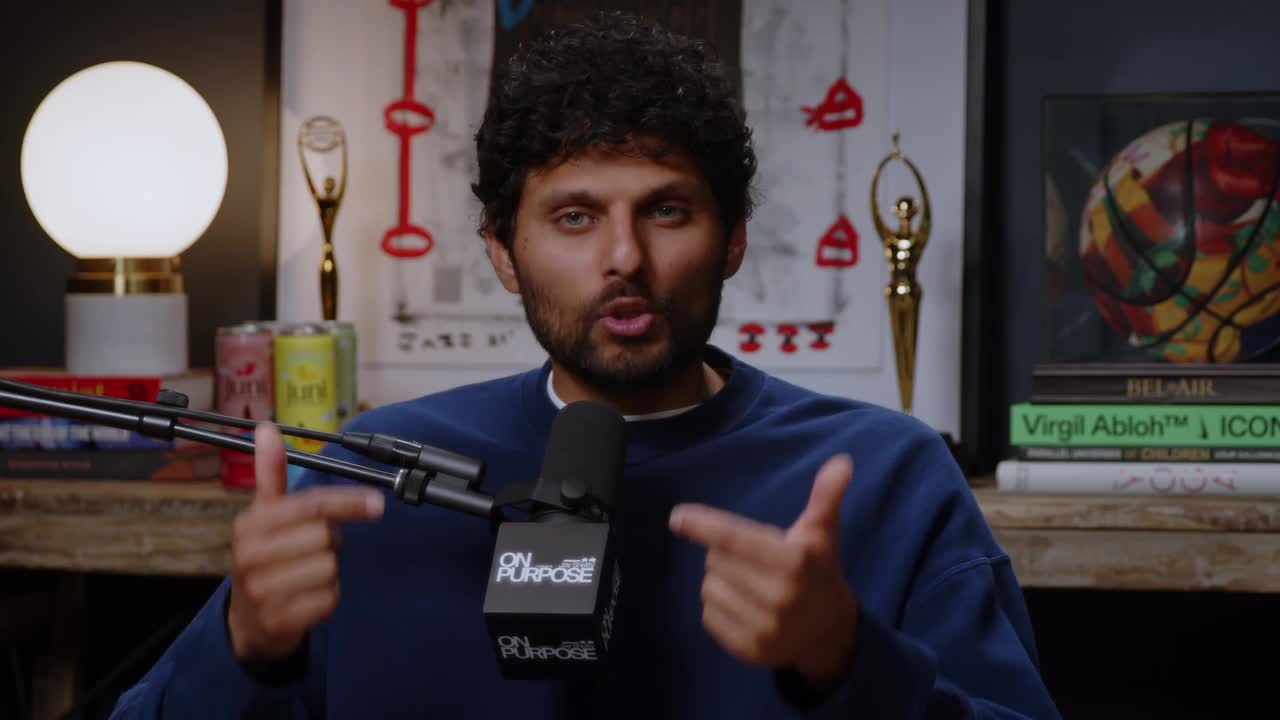
If you or your friend is going through a breakup right now, this episode is for you.
I want you to hear this carefully.
Nothing is wrong with you.
You're not weak for missing them.
You're not dramatic for feeling this deeply.
And you're not failing at love because it hurts.
What you're experiencing is grief.
And most people don't realize this, but breakups don't just hurt emotionally.
They activate the same neural pathways as physical pain and addiction withdrawal.
Brain imaging studies from neuroscientist Helen Fisher showed that romantic rejection activates the brain's reward system in the same way substance withdrawal does.
That's why your thoughts feel obsessive.
That's why your body feels restless or exhausted.
That's why logic doesn't seem to help.
I'm sure so many of you right now, if you've been through a breakup, are wondering why does my brain feel foggy?
Why can't I just go back to work?
Why can't I deal with the same conversations like I was before?
And here's the truth.
You're not just heartbroken, your nervous system is grieving the loss of an attachment.
So today I want to walk you through the stages of grief after a breakup, not as a straight line, not as something to rush, but as a map.
One of the biggest challenges when you go through a problem, a challenge, a difficulty like this is you don't know what the next step looks like.
You don't know what the next month looks like.
Maybe your friends are talking to you about dating again.
Maybe some other friends are talking to you about never dating again.
Maybe your ex keeps showing up in your life somehow and it all just feels like a mess.
I want you to know that there are certain phases, certain experience, certain emotions that you are going to go through.
And because you know they're around the corner, because you know they're going to happen, you can feel comfortable in the uncertainty.
You can take this discomfort and you can walk through with a bit more grace, bit more ease and a bit more support, mainly so that you can stop judging yourself and start healing without abandoning yourself.
One of the biggest mistakes we make during a breakup is we talk down to ourself, we're critical of ourselves, we get into blaming, shaming and guilting ourselves.
It's natural, but I want to help you move through it a little more gracefully.
Here's the core reframe, what grief actually is.
The stages of grief were first identified by psychiatrist Elizabeth Kubler-Ross while studying patients facing terminal illness, but decades of research since then, including work in attachment psychology, have shown that these stages also apply to any deep emotional loss, including breakups, because a breakup isn't just the loss of a person.
It's the loss of a future you imagined.
Let me say that again.
It's the loss of a future you imagined.
When you're dreaming up a future with someone, when you're thinking about your wedding day, when you're thinking about moving in together, when you're thinking about what that future looks like, you now create an attachment to a vision in your mind.
I know that sounds kind of interesting, but it's true.
You've built up an identity of what you will look like, what they will look like and what your life will look like.
The future you that you imagine together, the future you imagined for yourself, is what's being taken away.
You're also grieving daily emotional regulation.
Maybe they messaged you every day when you woke up.
Maybe you called them every night before you went to bed.
Maybe you saw them for a day every Friday or Saturday or whatever it was.
Maybe when you were stressed, they were the person you went to.
There's a daily emotional regulation that now needs to be replaced.
And in the beginning, it just feels like it's been snatched away.
It feels like it's been taken away.
It feels like the rug has been pulled from underneath your feet and you're just falling.
That daily emotional regulation is something you're grieving because it's a loss you haven't yet discovered a substitute for.
See, at different stages in our life, different things emotionally regulate us.
When we grow up, it's hopefully our caregivers.
Could be our siblings, our friends.
But when you're in a romantic relationship, there's almost an over-reliance in the emotional regulation you experience from that person.
You're also grieving routines your nervous system depended on right.
Those routines could be anything from well.
This was our favorite show we watched together.
That was our favorite restaurant we went to.
This was the place that we first connected right.
Whatever it means, we have these routines and what happens is our body and our biology and our mind get used to these routines right.
We get used to taking the same route to work every day.
You get used to talking to the same person every day, the sound of their voice, their scent, their touch being with them.
You are grieving that.
You're going through the transition of that.
What I want to tell you is that there will come a day when you won't feel that way.
There will come a day when that person may even feel like a stranger.
One day, your ex, the person you were most intimate with, who left, you will actually feel like a stranger.
I know right now they feel like someone who knows you better than anyone, someone that you gave everything to, but you only gave them this version of you, and a new version of you will arise.
What you're grieving is a version of yourself that existed with them.
We think we've lost all of ourselves.
We think we're completely confused.
We think we've given ourselves away.
But the reality is it was only this version.
You have been so many versions of yourself up until this point in life.
You've had friends at college that you're no longer connected to.
You had friends in elementary school that you no longer see.
There was a version of you that lived through all of that and you transformed, you evolved, you changed.
So here's the reframe.
You're not getting over someone.
I really don't like that language.
When are you gonna get over them?
Why am I not over them yet?
You're withdrawing from an emotional bond.
And withdrawal is not a mindset problem.
It's a biological process, right?
I really want you to understand that sometimes we think, what's wrong with my head?
What's wrong in my mind?
Why can't I just move on from this?
And it's biology, it's chemical.
So let's walk through the stages honestly and carefully.
If you're missing the most at night, it's not because they were perfect.
It's because your nervous system got used to them being there.
You're not lonely because they're gone.
You feel lonely because they provided regulation and that can be rebuilt slowly without them.
Remember this you're not missing them.
You're missing the future you thought you were building together.
You're not missing them, you're missing the routine your nervous system got used to.
You're not missing them, you're missing the way they made the future feel safe.
Remember, you're not missing them.
Let's talk about the stages of grief.
The first is shock and denial.
I'm pretty sure you all know what this feels like.
You're probably experiencing it right now.
There's a part of you that's shocked.
How could you leave me?
How could you break up with me?
I gave so much to this relationship.
Wait a minute, I should have been the one to give it up.
I worked so hard.
I put so much energy into this and you walked away?
Wait, I'm shocked.
I always thought that you loved me, thought you told me that we had something special.
I'm shocked.
I thought that we were going to spend the rest of our lives together.
Wait, i'm shocked because i thought if anyone was going to leave it was going to be me.
Wait, i'm shocked because you treated me badly, but you're the one leaving me.
I'm sure you've said some of these things, heard some of these things, felt some of these things.
The first stage is shock, often paired with denial.
This can show up as numbness, calmness that feels strange, saying I'm okay and meaning it temporarily.
What's interesting is that people think denial means pretending it didn't happen.
But psychologically, denial is your nervous system saying, this is too much all at once.
Sometimes your nervous system won't allow you to feel the extent of the pain, to feel the extremities of the difficulty, because it would just be all too much.
So you're somewhat allowing it to just be there, allowing it to just exist, and you're thinking i'm okay actually.
But really it's your emotions, just not allowing them to come to the surface, because your body and brain and everything are trying to help you survive.
Research shows emotional shock temporarily dampens pain to prevent overwhelm.
So if you feel disconnected or unreal, that's not avoidance, that's protection.
A lot of us feel wait, I should be feeling more pain.
I should be crying.
I can't cry.
I should be experiencing so much pain, but I'm not.
There's nothing wrong with you.
That's how your mind and body protects itself.
It doesn't want you to be overexposed to all those emotions and feelings right now.
There'll come a time when you can actually deal with them properly.
It's almost like saying that if you saw a fire, you would just run from that area.
You wouldn't stay in that area and try and figure out why it happened where it started.
What's going wrong?
You'd run away.
And then when the fire cooled down, you'd come back to check on what happened.
It's protection.
So what helps in this stage?
If you're in this stage, right now, here are a few things I encourage you to do, no matter how hard they are.
The first is basic routines.
After a bit of withdrawal, it's good to get back to work.
It's good to be able to go and attend the gym.
It's good to be able to see friends regularly.
The idea of creating routine is healthy because what it does is it allows you to forget and remove and distance yourself from the routine you had before.
The next is eating regularly.
It's just good biologically, just eating regularly.
Sleeping when you can this one's so important.
So many people, when they're in shock and denial, avoid sleep.
They can't sleep.
Allowing yourself to rest, giving yourself grace for what you've gone through, is extremely important.
Now, what hurts you is forcing emotional breakthroughs.
You're like i can't cry.
I want to cry.
I should be feeling pain, i should be mad, i should be angry.
You shouldn't have to be anything.
You can experience shock and denial and what you'll find is when you allow yourself to experience it.
Your body and mind will tell you when have you noticed that when you have a wound the first day, you have to attend to it.
You might put some you know ointment on it, you might put some essential oils, whatever you use, and your body learns to heal itself over time.
You don't have to keep looking at it every day.
You might put a plaster on it or a bandage on the first day, or the band-aid, but after that you're not looking at it.
You don't have to think about it all the time.
You don't have to force healing.
You don't have to force an emotional breakthrough.
Your body and mind help you along the way.
The other thing that hurts is making life-altering decisions.
When someone breaks up with us, we're thinking wait a minute, maybe i need to move city, maybe i need to move home.
Maybe i need to quit my job and pursue my passion, maybe i need to, you know, change my whole life.
Like we start thinking about these life-altering decisions because in some way it's again protection.
It makes us feel better.
We're dealing with something so much bigger.
But the chances are in that raised emotional dichotomy.
It's very hard to make good decisions.
Your best decisions are not made when you're angry.
Your best decisions are not made when you're sad and upset.
Your best decisions are not made when you're not thinking clearly.
They're made when you feel a little peace, when you feel a little centered and you feel a little distance from what caused you pain.
Don't force yourself to make big decisions after a big challenge.
Stage two is bargaining and obsession.
This is the stage people confuse with overthinking or rumination or procrastination.
But clinically, this is bargaining.
Your mind replays conversations, rereads messages, imagines alternate endings.
Why?
Because the brain is trying to restore attachment.
Bargaining is like if i did this we could have had this.
Maybe if i didn't say this i would have saved the relationship.
Maybe if i acted this way we'd still be together.
Maybe if i wasn't so annoying and so needy, we'd still be with each other.
That's what bargaining looks like.
You're bargaining, negotiating with yourself, thinking about all the things you could have done.
Studies show that after romantic loss, the brain increases rumination as an unconscious attempt to regain control and proximity.
This is where your thoughts sound like, if I had said that differently, they'd still be here.
Maybe we could still fix this.
I just need closure, right.
So we start bargaining and the challenge with this phase is that it feels real.
It really feels like if you did that one thing, they'd still be here, when you know that's not the case, but you can't access that.
Your subconscious can't access that.
Your subconscious is convincing you that you're absolutely right if you did that one thing, or didn't do that one thing, you'd still be with them.
This is probably one of the toughest stages to get through.
And I'm really glad that we're talking about it after the first stage, because it's the stage that can feel the longest.
It's the stage that can feel the hardest.
You tell all your friends, look, I really feel I could have made it work.
And they're looking at you like, you're crazy.
What's wrong with you, right?
You keep playing it over and over in your head for days.
You're looking at pictures, you're looking at social media and you're thinking, wait a minute, why they're with that person like i.
I thought they liked me for those reasons and maybe i was just too annoying.
Maybe i asked for too much, maybe i needed too much.
Here's the truth.
Closure doesn't come from answers.
It comes from accepting the loss of the bond.
Here's what helps here writing thoughts down instead of replaying them.
When you replay thoughts in your head, they all feel real.
When you write down thoughts, you can actually question them.
It's really hard to question a thought in your head if you're replaying on your head.
If i did that, they'd still be here and then this would happen.
It all makes sense when you write it down and you read it out to yourself.
You might even look at it and go that's bizarre, that's absolutely crazy.
I can't believe.
I thought that.
I want you to really ask yourself to write down what you're thinking.
Write down your most repeated thoughts.
Read them out to yourself and recognize the flaws that they hold.
Another thing that can help is reducing contact and checking behaviors.
A lot of the time, we're reading old messages.
Delete them.
A lot of the time we're looking at their social media profile, block it.
It helps to have distance at a time when you're thinking about all the things you could have, should have, would have done.
It's good to have distance.
And it's also healthy to recognize that this is a phase you're going to have to go through.
You will negotiate, but know that your negotiation doesn't mean that it's valid.
It's important to name what's happening.
This is withdrawal, because here's what's really going on.
You're not stuck, you're detoxing.
If you keep remembering only the good moments, remember this.
Your brain edits memories.
During loss, it highlights comfort and hides pain.
Healing begins when you remember the whole truth, not the highlight reel.
Again, to protect us, the brain just keeps thinking of all the good times, all the amazing moments.
And so now, when you're negotiating, when you're ruminating, when you're overthinking, when you're bargaining, you're only bargaining based on the highlights.
You're forgetting everything they did wrong.
You're thinking actually yeah, they did show me flashes of greatness beauty attraction romance, and you're forgetting the time they ignored you.
You're forgetting the time that they weren't emotionally available.
When someone breaks up with you, it's so easy to just remember the good times, but you forget the time that they ignored you.
You forget the time that they weren't emotionally available.
You forget the time that they put you down in front of your friends.
Just because your mind only remembers the good things doesn't mean that relationship was meant to last.
Don't get lost in the highlight reel and remember the truth.
Stage three is anger and protest.
Something shifts, anger appears, aggression is back, sometimes explosive, sometimes quiet, sometimes delayed.
Right, i think we think anger is just like this brute force.
Sometimes anger can be boiling inside.
You're quieter, you're scarier.
Anger is not regression.
I think a lot of us feel if i'm angry again, i've gone backwards, not realizing that.
If you go back to stage one that's why these stages are important when you go back to stage one, you never felt angry because you were protecting yourself.
So that's why, when we feel anger later, we go oh no no, i'm going worse, i'm going in the wrong direction, and that's the biggest mistake.
We think we're not improving, we think we're not evolving.
We think we're going backwards because we feel angry.
But the reality is, Your body was waiting for you to have space to feel this.
Your body and mind were waiting to give you permission to feel anger in a safe way.
Anger is not moving backwards.
In grief research, anger is understood as self-respect returning.
Let me say that again.
In grief research, anger is understood as self-respect returning.
It sounds like that wasn't okay.
You're finally saying to yourself, actually, yeah, the way I was treated wasn't okay.
You're not bargaining anymore.
You're actually realizing I deserve so much better.
I don't want to settle.
I can't believe i was going to settle for that.
I can't believe i was accepting less than i deserve.
You start to acknowledge i ignored things i shouldn't have and sometimes you get mad at yourself for thinking wait, why was i bargaining right?
Why was i actually not mad earlier?
I should have been mad before and now.
The mistake is i should have been mad before.
I'm actually going backwards and I want to give them a piece of my mind.
This is the point at which most of you want to text that person or pick up the phone to them, or get your friend to phone them and have a go at them right.
This is that moment.
And you want to recognize you're fair to feel your anger.
You're valid to feel your anger, but it's all happening in the right order.
It's all happening at the right pace.
It's happening for you.
Anger scares people because they think it makes them bitter, but research shows healthy anger speeds recovery when it's expressed safely.
Express safely means you'll share it with a therapist, you'll share it with a coach, you'll share with a friend.
You're not sharing it in a text to that person.
I think the biggest challenge we have here is we're judging ourselves for being angry.
We're either thinking i should have been angry earlier, i should have been angry at them, or i'm being angry now and it's too late.
It's not too late.
Everything is moving in the direction that it needs to.
That's why i want you to really stay till the end of this episode so that you can hear all the phases, so that you're not harsh on yourself when you're going through it.
It's almost like if you're doing a triathlon you know you're going to have to run, you know you're going to have to cycle and you know you're going to have to swim.
And you'll know the order.
But if when you're swimming, you're wondering, wait, why am I swimming right now?
I don't want to be swimming.
I should be cycling.
It doesn't work that way.
What helps here is movement, channeling that anger physically.
The other is boundaries setting boundaries as to how you want to communicate with that person and how you're going to avoid communicate with them.
To be honest,
Honesty really helps.
Honesty with yourself, honesty with others.
Because up until now, you've been bargaining with your own honesty.
But here's what hurts.
Shaming yourself for anger.
That's what holds you back using anger to reattach through conflict or now.
I need to connect with them to tell them how i feel.
Let anger inform you, not define you.
This is why i really want you to listen to the next phase, because this might be where you're at.
Stage four is sadness and depression.
This is the stage most people recognize the heaviness, the emptiness, the tears that arrive without warning.
I think a lot of us try and speed up to this point.
We kind of skip the other stuff.
We try and ignore it.
And that actually makes the stage harder.
It's easier when you get to stage four, having allowed yourself to go through the stages.
Neuroscience explains why.
After breakups, levels of dopamine and oxytocin the chemicals linked to pleasure and bonding drop significantly.
So this sadness isn't just emotional, it's chemical.
And this is why motivation disappears, right?
You start to feel like, what's the meaning of my life?
What's the point?
Am I ever gonna find love?
Joy feels distant.
You're thinking, I can't remember the last time I was happy.
Can't remember the last time I laughed.
I can't remember the last time I smiled.
Everything feels slower.
You think, God, I can't believe it's only been a month.
And here's what matters.
Sadness means you're processing reality, not avoiding it, and this stage requires rest.
It requires you to be the kindest, most graceful, most compassionate towards yourself.
This is the phase that requires friendship, and we've got to avoid pushing our friends away in some of these stages, because sometimes we can take it out on them.
You can be angry at them for how they're dealing with it, as opposed to just figuring out how you deal with it and we all do that, it's natural.
But friendship is so important at this stage.
When you're going through a breakup, productivity isn't important.
A timeline isn't important.
Pressure isn't important.
You don't move on, you move through.
And if you're scared you'll never love like this again, I want to say something to you.
You're right. you'll love differently.
You don't want to fall in love like this again because then you'll fall out of love like this again.
You want to fall in love differently, with more wisdom, more boundaries, more self-respect and that kind of love that lasts.
So many of us don't allow ourselves to move forward because we think what we had is the best, the epitome, the greatest version of it, not realizing that everyone who has come before us has found love.
That was better, different and an upgrade.
Stage five is acceptance and meaning.
Acceptance doesn't mean you approve of what happened.
It means you stop fighting reality.
This stage is called meaning making in modern grief psychology.
This is where you begin asking, What did this teach me?
So it's so interesting, isn't it?
When you go through a breakup, you might even have a friend who says to you what did you learn from this?
This is stage five, not stage one.
When you're going through pain, you don't have to learn from it in that moment.
You learn from it when you're reflecting.
Ray Dalio once said to me, pain plus reflection equals progress.
But when you do, that reflection is so important.
You'll get to it at some point.
You can be grateful for what was left after what happened to you.
When you have some distance, you can start asking questions like, what did this teach me?
What do I want to do differently moving forward?
Who am I becoming now?
Sometimes people say, just get busy in your hobbies and your passions and interests.
You can't really think about that till stage five.
Research shows people who integrate meaning after loss experience post-traumatic growth, not just recovery.
Notice the difference.
You don't just want to recover, you want to grow.
This is where your identity stabilizes. this is where self-trust returns this is where the past stops defining the present here's the reframe healing doesn't mean it didn't hurt healing means it didn't destroy you healing doesn't mean it didn't affect your self-confidence healing means it helped you build self-respect healing doesn't mean You didn't have boundaries.
Healing means you'll have better ones next time.
Here's what actually helps.
Across all stages, research consistently shows these things help.
No contact or low contact speeds emotional recovery.
Routine calms the nervous system.
Talking without rehearsing the story.
That's processing versus just replaying, resisting idealization.
Memory is always biased toward the good times and this is crucial.
You don't heal by erasing the love.
You heal by releasing the attachment.
You don't heal by blocking the other person.
You heal by setting the right boundaries.
You don't heal by by pushing yourself through.
You heal by processing each stage as it comes.
If you're going through a breakup, it's proof you loved deeply.
One day, this won't be the center of your life.
It will be a chapter, a teacher, a turning point.
And the way you treat yourself now will shape the love you experience next.
Stay with yourself.
This ending is not the end of you.
Remember, I'm forever in your corner.
I'm always rooting for you.
I hope you'll pass this on to someone else who's gone through a breakup or a difficult time, no matter what stage they're in or phase they're in.
And I hope this helps them through.
Thank you for listening and watching.
Make sure you subscribe to never miss an episode.
I'll see you on the next one.
If you love this episode, you're going to love my conversation with Matthew Hussey on how to get over your ex and find true love in your relationships.
Make a list of the things that are truly important for you to find in a partner, and then be that list.