From The New York Times, I'm Michael Barbaro.
This is The Daily.
Just hours before a federal immigration officer killed Renee Good in her car, the Minneapolis police chief warned that a tragedy involving ICE and the people of his city seemed inevitable.
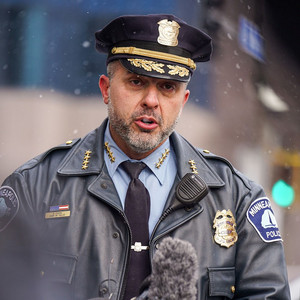
Today I speak with that police chief, Brian O'Hara, about his experience with ICE in Minneapolis and why, in his mind, the president's campaign of mass deportation is undermining faith in police departments like his.
It's Monday, January 12th.
Chief O'Hara, thank you for making time for us on a Sunday, no less, and a very busy weekend for you.
Sure.
Thank you for having me.
The past 48 hours were pretty extraordinary from the perspective of an outsider.
There were these enormous protests.
I believe you yourself ended up in the middle of one of them.
I've tried to make sense of the video.
I mean, what has this been like for you?
So what happened was we had a protest start outside of a hotel where people believed federal law enforcement might be staying.
They believed ICE agents were staying there, right?
Right, exactly.
During the course of that protest and march, it sort of transitioned into an unlawful assembly.
And things that typically happen in cities happen, and...
A woman who was disoriented drove her car onto a sidewalk and the police were called to respond.
So while the police car was there dealing with regular police work, suddenly they realized they had become surrounded by this crowd, which had become unruly.
So our officers called in that they were unable to drive out.
And I was in the area personally with other police officers.
We just we quickly ran in to back the crowd out to get a path for the police car to come out.
And I think, because we did that, I think that may have contributed to emboldening an already unruly crowd.
And we very quickly called in police well over 200 additional police officers, and then ultimately, we wound up placing 30 people under arrest for unlawful assembly and releasing them.
It's been very taxing for all members of the police department.
And this is a situation that has been building up for several weeks.
A lot of the disturbances and chaos that's been happening here as a result of the manner in which some federal enforcement activity is happening is requiring our officers to respond and step into situations and try and restore the peace, where oftentimes they themselves then become the target of people's frustration.
Well, you're hinting at all this.
The reason we're talking to you, of course, is because of the fact that ICE is there, but because specifically, of what an ICE agent did in the middle of last week.
The shooting of a Minneapolis resident, Rene Good, a shooting that killed Ms.
Good.
And at this point, millions of people have watched the video of that shooting from every conceivable angle on social media, on TV news.
But there was a lead-up to that shooting that a lot of us didn't watch as closely and didn't see on TV or on YouTube.
And that was the arrival of a large number of Immigration and Customs Enforcement agents, Starting in early December.
And so that's where I want to begin.
Take me back to that period for you as police chief.
What was your understanding of why the president decided to send these agents to your city?
About a month ago, in December, it seemed like the public messaging was largely political and it was a result of a real problem that does exist in the state, and that is a problem with fraud.
Dozens of people have been prosecuted by the FBI and the U.S.
Attorney's Office here in Minnesota.
You're referring to the fraud that had been specifically highlighted in the Somali community in Minneapolis.
And I do want to talk about the president's message when he decided to send specifically immigration officers to Minneapolis.
I mean, he was pretty explicit about his thinking in his mind the Somali population in the city, which is sizable and well-known.
Yes.
He described it as a community that was sowing disorder, committing crimes.
Basically, in so many words, a community of troublemakers who should be deported.
And I wonder what you made of that and if it felt like that had been your experience as chief.
Well, I'm from about 10 miles from lower Manhattan is where I grew up.
I was a police officer for over 20 years in Newark, New Jersey, but I had not known any Somali Americans until I moved to Minnesota.
And the Somali Americans that I have met here, including many of whom are police officers in this city, have been incredibly welcoming of me.
So, from a personal perspective, It was just bizarre, because I'm also aware that the overwhelming majority of people from that community are American citizens.
Well, from a crime perspective, was anything the president was saying true?
Well, there is a real problem with fraud in the state.
And unfortunately that is sort of lost now in all of this political rhetoric and sort of the extreme reactions that occur there.
You're drawing a distinction between fraud and kind of traditional street crime.
Yeah, yeah, yeah, yeah.
But you're acknowledging that there's some level of fraud occurring perhaps in this community.
Perhaps that's what the president is referring to.
Yes.
In your mind.
That's distinct from perhaps, the crime that you and your officers are dealing with day in and day out.
Yes, absolutely.
Those cases that were brought about, leading to dozens and dozens of prosecutions, were led by the US.
Attorney's Office here in Minnesota, as well as the FBI.
Got it.
So, in your mind, was this planned deployment specifically of ICE agents that the president asked for?
Was it warranted?
I mean there have been immigration enforcement conducted in Minnesota as long as there has been ICE.
I think the problem is what gets lost in this is it's not necessarily about which laws are being enforced.
It's about how that enforcement is happening.
To the extent that there are well-planned pre-planned, targeted enforcement against people who are violating the law, I think all of law enforcement can very clearly get behind that.
But to the extent that things are being conducted that may not be well planned, using tactics that generally are not viewed as sound, that may unnecessarily endanger the lives both of law enforcement officers conducting that enforcement as well as the lives of people in the community.
Certainly, those are concerns that I have to deal with and I am responsible for as a professional, managing my agency.
So it sounds like for you, it's not the fact of ICE coming that is the issue.
It's the way that ICE came.
So let's talk about that.
So the president makes his case that immigration enforcement should be happening on a larger scale in Minneapolis.
And in early December, he makes it happen.
How did the operations of these ICE agents work?
And how did it start to affect the police department that you run?
What changed?
I mean, you're hinting that their tactics are different.
Yes.
So we've just gotten a pretty dramatic increase in 911 calls from people in the community related to a lot of the street enforcement that's happening.
I mean, it's everything from.
People are being arrested and their cars are left in the roadway, sometimes blocking the street.
That one case left when it wasn't even placed in park and was rolling down the road.
Wait, wait.
So ICE officials are taking someone out of their car, arresting them, and their car is not even put in park.
We had that happen.
We had another time where there was a dog in the car, and they left the dog in the car.
Wow.
I mean, even this morning, we've gotten calls for individuals who were pepper sprayed by ICE.
There's just a variety of calls for service that we then have to manage and triage that were not happening before.
And how does that sudden influx of 911 calls because people are experiencing ICE tactics affect the department as a whole?
How does it complicate your policing?
It complicates things because we remain significantly understaffed.
This is the Minneapolis Police Department.
The majority of the cops that worked here in 2020, five years later, the majority have left.
And we're trying to rebuild.
We remain one-third below what had been typical of staffing for the police department here today, while we're dealing with a much higher level of serious street crime than what had been normal in the past.
So this is adding additional work.
Probably the toughest distinction is we're getting called and pulled into situations that are very tense and very emotionally charged.
And oftentimes we're asked to try and step in and deescalate situations where federal law enforcement may have been involved.
That very, very quickly.
As soon as we show up, we become the target of people's frustration.
Hmm.
So the minute you show up, the minute we show up where the problem you know, people are ready to go.
It could very, very quickly explode.
And, with the level of staffing that we have and the time that it takes to get the National Guard to come in, it will be too late.
That's my fear.
I mean, you've been talking around this and I think we should just make this extremely explicit that you come to the job of being police chief in Minneapolis at a very specific moment, with a very specific purpose.
You arrive just two years after a Minneapolis police officer murdered George Floyd, at a moment of extremely low morale for the department and really high levels of distrust of the police department by the community.
And when you took this job...
I went back and looked at the old clips.
You called Minneapolis ground zero for a global reckoning on policing and you, in the job, put in place sweeping reforms to try to rebuild trust, repair relationships between police and residents.
Just give us a couple examples of the reforms you put in place and that presumably are now being somewhat challenged by ISIS presence.
So we have placed a very strong emphasis on use of force, on employing de-escalation, on the use of critical decision-making practices.
We have gone out and had dozens of community meetings to get input from community as we revise our policies.
And I think it all boils down to trying to fight crime in a way that earns community trust, as opposed to alienating people.
And from what you're saying.
Suddenly, as of a few weeks ago, all of that work is confronted with an outside group of federal law enforcement officials arriving in your city doing police work But who don't answer to you and are not as inevitably invested in the reform efforts that you have put in place.
They have a totally different mandate.
And it sounds like you're saying, all of a sudden, that is just immediately overshadowing challenging, complicating this entire project that you have overtaken as police chief.
Absolutely.
And in the midst of all of those challenges, while we're trying to heal this community, while we're trying to heal— the men and women who have remained here and rebuild, while they're already the most scrutinized police department in the nation.
And I can tell you, the cops here, we're human beings.
And I worry that we might hit a breaking point.
It feels like, as the weeks went on here, That residents are taking it upon themselves to monitor ICE agents and their activity.
Minneapolis, this is not a secret, pretty liberal city.
And there are residents who organize themselves in this period into groups.
They're shadowing ICE agents.
They're texting each other.
They're blowing whistles.
Yes.
And it's amounting to a pretty meaningful effort to counter their enforcement operations.
I don't know if you quibble with that word.
Does that become its own problem?
And did you find yourself wishing that the residents were not doing that?
Did you try to discourage it?
Well, I can tell you, the role of the police and law enforcement in the United States is, first off, to protect life, but it's also to ensure people's human rights and their constitutional rights.
And people in this country have a First Amendment right to observe record and object to government activity.
And that includes the activity that Minneapolis police officers do, as well as other law enforcement in our city.
And so it is a challenge, but it's a challenge that policing in America has been dealing with and trying to improve upon for many years.
It does add a level of complication to our work.
But I just wanna be clear, though I'm not asking for federal law enforcement to do anything differently than what I expect the men and women of the Minneapolis Police Department to do.
What you're describing clearly sounds like a pretty combustible combination.
You've got ICE agents who are operating with their own systems and set of rules, and then you have these residents— in your words operating their First Amendment right to surround them, to monitor them, to scream at them.
And this is adding up to clearly a very delicate situation.
And there's a moment that I want to ask you about because it felt oddly prescient where, within the last week or so, you stand up at a news conference and you say, basically I am worried.
I do have an ask that's both for federal law enforcement.
You say, ICE agents, you have your job to do, but please do it lawfully.
And at the same time, to members of the community.
Residents, yes, you can have your protest.
Please do it peacefully.
I've been concerned for weeks that, because the issue is so emotional and because frankly, some of the way this stuff has been carried out, The greatest risk to me is that there would be unrest or that there would be a tragedy that somebody could get seriously hurt or killed.
But you seem to kind of know that something awful was coming.
Yes.
I mean, this was predictable.
And it's also entirely preventable.
I mean, I had been saying it for weeks.
I literally said it at a press conference the day before.
And when you found out that it was true that there was a shooting involving an ICE agent, what was your first thought?
I mean, I'm having a hard time describing it.
I just thought, fuck, this is it.
You know, this is the potential here for 2020 all over again. for George Floyd all over again.
For the destruction of the city.
We'll be right back.
So I understand that an investigation is still underway of what happened in this shooting, and we don't know exactly what that investigation is going to look like or what it's going to conclude.
And we'll talk in just a few moments about the conflict arising from the investigation over whose investigation it should be.
But just to focus for a minute on the shooting itself, have you watched the videos?
Yes, I've seen the videos that are available online.
What is your understanding of how this unfolded?
My understanding is that there was a woman who was in her car and was blocking the street, likely because immigration agents were present and she was likely protesting in some way, immigration officials being present.
Get out of the car.
Get out of the fucking car.
And ultimately some confrontation occurred, where federal law enforcement shot into the vehicle killing her.
Fucking bitch.
You!
Shame!
Shame!
Shame!
Shame!
Having watched the videos and spoken perhaps, to responding officers, does this strike you as a lawful interaction between the ICE officer and the resident?
Well, I can tell you, as a police officer for 25 years any time you hear a situation where a cop gets into a shooting situation with an unarmed motorist, it gives you pause.
And it's very concerning because, while policies and training try to do everything possible to prohibit those situations and to try and prevent them from occurring in the first place, there are times unfortunately, where law enforcement cannot avoid those situations from occurring.
The concern is, as a professional, to try and prevent our people from getting into that situation in the first place, so that we're not unnecessarily creating the risk unjustifiably.
Well, let's talk about that.
You mentioned training.
My sense is that there are some pretty universal rules around policing when it comes to a motorist in a running car.
The number one is you don't place yourself in the path of the vehicle.
That's like traffic stop 101.
You don't do that.
So in your mind, that's a flag that you have this ICE agent, the one who ends up shooting Renee Good standing in front of her car.
Absolutely.
And then the other one is, what exactly is the mission here?
Because if this person isn't the target of a pre-planned enforcement action, then what are we doing?
Are we trying to de-escalate and try and resolve the situation?
Are we trying to take an enforcement action and force some law here, or what exactly is?
Is the goal?
We're focusing here?
On the ice officers, i do want to ask you about the driver's decision making in this moment her refusal to get out of the car even after ice agents demand that she get out of the car, her reversing, then driving forward.
She appears to disobey spoken orders from from these officers.
As somebody who thinks about this stuff, let's just ask this really plainly.
Was she in the wrong?
Well, I can only speak to conducting the traffic stop from my perspective as a police officer.
What is our policy?
What is our training?
Number one.
You approach the driver, you introduce yourself by rank, by name, by what agency you work for and you tell the person explain why the person is being stopped.
You do these sorts of things to try and ensure one number one, to identify yourself, but to try and ensure a level of professionalism and to try and deescalate.
If the person asks you a question that's reasonable, you respond to it reasonably.
That is the expectation.
And did the ICE agent do any of that?
I didn't see any of that.
And further, it just seems like there's confusion.
And I don't know, just from what I recall, but it seems like someone else is saying to get out of the car than the officer who shot.
And I just it's not clear to me whether the two of them were working together and understood what each other was trying to accomplish.
Do you feel that this would have ended differently had this been handled entirely by the MPD, not ICE?
No question.
Do you have any empathy for the ICE officer, given the split-second nature of policing, putting aside whether he should have ever been in front of the car?
Yes, absolutely.
Law enforcement leaders, executives have an obligation to their people.
We have an obligation to ensure that our people have sufficient policies, sufficient training, sufficient experiences for the challenges that we are placing them into.
We have an obligation not to send our people out there and to tell them you know you have a specific quota today.
You have to get a certain number of people.
I mean, it seems like that's the situation these folks are being placed into.
And that went out the window a long time ago in professional policing.
And considering this agent was seriously injured in a stop you know somewhat recently, it certainly raises questions as to what did the agency do to protect their person.
You're referring to the fact that I believe this officer in the Times has written about it was involved in a stop where he was dragged in a car.
Yes.
He sustained significant bodily injury, for sure.
So what did the agency do to ensure that that officer would not be unsafe in similar situations?
Right.
I mean, you're basically raising questions about whether ICE agents are sufficiently trained to handle these kinds of encounters.
Yes.
And whether or not— Do you think they are?
I don't have specific information about that.
I just know what I've read.
I know what's been reported.
It's been reported.
That they're not even getting the level of training that they used to get, that the time of training is less.
I think that's concerning.
And I do think they are being forced into situations in which they are not well prepared to deal with.
Let me turn to the investigation.
And I want to ask you about two issues that have arisen with this investigation.
The first, of course, is that the federal government has blocked local officials from participating in the investigation.
And they basically argue that that because of comments made by your boss, Mayor Jacob Fry, that local officials can't be objective,
On the other hand, you've got the Trump administration out there basically saying You know, Rene Good is entirely at fault and the ICE officer did nothing wrong here.
So can they be objective?
I mean, how are you making sense of what has become an incredibly messy and contentious situation over what I normally think of as everybody doing joint investigations of a tragic situation?
Well, I think the loss here is the loss of any trust that the investigation would be legitimate.
And I tell you, I know a lot of the FBI agents here.
I believe the FBI will still do a thorough investigation because that's what they do.
That's what the people who staff this agency here, that's what they do every day.
But will Minneapolis residents believe that it's a serious investigation?
But that's the problem.
The way this has played out has taken all sense of legitimacy away from many people.
And that's very unfortunate.
I want to talk about what happens next now in this city, as this investigation, for which there may not be much faith locally, unfolds.
Because, in the wake of this shooting and these protests, your governor has dispatched the National Guard to Minneapolis.
The president is dispatching or plans to dispatch far more federal officials, border patrol agents.
Is that just going to magnify all the challenges that we have been talking about here?
Well, I had asked the mayor to have the National Guard on standby as this was initially unfolding, because it was so unpredictable.
I was afraid that once it came to the point where we might need the National Guard, it would probably take too long to get them here.
So that's why I'm glad they were on standby.
Going forward.
It's my understanding that there is additional federal law enforcement being added to the state specifically to conduct more of these operations.
That is concerning.
If this escalates, are you worried, Chief O'Hara, that all of this is just going to erase the work you've done over the past four-plus years to rebuild and repair the community's trust in the Minneapolis Police Department?
The number one priority that I worry about in terms of erasing work that we've done is ultimately erasing the gains that we've made, rebuilding the department and being able to reduce crime.
You know, in June of 2020, immediately after the destruction of the city, the burning of a police station here, in that one month we had about as many shootings in one month as the city used to have in half a year.
And that level of crime stayed very high.
And now the last couple of years has started to come down.
And it's come down despite not having enough officers.
And we finally have started... to rebuild.
And I'm just afraid, if we have another large-scale unrest, that we are both going to have a dramatic increase in crime yet again.
That's predictable, as well as another mass exodus of the department.
And we just, we cannot sustain that.
I mean, is there any part of you that feels that this moment could strengthen the relationship between the community and police and test this work and reveal that you all have made progress, that people will see a distinction between the MPD and the feds?
I know that is true.
I've had many people reach out and activists reach out, our elected officials, many people who typically have nothing good to say about the Minneapolis police, have been incredibly complimentary of how well, how restrained, how disciplined the Minneapolis police officers have been in these very, very tense situations over the last several days.
But it's not universal.
There's people here who, despite what's happening, seem to think it's our job to do ICE's job.
There's people here to seem to think that we should continue to make the same failed mistakes of the past when dealing with protests and crowd control and not utilize the best practices to deescalate and to keep everyone safe.
Are we fully aware of that?
Of course not.
We haven't accomplished winning trust with all levels of the community.
That was obvious this week with all the hate and vitriol that was directed towards our officers.
But there's certainly been progress.
Just to end this conversation, Chief O'Hara, how do you think you get back to a simpler time in your policing where you can be focused on the reforms that you brought to the city, on repairing relations between police and the community?
And in your mind does ICE, does Border Patrol, do all these federal agents need to leave the city for you to do that?
I mean, I think everybody wants to get back to some sense of normalcy.
And I think that does involve some level of returning to some basic things that we accepted as normal.
You know, that obviously isn't federal law enforcement stops enforcing federal law.
That's not the answer either, but it does have to do with having an honest conversation about reality.
We've had many instances of people being stopped, family members of police officers being stopped that are American citizens.
By ICE.
Yeah, it's definitely, at best, it is definitely questionable.
They're not stopping family members of folks who are Norwegian or Irish.
That's not happening.
Just to return to that question can your work at its best coexist with the work of an organization like ICE?
We are doing it right now and we are proving to the world that this is possible, that this is not the same police department.
It was five years ago or 10 years ago or 15 years ago.
But it is an unbelievable stress on everyone involved.
And I think everybody needs to turn the heat down and hopefully get some sense of some basic things to return,
Chief Oyerat, thank you very much for your time.
We really appreciate it.
Thank you, Michael.
We'll be right back.
Here's what else you need to know today.
As massive anti-government protests spread across Iran over the weekend, Iran's president vowed to address the country's economic problems, but showed no signs of backing off a harsh crackdown on demonstrators.
That crackdown activists say may have killed as many as 200 people over the, So Iran's in big trouble.
It looks to me that the people are taking over certain cities that nobody thought were really possible just a few weeks ago.
Meanwhile, the Trump administration is warning Iran's leaders that it could strike Iran if the regime continues to kill peaceful protesters.
The Times reports that US military leaders have begun to brief President Trump on options for such strikes.
And The Trump administration is escalating its long-running feud with the chairman of the Federal Reserve, Jerome Powell, by opening a criminal investigation into his conduct.
The investigation centers around whether Powell lied to Congress about the scope of a multibillion-dollar renovation project of the Fed's headquarters, But Trump's original conflict with Powell stems from his unwillingness to significantly slash interest rates as President Trump had demanded, a reality that Powell highlighted in a video released on Sunday night.
The threat of criminal charges is a consequence of the Federal Reserve setting interest rates based on our best assessment of what will serve the public, rather than following the preferences of the president.
And was engineered by Alyssa Moxley.
Special thanks to Mitch Smith and Nicholas Vogelboros.
That's it for The Daily.
I'm Michael Barbaro.
See you tomorrow.