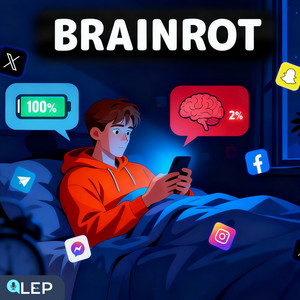
Welcome back to Podcast and Chill.
I'm Gwen.
And I'm Leo.
So, has this ever happened to you?
Your head feels heavy.
Your mind is slow.
You don't want to react to anything.
When you open your phone, you just scroll and scroll and scroll.
You know you need to do a task, but you can't make yourself do it.
If you say yes, then welcome.
You are now part of the brain rot team.
Don't worry.
This does not mean you are a bad person.
But things can get bad if we don't stop it early.
True.
That's why today we'll talk about brain rot, what it is, why it happens, and how we can stop it.
We also talk about some useful vocabulary later, so keep watching until the end.
If you want today's transcript and word bank, you can find them in our PDF file.
Just click the link in the description box below.
And hey, if you enjoy learning like this, give us a like.
It really helps the channel.
Alright, let's jump into today's topic.
So what is brain rot?
Leo, can you help us explain it?
You know, you look like someone with a lot of experience.
Oh, wow.
Thank you, Gwen.
What an honor.
You're welcome.
Anyway, brain rot is a state of your mind.
It's when your brain feels slow, tired, and not clear, even after eight hours of sleep.
You feel distracted, you cannot concentrate, you don't want to do anything and honestly, you cannot focus long enough to do anything.
Beautiful.
Thank you, thank you.
But yes, that's brain rot.
You know, when you open too many tabs in your browser, your laptop gets slow.
Sometimes it just stops.
That is your brain on a bad day, overloaded and exhausted.
Yep, that feels right.
So, why does this happen, Gwen?
The main cause here is one word, dopamine.
Oh, dopamine.
I know that one.
It's a thing in our body.
It appears when the brain expects something good.
It knows you will feel happy if you do it, so it tells you to go ahead.
Correct.
Dopamine reacts when you feel happy.
Many things can make dopamine show up.
One of them is short-form content.
Like YouTube shorts, Instagram reels, TikTok.
Bingo!
Short clips send fast, happy signals to the brain.
Dopamine reacts to that and says, nice, let's watch more.
I mean, who doesn't want to feel happy, right?
Yes, people can talk to friends, take a walk, or exercise to feel good.
But watching short clips is easier.
True.
Why work hard for one hour when I can feel good in 10 seconds?
That's why people watch short clips all day.
Memes, funny videos, quick drama, you name it.
But how does this connect to brain rot?
Well, dopamine is not bad.
But when dopamine is too easy to get, your brain gets used to fast rewards.
Then slow tasks feel harder.
Oh, so my brain gets lazy with slow work?
Not lazy.
More like trained to choose easy and fast.
That's why long tasks feel impossible.
And that foggy, exhausted feeling?
When you feel foggy, tired, or cannot concentrate, it shows your brain is used to fast dopamine and finds slow tasks harder.
Wow.
My brain is fighting slow things now.
That sounds terrible.
It is.
And short videos make it worse.
They are made to keep us stay, just like slot machines in casinos.
Slot machines?
Really?
Yes.
They keep players playing.
You spin the machine, you might win.
Dopamine shows up, so you play again.
Oh, so scrolling is like spinning the machine?
Yep.
Every scroll is a spin.
You hope the next clip is better.
And boom, your brain gets hit with fast rewards again and again.
So when we finally see what is happening, is it too late?
No, not at all.
We can stop brain rot with the right steps.
But before we talk about how to fix it, let's talk about who gets brain rot the most.
So who gets brain rot the most?
It's Gen Z. Gen Z?
You mean people born from the late 1990s to the 2010s, right?
Yep, that's the one.
Now that you say it, it's true.
Brain rot is very common in Gen Z. And why is that?
Because they were born in a time of technology.
The internet and smartphones were everywhere.
These technologies helped people, especially Gen Z, find things online very quickly.
What did they find online?
Short-form content.
Ah, I see.
Gen Z gets used to fast sounds, fast pictures, and fast changes from a very young age.
And then, slow things feel too hard.
Anything that takes time, like reading, feels painful.
Yeah, studying feels so slow.
Many people say even 10 minutes of English study is awful.
You know why?
Because they know they can't become good at English in 10 minutes.
There is no reward in that moment.
No dopamine.
No good feeling.
So, the brain says, what a waste of time.
Don't do it.
But somehow they can stay online all day.
It's strange.
Not really.
The secret is the content.
A lot of online content is made for Gen Z. It's fast, funny, shocking, or all three.
This kind of content makes dopamine appear again and again.
Ugh, that feels so awful.
Gen Z can't just beat this system.
Yeah, it's hard for them.
And you know what else is hard?
The social pressure.
We all have it, but I think Gen Z has more.
Why do you think that?
Because they stay online more than we do.
They see so many perfect lives every day.
Oh, yes.
That's another reason why Gen Z gets brain rot easily.
How?
When they see those happy people, they feel behind.
They feel sad, so they look for fast fun.
They scroll more to feel better.
But the more they scroll, the more perfect lives they see.
It's like going around in a circle.
Exactly.
And when you go in that circle again and again, your brain gets no break.
It gets used to noise and pictures all the time.
That's bad.
Even a machine needs a break.
If not, it breaks down. true.
Imagine living in a world that pushes your brain from a very young age.
Quick rewards feel like a drug.
Your brain has no time to rest or energy to fight back.
That's why the problem keeps getting worse.
So brain rot is not only a people problem, it's a brain system problem, right?
You got it.
This fast world creates brain rot.
And Gen Z is the biggest victim.
So how to stop brain rot?
Like I said earlier, there are some ways.
The problem is that not everyone thinks brain rot is dangerous.
So they don't feel like stopping it.
That's bad.
I guess we have to talk more about why brain rot isn't good for us.
Yeah.
First, brain rot causes low focus.
Your brain has this special part.
It controls your attention.
It's like a muscle.
You use it or you lose it.
With brain rot, you stop using this part of your brain, so it gets weaker.
Ah, that makes sense.
That explains why a five-minute listening task feels like climbing a mountain for some people.
Right?
And here comes the worst part.
Brain rot makes you less patient with long but useful tasks.
Can you give us some examples to make it clear?
For example, practicing a foreign language, English, French, Chinese, or whatever you like.
Let's say speaking a language is one of the best ways to get better at it.
But you can't say a word perfectly the first time.
You have to repeat it again and again.
It can take days, weeks, sometimes years.
I agree.
That takes a lot of time, effort, and patience.
But hey, that's the best way to get good at it.
The second best is, I don't know, magic or something.
I wish.
But the problem is, brain rot does not like slow things.
Why?
Because your brain gets used to quick dopamine hits.
It wants the good feeling now, not later.
That's why when something takes time, you don't really want to do it.
So my brain is basically a lazy roommate?
A little bit, yes.
A roommate who only wants fun things that take 10 seconds.
That's really bad.
I don't even wish that kind of roommate on my biggest enemy.
Bill Gates, you know him, right?
The father of Microsoft, a big brain of our time, once said, patience is a key element of success.
With brain rot, people can hardly be successful.
Ugh.
All because of dopamine.
If something doesn't give dopamine fast, brain rot makes you think it's useless.
And not only that, brain rot also makes real human connections feel useless.
Like, why talk to people when a meme can make me laugh in one second?
Oh my, that's so true.
My nephew came to my house last week.
The first thing he said wasn't, hello, Uncle Leo.
It was, Uncle Leo, what's the Wi-Fi password?
Wow.
Love that kid.
Straight to the point.
Yeah, but it made me a bit sad.
To him, internet connection is more important than human connection.
I get it.
Kids who come after Gen Z get brain rot even faster.
And parents can't really stop them from using phones anymore.
Right.
Kids, or anyone with brain rot, can't sit still for even 10 seconds.
They always need noise or a screen.
True.
Quiet moments are very hard to find now.
Not many people get them these days.
But here on Podcast and Chill, we always make a little quiet time for you friends.
Let's take a short break.
Have a quiet moment to rest your mind.
Drink water, take a deep breath, or move around to relax.
And then we can talk about how to stop brain rot.
Don't forget to like and subscribe to our podcast if you like this kind of content.
If you feel better now, let's talk about the first thing that help you fight brain rot.
That's a dopamine reset.
A dopamine reset?
What's that?
It means we help our brain stop wanting quick rewards all the time.
We cannot change it in one day.
We do it slowly, like a diet, but for the brain.
All right.
What can we do?
One idea is to set screen limits.
Yeah, that's good.
If I can't stop myself from scrolling, I'll let the app stop me.
Smart man.
Turning off notifications also helps.
Notifications make your brain think, oh, something fun is coming.
But when you turn them off, your brain stops waiting for that fun thing.
And that way, you get fewer little dopamine hits.
I see.
So I have to use my phone less, right?
Yeah, especially after you wake up.
Actually, you shouldn't use your phone at all in the first 30 minutes of your day.
Why is that?
When you wake up, your brain is calm.
But if you use your phone right away, your brain wakes up too fast.
After that, normal tasks feel boring, so you stay in bed scrolling to keep the fun feeling.
Ah, now I understand why I sometimes spend hours scrolling after waking up.
Yep.
Your brain says, hmm, scrolling is nice.
Let's stay here forever.
Sounds familiar.
Huh.
I bet.
Maybe you can try tomorrow.
Put your phone far from your bed so you can enjoy a quiet morning and, well, get up on time.
I mean, I understand all these no phone and no notification ideas, but honestly, it's hard.
What's hard?
Living without scrolling, duh.
I'll just sit there feeling weird.
My hands won't even know what to do.
Of course.
Your phone gives you little dopamine hits.
When you stop using it, you feel a bit uncomfortable.
So how can I get past this no-phone start?
Easy.
If your phone can't give you dopamine, find something else.
There are many simple activities that help you do that.
Like what?
Write a few sentences in your diary, take a walk, say some new English words out loud.
Anything that stops you from picking up your phone.
I bet many people find those activities boring.
Of course, they do at first.
If it were fun, you wouldn't need this episode.
But hey, we all start somewhere, right?
True, but it's still very hard.
People with brain rot can't focus well.
Even studying for five minutes feels terrible.
That's why we also need to rebuild our focus.
How do we do that?
Monotasking.
Do only one thing at a time.
If you write, then you write.
If you eat, then you eat.
No phone, no scrolling, no multitasking.
Just you and the task.
Even 10 minutes a day can help you rebuild your focus.
Oh, this reminds me of the Pomodoro method.
Work for 15 or 25 minutes, then take a break for 3 to 5 minutes.
Yes, that also works.
And if you like reading, one or two pages a day is great too.
If you don't like reading, just sit for two minutes with no phone.
Two minutes is not long, friends.
You can even count from 1 to 120 if you want.
Or use those two minutes to go outside, look around, breathe, and say hello to someone.
Try to connect in real life.
That's how we can get our interest back.
Then we can enjoy real, beautiful things, not just some quick scrolls on our phone.
So that was a good talk about brain rot and how to fight it.
Is your brain tired yet?
I hope not, because we're going to learn some interesting new words.
And don't forget that we have exercises for these words in our PDF.
If you want something to replace scrolling today, those exercises are a pretty good idea.
So the first word of today is distracted.
Repeat after me, distracted.
Distracted means your mind is not on the thing you are doing.
It goes somewhere else.
For example, I get distracted when my phone makes a sound.
Or, he was distracted in class because he was thinking about lunch.
Nice.
What's the next word, Gwen?
The next word is concentrate.
Repeat after me, concentrate.
Concentrate means to put your mind on one thing only.
For example, I can't concentrate when the room is noisy.
Or, she needs quiet time to concentrate on her homework.
Great.
Leo, can you say the next word?
The next word is exhausted.
Repeat after me, exhausted.
Exhausted means very, very tired.
For example, after studying for three hours, I feel exhausted.
Or, he is exhausted after walking all day.
Okay, Gwen, what's next?
Next, we have overloaded.
Repeat after me, overloaded.
Overloaded means you have too much to do or too much information in your mind.
For example, my brain feels overloaded after many short videos.
Or, she is overloaded with homework this week.
And last word, Leo?
The last word is rebuild.
Repeat after me, rebuild.
Rebuild means to build something again, make it strong again.
For example, I want to rebuild my focus.
Or we can rebuild good habits with small steps.
Nice job, friends.
Go check the PDF and practice.
Your brain will thank you later.
And before we end today's episode, we want to remind you of something very important.
Brain rot is not your fault.
You are not weak.
You are not lazy.
You are simply human in a very fast world.
The good news is that you don't need big changes to fight brain rot.
You only need one small action a day.
That's how you rebuild your focus and your mind.
Share with us what you think about this episode.
Or tell us about your brain rot story.
We really want to hear your experience.
If you enjoyed this episode, hit like and share it with your friends.
Don't forget to subscribe so you don't miss future episodes.
Thank you for staying with us today.
I'm Gwen.
And I'm Leo.
See you in the next episode of Podcast and Chill.