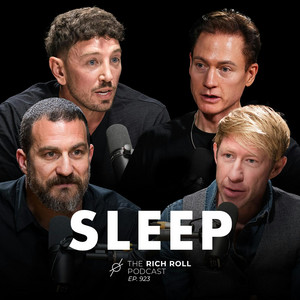
When sleep is abundant minds flourish, when it's not they don't.
We should be accessing as much uninterrupted deep sleep as we can.
Everything revolves around sleep, nothing changes existence more than sleep.
It is never too late to start sleeping better.
We know that this chronic circadian disruption significantly increases risk of metabolic diseases.
The leading cause of of death in late -stage adolescent teens is road traffic accidents, and here sleep matters enormously.
The thing that we are all a slave to, all of us, is the 24 -hour circadian cycle.
I love the sleep data.
I started to look at the data.
The data was immensely powerful.
Everything falls apart without sleep.
I don't know how to communicate any better.
This episode is brought to you by Whoop.
I just returned from a week in Boston where I had this really amazing privilege of spending the better part of two entire days at the Whoop headquarters.
I got to spend time with Will Ahmed, Whoop's founder and CEO, as well as dozens of key team members who pulled the curtain back to give me a rare behind the scenes look at what they do, how they do it, why they do it the way they do it, the culture, the intentionality behind the technology, the exciting innovations that are on whoops near horizon and it was all just so impressive and really affirmed why i not only love the product but feel kinship with their mission a mission i have been aligned with for years evidenced by this band on my wrist right here and why i never take it off in any event
in case you were wondering whoop is the only wearable that turns your health and fitness data into personalized guidance leveraging everything from resting heart rate HRV sleep stages and efficiency and real -time stress levels to inform how you train work and recover so you can live better and now the all -new whoop is here and the recent upgrades are dramatic in addition to the sensor now being seven percent smaller the battery life now extends to a remarkable 14 days the new health span feature shows how your daily habits impact your pace of aging and hormonal insights provide personalized guidance
throughout your cycle or pregnancy and the new whoop mg even boasts a heart rate screener with on -demand ecg reading so you can monitor your heart anytime and share your results with your doctor and you can join now at join .whoop .com slash roll that's join .whoop .com slash roll This show is sponsored by BetterHelp, and today I want to help you better by talking about workplace stress, which is something that is real and also something that's getting worse.
In fact, 61 % of people globally are dealing with higher than normal stress levels, which when you understand the very real connection between chronically elevated stress levels and and chronic lifestyle disease is concerning.
While we can't walk away from our jobs this summer, we can change our relationship with what we do because while a vacation is great, that is not a long -term solution.
A long -term solution requires we take steps towards reducing the negative emotions that we associate with our occupation.
And those steps include, learning how to navigate daily challenges, set boundaries, develop coping skills, all of which are very difficult.
called, I say this from personal experience, to do alone, which is where therapy comes in.
I'm a huge advocate for therapy.
I have been for years.
And this is something that really isn't just for crisis moments.
It's mental maintenance, learning tools to handle whatever the workday throws at you.
And BetterHelp really has done a great job of making this accessible.
Over 30 ,000 therapists serve 5 million people worldwide, 4 .9 out of 5 stars from 1 .7 million reviews.
As the largest online therapy provider in the world, BetterHelp offers access to a diverse range of mental health professionals with various areas of expertise.
Unwind from work with BetterHelp.
All of you can get 10 % off your first month at betterhelp .com slash richroll.
That's betterhelp .com slash richroll.
There was this reporter that wrote an article recently for GQ.
I was at this anti -aging conference and this person who interviewed me said, you know, like, what is the number one thing you do for, you know, anti -aging?
And this reporter, she told the story like, so people are listening, like, what's Brian Johnson going to say about this thing?
is he going to say like some peptide or you know Sano or whatever protocol and then he says sleep and she said then like the crowd just has this collective like sigh of disappointment right because it's much sexier to talk about rapamycin yeah whether that was true or not but she was just like everyone is so disappointed with my response but you know like I don't know how to communicate more everything revolves around sleep nothing changes existence more than sleep you have more willpower you have have more zest for life.
You have more energy.
Yeah. I just, everything falls apart without sleep.
I don't know how to communicate any better.
Yeah. And when people want to hear you elaborate on that, the focus tends to be on the blackout curtains and the type of sheets and the air purifier that you have in the room and the temperature of the room.
And those are all fine and well and important and play their part.
But to really appreciate it, you have to, you have have to actually embrace the entirety of the program.
Yeah, exactly right.
I mean, I think we're all competing for status and power in society, you know, like in all of our own little circles and places.
And there's so much mythology caught up in the hero being sleep deprived and sleeping under the desk and going days without sleeping.
It's so built into the psychology that people are trying to signal to others, I'm worthy of being respected.
I'm worthy of this status.
I'm I'm worthy of being admired.
I'm worthy of this mythology.
So they're doing things to play the script because they think it generates their respect of others.
And in their mind, they may believe it too, like this is how genius is achieved.
I can think of so many examples of people who have done this.
And so it's so deep in our psychology that sleep deprivation is somehow positive, that that's what stops most people from adopting it.
That hustle porn culture and notion of sleep is in its twilight.
Like, I feel like we've really gone a long way towards raising awareness around that.
Like, that's shifted a lot, even in the last couple of years, I think.
I concur. Yeah. Yeah, just even like when I talk to my friends, like, they'll come to me and say, like, I want this so badly.
We have to engage in a therapy session where I'm like, what's up?
How's it going? And then we dig into deep into their psychology and they uncover and unravel that they really are trying to be on mythology level with their levels of accomplishment.
Now, it takes a lot of vulnerability for the person to be that honest. But once we do that in private and they're like, oh my God, this is totally unnecessary, I can achieve my objectives of ambition and status and power and wealth and success, and I don't have to do this sleep deprivation thing.
And it's so liberating for them.
They actually become better at their craft. These circadian rhythms are primarily affected by two external cues.
in our environment there's two things that can really throw them out of whack one is light exposure so if we're sitting up late at night in very very very bright lights it's let's say it's 9 p .m our body and it's dark outside our body we might be sitting in la but our our body thinks we're in Sydney.
So we can cause some dysregulation of our circadian rhythms and then that affects the release of melatonin, which has an effect on your sleep, for example.
We can also dramatically affect these circadian rhythms through the timing in which we eat.
That's the other really important signal here.
So within this challenge, we have have two different habits that speak to nurturing our circadian rhythms one is light exposure we want people in the morning to get outside get at least 10 minutes of natural light exposure in the first couple of hours of waking up that's important that sets your clock this is the The Huberman protocol around morning sunlight.
And then at nighttime, as the sun's going down, ideally you don't have to turn all the lights off in the house, but it will be helpful if you dim the lights down.
And if you're using screens, you can adjust the brightness on those and put them into night mode.
And then with regards to the timing of our food, food, there's some really interesting research that has come out of Courtney Peterson's lab.
I interviewed her looking at how efficiently is our body utilizing nutrients at different times of the day.
And it seems that particularly at nighttime, a couple of hours before we go to bed, we have changes in hormones that make things like glucose metabolism much less effective.
It makes sense. Our body is getting ready to go to sleep, not to digest food and convert it into energy.
The ideal kind of eating window, and some people have described this as a circadian circadian, biology eating window or circadian fasting, I don't think it's really a crazy fast, is you're in bed for eight hours a night.
That's what we said just before.
And when you wake up, not eating for one or two hours upon waking.
And before you go to bed, not eating for one or two hours.
Before you go to bed.
Before you go to bed.
Now, let's say you do that as two hours.
So you're in bed for eight, you don't eat for the first two hours of waking up and then before you go to bed, you're not eating in the two hours leading up to bed.
Automatically, that means your eating window is at 12 hours.
The average person's eating window in America is 15 to 16 hours.
So pretty much rolling out of bed, having a bite of a donut and heating all the way up to going to sleep again.
The reason why all of this is important is that we know that this chronic circadian disruption significantly increases risk of metabolic diseases, significantly increases risk of obesity, of cardiovascular disease.
So there are repercussions if we're we're living in a way where our circadian rhythms are disrupted.
And it's not just the long term.
If you're experiencing chronic circadian disruption, you're likely to feel more brain fog, more fatigue, less lower energy or lethargy on a daily basis.
So just getting some routine in place where we're in bed for eight hours, which thinking about light exposure and then we're eating at a regular time trying to avoid eating too close to waking up or going to bed it can make a very big difference this is like my Mount Everest because I get so hungry at night man it's very difficult for me to not eat in the two hours before I go to sleep like that is my Achilles heel so if I accomplish nothing other other than figuring out how to master that as a result of doing this challenge.
That would be a huge win for me.
Have you played around with the types of food that you're eating?
Yeah. And, and, uh, you know, when I was wearing a continuous glucose monitor is very evident, like when I would eat, like right before going to bed, how it would wreak havoc on me.
Um, and, and, and, you know, I wake up, I wake up in the middle of the night and stuff like that.
and my blood glucose regulation is super dysregulated as a result of that.
I know I shouldn't do it and this is a habit that's been very difficult for me to break.
I haven't seen this formally studied so I can't speak to an intervention but I have a hypothesis here and I'm not sure whether you've tried this but I'd be interested to see what happens if you have a slightly lower carbohydrate dinner and higher fat.
And I suspect because that will be slower to digest and metabolize that you might feel fuller for longer.
It's a weird satiety thing and I don't know if it's just mental or emotional, but if I don't feel full when I get into bed, like I feel like agitated.
it you know i feel like i need to there's something emotional or physiological about you know how you kind of relax when you have when you when you've just eaten like your anxiety and your stress level lowers and for some reason if i'm going to bed and i'm hungry like it becomes very difficult for me to fall asleep i get that you might need a bigger bigger plate at dinner i eat plenty trust me dude anyway i don't want to get too sidetracked on that but i think that's really important and that's great and if you want to be more uh rigorous about your sleep tracking there's always you know like
a whoop or something like that that you can get um that you know listen i never take this thing off and it's really been helpful in keeping me on track not so much for the day -to -day but more for the trends and just understanding the types of behaviors and habits that influence things like HRV and the amount of RAM or deep sleep that I'm getting every night and how that impacts resting heart rate, stress, like all those sorts of things.
It's just information that arms you with the data points to kind of solve the arithmetic of what works for you and what's leading you astray.
Yeah, I love the sleep data.
And I agree, I've been able to identify a few different kinds of patterns.
I've noticed if I'm working really late, then my restorative deep sleep is much lower, probably going to bed thinking about things.
Right, and then if you correlated that with where your stress levels are and how long it takes them to go down as you go to sleep, because if you haven't reduced those before going to bed, you're gonna have a less restful evening of sleep.
Yeah. My recovery today was 86%.
That's pretty good.
I was happy with that.
Yeah. Right on. One thing that's clear from the work on sleep that's now working its way into the naming and understanding of brain states and wakefulness is that one state precedes another.
Now, your bike ride where you're listening to the audio book is a way in which you're coordinating your respiration physiology, your breathing and your motor output, your bike riding with the ability to access auditory information and remember it well so you figured out something about that state but the neuroscientist in me says okay but what follows that state when you get back what state are you in then is it a state of exhaustion that allows you to go into deep rest to access neuroplasticity or is it a state of where you've essentially moved all that excess autonomic arousal out of your body
and now finally you can sit down and just focus your cone of attention on your work so one state precedes another and one thing that i think can be incredibly useful to people would be to think about two hallmarks of brain states in order to access them more readily.
One is that the thing that we are all a slave to, all of us, is the 24 -hour circadian cycle.
Every cell in our body has a 24 -hour clock that runs at the level of genes and the level of cellular processes.
And every network in our body, whether or not it's nervous system, spleen, whatever, is governed by this 24 -hour clock.
We can fairly crudely but still accurately separately, subdivide that 24 -hour period into three phases.
What I would call phase one, and I'm just naming it phase one because we don't have a better name for it, is from about zero until about eight or nine hours after you wake up.
Phase two is from about nine hours after you wake up until about 16 hours after you've woken up.
And phase three would be from about 17 hours to 24 hours.
The 17 -hour to 24 -hour period that we're calling phase three is sleep.
And we know what we should be doing in that state.
We should be accessing as much uninterrupted deep sleep as we can.
And the beautiful work that Matt's done and others have done says, okay, lower the temperature in the room, elevate your feet a little bit, et cetera, et cetera, keep it dark.
I mean, there's a lot of things that we could talk about there.
Phase one and phase two, we know based on really good neuroscience, have certain signature patterns of neurotransmitter release and autonomic arousal that lend themselves better to certain activities, both mental and physical, and not others.
Phase one, for instance, is always accompanied by an increase in cortisol.
This is a healthy release of cortisol, a stress hormone that wakes us up.
It's part of the wake -up system.
The release of epinephrine, which is also called adrenaline, and the molecule dopamine.
It turns out epinephrine and dopamine, dopamine actually actually manufactures epinephrine there biochemically.
So that phase one of the day in many ways is ideal for any kind of linear action -oriented items. People will differ.
Some people say I do creative work best early in the day, but most people are going to do best at kind of correct answer type work, meaning where there is a correct linear output, it's going to be accounting type work, or it's going to be exercise where you might not know exactly what you're going to do, but there is a process that that you can follow.
It's going to be punching out a certain amount of words on a page because you're just trying to get the words down on the page for the book or doing math or doing any kind of linear operations during that first phase one.
Phase two has a signature pattern of neurotransmitter release in the brain and body that are more closely associated, not exclusively, but more closely associated with the release of things like serotonin.
These are neuromodulators that tend to make us feel a little bit calmer and they disrupt, or I should say they alter because cause it's not a pathological shift, but they alter our perception of space and time in a way that allows us to make mental associations that are a little bit looser.
They can be nonlinear.
So that's a time that's excellent for creative work or for brainstorming.
And you might notice that when you're a little bit fatigued, your mind is a little freer.
And if you're very fatigued, your mind is all over the place.
So one thing that I think has been missing from the brain state work has been a kind of cohesive framework.
And yet everyone, I think every neuroscientist would agree that the 24 hour cycle really governs, not just digestion and bodily temperature, because it does.
Temperature is higher in the morning, rising, rising, rising to the afternoon, then starts coming down.
And then you go into sleep in phase three because your body temperature is lowered.
So those three phases really drive our brain states.
And one precedes the other.
This is the key thing.
We can never look at a state in isolation.
But if you wanted to understand, for instance, how to access a state of heightened creativity, you might try placing it in phase two of the day, so 10 to 16 hours after you've been awake and see how that works for you.
And pay attention to your state of mind before you attempt to go into that state and as you exit that state.
And so I think that if we've learned anything from the sleep science, it's that we can't look at one state of mind in isolation.
We need to ask what preceded it and what follows it in order to understand its structure and how to access it better.
I've been drinking AG1 for 10 years now, a decade, which is so wild.
And I bring it up because it affirms a rule that is the secret to every success I've enjoyed.
And that rule is the little things are the big things.
And by that, I mean the tiny little positive actions that you you take consistently daily are the very thing that move the needle the most when it comes to turning who you are today into that better version of tomorrow.
And one of those small daily habits just happens to be AG1, a very easy and delicious way to simply sidestep any nutritional gaps that helps personally my energy stay high and my focus key.
AG1 is one supplement that just works and And therefore, a foundational part of how I start my day, every day.
One scoop, some water, that's it, simple.
I don't even think about it.
And I know I'm covering my bases in a way that supports my immune health and keeps my gut healthy.
And now AG1 has leveled up even more with their AG1 NextGen.
This upgraded formula has been clinically shown to increase healthy gut bacteria by 10x.
All for the same price of less than $3 a day.
Now clinically backed with an advanced formula, this is the perfect time to try AG1 if you haven't yet.
I've been drinking AG1 for years now, as I mentioned, and I'm just so happy to be partnering with them.
So subscribe today to try the next gen of AG1 for less than $3 a day.
If you use my link, you'll also get a free AG1 morning person hat.
Exciting. A welcome kit and more goodies included.
Check out DrinkAG1 .com slash Rich Roll to get started yourself.
That's DrinkAG1 .com slash Rich Roll.
We are brought to you today by Roca, the best shades and prescription specs you're going to find, which is why you will always find me wearing them.
The Hamiltons are my preferred daily go -to everyday shades.
I've got them in like four colors and the Torinos that I wear on the trail, on the bike.
But that's just a taste.
The main dish is their award winning sport technology behind their fashionable frames, because while all their glasses may look normal, suited for any social situation behind the scenes, they are built for performance.
performance. Super light, durable.
They never slip no matter how much you sweat, whether that is in the boardroom or in the pain cave. So for those who need it, Roca offers a full range of prescription eyewear, including prescription sunglasses, and they have a full optical lab at their headquarters in Austin, Texas.
Summer's a great time to upgrade your glasses.
So if you want to try them out for yourself, you can do that right now and unlock 20 % off with the code richroll at rocca .com.
That's R -O -C -C -A dot com.
The rates of suicide are far higher in young residents.
And what we've discovered over the past maybe 10 years, and we've been doing a lot of this work too, is the intimate relationship between sleep and your mental health.
And what we know is that when you are not getting sufficient when you have insufficient sleep, your suicidal thoughts increase, suicidal planning increases, suicide attempts increase, and tragically, suicide completion also increases as well.
And more generally what we've discovered, and I've been doing this for about 20 years now, we have not been able to discover a single psychiatric condition in which sleep is normal.
And so I think sleep is a profound story to tell in our understanding our treatment maybe even our prevention of grave mental illness well certainly in saying that it should be the first stop on the kind of treatment protocol right like how is your sleep let's deal with that first before we look at pharmaceutical interventions yeah it's a stabilizing force and we know it's a stabilizing force both in terms of your psychology as we we mentioned impulsivity, but also just from a basic reward brain sensitivity that your addiction potential from a brain perspective is higher with insufficient sleep.
Same individual, two different sleep conditions, two different addictive profiles.
Right, wow. Wow, I have to reassess my whole life now.
Oh, I'm so sorry. No, it's fine.
No, it's good. I wanna talk about sleep in adolescents and in teens because I think the work that you're doing here and the issues that you're trying to raise awareness around are super important.
The implications of chronic sleep deprivation in young people, the relationship to early school hours and how this plays out in terms of academic potential and the mental health implications that you just mentioned.
Yeah, so there's been a remarkable amount of work looking at this issue of early school start times, this incessant model of marching back the school clock hours.
And the summary of the evidence, really, I think it goes the following.
Firstly, we see that academic, when you shift schools to a later school start time, so when you do a causal intervention, what happens?
Firstly, academic grades increase, truancy rates decrease, psychological and psychiatric referrals also also decrease.
But what we also discovered is that the life expectancy of those students increased.
And you may think, well, hang on a second.
How do you, how does that work?
Well, the leading cause of death in late stage adolescent teens is actually not suicide.
It's road traffic accidents.
And here sleep matters enormously.
And there was one good example.
I think it came from Teton County in in Wyoming.
They shifted their school start times from around 7 .30 in the morning to just before nine o 'clock in the morning.
The only thing more remarkable than the extra hour of sleep that those kids reported getting was the drop in road traffic accidents.
That following year, after the time switch, there was a 70%, 7 -0 reduction in car crashes in students 16 to 18.
Statistically unbelievable.
It blows my mind. Now, statistically, you can give a relevance to that.
Think of the advent of ABS systems in cars, anti -lock brake systems that stop your wheels from locking up into hard braking.
That dropped accident rates by around 20 % to 25%, and it was deemed a revolution.
Yet here is a simple biological factor, giving our kids the sleep that they need, that will drop accident rates by up to 70%.
So if our goal as educators truly is to educate and not risk lives in the process, then we are failing our children in a most spectacular manner with this incessant model of early school start times.
When sleep is abundant, minds flourish.
When it's not, they don't.
Right. There's so much education, I think, that needs to be done in this area as a parent of two teens, I've got four kids, two older boys.
Any parent knows how difficult it is to wake up a young adolescent in the morning and the frustration that comes with that.
But what I've come to better understand by dint of your work is how crucial sleep is for that developing brain.
And during COVID, we have one child, our younger child, who's being homeschooled right now, we've let her sleep in as long as she wants.
And we don't start her first class until noon.
And so she's getting a ton of sleep, but if you even tried to wake her up at nine o 'clock, I mean, forget it.
You're gonna spend the next hour and a half trying to get this kid up.
So clearly there's a reason why that state of sleep is so deep, right?
Like that it is crucial in this developing mind.
Yeah, and we often have that classic idea of a parent at the weekend pulling the sheets off the teenager, riffing open the curtains and saying, you're wasting the day.
But firstly, what we know is that it's not their fault because during that adolescent transition, there is a biological shift in their 24 hour rhythm that they now want to go to bed later and wake up later.
later. So, asking a teenager to wake up at seven o 'clock in the morning and operate and conduct themselves with good grace and be able to learn effectively is like asking an adult, you know, to wake up at 3 .30 or four in the morning and be the best version of yourself.
You know, if I was to wake up at, you know, three o 'clock in the morning and come through to the kitchen and we were both awake, I'd have to say to my partner, you know, I would say to her, look, darling, and she would say like, well, why are you so moody?
I'm just not the best version of myself because I'm I've woken up too early and she will definitely tell you that.
But I think it's the same, you know, misgiving because we don't understand how sleep works with our teenagers.
And so putting them in the school at that time seven or eight in the morning essentially is, you know, educating them amnesic.
They are at that stage, they are leaky sieves And what will go in will just come out the other side.
So that's the first thing that's happening.
It's not their fault.
It's just their biology.
And then second, at the weekend, they're trying to sleep off a debt that we've lumbered them with during the week because of these early school start times.
And if you ask parents, if you sort of question parents of teenagers, what proportion of parents think that their teen is getting sufficient sleep?
and more than 70 % of them say, I think my teen is doing fine, I think they're getting the sleep that they need.
When in reality, less than 15 % of those teens are actually getting the sleep that they need.
So there is a parent to child mismatch in sleep understanding.
And as a consequence, there is a parent to child transmission of sleep neglect.
Parents don't see it, they don't understand it.
And so in 15 or 10 or 20 years time, that teenager, lo and behold, seems to have amnesia and they, with their own kids, will do the same thing.
They'll pull the sheets off and say, you're wasting the day because it was taught to them by their parents that sleep and getting the right timing of sleep and the right amount of sleep is something shameful.
So for that young person, do they need more hours?
hours? They do. So, the eight -hour rule doesn't really apply.
No, that's for adults.
Yeah. And in fact, the brain doesn't stop developing until it's about 25 years old.
And sleep plays a critical role in what we call brain plasticity, which is modeling the brain.
It plays a role early in life.
In the first couple of years, sleep seems to actually help wire up the brain.
so it's almost like sleep at that time of life comes in to a new neighborhood and like an internet service provider it wires all of those homes with high -speed fiber optic cables but then later in life that's when during the teenage years we've actually realized which homes are using the high bandwidth and which homes aren't really sort of drawing on that sort of you know that broadband band speed.
And so then the role of the brain, it goes from expanding and creating lots of connections, which is called neurogenesis, to then actually synaptic pruning, which is where we now have to make the brain efficient for adulthood.
Should we be sleeping though differently than the way that we are in modernity?
And I actually think there is an argument for this.
because if you look at hunter -gatherer tribes whose way of life hasn't changed for thousands of years, they don't sleep the way that we do.
They don't sleep in what we call a monophasic pattern which is trying to get one long single bout at night and then we're awake for 16 hours.
They sleep biphasically.
So typically, depending on what season, be it winter versus summer, they will sleep for anywhere between sort of six to seven hours at night and then they will have this siesta -like behavior in the afternoon where they have a nap, getting this sort of fuller opportunity.
So, I think modernity, you could argue, has actually dislocated us from our natural edict of sleep schedule.
Is there any other evidence to support that?
There actually is. Most people will know this.
somewhere between about two to 4 p .m. every day, you will have a drop, a pre -programmed and it's genetically hardwired drop in your alertness.
It's sort of that you're around the boardroom table after lunch and all of a sudden you start to see these head bobs going on.
It's not people listening to good music.
They're just giving way to what we call the postprandial dip in alertness.
And it is decoupled on some level from the food coma, right?
Like part of it is, oh, I ate a big lunch, but this is independent of that.
You can prevent people from having lunch and they still have, and I put electrodes on their head, we can still measure this alertness drop.
So it is independent of food.
Right, so siesta. So siesta, and you can ask, well, if that is how we were designed to sleep, is there any evidence that something goes wrong when you change that natural behavior?
behavior. And that actually happened as a natural, well, an unfortunate natural experiment in Greece a couple of decades ago.
They decided that they were going to do away with the siesta policy.
So if you went to Greece, you know, in the 1980s, and you walked around the towns, you would see on the shop windows, it would say open from, you know, 10 to 2 p .m., close from 2 to 5 p .m., and then open from 5 to 10 p .m., because there was a standardized standardized siesta practice.
They decided to do away with that.
And so Harvard researchers said, okay, we're going to see what happens.
What are the consequences?
And they focused on cardiovascular disease.
So they tracked the sleep and the health, the cardiovascular health of well over 23 ,000 Greeks.
And what they found is that across that five -year period, there was a 37 % increased likelihood of having a heart attack.
In fact, it was worse in males.
In males, there was a 60 % increase in likelihood of having a heart attack.
And what was happening, it seemed, if you looked at the data, is that they were still sleeping the same, maybe just six hours a night.
And they were doing away with the nap during the day And they weren't replacing that sleep time back into their night phase.
They were staying true to what they'd been doing before at night.
And they'd just been shortchanged of their sleep during the day.
And that led to cardiovascular health consequences.
So if no siesta, you gotta make sure you get the eight hours.
But if you're engaging in that hunter -gatherer practice, you can go six and two or whatever.
And that seems to be fine.
I would say that there's probably a couple of caveats with naps though.
Naps are a double -edged sword. If you are struggling with sleep at night, the recommendation is do not nap during the day because what you want to do is build up all of that healthy sleepiness.
And it's a chemical called adenosine.
It's sleep pressure, essentially.
And the longer that you've been awake, the more of that adenosine, the more of that sleep pressure builds up.
And it's not a mechanical pressure in your brain, don't worry, it's a chemical pressure to sleep.
And then after about 16 hours of being awake, there seems to be enough adenosine, enough sort of sleepiness to be weighing down on your shoulders that now you can fall asleep and then stay asleep.
So if you're someone who has fragile sleep or insomnia, you shouldn't nap during the day because taking a nap during the day will actually just, it's almost like a pressure valve on a steam cooker.
You just release some of that healthy sleep pressure that's been building up.
And now when it comes time to fall asleep or stay asleep at night, it's that much harder.
So the advice would be if you don't have sleep problems and you can nap regularly, then I would say naps are just fine.
But if you can't do it regularly, and especially if you suffer from sleep problems, try to stay away from naps.
If you are going to nap, nap before 2 p .m. in the afternoon.
Going later than that can be problematic for your sleep.
It's a little bit like snacking before your main meal.
It just takes the edge off your appetite.
It's the same way with naps.
I want to talk about fasting, something I used to think about in binary terms, like you're either eating or you're not, right?
Well, if you're a longtime listener of this show, then you'll probably recall my conversations with Dr. Dr. Walter Longo, who, if you don't know, is one of the world's preeminent research scientists on nutrition and longevity.
And this is the guy who pioneered a very novel middle ground approach to fasting where you can actually nourish your body while also triggering cellular repair processes that happen during fasting.
Like autophagy, a Nobel Prize winning cellular repair process that cleans house in your body and you get to eat while it happens, which is nuts, right?
And now there is a safe and simple way to do this at home, courtesy of Prolon's fasting mimicking diet.
A five -day plant -based nutrition program developed over decades at USC's Longevity Institute by Dr. Longo himself.
It's got soups, it's got snacks and beverages that nourish your body while also keeping it in a fasted state.
Prolon next -gen features include 100 % organic soups and teas with richer taste.
everything prepackaged and ready to go it supports biological age reduction metabolic health skin appearance fat loss and energy prolon is the first and only patented nutrition program for longevity through cellular rejuvenation for a limited time you can be the first in line to experience the new next gen at special savings prolon is offering all of you 15 off site -wide plus a 40 bonus gift when you subscribe to their five -day nutrition program.
Just visit ProLonLife .com slash Rich Roll.
That's P -R -O -L -O -N -L -I -F -E dot com slash Rich Roll to claim your 15 % discount and your bonus gift. ProLonLife .com slash Rich Roll.
I want you to pause for a moment because I want to tell you about my friend, RJ.
Now, you might know this guy as the founder and CEO of Rivian.
He's certainly that, but he's really so much more.
He's one of those rare people who actually walks the walk.
I've watched him over many years, and I know him to be this incredibly deeply committed person, committed to preserving wild spaces while also inspiring people to explore responsibly.
And that's basically Rivian in a nutshell.
Their mission, keep the world adventurous forever, ever comes from this understanding that adventure and a healthy planet, these are not separate things.
They're the same thing.
Here's what gets me.
Every generation deserves wild places to roam, to climb higher, to run farther, to be changed by the journey.
But obviously, that's only possible if we're not destroying those places in the process of getting there.
So yeah, Rivian builds electric vehicles, but really they're building something bigger, momentum toward a future where where exploration does not come at the expense of nature, but actually inspires us to protect it.
It's like, why create the ultimate adventure vehicle if we're not protecting the adventures themselves?
And that's why I'm so proud to align forces in partnership with Rivian.
This isn't just about transportation.
It's about building a world worth exploring for our kids, for their kids, and for generations to come.
So I'm sure you or somebody has studied what happens if you take exogenous adenosine, right?
Like wouldn't that seem to be the way in to resolving this problem for people that have insomnia?
Hard to get it across the brain barrier, which is a protective layer around the brain.
And, you know, there's some issues around toxicity as well.
So yeah, that certainly would have been the idea.
But what's lovely is that, you know, you can increase sort of sleep pressure in a number of non -pharmacological ways and exercise is a great demonstration of that.
And I think, you know, we can speak about all of these different over -the -counter medications that people try to invest in and think that that's going to give them a good night of sleep.
But there are probably two really simple things that you can do non -medication that are, if you look at the data, are almost guaranteed to improve your sleep, which is some form of physical activity most days or at least several days a week.
And the second is deal with your anxiety.
Anxiety is the principal cause of insomnia.
It's not the only cause, but it's our current working model of insomnia that people who have a high fight or flight activation of the nervous system, branch of the nervous system, they also have high levels of stress chemicals, such as cortisol.
And that seems to be very predictive of their insomnia.
and if you can start to manage your anxiety, for example, meditation is a fantastic practice.
And, you know, before I was writing the book and I was sort of starting to research, I was a bit of a stupid hard -nosed scientist. You know, I just thought this meditation stuff was maybe a little bit woo -woo and sort of, you know, come by hour and we all hold hands.
And I started to look at the data.
The data was immensely powerful and very robust that people, when they are suffering from insomnia, if you put them into a meditation or mindful practice, you can actually drop the severity of the insomnia in a way that medications, such even prescription medications can't come close to.
Yeah, I mean, I just know, Well first of all, if I don't exercise, forget about it.
I know I'm gonna struggle with sleep at night.
And if, and when I have difficulty falling asleep or I wake up in the middle of the night, I've become very attuned to what my mind is doing, and it will generally default to some problem that I'm having or conflict that I'm trying to resolve.
And I'll just loop some narrative.
And that produces a tremendous amount of anxiety, which obviously prevents me from falling asleep.
sleep. So I noticed that.
And then I course correct through either some kind of mindfulness practice to kind of create space and push that narrative aside or, you know, overcome it with a different narrative.
And sometimes I'll just think about a book that I'm reading or a movie that I saw, and I'll just immerse myself in that narrative.
And that's like a distraction.
Exactly. that literally short circuits that other anxiety producing narrative and I fall asleep.
You're so right. So I think, you know, in this modern day and age, sort of, you know, the MTV fast food 24 seven society, we're constantly on sort of reception, particularly with now all of this digital technology and rarely do we do reflection.
And unfortunately, the one time when we do reflection is when our head hits the pillow and that's the last time that you want to go into rumination.
You don't want the Rolodex of anxiety spinning up, which is what you were sort of describing because that leads to something that we call catastrophization, that you start thinking, oh, what didn't I do today and what do I need to do more of tomorrow?
And then I forgot this.
And at that point, good sleep is not going to be invited into the brain.
By the way, counting sheep does not work.
There was a scientific study done done by a colleague of mine at UC Berkeley that demonstrated, in fact, if anything, it hurts your sleep.
But if you're catastrophizing, it would probably be better to start counting sheep.
It could be, but what you described was actually what she found.
Far better was to engage in some kind of a mental aspect.
And what they found was take yourself on a walk.
Think about a walk that you know in the forest or in nature or down on the beach, and just start to try to to walk yourself through that or think about, you know, a book that you're reading or think about sort of a podcast and anything to get the mind off itself.
So, for example, I feel embarrassed to say this, but I love racing cars.
And so if I'm struggling with sleep, which I do too, you know, I am not immune to bad nights of sleep and I have had bouts of insomnia.
So comforting to hear that.
You know, I'm just as fragile.
fragile. And so, what I'll do is I'll put myself and I'll think about the track and I'll drive myself around the track.
I know when I need to, which gear I need to be in, where my braking zones are.
And then the next thing I know is I'm waking up in the morning and I just drifted off.
Yeah, yeah, yeah. It's great.
It's sort of a different version of what I do.
What kind of cars do you race?
Oh, gosh. I've raced all sorts of BMWs, Porsches.
But my real love and the car that I own is a little Mazda Miata.
When you're a professor, you can't really go racing in half million dollar cars.
And I love it to pieces.
It is a car unlike Ferrari or Porsche, when you're going 40 miles an hour, it feels like you're doing a hundred.
Whereas in a Porsche, when you're doing a hundred, it feels like 40 miles an hour.
So I'm usually the slowest guy on track, but it brings me a lot of joy and satisfaction.
satisfaction. That's cool.
Well, let's talk a little bit about best practices then.
I feel like we're at that juncture.
And I want to do this by walking you through the extreme lengths that I've gone through.
I know a little of your sleep history.
Tent included. Yeah.
Sleep in a tent causes a lot of consternation and confusion from people that listen to this show.
But I'll just provide a little background to that.
Like, historically have had issues falling asleep.
Part of it, and I'm interested in your take on this, is I think my sense is that it germinates somewhat from being like an extreme ultra endurance athlete.
I've gone through periods of my life where I've put my body through just unbelievable rigor, like 25 hour training weeks where you're just so exhausted.
Sleep is a non non -issue.
Sleep is not a problem when you're pushing yourself that hard. But it's been many years since I've been kind of habitating that space.
And now, but I've acclimated, my physical body is acclimated to doing that, right?
So now if I go out for a one hour run or I go on a casual bike ride, it's not enough.
Like I'm not getting enough of the fatigue to create the restful state state that I aspire to be in.
Like, I have to exercise more than the average person, which is challenging when you're a busy person, so there's that.
On top of that, my body's like a furnace.
Like, I literally burn hot and my wife likes the bedroom a lot warmer than I do.
And we would have these, this back and forth over many years where it's too cold for her, I'm on top of all the covers, she's underneath them, shivering, it wasn't working.
And as kind of a joke, I went, we have a flat roof off of our bedroom and I went and I just pulled a twin mattress up there and slept there one night.
I had an unbelievable night of sleep.
I thought this is fantastic.
It's nice and cold out, the desert air, even in the summer, and that I graduated from that into getting a tent and I've been sleeping in a tent ever since.
I absolutely love it.
The cold air, being under the stars, and being under a bunch of blankets, including a gravity blanket, which I'd love your thoughts on, which I found to be really helpful, speaking about the sympathetic nervous system and trying to calm myself down, and eye mask and nature sounds, and magnesium, like all kinds of stuff.
And the idea being, of course, to create the optimal situation for the best opportunity for eight hours of sleep every night.
And like yourself, I don't always, despite all of that, sleep still eludes me many nights.
but more often than not, I'm getting more high quality sleep than I used to.
But I'm interested in how this kind of measures up with what you found through your studies about best practices, specifically temperature, air quality, all these kinds of things.
Yeah, and so I think there are probably maybe five tips for better sleep tonight, if you sort of can suggest that, or sort of trying to optimize your sleep.
and temperature regularity darkness um walk it out and then alcohol and caffeine and I'll say the last one because it usually if you don't find me um deeply unappealing right now you will after that fifth one temperature is a fascinating one we know that your brain and your body need to drop their core temperature by about one degree celsius or about two to three degrees fahrenheit for you to fall asleep and then stay asleep across the night.
And that's the reason that you'll always find it easier to fall asleep in a room that's too cold than too hot.
Because too cold is taking you in the right thermal direction for good sleep.
And that's why sleeping in a tent, now we understand we're in Southern California, but nevertheless, it gets cooler at night than it is during the day.
Yeah, I wouldn't be doing this in Boston.
Right, yeah. Yeah. It's still, I mean, typically it's low 40s and it goes down into the high 30s and I've never not slept in the tent because it was too cold.
I know that in your research, you found there is an inflection point at which point perhaps too cold is not so good.
Yeah. Once you get into an extreme.
But I have to tell you, when it's 38 degrees, I'm happy and I sleep pretty dang well.
Yeah. I mean, I got a lot of blankets on.
And so it's sort of, you know, the local temperature may not quite be that.
And here's the other thing.
I always have my feet sticking out.
I cannot have my feet under the covers.
Yeah, do you know why?
Yeah, I think I know, but go ahead.
Because it's your hands and your feet that are these incredible radiators of heat.
Your hands and your feet are highly vascular.
In other words, there is this crisscross of vessels very close to the surface and it's very rich in its vascular nature, both your hands and your feet.
And so at night, what the body wants to do is almost like a snake charmer, draw the heat out of the core of the body and evacuate it through the extremities.
And the extremities in this case for as human beings are hands and feet, as well as head.
And that's why you'll sometimes see rebellious, you know when you see kids and you kinda tuck them in all nicely And, you know, you look at your wife and you smile and it's all beautiful.
And then you go back in two hours later just before, you know, you go to bed.
And these rebellious legs are dangling out, you know, sticking out.
It's because you're trying to evacuate the heat.
So you're wise in doing that because they are wonderful thermal discharges.
So that's temperature.
And we do need to drop that temperature.
It's different for different people.
But I think the recommendation would probably be about, you know, 65 degrees or so for most people.
Now, that's obviously averaging across men and women, and it's different there too, as you mentioned, which is around about, if I do my math correctly, it's probably around about 18, 18 .3 degrees Celsius.
So, that's temperature, and that's why I think you definitely will start to sleep better than you at least would do otherwise on a constant temperature.
Richard, because there's another way that modernity has dislocated us from our natural edict of sleep, which is we set a thermostat of maybe 70 or 72 degrees throughout the day and the night, and that's not how we were sleeping.
Now, if you go back to those hunter -gatherers, by the way, for whom you are in some ways mimicking their sleeping existence, they don't go to bed really on the basis of light, which is what we thought.
They usually will go to bed about an hour and a half to two hours after sundown.
And then when they wake up and they don't have alarms, if you ask them about this idea of, you know, artificially terminating sleep with an alarm, they're perplexed.
Also, you know, rates of insomnia in the general first world population is somewhere between 10 to 15%.
In those hunter -gatherer tribes, it's less than 5%.
They're also moving all day long.
They're moving all day long and we can look at diet as well.
So what is determining their sleep onset and their sleep offset is not light, it's temperature.
And if you ask people, if you just bring them into the laboratory and you say, at what point do you feel sleepy at night?
It's at the point where their core body temperature is on the steepest decline.
Now, they don't know that even though unfortunately we've placed a rectal probe inside of them, which is no fun for either the experiment to insert or for the participant to receive.
But they are on the awesome downslope of the thermal evacuation, and that's when they feel sleepy.
And when those hunter gatherer tribes wish to wake up is before dawn, just before dawn, but it's as the temperature starts to rise back up.
so it turns out that we actually need to warm up a little bit to get cold we need to bring the blood to the surface of the skin that's why cold it must be in the bedroom but you can wear socks if you want or you can have a hot water bottle but keep it cold because warming the feet or sticking them out of you know the mattress will help your body evacuate the heat and plummet your core body temperature and it's the reason by the way that hot baths and showers work for good sleep as well Well, I think many of us, even if we've got blackout curtains and sort of, you know, we're wearing an eye mask,
we will wake up and I think we have some general sense, but maybe plus or minus an hour in terms of accuracy that, okay, it's still probably the middle of the night, or it kind of feels like late in the morning.
And in part, that's because you do have an internal 24 -hour clock.
But I also think that there's something that we've lost in terms of our light exposure that you have gained back, which is that it's not just that your internal clock, which may get you, you know, within one hour plus or minus, it's not bad at doing that.
But when you open up your eyes and you get additional exogenous information, which is from the outside world, rather than the endogenous clock time that your 24 -hour clock is giving you, then you shift from plus or minus an hour of accuracy to maybe plus or minus five minutes, you know?
Yeah, it's fascinating.
You know, I love this.
You know, it's something I, when I retire, maybe I'll look at this because there's something very strange about sleep and time that is utterly paradoxical.
And what I mean by this is you can say, say okay I've got to wake up because I'm going to um you know I'm gonna fly out and meet Matt Walker in Berkeley and and you know we're gonna grab coffee and I've got to get this early morning flight from LAX and you set your alarm for you know five o 'clock in the morning and guaranteed you will wake up at 458 100 how is that right possible it happens too frequently for it to be you know just by chance so somewhere your brain has this quartz -like precision of clock counting however there is an absence of time particularly in dreaming because all of us have probably
had that experience that our alarm goes off and we were in this strange dream and then we hit the snooze button and our snooze button is just two minutes and we go back and we go right back into into the dream again and then the snooze button goes off and you think, now hang on a second, that felt like almost an hour of an experience.
So there is this temporal mismatch where when we go into the dream state, we can almost fold and compress time like a concertina.
It's like inception.
Yeah, and I think it's no big surprise that Nolan picked up on that with the help of maybe some sleep specialists offering that advice, we know that you get this dilation, I've called it dream dilation or dream time dilation where time is no longer time.
Right, so what do you make of that?
Like what would be the evolutionary advantage of that?
Well, it may be that there is no necessarily evolutionary advantage, but there may be a brain mechanism that explains it because what we know is that memories are replayed during both deep sleep and REM sleep.
Now, when we are in deep sleep, memories are actually sped up.
The brain will actually be replaying those memories anywhere between five to 20 times faster.
But when we go into dream sleep, the replay is actually much slower.
Is there a potential long -term organic atrophy consequence of insufficient sleep on the brain, we seem to think that there is, yes.
But again, I think I want to be really careful here, and I don't want to be causing people alarm.
And what I would say is that it is never too late to start sleeping better.
And that's not just me sort of pulling out the pom poms and trying to be positive.
We've got data. So in a series of studies, and we've done a lot of work in, as I mentioned, in older adults, but if you take a group of midlife adults who are suffering from untreated sleep apnea, heavy snoring.
And then you put them on treatment, which is called a CPAP machine, C -P -A -P, the continuous positive airway pressure.
And by the way, if anyone's listening to this and they think that they suffer from sleep apnea or they have a partner who does, please go and get diagnosed.
It is a deathly disease, untreated.
And what they found is that about half of those participants complied to the to the treatment, and about half didn't, and they tracked them over a 10 year period.
And what they found is that those individuals who complied to the treatment and whose sleep was improved as a consequence, they staved off the onslaught of Alzheimer's disease and cognitive decline by anywhere between 10 to 15 years relative to those who remained untreated or uncompliant with their treatment.
In other words, even in midlife, there is evidence to say it's never too late to start sleeping.
But can those brain centers that have atrophied be regenerated or is that a permanent thing?
We don't know. It depends on what extent of atrophy.
We used to think maybe 30 years ago that the brain didn't produce new brain cells.
Once it had matured and once you were an adult, that was your sort of smorgasbord of brain cells.
And as you lost them through time, that was never when you drink you kill brain cells they never come they never come back yeah well that's not true there are in many regions of the brain that is true but there are a couple of regions that it's not true and in fact these memory centers the hippocampus that's one of the centers that does actually seem to have some degree of regenerative capacity you know how how capable of meeting the demand of brain atrophy and damage that that system is of regeneration is unclear.
What I should note, by the way, is that that system of the creation of new brain cells, it's what we call neurogenesis, which I think is a great alternative name for a band rather than just genesis, Phil.
If you deprive a rat of sleep, it fails to have the regulation of that neurogenesis.
You lose the capacity for neurogenesis when you are underslept.
So it becomes this self -fulfilling negative vicious cycle of prophecy that if you are not getting sufficient sleep, those brain cells start to deteriorate and atrophy.
And then the one thing that could help you get them back is the one thing that you keep depriving yourself of, so you lose even the salvaging of that.
That's it for today.
Thank you for listening.
I truly hope you enjoyed the conversation.
To learn more about today's guests, including links and resources related to everything discussed today, visit the episode page at richroll .com, where you can find the entire podcast archive, my books, Finding Ultra, Voicing Change, and The Plant Power Way.
If you'd like to support the podcast, the easiest and most impactful thing you can do is to subscribe to the show on Apple Podcasts, on Spotify, and on YouTube, and leave a review and or a comment.
And sharing the show or your favorite episode with friends or on social media is, of course, awesome and very helpful.
This show just wouldn't be possible without the help of our amazing sponsors who keep this podcast running wild and free.
To check out all their amazing offers, head to richroll .com slash sponsors.
And finally, for podcast updates, special offers on books and other subjects, please subscribe to our newsletter, which you can find on the footer of any page at richroll .com.
Today's show was produced and engineered by Jason Camiolo.
The video edition of the podcast was created by Blake Curtis and Morgan McRae, with assistance from our creative director, Dan Drake.
Content management by Shana Savoy, copywriting by Ben Pryor.
And of course, our theme music was created all the way back in 2012 by Tyler Pyatt, Trapper Pyatt, and Harry Mathis.
Appreciate the love, love the support.
See you back here soon.
Peace. Buenas. Namaste.