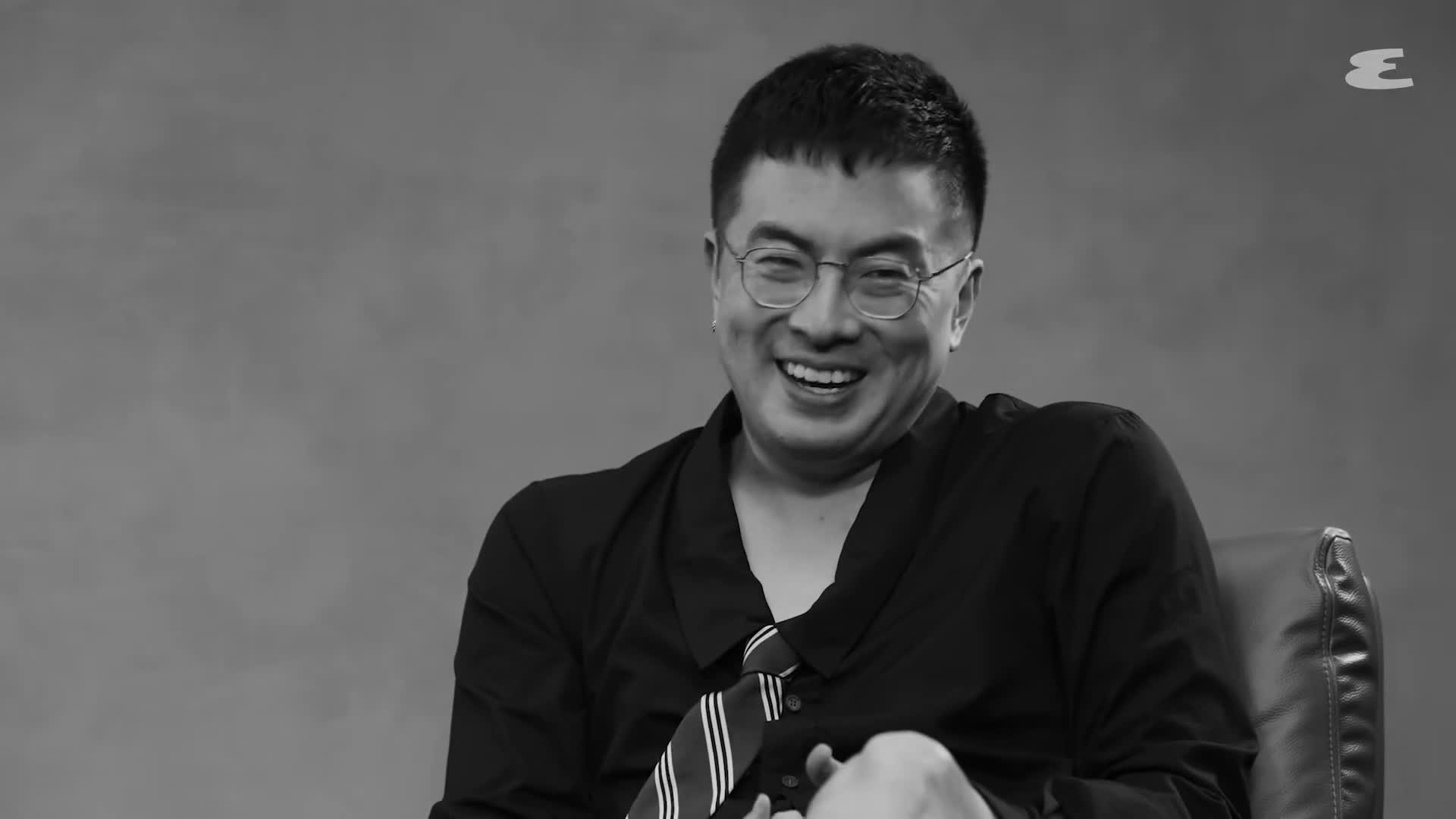
I think we've hit critical mass with me for a little bit.
Lorne Michaels said to you the last thing I want you to do is be the poster child for racial harmony.
How did you react?
That it didn't occur to me until he said it.
You developed a nice friendship with Ariana Grande.
What have you learned from her?
Oh, so many things.
Are there things that you've had to unlearn as you've reached this point in your life?
Hi, I'm Michael Sebastian, editor-in-chief of Esquire.
Today, I'm joined by a comedian writer and actor who's become one of the most distinctive voices in comedy.
Since joining the cast of Saturday Night Live in 2019, he's delivered sharp impressions, fearless characters and a wit that's made him unforgettable.
Somehow he's also found time to star in feature films like Wicked and co-host his insanely successful podcast, Los Culturistas.
Please welcome Bowen Yang.
Hello.
You have a very 2025...
SNL career, right?
You are in movies, you're in commercials, you have this great podcast and, of course, you're on the show.
And I'm curious, like, how do you pull that off?
I think it's all a series of flukes.
We started the podcast on a lark, Las Culturistas on a lark.
Somehow it kept going.
I feel like the SNL audition was also a lark, because it was like we'll never hire someone like me on that show.
So I mean, this is not like my like faux humility imposter syndrome answer.
I think it really is just a series of really lucky accidents.
But I'm very happy about it.
I love accidents.
Yeah, yeah.
So your parents are from China.
Your older sister was born there, and then they moved to Australia, where you were born, right.
If they had stayed in China, you probably wouldn't have been born because of the one-child policy.
Exactly.
Do you think about that?
Constantly.
That would have been very possible.
In fact, they were the first class of students, of young people after Mao's death, where they were allowing youth to leave the country for the first time.
If it had been a couple years later or before, the circumstances would have been so different.
These little butterfly effects are so existentially trippy to me.
I even went back to China this summer for the first time in nine years since I'd been on SNL.
And I just kind of assumed that people wouldn't receive it there.
And then, when I got there, I was taking photos outside my dad's childhood home in Inner Mongolia like a dirt and straw house.
And I posted that to Instagram.
That got picked up on like Red Note, which was like their Instagram TikTok amalgam, basically.
And then that kind of clued me into like the way that people in China, like Chinese nationals and natives, are like still very attuned to Western media.
It's very like spirited contingent of SNL fans in China who like kept up with the news and like all the cash shakeups.
This is just to say that, like none of that would have been possible had, like you know, had my parents not not immigrated out.
Yeah.
It's all trippy.
I mean, I think I've learned that it's just, it's that life is crazy, man.
I don't know.
It's like, there's no, There's no profound thought beyond that.
So then your family moves to eventually Aurora, Colorado, right?
Yes.
Okay.
So you're in Aurora, Colorado, and then you're a teenager right when you come out.
What did you learn from that experience?
Tell me about that.
Yeah.
I still like to remind people coming out being queer or just figuring yourself out in a world that, like It's trying to like download things into you about who you are.
It's a completely interior experience.
I was talking with Lucy Dacus about this, the singer, the wonderful singer.
And she was going on about how we should not damn people necessarily for like wearing the dangly earrings.
She was talking about.
Like she wasn't naming names, but she was like let's not make fun of the guy.
Let's say like the queer baiting guy, quote unquote, for wearing the dangly earrings.
What if that is just like a bridge to something else?
What if he goes back to being like, I'm not wearing the dangly earring.
The dangly earring is like symbolic of something here where it's like I don't even feel this way about actors playing queer roles and maybe they aren't necessarily queer.
It's like, it's an interior thing.
I feel like you're constantly gonna get tested on that interior thing.
What's the best lesson that your mom or dad taught you?
Mom taught me her philosophy is always to stay in your lane, mind your own business, don't get caught up in other people's consternation or drama or anything.
And I think that served me well.
I think I've mostly stayed out of trouble.
I think he just taught me to like keep my head down.
I think mom taught me that.
Dad taught me that hard work does get you out of certain circumstances.
I don't know.
I think that's like... Do the work.
Do the work.
Sometimes the work...
Sets you free.
Sometimes it entraps you.
I don't know.
That's something I'm relearning all the time.
What do you mean?
You can get trapped by the work, obviously.
You get lost in the sauce or whatever.
You know what I mean?
Yeah, yeah.
And then other times you just have to sort of understand that you can assign meaning to the work, but then you can also remove it.
I think work is not the most meaningful thing anymore, as there is this like collective malaise and this like nihilism that people are experiencing, where they're like, oh wait well, nothing means anything, like i've i worked this hard and nothing will come of it, and so therefore, why do it?
I'm getting very sort of like galaxy brained.
I think we love galaxy, we love galaxy brain.
But i think nihilism has two paths there's an active nihilism and there's a passive one.
A passive one keeps you in despair and an active one invites you to like assign meaning to things in life on your own.
And I think, I think I've gotten to that place where I'm like, you know what?
The things I like are spending time with friends, working every now and then, not being like caged by it, and all these things.
But I'm talking to a guy that has like five jobs or something like that, right?
So how do you reconcile those two things?
I reconcile them by turning the dial up on certain jobs and then turning the dial down on others.
And I think I'm very lucky with the podcast.
Matt is very good at taking the reins there when he knows that I am overwhelmed.
Stuff like films, let's say.
I know where to show up and then maybe step off the gas at SNL or something like that.
I think there's just different modulations of things.
And I think I've been very lucky to see examples of that.
Who were your kind of role models when you were a boy?
Yeah, I was absorbing things culturally in a very like digested, pre-digested way.
Because I was growing up without cable, right?
It was like only like three networks that I had access to.
I would adjust the rabbit ear antenna on my television downstairs.
So I could switch from SNL to MADtv to SNL to MADtv in the commercial breaks.
It really focused and curated my sense of people and, like, my sense of shows and writing.
And so it was, like, Conan and it was Letterman and it was Tina and Amy.
And so it was those people.
It was people who were just standing and delivering in an unadorned, unembellished way.
Like, this is jokes and this is an attempt at a joke.
And if it bombs and that's okay, we're going to move on to the next one.
I think that's the other thing that SNL has taught me.
Is that okay?
If you didn't get it this time, there's another chance at that.
So when you were announced as a cast member on SNL, there was this sort of sideshow.
That happened with Shane Gillis.
These remarks that he made that were homophobic and racist were revealed.
Lorne Michaels said something to you.
The last thing I want you to do is be the poster child for racial harmony.
How did you react to that?
What did you learn from that?
It felt like a relief, but it also felt like something that didn't occur to me until he said it.
The other thing he said to me when I got hired was he said I needed you to write the show first because you're going to be scrutinized in a different way on the show.
And I think when he was saying that about me and Shane is that he did not want me to.
Harry sort of weighed around navigating this.
I think he gave me permission to sort of recede because it was overshadowing something.
I never thought of myself as like the or a star there, because I think that sort of point of origin for me at SNL was this national story on cancel culture that overshadowed my hiring.
Like I had to sort of like step aside and let this other thing take the spotlight.
Right, took me a long time to sort of understand that and understand that.
That's why i've been like more comfortable on the sidelines.
I think lauren said that.
I think i took that as her mission to sort of like regress and stand at the proscenium of the action when it took, when i should have just like run into the action earlier on.
Yeah, like it was both this like wonderful thing to impart on me and like I think he wanted to relieve me of something.
But I think I also took that too far.
I think I overcorrected.
I think it's taken me a long time to sort of... stand in the light of it all.
I'm glad I've gotten there, but it took me a while.
So you're the first ever Chinese American SNL cast member and you're one of the few openly gay cast members as well.
Do you ever get sick of people like me asking you questions about that?
No, it's a way in.
It's a way in.
I think it opens up the conversation for other things.
I don't get sick of it.
I think I get sick of maybe people reducing the work I do on the show to those identifiers, those things.
There's a thought that all of what I do is queer and Asian, which I don't think is true. definitely not true i love those things that i do on the show that are those things but i think to say that like it's um recursive or that it sort of like retreads on the same things is something that i the only thing that actually bothers me yeah i think i've been proud of like the thing i've led with which is just to peel back something new and just to like grow from there i think anytime someone brings up something from the beginning of my time at the show i always think wow yeah i would have done that five years ago but now i wouldn't you know i think I think it's all playing in the same sort of milieu, but I think it's a different incarnation of that.
So I want to talk about your impersonation of JD Vance.
Okay.
What's the secret to that?
There's no secret.
What's the thing that isn't obvious to viewers that really nails his essence?
I think there's an eagerness to please there.
I think he is obviously a very smart, accomplished person.
I'll give him that.
I think that is all driven by being a product of like this bootstrap theory stuff that, like I think his people sort of really buy into.
And so the secret to the impression is just that middle zone between like someone being smug and self-assured but also really wanting to like break out of the current situation.
I understand that both moderators tonight are mothers, and I like that.
On a technical level, it was just getting the right balance between Appalachia and Ohio.
I think that was like there's a specific accent there and I don't think I nailed it, but I worked on it.
I can promise you I worked on it.
I don't know if it bore any fruit.
I took it really seriously because Lorne was insistent upon it, and I said yes.
And I put in the work and I think still at the end of the day people just saw like I mean, it's hard to like veil, that.
I think the veil is very thin with me when I put on costumes.
I think people know that it's me and sometimes I want to disappear into it, but then other times you just can't help it.
Is there a character that you feel like you do disappear into?
The Iceberg?
The Iceberg I disappeared into?
I think we did a Joe Exotic thing once when he was writing to get pardoned.
That just felt like a real, like, that I got to, like, play in.
I mean, I think you're fearless.
You strike me as being fearless when you are doing your comedy.
Do you feel that way?
Fear ends up like inuring more fear.
I think it ends, or it's not in a callousing way, but I think it just sort of it primes you for the next thing.
I feel, like anybody who's absorbed other people's trajectories, it's all motivated by this thing of like feeling something a little bit dangerous and then kind of transcending it.
And I feel like GuestNL gives you that sort of mechanism.
I think doing a podcast gives you that mechanism.
We're scared every single time a guest walks in.
Yesterday, we had Lucy Dacus, Sarah Paulson, and Jennifer Lawrence on it.
And all three of those people are, for different reasons, people that I would sort of straighten up for.
And then by the end of it, I was like, oh, that wasn't so bad.
I think you're constantly tested on your growth edges by those experiences.
Why do you feel scared or worried when somebody walks in to your podcast?
I mean, do you feel like you're not prepared?
Yeah.
I think you are not in control of how the conversation goes.
I don't know how you feel about this.
You're not scared at all, Michael.
How does fame change a person?
I think fame makes you a little bit too passive in life.
Hmm.
I think you expect things to come to you.
I think you expect things to happen.
And to work in a place like SNL is, I think, the perfect counterweight to that, because you have to be a self-starter.
Fame makes you confront yourself in a way that ultimately asks you what are you going to do about it?
What are you going to do about the situation?
That ends up being sort of the thing that defines someone's relationship to fame.
And I don't really know what mine is yet.
It's still a work in progress.
Good.
Let's talk about Wicked for a moment.
There is a Wicked group chat, yeah?
There is, but it breaks off.
There's little breakout rooms, and then we all come back together when there's big stuff going on.
How often are you in the... Look, so Ari and I talk about this.
We sort of demystify this.
We are all respectful of each other's time.
We are all on different schedules.
Jonathan Bailey is doing one thing.
Michelle Yeoh is in Singapore, Paris.
John Chu is God knows where working on the movie.
You know, it's like we're all over the map, I think.
We check in when we need to.
I think the Wicked cast is a great example of people who hold space, as it were, for each other's accomplishments.
It's heartwarming.
It sounds heartwarming.
Very heartwarming.
I never expected.
I just remember going into the Wicked process, the rehearsals for it and the shooting of it.
Just being like this is gonna unearth all of my like theater kid trauma from like being like a 14 year old auditioning for like once upon a mattress and being rejected.
I was like, it's going to be so rigorous and, and just devastating.
And it wasn't any of those things.
It was rigorous, but it wasn't, it was just so warm and beautiful.
And it was a place that, really showed me kindness.
And you developed a nice friendship with Ariana Grande, correct?
Yeah.
What have you learned from her?
Oh, so many things.
That is someone who has seen so many things come to light that could have really atomized her spirit, could have been so destructive to her, and she's only ever healed from those experiences and been stronger.
And I had a moment like that when we were shooting.
I think it's something I've talked about before.
Like I really lost a sense of myself because it was just back-to-back work of doing SNL and then going to London and then doing SNL again and going to London.
It happened enough times where it really unmoored me.
And she was someone who kind of very gently brought me back to shore.
She even said in an interview recently that's really stuck with me, where she said um the voices in her head, like the anxieties.
She's learned to really communicate with those voices and just be very gentle and collaborative with them even, and be like hey, do you mind grabbing a coffee for me?
Like just be back in like 20 minutes.
I just need like a moment to myself.
She's such a holistically, she's just a complete person.
That's what I've learned.
So I want to pose your own question back to you.
What was the culture that made you say culture was for you?
Great question.
There's multiple answers.
It's like a Final Fantasy video game.
It's Grey's Anatomy.
Or it's like Desperate Housewives and Lost, like ABC in 2004.
Or the common answer is the 1998 Oscars.
Billy Crystal hosted it.
It's the Titanic year.
For me it was just like the perfect compression of all that year's Titanic mania into one night where it was led by this guy, SNL alum, that I would later come to find out who would do like song and dance numbers, would insert himself into the films, you know, like those old clip packages where Billy Crystal was like me in the movies.
I miss those.
And so it just blueprinted all of these things that I still love about, about the ways that monoculture still exists somehow, and how the Oscars and how award shows are like a celebration of the things that we all loved in a specific period of time.
And I think that all kind of translated into the culture awards that we did over the summer and that we hope to do again.
We are thrilled to host you this evening at the legendary Orpheum Theater in downtown Los Angeles.
We never like approached it as like a, a coup or like a middle finger to award shows.
It just felt like us celebrating a love for award shows.
Love culture number 16.
There's not enough women on the Jedi Council.
Let's talk about that award show for a second.
What was the most kind of surprising thing to you?
So many things.
Ben Platt singing Diet Pepsi by Addison Rae going viral.
So many SNL people, Kristen Wiig being game to do a character that we wrote for her.
Same with Amy Sandberg. on a gas tire, Tina Fey, Amy Poehler sending something in.
To me, it was the perfect cross-section of all my loves and interests.
It was also completely on us to explain to people what this was.
Because we would try to book people and then a lot of publicists and people would reach back out and be like what is this?
It's a fake award show, but you want us to show up and act like it's real?
It was just...
It was a really interesting sell.
I did not expect for people to be game.
You mentioned some of the SNL alums.
I assume many of them, or at least some of them, have reached out to you over the years.
Is there one piece of advice or feedback that one of the alums gave you that you really took to heart?
A couple.
Kristen Wiig, I remember when she hosted the first time that I was there, texted me afterwards.
She was like, Have fun.
It's the funnest job in the world.
And you'll miss it when it's done.
And you won't realize how much you miss it until you leave.
That's one.
And then the other was Tina Fey on our podcast saying, authenticity is dangerous and expensive.
Which is something that I've wrestled.
I still don't know where I'm landing on that.
I think I'm still, I go back and forth all the time.
I don't think so, honey.
Bowen Yang giving his real opinions about movies on this podcast.
Ah!
I regret to inform you that you are too famous now, sir.
I think in prior episodes before she came on last year it was in the middle of the Oscar race for, I think 2023, 2024.
And I had just been a little bit brazen in my opinion about certain films.
And then at that point I had a public letterboxd account that people could like access and read my unvarnished thoughts about films that had come out.
And this was after the Iowa Debris episode of SNL that she hosted.
Antina was just there to like, impart something onto, like this micro generation of comedians and actors.
Being like you guys grew up, you guys are like digital natives, right?
You guys grew up in this internet where you could be yourselves, and it encouraged you to be very honest about things.
But I think, now that you are being perceived in a very specific way, that authenticity is dangerous and expensive.
It will maybe keep you from certain things, or it will, you will.
There will be a cost, whether monetary or spiritual or something, to that honesty, to that authenticity.
And she was, she was looking out for us.
But I think she, she did it in her amazing way.
I mean, there's no one like her.
She's my number one.
I think she's someone I've like modeled, at least took a sensibility from.
After you're doing so much right now you seem to have this healthy or approaching healthy kind of relationship with approaching healthy with work.
Where do you see yourself in five years?
Probably plugging away at something and probably doing something quiet.
I think we've hit critical mass with me for a little bit and um, and it's okay, but i obviously want to.
I just want to do things that um.
I think for a while I placed myself in that boundary.
In saying that I could never get hired at SNL, that was me sort of self-imposing something onto myself.
The story that I would never be on the show.
And then when I was on the show, that was sort of like a growth spurt.
I think it's just continual molting, you know what I mean?
It's just, I think I'll have molted into something, into a different sort of plumage at that point, or whatever skin, whatever gross, gross metaphor.
You're really good with a metaphor, by the way.
I don't think I, I think I lost the plot on this one.
No, no, no.
I think what's impressive to me is that you extend it, you don't mix it, and you kind of know when to end it as well.
When you used the term unmoored and then brought me back to shore, I was like whoa, this guy knows what he's doing.
Look, coming from an EIC, that means a lot.
Okay, last question.
This series is what I've learned, but I'm curious are there things that you've had to unlearn as you've reached this point in your life?
So many.
I feel like I don't keep track of those things because I've unlearned them.
I've shed them, but so many things.
I've unlearned this idea that people are going to show you the way.
Everyone has to have like a dark night of the soul where they just sort of understand that no one's going to do it for you.
I thought, I got really comfortable with being told what to do.
I think I and I still like just showing up and hitting my mark or whatever, but I think there's, I had to unlearn that that is like the better way.
But I think about, like Phoebe Waller-Bridge in Fleabag, who just has this scene in the confessional where she was, like someone could tell me like, what music to listen to and who to vote for and what to wear, and all these things.
And that is, that is just a surrender to this idea that, like you, have to have to have to resist that urge.
I think that is for surrendering to.
I think the reason that resonates with so many people, and to me certainly, is just that we all secretly want to be told what to do and where to go and how to be.
But I think there's no point to living if you do, if you, if you give into that completely.
Hmm.
But I think there are times when it's most important and it's imperative to just have your own compulsion and sense of direction to sort of arrive somewhere.
I think that is another thing in the project of life or whatever.
I think Fiona Apple, the MAs, RIP MTV, but she said, go with yourself.
The world is bullshit.
Go with yourself.
That's it.
I think it's good to end it there.
Okay.
Bowen, thank you for joining us.
Thanks, Michael.
Watch my SNL, go see Wicked, listen to Las Culturistas, anything else?
That's it.
That's it.
That's it.
All right.