From The New York Times, I'm Rachel Abrams, and this is The Daily on Sunday.
Athletes at the Olympics compete for the gold, but the games are about more than just winning.
They're about people pushing themselves to their physical limits to achieve what seems impossible.
They're about overcoming adversity and national pride.
And to some degree, they're always a little bit about geopolitics.
But perhaps never before in recent memory has that last category taken the spotlight as much as it is at this year's Games, as Americans face off against athletes from countries who have found themselves in the crosshairs of the Trump administration.
Today I talk with my colleagues Motoko Rich, Shauna Richer and Juliette McCurr about the heated rivalries at this year's Games and the biggest dramas so far.
It's Sunday, February 15th.
Mitoko Rich, welcome.
Thanks so much for having me.
So, going into these Olympics, I have been wondering just how awkward it was going to be for American athletes to compete against countries that our president has basically been openly sparring with over the past year.
So we're talking about Canada, Denmark, a ton of our European allies.
You, Mitoko, you've been a foreign correspondent on multiple continents.
You are currently our Rome bureau chief.
So you are well positioned to have been focusing on the international politics that are the background noise of these games.
What is the vibe there?
Well certainly, going into the games, the political landscape was that Trump had already denigrated Europe multiple times, had been talking about how he was tired of some of the responsibilities of the alliances, was engaging in trade wars, was even threatening at one point to attack Europe.
Greenland militarily.
So there was a lot of kind of nervous and anxiety on the political level.
It spilled over, I think, into the public when news emerged that ICE agents from a special department of Homeland Security were going to accompany the diplomatic corps when they visited Washington for the Olympics.
And that really upset people in Italy, because they, of course, had been seeing the images that Americans are seeing on their television out of Minneapolis.
So I think there was a lot of fear that this was going to be imported to Italy for the Olympics.
So in light of all of this, how has the United States been received so far?
Well, I think we saw the most visible expression of this nervousness anxiety, even opposition at the opening ceremonies.
Welcome to Milan.
Welcome to the Olympic Winter Games.
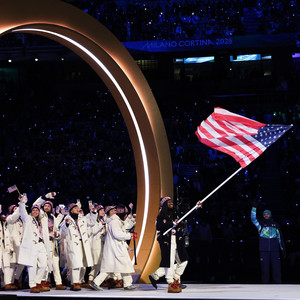
The athletes all march in this parade and they come in under their national flag.
And so, of course, every delegation comes in, and then the United States athletes arrive in the stadium where I was sitting in Milan, and there were huge cheers for them.
United States of America!
But then on the jumbotrons above, they were projecting images of Vice President J.D.
Vance.
There is the Vice President J.D.
Vance and his wife Usha.
Those are not, those are a lot of boobs for him.
And that's when we heard a smattering of boos and jeers.
So they're not directing their anger at the athletes, but there is some expression of anger when the vice president's face showed up on the screen.
Okay, so the crowd in Milan seemed to differentiate between the American leadership and the American athletes.
Absolutely.
And the reason why that was notable was in part because before the United States delegation came in, the Israeli delegation came in.
And I was a little surprised when the athletes marched in.
There were definitely audible boos in the stadium.
And there were no Israeli leaders being projected.
It was the athletes themselves that were getting booed.
And that was definitely different from what happened when the Americans came in.
So why have the American athletes gotten a pass from the audience so far?
I think part of the reason why the public is not taking it out, if you will, on the athletes is, first of all, they just understand that they're athletes and that they're here to compete in the games and that this is not supposed to be about a geopolitical standoff.
So I think from the spectator's point of view, there is that understanding.
And so I think that's one point.
Mm hmm.
But the other point is that a lot of the American athletes themselves have been very aware of how their country has being viewed or their country's government is currently being viewed.
And so they're speaking out.
It's been a hard time for the community overall under this administration.
So we've heard from athletes ranging from Amber Glenn, a figure skater, who's talked about the treatment of the LGBTQ community in the United States by the Trump administration.
I hope I can use my platform and my voice throughout these games to try and encourage people to stay strong.
And then several other athletes have talked a little obliquely about having mixed emotions about being here representing the United States, you know, emphasizing that what they think is good about their country is diversity, that they want to come from a place of love and community.
Michaela Schifrin read some quotes from Nelson Mandela.
Peace is not just the absence of conflict.
Peace is the creation of an environment where we can all flourish.
Chloe Kim talked to me about being the daughter of immigrants and that that was the important thing that the country was founded on.
The US has given my family and I so much opportunity, but I also think that we are allowed to voice our opinions on what's going on.
And I think that Hunter Hess actually went a little further.
He's a skier and talked about how he felt quote It brings up mixed emotions to represent the US right now, I think.
Mixed emotions about representing the United States?
There's obviously a lot going on that I'm not the biggest fan of and I think a lot of people aren't.
That side of what's happening among the American athletes is probably resonating here among spectators as well.
It makes me wonder what the guidelines actually are for what athletes are supposed to say on this world stage.
Like, are they allowed to talk about politics generally?
So the rules are at the IOC level that on the field of play, as they called it, when you're actually in competition or on the podium, you're not supposed to make any political statements.
And there's a Ukrainian, I believe he's a skeleton racer who was wearing pictures of victims of the war in Ukraine on his helmet, and the IOC ruled that he was not allowed to do that.
For Team USA.
The guidelines say that players can talk about racial and social justice generally when they're in press conferences or when they're in the mixed zone after they compete, but they are not supposed to engage in partisan politics.
So I have not heard anyone mention specifically Trump's name or talk about a particular administration, but are speaking more generally about values that they want to espouse.
And what has the reaction been from the White House and from President Trump to some of the harsher criticism?
Well, it started with Hunter Hess.
Actually, the first person that we saw comment was Richard Grinnell, who was appointed by President Trump to be the president of the Kennedy Center.
And he said something in effect of you know, if you don't want to compete for the United States, move to Canada.
And then the next day on Truth Social the president himself came out and attacked Hunter and called him a loser and that kind of thing.
So there's definitely been a backlash from the White House directly against this particular athlete for having made these comments publicly.
It really sounds like these athletes are towing a very fine line in these public comments.
And I wonder how much of that is actually spilling over into the physical games that they are competing in.
Well, if you're talking about whether or not people are jeering at them as they compete, none of us have witnessed that.
Whether or not it's affecting the mental health of the athletes, it's hard to say.
In some cases, it's hard to imagine it couldn't be.
It's a lot of stress.
Mm-hmm.
Right.
How could it not?
Mm-hmm.
That being said, if there's any sport in which these geopolitical tensions could play out, that's going to be on the ice hockey rink.
And we'll see that in the coming days.
Motoko Rich, thank you so much.
Thanks for having me.
After the break, I'm going to talk to my colleague Shauna Richer about hockey.
We'll be right back.
Shauna Richer.
You are an editor at The New York Times covering sports but, perhaps just as importantly, you are a big hockey fan, right?
Yes, I've been paying attention to hockey pretty much my whole life.
I used to be a sports reporter and I covered hockey for many years and, probably most relevant, I am Canadian.
And so you don't get to ignore hockey then.
No, you do not.
So Shauna, we just heard from a Toko Rich that perhaps nowhere will the tensions, the geopolitical tensions of this year's games be more evident than in the hockey rink.
And so can you explain to us what is she referring to?
She's absolutely right.
The most direct representation of the geopolitical tensions on the world stage right now is the hockey rivalry between Canada and the US.
We're in a time right now where the political tensions between Canada and the United States, who have been rivals on the ice for some time now, but these tensions politically have never been higher.
And I think Canadians and maybe some Americans, but definitely Canadians, are tapping into that as fans.
And the hockey is almost acting as a proxy for what the countries are sort of experiencing politically.
And that's actually really interesting, not just because of what's happening now, but also because of the fact that Canada and the US specifically, have always had a pretty intense hockey rivalry right.
Yes.
But before we get into the Canada-US rivalry history, I think it's important to remember that hockey has often been an arena for geopolitical tensions, right.
The 1980 Miracle on Ice is a really good example of that.
In a political or nationalistic sense.
I'm sure this game is being viewed with varying perspectives, but manifestly it is a hockey game.
It was the height of the Cold War.
Tensions between the US and the Soviet Union were at an all-time high and the countries were facing off against each other at the 1980 Olympics in Lake Placid.
Well, the U.S. team, it's really discovery time.
It's one thing to be young and promising, And at the time the Soviet team was arguably the best in the world.
The U.S. team was a frag-tag group of college kids.
It was a very tense game, and in the final moments of the game...
The U.S. managed to beat the Soviets 4-3.
It was an absolutely stunning upset.
Players just don't know how to express their emotions now.
They're just jumping around.
Unbelievable.
And it turned out to be this much-needed morale booster for the United States at this incredibly fraught geopolitical moment.
No notes tonight.
So hockey...
Long history of being a proxy for geopolitical tensions.
How do we go though, from that drama in 1980 that you described to the drama between the United States and Canada that we're talking about today?
Historically, going way back, Canada and Russia had the most intense rivalry.
Russia was a powerhouse of a hockey program.
They had the most skilled players.
They were practically professional, even though they were supposed to be amateur teams.
That lasted through the Cold War.
But then in 1991, when the Soviet Union fell, the Russian hockey program also fell apart.
And there was an opening for a new rivalry for Canada.
And into that void came the United States, which had a rising hockey program.
And so, Shauna, take us from that moment to now.
What has happened in the intervening time?
Well, over the next couple of decades, the rivalry between the U.S. and Canada persisted.
And it was definitely heated, but it was really focused mostly on what was going on on the ice.
But that really started to change in the last year because of Trump's antagonism of Canada.
Have never been good to us on trade.
They're treated as very unfairly on trade.
And we will be able to make that up very quickly.
The president was threatening to use economic force to tariff Canada to death.
Fox News is reporting that Trudeau warned Trump that his tariff proposal would kill the Canadian economy, to which Trump replied that Canada could then become the 51st state and that Trudeau could be governor.
And I think, when President Trump was saying all this stuff, Canadians were initially hurt, but then they got really angry.
The whole thing was very mystifying for Canadians.
Like, why is he picking on us?
We've been friends and neighbors for a long time.
And just as those feelings of animosity and hurt and anger were reaching a boiling point, along comes this one-off hockey tournament featuring the best players in the world.
It was called the Four Nations Tournament and it was played in Montreal and Boston.
And it was an opportunity for Canada and the U.S. to face off against one another.
And that tournament became a proxy for really how we felt about the United States in this moment.
And I think more importantly, how Canadians were really processing their emotions.
Because hockey is a really emotional game and Canadians can get very worked up about it.
Sure.
So the first game between Canada and the U.S. is in Montreal.
And the tensions are already very apparent.
Before the game even starts, when the US national anthem starts to play, the Canadian fans start to boot.
Then the teams line up for the opening face-off.
And this Four Nations face-off matchup is underway, and the gloves are off.
And almost immediately, a fight breaks out.
And this start, if you can call it that, and we even started reminiscent of the old days.
Wait, like an actual fist fight?
An actual fist fight.
A U.S. player wailing on a Canada player.
And historically, fighting has been a huge part of the game.
Less so in modern times.
But it's very rare, especially in international hockey, to see a fight break out off the opening faceoff.
Oh, wow.
Okay, so what happens next?
So once they're done fighting, players get sent to the penalty box.
And the game starts up again.
And as soon as the puck drops...
Before the first Kachuk fight, this was set up.
Here you go.
Two more players square up and start wailing on each other.
Three seconds, two fights, and we thought it would be a wild night here in Montreal.
We're off to this start.
And once that fight finishes up, just as the players start to skate, the US players run the Canada goalie and a huge fight breaks out in the goalie crease.
Oh my God.
We had a fight two seconds in, another one one second later.
Now in the center of the action, it's Colt Pareko and JT Miller.
So altogether, that's three fights in the first nine seconds of the game.
Three tilts in nine seconds.
Eventually we'll get some hockey here.
I can't imagine this is normal.
No, even for hockey, it was very over the top.
And it was a real indicator of how these two countries were feeling about each other.
And that was less than one year ago, right?
So those tensions have not gone away at this Olympics?
I think the tensions have only increased.
President Trump's continued tariff rollercoaster, social media attacks on Prime Minister Mark Carney, especially after a speech at Davos.
That was essentially a message to Trump that Canada was going to go its own way and asking other countries to come with.
Even a few days ago, the president threatened to stop the opening of a new bridge between Windsor and Detroit that Canada paid for and is also named after one of Canada's most famous hockey players.
So that's the political backdrop to this Olympics hockey tournament.
If the United States and Canada do go head to head.
I know it's hard to predict whether a fight will happen, right.
But are people talking about this game like a fight could happen?
Is that what people are expecting?
I think everybody expects that the gold medal game will be played between the U.S. and Canada.
I think it would be highly unlikely to see any real violence, because fighting at the Olympics will get you thrown out of a game and no one would probably risk that.
Right.
But the reason we love sports is because anything can happen.
If that match between the United States and Canada happens, how would you describe what is at stake for Canada?
You know, Canada winning a gold medal, it's really a defensive stand for the country.
It's a massive point of nationalistic pride.
And I do think it means more to Canada than it would in the United States.
I think Canada could come home from the Olympics with the most medals of any country.
But if the hockey medal was a silver, I think that would really bum Canadians out.
You have to remember that Canadians connect very deeply, connect their identity very deeply, to hockey.
We're a cold weather country and the origins of hockey is on outdoor ponds and rinks.
And it's going way back.
It's kind of how we got through the winter.
So I think in this moment when so many Canadians feel really bullied by this much larger nation to the south, Canadians are hoping to see a Canada-United States gold medal game and a Canada victory over the Americans at this moment in time would feel very, very good.
Shauna, thank you so much for being here today.
And good luck to you.
Enjoy the hockey this week.
Thanks for having me.
After the break, we're going to talk about some specific athletes who are, of course, the real stars of this year's Olympics.
We'll be right back.
Juliette McCurr, thank you so much for joining us from Milan.
You're welcome.
So I got back here at 3 a.m. last night, so I am very fresh, ready to go.
Wow.
Well, we really appreciate you making the time.
It's been a very, very busy Olympics so far.
Maybe it's always been.
You would know better, actually, than I would, since you are an expert on the Olympics.
How many have you been to at this point?
This is my 14th Olympics.
But many people start multiplying by four, like the Olympics are every four years, but it's every two years because I do summer and the winter.
So I'm not actually 125 years old, but I have done 14 Olympics.
Well, that is pretty incredible.
We've been really focused up until now in the conversation on the politics underlying these games.
But ultimately the Olympics is meant to highlight obviously, these sort of superhuman feats that sometimes people have spent their entire lives preparing for.
Before we get into the individual events that are interesting, I wonder if you could just tell us about any top-line big trends that you've noticed with the athletes this year that stand out to you.
Well, first of all, the United States is expecting to have its best Winter Olympics almost ever.
You know, they're competitive in so many different sports, you know, figure skating, skiing.
You know, we have a star in speed skating, Jordan Stoltz, who could win four gold medals.
I don't think I remember an Olympics where we've had so many different possibilities for medals and gold over so many different sports.
One thing I've noticed and perhaps because I'm older now is there seems to be a lot of older athletes in the Olympics, especially in something like figure skating, where they used to be 15 or 16 years old.
And that's across all sports.
And we should note that old by Olympic standards is still very, very young by normal human standards.
Right, yeah.
I mean, most of the people in Olympics, at least in my mind, are going to be in their 20s, right?
In their, quote, prime.
But you know, people have been taking better care of their bodies and training much better over the last, you know, decade or two.
And so we'll see athletes going for multiple Olympics.
And that's another thing that people should keep an eye on is just...
So many athletes have been to so many Olympics.
And in the past, that was so rare.
But it's like athletes are, you know, their third, fourth, fifth Olympics, like it's no big deal.
Well, somebody that I think fits that profile of both the older athlete and the veteran athlete is Lindsey Vonn.
And that's someone that we've been hearing a lot about during these games.
And I wonder if you could tell us a little bit about her backstory and what has happened at these Olympics.
Right.
And, you know, you could call Lindsey Vonn old.
It's OK.
You don't have to say relatively old.
She is ancient in comparison.
Only in Olympic years, right?
Only in Olympic years.
Oh, not compared to the rest of us.
But she's, you know, 41 years old is that would be unheard of decades ago.
Right.
Or even like several years ago.
But right.
She is one of the greatest skiers in American history and one of the greatest really skiers in history.
She is really going for it.
Lindsey Vonn is such a fierce competitor come race day.
She is a gold medalist from the 2010 Games.
There is the first ever American woman to win an Olympic gold medal in downhill.
Multiple World Cup champion.
And Lindsay is one of the most daring and fearless Olympic athletes in history.
So, after winning the bronze medal at the 2018 Olympics, she actually retired the very next year, at 34.
Her knees were in terrible shape.
Her body was broken.
I have so much fun.
I love what I do.
My body just can't take another four years, but I'm proud.
I'm proud to have competed for my country.
I'm proud to have given it my all.
And frankly, people never thought they would see her again.
You know, it's past the use-by date in that Olympic sport in particular.
Depressing.
That is very depressing.
But in 2024, she had a partial knee replacement on her right knee.
So part of it is made of titanium.
So that part of her body is bionic now.
And then she, against all odds, she came back to the sport at age 40.
And Von and her head skis are flying here.
And also against all odds, she actually starts winning.
Wow.
Let's see Von now.
He's absolutely flying.
History in the making.
41 years of age.
Oldest winner of a World Cup race.
Von is there.
People were just shocked, right?
Because not only because of the injuries, but because just of the potential for injury, right?
Because she had all these surgeries and, you know, could she be as strong again?
Could she be as courageous again and just go all out?
But she qualified for the Olympics and people were waiting to see if she could bring back that glory again and win a gold medal.
And she was among the gold medal favorites to win the downhill.
And I understand that there was some trouble right before she got to the Olympics.
Tell us about what happened before the Games even started.
So nine days before the Olympics, while everybody's waiting for her huge comeback.
Where is Vaughn?
Where is Vaughn?
Disaster strikes.
Oh, Vaughn is in the netting.
Oh, my goodness me.
Lindsey Vonn has crashed out.
She tears her ACL, which is a ligament in her left knee.
People think, you know, this wonderful, dramatic, great American story comeback has ended.
But it makes sense that someone like Lindsey Vonn would decide that it's not going to stop her, and she decides to compete in the Olympics anyway.
Wow.
I would imagine that that is a decision that most people absolutely would not have made, since it sounds like she did not have a working knee for the Olympics.
Yeah, believe me people.
I mean that was a talking point for people all over the country and all over the world.
Like, why is this person coming back?
You know, and can she come back?
Can someone even ski on a knee that doesn't have an ACL?
There's always a moment where you break down and you realize the severity of things and that your dreams are slipping through your fingers.
But I didn't have that this time.
I'm not letting this slip through my fingers.
I'm going to do it.
So everybody was tuned in, you know, when she was at the starting gate.
Lindsey Vonn pulls out of the gate in hopes of more Olympic glory.
Wondering not only if she could win a medal, but how she could get to the bottom without you know, without hurting herself.
So unfortunately, that debate ended only 13 seconds into her run.
The tone is set right here.
Oh my goodness, no!
Oh, oh, oh my goodness.
She was coming around one of the gates and hooked her arm around one of the poles of the gates and it just sent her flying into the air.
She had to be airlifted out.
And I wasn't there on the mountain, but people said that it was pretty horrific.
They had heard her screaming on the mountain in pain.
But it was.
You know the hush on the mountain and I'm sure people around the world watching television, people were wondering wow, you know, this incredible athlete in American history and skiing history took this incredibly brave chance at coming back for this glory to see if she could get it again.
And she broke her leg.
So it was serious enough for surgery.
And she said she would need multiple surgeries to make it whole again.
So yeah, nobody's quite sure how it will end up for Lindsey Vonn, but I don't think we'll be seeing her at the Olympics ever again.
So that is a really sad story.
And I hate to do this Julia, but I think we have to talk about another sad story at the Olympics this year.
I think you probably know what I'm talking about.
Yep.
Unfortunately, I do know what you're talking about.
Of course, it's Ilya Malinin, who came into the Milan Games as a favorite by far to win a gold medal.
One of the biggest stars of the Milan Olympics, one of the greatest skaters in history, who's revolutionizing the sport.
And unfortunately, as it turns out, he is now one of the most heartbreaking skaters stories that I've ever seen at an Olympics, which is a lot because, as I said, I've been to 14 of them.
So Julia, before we get into exactly what happened at the Games, can you give us a little bit of Ilya's backstory?
Absolutely.
So Ilya Malinin is a 21-year-old first-time Olympian who has been showing the world things in figure skating that have never been done before.
This is just the beginning of the Ilya Malinin era.
My name is Elaine Melanin.
I'm a figure skater from Fairfax, Virginia.
His goal, even many, many years ago, was to revolutionize the sport.
It's like he broke physics and turned it into something that everybody wanted to tune into.
Like, maybe you don't want to watch the NBA today.
Maybe you want to watch men's figure skating.
No one in the world can do that.
Both of his parents are Olympians.
They were born in Russia, but competed for Uzbekistan.
And he's nicknamed himself Quad God.
And that's because he does these.
Quad God.
The Quad God says tonight, I own this Olympic ice.
He did that when he was 13 years old, after he landed his first quad jump, which is a jump that requires four revolutions in the air.
And since then, he's landed all the variations of the quad jump, including the quad axel.
Just amazing.
First quad axel ever performed in an ISU Grand Prix.
The axel is when you leap into the air going forward instead of backward which counterintuitively, is actually harder to go forward, because if you fall on a jump going forward, you could smack the ice with your face.
So he does this quad axel, which nobody else in the world has ever done in official competition.
It's incredibly hard.
And every time he does it in competition...
It's like the windows shatter because people scream so loud because they're so excited.
Besides the fact that this man has been practicing his whole life and is obviously quite talented, is there some other explanation for why he is capable of doing this thing that seemingly few, if any other people can do?
I mean, like Simone Biles, Ilya has this, this sort of innate understanding of where his body is in the air?
I mean, figure skaters are afraid of trying these things because they're just afraid they're not going to do the revolutions and they're going to get lost in the air.
And that's when you might fall or you could break your ankles or hit your head on the ice and people are afraid of that.
But he knows exactly if he can get around the four and a half revolutions.
And also in terms of revolutionizing the sport with not only these, all these quad jumps that he does in his routine.
I mean, he had seven quad jumps in one routine in December, and that was a world record.
So every time he had an opportunity to jump, it was a quad, which is totally unheard of.
So he's the best at jumping.
But also another thing that he's been doing which actually doesn't get any points.
It's not even style points, it's like fan appreciation points.
Newly legalized element here, the backflip.
He does a backflip.
On the ice?
On the ice, yeah.
So he did the first backflip, official backflip at an Olympics in the team competition.
And that was the first one in 50 years.
So the last time was 1976.
And shortly after that, it was banned because it was too dangerous.
Actually a French skater, surya bonnelly, did it in 1998 but it was illegal.
So they they count it as the last time it was officially done was 50 years ago.
So he it's just, it's it's not your, you know your grandmother's like classical music kind of balletic routine, it's like you know he's on fire and people like it.
You know it's bringing like a like a freshness to the sport.
Okay, so talk us through what happened on friday night.
So he had the team event actually the week before and he competed twice in that in the short program and the long program.
And it wasn't regular Ilya in those two competitions.
Messi landing on that triple axel.
He, of course, known as the quad god because of his quad axel.
I almost thought for a second, Johnny, he was going for the quad axel.
People were really wondering what was going on with Ilya, although he said he was getting better and better and less nervous as the competition went forward.
And Friday for the men's free skate was his final chance.
The moment we've all been waiting for was his free skate, his long program where he was finally going to clinch this gold medal that people have been saying he was going to win for the past really four years.
This is place to be.
Hottest ticket in town tonight.
The crowd, you can sense it.
A little more revved up than any other night so far.
But the day started out really strangely.
There were a lot of skaters who were feeling Olympic nerves, a lot of falls during the last group, which is the group that has the best skaters, including Ilya.
Man taking the ice certainly does have the talent, and he's had big moments.
Mikhail Shadorov.
The Kazakh skater, he had the best skate of his life.
Setting up quad lutz, the second most difficult quad, back outside edge, so difficult.
Right on the music.
It felt like an Olympic gold medal skate.
Look at the numbers.
Wow.
I'd be tired too.
He finished, he was cheering, he was that happiest kid on earth.
Talent, Ilya Malinin. moments away from skating for gold.
And then, when it came to Ilya, he skated onto the ice and you could tell from the beginning that he wasn't as confident as usual.
Effortless start.
It did start out pretty well.
If he does attempt the quad axel, it will be the next element.
And then went into the corner to try the quad axel.
He was going for just a single.
And then he pulled out of it.
Was going for a quad loop, only a double.
We don't usually see Ilya make mistakes like this.
From there, it just got worse.
It's like his focus was gone.
It is not often to see Ilya Malinin fall.
He fell twice in the program.
He even fell on a double jump, which is, you know, it's really mind-blowing, because you know he could do that in his sleep with just wearing one skate and the sock on the other foot.
We said he could win it with mistakes, but how many mistakes?
The last jumping pass here.
Oh, my gosh.
Oh, my goodness.
Even the backflip, which did receive a roar from the crowd.
He didn't do it as well as he usually did.
And it just, he had this look of fear on his face.
A reminder that nothing is certain in sports.
There's no such thing as inevitable.
When all is said and done, he gets his score and the whole audience groans.
Nope, not going to get there.
And that is a shocking result.
Because not only did he not win a gold medal.
Ilya Malinin, eighth place.
But he didn't win any medal of any color, which nobody could have predicted.
I think part of what felt so shocking and moving to people was this guy is, as you mentioned, 21 years old.
And he has just kind of face planted on the biggest, most elite stage in the world for this sport.
And I think people probably felt quite bad for him.
Just looking at this kid who just seemed so broken down after this.
Do you have any sense, given how much confidence he has always projected?
Obviously he's nicknamed himself the Quad God.
How did this go so wrong in these last moments?
Yeah, there are a lot of opinions on what happened there.
And, you know, and Simone Biles, the greatest gymnast of all time, was in the stands.
And maybe she knows more than anyone how the pressure of the Olympics can get to somebody.
And afterwards, you know, he came to talk to reporters and he said something that was really I just was really surprised.
It was a weird feeling just going into the program.
I just had so many thoughts and memories flood right before I got into my starting pose.
I think it maybe overwhelmed me a little bit.
I've been through a lot in my life, a lot of bad and good experiences.
He said you know, when he was right before the competition, he felt every single trauma that he ever had in his life pour into his brain, like every single negative thought pour into his brain.
And he just couldn't stop this lack of confidence.
You know, the pressure of the Olympics is it's really something different.
And I think that not a lot of people will understand that.
They'll only understand that from, you know, the inside and inside.
God.
That sounds so relatable just in the sense that I think a lot of people have had an experience where they have this enormous high pressure situation and their brain is suddenly filled with negative self-talk.
Right.
And that's basically, it seems, what happened here.
And also could be the Olympic champion.
Then I wouldn't have stated like that.
He just said that if they'd sent me to Beijing four years ago, when many thought he should have been on the team us included he wouldn't have skated like that.
He said this thing right after the competition.
That was so interesting about how he should have been allowed to compete in the last Olympics.
Do you have any idea what he was referring to, Juliette?
Right.
So four years ago, he finished second at nationals.
And typically the top three skaters.
You know, if there are three spots for an individual skater, they really pick the top three to go.
They do look at, you know, your body of work over usually it's a couple of years.
And they didn't choose him because they didn't think he was old enough or poised enough, so they chose somebody who finished below him.
So people were arguing back then that, well, maybe they should have chosen him.
Maybe he wouldn't have won a gold medal at the Olympics, but it's what he experienced here, which is this pressure of the Olympics and sort of understanding just what it really feels like to have every single person's eye in the whole world on you at that skate, and every sponsor and every social media post and all these things.
You know everybody thinking that you know you're going to win the gold medal easily.
And you know he had to experience what that felt like this year, when he was the favorite to win, instead of four years ago, when you know he would have finished 20th and people would have said that was awesome.
Less pressure.
He's saying, I would have done better under less pressure.
Yeah.
And some people thought that that was kind of a rude thing to say.
What a poor loser.
But I think people have to remember that this guy is just 21 years old.
He spent much of his life inside this rink for this one goal.
And we're asking him this question right afterwards.
Why did you lose it?
Why did you blow this?
And I don't think he meant it in a negative way in terms of just being cocky.
I just think he just had no idea what just hit him.
Obviously, figure skaters tend to skew a lot younger than other athletes who compete at the Olympics.
They tend to be in their 20s.
Ilya Malinin, as we said, is 21.
What are the chances that we might see him at a future Olympics in four years when he'll be 25?
I think it's 100 percent chance that you'll see him again.
I think Ilya will hit the next Olympics and the Olympics after that.
When I think about what happened to Ilya, I think about what happened to Nathan Chen, who was the gold medalist in 2022.
Nathan Chen, the US champion capable of five quads in one free program, definitely will be going after two in his short program.
Was very young in 2018 and had a kind of a similar experience.
Bailed on his second quad, missed the triple.
Nathan Chen.
He absolutely botched his short program, came out of it losing his chance to win the gold medal.
Our final skater represents the United States of America.
Nathan Chen.
And then came back four years after that and won the gold medal.
Nathan.
Which for me personally, it was one of the most beautiful Olympic moments I'd ever seen.
When I think of all these people like Simone Biles, Lindsey Vonn, Nathan Chen who just happened to be sitting in my row watching Illya on Friday night it's a reminder that it's so incredible to watch them, because they do things that are superhuman.
But it's also incredible to watch them because they're human.
And that's what makes the Olympics so powerful.
And that's why I've loved to watch it for so many years, and what keeps me coming back to cover it every two years.
Juliette McCurr, thank you so much for being with us.
Thank you for having me.
I appreciate it.
Today's episode was produced by Luke Vander Ploeg, Alex Barron, and Tina Antolini.
It was edited by Wendy Doerr and engineered by Rowan Niemisto.
Our production manager is Franny Kartoff.
Original music by Leah Shaw Demeron, Rowan Niemisto, Marion Lozano, Dan Powell, and Diane Wong.
That's it for The Sunday Daily.
I'm Rachel Abrams.
See you tomorrow.