Hi there, Alistair here.
You might have seen that we're doing something special this week.
We're releasing a previously member -only episode, like this one, every single day.
All the accompanying interactive transcripts, subtitles and study packs are also free for this week only, so I hope you'll enjoy them.
The other thing we are doing is perhaps even more special, and it's a once -a -year Black Friday sale.
Until midnight on Sunday 1st December, you can get 33 % off your first year of our Annual Pro membership, saving a whopping 67 % versus the monthly price.
This gives you access to more than 250 bonus episodes, interactive transcripts, study packs with advanced vocabulary and quizzes, and learning challenges, like the one that is starting on Monday 2nd December.
Essentially, it turns this podcast from an interesting thing to listen to, into an incredibly powerful tool for improving your English.
Okay, enjoy this special bonus episode, and if you'd like to unlock more than 250 more member -only episodes at a massive discount, well, there's a link to our Black Friday sale in the description for this episode.
That's it, and I hope to welcome you as a member soon.
Hello, hello, hello, and welcome to English Learning for Curious Minds by Leonardo English, the show where you can listen to fascinating stories and learn weird and wonderful things about the world, at the same time as improving your English.
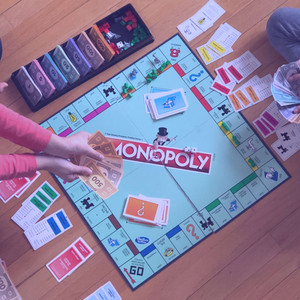
I'm Alistair Bunch, and today we are going to be talking about Monopoly.
It's one of the most popular board games in the world, and has brought joy and infighting to players and families all over the world, including my own, I should add.
And where it came from?
Well, it is an interesting story in itself, so let's not waste a minute and get right into it.
I imagine that most people listening to this will know about the game of Monopoly.
It is one of the best -known, best -selling, and best -loved board games of all time.
On the off chance that you don't know what Monopoly is, it's a board game where players roll a dice and move around a board, trying to acquire property.
If you own a property and another player lands on your property, they need to pay you money, depending on the kind of property that you have and the number of properties that you own.
There are a bunch of other different elements to the game, but it usually ends with one player acquiring more and more properties and everyone else going bankrupt.
It is a lot of fun, especially if you win.
Now, you might have already heard something about the legend of the origin of Monopoly.
The story goes something like this.
One evening in Philadelphia, a man called Charles Todd invited his childhood friend Esther Jones and her husband Charles Darrow over for dinner.
The year was 1932, at the height of the Great Depression, and the Darrows were no doubt happy for some company and an evening of pleasant conversation.
After all, Charles Darrow was one of the tens of millions of Americans who had found themselves out of work.
He lost his job, was struggling to make ends meet, and there was little hope in sight.
It was evenings like this, friends and a warm meal that kept people's hopes up, no matter how dire the future might look.
When dinner was over, the Todds brought out a board game and suggested that the four of them have some fun.
It wasn't an official board game, it was something it seemed like the Todds had made themselves.
The game involved throwing dice and moving counters around a board, being able to buy property, real estate, and then collect pretend money if someone landed on your property.
The Darrows took to the game quickly, Charles Darrow in particular.
He loved it, started inventing his own advanced rules, and would frequently return to his friend's house to play it again and again.
The game didn't have an official name, it was just referred to by the group as the Monopoly game.
As Darrow asked more about it, it turned out that quite a few couples they knew had made copies of the game, all slightly different but with a similar premise.
There were no written rules to the game, and it was passed from one person to another, in a similar fashion to how it was passed from the Todds to the Darrows, introduced over dinner or at a social gathering of some sort.
Charles Darrow thought this was slightly odd.
After all, it was such a good game, it seemed a shame for it to be so unofficial.
So, he decided to start producing copies of the game himself.
He made the boards, colouring them in by hand, with his wife and son helping out too.
They moulded the pieces, typed out the cards the information about the property would be written on, and packaged it all up in boxes that had previously been used for storing ties.
In other words, he took this fledgling of an idea, this unofficial game, created the official rules and started to produce it en masse.
Well, perhaps not quite en masse, but at least in relatively large quantities, far greater than ever before.
It was originally something of a side project, something that he hoped would earn him some money while he waited for the economy to recover and he could find a full -time job.
But before long, it became something much bigger.
He managed to persuade a Philadelphia department store to stock it.
The store agreed, boxes flew off the shelves, they were very popular, and just a year later, in 1935, a toy company called Parker Brothers bought the rights to it.
Now, with a large toy distributor behind it, the game exploded.
It became hugely popular all over the country, providing a welcome respite to economically challenged American families.
You bought the game for a few dollars, and it could guarantee you hundreds of hours of fun, and perhaps a few hundred hours more, arguing with your family and friends.
What's more, it gave you the opportunity to imagine, just for a minute, that you were a real estate mogul with a collection of houses and hotels all over the country, sitting around collecting rent from other people instead of your real -life situation, which for most of the country meant not having
a job and paying rent to someone else.
And as for Charles Darrow, he had filed a copyright for the game, and he would go on to collect royalty payments from Parker Brothers Toy Company for the rest of his life.
By creating this game about people who roll the dice and can become fabulously wealthy, he did exactly that himself.
He became the world's first millionaire game designer in the process.
But, as with many great success stories, there's a twist.
While Monopoly was bringing families together around dining room tables across America, providing a delightful escape from the economic woes outside, its true origins were much less known, and somewhat controversial.
See, Charles Darrow was a fraud.
Or at least, the man himself wasn't a fraud, but there is more to his claim to be the inventor of Monopoly than first meets the eye.
The real story of Monopoly started not with Charles Darrow, but with a remarkable woman named Elizabeth Maggie, a name that until recently was largely unknown in the history of this iconic game.
Elizabeth Maggie was a bold and progressive thinker, born in the aftermath of the Civil War, a time of great change and upheaval in America.
Her father, James Maggie, was a staunch abolitionist and a friend of Abraham Lincoln.
He instilled in his daughter a deep sense of justice and a keen awareness of social issues.
And it was from this background that Elizabeth Maggie was inspired to create her own board game, The Landlord's Game, which she successfully patented in 1904.
I'll read you a description of how it was played, and you can decide for yourself if you can see any similarities with another game.
Players used fake money to buy and sell deeds and properties, borrowed from the bank and paid taxes.
They circled a clearly drawn path, one corner anchored by the poor house and public park.
Across the board was the jail.
Another corner showed a globe with a homage to Maggie's idol, Henry George.
Labour, upon Mother Earth, produces wages.
And included on her original board were the words, go to jail.
Players circled the board, performing labour and earning wages.
Each time they passed the Mother Earth space, they were supposed to have performed so much work they received $100 in play money wages.
Players who ran out of money were sent to the poor house.
Traspassing on someone's land earned you a trip to jail, where you sat until you either threw a double or paid a $50 fine.
Okay, end of the description.
It sounds a bit like the game you or I might know as Monopoly, right?
Now, interestingly enough, Elizabeth Maggie created two sets of rules for this game.
One that rewarded all players when wealth was created.
The so -called anti -monopolist rule.
And another where the goal was to crush your opponents and establish monopolies.
The monopolist rule.
It was a teaching tool.
A way to demonstrate the injustices of the capitalist system.
A system that had led to men like J .D.
Rockefeller acquiring monopolies and accumulating huge fortunes, while most Americans still struggled to put food on the table.
It was a fun game, it seems.
But it was played mainly in left -wing academic circles and among Quaker communities, including one in Atlantic City, close to Philadelphia.
Like the version that Darrow was first shown, it was unofficial, evolving as it passed from one family to another, with different local neighbourhoods being added to and removed from the board.
It might have been intended as a bit of fun and a social statement, but Maggie was awarded a patent for her game in January of 1904, almost 30 years before Darrow made the first version of his game.
So it wasn't his game at all, it was Maggie's.
And, as you might have realized, the version that he was introduced to wasn't the anti -monopoly one, the one where all players were awarded for wealth creation, but the monopolist one, the one where you try to amass as much money as possible at the expense of your fellow players.
Now, back to Maggie.
She was clearly a remarkable lady and had many other talents and occupations.
Alongside designing the Landlords game, she wrote short stories and poetry, acted in plays and was a keen advocate for women's rights and economic reform.
There were many strings to her bow.
And then, out of the blue, in 1935 she was contacted by Parker Brothers, who wanted to buy her patent for the Landlords game.
She didn't realise this at the time, but another game that brought a striking resemblance to her original Landlords game had been taken off.
Parker Brothers were doing everything they could to buy up patents and copyrights to any similar games, to protect Darrow's monopoly, their golden goose.
On their search, they came across the patent for the Landlords game, which had been filed more than 30 years beforehand.
They offered Maggie a flat fee of $500 for her patent.
$500 is about $11 ,000 in today's money, not bad going whatsoever, especially for something that Maggie had been considering as something of a hobby, a bit of fun and social commentary.
But, when you consider that more than 275 million copies of the game have been sold since 1935, it was one of the worst deals in history, or best deals if you are Parker Brothers.
When Maggie realised what had happened, it was too late.
She had sold the rights to her game, and she wouldn't see a penny more from it.
And not that she seemed particularly interested in money, but she can't have been best pleased to find out that someone else was getting rich off her creation either.
And she was even more angry that the game she had intended to be a criticism of monopolistic practices was being played up and down the country to celebrate wealth creation and monopolies, exactly the opposite of what she had intended.
Maggie died in 1948, with her role in treating monopoly not even featuring in her obituary.
And for decades, her contribution to the game remained unknown.
It was only rediscovered in 1974, after a German -American left -wing economics professor, called Ralph Ansback, tried to patent a game called anti -monopoly.
As part of the patent search process for this game, he discovered Maggie's original patent from 1904, and this opened up a whole new can of worms.
It resulted in a lengthy legal battle, with Ansback using it to highlight Parker Brothers' monopolistic practices, and drawing attention to the irony of a company trying to have a monopoly on a game called monopoly.
Now, Parker Brothers was bought by the toy giant Hasbro in 1991, and Hasbro only really mentions Darrow in its communications.
There is zero mention of Elizabeth Maggie's involvement in the creation of monopoly.
This does, of course, raise interesting questions about the whole idea of patents, copyrights, and the creative process.
Lizzie Maggie's The Landlord's Game was perhaps the original game centred around moving pieces around the board, doing work and collecting money, depending on where they landed.
Darrow's creation was very similar, but his creation, if we can call it a creation, came almost 30 years later.
If it hadn't been for Maggie, there would have been no Landlord's Game, and if it hadn't been for the Landlord's Game, there would probably have been no monopoly.
But if it hadn't been for Charles Darrow's changes to the game, and focus on getting it into a toy store, it would almost certainly not have reached the success and popularity that it has today.
And bringing it back to the present day, Monopoly is probably the world's most successful board game.
From Monopoly Junior, which is aimed at younger players, to even a braille version for the visually impaired, from a French to a Star Wars version, the game's adaptability and universality has been key to its success.
And no matter what kind of country or society you live in, it is easy to understand, play and get behind.
Acquire stuff through a combination of luck and skill, hope other people are not as lucky or skillful as you are, and get rich off others' misfortune.
That might be a cynical and simplistic way of looking at it, but it is precisely Monopoly's simplicity and universality that has made it such a resounding success and global phenomenon.
But to bring it back to the original topic, the origin of all of this, who should get the credits?
Who should be rewarded for the success of Monopoly?
Darrow certainly grew wealthy from his role in the creation, and as we heard, Maggie got practically nothing.
It was, in fact, Parker Brothers and then Hasbro, who have profited most greatly from the invention.
And you could say that they are merely the distributor, the final part of the process.
So what does this tell us?
It's probably a lesson that Elizabeth Maggie would not like to hear.
It's that when it comes to something like game development, it isn't the genius creative who thinks up the game at her kitchen table, or the out -of -work, 30 -something American salesman who discovers it and sells it into a shop.
But it's the huge game distributor that bought up all the patents.
Elizabeth Maggie certainly wouldn't be best pleased to hear this, but the story of the game that she created is perhaps the best example in history of the power of Monopoly.
Okay then, that is it for today's episode on Monopoly.
I hope it's been an interesting one and that you've learned something new.
As always, I would love to know what you thought of this episode.
Do you like Monopoly?
Is it the sort of thing that you play with your family over the holidays?
And did you know about this unusual origin story?
I would love to know, so let's get this discussion started.
You can head right into our community forum, which is at community .lianardoenglish .com and get chatting away to other curious minds.
You've been listening to English Learning for Curious Minds by Leonardo English.
I'm Alastair Budge, you stay safe, and I'll catch you in the next episode.