Grownups, Wondery Plus subscribers can listen to Wow in the World early and ad-free right now.
Join Wondery Plus in the Wondery app or Wondery Kids Plus on Apple Podcasts.
Hello, Wowzers.
It's me, Dennis.
And before we start the show, this month for our new members, you can have Reggie in your pocket.
No, Reggie, not for real.
You're too huge.
You can't fit in pockets.
I'm talking about our exclusive VIP new member T-shirt grown-ups.
For a limited time, only new members to the world organization of wowsers can get this t-shirt featuring reggie.
Yeah reggie, see it's a red shirt with a shirt pocket and your little head is poking out.
So it looks like you're in the pocket, and That's right, Reggie.
Our members also get birthday cards from Mindy and Guy, quarterly mailings from you Reggie, and so much more.
Grownups.
For access to this t-shirt, visit Tinkercast.com slash membership and sign up your wowser today.
That's Tinkercast.com slash membership.
That's it.
Now let's get back to my show.
I mean, our show.
I mean, the show.
Hey grownups, as your family gears up to go back to school, make sure that you're preparing both minds and bodies.
Try Oli, the number one kids' supplement brand that makes your family's health and wellness a breeze.
Ollie offers a range of vitamins and supplements for kids and adults, so you can trust them for your whole family's needs.
Kids Multi Plus Probiotic is a tasty essential that kids love and Kids Sleep offers gentle supports to help them rest.
And for the parents, Ollie has your back too.
Try multivitamins for immune support and more, and sleep gummies to help you get your best rest.
Shop at Oli.com or retailers nationwide.
These statements have not been evaluated by the Food and Drug Administration.
This product is not intended to diagnose, treat, cure, or prevent any disease.
Proceeded, 3, 2, 1, ignition.
The levels are in a picture of magnificent proportions.
We'll be right back.
Um, I think, oh yeah, this one.
Congratulations, Mindy.
You're on a five-day language learning streak.
Yes!
How about another lesson with Uno?
Why not?
Oh, that lesson's going to have to wait for today.
Someone's at the door.
Yeah, no.
Do your lessons or Uno will get sad.
Opening the door.
Guy Razzi!
Hey, Mindy.
What's going on?
Mindy, play with Uno.
Oh, not much.
I was just wondering if you had any sugar I could borrow.
Oh, sorry, Guy Raz.
I used up all my sugar last week when I was rebaking my gingerbread laundry room.
Uno is waiting.
Uh-huh.
Mindy, I'm live with Oona.
Do you want to get that, Mindy?
It sounds like you're getting a bunch of messages on your phone.
Why aren't you doing your lessons, Mindy?
No, these aren't messages.
This is a new language learning app I downloaded.
Oh, you're learning another language?
Oh, yeah.
I got this buddy who lives out in Congo in Africa, and I'm trying to learn his language so I can chat with him more easily.
Wow, I love that idea, Mindy.
Yeah, I know.
Ah, but the only problem is this app is, like, super pushy.
Does Mindy not like mooners?
Oh, wait, who's Uno?
Oh, Uno's the language learning penguin.
The what?
He's like the mascot, sort of harasses you into learning the language.
That sounds horrible.
Horribly effective?
I can already say like five different phrases.
Oh, and which language?
Lingala?
No.
French?
Nope.
Swahili?
Uh-uh.
Wait, so your friend is from Congo, but he doesn't speak Lingala, French, or Swahili?
Nope.
Well, then which language are you actually learning, Mindy?
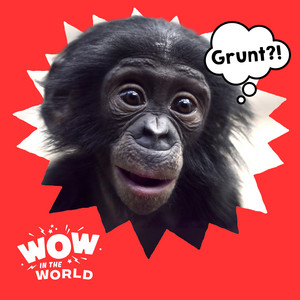
Bonobo.
Bonobo?
I don't think I've heard of that one before.
Oh, it's a beautiful language.
Really?
Can I hear some of it?
Okay, well, you're putting me on the spot a little, but let's try this.
This is how you say hello to someone who is far away from you in bonobo.
Beautiful, isn't it?
It's, uh, something.
And this is how you say, Danger!
Incoming snake!
In bonobo.
Danger!
And this is how you say, Can I have some of those figs?
Wait a minute, Mindy.
Is your friend who lives in Congo human?
Yes, of course he is not human, Guy Raz.
What kind of human talks like that?
Well, then what in the world is he?
He's an ape.
An ape?
Yeah, an ape.
Specifically, a bonobo ape.
Mindy, I thought you were learning an actual language, not just some ape shrieking sounds.
It's not just a collection of shrieks, Skyroz.
It's a true, blue, bonafide, classified, verified, certified language.
It is?
Yeah.
According to researchers at the University of Zurich in Switzerland.
It is Mindy.
It's time for a lesson.
And my language learning app... You know, I'm just going to turn off the notifications, I think.
Mindy, it's...
Wait, you're saying real-life scientists have discovered a new ape language?
You know it, Guy Raz.
Okay, I'm confused.
Okay, um, here.
I think it's best if I show you.
So what do you say?
We just head on over to Congo and see how far my bonobo language skills can get me.
You want to travel to sub-Saharan Africa now?
Uh...
I don't know, Mindy.
I mean, Guy Raz, don't you always say the best way to learn a new language is to dive in and just start speaking with the locals?
Well, I guess that's true.
So come along.
Maybe you'll pick up a little bonobo, too, while you're at it.
Well, uh... Anything for science?
Okay, anything for science, Mindy.
Booyah!
All right, let me just give Reggie a call here.
Hey, Reg, what are you up to right now?
Okay, well, that birdbath's gonna have to wait.
Yeah, Guy Raz and I need a lift to Congo.
Yeah, as in Africa.
Uh-huh.
Okay, great.
See you soon.
Reggie will be here to pick us up in a minute.
So, Mindy, I don't understand.
Don't almost all animals use some sort of sound to communicate with one another?
I mean, yeah.
Birds use calls to attract maids.
Whales use songs to navigate and find their way around.
Even frogs use their ribbons to warn other frogs not to mess with them.
Oh.
Okay, so how come that language app of yours doesn't offer language learning courses in bird or whale or frog?
Because there's a difference between plain old animal communication and language.
You mean there's a difference between a bird song and the kind of shrieks that the bonobo makes?
Oh, yeah.
Reggie!
That was quick.
Mindy, did Reggie just smash through your living room wall?
Well, yeah.
How else was he going to get inside?
Have you seen his wingspan?
Well, uh... Anywho, you ready to go, Reg?
Great.
All right, come on, Guy Raz.
Let's hop on Reggie.
You got some bonobos to me.
Here, I'll pull you up.
All right.
Ahem.
Welcome to Reggie Airlines.
The temperature outside is a balmy 76 degrees Fahrenheit, and this will be one nonstop flight to the Congo Basin, taking anywhere from two minutes to 15 hours.
And uh, in case of emergency, remember to put your head between your legs and kiss your bottom goodbye.
Mindy!
Okay, Reg, I think we're ready.
Wait, Mindy, shouldn't we take off from outside rather than from inside your living room?
I mean, I don't see the point.
We've already got a hole in the wall.
I guess.
Now hold on tight, because here we go.
Oops.
Sorry.
So, Mindy, explain to me what is the difference between animal communication and language?
Oh, that's a good question, Guy Raz.
So why don't I answer your question with another question?
Oh, okay.
Do you want chicken or fish for your in-flight meal today?
Mindy!
Okay, fine.
The difference between simple animal communication and language is the ability to string different words together to create new meaning.
What do you mean?
Well, when an animal makes a sound, it typically means just one thing.
Oh, right.
Incoming human.
Exact, Doritos.
But us humans, with our language, we're able to string words together in ways that combine their individual meanings into a whole new meaning.
Ha, like if I said something like, I'm a bad dancer.
Well, that doesn't mean I'm saying I'm a bad person who also happens to dance.
Instead, what I'm saying is I don't dance that well.
Exactly.
Exactly.
Bad and dancer by themselves mean something individually.
But when we put those words together, they mean something new.
And scientists actually have a word for this.
It's called compositionality.
And it's what separates normal animal communication from language.
Okay, so these scientists from the University of Zurich who have been studying these bonobos, they think that they've discovered them using compositionality, like combining two different words to make something new.
Yeah, and it's not the first time scientists have discovered this in apes.
Really?
Yeah, but I can't tell you about that right now.
Why not?
Because we're here!
Reggie!
You can land now.
Please prepare the cabin for landing.
And you might want to hold on tight to something, Guy Raz.
Looks like we're going to be landing somewhere in the dense rainforest.
What does that mean?
Just keep your mouth shut, Guy Raz.
Keep the leaves out.
What?
And thank you for flying with us here at Reggie Airlines, the friendliest pigeon-based airline in the world.
Mindy, my mouth is full of leaves.
I told you you had to keep your mouth closed.
Uh-huh.
Thanks for the ride, Reg.
I'll call you when we're ready to get picked up.
Mindy, is this rainforest we're standing in in the Congo Basin?
Sure is, Guy Raz.
Right in the center of the whole African continent.
Right.
But where exactly in the Congo Basin are we?
Huh.
You know what?
I'm not exactly sure.
Well, if you don't know where we are, then how are we going to find your bonobo friend?
Huh, good question.
Oh, I know.
What?
I have his address.
You have his address?
Yeah, he texted it to me a few months ago after talking on the phone.
Let me just check our chat here.
OK, that's a photo of a fig.
Nope, that's a photo of another bonobo.
That's a photo of a stick.
He loves sticks.
Here we go.
His address is the big green tree next to the large rock.
Mindy, they're all big green trees.
Yeah, and there are a lot of large rocks around here too, huh?
Yeah.
Okay, Guy Raz, guess we're going to have to trust our guts on this one.
And my gut is telling me it's this way.
Are you sure, Mindy?
Yes, of course I'm not sure, Guy Raz.
Come on, follow me.
So, Mindy, you said that this wasn't the first time that scientists have discovered an ape language.
Oh, yeah.
Here, let me show you on my Guy phone here.
I'm opening the app.
Mindy, where have you been?
Yikes!
Uno is really upset with me for not finishing that bonobo lesson earlier.
Maybe just a quick lesson.
Yay!
Mindy!
Wait, wait, wait, wait.
Okay, other ape languages.
Okay.
So if you go out into the main menu here, you can see that the language courses are divided into human languages and ape languages.
So if we go into the ape languages section here, we see that they offer courses in bonobo and Chimpanzee.
Ooh, exact Doritos, Guy Raz.
They offer a language learning course in chimpanzee?
Yeah, and it's based off of a scientific study by another scientist named Simon Townsend.
And it's a really great story.
Tell me more.
Okay.
Once upon a time, Dr Townsend and his team spent years in the forests of Uganda studying the chimpanzee in its natural habitat.
Dr. Townsend!
Dr. Townsend!
What is it, team?
Over there, sir.
It's a chimpanzee.
What?
What are you waiting for?
Get the tape recorder and microphone out immediately.
Uh, why?
Why, to capture and catalog all the sounds the chimpanzees make.
What do you think we're doing out here?
I thought we were camping and making s'mores.
We're doing both.
Uh, okay.
Let me get the microphone.
Here we go.
And record.
Over the course of the study, Dr Townsend and his team recorded more than 330 hours of chimpanzee sounds as they went about their daily lives.
Ooh, that was a new sound.
Write that one down.
Yes, sir, Dr. Townsend, sir.
After a while, Townsend noticed that some of these calls were joined together into pairs.
Oh, very interesting.
Sort of like how we would join bad and dancer together in our language to make bad dancer.
Exactly.
Except these chimpanzees were combining calls for... Hey, get over here and... Watch out, snake!
To make something more along the lines of... Hey...
Can you get over here and help me deal with this snake?
Huh.
And, in the end, Dr Townsend and his team of scientists were able to identify 15 individual call pairings.
Whoa.
So chimpanzees have their own language, too?
Yeah, well, when Dr. Townsend's findings first came out in 2023, people thought he was bonker balls.
But now that these researchers from Zurich have found bonobos doing the same thing with their calls, seems a whole lot more likely that some ape species are actually developing languages.
Because both the chimpanzees and the bonobos were using compositionality, where they used two different words to make a new word with a whole new meaning.
Exactoritos.
Baby, do your lesson and own all that poo-poo in yourself.
Ugh, gross.
Sorry, Guy Raz.
I really need to do this lesson for today.
Oh, hi, Mindy.
And I missed you.
Aw.
And you said, hey, I'm over here.
And then nobody Oh, oh, I know this one.
Mindy, I really don't think we have time for this right now.
Wait, wait, wait.
I know it.
It's on the tip of my tongue.
Uh, it's, uh... Mindy?
Ah, that's it.
It's... Whoa!
That was correct!
Hey, Roz, did you hear that?
I heard it, Mindy.
It sounded like another bonobo responding to your call.
Okay, okay, let me try it again.
Um...
That's probably your bonobo friend calling back, Mindy.
Oh, this is so exciting.
All right, follow me, Guy Raz.
We've got a bonobo to meet.
Run, run, run, run, run, run, run.
Come on.
This way, Guy Raz.
I'm right behind you, Mindy.
Look, Guy Raz.
It's a big green tree.
And there's a large rock.
This must be my bonobo buddy's house, Guy Raz.
Mindy, look!
A bonobo!
Hey, buddy!
It's me, your friend Mindy!
Hi!
So, Mindy, you really think you're able to talk with this bonobo?
Well, I think...
I think so, Guy Raz.
I mean, I have been putting in a whole lot of practice on that language learning app.
Well, why don't you give it a try?
Okay.
Okay, I'm done.
Wait, what?
Well, that's all the bonobo I know.
Uh, that's all the bonobo you know?
We came all this way for that?
Well, yeah.
I mean, the researchers from Zurich were only able to identify about four call pairings.
That seemed significant.
So you only know how to say four things in bonobo?
Yeah, but the researchers are hoping to add many more in the future.
But for now?
Oh, for now, I've exhausted all my bonobo.
Oh, Mindy!
Time for another lesson with Moon Eye!
Ooh, another lesson.
Kairos, you should try it.
Okay, fine.
Oh, boy.
Okay, now in this game you have to match the bonobos' shriek with the picture that their shrieking is about.
Uh-huh.
So what's tricky about this one is...
Wow in the World will be right back.
Grownups, this message is for you.
That's it.
Back to the show.
Wow in the World.
Hi, thanks for calling Wow in the World.
After the beep, get ready to record.
Hi, Mindy and Gara.
My name is Red, and I'm eight years old.
I live in Chicago, Illinois.
And my law in the world is that to successfully cook an egg on the sidewalk, the sidewalk needs to be 158 degrees Fahrenheit or 70 degrees Celsius.
Isn't that bonker, boss?
Say hi to Grandma G-Force.
Yeah!
Hot dog!
The soy cast.
Yeah!
And tell Guy Ross that me and my mom listen to his show on NPR.
Bye!
Hi, my name is Annalise, and I live in Los Angeles, California.
And I am eight years old.
And my law in the world is that a tree could grow more than one type of fruit.
Say hi to Thomas Fingerling.
Grandma DeForest.
Oh, goody.
That is my static man.
Reggie.
Bye.
Hi, I'm Cody.
And hi, I'm Tommy, and we are from Charlotte, North Carolina, USA.
In America, a chocolate bar named Chicken Day used to be sold.
Hi, I'm Indian Guy Raj.
My name's Ava.
I'm 13 years old, and I'm from Boone, Maryland.
My wow in the world is that dolphins can hold their breath underwater for 8 to 10 minutes.
Isn't that crazy?
Say hi to Grandma G-Force and Reggie for me.
Oh, fun.
Bye.
Hi, my name is William, and I'm from Peru.
And one wow in my world is that I was at Peru for the summer.
I went to the Amazon rainforest in the land that Kathy bought us are really good at surviving in the Amazon rainforest and they're nocturnal.
Bye.
Hi, Indian Diaries.
My name is Amitullah, and I live in Naperville, Illinois.
My wow is that when a dolphin sleeps, half of its brain dies. stays awake.
Isn't that bonker balls?
Say hello to Grandma G-Force.
That's nasty.
Dennis.
Yay!
And Thomas Pringerling from you.
Ooh, what are you doing on that?
Thank you.
Bye.
Hi, my name is Benny, and I'm from Schoharie, New York.
My wow in my world is that cats can hear ultrasonic noises.
Isn't that crazy?
Goodbye.
End of messages.
Grownups, if you like Wow in the World, you can listen early and ad-free right now on Wondery Plus.
Join Wondery Plus in the Wondery app or on Wondery Kids Plus on Apple Podcasts.
Prime members can listen ad-free on Amazon Music.
And before you go, tell us about yourself by filling out a short survey at wondery.com slash survey.
Thanks for listening to this episode of Wow in the World.
If you're a kid with a big wow to share with us, call our wow hotline at 1-888-7-WOW-WOW for a chance to be featured at the end of the show or an upcoming episode of Two.
What's in a Wow?
And while you're at it, why don't you head over to Apple Podcasts and tell us what wows you about our show by leaving a review?
You just might hear your reviewsy read by Dennis on WeWow on the weekend.
Oh, and don't forget to visit us at Tinkercastcom and become a member of the World Organization of Wowzers.
With that, you'll get year-round mailings, weekly activities, birthday cards, and more.
On Tinkercastcom.
You can also shop our Wow Shop, get tickets for upcoming live events, find our books and learn about all the other amazing podcasts from Tinkercast.
Once again, that's Tinkercast.com.
Wow in the World is written by Mindy Thomas and Tom Van Kelken with contributions from me, Guy Raz.
Original sound design and music editing is done by our senior production director, Jed Anderson.
You can also hear Jed Anderson in the voices of Dennis Thomas Fingerling, Reggie and many of the other silly characters you hear on our show.
Jessica Bode keeps our facts straight as our fact checker and Meredith Halpern-Ranzer powers the wow at Tinkercast.
Our theme song was composed and performed by three-time Grammy nominees, the Pop-Ups.
Find them at thepopups.com.
Special thanks to our team, including Kit Ballinger, Rebecca Caban, Dr Natasha Crandall, Kenny Curtis, Kristen Yang, Thuy Mac, Erica Medina, Henry Moskal, Jody Nussbaum, Ali Paksima, Linda Rothenberg, Steph Sosa, Tyler Thull, Anna Zagorski and all of the other tinkerers at Tinkercast HQ.
Grownups, you can follow Wow in the World on Facebook, Instagram, and Twitter at Wow in the World.
And our email address is hello at Tinkercast.com.
Thanks for listening.
Find episodes of Wow in the World every Monday, Two What's in a Wow every Friday, and We Wow on the Weekends with Dennis every Saturday and Sunday, right here in the Wow in the World podcast feed.
Until then, keep on wowing!
Wow in the World was made by Tinkercast and sent to you by Wondery.