NPR. This is the Indicator from Planet Money.
I'm Daryon Woods. I'm Waylon Wong.
Back in October, Kelly Ortberg presided over his first quarterly earnings release as the new CEO of Boeing.
He'd been on the job for just over two months.
Given all of Boeing's troubles, there really wasn't much of a honeymoon period.
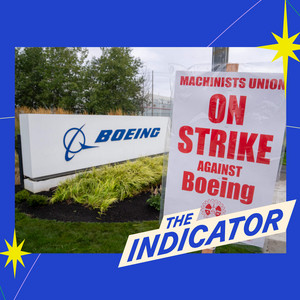
Yeah, 33 ,000 Boeing machinists were on strike, and Kelly Ortberg had announced plans to lay off about 10 percent of employees.
He told CNBC in an interview that his short -term priority was stabilizing the company.
And looking further ahead.
And we really need to embark on a culture change that is something more than just a poster on the wall.
It's really good. I guess those posters of the cat saying, Hang in there, didn't work.
If that doesn't work, I don't know what will.
I know. I know. Let's just give up.
You know, this culture change that Kelly Ortberg is talking about, it's an acknowledgement that what's gone wrong at Boeing was something fundamental, interwoven in the very nature of the company and its decision making.
And for many Boeing observers, the mistake was shifting focus from engineering to financial engineering.
Today on the show, we explain what financial engineering is and why this cultural change at Boeing may have led to the company's current problems.
Carl Tack is a former corporate lawyer and investment banker.
Today, he teaches finance at the College of William & Mary.
And a couple weeks ago, he gave a talk about Boeing to a group of students and he opened with a provocative question.
What is the purpose of a business corporation?
What's the purpose of Boeing?
These are deep metaphysical questions.
Many a corporation has sat on a hillside and pondered this very thing.
These were mostly finance majors.
And when I polled the class, the vast majority of students put up their hand effectively to say the purpose of a business corporation is to make money for shareholders.
That's what I would have said.
That's what a lot of people say.
And it's not necessarily wrong.
The real question is, okay, but how?
And what does that mean when we have a situation where, for example, serving customers conflicts with making money for shareholders, which takes priority?
Yeah, which does take priority.
You know, Carl thinks it should be serving customers by making products or services that they want to buy.
Boeing makes airplanes.
That's why Boeing exists.
To do that sustainably over long periods of time, we have to make money for shareholders because if we don't make money for shareholders, we're not going to attract the funding we need to build airplanes.
In other words, making money should be subordinate to the goal of making airplanes.
For Carl, the tension between these two purposes, making money or making airplanes, is at the heart of Boeing's troubles.
But this tension wasn't always so apparent.
For the first part of Boeing's history, the company was known for its engineering prowess.
There's this old saying, if it's not Boeing, I'm not going.
And the company actually still sells merch on its website with the slogan.
Chances are you've heard about the plane with a spiral staircase in first class.
This 1969 commercial for Pan Am touts the features of the Boeing 747, the first airplane with two aisles.
Because of its size, it revolutionized air travel when it was introduced.
We're playing with the two wide aisles and the three widescreen movies and the eight foot ceilings in economy.
And chances are - Chronicles of Boeing's history point to 1997 as a turning point for the company.
That year Boeing acquired fellow airplane maker, McDonnell Douglas.
And then effectively, McDonnell Douglas executives took over the company, by all accounts that changed the culture of Boeing over a 20 -year period, from a firm of engineers to a business run by not necessarily engineers.
Boeing became much more financially oriented.
This is financial engineering.
Earlier, this mindset had transformed General Electric.
It was during the tenure of legendary CEO Jack Welch.
He was known for a relentless focus on short -term profits and boosting GE stock price.
In practice, this led to closing factories and laying off workers.
Former GE executives took the Jack Welch playbook to other companies, and this group of alums included a CEO of McDonnell Douglas who later became CEO of Boeing.
I can tell you the hallmarks of a financial engineering run company, and they look a lot like GE and its heyday.
We're gonna talk about two of these hallmarks, aggressive cost management and distributing money to shareholders.
So number one is pushing costs down.
For Boeing, they spent layoffs, freezing out suppliers that refused to discount their prices and evaluating managers based on their ability to cut costs.
Former Boeing employees have talked about feeling pressure to choose efficiency over safety, although the company disputes this.
The focus on cost cutting also meant outsourcing more manufacturing.
Now, this is something a lot of companies do, from Apple to Boeing's European rival Airbus, but the supply chain for, say, Boeing 737 Maxes became really complex.
It had over 600 suppliers, including ones for critical components, and that limited how much oversight Boeing had when it came to quality.
Here's one example of that outsourcing.
In 2005, Boeing offloaded plans in Kansas and Oklahoma to an investment firm.
That investment firm created a new company that later became the supplier of fuselages for the 737 Max.
The supplier came under intense scrutiny this year after a door plug blew out at the site of an Alaska airline 737.
This summer, Boeing announced it was acquiring that supplier, basically reversing the deal it did back in 2005.
Carl thinks Boeing may be having second thoughts about outsourcing some of its core operations.
When Boeing shifted from 25 years ago, a culture of engineering, design, manufacturing excellence, to, in this middle period, making a lot of money for shareholders, decisions were made which may have had some relationship to Boeing's recent travails.
I'm not gonna pound the table and say, Boeing's had the crashes in 18 and 19 and the Alaska airline incident because of financial decisions they made 15 years ago.
I'm not saying that.
I can't say that. But a lot of insiders think those two things are related.
So Hallmark number one of a financial engineering focused company is aggressively keeping costs down.
The second hallmark is distributing lots of money to shareholders.
Carl says Boeing spent $65 billion on stock buybacks and dividends between 2013 and 2019.
Money that could have been used in the company for in various ways.
And instead it went out the door to shareholders.
Boeing is the dominant commercial aircraft maker in the US.
Carl thinks executives may have believed their company was too big to fail.
And that might've enabled greater risk -taking on the financial side.
This is a concept known as moral hazard.
And Carl believes Boeing's habit of paying shareholders instead of reinvesting profits or saving money for a rainy day, it worked until it didn't.
When the proverbial stuff hit the fan, Boeing was in a financial position which could very well have taken down the company, right?
As of now it hasn't, but they're still not out of the woods, they don't think.
We reached out to Boeing for the story and the company referred us to a statement CEO, Kelly Ortberg recently made where he said, we need to be on the factory floors, in the backshops and in our engineering labs.
It's language that hearkens back to Boeing's roots and he does have the pedigree to match.
He's a former engineer who previously ran an aerospace company.
Still, Kelly Ortberg has a long list of problems to address.
They include an almost $60 billion debt pile, a backlog of more than 5 ,000 commercial airplanes and maybe most importantly, a re -engineering of Boeing's culture.
This episode was produced by Inúr Corráz with engineering by Gilly Moon.
It was backchecked by Ciar Juarez.
K Kannan is our show's editor and the Indicator is a production of NPR.
Hey, it's Darien Woods.
Weyland Wong. And Adrian Ma.
We want to take a moment to talk about what makes the Indicator and everything you hear on NPR, And because it's the Indicator, we're going to have some fun and do it as a little poem.
Adrian and I have not heard this, so take it away, Darien.
NPR is public media, like an interstate, a public good.
Connecting places big and small, we want everyone understood.
Freely available to whoever wants it, no paywalls or tolls to drive through.
Now the reason we can keep building these roads, it's all because of you.
Wow, Robert Frost reincarnated.
Well, you know, there's two roads ahead.
One is donating to NPR and one isn't.
Choose the other one.
So yes, it is because of you that NPR can do this work and the Indicator can come to you every weekday to explain what's happening in the economy, in business, at work, and at home.
If you already support us, whether it's through NPR plus or donating to your local station, thank you.
If you haven't taken the leap yet, now is a great time because it's Giving Tuesday.
With NPR plus, you get to hear this and other NPR shows without sponsor messages.
And there are other perks too, like bonus episodes and discounts at the NPR shop.
To learn more, just go to plus .npr .org or you can always make a gift at donate .npr .org.
Thank you. Hey, it's Ana Maria Sayer, cohost of Alt Latino from NPR Music.
Today is Giving Tuesday, the perfect time to give back to NPR for all the news, music, stories, and overall good vibes it brings to your life.
Please give today at donate .npr .org.
Thanks. This is Eric Glass.
On This American Life, we specialize in compelling stories from everyday life.
I was like, wow, you literally just died and came back and the first thing you ask is, do you need any money?
Your life stories, really good ones in your podcast feed, This American Life.