Discussion keeps the world turning.
This is Roundtable.
You're listening to Roundtable.
I'm Niu Honglin, joined by Steve and Yushan.
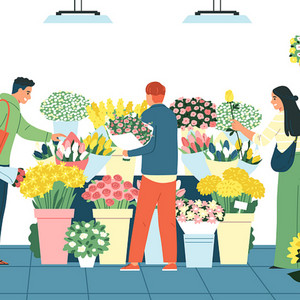
While the spring festival may be over, the charm of nianxiao flowers endures.
These vibrant blooms, from elegant orchid to cheerful, emotional plants, we'll explain what it is, are now a staple in homes across China, brightening our spaces and spirits.
Let's explore this, you know, growing influence in the flora market.
And leaving trash outside your department or apartment door, harmless habit or hidden hazardous?
We'll find out. But first, as the spring festival festivities wind down, the wave of excitement is still blooming in homes across China.
Nian Xiao flowers or Nian Xiao Hua Nian being the year or the spring festival, the spending of the new year and Xiao carrying similar meanings.
The seasonal beauties from 20 orchids to mood -boosting emotional plants have become a year -round sensation, offering lasting joy and greenery in our daily lives.
So Nian Xiao Hua, exactly what are Nian Xiao Hua Nian Xiao flowers?
It's a weird name, to be honest.
Really? This is the very first time I ever heard of Nian Xiaohua or the New Year's flowers as directly translated to English.
So this is a type of say marketing strategy that are typically available from December from the previous year to around Valentine's Day in the coming new year.
And that covers a time frame that includes many holidays such as Christmas, there's the New Year, Spring Festival, Lantern Festival and also Valentine's Day.
So this period also sees a high volume of weddings and ceremonies and celebrations, which leads to a significant demand for flowers.
So that's why I say this Nian Xiao flower is more of a marketing thing that's making it the peak season for flower sales.
Yeah. So there's so many reasons to buy flowers from that December to Valentine's Day period.
And that's why it's a peak season for flower sales.
There are some different flower types that are really popular.
And I was looking this up earlier today because I didn't recognize the name Phalaenopsis orchids.
Are you guys orchid fans?
I mean, my family is.
The one you just mentioned is hudieland in Chinese.
And it's something that my dad will always get annually as the wintertime approaches.
Me too. That is why I don't think nianshiow flower is a strange concept.
It happened in my family for years.
And the problem with this or the new phenomenon, or at least new this year, the kind of trend, is that usually we get one of this hudielan, this special type of orchid, a strange, strange flower.
You do not see a lot of leaves, just the branch and the flower can be very beautiful, even look a bit fake because it has no leaves.
So, yeah, go ahead.
And the problem or the thing in my family is that we do not have green fingers.
So when they arrive, they look beautiful and vibrant and amazing.
And it's during the spring festival period of time, so it decorates the home.
And with time goes by, with the spring festival come to an end, so does the life of this poor plant.
Oh, dear. I didn't know anything.
I love plants. We love plants.
We have a lot of plants in our home.
But I had never heard of this orchid before, the phalaenopsis orchid.
And apparently it's just one of the easier types of orchids to take care of.
And you plant it within tree bark and moss and things like that.
Don't plant it in soil, they say.
It doesn't like it very much.
What do I know? I killed so many.
Don't keep it in too much water.
They don't like that.
I was deep diving into phalaenopsis orchids this morning.
But here in China, apparently, tell me if I'm wrong, they symbolize elegance and longevity.
Maybe even all around the world, this is what they symbolize.
They come in different colors.
There's white, there's purple and pink.
And they're really pretty.
They just come on, looks like one tree branch.
It looks like grapes, doesn't it?
I mean, the flowers don't look like grapes, but it kind of looks like a bunch of grapes on one particular branch, or at least the ones that I saw were.
Yeah, sometimes the flower merchants will even use plastic supporters to, you know, kind of elevate the flowers in the way that there's like, it looks like there's a bunch of butterflies flying towards the center of the pot.
So that's the way how they plan, or rather to decorate the flowers to make it more attractive.
And usually, at least in my family's case, the purple ones are the most popular ones.
And usually they can last for like two to three months, I think.
That's the thing, because in my memory or in my impression, Nianxiao flowers are supposed to be flourishing during this December to February period of time.
And after that, my home goes back to a little bit plantless or just some really ordinary plants.
But apparently, that is changing.
The Nianxiao flower market is welcoming some new trends.
So this year, there are several new trends.
as I mentioned, some flower merchants, they use this Chinese fashion or rather the guo chao fashion to decorate or design the outcome of the general figure of their flowers.
In one case, there's this pot of plum blossoms that's styled in the spreading branch and also displayed on an antique tea table.
So that is to blend into this whole traditional Chinese aesthetics.
And also this shop that demonstrated this plum blossom also noted that this is their design of the Chinese fashion through flowers, through nianxiaohua.
And it's also recently influenced the plant market as well.
And there are some other creative flower arrangements, such as the orchards combined with slipper orchards in the staggered arrangements with also other decorations hidden among grass and all paired with complementary pots and stuff like that it's like creative creativity plus aesthetics for flower
traditionally and customers are requesting custom arrangements so they combine you know the beauty with the fun and the individuality one shop owner was talking about this new demand is really challenging for them Because it tests their skills and arrangement But it also, it tests their aesthetic judgment
Their artistic judgment as well So it's kind of fun The customers are having fun The shop owners seem to be having fun too And speaking of creativity I actually got a pot of lemon Gifted to me at the New Year season A plant, not just the fruit It's actually a lemon tree Tiny lemon tree That's as tall as
a computer set on your table and it actually has green lemons on it when we receive the gift.
It's not limes, just actual lemons that are tiny.
My parents were so worried that we can't kill it.
We need to raise it and wait until the lemons become yellow.
Keep it away from our host over here then.
Yeah, keep it away from the cats.
I'm really just not good at raising plants.
I kill so many. But apparently nowadays young people are getting really, really great.
They're growing numerous green fingers, in my opinion.
They are really good at this.
They're making the Nianxiao flower a yearly thing or a long -time thing.
Instead of, like my family, getting it every year, kill it and get a new one the other year, what they are doing is that instead of purchasing the traditionally popular Nianxiao flower, like the orchid we talked about.
They are buying different types of nianshao flower and even nianshao plants.
And they're keeping it in the family for, you know, the long run.
For as long as they can.
Yes. Sales are doing well too.
From January 24th this year to February 8th, the transaction volume at the Kunming International Flower Auction Trading Center that, by the way, is the biggest flower market in China.
I'd love to visit there sometime.
They reached over 56 million in volume That's nearly 40 % increase compared to the previous year So the sales volume is there And we talked about the fact that these flowers are very pretty People are falling in love with it on social media This is a win -win -win situation Oh definitely Actually according
to the latest report released by the China Flower Association the total scale of the national flower retail market in 2023 reached over 210 billion yuan with a fresh flower e -commerce retail market accounting for more than half of the total market size which leads to another trend that is previously
when i purchased flowers yes i still do that i might not be able to keep them alive for that long still i like a little bit of beauty natural beauty in my home.
So when I did that, I used to go to a local plant market, like Steve has said, or maybe I'll go online and find the flower from Yunnan province directly, because that is definitely a huge base of flower raising.
Yet nowadays, a lot of people, instead of consider it as a huge decision they have to make in their daily lives, or they instead of taking it as a ceremonial little gift or decoration you can only enjoy in special occasions.
They are actually welcoming them in their homes in a very regular term and seeing it as something quite simple.
That is why they're ordering them even from the online food ordering market or retail market.
Yeah, they're able to do that because of the impressive supply chain.
The industry itself here in China is impressively big.
The flower cultivation area spans about one and a half million hectares and there are about five million people working in the flower industry.
I'm envious somehow.
That must be such a peaceful job, I would think.
And like I said, the supply chain is impressive.
So flowers are delivered to stores and homes through different ways.
Could be air, could be high -speed train, It could be cold chain deliveries as well.
And the turnover cycle from farm to the flower shop is typically around three to four days.
So this is very, very good for the businesses and very convenient for customers.
And you know who are buying them mostly nowadays?
Boyfriends. I was going to say young people in general.
Husbands that are in trouble with their wives.
Oh my gosh. We're getting too realistic at this point.
Yes, they're buying flowers too, but young people are also buying flowers.
Thank you, Hong Lin.
The point is, nowadays, there's been a shift in customer demographics as well.
Because younger generations, the younger consumers, especially those born in the 1990s or also after the 2000s, they're also increasingly becoming the main consumer group for Nanshao Flowers.
I received that lemon tree from my cousin, who is around the same age as I do.
So, yeah, that's a living proof of that.
When are those lemons going to come into, I mean, what's the timeline?
Is there one? There are four lemons when I was given that are all green, and it was given to me upon the New Year's time in early January.
I don't remember when exactly, but now they're all turning yellow, and we're cutting them to make them nice.
How fun. Yeah, and also for different purposes of plants as well.
Nowadays, we see young people exchanging emotional plans.
Yes, explain that. Yeah, I mean, there's one example that I found.
This lady named Feng, a 25 -year -old from Beijing, she has discovered that the therapeutic value of caring for plans, I think we all need to learn from her as well.
So what started as a wish for good fortune has evolved into a deeper connection between her and her plans.
So this is some new ways that young people find joy within and also in just simply nurturing their plants.
Just like caring for some living beings next to you.
They are living beings.
They're alive. They're plants.
I told you we have a lot of plants in our homes.
They all have names.
Yeah, we've named all of them.
So losing one means a funeral in your family?
One is named Lady Sapphire.
She looks quite majestic So yeah, we named her that I'm not going to go down all the list of 11 names But anyway, speaking about the emotional value of having plants So it's not just in your home It is in your home, but not just Office spaces have gained popularity for their aesthetic appeal as well
You think of your own desk space, right?
Not the whole entire office space That's great if you have a lot of plants in your office But even on your own desk you know you can bring your lemon tree to work and put it next to your computer if you want if you wanted to uh you shouldn't and i we take care of a small plant together the last one
died i blame him the new one uh is is doing quite well i gave it some water uh this morning as a matter of fact i think on top of the real well excuse me the um let's say regular benefit you get from being around a plant, there are new things that young people are doing, like naming, like what Steve
has just said, naming the plant or finding some connotation about the plant that has something to do with the nature of the plant or the name of the plant, like making sure that one of your plant reminds you of stop being so anxious about future and naming a plant or finding the kind of plant that gives
you good fortune in bringing the good things in your life.
And these new connotations are also being added to the value of the plan itself.
And I think that this kind of topics always make me happy because the reason that we are doing all these is because we have a little bit of extra time, a little bit of extra money to, you know, enjoy the beautiful things in life that bring us joy.
And that is quite interesting.
So do all these things that we've discussed above indicate a brighter future into or about Chinese flower market or plant market?
I believe yes. My answer will be yes, especially when we're looking at younger consumers who, in particular, they no longer just go to flower markets like Steve does, that pick the favorite flowers and carry it home.
Nowadays, a lot of young consumers, they buy it online, just like calling for food or any other things.
So here are some data to prove that.
So this is according to the National Forestry and Grassland Administration.
So the share of online flower retail in the total flower market has now surpassed 50%.
And also another lifestyle, domestic lifestyle platform called Meituan also reports that by the end of 2023, the number of flower selling merchants on its platform had increased 10 -fold compared to that of 2018.
And also iMedia Consulting forecasts that China's online flower market will exceed 210 billion US dollars, which roughly equals to 1 .5 trillion yuan by 2025.
We see there's such a booming online flower market here in China.
So at least for many of the consumers, young or not, it's becoming more convenient for them to get flowers nowadays.
For me, yeah, you can order online and with the supply chain being as impressive as it is and the turnaround from farm to shop being as impressive as it is, that's always an option.
But for me personally, I prefer going to the flower market.
There's a plant market in our neighborhood, not so far away from here.
And my wife and I often go and we just walk around.
The smell is amazing.
The people that work there They really like Plants And that means that they like taking Care of something that's alive And I like that kind of Human being so just to go there And look around and Kind of be chilled out and relaxed It's a stress release and then pick out Two or three plants And have them
delivered or take them home yourself I think it's just a nice peaceful Serene activity Yes, we see the Nianxiao flowers have blossomed beyond their seasonal roots, embedding themselves into the fabric of daily life in China.
Their variety and cultural symbolism have enriched our homes and hearts, while also fueling the growth of the flora market.
You're listening to Roundtable, coming up next.
Leaving trash outside your door, something we've all seen or done at one point or another.
It might seem like a small thing, but is it actually illegal?
Is leaving trash outside your door just a harmless thing to do, or is it breaking the rules and impacting our neighbors?
We'll dive into this topic and hear both sides.
Don't go away. Looking for passion?
How about fiery debate?
Want to hear about current events in China from different perspectives?
then tune in to roundtable where east meets west and understanding is the goal it's roundtable with myself nil honglin steve hatherley and yu shan moment of truth have you ever left a bag of trash outside your apartment door for how long that is a horrible answer i i would imagine a month no a year
no um maybe like an hour um overnight what no no no no never overnight no no no no no that's rude in my opinion because good citizen yeah so i'll do i've done that in the past where i'm doing like a big house clean or something and then i'll just put the bags outside the door before i take them all
down on one trip but yeah just putting it out outside the door overnight or like having it as that's its permanent location no i haven't done that how about you shen guilty as charged i actually put um a copper box like like the box from delivery or boxes from parcels outside of my door but for food
waste and stuff that's that could be smelly sometimes i will put it indoor or hang into the indoor side of my door handle to just avoid public opinions about leaving trash outside, but still.
What are we talking about when we talk about garbage here?
That is actually a good question because I'm thinking about it too.
When you say garbage, I'm thinking like stuff that smells bad, not like a box from a delivery, an empty box that might be okay to stay there overnight.
Because actually when it comes to garbage, definitely the thing that you would leave in a garbage can qualifies as garbage.
So I think what Yushan has said also accounts.
And for me, I had also had the experience.
I had a plastic bag or a full plastic bag of used cans.
And the reason I left it outdoor is because my cat eats plastic at that period of time.
And I cannot put it indoor or my cat will just consume the entirety of it.
So I left it outdoor, but it was an overnight outdoor experience for that bag.
And I was wondering, the reason we're talking about it is because people here in China on the internet are having different opinions towards the situation.
So what are they saying?
Indeed. And this is a discussion, very much heated discussion from in eastern Beijing's Tongzhou district's Dongfang Life community.
Very specific. Yeah.
I mean, people are just getting crazy about it because some support the fact that it's okay to just store your garbage outdoor for temporary time because sometimes people who live on the top floor of a walk -up building, they find it impractical or hard to really travel multiple times by foot, walking
up and down stairs to just simply to dispose trash for one go.
So some of them, particularly those from a higher floor, they will just temporarily store it outdoor.
I get that, by the way.
You know, if you don't have an elevator in your building and you live on a higher floor, and then you're going to go out early in the morning anyway when you go to work or school, and you just leave it in front of your door so you'll take it out in the morning.
I get that mindset, sure.
Yeah, and this is actually, I mentioned the name of that community, but this is some very common scene everywhere else as well because we see a lot of people disagreeing with it online that it's an occupation of public spaces and also for particularly food waste, as we discussed earlier, Steve, that it
leaves odor in the hallway that can just spread throughout.
Oh, that is not okay.
So sometimes people, not sometimes, all the time people will try to file files or just put in their complaints saying that you can't simply just do that.
So there's this discussion that's raising online attention, and I believe it's always been there sometimes.
It's just been raised recently because of this very community's discussion as well.
In the beginning of the conversation, we touched upon an element that actually got my attention.
That is why I put it in the lead.
That is, have you ever considered this might be illegal?
my guess would be that it's it it might be technically illegal because that's a shared public space just as you if you left your garbage out in the street that is also a shared public space so by that logic i can see how technically it might be illegal but also extremely difficult to enforce.
Indeed. And also, just to what extent and under what context are these just city residents sharing a building with, say, hundreds of other people?
And to what extent can they maintain the public space as clean as everybody wants is also something to be considered before you decide if it's illegal or not.
But there are indeed safety issues to be considered as well, such as the public space occupation, like Steve said.
And also there's this fire safety concerns because foodways, cupboard boxes from deliveries, these are all easy to burn stuff.
And once the unfortunate happens and there's fire alarms, it's in that public space where everybody would need to run out of the building.
So that's a huge safety concern right there.
Yes. And the reason we are talking about it is because with the development of the society, We started to understand more about respecting your neighbor's rights as well.
We started to be more considerate when it comes to setting the boundaries, when it comes to making sure that our behaviors are not hazardous or pose any risks to other people as well.
So here is a little moment that you can use to complain about some behaviors from your neighbors that you think are making you unhappy or you want to file a complaint.
is there any of those behavior here maybe being too noisy oh that is a good one yeah that's me actually oh wow i'm the noisy one karaoke 11 p .m no but you know like a movie if it's really good might run past midnight and uh there was a note on our wall not our inside our house but in front of the elevator uh
let's remember that we all have to wake up early in the morning to keep it down after midnight and I was like oops I think that's me uh so after that we adjusted our volume after after 12 o 'clock yeah noisy overly noisy neighbors can be a pain can't they and especially in hallways well by mentioning
noisy I was I wasn't mentioning that being you know playing things in a loud volume at your respective closed up private spaces but rather just being noisy in the hallway you know sometimes people just bang their doors really loud in late hours and and sometimes they talk really loud in early mornings i
understand sometimes there's delivery man trying to knock open doors to to do his job to delivery parcels but in other cases it's kind of disturbing to you know people who lives on their own or or or people who choose to you know live quietly and without disturbed by outside noise, just like that.
What's your neighbor's situation?
Mine is definitely not illegal, and it's definitely within their own rights.
It definitely does not violate any rules.
It's smoking in their own home.
Oh, yeah. Right. It's definitely something that you can only complain about, but you cannot really say anything because it's in their own homes.
But once when I step into my bathroom at home, I smell this huge, huge smoking smell.
And it's because they were smoking in their bathrooms and the odor just transmitted to our home.
So, yeah, that's unpleasant.
That's unpleasant, but I understand.
Just very quickly before we finish up, I don't know if we answered the question.
Lawyer Ping Yan -jun emphasized that leaving trash in public areas is not only unethical, but also illegal.
In China's civil code, it infringes on the rights of other residents and can lead to legal consequences, especially if it obstructs emergency exits or causes health hazards.
So beware. Beware. Technically speaking, it is illegal.
So if you still do it, maybe after listening to today's show, stop doing it.
And that brings us to the end of today's roundtable.
We'd love to hear your thoughts on today's topics.
Leave us a comment or send us an email to roundtablepodcast at qq .com.
I'm Niu Honglin with Steve and Yu Shen.
Thanks for listening.
Bye -bye.