Explorer's log. Joy Dolo, captain of the Forever Ago here with my trusty companion, Senna.
We're entering the ancient ruins of a long forgotten civilization.
We're making this recording to share what we find on this dark and dangerous journey.
In case we don't return.
That's right, we've traveled long and far by plane, ship, rollerblade, pogo stick, hopscotch, bicycle, tricycle, unicycle, did I mention rollerblade?
And two stops on the metro, all in search of this legendary location.
Now that we've found it, we shall explore.
Tortures blaze! Actually, these are glow sticks.
Stepping lightly, so as not to disturb the shaky ground.
That's why I'm in my bunny slippers.
Hop, hop, hop. Pen in hand, taking notes of the ancient artifacts we find.
Oh, this isn't a pen.
It's a Twizzler. Was I supposed to bring a pen?
Sorry. Who knows what wonders we'll discover.
Uh, excuse me. Lady with the bunny slippers and glow stick, no eating candy in here.
You'll get the shelves sticky.
Eat Cats, a citizen of this forgotten realm!
And he's alive! Of course I'm alive, and this isn't some forgotten realm, ma 'am.
This is a video rental store?
Ah, yes, the ancient site known as a Video Rental Store.
People would come to this establishment to borrow physical copies of movies, and watch them at home!
Truly a wonder to behold!
Oh, the Little Mermaid!
I love this one! I'm Joy Dolo here with my pal Sena.
Hey! And this is Forever A Go from APM Studios.
We're a nonprofit public radio program.
That means you keep us going.
You can do that by donating, joining SmartyPass, or buying a shirt that has my face on it.
Head over to foreverago .org and show your support.
Thanks! Now, today, Sena and I are on an adventure.
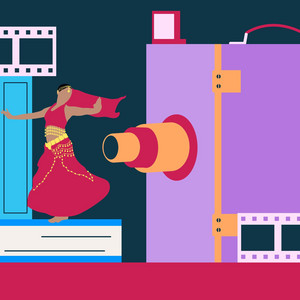
We're exploring the history of Bollywood cinema.
And the story of one man who helped bring it to life.
His name was Darasaheb Phalke.
Bollywood is the nickname given to a giant movie industry in Bombay, India.
It's a mashup of Hollywood.
That's the hub of movie -making in the US.
And Bombay. Bombay plus Hollywood equals Bollywood.
Bombay is the old name of India's largest city.
Today, it's called Mumbai.
But the name Bollywood lives on.
Senna, do you watch Bollywood movies?
I've watched a few clips from Bollywood movies.
I also like the song, Chaya Chaya from the movie Dil Se.
Teh Lih Teh Ya Teh Ya Teh Ya Teh Ya Teh Lih Teh Ya Teh Ya Teh Ya Teh Ya Teh Lih Teh Ya Teh Ya Teh Ya Teh Lih Teh Ya Teh Ya Teh Ya Teh Ya I like it cause its a train.
People are on top of the train dancing.
Oh yeah, that sounds pretty cool.
To help set a cinematic, movie -tastic mood, we're camped out in this dusty old video rental store.
Geez, it's just a video rental store.
Not the lost kingdom of Atlantis.
And it's not that dusty.
I actually cleaned it last week.
Or was that last year?
Oh, I almost forgot, that is our noble guide.
His name is Doug, guardian of the Divids.
For the last time my name is Doug, Doug.
and they're pronounced DVDs, you know, the shiny little discs that play movies.
By the way, Bollywood.
That's in aisle six.
Just passed French New Wave and right before Korean drama.
Thank you, Doog. hmm so how do you define a Bollywood film anyway?
Like, what makes it different from other movies?
I can help with that.
Whoa! Where did you come from?
Oh, just behind that rack of movies.
I'm just picking up a couple to watch this weekend.
Oh, cool. And who are you?
I'm Tejasvini Ganti.
I'm a professor at New York University.
And I know all about Bollywood.
I've even written some books about it.
Oh, hi. My name is Sena, and this is Jyothi.
We love to pick your brain.
Sure. So what makes Bollywood films unique?
Bollywood film features.
One thing that I'm sure many people, especially in the US, as soon as they think of Bollywood, they think of music.
They think of song and dance.
That's right! You usually see big, flashy dance numbers.
Lots of people with colorful costumes and super catchy songs.
I love dance numbers.
I'm actually taking lessons to learn Bollywood dance moves.
So what moves are you learning, Senna?
I like the flower blooming step.
It's kind of like a flower opening.
you twist your hand, so it's like a flower opening.
Oh, cool, like a flower blooming dance.
Yeah. That's cool. Is there other moves that you like?
I really like the glitter.
It's like, you can shake your hands from side to side, like you're trying to get the glitter off your hands.
Oh, like you're shaking glitter off?
Yeah, like from left to right or right to left. Oh, I like that glitter.
I'm going to work on that one.
So, Tejaswini, what about the stories?
What kind of stories do you usually see in Bollywood films?
The stories are kind of seen as epic.
You know, they're always kind of like larger than life struggles.
It's often about love.
Rich girl, poor boy, poor girl, rich boy.
You know, so a lot, you know, often about like love across social boundaries.
The other thing that's also distinctive is that all these films have an intermission.
That means Bollywood movies usually have a Right.
Because these movies are long.
Sometimes three or even four hours.
Well nice chatting with you.
I got my movies so I gotta run.
Hey Doug, put these on my tab.
See ya! Let's see what Bollywood movies they have on the shelf here.
Oh, this looks cool!
It's called Mr. India and it's from 1987.
Wow. It says, it's about a man.
His father was an inventor who built a machine that can make the person who wears it invisible.
The man finds the invisibility machine and uses it to fight crime and save all of India.
Ooh, this looks great, too.
It's called Jagat Jasus.
It's from 2017. It's about a boy who goes on a wild adventure.
He's looking for his long lost father.
The boy struggles with words but can express himself in song.
I gotta see that! Grab these movies and let's watch them later.
Good call. Okay, now that we know a little more about Bollywood movies, let's learn about the history.
And the man who helped pioneer Indian filmmaking.
His name was Dar Esiheb Phalke and his story begins in the late 1800s.
Back then, people mostly traveled by train or ship.
Cars were still new and very rare.
Most homes didn't have electricity or radios or even telephones.
People mostly got their news from newspapers or talking to their neighbors.
During this time, India was under British rule, which meant that the country was controlled by Great Britain.
That means British people usually made the rules for the Indian people who lived there.
Which was totally unfair.
They made Indians pay them lots of taxes, and they took a lot of natural resources out of the country.
Much of India was very poor back then too.
Dadasaheb Falke was lucky though.
He grew up with a lot of opportunities.
He was able to get a good education and even went to art school.
He picked up a ton of skills.
Drawing, painting, printing, architecture, photography.
He even did magic shows.
This guy picked up new skills like my sweater picks up cat hair.
But Fauqué didn't find his true calling until he was about 40 years old.
That's when he saw his first movie.
It was the year 1911.
Movies were brand new technology at the time, and they were pretty different from today.
They were black and white, and they were silent.
So they didn't have any talking or music.
But sometimes live musicians played along with the images.
One of the first movies Fauke saw was a religious film called the Life of Christ. He was inspired by this new technology.
He thought, what if you could use this same technology to show Hindu epics?
Hinduism was, and is, the biggest religion in India.
It's full of incredible stories with gods and goddesses, daring heroes and demons.
Fauke thought putting those tales on a movie screen would be the cruelest. Falcon became obsessed with movies.
He started watching hours of them every day.
He was skipping sleep.
He had to make his own movies.
But cameras were expensive and buying film, hiring a cast, getting costumes and sets, that was gonna take a ton of money, which he didn't have. But like the hero of Bollywood film, Falcon would succeed against these incredible odds.
We'll tell you how in a minute, but first let's hit pause and play a game of First Things First. That's the game where we put three things in the order that came in history.
Today's things are movie milestones.
We've got the first color movie so a full length film in color, the first full length movie with talking in it and the first full -length animated or cartoon movie.
Senna, which of these do you think came first and what you think came second and most recently in history?
I think maybe animated came first, then color, and then maybe talking.
I'm not completely sure though.
Animated, color and then talking?
I think so maybe. So why that order?
I don't know. Animated feels like it would be pretty easy just draw a bunch of animated pictures.
Yeah. and then talking sounds really hard to put on and color too, you have to color a lot.
A lot of coloring, okay, so animated because it seems like it's easy to draw, color and sound, talking, because it seems like it's a little harder to lay over.
Those are great guesses.
Is that your final answer?
Color and talking maybe switched around, but I think animated is, I think animated should stay there.
So it could be animated color talking or it could be animated talking color.
Yes. All right. Well, we'll hear the answers at the end of the show.
So stick around. We're working on an episode all about the Girl Scouts.
Girl Scouts earn badges for gaining special skills like learning how to do first aid or cooking a delicious meal, or even being a great friend.
And we want to know if you could give a badge to an important person in your life, what badge would you give them and why?
what about you Sena is there someone in your life who deserves a badge for something?
I would give a badge to my dance teacher Vonnie for teaching me all my dance moves.
That's cool for me I would give my dog King Louie a poop master badge because he's the poop master.
Like when he goes outside he just does his business there's no waiting around it's Minnesota it's freezing here you don't have to wait in the snow in the cold you just do the poopy and you head back in the house.
And that's why we give him the poop master badge.
Listeners, we want to hear from you too.
Record yourself describing who you would give a badge to and what it would be for and send it to us at forevergo .org slash contact.
You can also send us questions and fanart.
Yes, like a drawing of me and my pet elephant Hermy dancing to Bollywood music.
Can't wait to see it!
Brainzon Universe is a family of podcasts for kids, and their adults.
Since you're a fan of Forever Ago, you'll love the other shows in our universe.
Come on, let's explore!
It's alien exercise hour!
Hi -yah! Hoo -ha! While I stretch my snootles and bounce on my trampolini.
Ah, listen to a new podcast. Ha, ha, ha, ha.
I'm going to try Brains On, the best science podcast ever.
It's starting, yay.
Hello, and welcome to Pop Planet, the only show that gets you up close and personal with space.
I'm your host, Star Eden.
Zoop! Come back here, podcast. Must listen to Brains On now!
Listen to Brains On wherever you get your podcasts.
Welcome back to Forever Ago.
I'm Joy and I'm Senna, and we're telling the story of Dada Saheb Phalke, the man who helped launch the Bollywood film industry.
And I'm Doug, and I work at this video store and I'm just letting you know that we close in five minutes.
Got that? But we can't leave Doug, we're not done telling the story.
Plus you have all these movie snacks for sale.
You can't pump movie history without snacks.
You know you have to pay for those.
I know Doug, here. Now, where were we?
We're talking about Dadasaheb Falke.
He wanted to make a movie in India, but he didn't have a camera or the skills or anything really.
Right. But he did have one thing, not giving up -ness.
Or, as most people call it, determination.
Falke cobbled together some cash and traveled to London.
There, he managed to meet up with a filmmaker named Cecil Hepworth.
Yes, Falke literally went out of his way to get what he wanted.
Oh, hello, let me guess.
You are looking for DVDs?
Yes, I am. And you happen to be an expert on Bollywood cinema?
Why yes, my name is Anupama Prabhala.
I am a professor of Film, TV and Media Studies at Loyola Merrimont University.
I write about and teach classes on the origins and history of Bombay Cinema, also known as Bollywood.
WOW! What are the odds?
So tell us more about Falke's time in London.
That's where he kind of learns the grammar of filmmaking.
What is a shot? How to cut?
How long a shot should be?
What films well in black and white?
He learns some of these things in the Hepworth studio.
But back in Bombay, he adapts the tricks he's learned to appeal to Indian audiences.
So he learns the basics of moviemaking while he's in London and manages to buy a camera.
Then he heads back to India to make his first movie.
But he quickly runs into another problem.
He can't find a woman to star in the movie.
Women were supposed to play very traditional caregiving roles, cook for the family.
And any woman who had a public life was seen as, you know, not respectable.
And that's why women wouldn't act in front of the camera.
So there was a lot of pressure from society on women.
It made them feel like acting was a bad thing to do.
Even Falke's own wife wouldn't be in his movie, so eventually he found a man working at a restaurant and convinced him to play the leading lady role.
Finally, in 1913 the movie was ready.
It was called Raja Harshchandra.
It's a story about a noble king who has to give up his kingdom.
But in the end he makes the Gods happy and they give it back to him.
He was forty minutes long, black and white, and silent.
Sometimes there would be a person there describing the action while the movie played, or live musicians playing along.
The next challenge was getting people to see it.
Back then, movies were played by running long rolls of a thin, plastic -y material called film through a big projector.
The projector then shined a moving image on a screen.
At the time, people watched plays for entertainment, or went to concerts, but they had never seen a movie before.
Movies were totally new.
The idea of moving pictures was so strange that it was kind of scary.
But people had seen still photos before, so Falke told people movies were just lots of photos combined together.
Right Anupama? Exactly.
So at one point he was like you know, one minute of a film strip is like 3750 images.
And then he goes, That's 3750 photographs.
He used something they had seen before, photos, to make them feel more comfortable with something they hadn't seen before, movies.
And he tried to drum up interest by having his cast act out parts of the movie at busy places around town.
So he does all of these things and people at one point think he's mad, he's a maverick because he's experimenting so much. But Falke wasn't just hustling to convince people to see his movies, he was hustling to show them to people, too.
Sometimes he had to literally carry those big reels of film in a cart all across town from show to show.
And we can imagine, you know, how much of a sort of family effort this was, like, okay, his wife is helping him, and he's kind of carrying this material to smaller parts around Bombay in order to get that new audience, right?
But eventually, it pays off, big time.
His movies were hits.
Critics loved them.
Soon people were offering him big money deals to make more and more movies.
And he made new film fans left and right.
After this, there was no going back.
India became a country that loves movies.
Of course, he wasn't the only one making films at the time, but he was one of the most successful of the silent era, and that helped build an audience.
Exactly, and oh, here's the movie I was looking for.
I gotta head out now.
Nice talking to you both.
See you around, Doug?
Yep. On the tab. See ya.
Wait, so what happened next?
Doug, have you been listening this whole time?
Yeah, I consider myself a film buff.
But I didn't know any of this.
Finish the story, please!
But isn't it closing time?
Eh, I'll stay open for you.
Awesome. Well, Falke went on to make a lot more hit movies.
and he even found women willing to act in his second film.
In fact, by the 1930s, it became more common to see women on the screen in India.
Around that same time, movies with sound got popular.
Song and dance became a key part of Indian cinema.
Right. Live theater performances in India already featured a lot of singing and dancing, so it was a natural fit for the movies.
From there, movies got bigger and bigger, and so did the audiences.
Today Bollywood is a multi -billion dollar industry and Phalke is still remembered.
In fact, one of the top prices for film in India is named after him.
Wow! So cool! Consider me a Phalke fanatic!
Now, I hear tell that you're looking to see one of these ancient films of Phalke.
Yes, that's exactly what we seek to find!
I am here to tell you they are not on the format you call DVD!
I have them on an even more ancient vessel, one called a V -Hissssss.
Wait, you mean a V -H -S tape?
The big blocky things people used to buy movies on?
Yeah just kidding, they are called V -H -S.
We can go watch them in the screening room, come on!
one sec, just gotta grab a few more twizzlers.
Joy, again, you do have to pay for that.
Ugh, why does shopping always have to cost money?
Dada Saheb Falke was a visionary who helped shape an entire film industry.
Yeah, he not only had the dream of telling Indian stories on screen, he was creative enough to make those movies and smart enough to build an audience.
Even though Bollywood films today are pretty different from Paul K's silent movies, you can see his fingerprints all over the industry.
And speaking of fingerprints, Joy, your candy -covered fingers are leaving prints all over the DVDs we rented.
Don't tell Doug it was me!
This episode was written by Sandin Totten.
It was produced by Nico Gonzalez -Whistler.
And Ruby Guthrie. It was edited by Shailah Farzan.
Fact -checking by Rebecca Rand.
Engineering help from Alex Simpson with Sound Design by Rachel Brice.
Original Theme Music by Marc Sanchez.
We had additional production help from the rest of the Brains On!
universe team. Molly Bloom, Rosie DuPont, Anna Goldfield, Lauren Humprupt, Joshua Ray, Mark Sanchez, Charlotte Traver, Anna Weigel, and Aran Goldesalasi.
Beth Perlman is our Executive Producer and the executives in charge of APM Studios are Chandra Cavati and Joanne Griffith.
Special thanks to Tejaswini Ganti, Anupama Prabhala, Nicole Dubriel and Sharath Chilletti and Avni.
Okay, Sena, ready to hear the answers for first things first?
Definitely! Okay, as a reminder, we're putting these things in order.
The first color movie, first full -length movie with talking in it, and the first full -length animated or cartoon movie.
And so you said one animated and then color and then talking right?
Yes or talking in color.
Well, talking in color.
Well let's see what the first feature film was that was in history that alright the first one was color movies can you believe what yeah that was invented in 1914.
That's over a hundred years ago!
That's crazy. I know!
So the first movie credited as having natural color was called, The World, the Flesh, and the Devil.
And it was filmed with red and green filters.
So while it was definitely more colorful than previous movies, some shades, like blue, were missing.
And before this, filmmakers would sometimes paint the film by hand to give a movie color.
Could you imagine painting a movie by hand?
That would take a long time.
And then second was cartoon movies, isn't that something?
And that was in 1917, so just a few years after the Colored movie.
So historians usually say the first full length animated movie was a political fantasy from Argentina.
It was called El Apostol.
It's about the then president of Argentina having a dream where he climbs Mount Olympus and talks politics with the gods there.
The animation was made with figures cut out of paper.
That's a long way from SpongeBob the Movie.
So last but not least is Talking Movies.
And that was 1927, which is again 10 years after that last one.
It's crazy. Boom, boom, boom.
Yeah, it was all back to back to back.
It was like movies were invented and all these different kinds of movies came out afterwards.
So the first full movie with recorded dialogue was called the Jazz Singer.
and it's about a young man who dreams of being a famous singer, even though this goes against his parents' wishes.
The movie is credited as being the first Talkie, a nickname for old films with talking in them, but it only had 281 words in it, which is hardly any talking.
Still, most people say it marked the end of the silent film era.
Okay, that was a lot of information.
Let's digest it. What do you think of that?
My brain is blown. Yeah.
What's the coolest fact you heard there?
It's like really mind blowing that they made the first animated, I don't know, but cut out like people out of paper.
Yeah. Like that took a lot of hard work.
Would you ever do something like that?
Like make little papers and make a little movie?
I don't think so. Well, I am doing a stop motion and me and my two friends who are doing it with me, we cut out the paper, but we didn't have, We don't have that many like props, so it's pretty easy but...
So you cut out the paper yourselves and then you like make a story or is it like...
Yeah like it's about a farmer so cut out a farmer, draw the farmer on the paper and it's like stop -motion you have the things in place you take a picture and you move them the tiniest bit and you do that over and over again and then when you speed it up it looks like it's moving Oh that's so, okay, so you're making a movie Sort of Yeah, so you're movie maker, film star, okay.
Not a big deal. Can I be in it?
Can I be the farmer?
Listen to my farmer voice.
Herk, get off my crops you kids.
Change my mind, I've changed my ways.
That was my audition.
We're not gonna have anyone to speak for the farmer.
Yeah. Or the sheep, it's about a farmer trying to grow a rainbow grape, or a beautiful grape.
It ends up growing a rainbow grape, and then the sheep with concerningly long legs eats it.
Yeah, and then it turns rainbow.
And then wolves come and eat the sheep and they turn rainbow.
That's so cool! You know what you should do?
You should add like a rainbow dance so then it could be like Bollywood with music and things.
Join us next week for a new episode all about the Native Youth Olympics.
Thanks for listening.