Support for NPR and the following message come from Boll and Branch.
Experience your best sleep in the softest organic cotton sheets.
Get 15% off and free shipping on your first set of sheets at BollandBranch.com with code NPR.
Exclusions apply. See site for details.
This is Planet Money from NPR.
So, we have an election coming up and there's some serious economic policy being lobbed about.
Yeah, for the wonks, this has actually been an exciting few weeks because we are starting to see hints, at least of economic policies from both candidates.
Some of them are clear, but most of them are shrouded in jargon or hidden behind campaign slogans.
Opportunity economy. Deindustrialized third world nation.
A homeowner bill of rights.
Energy dominance. A middle class tax cut.
Net zero policy. What does that mean?
I have no idea. Yes, what does any of that mean?
Right, but these are all things you are likely to hear out on the campaign trail or at next week's debate.
And you know what? We were thinking.
These next few months are going to be a jargon-y slog.
So, what if, hear us out, we turn that slog into a game?
That's right. We're doing bingo.
Nope, stop it. Hold on. Halt.
That's not bingo music.
Let's go for something a little more chill.
That is bingo music. Yeah.
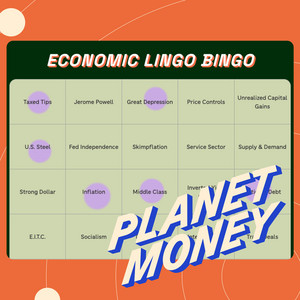
Hello and welcome to Planet Money's economic wonk collection, lingo bingo extravaganza.
I'm Erica Barris. And I am Nick Fountain, not a huge bingo guy, which is a big contrast apparently to you, Erica.
That's right. I'm not going to brag here or anything, but I know my way around the bingo hall.
Awesome. Well, we're going to lean into your expertise when it comes to bingo today.
And we're going to look for wonky economics terms to fill our bingo card with.
That's right. Our bingo card is going to be chock full of econ lingo.
So roll up your sleeves, turn up your TVs, get those doppers ready.
Doppers? You know, the stamp you use every time you get a bingo square?
Of course. This election season, you can expect to hear a lot of news, some of it meaningful, much of it not.
Give the Up First podcast 15 minutes, sometimes a little less, and we'll help you sort it out.
What's going on around the world and at home?
Three stories, 15 minutes, Up First every day.
Listen every morning wherever you get your podcasts.
When voters talk during an election season, we listen, we ask questions, we follow up, and we bring you along to hear what we learned.
Get closer to the issues, the people, and your vote at the NPR Elections Hub.
Visit npr.org slash elections.
All right. So what we're going to do today is make a bingo card, mostly for our own entertainment, so the play-to-buddy staff can compete during the next debate.
But we figured if we're going through all the work, we might as well make a real proper bingo card too.
And you, dear listener, will be able to find that at npr.org slash bingo.
And you can print it out and play along with us.
Erica, you are our guide to all things bingo.
What do we need to know about the game?
Okay, so your standard bingo card has 25 squares.
And what we're going to do today is fill in each square with a different econ or econ adjacent term.
The first, planet money staffer to get five in a row wins some, like, yet to be determined prize, probably something from the office supply closet.
And bragging rights. And bragging rights.
The middle square is usually the free square.
Everyone gets that. And I've been thinking about this a lot.
I think our middle square should just pretty obviously be the middle class.
Because even though the share of people in the middle class has been shrinking for decades, it sure seems like politicians' references to it have been steadily growing.
Middle class in the middle.
Love it. No politician can avoid saying that term ad nauseum.
But that leaves 24 squares left to fill.
So let's get moving. Yeah.
So one term that I'm pretty sure is going to show up is one that I've heard economists talk about quite a bit over the past month.
Price controls. Literally every economist I've called lately has wanted to rail against price controls.
Erica, you've been looking into this.
Tell me, why are we talking about this?
So last month, Kamala Harris made this big policy announcement about something we're all feeling right now.
The high price of groceries.
As president, I will take on the high costs that matter most to most Americans, like the cost of food.
And what people heard when she made this speech was, I want the federal government to set or control the price of food.
And economists hate price controls.
Totally because market prices are a signal to producers on how much of any given good to make.
And when that signal is broken, it breaks the market.
Every economist has a favorite cautionary tale about price controls.
Yeah. One of them, the 1970s.
Good evening. We had high-ish inflation and President Nixon put in price controls.
I am ordering a freeze on prices.
The results were a disaster, like farmers stopped sending their goods to market.
They're holding up a higher price.
Consumers cleaned out the shelves.
The cattle simply are not being brought to market.
It just very famously did not work.
But what I have gathered is that Kamala Harris was not actually advocating for price controls.
That right? No. She was actually talking about a totally different thing.
Banning price gouging.
Yes, but there seems to be considerable debate over what that actually means.
What have you found? So price gouging is hiking up the price of a good.
But it isn't just that. There are other criteria that are used to actually determine when something is price gouging as opposed to just a regular price increase.
Like are sellers taking advantage of an emergency situation, a hurricane or a wildfire?
Are these essential goods?
And are they excessively overpriced?
Some state laws that ban this practice say price hikes of 10 to 25% are excessive.
Sure, but like, come on, during a crisis, it's just more expensive to make stuff.
It's really hard to get stuff to a disaster area, for example.
Right, right. And this is an important part of this.
For it to be considered price gouging, those increased costs have to be taken into account.
Huh. And so this is what Harris is proposing is something similar to those state laws?
The details are a little light, but most likely her policy will look much more like those laws than any price controls.
All right, along with price gouging and price controls and I guess supply and demand, we have filled in three more squares.
Eric, I was wondering, do you think we should throw in the fancy term that economists use when they want to say crisis but want to see pretty cool, exogenous shock?
No, I don't think so. It's a little too obscure.
I'm actually trying to win this bingo game.
Oh, come on. Fair, fair.
No dice. All right, Erica has gone off in search of more terms for our bingo card.
She's presumably watching stump speeches on four screens at once at double speed.
In the meantime, let us take a detour into the world of monetary policy for a second.
In any normal presidential campaign cycle, the candidates are not actually talking about monetary policy and the Federal Reserve very much for a very important reason.
Normally, the president doesn't meddle with the Federal Reserve's work of maintaining low unemployment and low inflation because the Fed is supposed to be independent.
But this campaign, that very idea is being questioned.
For more on that, we are joined by Darian Woods from across the hall at the indicator.
Hey, hey. Hey, Nick. All right, so why right now are we talking about Fed independence?
Well, because the candidates are.
He has formed a president, Donald Trump, just a few weeks ago talking about the Fed.
I feel the president should have at least say in there.
Yeah, I feel that strongly.
I think that in my case, I made a lot of money.
I was very successful. And I think I have a better instinct than in many cases people that would be on the Federal Reserve or the chairman.
And his vice president, Kamala Harris, with pretty much the opposite take.
The Fed is an independent entity.
And as president, I would never interfere in the decisions that the Fed makes.
All right, so different takes on how much and whether the president should influence monetary policy.
Why does this matter, Darian?
Well, think about the current situation we're in.
You know, we had very high inflation not too long ago.
And the Federal Reserve has mostly gotten it down to a place that they're more comfortable with.
But could they have done that had the president been meddling?
Raising interest rates is a challenging lever to pull.
It brings down prices by slowing the economy down.
It makes new mortgages more expensive.
It can put people temporarily out of work.
And whereas a president might not want to pull that challenging lever because it's politically unpopular, an independent Fed is more likely to do it.
Yeah, it's not a popular line of action for any politician.
Now, the Fed is not totally independent, though.
The president appoints members of the Fed board and Congress has oversight over the Fed.
We love to see Jerome Powell being grilled by members of Congress.
Yeah, well, I'm not sure if he loves it, but yes, he does regularly get his feet held to the fire.
And it's worth saying that the idea that the Fed gets to do the hard work free from meddling by the executive branch is this longstanding tradition that goes back to the 1950s.
OK, but that could change very soon, it seems like.
Yes, however, and this is a big however, we should note that Donald Trump has recently walked back that comment about Fed independence.
Those of us who remember his presidency will remember that this is not exactly new territory for him.
I remember a lot of angry tweets about Jerome Powell.
So many. And listen, one final point about this is that it's not just a theory that central bank independence tends to mean lower inflation.
The evidence points to it, too.
Countries with more independent central banks have lower levels of inflation, though it is a correlation, not necessarily causation.
All right, Darian, I appreciate you schooling us on this subject.
Thank you for coming in.
Yep, anytime. And if you want to call me again, maybe even for this very episode to chat about something else election related, just let me know.
I will take that under advisement.
Thank you, sir. Erica, you're back.
How was it? I've been watching those Thumbs Meets.
What economically go have you picked up from them?
What should we be adding to our card?
I have picked up housing shortage.
Trump likes to talk about the Great Depression, also a favorite topic of economists, and the national debt.
Big topic. Terrific. And Darian hooked us up with a few as well.
Fed independence. Let's throw in inflation and unemployment.
Interest rates. Maybe even Fed chair drone power.
Erica, you are the official keeper of the official bingo card.
Yes, I am. How many squares have we filled in so far?
12 out of 25, which means we got to keep them coming.
Right. And for the next subject area, we thought we could mine for lingo bingo.
We thought we would turn to taxes.
Okay, so both candidates are probably going to talk about the rate that corporations pay on their taxes, also known as the corporate tax rate.
Trump wants to reduce it.
Harris wants to raise it.
So we should add it to the card corporate tax rate.
And of course, parts of the Trump tax bill from back in 2017 are set to expire next year.
And so maybe we're going to get real wonky about the tax code.
Maybe the candidates are going to start talking about the standard deduction and the salt deduction.
What do you think? Should we add those to the list?
The state and local tax deduction, the one that residents of high tax states like to use to lower their federal tax bills.
I highly doubt the candidates are going to say it.
It doesn't play that well in most swing states, but one can dream.
Add them to the card. Yeah, this would be a good game if we didn't throw some real hard balls in there, right?
Yeah, yeah, we don't want anyone getting a cover all, which is, you know, when you get every square on the bingo card.
Now that I know what that means, I know that especially no one can need to get one.
And there are some other hotly debated tax credits that are being bandied about by the candidates here.
I'm just going to let Kamala Harris speak about them.
Under my plan, more than 100 million Americans will get a tax cut.
And we will do this by restoring two tax cuts designed to help middle class and working Americans.
The earned income tax credit.
And the child tax credit.
Okay, now there are two policies in there.
Expanding the child tax credit that is supported not just by Harris, but also by Trump.
That one is kind of self-explanatory.
It gives money to people with kids.
So we're going to just add that to the card.
Put it on the card. Put it on the card.
But Nick, you cannot shut up about that other thing that Harris mentioned, the earned income tax credit.
Yeah, the earned income tax credit is like the undisputed headway champ of public policy.
I wanted to geek out about it, so I called up Diane Schoensenbach, an economist at Northwestern.
Is this economist's favorite policy?
It might be. Let's go with it.
It's certainly my favorite policy.
That's right. That was the longest pause I've ever heard.
Okay, so maybe not every economist's favorite policy, but certainly Diane's.
So tell me about it. Yeah, so first off, it comes from this rather unusual place, the OG of conservative economics, Milton Friedman.
And this idea that he helped popularize, it's called the negative income tax.
The proposal for a negative income tax is a proposal to help poor people by giving them money, which is what they need.
Milton Friedman. Not exactly who you think of when you think of a policy that a Democratic candidate would be into.
Yeah, well, this idea is really popular across the board.
Economists who usually disagree about a lot of things agree on how brilliant this policy is.
And the basic idea behind the negative income tax is that at low levels of income, rather than tax people for every dollar they earn, you do the opposite.
You give them a little extra.
Like a bonus? Yeah, sure.
That is a good way to think about it.
And that is how the earned income tax credit, which was introduced in the 70s and then expanded in the 80s and 90s, works.
If you make no money, you get no bonus.
But then if you earn a little bit of money, the government doesn't tax you.
They supercharge your earnings, says Diane, by giving you more money than you earned.
And so that makes working more attractive.
And the way that then this is set up is it's going to draw more people into working for the first time that haven't been working before.
So whereas like if there was just an income tax and not this policy, every hour I work, the government's going to take away a little bit of that in taxes.
Now, every hour that I work, the government's going to add.
That's right. That's right.
You're only up to a certain point.
After that point, a certain income threshold, the credit slowly fades away until the earner enters the world of regular income taxes where the government just takes money out of our checks.
Okay, so this is like a way to draw people into the workforce by supercharging their earnings.
Yes, and, and. Now, I do want to say just before we forget it, this policy is a huge deal.
It lifts more children out of poverty than any other policy that we have.
It's the second, you know, biggest anti-poverty policy that we have behind social security and, you know, many, many people are no longer in poverty because of this program.
Okay. And so what Harris is proposing is expanding the earned income tax credit.
Is she going to sweeten the deal even more?
Kind of. Right now the policy is sweetest for people who have children.
And Harris' proposal is to expand the number of childless workers who it reaches and also make it more generous for those people.
All right. Thank you, Nick, for your tribute to the earned income tax credit.
I'm just thrilled that it's going to be on our bingo card getting the respect it deserves.
However, not in full form.
We're going to use the abbreviation EITC.
Real ones know. All right.
Now from a topic that I personally love to one of your favorite topics, Erica, trade.
I do love a good trade story.
And there is no better place for a bunch of trade lingo than a presidential campaign economic bingo card because as opposed to a lot of other things, presidents actually do influence trade policy quite a bit.
Trump, of course, did a whole lot on trade.
He pulled out of and renegotiated trade deals.
He was extremely hostile towards the big international trade organization, the WTO.
But his administration will be remembered first and foremost for the trade wars.
Yes. And the economics term that Trump may be popularized the most and which we should definitely add to the card is, of course, tariffs.
Of course. No president in our lifetime has slept so many tariffs on imports.
And this time around, he is proposing even more, a 60% tariff increase on goods from China and a 10 to 20% across the board tariff increase on goods from all other countries.
So quite a lot. And Erica, the thing I wanted to ask you about is a trade related thing that came up in a Trump speech that I was watching the other day.
It was not an economics term per se, but as a student of economic history, my ears really perked up.
Our greatest company by far was United States Steel Corporation.
That was the big deal. And now we have Japan buying it.
They shouldn't be allowed to buy it.
We have to make it work. We have to make it work.
You don't want to sell US Steel.
Erica, I heard that and I was like, where have very recently I heard about US Steel from?
And then I realized me right here, me.
It was you. Yeah. And it is not just that you're Planted Buddies Western Pennsylvania correspondent.
You are also Planted Buddies resident trade wonk.
And you did this show earlier this year about the rise and fall of American made steel.
But this, this US Steel stuff was new to me.
So catch us up. What is going on here?
Okay. So late last year, the company US Steel announced it was going to be sold to Nippon Steel, a Japanese company.
And this caused an uproar.
Since then, both Trump and Biden have been talking about blocking the sale.
And on Labor Day, Kamala Harris said US Steel should remain American owned and American operated.
And I think the response to the proposed sale says so much about where our economy is at the moment.
So first, I'm going to give you this tiny little backstory on US Steel.
Hit me. It was started by Andrew Carnegie, Henry Clay Frick, Charles Schwab, JP Morgan, like the original super group of business parents.
The backstreet boys of 19th century capitalism.
Yeah, more like boy genius, but sure.
And they created the biggest company in the world.
Okay. I am sensing a but.
But. But that is of course not the case anymore.
US Steel is not the biggest company in the world.
It isn't even the biggest steel company in the US anymore.
Obviously, manufacturing in the US has been in decline for a long time.
And selling this iconic company to a foreign entity feels like the final nail in that coffin.
And blocking it, or at least signaling that you might, is just good politics.
We should also note that both parties are using that other protectionist tool when it comes to steel.
Tariffs. Right. The Biden-Harris administration is trying to put additional tariffs on steel, even though research shows that those tariffs actually led to a decrease of tens of thousands of manufacturing jobs in the US.
And yet they are still very popular.
Yeah. And I think it's that Nostalda thing.
But just look at the numbers.
15,000 people in the US work at US Steel.
Compare that to another great American builder.
Chipotle. It employs 120,000 people.
That is not worth how you were going with that one.
But yes, point taken, we have a service sector oriented economy.
I'm going to add that to our Bingo Card service sector, along with manufacturing and US Steel.
Coming up after the break, we're going to finalize this Bingo Card.
Send it off to the printers.
After we add one more term, it's something people, probably yourself included, have a lot of opinions about.
Christian nationalists want to turn America into a theocracy, a government under biblical rule.
If they gain more power, it could mean fewer rights for you.
I'm Heath Druzen, and on the new season of Extremely American, I'll take you inside the movement.
Listen to Extremely American from Boise State Public Radio, part of the NPR network.
Wilderness is changing.
More wildfires, more people, more cell service.
The How Wild podcast hits the trail to explore the history of wilderness, how it's changing, and what that says about us as humans.
Listen now to the How Wild podcast from KALW, part of the NPR network.
When it comes to your health, Shortwave is a science show you can count on.
We bring you clear information rooted in the best research to keep you and your loved ones safe and well.
Listen to the Shortwave podcast from NPR.
All right. Economic lingo bingo continues.
Last but not least, there is one policy this year that is all the rage, and it has to do with everyone's favorite part of buying a bag of coffee at the coffee shop these days, being coerced into tipping 20% at the register.
It's called No Tax On Tips.
No Tax On Tips. That's Trump there, but he's not alone.
Here is Harris with a very similar line.
And eliminate taxes on tips for service and hospitality workers.
To help break this down, we have taken Darian Woods up on his offer.
He is back again. Thank you, Darian, for coming back.
I'm back. I hope you had a nice break.
It's time to get a flat white and tip.
That was nice of you. All right.
So what is going on here?
Does everybody in the world love this policy proposal?
No, particularly economists and tax policy experts like Howard Gleckman from the Urban Brookings Tax Policy Center.
It's a terrible idea. Okay.
Why does Howard hate this policy proposal?
Well, for starters, it's not entirely fair, right?
Like why should a server get a big tax break while a dishwasher in the back doesn't?
Sure. Reason number two, actually a good portion, more than a third of workers who earn tips don't even make enough to owe federal income taxes.
So this isn't a tax cut for them.
It's more for the higher earners.
Got it. And thirdly, economists and Howard say that this will just warp how the economy works.
When you tax income in different ways, people are going to work very hard to characterize their income in the lower tax form.
So we're used to tipping the barber or the barista, but what if the surgeon or the dentist pulls up the touchscreen at the end asking for a tip?
Oh, I'm definitely not going to tip them.
No way! So this is a dangerous proposition, Nick, for not tipping your surgeon.
What if you need a follow-up?
All right. Given that both of these candidates support this change to the tax code and there are several bills going through Congress right now about this, it might happen, right?
Indeed. So I asked Howard, the guy who thinks it's a terrible idea, to think up how to make it less terrible.
So this starts getting really complicated.
I mean, you certainly could put in income limits.
So capping the income at which you can get tax-free tips is something that Kamala Harris said she would do, so that would stop those wealthy white-collar workers from claiming their income as tips.
Donald Trump's proposal doesn't have that detail.
You certainly could try to define those occupations that are eligible for the tax-exempt tips and those that aren't.
Again, this is something that Harris has included in her proposal to only allow this for hospitality and service workers.
Trump again hasn't specified this, but that said, Howard is skeptical that this would solve the problem.
He says that people like freelancers could redefine what industry they're in in a way that's either legal-ish or outright tax fraud.
I certainly know that when I worked for tips, I would do some things that were pretty sketchy to increase my tips, my cash tips, in order to not pay taxes.
I didn't know you would want to admit to tax evasion on air, Nick, but you do you.
It was a long time ago. I think the statute of limitations is over.
All right. So it seems like Howard at least has some good solutions on how to make this policy proposal better.
I guess so, but actually, no.
The bottom line really is, it's unworkable.
You can't. I mean, I'm not going to sit here and try to fix something that shouldn't happen and shouldn't actually be fixed.
Well, I appreciate you being game at least enough to think about the hypothetical.
Yeah, I try, but I'm not going to help them out on this.
They're making this mess.
They got to get out of it themselves.
Love that man's honesty.
All right. Darian, taxed tips.
Thank you for coming back and helping us again.
Yes. Well, Policy Bingo, my favorite game.
Now for the moment of truth, the big bingo card reveal.
Erica, how's it looking?
With tax tips, we are at 25.
Let's go. Yeah. I'm out over here.
Look at that. This is beautiful.
Amazing. I've never seen a bingo card that warmed my heart so much.
And you know what? Looking at this, there is something very satisfying about it, not just that we did it and we're done with it, but also this is kind of like a map for where we're at as a country economic policy wise for the next little while.
It's a butte to behold. But also Nick, this is just a game, right?
This is really just a reason for us to get up in each other's faces.
Probably most likely me and Yael.
I won. You lost. That's it.
Game over. Can't wait to compete against you next week.
Let's go. If you want to play along at home, beat me, maybe beat Erica.
Impossible. You're not going to beat me.
You keep talking about this like it's a game of skill.
It is not a game of skill.
There is so much skill to bingo.
Are you kidding? Anyways, if you want to play along at home, whether it's during the debate or even out at a campaign rally, you can head over to NPR.org slash bingo to get a randomly sorted card of your own.
We've added a bunch more terms to the list.
May you be so lucky as to not get the dreaded inverted yield curve.
And as we were about to hit publish on this episode, Paris was getting ready to lay out even more economic policy proposals.
We're going to add another term to our card.
Small business. Special thanks to Brent Jones and Allison Hurt for making our bingo cards look amazing.
Yes. Today's episode was produced by Sam Yoloheres-Kessler with help from Emma Peasley and edited by Meg Kramer.
It was fact checked by C.R.
Juarez and engineered by C.
Nela Frayvo. Alex Goldmark is our executive producer.
I'm Nick Fountain. I'm Erica Barris.
Thanks for listening and for playing along.
I think it's going to get so sad when I can't talk about bingo every day.
For a while now, you've probably been hearing about book bans, how they're gaining momentum everywhere in Texas, in Missouri, Florida and Pennsylvania.
On the Code Switch podcast, we're taking a look at why.
Why are so many books suddenly considered so dangerous to kids?
Listen to our new series on the Code Switch podcast from NPR.