Money.
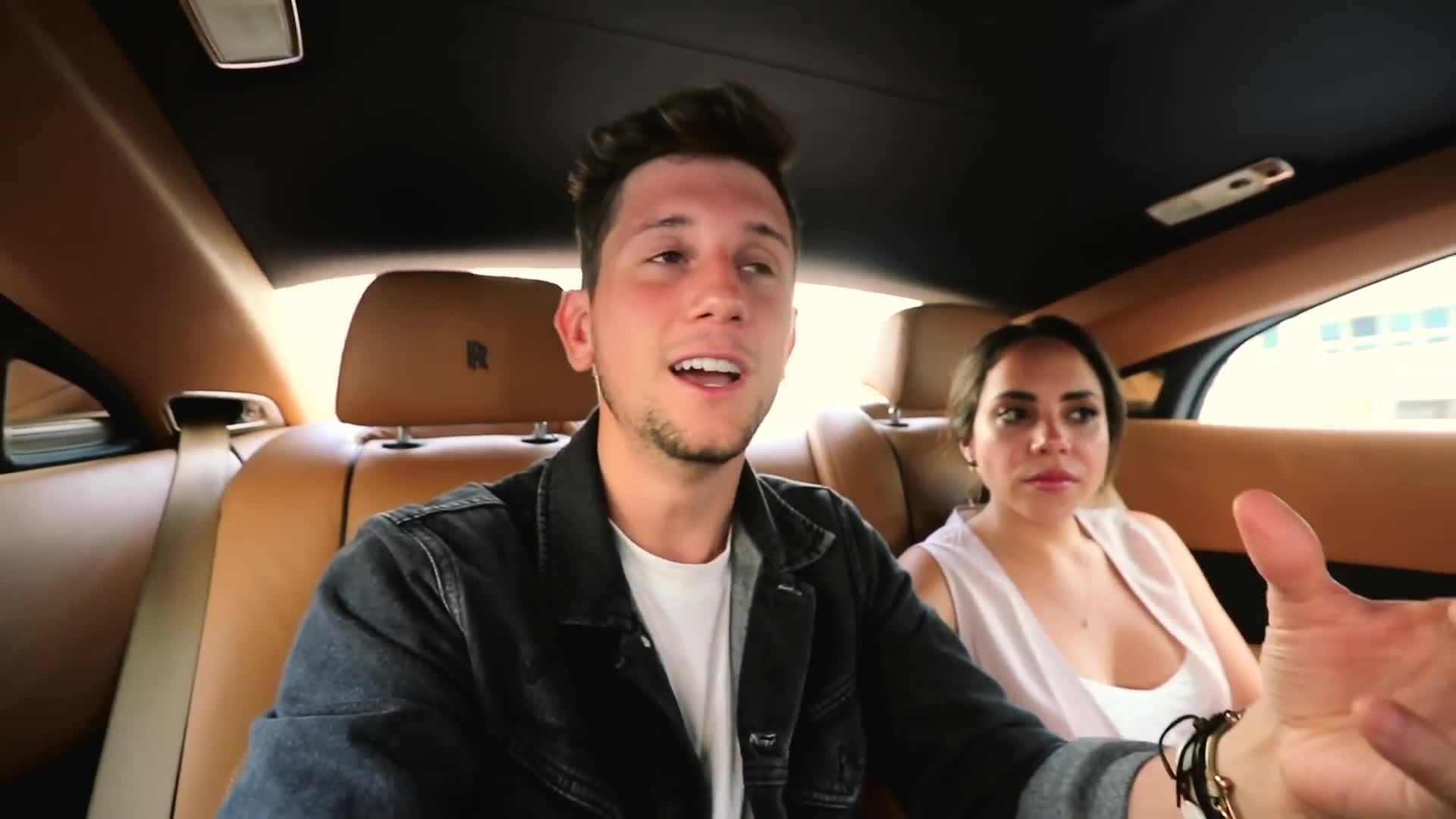
It can't buy happiness, but it can buy a Rolls Royce.
It can buy a night stay in the same room as Kim Kardashian stayed, and it can buy countless other cool things.
This week, we're going to be exploring Dubai's most luxurious experiences to find out is it all worth it?
We are currently in Dubai, which is a global destination for millionaires and billionaires to spend fat stacks.
It wasn't that long ago that I was working a job that paid me 30000 a year, and so to think that you can drop thousands of dollars a night on a hotel, on a dinner, on a cupcake it blows my mind and I don't think I'll ever fully understand it.
I'm curious to know why people spend so much money in this kind of activities and products.
So I think this is the perfect opportunity to try them out.
Starting by going to the JBR Rixos, where we will be staying for two nights in their limited edition crystal suites on the very top floor.
I can't wait.
Let's go check it out.
All right guys.
So we are right now on the top floor of the Rixos JBR and we are about to enter into the limited edition crystal suite.
And right now I just checked online, like with taxes and fees, $7,500 US a night.
This is actually one of the highest up views, if not the highest in the entire JBR region.
I have never seen something like this.
The biggest Ferris wheel in the world is right there.
So it's a two bedroom suite and both bedrooms are the same.
So I'm just gonna show you one of them.
It looks like the bed's in use, a beautiful king-size bed, and what i again love most is just that view right there the ferris wheel, the beach, popping bottles.
You gotta shake it a little bit, don't you?
No, i won't.
Yeah, how often do you get a seven thousand dollar a night place?
Come on, shake it up.
What if i break something?
You left a mark in the roof.
She actually left a mark in the roof.
This suite comes with any vehicle you want.
It could be a Ferrari, Rolls Royce, McLaren.
And then what I like the most is that you have unlimited spa.
Guys, unlimited spa.
And if you stay for three nights, I think they said, you get a helicopter ride.
You can go and order the most expensive steak or the most expensive drink and you can have it, and don't worry about paying after, because you're already paying.
So this is a first for me, but we have a luxury menu for cars.
My question is today, madam, what can I offer you?
Alright guys, I am so stoked right now.
This is one of the coolest luxury things that you can do here in Dubai.
And that is taking out a five-star exotic car onto the track.
And for today we have a Porsche GT4.
I feel like I'm in a death trap.
There's like minimalist everything to be as light as possible.
One last kiss?
I wanna go fast!
That was so crazy.
It was really fast.
This is a different beast.
This is a monster.
Good luck.
This is the first step.
Here comes Kathy racing down the track, And actually I don't know if you said it for real, but you said at some point that I went faster than Christian.
I need to check the times, but I think you did.
Guys, Dubai Autodrome, it was so, so much fun.
If you're looking to try an exotic car, this is definitely the place to do it.
All right, guys.
Good morning and welcome to the beachfront right in front of the rixos.
It's got to be like 35 to 40 degrees.
With that being said, the ocean must be a little bit refreshing, right?
Not at all, i think.
When we start going a little bit faster on the jet skis, it's either going to be refreshing or feel like we're in a blow dryer.
I'm not sure which one it'll be.
Today, we prepared a beautiful tour through the island in this beauty over here.
It's a private jet.
Again, this is a first for me.
Never in my life have I been on a yacht and never did I expect to be on one.
This is truly one of Dubai's most luxurious experiences.
Oh.
Oh hi there.
Hi.
We're only doing a two hour tour around the harbor, but of course, many people rent these for multiple nights and they go out to sea, and that's why you need some living quarters here.
You've got the bathroom, and this right here is the master.
Well, that was the exclusive yacht experience.
It was incredible, thank you very much.
Now it's time to head back to the hotel and get ready for our next ultra, mega expensive luxury activity.
So right now we are in the Atlantis Resort.
It is like nothing else in the world.
It's so incredible.
Everything is marine based.
There's aquariums everywhere.
Tens and tens of thousands of marine life in this building.
Moray eels.
Wow.
So how was your first ever underwater yoga class?
It was very challenging.
Definitely it was a more advanced level than I usually do, but it was so mind-blowing.
So we spent the morning stretching next to the fish.
Now it's time to go touch the fish.
We're doing the VIP dive.
So I have my patty, so I actually didn't need to go through the course, but Cathy had to take a little 20 minute orientation.
She's now theoretically ready.
Theoretically, we'll see if she survives it.
Hey.
Oh really?
That's good, yeah, that's good practice.
11 million liters of H2O.
Lots of sharks, lots of rays, but as I always say, another day, another manta ray.
Here's the crazy part.
You know, what we did earlier today was incredible one in a million but it's not truly the most luxurious of Dubai, and this is what this video is all about.
We want to show you the most expensive, the craziest, the wildest, and we are about to show you inside the Atlantis, the most expensive hotel room in all of UAE, arguably one of the most expensive in the entire world.
And it all starts right here, with a secret entrance.
Mrs kati, please lead us through.
This is a private entrance, all right, There's only two buttons and here we are.
This is the entrance to the bridge suite here at the Atlantis, and it's up to us to figure out.
Why is it so much?
Everything is incredibly detailed.
Marble flooring, I'm sure that's all hand painted.
There are so many things to see.
You have a long hall, but actually you have many rooms.
Everything is so beautiful.
Look at this door.
Bathroom.
Ooh, the golden butt spray.
If you don't spray your butt with gold, then you're doing something wrong.
Shower.
One, two, three, six.
I don't think this is even the master.
This is just a spare.
You put your credit card in the reception, right?
So I'm just going to stay longer.
Oh, yeah, please.
Just tack on a few nights.
It's no problem.
Please help me.
Ooh.
For when you have guests over, you need a place for them to stay, and this looks like a pretty decent suite to entertain with.
Wow.
I love how they decorated.
Look at that screen.
That's the biggest TV I have ever seen.
So, as I'm sure you guys are used to, when you grow up you know your mom would tell you to wash your hands.
She'd always say if there's no gold in the soap, your hands are going to remain filthy.
So luckily, here at the Atlantis they've got you covered because there's gold flakes inside of their hand soap.
It's over?
It's over.
But we still need to see the other half.
So how much is this place a night?
Well, it depends on what season you come, but certain times of the year, I've heard, it can get as high as 27000 US dollars.
Three years ago, when I was working downtown doing the accounting grind, my annual income was about what this cost for one night.
So now it is time to show you the master bedroom.
You excited?
Yes, this looks like an entire different lobby.
It's a lobby for the master.
It's an entrance into luxury.
This is the bed.
Much of you broke it.
Just off of the king bed here is a little office area.
Nice desk to do some work.
You usually see in a bathroom his sink and then her sink.
Here you have his bathroom and her bathroom.
No, for real.
Is this gonna be yours?
Yeah, they're the same.
Okay, sweet.
I'm gonna go check out my bathroom.
They're the exact same.
Exactly the same.
Each of them has this fancy AS jacuzzi.
So my favorite thing about the suite.
A modern day Cleopatra.
Where are my grapes?
I love checkers.
So one of the craziest features of the suite is the 24-7 service, or a 24-7 butler, and this is Ferdinand, and so he's gonna be taking amazing care of us today and tonight.
And cake as the most beautiful hotel room i have ever seen.
Everything is really well integrated and what we want to do now is just enjoy ourselves, because usually we're filming so much, so i think this time we're gonna turn off the camera and we're just gonna enjoy this amazing once in a lifetime opportunity and we will take you out for dinner and drinks later tonight.
Just down below 25 premium beluga shot, and essentially you have to take the oyster first and then from there you taste it with your Bloody Mary shot.
Here we go A lot of flavour Good morning.
Good morning.
Hi.
How'd you sleep?
Very bad.
Very bad?
Yeah, because you were sick and while you were like...
Night one, huge success, and I'm very excited because they're actually gonna be showing us one other presidential, executive, five-star, even arguably six-star suite that we'll be checking into after we go and feed some pancake puppies.
This is a lot harder than it looks.
So you gotta feed it with a fist so they don't accidentally mistake it.
Can I sit down?
No, there's no way I sit down.
You gotta sit down.
There's no way I sit down.
Ah, my butt, my butt!
I'm gonna grab a bit of food here.
Ah, my hair!
No!
All right, so you may not have known this, but in the desert, you can actually have a beach day.
I'm losing my voice a little bit, excuse that.
Right outside of the resort, they've got their own private beach.
It's actually surprisingly clear though.
Okay.
So I'm very excited right now because yesterday's bridge suite was unbelievable, but we have the incredible opportunity to have one more night and we're gonna be showing you the different suite that they've given us.
There's nothing like this in the world I don't think.
It's very unique.
So actually this suite has three rooms.
You can see here, we've got an incredible living room.
And, to be honest, after showing you the bridge suite, I don't really want to spend too much time showing you that, because what's interesting about this place is down below.
So you've got your own elevator, of course.
Did you intentionally dress like Britney Spears from Toxic?
Alright, oops.
No, baby, one more time.
Oh my gosh!
Look at this!
This is the coolest hotel room I've ever seen!
A pumpkin puppy!
What did you say?
A pumpkin puppy.
No, it's a pancake puppy.
This is my favorite suite I've ever stayed in.
I'll see you in the morning.
Oh my god.
Good morning.
Yeah.
I just woke up and saw that.
Oh my gosh.
I will show you how big it is.
Oh my gosh.
That's the best wake up call ever.
Are you excited?
Yep.
Alright, guys.
So we are about to go all the way to the tallest building in the entire world here and we're checking out a restaurant at the top of it, and it's definitely with a large price tag, but that's what this video is all about.
This right here is the fastest elevator in the entire world.
That's how fast we're going.
I can feel it here.
For about 500 AED, or about 125 150 US per person, you can get a very beautiful, elegant high tea with an incredible view from the top here.
We were about to leave and they bring this beauty here.
Oh my gosh, it even has a gold flake on it.
I know.
Have you ever eaten gold?
No, going to definitely live past 100.
It tastes like perfume not that i have tried perfume before.
But guys, we've just checked in here for two nights to the grand suite in the rixos palm.
It literally has the entire top floor to itself.
You have your own elevator, nobody else on this floor, and it is exquisite, it is stunning, it is.
Whatever big word you want to use, it's beautiful.
Behind me is JBR.
It's an incredible view of the beachfront.
You're looking at between 15000 AED during the low season, upwards of 40000 during special occasions.
But I'm gonna give you a quick little room tour to show you what it's all about.
We want to wrap up this entire one week experience of living like multi-millionaires and share with you guys if we thought that it made us happier.
So, first of all, this is not normal for us.
We're not used to this kind of lifestyle, but i will say that everything together the luxurious cars, beautiful hotels, incredible food made it a really unforgettable experience.
So you basically get what you're paying for.
But there is one thing I wanted to talk about and it's an economics theory called the diminishing marginal returns.
And essentially it's this.
If you eat your first cheeseburger, you get a lot of value, a lot of happiness.
But by the second cheeseburger, you get a little bit less.
It's the same thing with luxury accommodations, with yachts, with luxury cars.
Every single experience you get, the marginal return, the extra happiness you get from that activity, it decreases a little bit.
So I don't know if you feel this way, but by the end of the week things were still outstanding, still incredible, but because it kind of shocking to say it started to become normal, it became a little bit less valuable.
I don't know.
I totally agree.
The first time we went to a really nice hotel, I felt like a newborn.
I was just mesmerized by everything I saw, like the curtains closing by themselves.
But then, when we went to the third or fourth hotel, I was still impressed, but I was like oh, I already saw that.
Yes, I already had a really nice view like this one.
So I was really thankful still for what we were getting, but I wasn't super surprised anymore.
The great thing though, is that for Kathy and I, this is not our normal
We'll be back to affordable accommodations, and it will kind of reset the clock.
It'll be back to enjoying things like we were a newborn, as she said.
So overall, it's an incredible experience and, for those who are not used to this, it truly makes you feel incredible.
It's a rush.
It releases those endorphins.
We also have made a video on the polar opposite of things here.
It's called how to travel Dubai affordably.
It'll be right there.
Go click it there if you want to see how you can see this luxury travel destination from a much, much more affordable standpoint.
And if you want to see Katty's video, it's going to be right here and it's in English.
Yes, i just tried to do english videos for you guys.
I have received so many requests that i said okay, let's do it.
And if you want to subscribe to our faces, then check out these little bubbles right here.
As always guys, if you made it this far, hit that like button.
Let's get lost again in the next one.