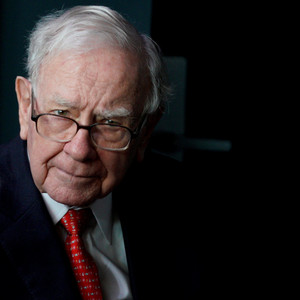
Warren Buffett, a legend of finance.
I stick with what I know.
If somebody owns 50 stocks, can they really like the one they rank as number 50 as well as the one they rank as number one?
Can they know it as well?
I don't think so.
He's stepping down after eight decades in investment.
He's got that folky, witty, thoughtful persona.
And I always say what you see is what you get.
The Buffett Legacy, here on World Business Report from the BBC.
Yes, I'm Ed Butler.
And today we're going to be looking back at the life and the work of the sage of Omaha, Warren Buffett who, at 95 years of age, is setting aside his books and market reports for hopefully, a quieter life.
Also in the show, the upcoming trial of the officer accused of blowing up one of Europe's biggest gas pipelines.
And we question the true growth rate of China.
Now then, the Beatles, the Bible, and Warren Buffett.
The best-selling artist of all time, the best-selling book of all time and, you could probably say, the most successful investor of all time.
The third on that list, Warren Buffett, is retiring at the end of this month.
This after 60 years as the CEO of the investment firm that he founded back in the 1960s Berkshire Hathaway.
It feels like the end of an era.
So if you don't know much about him, here's a brief reminder.
Warren Buffett is sometimes known as the sage of Omaha, sometimes the oracle of Omaha, but probably the most successful investor of all time.
I stick with what I know.
If somebody owns 50 stocks, can they really like the one they rank as number 50 as well as the one they rank as number one?
Can they know it as well?
I don't think so.
From here, Buffett makes investments and buys companies.
Working his financial magic.
Mr Buffett, who is 94 years old, has built up the company over the past six decades into a financial juggernaut which is now worth well over a trillion dollars.
Despite the immense wealth he's accumulated, he actually doesn't seem to enjoy spending money.
Like many of our billionaires,
Like his favourite food is ice cream sundaes.
He drinks cherry Coca-Cola.
Warren Buffett really is different to the other super wealthy, the kind of people that you read about and perhaps even envy.
I'm sorry that Mr Buffett can't tell you how to make money like they do, but I suppose at least you can pick up some tips on how to lead a rich life like he does.
Well, Warren Buffett has certainly had a longer career than most of us.
He earned his first money as a six-year-old, bought his first shares aged 11 and filed his first tax return at just 13.
He's now one of the richest people in the world and he's also known for his philanthropy.
Tens of thousands of people attend the company's shareholder meetings, some of which are held in stadiums in the US.
And one of those who's been closer to him than most is Lawrence Cunningham.
He's the author of the essays of Warren Buffett and director of the Weinberg Center at the University of Delaware.
I first asked him what are the so-called sage of Omaha, whose every word has been known to move markets?
What he is usually like in those shareholder meetings.
He is all charisma.
And it's just like he is when he's in a room with one person.
I mean, I have lunch with him.
He is charismatic, witty, funny, unassuming.
And he's just like that on stage when thousands gather to ask questions and listen to him.
He's got that folky, witty personality. thoughtful persona.
And I always say what you see is what you get, because his public persona is really the same as the person you see at a dinner gathering or at a board meeting.
And when he's not in the room, typically what is he doing?
I think his most typical activity is reading.
I think he has spent more hours on that than pretty much any other.
And mostly reading of books. business material and nonfiction works.
But he really loves reading annual reports, proxy statements, and he has a voracious reading list.
And, you know, that's That's how every teacher will tell you, you learn best.
It's just by reading a lot.
Does he build any of his investment strategy around the personalities involved in companies, or is it really much more technical, on the basis of the demand for the product and the way that the product is created?
Yeah, on the business itself, it's about the fundamentals, the product, how it's created and so on.
But on the leadership, it's all about people.
He focuses intensely on trustworthiness, on personality, on incentives and behavior.
So he is very focused on understanding people and how they're likely to behave.
And that's CEOs of companies, boards of directors of companies because, after all, these people have substantial discretion over deploying your investment.
And you're not going to be able to watch them all the time or certainly second guess them.
So you've got to have a clear, explicit level of trust.
He never goes into business with people that he doesn't like, trust and admire.
I'm wondering if this Strategy, this approach, if you've seen it evolve much.
The dot-com bubble there have been any number of new technologies and new ideas.
Has that caused him to change his template, if you like, for investing?
He evolves regularly.
I mean, the most spectacular, classic example was before the 1970s.
He focused on price, trying to get businesses or stocks on the cheap.
After that he appreciated value as much that sometimes the business is so wonderful it has a franchise, a product, a loyal base that paying a little higher price to acquire it may in the long run be worth it.
That was a big shift from so-called cigar butt investing to quality investing.
I think another shift did come around tech in a way that until the 2010s, let's say, he was articulately averse to tech as such.
And then later you see him making big positions in Apple, for example.
And so there's a little bit of a mental switch there.
My interpretation of it wasn't so much that all of a sudden he has an appetite for tech, but that he learned, as with the rest of all of us did, about the features of that particular technology product, especially the cell phone and apps, and appreciated the enduring value that that franchise is very highly probable to carry.
He earned his first money as a six-year-old.
He bought his first shares aged 11.
Clearly, he filed his first tax return aged 13, I'm reading.
That's extraordinary.
And now he's in his 90s.
Do you feel like the essays, the book you've written?
You learned something very specific about what makes somebody such an enduring winner.
Yeah, you do.
And I think it's most...
People often think of Warren as super smart or having X-ray vision, being able to see the future.
They call him the Oracle of Omaha.
And I think that reading the essays, you'll find you'll find a very super smart author.
But there's no sense of trying to see the future.
In fact, he's quite the opposite.
Look, I don't.
I don't think being super smart or being able to see around corners is really what matters most in investing.
What matters most in investing is disciplining your emotions and being consistent and trying not to imagine that you're the smartest person or the most visionary.
What do you think his long-term legacy will be?
I mean, he's also known, of course, as a philanthropist.
He's made the Giving Pledge.
Is his aim to change the world for good in some specific way?
Yeah.
I mean, he wants his legacy to sort of the number one description on his tombstone to be educator.
That was his most important goal in life is sharing knowledge, conveying knowledge, what he considered to be valuable points of view.
And so and that's one of the reasons why he permitted me to publish the essays, because he thought that's a perfect way to encapsulate his views in an educational way device that'll basically last forever.
And I think that's what he did with the annual meeting, all his shareholder letters, much of that philanthropy, the visiting with students, having classes, come out to him.
I think that's really what it's all about for him is sharing the wisdom that he's gained.
And he always says, look, Ben Graham, his mentor, shared all that knowledge with me.
I think I should share all that knowledge with the next generation.
And many generations now, 1995 or so.
That's Lawrence Cunningham.
He's author and friend of Warren Buffett, who's retiring as CEO of his investment firm Berkshire Hathaway.
Now, in yesterday's programme, we told you about the eruption of new economic protests in Iran.
Today, it seems they've spread, and quite rapidly.
University students have joined the protests, shouting anti-regime slogans, including death to the dictator, a reference to Iran's supreme leader.
Today, there were even chants calling for the restoration of the family of the former Shah Ahmed Reza Pahlavi, who ruled Iran until 1979.
Well, here at World Business Report, we've been receiving messages from one of those caught up in the protests.
We'll call her simply Yalda to protect her identity.
She's 26.
She's from Tehran.
And she says she's taken part in all three days of street protests in the capital city.
People know where they stand.
There is nothing worse than the current situation.
Either kill us or make our lives better.
On the streets today, there was a heavy security lockdown in Tehran's Grand Bazaar.
There were so many security officers that I can tell you there were over a thousand officers in the main section of the bazaar.
And what I've heard from the bazaarees, many of whom are close friends of mine, is this.
Our problem isn't the rising price of the dollar.
Fine, let the dollar go up.
We'll do our work anyway.
What's hurting us is the currency volatility.
And the Islamic Republic can no longer control this volatility.
People are no longer afraid of anything.
Even I myself am not afraid at all.
Not of being seen, not of my face being recognised, not of coming face to face with riot police.
Before we used to spot them from a distance in their uniforms and run away.
Now it's different.
That's Yalda, a protester in the capital Tehran.
Many other cities have also seen demonstrations.
We've heard that riot police confronted protesters in Isfahan, in Kermanshah and Mashhad, as public anger has grown over rocketing food prices.
Well, the initial anger has focused on the Iranian rial.
The currency has lost nearly half of its value since September, when Western sanctions were renewed because of Iran's nuclear activities.
On Tuesday, the Iranian president, Massoud Pazeshkian, insisted he would listen to protesters' legitimate demands and that a mechanism for dialogue would be set up with leaders of the protest movement.
Hundreds, though, died after the last major wave of nationwide protests in 2022.
What happens now?
Well, Dina Esfandari is a Middle East leader for Bloomberg Economics.
She's told the BBC this is a highly perilous moment for the Islamic Republic.
So the question now is with this criticism that's being levelled at the Supreme Leader, that's being levelled at the Islamic Republic, what's going to happen next?
How are they going to react?
Are they just going to take stopgap measures now and close down the shops like they did the first day?
And if that doesn't work, resort to more repression?
Or are they going to actually address some of the grievances of the population?
My sense is it's more likely to be the former, not the latter.
Some thoughts there on the rapidly developing economic protests affecting Iran at the moment.
Well, now to the markets.
George Conboy is chairman of Brighton Securities in Rochester, New York.
Hi, George.
We're hearing reports that Warner Brothers is in the latest twist of this huge takeover saga.
Warner Brothers is going to reject Paramount's latest hostile bid for that company.
Right.
Rejecting it a second time or firmly rejecting it after guarantees of what Paramount had offered.
I don't think the deal is done yet.
And I think there's still a chance that either Paramount or Netflix could raise their offer.
Right.
And shareholders have yet to actually make their feelings felt, don't they?
Do they?
No, they haven't, and I think you're going to see a big barrage of publicity communications to shareholders on both sides, trying to woo them to vote in favor.
But, as I said, what may sway them more is an increased price, and I think you may see it before the vote is finished.
Meta is buying the AI startup Manus for more than $2 billion.
This has caught people's attention, I guess because this is the first in which a major tech company has bought a startup with Chinese roots.
Right, right.
Meta is saying that they plan to discontinue any Chinese involvement, any mainland Chinese operations.
But I did look at an interesting statistic.
They're paying $2 billion.
Manus has about 100 employees.
That's about $20 million per employee.
Sounds like a lot.
But if you do the same math on Meta, Meta's 74000 employees and their 16 trillion market cap, work out to 21 million per employee.
By that metric, maybe it's a bargain.
OK, quick thought.
China ordering 60 Airbus A320 neo jets in a nine point five billion dollar deal.
This is a big purchase, isn't it?
Yeah, it is.
And I think it's it's they're buying the planes because Airbus makes good planes.
But I think the likelihood is they're not buying Boeing because China is still in head to head economic competition with the US worldwide.
Don't think you'll see Boeing orders out of China too much if they can buy from Airbus.
George Conboy, thank you very much indeed.
You're with World Business Report from the BBC World Service.
Now, after a show of optimism following that meeting between President Trump and President Zelensky of Ukraine on Sunday in Florida, there is yet again more uncertainty when it comes to the question of peace in Ukraine.
There could be yet more controversy or uncertainty still.
Still as we enter 2026, this time with Ukraine's EU partners, because it could be the start of a high profile trial in Germany.
Prosecutors are expected to bring charges against a Ukrainian former military officer who's accused of blowing up the Nord Stream pipeline in 2022, a major route that was being developed for Russian gas going to Germany.
Our East European correspondent, Sarah Rainsford, has been following the case throughout the year.
This autumn, TV crews crushed into a Warsaw courthouse to capture the moment when a Ukrainian man was led past in handcuffs for an extradition hearing.
I shouted a question, but he kept his head lowered and walked on in silence.
Vladimir Zhuravlov was accused of attacking the Nord Stream pipelines from Russia.
Before the invasion of Ukraine, Germany got almost half of all its gas through Nord Stream.
But in September 2022, it was blown up in Europe's biggest act of sabotage in decades.
For a while, Russia itself was the prime suspect.
Vladimir Putin had been threatening to cut off the energy flow to Europe, trying to force governments to stop supporting Kiev.
But the evidence soon began to point towards Ukraine.
Three years on, German prosecutors tracked Vladimir Zhuravlov to Warsaw and they issued an arrest warrant.
His wife, Yuliana, told me what happened next.
It was morning.
We all were at home.
Police came and it was six person, I think.
Started to talk with husband and they say that they need to take him.
It really was a shock.
The family had left Kyiv before Russia began its all-out invasion.
Vladimir began selling air conditioning units, but investigators believe he had another life.
They say, in September 2022.
He was part of a group of Ukrainians who used fake passports to hire a boat, sail out into the Baltic Sea and plant explosives on the pipeline far beneath the surface.
Vladimir is a deep-sea diver and the prosecutors believe several members of his diving club in Kiev were involved in this plot.
So what does Yuliana think?
I know him very well, and he didn't do any bad things.
If he would involve, I think that I know about it.
Can I ask you where you were in September 2022?
I didn't remember the concrete things because it was three years ago, but we were here, whole family.
She hasn't looked for firm proof of that, she admits.
But for now, she doesn't need to.
Because that day, in court in Warsaw, the Polish judge made a passionate speech about Russia's genocidal war, as he called it, and Ukrainians' right to defend themselves.
Even if Vladimir had blown up Nord Stream.
He said the pipeline was helping to fund Russia's war economy and so a legitimate target.
In a ruling that was very popular in Poland, he refused to extradite Vladimir, but the German prosecutors persisted and they had a second suspect.
This summer, Sergei Kuznetsov was arrested on holiday in Italy.
Fighting his extradition, his lawyer also argued that a Russian pipeline was fair target.
Critically.
He pointed out that Sergei had been serving in the Ukrainian military at the time of the blast.
So how could he abandon the front line and mount a major attack abroad without his commanders, even his government, knowing about it?
I spoke to Sergei's Italian lawyer here in Rome.
Has he said whether he did this or didn't do it?
What I can tell you is that he told me.
I cannot tell you if I did it or if I did not because I'm a military officer.
But what I did, I did it under orders.
Those were his words?
Exactly.
Ukrainian government knows exactly where he was in every day of September 2022.
If he's innocent, why don't they say?
If he did it, why don't they say?
That's his question.
Instead, the Italian judge did extradite Serhii and his own government stayed silent.
The most frank comment I got came from the Human Rights Ombudsman, Dmitry Lubinets.
He told me the Polish judge had had the right idea, considering the context of Russia's invasion.
But on record, no one will go further than that.
Because abandoning a soldier looks bad.
But riskier still is losing Germany as an ally when its support is critical for the entire Ukrainian military, for all its soldiers.
The controversial trial of Sergei Kuznetsov should begin in Germany next year.
What he chooses to reveal then will define how this drama unfolds.
Sarah Rainsford with that report.
Now, for years there has been a troubled question in economics when it comes to the world's second largest economy.
What is China's actual growth rate?
Officially it's doing very well, from some 6 or 7 growth a few years ago to now a very impressive 5 this year.
Except...
Is that really the true number?
Each year we hear in advance what the figure is going to be.
And then each year it's duly announced, although the underlying economic data is mostly unavailable to outside observers.
Many economists say China is cooking the books.
And now a new detailed economic report has decided that China's real growth rate may only be about half of what's advertised, about two and a half to three percent.
Logan Wright is partner and director of China Markets Research at Rhodium Group, which produced this report.
China's economy was extraordinarily dependent upon investment, and investment in the property sector in particular, for many years, especially after the global financial crisis.
And the property sector in China has collapsed.
But that decline has not been reflected in the official statistics.
The official GDP data is showing basically no variation around the targeted rates of 5%.
We find that statistically improbable.
And in reality, it appears that there's a much larger volatility in the regular business cycle in China, just as there would be in any other economy.
Right.
So it's too consistent to be true.
And those investments?
You think they are simply leaving off inconvenient truths from their overall figure.
That's correct.
And if you look, especially in 2022, is really where the largest discrepancy developed.
In 2022, you had lockdowns associated with zero COVID policy.
You had severe contraction in overall consumption and freight volumes.
Even the official data showed a contraction in consumption activity, but they still reported 3 growth.
We think it was highly probable that growth was negative.
And since that time, the only thing that has really recovered is is not the investment component of GDP, which had powered growth previously, but the consumption component, which was just recovering from post-pandemic lows.
Last year, in 2025, what was happening was at the start of the year, there was some support for the economy from front-loaded export manufacturing and there was support for consumption because of subsidized products like home appliances and autos.
All of those factors faded in the second half of the year.
So we entered 2026 with an economy that looks like it's growing closer to 15 maybe 2, rather than the official 5 full-year growth rate.
You've mentioned exports.
China itself says, look, our exports are up.
Our exports are booming.
We're doing better and better on that.
And that's offsetting the collapse of the property sector and low consumption by ordinary citizens.
That's true to a certain extent.
It's just not enough to actually create 5% growth.
I mean, even on the official data, net exports are contributing 1.5 percentage points of GDP growth.
The truth is that China is more dependent upon net exports and continue to expand their global export market share for their own domestic economy than ever before.
And so China is more vulnerable to a slowdown in external demand in the US or Europe.
That might restrict their exports next, And it's going to get worse next year.
Well, I think domestic demand is probably relatively stable at a low rate.
The real question is we can't find an example of another economy that's claiming to grow at 5 real rates along with domestic deflationary pressures, especially if it's an investment-led economy for a three-year period.
It's just an extreme – if deflation is discouraging new corporate investment, how is it that new corporate investment is still growing at the same rates as it was before?
So, on the domestic demand components, we think that the levers that China has to – drive domestic consumption investment through the use of their financial system and their fiscal system are simply less effective now than they were five or 10 years ago.
You made the point that data manipulation, some will call it has been a consistent accusation leveled against China for many, many years and a feeling that the growth rate is exaggerated.
Does it matter?
It does matter.
The reason it matters for the rest of the world is the rest of the world is dependent upon China, representing a significant proportion of global growth anywhere from 30 to 40 percent, based on the official statistics.
If that is not happening –
If China cannot grow their domestic economy strongly enough, that means their policies are increasingly dependent upon increasing global export market share, which forces disinvestment in the rest of the world.
In other words, its policies are dependent upon reducing employment, investment and output among most of its trading partners.
And that is a far different policy mix than what we've seen over the past decade, in which China was at least more supportive for global demand.
And that's, I think, the real significance of this, because it explains why more countries are going to be looking to try to restrict Chinese exports, precisely because there's not the same opportunities to trade with China to service their own domestic market if it is no longer growing at the same rates.
Some challenging thoughts there from Logan Wright of the US-based think tank, the Rhodium Group.
And that's it for this edition of World Business Report.
From me, Ed Butler, and the rest of the team, thanks for listening.