🎶 I had a dream 🎶 Broadway's Gypsy Tony Award nominated for Best Musical Revival 🎶 A dream about you 🎶 And Best Actress Audra McDonald in The Mother of All Roles 🎶 It's gonna come true 🎶 The best reviewed musical revival of the year The greatest Broadway musical of all time Gypsy Get your tickets today From the New York Times, I'm Michael Bobaro.
This is The Daily. President Trump has called it the most important piece of legislation in his second term—a single bill that would unlock his entire domestic agenda.
But as that bill heads from the House to the Senate, it's raising existential questions among Republicans about who Trumpism is really for.
Today, my colleague, congressional correspondent Katie Edmondson on the big, messy battle over the big, beautiful bill.
It's Thursday, June 5th.
Hey, Katie. Hey, Michael.
Katie, as we speak with you on Wednesday afternoon in Washington, D .C., where you are, the big beautiful bill is navigating what looks like some big ugly obstacles.
Yeah, that's not an overstatement.
It has been a very difficult, very trying forty -eight hours for this piece of legislation and that really began when Elon Musk came out yesterday and called it a quote, disgusting abomination, unquote.
So it all kind of went downhill from there I would say.
An auditorium full of voters venting their anger at Representative Mike Flood.
This provision was unknown to me, what I voted for the bill.
We're hearing from some Republican lawmakers now who are saying yes, I voted to support it but actually this is a terrible bill.
We don't get the full bill text until very close to the time to vote for it.
And so that was one section, that was two pages, that I didn't see.
If I knew then what I knew now I wouldn't have voted to support it.
Old if I'd read the bill I might not have voted for the bill.
Well, sure, of course.
Here's a lesson for us all.
No matter what political party holds office and is in charge, we should all watch carefully the bills that we pass.
And then I guess just a few hours ago, a new analysis came out from the independent budget scorekeeper here in Washington that found this bill is going to add $2 .4 trillion, trillion with a T, to the national debt over the next decade, which was not entirely unexpected, but is nonetheless a very big number.
So yeah, I think it's safe to say, it's already been an incredibly messy week for this piece of legislation.
And, you know, I think even though this legislation it seems as though it's going to be headed for passage in the next few weeks, in some iteration.
I also think it's forcing Republicans to confront a lot of really tough questions about who this legislation is for, who their own constituency that they need to serve is, what it means to be a Republican in this moment, and who really they need to be looking out for.
Well, those are some very big, existential questions for Republicans.
So, tell us what has made this bill trigger all those questions.
What's in it? Well, I think we should start with what this bill is called.
We're trying to come up with a name and I said, why don't we just go with the great, big, beautiful bill.
That's what everyone, you know, so we're going to probably do that.
Which as you hear President Trump referring to it a lot as the big, beautiful bill.
It's very big. It's the big, beautiful bill.
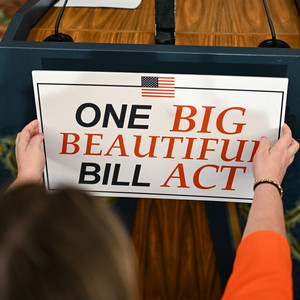
And in fact, Republicans have decided to formally call it one big, beautiful bill.
Bill, we love that bill.
I won't like it if it doesn't pass.
Neither will you. And it's an unusual piece of legislation.
It is not normally the type of bill that we talk about you and I talk about on this show.
Typically you have me on to talk about the spending bills that fund the government on the sort of edge of government shutdowns.
This bill is not related to that whatsoever.
This is a bill that is being shepherded along through the reconciliation process, which is really a special process that is unlocked when one party wins a trifecta in Washington, the House, the Senate and the White House.
So when one party wins the House, the Senate and the White House, they're able to use reconciliation to push through legislation with major tax and spending implications through the House and through the Senate.
And on the Senate, what's really important is that it's a simple majority vote, they can avoid the filibuster.
Right, and in that sense, this bill really doesn't require any involvement from Democrats who can and probably will all vote against it.
It just requires, like you said, a simple majority of Republicans in the House and the Senate to get on board. Yes, that's exactly right.
We don't in fact expect a single Democrat to support this measure in the Senate, no Democrat supported it in the House.
And with the slim margins that Republicans have in both the House and the Senate, that is why it is so important for them to find unity on this legislation.
OK, so back to the substance of what's actually in this big, beautiful bill.
There's a lot crammed in there.
We expect senators to want to change some aspects of it.
But in terms of what is in the House -passed bill, the centerpiece of it really are tax cuts.
And that's extending the tax cuts that President Trump signed into law during his first administration in 2017.
And as a reminder, those cuts reduce the tax rates for individuals at almost every individual income bracket, as well as for corporations, reducing the corporate tax rate from 35 % to 21%.
And then there are some new tax cuts as well.
You'll remember, Michael, that on the campaign trail President Trump spoke a lot about wanting to eliminate taxes on tips, on overtime, and those policies are included in this legislation.
Mm -hmm. And given just how many tax cuts we're talking about, how much do they add up to?
How much do they cost?
Well the number that we just got today from the nonpartisan budget office is that it will add to the deficit 3 .6 trillion dollars over the next decade.
That's how much the tax cuts would cost by reducing how much the US Treasury brings in.
That's right. Got it.
And then the second big element of this bill I think is actually new spending, and that's really in two categories.
One is for the military.
So it allocates a new 150 billion dollars in funding for the Pentagon.
And that has been earmarked for specific areas, including trying to jumpstart the nation's shipbuilding capabilities, trying to bolster our presence in the Indo -Pacific.
And then there's an additional 175 billion dollars, again, over that 10 -year period in immigration enforcement money.
So that is money to continue building the wall on the southern border, another one of President Trump's big campaign promises, as well as things like drones, technology to be able to enforce additional border security measures.
So taken together, the widespread tax cuts and higher spending for the military and for immigration enforcement, and makes this bill sound very expensive so far.
That's right. Now all of those provisions are items that Republicans really are in widespread agreement over.
They all want to do these things, but they also know that it would be politically terrible for them to vote for a bill with a hugely expensive price tag.
And so really, the central fight around shaping this bill where are they going to find the cuts to offset these big, beautiful provisions that they want to pass?
And so far, where have they found those cuts?
So I think the really interesting dynamic here is that a lot of the drama and infighting around cutting programs here really comes down to a debate over whether Republicans should cut programs that were passed when Democrats were in power that now benefit a lot of Republican voters.
Such as? Well, the first example here is the Inflation Reduction Act.
That was President Biden's signature landmark climate change healthcare policy legislation that Democrats actually passed using the reconciliation process, using the process Republicans are using now.
And one of the major elements of that bill was establishing tax credits for clean energy projects.
A lot of those clean energy projects have sprung up in districts and states that are held by Republicans.
And so what we've seen actually is a surprising number of Republicans both in the House and the Senate say, hey, I know we all want to repeal the things that President Biden did, But there are actually some good things in that particular law, and we would very much prefer if you did not roll back these tax credits that our constituents have come to rely on.
Hmm. And what's an example of a program passed through the Inflation Reduction Act that Republicans are now relying on or invested in to the degree that they would be pretty upset to see it rolled back?
Well, I think a great example is actually in Arizona.
It is in the Tucson -based district of Congressman Juan Siskamani.
He flipped his seat in 2022.
He is considered one of the majority -makers.
He was considered really the best recruit that Republicans had that cycle in the House.
So he's a Republican who flipped a Democratic -held seat and contributed to the Republican majority.
That's right, and he has a major electric vehicle company in his district called Lucid Motors, and they actually expanded significantly their factory in his district, bringing in additional workers, creating new jobs, under the assumption that they were going to be able to reap the benefits of these clean energy tax credits created by the IRA.
Mm -hmm. Now, obviously, they're looking at losing those tax credits.
That is going to take a hole to their profit and loss sheet.
And they have been quite outspoken in wanting to make sure that these tax credits weren't entirely stripped away from them in this legislation.
And in fact, Congressman Siscamani himself was pretty outspoken in asking Republican leaders to ensure that didn't happen.
He and a number of his colleagues in the House who really were all across the political spectrum, these weren't just moderate Republicans, signed a letter asking House Republican leaders to do exactly that.
They said, please do not take a sledgehammer to these tax credits, to this legislation, let's use a scalpel, right?
Because these are very important industries that are popping up in our districts.
These create jobs for our constituents and we owe these businesses certainty.
Right, and by the way, districts like mine are the reason you have a majority so be careful.
That's right, but what ends up happening is, House Republican leaders do end up taking the sledgehammer to this legislation, to these tax credits.
And by the time the bill comes to the floor and House Republicans are being pressured by President Trump to vote for it, all of these lawmakers who signed onto that letter, including Congressman Siskamani, end up voting for this bill that is carrying really the centerpiece of President Trump's domestic agenda.
Right, and so that's the way in which, thinking back to what you said at the beginning of this conversation, this bill becomes a kind of existential question for some of these lawmakers about what it means to represent Republican constituents.
I mean, this Congressman, Siskewani, is being asked, in some sense, to show his loyalty to the President over the workers in his district.
That's right. And by the way, that's one of the reasons why House Republican leaders wanted to contain all of these provisions into one big, beautiful bill.
They did it because they wanted to force these lawmakers to take one single up or down vote, essentially on President Trump himself.
Fascinating. In other words, just take one hard vote on behalf of your president and then you're off the hook.
Or, more cynically, you get one chance to show whether you're with us or against us.
Hmmm. So the President managed to overcome the reservations of House Republicans when it came to gutting the Inflation Reduction Act.
Now that this bill is headed to the Senate, which must pass it for this bill to ever have a shot at becoming law, what are Senators saying about these IRA cuts?
Well, we're hearing a lot of the same concerns.
We will be going through, I think, a fair amount of changes over here on the Senate side.
Senators like Lisa Murkowski of Alaska, for example.
There are a lot of things that I'm watching very carefully.
It's very public about my view of how we should treat the energy tax credits.
It's not that I feel like we shouldn't touch them.
But I just think we should be thoughtful.
And John Curtis of Utah.
But even in the past couple of days, Michael, there have been additional Republican senators who have started to come out of the woodwork to say that there are clean energy projects in their states as well, that they want to protect in a way that has actually been quite surprising to me.
I think the well of resistance around again, trying to gut this law entirely is actually deeper than I had anticipated.
Suggesting in a way that I don't think I quite understood that President Biden's most important single piece of legislation has really woven itself into the fabric of this country in a pretty meaningful bipartisan way.
That's right. And by the way, not a single one of those Republican senators voted for that law, yet here we are three years later, and you have all of these Republicans defending it.
And that I think was part of the idea behind the law itself was the idea that so many of these projects would go to Republican districts, to Republican states, there would be a bipartisan mandate to protect it even if a Republican won the White House.
So that is one democratic law that is proving to be harder for Republicans to kill than maybe some had anticipated.
But I think that fight is really going to pale in comparison, honestly, to what I think is the marquee fight at the center of this legislation, which I think is going to be Republican's efforts to cut into another major Democratic initiative, which was expanding access to Medicaid.
Right. And we will talk about what it means to touch that third rail after the break.
We'll be right back.
When the markets are unstable, choose a partner that's anything but.
For 174 years, MassMutual has stood by you through turbulence, stability, and everything in between because MassMutual offers financial protection and personalized guidance built on one idea.
When we stand together, we can weather any storm.
Access time -tested market volatility guidance at the MassMutual blog.
This podcast is supported by on investing an original podcast from Charles Schwab each week hosts Liz and Saunders Schwab chief investment strategist and Kathy Jones Schwab chief fixed income strategist along with their guests analyze economic developments and bring context to conversations around stocks fixed income the economy and more Download the latest episode and subscribe at Schwab comm slash on investing or wherever you get your podcasts So Katie, tell us more about the proposed cuts within this bill to Medicaid and for those who are not intimately familiar with it, exactly what Medicaid
does. Well, Medicaid is really one of three major programs that make up the heart of the social safety net here in the United States, right?
There's Social Security, there's Medicare and there's Medicaid.
And right now, Medicaid provides health insurance for about 71 million disabled and or low -income Americans.
It's a really big deal.
It is a big deal. And the proposal that this legislation puts forward would impose new work requirements on people who receive health care coverage through Medicaid.
And Michael, these are the most stringent work requirements that congressional Republicans have ever put forward. In other words, these are requirements that say you don't get your Medicaid unless you have some form of employment.
Well, it actually, even goes further than that.
It allows states to say you can't enroll in Medicaid unless you can prove to us in some cases that you've been working for six months or even a year prior to your attempt to enroll in the program.
And this, of course, plays into a long -running Republican critique of the U .S. Social Safety network, which is that it does not require, many Republicans would argue, enough of those receiving the benefits.
I think it's fair to say that the idea of work requirements is broadly very popular amongst congressional Republicans.
But where we're seeing major concerns is from Republicans who are now looking at the numbers of what some of the consequences of these new policies would be and are starting to feel pretty skittish about voting for it.
And, Michael, the number that comes to mind is that that nonpartisan budget office has projected that these changes are going to lead to about 10 million Americans losing their health care insurance.
Wow. That's a lot of people suddenly without health insurance.
That's right. And look, this was the major Democratic initiative of President Obama's term.
That through the Affordable Care Act, through Obamacare, the number of people who could benefit from Medicaid was drastically expanded to the point where we now have 40 states plus DC that have opted into the Medicaid expansion program essentially and what happened was that those expansions created a lot of new constituencies on Medicaid and so what we're seeing now is that you now have a lot of Republican voters who are benefiting from the expansion And you have a lot of rural hospitals, again, in some of these more conservative areas that have really come to rely on Medicaid.
So a lot like the proposed cuts to the inflation reduction act, these proposed cuts to the expansion of Medicaid run up against the reality that Republicans and Republican voters have become big stakeholders in Medicaid.
That's right. And you know Michael earlier this year I went out to a Republican held district in California in Bakersfield.
And that is a district that is always politically hotly contested.
It is held right now by a Republican David Valadeo.
And Michael two thirds of Congressman Valadeo's constituents get their health coverage through Medicaid.
Oh. I need the coolant, I need to see that on the internet.
I went to a town hall that was sort of rallying around trying to protect the program.
In our district over 500 ,000 people are supported by the Medicaid system.
And it really was a stunning array of different types of people, honestly, who came out to that event.
When you have a disabled daughter, nobody wants to take care of it, because there's a lot of work.
There were moms of disabled kids who were talking about how important the program was in ensuring that their kids got the services they needed.
Meeting our veterans.
Meeting the rescue here.
There were a number of veterans who were there who were reliant on Medicaid.
Favorite? Come on, dude.
We've been looking for you.
and we're counting on you.
And it's something that Congressman Valadeo was acutely aware of.
I've heard from countless constituents who tell me the only way they can afford health care is through programs like Medicaid and I will not support a final reconciliation bill that risks leaving them behind.
Congressman Valadeo actually went to the House floor to say that he was not going to lend his vote to any legislation that cut the benefits his constituents received from Medicaid.
But Work requirements, things like that, are things that we look at as a way to protect those who need it and should be on it.
And so we're having that dialogue.
We also made the case that imposing work requirements wouldn't really cut benefits for any quote unquote, worthy or needy recipients.
I mean, I know you hear it a lot, waste, fraud, and abuse, but there are people who are on the program that shouldn't be on the program.
And so at the end of the day, when the bill comes to the floor, Congressman Valadeo votes to pass the bill.
Much the way Siskamani did when he voted for this bill, despite knowing it would probably hurt the auto company in his district, in Arizona, in both cases, you've got these Republican House members backing this bill that on some level, they know is going to hurt their constituents.
That's right. And it's actually an argument that we're starting to hear over in the Senate made by at least one Senate Republican very forcefully.
It is wrong to cut health care for the working poor.
That's what we're talking about here with Medicaid.
My state is a Medicaid… And that's Josh Hawley of Missouri.
And I'm totally opposed to that.
Republicans now, thanks to Donald Trump, are the party of the working class mono you referenced.
And his whole argument essentially is that Republicans have just made really remarkable in roads and winning over working -class voters.
His argument is why would we as Republicans immediately turn around and push through legislation that would hurt them.
I hope this bill will get refocused on delivering relief for working families, that's what we ought to be doing.
And that of course dovetails with what our colleague, Shane Goldmacher, just told us a couple of days ago on The Daily, which is that Trump has expanded the Republican share of the working -class vote in each of the last three presidential races, more each time.
Thereby, as Hawley has said, cementing the Republican brand as the political party of the American working class.
And it seems what Hawley is asking is, why would you ever betray those voters?
Why would you give up that extraordinary electoral advantage that Republicans have created?
That's right, and he has some very recent political history to back him up on this, right?
If you remember, in 2018, Republicans again had a trifecta.
They had used that trifecta to try to repeal the Affordable Care Act.
That effort failed, but Democrats made the strategic decision to run exclusively, really, on healthcare during that midterm cycle.
And look, there are a number of congressional Republicans who distinctly remember that blue wave in 2018.
And one of them is actually the Congressman we were just talking about, David Valadeo of California, who was in Congress in 2017, voted to repeal the Affordable Care Act, and actually lost his election.
He came back, but he lost in 2018 after he took that vote.
Mm -hmm. So here we are again, and we're already seeing some previews of how this could play for them in the midterms. We saw Senator Joni Ernst of Iowa, for example, That's because they're not currently eligible by the original definition of Medicaid.
And they will be Being asked at a town hall in her state about the impacts of these cuts to Medicaid.
— the constituents said people are going to die as a result of these cuts to which Senator Ernst responded.
— Well, we all are going to die.
— We're all going to die.
— Right, an unusual response.
— No— — It ignited a firestorm in a normally, pretty reliably conservative state, I think because it came off as sounding pretty callous, given the stakes.
And so there's a sense among Democrats that this is going to be an extraordinarily resonant issue among voters.
Right. I mean, it would seem like the only reason for Republicans to back these work requirements that would end up kicking so many of their working class voters off of Medicaid is that it puts a real dent in the new spending from this bill.
But from what you said at the beginning of our conversation, the bill is not balanced.
It's adding to the deficit.
So how much money would these Medicaid changes actually save?
Well the number that we got today from the budget office is that just the healthcare changes would save $1 trillion.
But the problem for a lot of Republicans is that that still leaves that $2 .4 trillion hole in this legislation.
Right. which is where you get your critique from the Elon Musks of the world.
That's right, and it's not just Elon Musk.
It would be a lot easier for Republicans if it was limited to Elon, but there's actually a number of Republican senators right now who are saying that they do not want to vote for this bill that is going to saddle their grandchildren with debt.
The math doesn't really add up.
One of the things this big and beautiful bill is is it's a vehicle for increasing spending for the military.
Those are Republicans like Rand Paul of Kentucky, Ron Johnson of Wisconsin.
We have to reduce the deficit, and so we need to focus on spending, spending, spending.
You don't defeat the deep state by funding it.
They are tremendously disappointed, to use a nice word, in the number of spending cuts contained in the House -passed bill.
They've said they want to agitate for even more.
Look, I want to vote for it.
I'm for the tax cuts.
I've voted for the tax cuts before, but at the same time I don't want to raise the debt ceiling.
And you even have some Republicans like Senator Paul saying that there's actually an additional provision of this legislation that he despises, which is a provision that would lift the debt limit by about $4 trillion, which would basically get us over the midterm elections because Senator Paul is one of a number of Republicans in Congress who do not want to add to the debt problem, who have sort of an existential problem with lending their vote to any piece of legislation that raises the debt ceiling.
And we should say it is not just scattered congressional Republicans who have raised questions about the fiscal impact of this legislation.
There are economists and there are prominent people in American finance who regard this bill as a genuine threat to America's financial future.
That's right. And as a result, you can now argue, and some Republicans are, that the bill betrays two different kinds of Republican party values and identities, a new one and an old one.
It betrays the party's new conception, as Josh Hawley said, of itself as champions of the working class by kicking so many people off Medicaid.
and it betrays the party's old conception of itself as the steward of fiscal responsibility.
And in that way, I'm now very much understanding your point early on in this conversation that this bill really does raise questions about what it means to be a Republican, when Trump is pushing this version of Republicanism.
That's right. I think we always knew that there was going to be kind of open warfare between the two two factions, right, that you just talked about, the Republicans like Senator Hawley who are saying, we simply can't pay for tax cuts at the expense of working class voters who, by the way, voted for us.
And that we knew that he was going to be clashing with senators like Senator Ron Johnson, Senator Rand Paul, who again, want those deep spending cuts to be able to vote for a deficit neutral bill.
Now, I think it's most likely that neither of them are going to get their way here.
And that instead they're going to end up unifying around this big beautiful bill that no one thinks is really that beautiful.
Because they know they have this opportunity to deliver for President Trump and that he is going to demand that they deliver for him.
Throughout this episode, Katie, we have quite understandably been talking about the battle within the Republican Party over this bill because that's where the votes are to get passed.
And from everything you're saying, the president will twist the arms and apply the pressure required to get this through the Senate and if it has to go back to the House, ultimately the House.
And I wonder if we can talk a bit more about the Democratic critique here, because there is more to it than just criticism of the cutbacks to Medicaid.
Fundamentally, Democrats argue that this bill represents an extraordinary transfer of money from those who have the least in this country, including those on Medicaid, to those who already have the most, who are going to be getting from this bill corporate tax breaks and big income tax breaks.
and that as a result, this bill is just extremely unfair.
And I wonder what the Republicans putting this bill together and voting for it have to say to that.
Republicans know that they are going to face a lot of political attacks from Democrats on this.
And frankly, there's a lot for Democrats to attack beyond the cuts to Medicaid that we've been talking about, Beyond the sort of repeals of these clean energy tax credits This bill also contains new work requirements for recipients of food stamps or snap That are projected to result in three million people losing access to food stamps mean now at the end of the day I think Republicans are fundamentally banking on the idea that tax cuts are broadly popular But that is really something that they can sell to their voters especially the provisions relating to eliminating tax on tips, eliminating tax
on overtime. But I think Democrats really feel that they have an opening here to try to win back some of that support from the working -class electorate that moved over to support Republicans.
And we've seen them distill this huge bill into one very simple talking point.
This bill is a scam, a tax scam designed to steal from you, the American people, and give to Trump's millionaire and billionaire friends.
Which Michael, to your point is this is a piece of legislation that fundamentally takes from the poorest, the most vulnerable to give to the wealthiest. It seems that nothing is off limits and everything is on the table to get that done, including meals for hungry families, working families' health care, and the incredible gains that we have made to get more families affordable coverage.
And even beyond that, to put a finer point on it, that this is a piece of legislation that guts very popular programs that we as Democrats created and that you, the voters, have been benefiting from.
We have to stand up for these people.
I came to Congress to be a voice for people who need, who need things like Medicaid, who need things like SNAP benefits.
And I think that is a message that we are going to hear over and over and over again that I think is going to be plastered across the airwaves as we get closer to the midterm elections.
Well, Katie, thank you very much. Appreciate it.
Thanks for having me, Michael.
We'll be right back.
This podcast is supported by Question Everything with Brian Reed.
The host of S -Town and The Trojan Horse Affair is tackling a new mystery.
How did we lose the truth and how can we get it back?
Brian unravels the contested work behind the stories we see in our social media feeds and the people who tell them journalists, spy, propagandist, influencer.
AI bot, when facts are under attack, we need to question everything.
Follow Question Everything with Brian Reed wherever you get your podcasts.
This message comes from Capital One.
Your business requires commercial banking solutions that prioritize your long term success.
With Capital One, get a full suite of financial products and services tailored to meet your needs today and goals for tomorrow.
Learn more at CapitolOne .com slash Commercial.
Member FDIC. Here's what else you need to Notre Dame.
Very simply, we cannot have open migration from any country where we cannot safely and reliably vet and screen those who seek to enter the United States.
On Wednesday night, President Trump banned citizens of 12 different countries from traveling to the United States.
most of them from Africa and the Middle East, saying in a brief speech that it was necessary to protect Americans from the threat of terrorism.
We will not allow people to enter our country who wish to do us harm, and nothing will stop us from keeping America safe.
The travel ban revives a controversial immigration policy that defined the opening weeks of Trump's first term.
It covers, among other countries, Afghanistan, Chad, Haiti, Libya, and Sudan.
Citizens from seven other countries will be borrowed from permanently immigrating to the US, including Cuba, Venezuela, and Sierra Leone.
Both measures are expected to face immediate legal challenges.
And wildfire smoke from Canada and desert dust from the Sahara are smothering large portions of the United States, creating hazy skies and hazardous air quality from the northeast to the southeast. On Wednesday, the National Weather Service issued air quality alerts for New York City and many surrounding suburbs, including those in New Jersey and Connecticut.
Officials said that those sensitive to air pollution should limit the time that they spend outdoors.
Today's episode was produced by Rob Zibko and Eric Krupke.
It was edited by Rachel Kweister and Liz O 'Balin, contains original music by Pat McCusker, Mary Lozano, Dan Powell and Rowan D 'Amisto, and was engineered by Alyssa Moxley.
Our theme music is by Jim Brundberg and May Landberg of Wonderly.
That's it for The Daily.
I'm Michael Bobaro.
See you tomorrow. This podcast is supported by BetterHelp.
June is Men's Mental Health Month and every year 6 million men suffer from depression.
If you're feeling overwhelmed the strongest thing you can do is ask for help and BetterHelp makes it easy.
Take a short online quiz and connect from home with a qualified therapist. BetterHelp.
Visit betterhelp .com slash the daily today to get 10 % off your first month.
That's a BetterHelp.
H -E -L -P .com slash the daily.