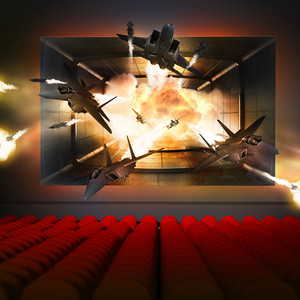
Think of the movie moments you never forget the epic battles, dazzling visuals or dreamlike worlds.
Behind them, all is technology, now boosted by AI, driving what we see and feel on screen.
Chinese filmmakers are embracing these tools in fresh ways, and the Golden Panda Awards spotlight how far world cinema has advanced.
And who says science is just in textbooks and labs?
This September, China is turning science into a full-on festival, with Science and space exhibitions, AI demos, science plays and interactive tours all month long.
We're diving into how tech is changing lives and how everyone, yes, everyone can join the fun.
Coming to you live from Beijing, this is Roundtable.
I'm He Young.
For today's program, I'm joined by Steve Hathaway and Fei Fei in the studio.
First on today's show.
This year's Golden Panda Awards go beyond honoring outstanding films.
They highlight how technology, including AI, is turning imagination into cinematic reality, from recreating ancient battlefields to rendering deep seas space in breathtaking detail, to crafting entire animated worlds.
These tools are transforming both storytelling and the way audiences connect with it.
Chinese cinema is taking these possibilities and weaving them with local creativity, building a distinct voice that resonates on the world stage.
Let's start big.
Where does Chinese cinema stand today when it comes to technology?
Well, I think, among experts and scholars in the cinema field, I think they believe that the Chinese cinema is now entering a mature development stage, meaning that more and more Chinese movies across different genres, not only just sci-fi movies, not only just animations, but to a range of not only films, even a lot of the TV series, for example the three body problems.
That was quite brought on to the television by very advanced post-production technologies.
I watched that one.
It's good.
It's really good.
It's one of those shows where you really have to pay attention to know what's going on, but it was really popular.
Exactly.
And also with the Wandering Earth movie series, the latest one coming in around 2023.
And you can see the first one that was in 2019 and the second one in 2023 the big differences and you can see the fast pace of development in technology in post-production, when it comes to filmmaking and also television making.
Yeah, there are some movies, of course, that stand out.
Fei-Fei, you mentioned The Wandering Earth.
Another one that we talk about, and we talk about this movie all the time, right?
Nidja.
Nidja 2.
Nidja is really well known for its storyline, of course, but also for its visual effects.
And it ranked 5th. in the worldwide lifetime grossing list, according to box office Mojo.
We do.
We talk about Ninja 2 all the time.
But here's why.
This will explain it if we haven't explained it well enough before.
Number one on that worldwide grossing list, lifetime grossing list, is Avatar.
Number two is Avengers Endgame.
Number three is Avatar The Way of Water, which is really fun, by the way.
Number four is Titanic.
And number five is Nuja 2.
It's the fifth highest grossing film of all time, right?
So, I mean, this is just astonishing.
And we talked about it in many different aspects, but today we mentioned it, along with other films in the Chinese film industry, for its use of technology to deliver such a brilliant story.
Yes, and that is, I believe, the only animated film among the top five.
So I think with animation films it in a way almost gives the filmmakers more room for creativity and imagination and, you know, world building.
And that's all so exciting.
And number six on that list, by the way, was Star Wars The Force Awakens.
So, N'Jadu beat Star Wars.
And when we talk about film technology, what are we really talking about?
What's actually inside that toolbox?
Yeah, it's not just a gadget.
It's not a trick, right?
It's a whole system and they cover everything from filming and editing to special effects and even the way that movies are projected onto the screen.
You think of things like virtual production where giant LED screens surround the actors.
So maybe a long time ago actually, maybe not that long ago actors would stand in front of a green screen, right.
And they still do, I guess, for... for perhaps smaller productions.
But they would stand in front of the green screen and then the production crew would add that background later, right?
Directors.
Now though, with these giant LED screens, they can see the world instantly, in real time, while they're filming.
And I'd have to think...
That would make things so much easier for the actors, too.
Well, I think it could be also challenging at the same time.
You know, in the old times, you are sort of performing with real things, real gadgets on your hands.
But now you're sort of based part of your acting based on your imagination.
Yeah, that's true.
Yeah, I remember a while ago watching this interview of Hugh Grant talking about his role in one of the Paddington Bear movie franchises.
I can't remember which one he appeared in.
And, you know, him with his sordid British humor, he was saying that he was acting towards a stick.
And that was supposed to be the bear.
And we see the cute little bear on the screen.
But when he's acting, he's talking, making jokes, acting towards a stick.
And then he had some horribly funny joke, but I can't remember that.
I won't recite it here.
So I suppose with these upgrades in tech, then... acting becomes different, right?
Yeah, it's just a different ballgame, I guess.
So you've got that, then you've got CGI.
I mean, that really changed the game, right?
Huge battle scenes and alien worlds or really whatever your imagination can come up with, can be created on the screen.
Then you've got animation software, where where things become capable, or things are capable that weren't capable in the past, like creating millions of little tiny digital particles that can be programmed to move like brush strokes in a painting.
Then there's the movie screens themselves.
4DX, have you ever watched a movie in 4DX?
I don't even know what that is.
Okay, so that's where all five of your senses are involved.
So the seats move.
And then you've got wind in the theater.
Then you've got water coming out from the seat in front of you, from the back of the seat in front of you.
Then you've got certain scents that will be released as well, certain smells.
And then the lighting with the on-screen action.
I watched one movie...
Like that, the Charlie and the Timothy Chalamet, is that how you say his name?
Chalamet.
Chalamet, Charlie and the Chocolate Factory or whatever that was called.
Hugh Grant was in that too.
Oh yeah, he played the little Oompa Loompa, I forgot about that, which was really great for him.
I watched that in 40X and it was just such a cool experience to watch that kind of movie because that's such a fantasy land type film.
So to watch that in 40X just added to the experience.
IMAX screens are incredible.
Dolby sound systems where you've got... sounds from speakers overhead and all around the theater.
It's just the way that we watch movies, the way that we listen to movies, the way that we even move in our seats during movies is just that's what's available now.
Exactly.
And just imagine like how our senses, I think, was elevated every few years.
I remember when I first watched an IMAX movie it was a part of the Transformers series and people were thrilled about wow, such a big screen that you can feel you can sort of touch the Transformers fighting in front of you.
But now I think watching the NIMAX movie has stopped being such an elevated or thrilling experiences for a lot of the audiences, and people want more and more stimulation when it comes to different senses.
Yeah, you get used to it because we're spoiled, aren't we?
Yeah, but still watch a movie on an IMAX screen.
Then go to the theater next door and watch it on a regular screen and see if you still have that same opinion about IMAX screen.
So they're still pretty awesome, in my opinion.
It's funny you brought up Transformers, because isn't Michael Bay, BoJack Bay?
Exactly.
That describes every Michael Bay movie ever made.
Boom.
And your expression there echoes my Chinese nickname for that director, Mr. Explosive.
Yeah, exactly.
And yeah, but I remember throughout the Transformers franchise when those days it was popular.
People started talking or sort of complaining that the movies were filled with the explosions and with the wonderful tech, cutting edge tech of the time, but the story was so weak.
And, but people still meant to see it, right?
I think that can also be a further discussion point today, whether you know the role of tech, whether it is all that useful or not.
But also, let me just say, 3D movies, I am so beyond that now.
I wear glasses.
And I hate it when I have to wear glasses on top of glasses.
I don't have a big nose for that.
So...
Yeah, 3D for me was kind of like, do you remember when mini disc players came out?
They were kind of like the shape of a.
No, this was like 1999 2000 2001 2, when they were all the rage.
They were like the size of a Walkman, except you took a disc.
And you put it in there and you could actually record sound.
You could record music with it.
Nobody liked them and they disappeared rather quickly.
3D films for me were kind of like that in the sense that you try it once and you think okay, and then it kind of fades pretty quickly and it didn't avatar the first one.
I think it was.
It was the first, that's what i okay.
So i watched the first avatar in 3d right, but i bought my seat at the last second so i was on the extreme far right of the theater like the last seat on the far right, right next to the emergency exit and wearing these 3d glasses and I'm like I don't think these are working.
So I'm leaning over far to my left in my seat trying to get an angle where I didn't enjoy.
That's why I didn't like the first avatar I.
I remember feeling a little bit dizzy after watching it.
Yeah, one of my friends even threw up watching Avatar for the first time.
Not a Cameron fan, huh?
No, but I still remember when we came out of the theater.
I remember one of the audiences.
He was very thrilled.
He was like, wow, it's like watching a video game.
That was so cool.
But now I guess a 3D movie is stop being cool.
Yeah.
To understand what these new tools mean for filmmaking, we turn to Yangxin Di, researcher at the Digital Media School of the Beijing Film Academy, for her industry expertise.
AI is playing an increasingly important role in filmmaking.
Take The Wandering Earth II.
Alibaba's AI helped enhance space visuals, automatically filling in blurred parts of nebula, speeding up work and reducing human error.
It was also used for sound corrections and fine-tuning.
Beyond production, AI and big data guide planning and marketing.
Studios can analyze past box office results and social media reactions to predict audience interest, understand which cities prefer comedies or which age groups lean towards suspense, and adjust marketing and release strategies in real time.
It makes the movie feel like it understands the audience, even though it's really data behind the scenes.
And cloud computing further accelerates production.
Tasks can be split into hundreds or thousands of slices, processed across servers worldwide, allowing teams in different countries to collaborate seamlessly.
Cloud platforms also make file management easier.
And that was Yangxin Di giving us a clear look at how AI is becoming part of the filmmaking process.
Yeah, filmmaking and then film analysis too, right?
Because you can have a look at all the data. to see how audiences are responding.
Of course you're going to look at box office numbers, but you can look at so much more with much more detail now.
Yeah, and we're going to hear from her a little bit more, a couple times more in today's discussion.
When it comes to filmmaking, technology is really opening up some new creative frontiers.
And Fei-Fei, what are the aspects that you think are really quite stunning?
Well, I think for a lot of us who are not really in the industry we certainly think about technologies can help with post-production.
But I think right now, the technology are entering into more different stages of filmmaking.
For example, I read about an insider.
He is overseeing a sort of film company.
He said they now have this system that's powered by big data and AI.
So they sort of put input a lot of the novels inside this system And for example, it's about 200000 words of a novel.
And within a few minutes the system can tell you which genre could be fitting into this kind of storyline, so that they can carry on with their script writing and you know the whole film production process.
Yeah, I mean, that's a great tool.
But in this case, I think it's something that you have to take with a grain of salt.
Because in this case, I might trust the people working in the film industries more judgment more than ai, because we know that ai can give bad advice, sometimes right.
We know that ai can be wrong, and that's just.
This is the reason i bring this up is because this is a subjective question.
This is not one plus one equals two.
This is, here's a work of art.
What other art form would be best represented through these words?
And you're trusting AI for that.
But also, if I may jump in for one second, with AI tools getting just better every day, it feels it truly democratizes the process of filmmaking.
Now, it could be a one man or girl film crew.
And you can do.
You just ask the AI and, of course, picking the most advanced one of going from you know the text to a text generated video kind of AI tool, and then you just constantly asked it to retweet and retweet and just make it better.
And Some of the quote unquote films.
We already see short films.
There are plenty out there and they're surprisingly good.
If you were working in the film industry.
I'm sure a lot of people are kind of shuddering at the idea.
But yes, in 2025.
We're already seeing that technology is really bringing us to brand new stages of filmmaking and also just thinking about this whole art or entertainment form.
And in recent years, where has Chinese film technology made the biggest strides?
Film researcher Yang Xindie points out how China's Strengths aren't just in technological benchmarks, but in the way those tools are woven into cultural storytelling.
我们国内的电影在制作上我们的优势在哪里?
Where does Chinese filmmaking really shine?
In my opinion, it's not about who has access to better technology, but in how we apply them and expand upon its possibilities.
Chinese filmmakers are great at learning and internalizing techniques from around the world, then using them to tell stories that feel uniquely Chinese.
For example, the Wandering Earth involved production from global resources with international expertise, but the story remained rooted in Chinese culture and local values.
Or in Nezha II, where its ink painting-inspired particle effects weren't technically a breakthrough.
But combining them with Chinese mythology and ink painting aesthetics created visuals that had Hollywood-level spectacle and a distinctly Eastern poetic feel.
So the strength lies not just in the tools themselves, But in how we use them to broaden what cinema can do, making techniques serve stories with a uniquely Chinese spirit.
Yeah, what do you think about what Yangxin just said there?
Yeah, the particle ink painting.
This is really cool.
That's where the tech uses computer graphics and visual effects to simulate the brush strokes and the textures of traditional ink painting.
And with that, it allows for this unique and really artistic visual style.
And that's where you've got this modern technology put on a screen with computers that still has that really traditional Chinese look to it or Eastern poetic look to it.
It's really, really cool.
Yeah, and I really I totally agree with what Yangxin Di said, because it's not really a film.
But coming back to the game Black Meth Wukong, that is sort of applying similar CGI technologies and are building on a story that's very Chinese, very local Chinese has won international attention.
People can start to relate and resonate with a very Chinese story.
And I think, so with the technology, as you know, what Steve just mentioned about mimicking the brush, onto the computer so that people can get the aesthetics of Chinese paintings or Chinese cultures.
And I think technologies are helping this way.
And so I think we have the wandering earth, and I think the sort of philosophy behind that story is also very Chinese, even though it's a sci-fi movie.
It's about, you know, a very common theme in the sci-fi world.
The instinct of people who are using the technology in the film industry might be to, you know, Michael Bay, it I just turned his name into a verb but to go like too much, too strong, too hard.
But sometimes the subtlety in the art is where the beauty lies right, and that's very much how the the I don't want to say Eastern, but the Chinese sort of aesthetics lies that in theory, like traditionally, we don't like the massive explosions.
We like things to be subtle, you know, like deep water runs deep.
I can't remember the adjective.
Somewhere.
Somewhere yeah, but slowly and consistently, and it sort of just gently brushes away against your heart and it doesn't go boom.
That's just not the way we see beauty.
And it's just really interesting to see all these different things happening.
But for audiences in 2025, those technological advances on the screen are almost taken for granted.
But behind the scenes, what challenges or trade-offs come with these technologies in filmmaking?
Once more, Yangxin Di, the researcher, explains why even the most advanced and effects must feel believable to audiences and why sometimes the hardest tricks aren't explosions in space, but simply making familiar faces look right.
The hardest part of visual effects isn't just how advanced the tech is.
It's whether the audience believes it.
Let me take the nominated Oppenheimer in this year's Golden Panda Awards as an example.
Nolan stuck to his signature practical style, but does that mean he avoided digital media entirely?
Of course not.
On set he shot physical explosions but then layered them through a computer so it feels real without being pure CGI.
It's a bit like making a burger.
You bake the bun by hand, you press the beef patty yourself, but you still add some industrial ketchup and send it down the production line.
So is it homemade or factory food?
Honestly, most films are somewhere in between. and audiences usually can't tell where the line is.
Effects today are so polished that, unless you have behind-the-scenes info, even experts may not know exactly what's real and what's digital.
And that's the point.
For the average viewer, what matters most is whether they can stay immersed without the technology feeling jarring or pulling them out of the story.
That's why the real challenge isn't just technical fireworks.
It's finding the versions that feels right.
Like in the Wandering Earth, The toughest task wasn't cosmic explosions, according to the director, Guo Fan.
It was making Wu Jing and Andy Lau, the main actors, look younger, because people are already familiar with their younger faces.
You can't just smooth their faces with a filter.
People will catch that right away.
At the end of the day, good effects aren't about showing off technology.
They're about finding what feels true to the audience.
Yeah, technology has to serve the stories right.
You know, when the music is pretty good in a movie, you don't really notice it.
Of course, if it's excellent and it's like one of the stars of the film, like Guardians of the Galaxy, where the music is almost, you know one of the actors, sure?
But if the music is good in a film, you don't really notice it.
But if the music's bad and out of place, you really notice it.
I kind of think that's what technology is like with films.
If it's good and it matches the story, you don't even pay attention to it, really.
You don't even think about it.
But if you don't pay attention to it and you don't think about it, that means it's good.
When you do notice, and it's bad, the whole the suspension of disbelief is destroyed.
I mean, the movie is just done for right.
Yeah, and i think i remember when i first read the novel three body problems um, i was thinking there's no way it can be put on the screens because at that time i think was almost 10 years ago um, I can see that the rendering of the world that the novel built would be very fake, not really real.
And as an audience, we can't feel ourselves immersed in that experience.
But with the current technology, apparently it can be a very well-down television series.
And also they are thinking about putting on a film about that novel.
And I think technologies are helping us to sort of put our imaginations on big screens and smaller screens.
But as what Yangxin Di said, the core is really with the story itself and how the story relates.
Yeah, I agree with that.
And also, I'm a really picky member of the audience.
I always sort of now, because we talk about this all the time, and I just sort of want to...
Use my naked eye to pick out what parts are technological heavy in production.
And with Nuja 2, with the sci-fi films in China, and...
Hollywood made as well, like in June.
Oh, that franchise has been amazing.
I think the latest additions.
And there are certain scenes when you can tell that the whole thing is basically constructed with within a studio or using CGI.
And I just feel every frame is burning through the budget.
And it's really great when the film director and production team can utilize that money and technology really really well.
And now looking into the future, how might these technologies influence the next chapter of Chinese cinema?
Well, I think you're going to look at human-centered technology, because in the long run, visual aesthetics usually face audience fatigue, right?
Um, people are always blown away by something when it first comes out, and then they get used to it and then maybe not so much anymore.
If they mentioned the imax theater, maybe i still love it, but maybe for some people it's just like it's just a movie theater.
Now it's just a, just a screen.
We're so spoiled.
So the tech catches up.
Or maybe it's better to say we catch up with the tech quite quickly in terms of what we're used to.
So perhaps using the technology in film in the future to bring audiences emotionally closer to the story as opposed to simply being impressed by the technology itself?
And I think a very interesting latest update from the cinema world is with virtual reality cinema.
I recently read on the news that the animation film 30000 Li in Chang'an, Chang'an Sangwan Li, was recently transformed into a virtual reality film, meaning that people can put on their gadget, walk into a big theater and experience the story themselves for about half an hour.
Wow.
That can be the future of cinema.
Maybe that we no longer sit in our seats and watching the screen with an AKI.
Will movie theaters disappear in the future?
I've been thinking about that, too.
I hope not.
Yeah, that would be a shame.
I think so.
Yeah.
At the end of the day, technology might light up the screen, but it's the stories that leave a mark.
The Golden Panda Awards show how Chinese cinema is balancing both pushing tech forward while staying rooted in human emotion.
And tomorrow we're zooming out to explore the bigger picture how movies boost tourism, drive local economies and turn filming locations into destinations.
Coming up during the second half of the show, swipe, scroll, and explore.
China's just turned science into a month-long adventure.
Find out more after this break.