Squiz kids acknowledges the traditional owners of the lands on which we podcast the Turrbal and Combermary people.
Squiz kids, it's your daily news fix fun free fresh.
hello and welcome to squiz kids today your fresh take on what's happening in the world around you i'm Cristi Kijerina it's Thursday May 22.
In Squiz Kids today, a big political break -up!
Massachusetts Magna Carta millions, octopus or pancake and the mega -quake misinformation.
That's what's making news, Kidstyle.
The Lowdown You know how sometimes even the best of mates can have a bit of a falling out?
Maybe argue over what game you're going to play or whose turn it is to go first?
Well, something a bit like that has just happened in Australian politics.
After nearly 80 years of working together, the Liberal Party and the National Party, who usually form a team called The Coalition, have split up.
It's the first time that's happened in 38 years.
While the two conservative parties often agree on things, this time they didn't.
New Liberal Leader Susan Lee promised her party that she'd review all of its policies after a big election loss, including climate targets and nuclear power.
But the Nationals weren't happy to wait.
They handed Lee a list of demands, including support for nuclear energy, and when Susan Lee didn't agree, the Nationals made the break.
Now, instead of being one team, they'll sit separately in Parliament, with the Liberals holding 28 seats and the Nationals 15.
And that's a lot less than Labor's 94 seats.
Former Prime Minister John Howard called the split a stupid move that could deepen divisions.
It's not the first time that the two parties have split and people on both sides of the disagreement are hopeful that they'll both make up.
Spin the globe. Each day we give the world globe a spin and find a news story from wherever it stops.
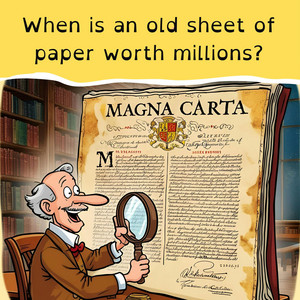
And today, we've landed at Harvard Law School in the American state of Massachusetts, where what was once thought to be a faded old copy of a famous document has turned out to be the real deal.
That document? The Magna Carta, one of the most important pieces of paper in history.
The Magna Carta was written way back in 1215 in England.
It was a deal between King John and a group of rebellious barons who were sort of like powerful lords who were unhappy with how he was running the country.
They wanted rules to stop the king from having too much power.
And that's why the Magna Carta is such a big deal.
It was one of the first times in history that a ruler agreed to follow the law, too, and it inspired many of the rights and freedoms that we have today.
Now, there were multiple copies made and sent across England, but only a few originals still exist. And the one just discovered at Harvard was issued by King Edward I in the year 1300.
That's 725 years ago!
It was bought in 1946 for just, get this, $27 .50.
But now that it's confirmed as a rare original, it could be worth millions.
Not bad for an old stained sheet of paper.
Animal Kingdom First up, scientists have discovered a new deep -sea octopus off the coast of Western Australia and it looks just like a tiny squishy pancake.
Called the Carnarvon Flapjack Octopus, it's only four centimetres long, has big eyes, red tentacles, and can flatten its body like a flapjack or pancake.
It also has little fins on its head, earning it the nickname Dumbo Octopus, because they look like miniature elephant ears.
Adorable! I've stuck a link to a picture in the episode notes.
Now on to the real headlines stealer, we recently told you about a capybara that escaped from a zoo in China.
Well, this week, two more capybaras escaped from a zoo in Poland!
The giant guinea pig lookalikes made a run for it on Monday and were eventually found by locals hiding in some thick bushes.
Safe, happy, and apparently having the time of their lives.
Another week, another Capybara breakout.
What is going on? Newshounds Every Thursday Squizzy the Newshound sticks his snout into Squiz Kids HQ to report back on fishy things he sniffed out on the internet.
And today his nose is twitching because of some very shaky science.
There's a rumour going around online that a huge earthquake is going to hit Japan in July.
The prediction comes from, wait for it, a manga comic, based on the author's dream.
Hmmm, not exactly scientific.
But that hasn't stopped people from worrying.
A Facebook group with over 250 ,000 members has been sharing the rumour and a video telling people not to visit Japan has been watched over 100 ,000 times.
Some travel agents in Hong Kong say they've seen a drop in bookings to Japan because of it.
So what's actually true?
Well yes, Japan does get a lot of earthquakes and in 2011 a big one caused serious damage.
Yes, scientists say there is a chance of a mega quake sometime in the next 30 years, but no there's no scientific way to predict the exact date or time of an earthquake.
So remember Newshounds, if you see something online that makes you feel big emotions, stop, think and check other trusted sources to see if it's really true.
Thanks Squizzy. You've done it again.
Hello, it's Bryce here.
And well done, Squizzy on sniffing out another example of fishy information online.
That dog in his nose, I tell you what, nothing gets past him.
I'm just jumping into the podcast for a moment to let you know that at the end of today's episode we've got an interview with ACARRA CEO Stephen Ginnell.
ACARRA is the National Curriculum Authority, the people who decide what you should learn at school and why.
And this week they made the big announcement that media literacy would be part of the Aussie Schools Curriculum.
Hurrah! And they've recommended teachers use NewsHounds to help teach you lot how to tell online fact from fiction.
Double hurrah! Parents, teachers, kids, keep listening at the end of this episode, to hear Steven tell me about why media literacy has been added to the curriculum, why Squizzy is the dog for the job and what it all has to do with protecting our precious democracy.
Time for the S -quiz.
This is the part of the podcast where you get to test how well you've been listening Question number one which two political parties that make up the coalition are taking a break from each other That would be the Liberal Party and the National Party Question number two which King first agreed to the set of rules laid out in the Magna Carta That was King John way back in 1215.
Question number 3, the fins on its head have earned the flapjack octopus which nickname?
It's also known as the dumbo octopus.
Shout out. It's Thursday, May 22, Sherlock Holmes Day.
Sherlock is a fictional character invented by author Sir Arthur Conan Doyle way back in 1887.
He used logic, observation and a sharp eye for clues to solve even the trickiest of mysteries.
Today might be the perfect day to test out your own detective skills.
Elementary my dear Squizz kids!
It's also a special day for these Squiz kids celebrating a birthday today.
Piper from Para Badoo, Thea and Archie from Camp Hill, Corey from French's Forest, Patty from Walkavale, Brayden from Woodcroft and Hasan from Mossman.
And a belated birthday shout out goes to Archer from Bundaberg.
Classroom shout outs today go to Class 56 Raptors, with Ms Gersham at Al Hickmar College in Lakemba.
Class 5 OD with Mr Duncan at Seabrook Primary School.
Class 3 MW with Mrs McHugh and Mrs Wright at St Ives North Public School.
Class KS at Green Hills Primary School.
And lastly, but definitely not least, Class 5 S with Mrs Malone at Sacred Heart Catholic Primary School in Wagga Wagga.
And if your class, like all those classroom shout outs that we just had, would like to go into the draw to have Bryce drop into your classroom in a virtual visit, then all you have to do is submit your classroom shout out this month.
And don't forget if you've got a birthday coming up and you want a shout out, or for one of those classroom shout outs, drop us a line at squizkids .com .au or just fill out the form on our website.
Well, that's all we have time for.
Thanks for listening to Squiz Kids Today.
We'll be back again tomorrow with the Kids Vs Adults weekly news quiz.
In the meantime, folks, get out there and have a most excellent day.
Over and out. Music Steven O 'Neill CEO of Acara, welcome to Squeeze Kids.
Great to be here. Now, Steven, can you tell us what Acara is and what it does?
Well, look, it's in the name, but it's a bit hidden because it's an acronym of course.
So we are the Australian Curriculum Assessment and Reporting Authority, which sounds very formal but most people know us for things like NAPLAN, the National Assessment Program for Literacy and Numeracy.
We're also responsible for the Australian Curriculum and we're also responsible for reporting on schooling in in Australia as well as the my school website which many of you listeners may have heard of as well.
Important job then And you've released a new teaching resource this week focused on media literacy.
Can you just tell us why that is an important skill for kids to develop?
Yeah, absolutely. I mean, part of our remit and what we aim to do is to help all young Australians become successful learners and confident and creative individuals as well as active and informed citizens.
And so of course, to be an active and informed citizen, you need to understand about the media.
You need to understand, what's fact and fiction.
you know some of the content in your other podcasts which are you know fantastic getting our message out and the general message about the importance of this area to our young people and look we do live in this really media saturated digitally connected world more and more of our young people and like all those people listening are choosing to consume their news through internet social media rather than that traditional media that that I'm used to, the good old newspaper that myself and their parents and grandparents and others are used to.
So you know we've got to shift with that as well.
We're going to make sure that we're preparing those young people for the future.
And Stephen why is it that when kids are watching YouTube or they're getting information off social media, why can't they just believe everything they see on these platforms?
Well I wish they could you know, that'd be pretty simple wouldn't it?
But the reality is you know by some the valuable parts about the internet is the sharing of ideas and those things.
But it also creates an environment where we can get a lot of fiction and sometimes less fact.
And so not everything you read is true.
And then look that's been the case even from the time of books, and writing, and those sort of things.
But there was probably more layers that meant whether those things were published or distributed or those things.
Now of course people can go in and podcasts, or social media links or whatever they want and just publish.
They literally hit a button and it's there.
So it's really important that we start from the point of view that not everything is true, not everything is accurate.
We need our children, our young people and for that matter our parents, you know, in our community more broadly to really be able to understand that and to spot those fake news, those things about we're really trying to control what people are thinking through, you know, really poor means like trying to really fake them out, tell lies, those sort of things.
So you know, there's a lot of that content out there online that's really been deliberately created to spread misinformation, cause confusion and that's why we are so central that we help develop our children's media literacy skills and that knowledge is more important than than rarely ever.
We couldn't agree with more here of course at Squiz Kids and we're super excited that you've listed our very own NewsHounds the free media literacy resource for primary school kids in your table of resources that teachers might like to use.
What lessons can Squizzy the NewsHound teach primary school kids?
It will keep going, I would say, I mean I had a quick look at those resources the team have really worked you know to make sure that we are shining a light on good resources as such as this, that's a simple message, isn't it?
Stop, think and check, not just read and believe.
I think it's just the opposite of that.
So I think that a clear message from New Sounds and, yes, Squiz News, et cetera.
Those are key parts of this, is really helping unravel what is out there.
There is just so much there.
We worked with a number of people about these resources, those media literacy experts, to help us with the best way you know, put some of these in the hands of our teachers, to really support them to engage with this really important area of the curriculum.
And of course, being able to tell the difference between online fact and fiction is a really important life school for anyone living in a democracy, no matter what age you are, and especially important to help protect our democracy.
Why is that? Well it's a really important question and I would say it's not only about protecting our democracy but making it sustainable.
You We need our young people to engage in this, they are the leaders of tomorrow.
This is crucial for people who are going to be in those positions of power, leading nations, leading communities.
It is really an important part of that.
And as you say, the elections rarely put that into light.
What are we taking our information from?
And we saw a bit of a shift, we know this has been happening for a number of years about where people get that information from.
It used to be maybe the flyer that was in the letterbox or those sort of things, or what you've picked up along with your democracy sausage as you're lining up to vote.
But these days, people are literally swamped with social media, posts, and those things about it.
As well as, we saw in this one, unsolicited text messages.
And so the stuff flying at people all the time, and especially during election time where people are trying to create the story and have people believe in what they want to see happen for a community, just of paramount in accordance to make sure that our children, our young people, and our voters at large can distinguish between the fact and fiction.
Well, you are singing from the same hymn sheet as us here at SquizKids.
We're super excited to be a part of this media literacy crusade with you.
Steven, Gouniel, thank you very much for your time.
It's great to be here.
Thanks very much.