From The New York Times, I'm Rachel Abrams.
This is The Daily.
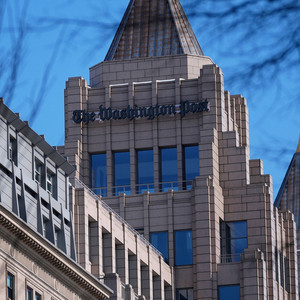
When Jeff Bezos bought The Washington Post more than a decade ago, journalists inside and outside of the newsroom were cautiously optimistic.
Maybe he could revitalize one of America's most storied news organizations.
Brutal blow to one of journalism's most legendary brands.
The Washington Post is laying off one third of its staff across all departments.
Those hopes though, were dashed on Wednesday when the paper laid off more than a third of its newsroom, affecting nearly every section of the paper.
The newspaper's books department will close.
Its Post Reports podcast suspended.
Its entire sports department and most of its overseas journalists.
Today, I talked to my colleague Eric Wemple about what went wrong and what comes next.
It's Thursday, February 5th.
Eric Wemple, welcome to The Daily.
Thank you.
Thanks for having me.
A lot of people listening to our show today probably have some kind of awareness that people have been talking in really apocalyptic terms about the state of affairs of The Washington Post and specifically the layoffs that happened on Wednesday, which were described by many people as frankly, a bloodbath.
And you, Eric.
You are not only a media reporter at The New York Times, but you also were a media columnist at The Washington Post.
And this is why we wanted to talk to you today, because of this unique vantage point that you have.
So just to start, tell us what we know about these cuts.
So this is an extremely grim outcome at The Washington Post, a dark day, as many people have been saying.
We knew the layoffs were coming, but they hit, and they hit with a tremendous amount of force.
And that analysis doesn't need to extend that much further than just saying that 300 people who practice journalism for the benefit of American civic life have lost their jobs, maybe lost their careers and their livelihood, at least for some time.
So it doesn't really have to go beyond that analysis.
But there is another dimension to it, which is that this is the Washington Post, and the Washington Post right now is playing an enormously important role in covering an administration that for whom no headcount is really sufficient.
So that's what I would say about the enormity of these events.
What do we know at this point, at about 3.50 in the afternoon on Wednesday, about who was laid off?
Well, we know that the cuts took about 300 positions out of the newsroom.
And this was a newsroom that was at about 800 in terms of its headcount.
It had crested up above 1,100 several years ago, I think, and maybe in 2021, around then.
And since then, it has been an exercise in retrenchment.
The layoffs landed disproportionately on the Metro desk, the sports desk and the international coverage.
Those are three areas that had been rumored to be hit in recent weeks, recent months, and indeed that's what happened.
It feels like there are many different things happening at once at The Washington Post.
You've got a tough business.
You've got a billionaire owner.
You've got an entire industry struggling to figure out how to make it in the age of the internet and social media.
So which of these narratives helps explain why a third of the newsroom was laid off on Wednesday?
The question of what's happened to The Post is a little bit layered.
Number one, The Washington Post is a legacy regional newspaper.
And as a legacy regional newspaper, it has business model problems, very clear ones that relate to the drying up of revenue streams.
And that's across the industry.
Add on to that that Jeff Bezos, in the past couple of years, has made some missteps that have led to the desertion of subscribers and business model problems for the Washington Post, and that really don't come with the standard issue crisis that we've seen over the past few decades.
So that's how I'd put it.
And I think that that's one of the reasons why this is such a big story.
I want to rewind a little bit and go back to 2013, the year that Jeff Bezos purchased The Post.
And at the time, people both inside and, I think, outside journalism were extremely optimistic that this guy was going to basically ride in on a white horse and infuse the place with cash and help it realize its ambitions.
So bring us back to that moment and tell us kind of how things evolved from there.
So when Jeff Bezos bought The Washington Post, he was buying essentially the same sort of paper that we had seen fail in a lot of markets in the United States, which is to say a struggling paper, a paper that had lost staff, a paper that had lost a little bit of vigor and a paper that had lost a fair bit of morale.
I mean, it was still producing very good journalism, but it was definitely not, at like, the top of its game.
It was a newspaper in need of investment, especially since the demands of the time were to figure out new ways of putting reporting and content online, which was frankly a very expensive thing to do.
Right.
So Jeff Bezos buys the Washington Post for $250 million, basically in the summer-fall of 2013.
And Bezos had this idea that this was a lofty goal, certainly a worthwhile pursuit to turn this sort of distressed property with a lot of social value, a lot of civic value, turn it around, make it profitable.
The newspaper industry needs new approaches and, you know, Jeff Bezos may be the guy to do that.
We hope so at the Washington Post.
And there were a lot of eager people who were really happy and excited to be working with him.
And I think that that was a powerful combination for a new owner.
I remember reading a quote from Jeff Bezos at some point that said something to the effect of when he was old, one of the things he'd be proudest of as part of his legacy was the Washington Post and helping to turn that place around.
And I remember reading that and I remember the sense of optimism that you are describing.
But I also remember Eric, that there were some concerns about editorial independence, concerns about what does it mean for a person that rich, that influential, who has that many different business interests, to come in and take control of a newspaper?
There were absolutely concerns about editorial independence.
I mean anytime you have a news organization owned by a businessman of such proportions, you're going to have really, really legitimate conflict of interest concerns.
But Bezos, from the very beginning, made it clear to newsleaders at The Washington Post that he would not interfere in the coverage and essentially said with respect to Amazon and other interests of his other companies, and so on and so forth.
Whatever he would do, have at it.
Cover it the way you would any other company.
He said all the right things to a group of journalists.
That's right.
So what did he do next?
So next, after buying the place, he invested in the place.
He invested in the politics coverage.
He invested in the international coverage.
He invested in the technology.
The Post's website was sort of creaky.
It would take a long time to load.
So the Washington Post became more of a news technology company and less of this sort of old fogey sort of readout where you know the technology didn't work too well and it was just let's see how many.
How many pop-up ads do I have to fight off before I get my content and so on and so forth?
So Bezos really, he brought the newspaper ahead leaps and bounds with those investments.
He made it user friendly.
He made it much more user friendly.
Am I making this up, Eric?
Because I feel like I remember, around the time you're describing, suddenly seeing a lot more articles that seemed like general interest on social media.
I would see things pop up on Instagram and things that seemed like very user friendly, very general interest.
I remember having the impression that they they seem to like really be broadening their reach in like a technologically savvy way.
Yes.
I mean, under Bezos, the Post invested more in its audience teams and how to reach people.
You know the cliché that now is you need to reach your audience where it lies or where it sits or where it is all that sort of lingo.
That was reality at the Post, and it was much needed.
And what about Bezos' promise of staying out of the news coverage?
Well, I mean, there were many indications that he was indeed staying out of the coverage, as he had promised to.
The Washington Post did tremendous coverage of Amazon.
It had its own reporter on the company.
And a lot of people were looking for signs that conflict of interest was coming to roost at the Washington Post.
And they didn't come up with much.
And not only did they seem independent, but they were really, really knocking it out of the park.
During this period, the Post was doing an extraordinary amount of excellent journalism before Donald Trump's election.
After it.
Throughout that term, the Post was investigating him as a candidate as a president, along with other major outlets, in a way that I believe was almost unprecedented in American politics.
They were delivering scoops about his philanthropic organizations, about his business operations and then into his administration, first year.
For example, the New York Times and The Washington Post shared a Pulitzer Public Service Prize for coverage of the Trump administration's approach to Russia.
And if you want to know how badly that offended Mr Trump, you can just look at the lawsuit that he filed against the Pulitzer Board a few years back.
And so this was an era of tremendous, tremendous journalistic effort and output.
They were breaking things that were influencing the news.
Yes, absolutely.
And during those years, too famously, the Washington Post came up with a new motto democracy dies in darkness.
I remember.
I think those years represented Bezos' promise fulfilled, an era of tremendous success.
So, during this period of what sounds like a reinvigorated newsroom, How was it doing on the business side?
Was it making money?
Was there a strategy?
Yes.
I mean, part of the strategy, of course, was to ride the Trump bump.
Let's be honest about that.
But they did a lot of things to improve the product.
They were bringing on more subscribers month after month.
And through those initial Trump years, the post was allegedly profitable.
But then it fell off a cliff, sort of in the beginning of the Biden administration 21, 22 years, when digital advertising sort of dried up and audience dried up.
It was not as interesting a time from the viewpoint of a news consumer.
There weren't major stories coming out of the White House hour after hour on a Saturday morning.
So that was less news. and less crisis, and fewer eyeballs, fewer clicks.
That had a big impact on the Post's business, and there was also a slump in digital advertising to boot.
So what you have then, is that the Washington Post started losing a lot of money year after year, up to like 100 million.
And The eerie sort of feeling you got, looking at this, is that those systemic problems with the newspaper relating to digital advertising subscribers, those problems continued to haunt the Washington Post ledger.
Right.
What you're saying is essentially that the bump that the Washington Post got in the years after Trump was elected was not a response to a new strategy, of a new business model.
It was a response to Trump.
And so therefore, the Trump bump, this enormous influx of readers right after the election in 2016, kind of papered over an intractable problem that was much more intractable than perhaps anybody had anticipated.
Yes, indeed.
That is essentially what we've learned kind of the hard way that the post emerged from these years of profitability.
And then this went a little bit sideways.
That went a little bit sideways.
The audience wasn't fully there, which means that the business model isn't really robust.
It can't handle anything less than optimal circumstances.
So the Washington Post's business model problems were such that even if you had a management team that was making reasonably smart and logical decisions, the paper would still be struggling.
But starting in 2024, Jeff Bezos took a number of steps that turned a problem into a genuine crisis.
So, Eric, before the break, you mentioned that The Post in 2024 hit the state of crisis.
I think I know what you're talking about, but tell us what happened.
Yeah, so what happened in 2024 was really significant.
The election proceeded with respect to our coverage just as it always had.
The news side was doing its articles, the editorial side was doing its editorials and its op-eds, and things were bumping along just fine.
Now, as usually happened sometime in late summer, early fall, The Washington Post editorial board would begin drafting and publish an endorsement of one of the candidates in the presidential race.
And this was something that readers had come to expect.
But as we inched closer and closer to the election, there was no editorial coming forth from the Washington Post.
Nothing was published?
Nothing was published, even though People on the editorial board were working on one and indeed had mustered a draft endorsement in favor of Democratic candidate Kamala Harris.
But 11 days before the election, Will Lewis, the publisher, announced that there would be a new policy, and that policy was to not publish endorsements at all in this race and in future races.
It was articulated as a policy shift and not as some sort of political decision.
Yeah.
Explain the reaction to that a little bit.
It was epic. went berserk on the Washington Post.
You mean people were writing in and expressing their displeasure?
Our digital messaging platforms were aflame.
They were very busy.
And people answered immediately with their money and they canceled their subscriptions.
NPR reported that there were in excess of 250000 cancellations of subscriptions against a subscriber base that was about 25 million at the time.
And Eric, why did people have that kind of reaction, given the fact that an owner of a newspaper traditionally has the right to influence the editorial page?
Yes, that's traditionally the prerogative of owners and it's been cemented for decades in American newspapering.
But what was particularly problematic here was was not necessarily that Bezos had instituted a new policy per se.
The issue was when it happened and what had preceded it.
When it happened was 11 days before the election.
And what preceded it was that The Washington Post had a draft endorsement for Kamala Harris in the hopper, ready to go.
So many people just did the shorthand and say, Jeff Bezos killed the Kamala Harris editorial.
Now the Washington Post's statement was written to kind of prevent that impression from taking hold, but it wasn't very effective in doing that.
And a not insignificant portion of subscribers canceled, it seemed, because of this decision to pull the endorsement.
There was no uncertainty about the cause and effect here.
None.
This drop happened because of this decision, and people at the Post were livid about it, and they were also insistent we should not be held liable for this particular loss.
This one's on management.
They should take the consequences of this awful decision and not foist it on us via cutbacks layoffs buyouts, whatever.
I remember this moment as really the first, clearest example of something happening that people had worried would happen when Bezos bought the paper, which is that he would make a decision that at least seemed like it was caving to power.
In this case, giving what seemed like a gift to then candidate Trump.
Right.
Well, you have a lot of company in reaching that conclusion, is all I would say there.
And of course, that wasn't the end of it.
Just months later, in February of 2025, Bezos just out of nowhere declared a pivot in the Washington Post opinion section's ideological outlook towards personal liberties and free markets.
And that came out of the blue.
In And again, people reached the conclusion that this was a way of pivoting the opinion offerings in favor of Donald Trump and the GOP.
And then I would say that there was a dismay that deepened over the course of several months.
I think that there started to be a growing dissatisfaction with leadership.
And a number of people took a buyout to leave.
Other people... just chose to leave.
Including you, right?
Including me.
That was my wife who slapped me and said, wake up bucko, pretty much because I was sort of in a state of denial about where everything was headed.
I think a lot of us had that same sort of feeling that we had been at this institution for so long.
It had been so steady.
It had been so reliable. that we could not believe that the ground was shifting underneath our feet.
But there is and was a sentiment there that things were just not very well managed and very well thought through.
And that had never been the case before.
And that was, I think, the factor that drove a lot of departures and drove a lot of dissatisfactions.
It feels worth noting that none of what we are talking about is happening in a vacuum.
The layoffs in particular that have happened this week.
Jeff Bezos just paid 75 million to a company controlled by Melania Trump the first lady for a documentary.
It's an exorbitant amount of money.
It's caused a lot of people to say that this is nothing short of a transparent attempt to cozy up to the administration.
Amazon is also one of the top donors to the East Wing ballroom project the president has pursued.
And all of this is happening at a time of unprecedented attacks on the press, including at the Washington Post, where a journalist recently had her home searched by the FBI.
And so I think a lot of people are probably listening to this and have heard all of this context and are thinking about all the other things going on right now in the world and in the world of journalism.
And they're wondering, do these cuts that we are talking about fit into that backdrop in any way?
I am going to say if you are going to cut a newsroom to please Donald Trump in any way, I think that those cuts would have been different.
In other words, they would have gone first, after the investigative capacity, the politics desk, the national security desk of The Washington Post.
Those desks have done the greatest damage over the years to President Trump.
And the deaths that you just outlined, to be clear, those are remaining intact.
Well, those are remaining more intact than the ones that they targeted.
Management has said that the cuts affect pretty much all areas of the newsroom, but the most directly affected, the most proportionately deep cuts fell on the metro sports and the international staffs.
So...
I don't think that that particular read is operative here.
The broader critique at play, I think, is just that Bezos is gutting the newsroom that he once propped up and that he once invested in and that he expanded.
So we're basically seeing a clawback of the investment that he put into the newsroom.
It's basically like a boomerang.
So that is kind of a cataclysm at The Washington Post.
That is a major, major media story.
Why double down on the desks that you mentioned?
National security, politics, investigations.
Why are those desks the ones that he and the rest of the leadership are banking on?
Well, the explanation is that they have found, through looking at the data, through looking at the analytics, the areas that readers want.
And they've de-emphasized the ones that readers don't want.
We don't have all their analytics.
But that's the rationale that they looked at the analytics.
They decided that this was the way to go and that this was the route to saving the institution.
Saving by shrinking the institution, though.
Yes.
I can understand why that might make sense to double down on what you believe to be your core product.
But I want to read you something that Jeff Bezos said when he bought the paper.
So how does that square if it squares at all with the idea of doubling down on just those few core areas?
Well, I do think that there is some logic there, and that is that the Post has had a tremendous run in these areas.
The problem is that they are cutting all kinds of stuff that people have enjoyed in the past.
And whenever a newspaper cuts, there is a desertion.
And that desertion basically lowers their revenue.
It cuts into their revenue because subscribers leave.
Digital advertisers don't see as much content they want to be adjacent to.
And so you get into sort of a spiral, which people in the industry call a death spiral, where you cut the product, people desert the paper, revenues go down, you cut more.
People desert, you cut more.
And it's a self-reinforcing cycle.
And it's misery.
And there is no guarantee whatsoever that the post is not descending into one of those spirals.
Because there is an open question as to whether doubling down on these areas is going to float the business model.
There is just no guarantee that it will.
I want to read you one more thing Eric, and this is a quote from Marty Baron's statement on Wednesday.
Marty Baron, former executive editor of The Washington Post, and his statement says the Washington Post's ambitions will be sharply diminished, its talented and brave staff will be further depleted and the public will be denied the ground-level, fact-based reporting in our communities and around the world that is needed more than ever.
Looking at all the cuts that you've outlined, looking at the reaction from people both inside and outside the Post talking about this in, as I mentioned, apocalyptic terms, what do you think we can say about the possibility to do the kind of journalism we have come to expect and rely on from this paper?
Well, I would say we should never sell short the abilities of the journalists that are there.
When a story emerges, they will get on it.
And they will continue investigating.
They will continue breaking news.
They will continue kicking ass in journalism.
So people will continue.
I will continue to subscribe to The Washington Post as I have for decades.
Nothing will make me ever stop my subscription to The Washington Post.
I get it in print.
I read it every day.
I've read it through this tumult, too.
Every day, I find plenty to read in The Washington Post.
It will not stop producing really good journalism.
What will happen is we will never see the stuff that they just don't have the manpower to produce.
So this becomes something that is utterly ineffable, utterly invisible and utterly impossible to quantify.
That there'll be things going on in the world that the Washington Post does not have the resources or the eyes to see through.
Eric Wemple, thank you so much for joining us.
Well, thank you for having me.
We'll be right back.
Here's what else you need to know today.
We currently have an unprecedented number of counties communicating with us now and allowing ICE to take custody of illegal aliens before they hit the streets.
Unprecedented cooperation.
On Wednesday, the president's border czar, Tom Holman, said the government would immediately withdraw 700 officers from Minneapolis after local officials agreed to increase their cooperation with federal immigration agents.
The cooperation Homan said involves local officials allowing ICE agents to take custody of undocumented immigrants before they are released from jail.
More officers taking custody of criminal aliens directly from the jails means less officers on the street doing criminal operations.
And the Supreme Court has cleared the way for California to use a new congressional map explicitly designed to help Democrats in this fall's midterm elections.
The justices rejected an emergency request by the California Republican Party to block the map.
Democrats redrew the state's congressional districts last year to counter a similar effort undertaken by Republicans at President Trump's behest in states like Texas.
Today's episode was produced by Carlos Prieto, Shannon Lin, and Eric Krupke.
It was edited by Devin Taylor and Liz O'Balin.
It contains music by Dan Powell, Sophia Landman, Diane Wong and Rowan Nemisto, and was engineered by Chris Wood.
That's it for The Daily.
I'm Rachel Abrams.
See you tomorrow.