Take away Chinese where you can take some Chinese away and experience progress day by day Take away Chinese we will promise you a difference In how when shooting ceiling hi welcome to take away Chinese I'm young Lee and joining me today our friend better.
Hello better. Hello.
Hello everybody wait Yes, I was too happy I had to come back.
Now, I feel like an old friend with you.
And in the previous time, I was still very polite and didn't ask you to introduce yourself in Chinese.
So would you His yen Talking in a real bazin accent.
No, this is the real That's not the real Pu trun kua does not have that many r1 either it's closer to Well, that's good enough for me like i'm still oADE You know what I mean?
The truth be told is jokes aside is my first Chinese teacher, she was from Harbin I'm just saying, your Chinese is really good!
Thank you very much!
And I want to know whether or not you know China a bit more, or the knowledge about China is at the same level of your Chinese language.
So, let's do a special episode for today!
Alright, I'm nervous now.
Don't be nervous, you are gonna do a great job.
And for our dear listeners, if you're interested in Chinese culture and you want to get a grip on the Chinese language, then this is the show for you.
Stick with us for 30 minutes and you'll soon see the rewards.
And for more fun Chinese learning, follow our Facebook page, Learn Chinese, to watch many fun videos and live streams.
But now, let's provide you with some free Chinese for take away.
So here is the conversation and let's see if you I think you're going to understand the conversation quite well, but let me try anyway.
你 BW 你欢angan What do you think?
Straightforward – very very direct Very very direct We make sure that each and every component of the sentence serves a function not like These words they're important actually in daily lives, but we're still in the stage that we want to Let's say include the words that actually mean things so that one our listeners want to Compose a sentence they can find the words they need right?
So we're still at that stage So for the first sentence, what's the sentence mean?
You're asking me final, how many ethnic groups there are in China?
Quite good. So 你, that's.
你, 你? 你, China. Half.
你們? How many units?
It's a measure word.
Yes, it's a measure word.
It's the most common -measure word.
Min -suu. Ethnic groups.
Ma, is a question mark.
Yeah, si, you're just really good.
Is there any word in the sentence that stands out for you?
Do you think our listeners should pay attention to any of the word?
Well, I think the gong sometimes is used, the gong for total.
Sometimes it's used as i gong words on vong.
Like, iya together.
So, but in a sentence, you can use just character alone.
Just go alone." That's an interesting phenomena in the Chinese language.
Usually, we'd like two -syllable words.
Right. The modern Chinese enjoy two character words because previously in ancient time, I think in ancient times Usually we have one character word and we didn't have any likeclamation marks or question mark or comma or period.
We don't have any of those.
It was all one text, big text.
One big text. that is why for ancient Chinese learner or for those little kids living in ancient time, one very important lesson for them is to learn how to separate each and every group of words and putting them together they would understand the meaning.
So we call it zhizhou.
Zhizhou is basically how do you group the characters or the words in that one huge passage.
Later on we realize, huh, we didn't really have to do that.
We can have some of the common, it helps us.
And then, in daily language, the idea is that if you have two character words, it's easier for people to not make any mistakes or misunderstand.
That is true. Because we only have limited number of sounds in the Chinese language.
Yet when you put it in sentence, because usually the two syllable words or two -character words, sometimes the two characters actually mean the same thing – because you are expending it from one -character -word to two -character -word.
So it can be omitted sometimes.
It's the same thing for 이고 서고, the example you gave.
Yes, exactly. So 이지다 정고 고요 여재에 미수마어 do you know how many ethnic groups there are in China?
Okay, so the answer here is 시우 시리어고.
So 56. 56. So 午足学麼, 我.
Yes, 午 is is. is is 午足学麼.
56. crab And then again the measured word.
Yes. And in the sentence, there is no subject.
What's wrong with the sentence?
It has no subject. But it's a direct answer to the question, you know.
Again, the context, right?
Yes, yes. And actually, it's kind of like saying, � Phillips, 我最麼, 下足学麼.
The answer is 56. But without the actual dà… the answer, you don't really misunderstand it anyway.
So different components can also be omitted in the Chinese sentence.
And then… Very good.
I think your pronunciation is very good.
Thank you! And what does that sentence mean?
okay so basically each one has means each ethnic group has its own distinct cultures and traditions yes so each one can I say may uh yes yes it's the same and again one you only see a measure word without a number in front of the measure word usually it's one is usually it's a minute yes means or ethnic group ethnic group actually min, zhen, min, people, successfully is like group so precisely people group yes so min zu ethnic group dou you they all have they all have they both have if we're talking about two so dou is saying every one of them but in collective form right dou tu unique unique so dou
do you know what do So, alone.
Yes, only. Only, yes.
Special. So, unique, the thing that only this one has.
So, that would be unique.
Culture. Traditions.
So, that's habit. So, means custom.
So, that's what you do, what you're used to do in your daily life.
And something that's in the custom of your ethnic groups.
so that would be a custom or tradition, something we do.
Very good. This is a funny one because I want to ask you, I feel like I don't say that often in my daily life.
Do you? I do. Really?
I do, I do. So it's a habit thing?
It's a habit thing, yes.
And I got it from my friends.
Ahh. if you don't know I think for me it was an absorption thing like I they I had one specific friend that was with me frequently we used to work together and she used to say mehto all the time so I started to say it yeah no that's also the thing because you could say you know you can say you can say yeah and one thing about learning Chinese actually not learning Chinese one thing about speaking any language even if it's your own language is that you get influenced by people around you quite so much.
Oh yeah, yeah. Your accent, your catchy phrase.
Everything, like everything, yeah.
And it's a good thing if you see that happening to your language, it means you are very sensitive to influence.
It also means that you can learn a new language faster.
That is true. Because you pick up the habit faster.
Yeah these habits are actually what turns your level into very natural.
Yes. Right? It's like this...
It's all the mistakes, for example on the first sentence that I said that it was the grammatic There's a lot of mistakes but like they're on their own mistake But I understand what you mean And it's very like you could say the same thing without using them any words Let's put it this way, but that is what makes it very natural natural.
You know, yeah Yeah, in my case.
I just pick it from other people.
Yeah, and gradually because when I'm doing the show I need to really carefully separate the personal habit with the actual rule in the language.
Because sometimes I feel like I don't use this word with another word and it turns out it's only my personal habit.
So when I was doing the research I would make sure that if I say, okay so this word cannot be used this way, I need to be right about it.
Yeah, of course. But for those who are learning the language you do not really have to think about it too much, you can just to pick up whatever a native speaker is saying." And just gradually you would know whether or not it's his or her personal habit or something that you have to align with, but nevertheless, it's a native speaker.
So copying what they're saying would only make your language level a bit better.
Yeah, copying is a good thing in this case.
Yes, yes. Yeah. So That's right.
And they even hold grand sporting events.
Yes, so, HAI, still, Hway.
Hway is tricky. It is.
It's a really hard one.
But in this case it means to do.
To do. It's closer to do.
Yeah, yeah. So when it comes to Hway, there are so many, I think, on a certain language teaching page or website, I see several pages of words describing how to use Hway because it carries the meaning of a capability, it carries the meaning of something will happen, something that will definitely happen, but you do not want it to happen, right?
Ha ha, yes, yes, yes, yes.
I don't know why it's specified, but I mean it's saying it will definitely rain tomorrow, but I am also saying I don't want it to rain without saying it.
Yes, yes, yes. Yeah, so there are different meanings, so my suggestion would be that you remember how to use it in different scenarios without trying to remember why just remember how to use it yeah I think I think yeah this this is again the complexity of the Chinese language in terms of context because sometimes actually if we sit down here and we talking depth about the meanings of Hui I don't think we're ever gonna finish it.
It's gonna be a whole show and we're You're probably not gonna get to the final answer and if we come up with a huge list, it's not gonna help anybody.
You know? So I will advise to do exactly what you just mentioned.
Just accept it and pay attention.
Accept it. Like, yeah.
Accept it that you...
I like that way of saying...
Just don't like... You know?
Like, just be in peace with the fact that you're not going to get the whole list and just fill it.
You know what I mean?
Because after a while you wouldn't know when to use it without knowing why you're using it.
Precisely. And here Hui Ju Xing, it's not saying it will happen recently, it's not saying they would do it.
It's like this is a constant.
It's more like saying the ethnic minorities.
They have this, so they have this different grand ceremonies, sporting activities, things like this.
Yeah, so this is I don't know why, for example, you know, the feeling that, for example, it's hey, hey, do you ban?
Right, but, like, if I take the way out and the way out and just say, like, how do you ban?
It's wrong. It's weird.
It's weird. I don't know why, but it's just there's something missing there.
You're really good in China.
It's weird. Yeah. So, so if you want to say that something is a constant in certain occasions yet you do And I want to specify, it's going to happen in two days, or it has already happened previously.
It's just 你為, something 你為 happen.
So I think 你為為 is kind of like a good example.
It's like, it will rain you don't know when, but for weather, raining happens.
Raining is like one of the choices of the weather.
So it happens. You don't know when, but it will rain some day.
True. Yes. So, that's the 你為.
means to organize, but in terms of an event an occasion.
you can do by a wedding you can do by an event, yes, yes and that you carries the meaning of hold it's like in English you say you hold an event yes but you actually can mean hold like physically you're holding something with your two hands.
You can also use the character ji.
And ban is directly organized.
And xiao shu minzou, that's one of the keywords of today's episode.
xiao shu minzou. So altogether, it means ethnic minority.
Yes, so xiao means little or little, shu is shu zi number.
So xiao shu actually means short in number, means we know is already the ethnic group.
So xiao Here in China, we have So the Han ethnic group, actually it's talking about here in China, the context, we're talking about the number of people, the population in the ethnic group.
So it's kind of like a short form of saying it.
we're saying that the ethnic groups that have fewer people.
Yes! So that's Shao, Shu, Ming, Zhu.
Precisely so. Ethnic minority.
Yoon, Dong, Hui. Sporting events?
Sporting events. Yeah, base.
Yoon, Dong, is sport.
Hui is a meeting. Hui is a meeting.
Again, Hui. You know how it is.
In this case, it means meeting.
And also, it's the same character.
Because here, we're doing an audio show.
So we want to specify the difference between same pronunciation different characters.
Yes, and here it's the same character.
Yes All right, okay, this is good Sunda it means big and short translation is big but like you could just say that right in this case no Don't you think so?
Okay. So the idea is that here the sentence is shown Because the shèng here is just to emphasize how Dai is.
It's like you use shèngdà to start with, you use shèngdà to describe wǔ dōng, to describe activity.
You cannot use shèngdà to describe an architecture or a natural scene.
So if you're seeing a huge mountain, even if it's still magnificent, you cannot really say shèngdà.
So shèngdà is about activity.
It's about the activity that has a lot of people to take part in, that it's a huge grand ceremony.
So, 추다 precisely is about a man -made activity.
Right. That is the difference.
Right. Okay. I'm finally teaching you something.
Yes, I'm learning. Yes, I'm learning.
I always had a problem with like 추다, 군니, all the words you used before 궃다.
Yes. Like, I was like… It's like the correlation you have to remember.
Now you can just relate 並且 with 个且.
So 个且且且个且个个个且个个个个 is the activity here.
And then Interview with 个且个个个个个个个个个?
I did not expect that.
Yes. Yes. It means, I'd love to see it.
I'd love to see it.
And yes, the reason that David or didn't expect is because the kind of expression does not happen in daily language, that's so much.
yet, for example, in written conversation, or even if it's screenplay that you want people who are reading it to understand the precise emotion that sentence carries, you would put, why?
There. And how to play it for different actors.
It's their own interpretation.
They might use why.
They might use extravagant body language or official expressions.
But the idea is that the why, they can happen in daily language.
It's just in different forms.
It's not like, wow!
My way of doing it is a bit too much on stage play.
A little bit. But that's true though.
It's true because that shofa, the way of singing it actually...
Depends on different people.
Depends on different people.
But there's specific characters that are just used to get the tone right, they don't mean it like the ah here.
They're just like doesn't mean anything, it's just to get it, to increase it a little bit.
Let's put it this way.
Okay. And Hao Xiang means I would love to?
I'd love to. Can you can?
Look to see. Take a look.
Yes. So that is the conversation.
Hopefully you've learned something.
You're listening to Take away Chinese with myself, Neil HolAcne and VanViter, we would love to hear from you.
Send us your thoughts via email to learnchineseatcri .com .cn.
Coming up next let's see whether or not VanViter knows anything about the Xiao, Xu and if he doesn't, I will again teach him one thing or two.
Oh my god. Don't go away so you will take some Chinese away.
Welcome back to Take Away Chinese.
I'm Yeuhong Lian, joined by Victor.
So, Victor, have you ever heard about the Actually, actually, no.
That's for sure. That's kind of what we say all the time when it comes to different ethnic groups.
When it comes to the population we would always say all of the… timeline.
If you think about a Pomegranate, because they have a lot of… How do you call it in English?
What? The little actual fruit inside, when they're squeezing so close to each other.
I don't even know how to say it in Chinese.
The seed. The fruit?
Could be the seed. Could be the seed.
And the idea, if you imagine a poem of Granite, they are so closely squeezed with each other.
Together yes. They're so together.
That's what we want.
And that's actually what we have with different ethnic groups because deep down, share something common.
And yet you would have different, like we said in the conversation, different tradition, different habit, and even different ethnic group costume.
I love, love those costumes.
Well, one thing about Chinese, I don't know if you have noticed already, I'm pretty sure you have, is that in some other countries, if you're, quote unquote, borrowing ethnic costumes from other ethnic groups, it's sometimes not welcomed, but in China, it's totally welcome.
People would think it's a compliment.
You're saying that, wow, it's very beautiful.
Can I try it on? They would always be super friendly and happy to have you try it on.
When I was traveling around, especially for business trips and doing different shows in different parts of the country, I had tried on a lot of different.
Yeah. And I love them.
It is, it is very diverse.
And actually this is the ethnic diversity in China.
I think is a lot of people, especially if you'd never been to China before, a lot of people don't know, right.
It's like, because the Hanseo is so predominant in terms of numbers, the population.
that's what became the stereotypical Chinese idea right but like actually China is a very ethnic diverse country as well and you go when you go to these regions of the country where the ethnic minorities live you actually get to enjoy a different sense of even different food different everything and so it's really interesting yeah really interesting what was the one ethnic minority that got your attention over the course of ten years I've had a few experience with ethnic minorities but I think one that I got more let's say a deeper experience with was miao zu in Guizhou yeah so I was like there's
this place called Xijiang from Miyaujai something like yes miao jai yeah and then it's Miyao and then I went with a friend in Guizhou province and we were, like, around the area and we gathered to sit down this place we actually stayed there for a few days and what's really interesting it looks like all the food like and like even the they have their own local language as well you know which is getting like of course simple don't you know what I mean so of course simple don't but like it's interesting is very very we're there we did like some local painting using some local tools like as very
unique very You know what I mean, yes.
In the meantime, actually, if you are an ethnic minority here in China, often you would be able to learn both your own language and the Mandarin Chinese in school.
So as for the paper tests, they would provide two versions so that if you want to take the test in other language, I think it suits the situation for those ethnic minorities that have relatively larger number of people, right?
Because if it was only hundreds of people, then no, no, not really.
But you can still use your own language in your daily life.
And being inside the shou shu means there's different categories that just meant that we have, like, we have the drones in Guangzi.
For example, there are like millions and you still have others.
There are like just a few hundred people.
Yes, yes. So it's yeah.
They're not in the same.
It's a very interesting thing.
and I think if I have the time I would definitely do a lot more research and a lot more demonstration on different shows about the beauty of different ethnic groups here.
That is so true. Yes.
Do you know there actually is a traditional sports games of ethnic minorities in China?
Actually I did not know.
I knew for example the Mongol Suu.
They have their own events in the Mongol.
I've heard of that.
But I think it's between them.
I didn't know it was a cross.
There actually is a cross different ethnic minority one.
And there are a lot of fun, interesting, different kinds of sports played because we all know the very international one.
Basketball, football.
Eh, they're not boring.
I'm just saying, they're very common.
Yet, for example, we have jin ju qiu, pearl ball.
Jin ju qiu. Yes, pearl ball.
for the traditional sports games.
Pearl Bowl is formerly known as Peking Pearls, Cai -Jin -Juu, evolved from the activity of collecting pearls by ethnic men.
It combines the characteristics of basketball, handball, football, and volleyball.
So basically in that one bowl, you have to do all these different types of things.
We would have six players from each team compete on a 28x15m court with the goal of the offense being to shoot the ball into a small net held by one of their teammates.
While some of the defenders have petals they can use to deflect the ball away from the net.
So it's like doing multiple things, just one sport.
There are also hua po.
The translation here is ethnic style rugby.
It's kind of like rugby, but it's like rugby in the sense that you can also, quote unquote, attack other players.
Tackle, tackle them.
Thank you for using tackle.
Yes, you can tackle them, you can do all these things, it can get a bit physical and can be a very fierce competition.
Ok, I see. Yes, and there's also mucho, wood ball.
This is not the kind of wood ball that you would see outside of China, there is an international wood ball.
But this one it's kind of like played on a instead of a court, more like a grassland.
So before doing the show, I also didn't know there are so many different types of very complicated and interesting sports.
I'm surprised. Actually no, I don't know any of them.
I think, When it comes to sports, many sports generate from a military training.
Yeah, definitely. And I feel like these sports are generated from actual games played within the ethnic group, in the clay, on the land, and you just find a way to entertain yourself by you know, playing different types of activity in sports with others, and you set your own rules.
And after a while the rules are accepted.
They evolve, right?
They evolve. Involve into something bigger.
Yeah. So I would definitely assume these ethnic group grand games can be much more entertaining, especially if you are to watch them.
I think that would be much more fun, because the rules are much more complicated.
Yes, definitely. But I'm surprised with the diversity here.
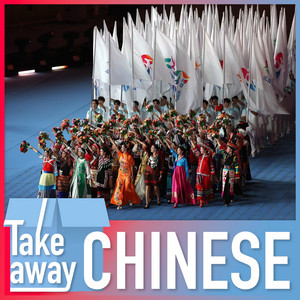
So for those of you who are interested in the mien zu yun donh hui, actually, we have our colleagues going to interview this means Yoon Dong -ho, I'm pretty sure she's going to bring about a lot of fun interviews, fun videos, just go to Learn Chinese Facebook page to see all of those.
And that brings us to the end of today's Takeaway Chinese.
I'm Yong -ho Lin with Bitter here in the studio.
For more fun episodes of the show, you can visit our website at video .cjtn .com and go to the column podcast.
You can also listen to the show and read the script there.
find us wherever you listen to your favorite podcast.
Just search for Take Away Chinese and thanks again, Lydia, for coming.
Thanks for having me.
It was a pleasure. Hope, I actually thank you because I learned a lot so happy.
I'm very glad and I hope to have you back in the studio in the future.
Thank you for coming.
Thank you for coming and for those of you who are enjoying this episode, make sure you leave us a five -star rating wherever you're listening.
Thank you. I'll see you next time.
Bye bye.