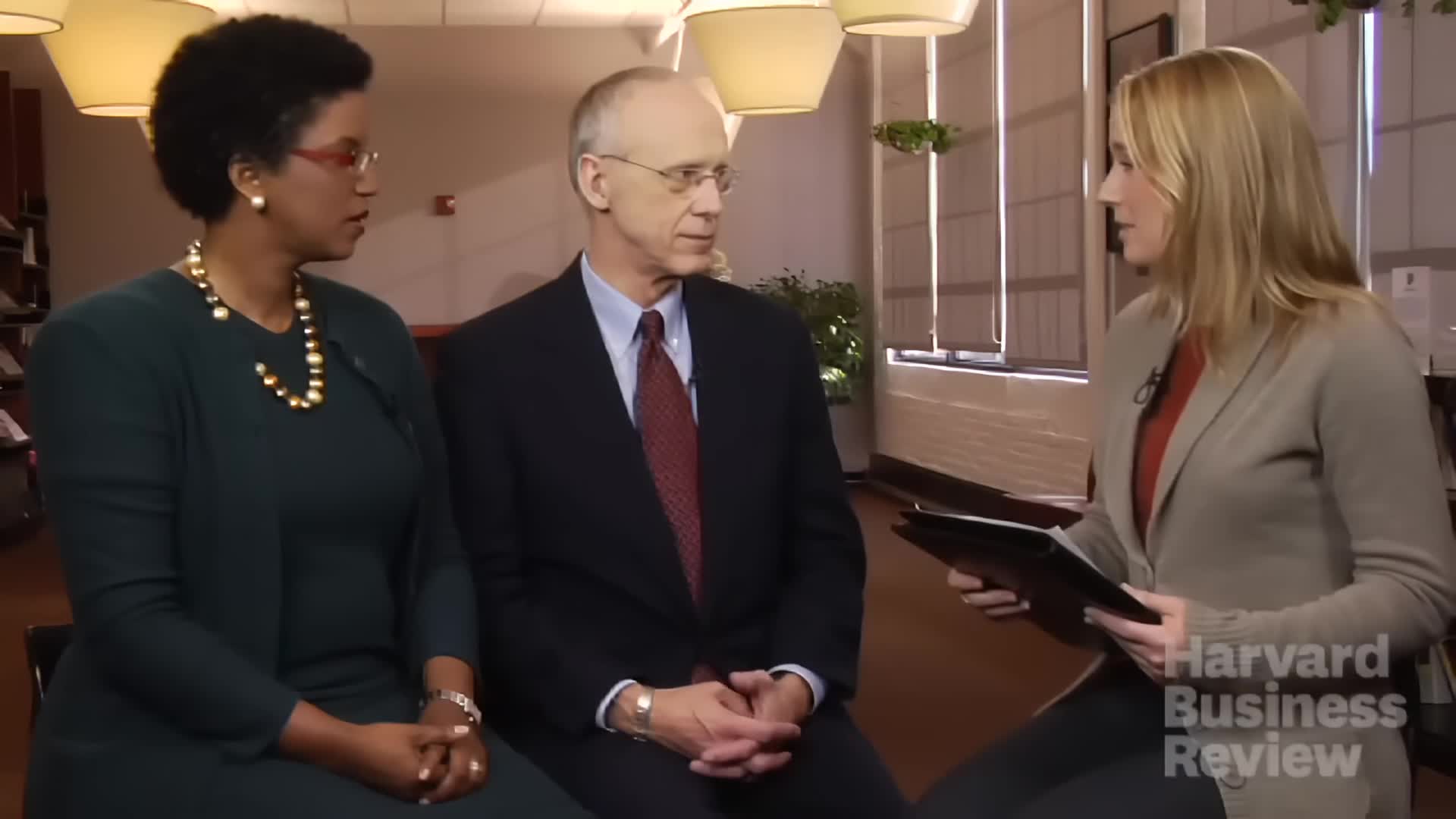
Welcome to the HBR IdeaCast from Harvard Business Review.
I'm Sarah Green.
I'm here today with Linda Hill and Kent Lineback, authors of Being the Boss The Three Imperatives for Becoming a Great Leader.
Thanks so much to both of you for joining us.
Pleasure.
So in the book, when you talk about managing your network, which is essentially, it sounds like inter-organizational politics, what's one of the biggest mistakes that a new manager can make?
I can tell you the mistake I made, which was don't do it.
I just kind of refused to do all that stuff.
To me, organizations were political and I didn't really want to have much to do with any of that.
And it did not help me.
It took me a long time and I'm not sure I ever completely learned the value of doing that.
But it was difficult.
I just simply thought it was a waste of time, didn't want to do it.
I think that's a huge mistake.
How come so many managers seem to have this same impulse of?
It's a waste of time and I don't want to deal with it.
I think, in fact, many managers think that way, because they think about power being sort of corrupting you, that it's a bad thing and that you don't want to be using your power or playing with those politics, instead of appreciating that Organizations are inherently political entities and they are political because of the resources of conflict that are just built into organizational life.
We have diversity of perspectives.
We have a need to work those through because we're interdependent and of course there's going to be inevitable conflict and we have to make tough choices about the scarce resources in an organization.
And those are the factors that actually create the political dynamics that you need to pay attention to.
So unless you pay attention to those and understand how to use them constructively, you actually will find yourself being powerless and not being able to get done what you think is the right thing to do.
So if you want to behave ethically and in a productive way for your group, you actually need to pay attention to those and use those dynamics to get things done, as opposed to being afraid of them or ignoring them, because it's impossible.
Linda actually points out something very useful that I had actually never thought of.
But powerlessness corrupts.
The lack of power corrupts.
If you don't have power, then you can't stand up for what you believe is right in an organization.
And how many people through history have we seen who said, I had to do it.
They made me do it.
They had no power.
Now Kent, at the risk of getting a little bit personal, since you brought up your own sort of experience there, I just want to ask did you find yourself often in a position of powerlessness by not sort of paying more attention to the politics of the company?
I probably wouldn't have described it as powerlessness, though that probably was what it was.
I simply found that some things I really wanted to get done didn't get done.
I didn't build bridges to other people.
I didn't make allies of other people.
I thought if they can see the light, then good for them.
If they can't see the light, well, they must be dumb.
They must be dense.
There's something wrong with them.
It didn't work all that well.
Well, let's get into then, maybe a little bit more, how people in a position like that could build those bridges.
I know in the book you talk about the need to build actually three networks.
Can you maybe talk a little bit about what those are and we can then get into sort of how we might go about doing that.
Why three?
Well, I think a couple of things are important to keep in mind.
I think one of the reasons why people actually ignore or don't pay attention to politics is they sort of see their job as just managing their team.
They think about the people that they have formal authority over and they think they're supposed to focus their attentions there and not appreciate that you need other people for a range of things, which is why there are three networks you want to pay attention to.
You need one group of people to help you sort of get your job done in a daily way and get your job done, and I should say the team's job done, because you're responsible for what the team is doing.
So that's your operational network.
Then you need your strategic network, and that is a network that you use to really help you keep track of what's really going on, to scan the environment and know what the opportunities are that are out there that your team might take advantage of, or the challenges or the threats they need to prepare for.
That's your strategic network that you sort of develop to help you prepare for the future, which you always must be thinking about in our very dynamic business environment.
And then the last network is really your developmental network.
Who do you need to know and be in connection with, and have a relationship with to help you continue to grow and develop?
Because fundamentally, we're very practical learners, we're very social learners and we only learn from really our work experience.
And to get access to the kind of work experience you need, you need to have the right relationships.
Because what you know determines what you, who you know determines what you get to do.
And what you get to do will determine what you get to know.
So you have to worry about that developmental network as well.
When you're talking about these different kinds of networks, how do you decide who gets to be in them?
How do you know who should be in your developmental network versus your operational network?
There can be overlap, obviously, amongst these three networks.
And so, to the extent that you can create that overlap or that overlap exists, it makes it easier, because they all take time and energy to cultivate.
You don't just say by the way, you know, I guess when we were younger we used to say will you be my friend?
You can't really walk up to someone and say, will you be my mentor?
Will you sponsor me?
Will you do this for me?
You can't sort of do it that way.
You have to cultivate and build some credibility with that person first.
So to figure out who should be in those networks, what you first need to be clear about is what are you trying to get done and where are you trying to go?
And unless you have an understanding of what the plan is for the group and what the plan is for your own developmental needs, then you're not going to be in a very good position to figure out who in fact you should be targeting to try to build relationships with.
And then you've got to make sure you can kind of create the opportunities to build those relationships in a real way.
And that means sort of thinking strategically that maybe you might want to be on that task force.
Even though it feels like a waste of time, it might be a way for you to figure out what's going on in another part of the organization, to meet some different people.
So you're not just talking to your friends and you get access to maybe a person who's important in another part of the organization.
That's going to be very important for the future of your group.
So you need to think a little bit strategically about that.
You also need to understand the company and where it's starting to go, because your plans need to fit with the company and you need to understand how the company is going to work in the future.
You need to understand how your group's plans fit with that.
And if you don't, is that, you know, perhaps indicative of a bigger problem?
Or is that kind of the kind of thing you could figure out by paying more attention to your network to get that kind of information flowing to you?
Well, I think sometimes we act as if you can come up with what your plan is by sitting at your desk and sort of writing out oh, this is what I see.
It's like an analytic task.
But it's much more than an analytic task.
You need to go out and collect information from all the various constituencies who you're dependent on and your group's dependent on and that are dependent on you, so that you can do that alignment, so that you're making sure that your priorities are consistent with the priorities of the other people in the organization and that they actually understand what your priorities are.
So when you go to ask for that big favor, they know you're well intended, they get what you're about, as opposed to feeling like you're simply trying to force them to do something that is in your interest, that they don't even understand what you're talking about because you haven't bothered to build a relationship with them and to collect information from them about how your needs either are consistent with, or need to be reconciled somehow with their needs.
I think that's an important point, because you can't create a good relationship by only seeing someone when there's a problem.
Problems are not a great way to build a relationship.
You need, as Linda says, to create the relationship, and then the problems get seen and dealt with in the context of a relationship that already exists.
I think what happens for people like me is that we all create networks.
We don't live in our offices and never go out, but we create networks with people we have to deal with.
We have no choice to do the work and we create networks with people we like.
And the people we don't like, we don't want to bother with.
I think one of the points we're making is that you can't, you don't have the liberty to make that kind of distinction.
You need to identify the people that you need to do your work and who need you because they're going to make demands on you.
And you need to consciously go create relationships with them.
And the personal chemistry doesn't have a lot to do with it.
I mean, you may want to have a beer or a coffee or whatever with some of them, not with all of them, but you need to have a relationship and it doesn't have to do with personal chemistry.
And I think that's quite important to pay attention to, particularly now that we have global companies.
It's always easier for us to build relationships with people who are quote like us, independently whether we like them or not, that are more like us in the various characteristics that you know demographic characteristics, same culture, whatever it is.
But if you only build relationships with people who are like you your same culture, your same kind of background in a global company, then for sure you don't have those relationships you need to get the job done in implementing a global strategy.
So you're going to have to figure out how to build a relationship with people who might be across on the other side of the globe, who have grown up with a very different perspective about authority, about time, about a whole range of things.
And you need to work all of that out with them when there's not a whole lot of urgency, so that when you really get down to working on an issue or a problem or taking advantage of an opportunity, you understand each other.
So I'd like to.
We've sort of been talking about how the manager in this case sees other people, but actually one of the things you encourage people to do in the book that I think is really useful is to sort of turn that lens around and ask well, how do people see me?
Do they trust me?
Do they like to deal with me?
What are some signs that because it's kind of hard to be honest with ourselves on this topic what are some signs that people might not trust you or might not like dealing with you, even if they like you as a person?
I think one of the examples we use in the book which is an incident I always like to use is when you go to a meeting and you discover that some of the people had a meeting before the meeting and didn't include you.
They decided what was going to come out of the meeting of the larger group, and you weren't part of that.
And you're not part of it for the reasons Linda said.
You're not considered powerful.
Maybe people don't like to deal with you.
It's rare if someone likes you that they cut you out.
Usually it's the other way around.
You can be competent but not nice to deal with, in which case people will cut you out.
You need to see yourself as other people see you.
And you need to as Linda, I think, always talks about.
You need to understand how you make other people feel when they're with you.
That's a point of view that most of us in management don't. often take.
How do people experience you and how do people experience themselves with you is one of the things we tried to explore a fair amount in the book and to force you to kind of think about that.
But those are hard questions, and so you constantly need to be checking in and getting feedback on that.
And one of the things we talk about in the book is about what happens if you're a competent jerk, which is a very technical term that one of my colleagues actually came up with.
And what you find is, if you're a competent jerk, when people think you're competent at first, they will deal with you and you will be a part of a network.
People will come to you.
But the more you abuse them or the harder they find it is to work with you.
They don't care how competent you are.
They kind of act like they work with you, but they don't.
They avoid you, and you are no longer included.
And what you will discover is that you will lose your competence because again, we really get our competence from other people, from interacting with other people.
That's where expertise comes from.
And if you're isolated, you are not going to have the latest expertise.
You're not going to know what is really important or how to use that information most constructively in your organization.
So in essence, that means if you are feeling isolated and left out of decisions, instead of assuming that there's a cabal or some sort of conspiracy, maybe you just need to look at your own actions and ask well, am I the best person to deal with?
I think that's what I think we'd both say.
On the other hand, I don't think neither one of us are naive.
There are organizations that are political in the negative sense of the word.
And I recently was counseling a pretty senior executive about this and he was describing what was going on with his bosses above him and i said you know what in this kind of situation you keep your head down and you get to work because you do at times find yourselves in situations that are horribly ugly people have a lost sight of the organizational interests are being very self-interested and it is only self-protective to kind of keep yourself out of that don't think that you can beat other people at the game because it does become a game, and you are not going to win that game, so there are moments when you kind of do pull back, you stick with your group, and you do your thing, which is maybe the other reason why I think people sometimes steer clear of the politics, because when they think about them, they think about that ugly, sort of dark side of it.
That can happen.
There are people who get their entire satisfaction at work out of the organizational politics, out of beating other people.
They don't care about the company, they don't care about the mission, they don't care about what anybody's trying to do.
They simply want to win.
It's another arena in which they can compete and beat someone else.
The only way you can deal with those people though, is to have your own source of influence and power.
The way to deal with them is not.
I'm not talking about dealing with higher ups, the example Linda just gave.
There are situations where you need to stay out of it.
But in general, the way you deal with people who try to abuse their influence in the organization is you need to have your own influence.
Simply hunkering down and doing the work and assuming that everyone will recognize the right answer.
Good work, and all of that will speak for itself.
Sadly, too often is not the case.
And I think what we say in the book is that if you really want to do this right, you're thinking about building long-term relationships, partnerships.
And, by definition, when you think that way, if someone's going to be your partner for some period of time, you're a little bit nervous about doing something that doesn't take into account their interests.
And frankly, you need to be reciprocal in your relationships.
If you're taking all the time and never giving, that isn't fair and vice versa, because that's not what work relationships are supposed to be like.
So I think you always start with some self-awareness of how you're perceived potentially, if you can figure that out.
And sometimes we need to simply ask.
And if you're sort of worrying about it, chances are you know you do have a problem little bit.
If you, if you find yourself you said how do you know that it's not working right?
Well, if you find that you're blindsided and you frequently don't know what's going on, you're not talking to the right people and that's bad for your group.
This is not about your career.
This is about making sure that your group has the right expectation set for the group and and the right sort of resources.
Again,
So if you find that you never have what you need, etc.
Then you've got to ask yourself is that because I'm not doing my job as the manager whose responsibility is to create the conditions necessary for my group to be successful?
And if you're not doing that, then your group can't be successful, and they're very dependent upon you to help them with that.
So you cannot afford, once you move into management, to ignore that responsibility.
Well, it's a tough problem, and certainly there's a lot there to think about.
Thank you both so much for talking with us today.
Thank you.
Thank you.
That's Kent Lineback and Linda Hill, and the book is Being the Boss.
For more, go to hbr.org.